


Questions
Newest firstShowing 1–49 of 49 questions
-
- (A) 2
- (B) 3
- (C) 6
- (D) 8
Show answer and solution
Correct Answer: (C)
The central atom in \(XeO_6^{4-}\) is Xenon (Xe).
The number of valence electrons in Xe is \(8\).
Let the oxidation state of Xe in \(XeO_6^{4-}\) be \(x\).
\(x + 6(-2) = -4\)
\(x = +8\)
Since the oxidation state of Xe is \(+8\), all \(8\) of its valence electrons are involved in bonding with the \(6\) oxygen atoms. There are no non-bonding electrons left on the central atom.
Number of lone pairs on Xe \(= 0\)
Xe forms \(6\) \(\sigma\) bonds with the \(6\) oxygen atoms (and \(2\) \(\pi\) bonds to satisfy its \(+8\) oxidation state and minimize formal charge).
Number of \(\sigma\) bond-pairs \(= 6\)
Total number of \(\sigma\) bond-pairs and lone pairs around the central atom \(= 6 + 0 = 6\).
Answer: \(6\) -
- (A) 2
- (B) \(0\)
- (C) 1
- (D) 3
Show answer and solution
Correct Answer: (C)
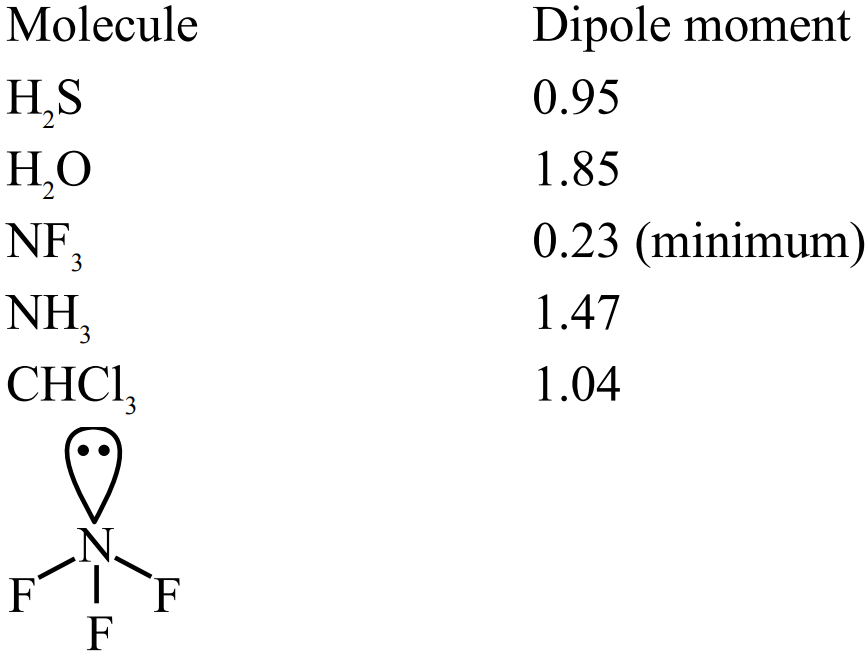
Number of lone pair on central atom = 1 -
- (A) bent, square planar
- (B) linear, square planar
- (C) bent, see-saw
- (D) linear, tetrahedral
Show answer and solution
Correct Answer: (A)
The autoionization of bromine trifluoride is given by the reaction:
\(2\text{BrF}_3 \rightleftharpoons \text{BrF}_2^{\oplus} + \text{BrF}_4^{\ominus}\)
For the cation \(\text{BrF}_2^{\oplus}\):
The central atom Br has \(7\) valence electrons. Due to the positive charge, it has \(7 - 1 = 6\) electrons available.
It forms \(2\) single bonds with F atoms, leaving \(4\) electrons, which constitute \(2\) lone pairs.
Steric number = \(2\) (bond pairs) + \(2\) (lone pairs) = \(4\).
The hybridization is \(sp^3\). With \(2\) bond pairs and \(2\) lone pairs, the shape is bent (or V-shaped).
For the anion \(\text{BrF}_4^{\ominus}\):
The central atom Br has \(7\) valence electrons. Due to the negative charge, it has \(7 + 1 = 8\) electrons available.
It forms \(4\) single bonds with F atoms, leaving \(4\) electrons, which constitute \(2\) lone pairs.
Steric number = \(4\) (bond pairs) + \(2\) (lone pairs) = \(6\).
The hybridization is \(sp^3d^2\). To minimize repulsion, the \(2\) lone pairs occupy opposite (trans) positions in the octahedral geometry, resulting in a square planar shape.
Thus, the shapes of the cation and anion are bent and square planar, respectively.
Answer: bent, square planar -
- (A) Both Statement I and Statement II are true
- (B) Both Statement I and Statement II are false
- (C) Statement I is true but Statement II is false
- (D) Statement I is false but Statement II is true
Show answer and solution
Correct Answer: (D)
Explanation:
1. Analysis of Statement I: Aluminium reacts with hot aqueous sodium hydroxide (\( \text{NaOH} \)) to form a soluble tetrahydroxoaluminate(III) complex, \( \text{[Al(OH)}_4\text{]}^- \), along with the evolution of hydrogen gas. The balanced chemical equation is:
\( 2\text{Al} + 2\text{NaOH} + 6\text{H}_2\text{O} \rightarrow 2\text{Na}^+[\text{Al(OH)}_4]^- + 3\text{H}_2 \)
Since it forms a monovalent complex ion \( \text{[Al(OH)}_4\text{]}^- \) and not the hexavalent \( \text{[Al(OH)}_6\text{]}^{3-} \), Statement I is false.
2. Analysis of Statement II (Geometry vs Shape): As correctly noted, terms like "square planar", "pyramidal", and "linear" describe the spatial arrangement of the atoms excluding lone pairs, which refers precisely to the molecular shape rather than the total electron-pair geometry:
- For \( \text{ICl}_4^- \): The central iodine atom has 7 valence electrons plus 1 from the negative charge, giving 8 electrons (4 bonding pairs and 2 lone pairs). Its hybridization is \( sp^3d^2 \); its electron geometry is octahedral, but its shape is square planar.
- For \( \text{ClO}_3^- \): The central chlorine atom has 7 valence electrons plus 1 from the negative charge, giving 8 electrons (3 \( \sigma \)-bonds and 1 lone pair). Its hybridization is \( sp^3 \); its electron geometry is tetrahedral, but its shape is trigonal pyramidal.
- For \( \text{IBr}_2^- \): The central iodine atom has 7 valence electrons plus 1 from the negative charge, giving 8 electrons (2 bonding pairs and 3 lone pairs). Its hybridization is \( sp^3d \); its electron geometry is trigonal bipyramidal, but its shape is linear.
Thus, Statement II correctly identifies the molecular shapes of these species, making Statement II true.
Hence, Option D is the correct choice. -
- (A) Statement I is true but Statement II is false
- (B) Both Statement I and Statement II are false
- (C) Statement I is false but Statement II is true
- (D) Both Statement I and Statement II are true
Show answer and solution
Correct Answer: (C)
Statement-I:
\( SF_{4} \) (See-saw),
\( XeF_{4} \) (square planar),
\( [PtCl_{4}]^{2-} \) (square planar),
\( [NiCl_{4}]^{2-} \) (Tetrahedral),
\( [Ni(CN)_{4}]^{2-} \) (square planar),
\( SeF_{4} \) (See-saw),
\( NH_{4}^{+} \) (Tetrahedral).
Statement-II:
\( NO_{2} \) (seven electrons on N) ,
\( BeH_{2} \) (four electrons on Be) ,
\( BF_{3} \) (six electrons on B) ,
\( AlCl_{3} \) (six electrons on Al). -
- (A) A-II, B-I, C-III, D-IV
- (B) A-II, B-III, C-IV, D-I
- (C) A-II, B-III, C-I, D-IV
- (D) A-II, B-II, C-IV, D-I
Show answer and solution
Correct Answer: (B)
\(XeF_{2}\) & \(I_{3}^{-}\): 2 bond pair 3 lone pair; Linear
\(XeOF_{4}\) & \(BrF_{5}\): 5 bond pair 1 lone pair; Square pyramidal
\(XeO_{2}F_{2}\) & \(SF_{4}\): 4 bond pair 1 lone pair; See saw
\(XeO_{3}\) & \(NH_{3}\): 3 bond pair 1 lone pair; Pyramidal -
- (A) C Only
- (B) C and E Only
- (C) A and D Only
- (D) B and E Only
Show answer and solution
Correct Answer: (B)
In \(SF_4\), the central sulphur atom has \(6\) valence electrons. It forms \(4\) sigma bonds with fluorine atoms and has \(1\) lone pair. The steric number is \(5\), corresponding to \(sp^3d\) hybridization, and the shape is see-saw.
In \(BrF_4^{\ominus}\), the central bromine atom has \(8\) valence electrons (\(7 + 1\)). It forms \(4\) sigma bonds and has \(2\) lone pairs. The steric number is \(6\), corresponding to \(sp^3d^2\) hybridization, and the shape is square planar.
In \(CH_4\), the central carbon atom has \(4\) valence electrons. It forms \(4\) sigma bonds and has \(0\) lone pairs. The steric number is \(4\), corresponding to \(sp^3\) hybridization, and the shape is tetrahedral.
In \(IF_4^{\oplus}\), the central iodine atom has \(6\) valence electrons (\(7 - 1\)). It forms \(4\) sigma bonds and has \(1\) lone pair. The steric number is \(5\), corresponding to \(sp^3d\) hybridization, and the shape is see-saw.
In \(XeF_4\), the central xenon atom has \(8\) valence electrons. It forms \(4\) sigma bonds and has \(2\) lone pairs. The steric number is \(6\), corresponding to \(sp^3d^2\) hybridization, and the shape is square planar.
In \(XeO_2F_2\), the central xenon atom has \(8\) valence electrons. It forms \(4\) sigma bonds (\(2\) with oxygen, \(2\) with fluorine), \(2\) pi bonds, and has \(1\) lone pair. The steric number is \(5\), corresponding to \(sp^3d\) hybridization, and the shape is see-saw.
Therefore, \(IF_4^{\oplus}\) and \(XeO_2F_2\) are isostructural with \(SF_4\).
Answer: C and E Only -
- (A) B, C and E only
- (B) B and D only
- (C) A and D only
- (D) B, D and E only
Show answer and solution
Correct Answer: (A)
(A)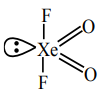
(B) Xe has 7 electron pair in its valence shell
(C) O-Xe-O Bond angle is close to \( 120^{\circ} \)
(D) F-Xe-F Bond angle is close to \( 180^{\circ} \)
(E) Xe has 14 valence electron in \( XeO_{2}F_{2}\) -
- (A) Square pyramidal
- (B) Octahedral
- (C) Pentagonal planar
- (D) Trigonal bipyramidal
Show answer and solution
Correct Answer: (A)
Given A is rarest, monoatomic, non-radioactive p-block element and form \(\mathrm{AX}_4 \mathrm{Y}\) type of molecule.
\(\therefore\) It is concluded that it is Xe
It is given the electronegativity of A is less than X & Y
It is given the electronegativity of \(\mathrm{X} ~\&~ \mathrm{Y}\) is highest and second highest respectively among all element.
\(\therefore \mathrm{X} ~\&~ \mathrm{Y}\) are \(\mathrm{F} ~\&~ \mathrm{O}\)
\(\therefore\) Compound is consider as \(\mathrm{XeOF}_4\) with square pyramidal shape.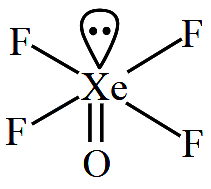
-
- (A) A and C Only
- (B) A, D and E Only
- (C) B and D Only
- (D) B and C Only
Show answer and solution
Correct Answer: (B)
\(\mathrm{ClF}_3\)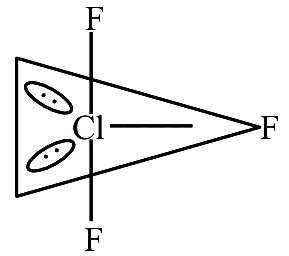
\(\mathrm{n}=2(\) No of lone pair present in equitorial plane \()\) (Unpaired \(\mathrm{e}^{-}\))
(A) \(\mathrm{V}^{+3}:[\mathrm{Ar}] 3 \mathrm{~d}^2 \quad 2\)
(B) \(\mathrm{Ti}^{3+}:[\mathrm{Ar}] 3 \mathrm{~d}^1 \quad 1\)
(C) \(\mathrm{Cu}^{+2}:[\mathrm{Ar}] 3 \mathrm{~d}^9 \quad 1\)
(D) \(\mathrm{Ni}^{+2}:[\mathrm{Ar}] 3 \mathrm{~d}^8 \quad 2\)
(E) \(\mathrm{Ti}^{+2}:[\mathrm{Ar}] 3 \mathrm{~d}^2 \quad 2\) -
- (A) Both Statement I and Statement II are false
- (B) Statement I is false but Statement II is true
- (C) Statement I is true but Statement II is false
- (D) Both Statement I and Statement II are true
Show answer and solution
Correct Answer: (C)
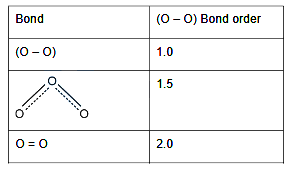
Bond length \(\propto \frac{1}{\text { Bond order }}\)
Order of \(\mathrm{O}-\mathrm{O}\) bond length
\(\mathrm{O}=\mathrm{O} < \mathrm{O}_3 < \mathrm{O}-\mathrm{O}\)
\(\therefore\) Statement \(I\) is true.
Lone pair-lone pair repulsion between O-atoms is not solely responsible for the correct order of O-O bond length. Bond order also should be considered.
\(\therefore \quad\) Statement II is false. -
- (A) Statement I is incorrect but statement II is correct.
- (B) Statement I is correct but statement II is incorrect.
- (C) Both Statement I and statement II are correct.
- (D) Both Statement I and statement II are incorrect.
Show answer and solution
Correct Answer: (B)
Statement 1 is correct.
Statement 2 is incorrect since in \(\mathrm{sp}^3 \mathrm{~d}\) hybridization; lone pair cannot occupy axial position. -
- (A) A-IV, B-III, C-II, D-I
- (B) A-III, B-IV, C-II, D-I
- (C) A-III, B-IV, C-I, D-II
- (D) A-II, B-I, C-IV, D-III
Show answer and solution
Correct Answer: (B)
(A)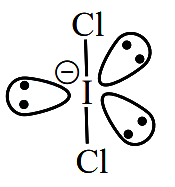
________ B.P : L.P = \(2: 3\)
(B)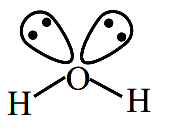
________ B.P : L.P = \(2: 2\)
(C)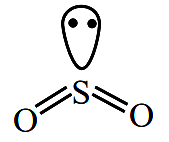
________ B.P : L.P = \(4: 1\)
(D)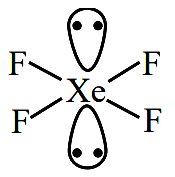
________ B.P : L.P = \(4: 2\) -
- (A) \(\mathrm{BrF}_5 \& \mathrm{PCl}_5\)
- (B) \(\mathrm{SbF}_5 \& \mathrm{PCl}_5\)
- (C) \(\mathrm{SbF}_5 \& \mathrm{XeOF}_4\)
- (D) \(\mathrm{BrF}_5 \& \mathrm{XeOF}_4\)
Show answer and solution
Correct Answer: (D)
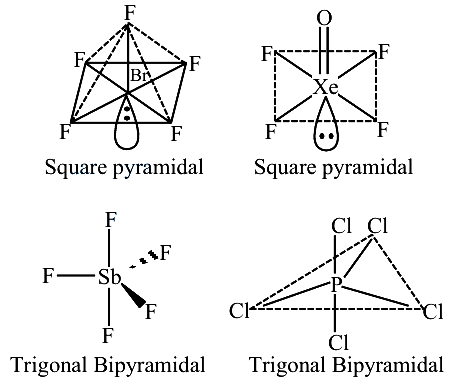
\(\mathrm{BrF}_5\) : Square pyramedal
\(\mathrm{XeOF}_4\) : Square pyramedal
\(\mathrm{SbF}_5\) : Trigonal bipyramidal
\(\mathrm{PCl}_5\) : Trigonal bipyramidal -
- (A) 4
- (B) 6
- (C) 8
- (D) 10
Show answer and solution
Correct Answer: (B)
Linear species are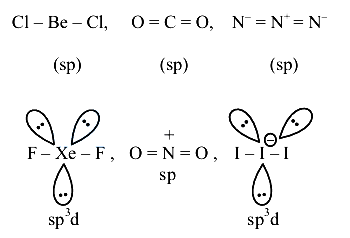
-
- (A) \(\mathrm{PF}_5\)
- (B) \(\mathrm{XeF}_4\)
- (C) \(\mathrm{SF}_4\)
- (D) \(\mathrm{XeF}_2\)
Show answer and solution
Correct Answer: (C)
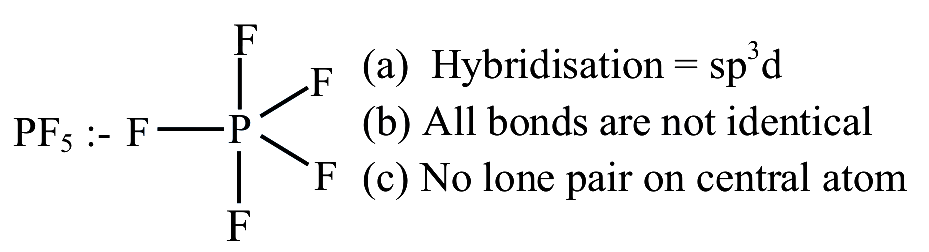
\(\mathrm{XeF}_4:-\mathrm{sp}^3 \mathrm{~d}^2\) Hybridisation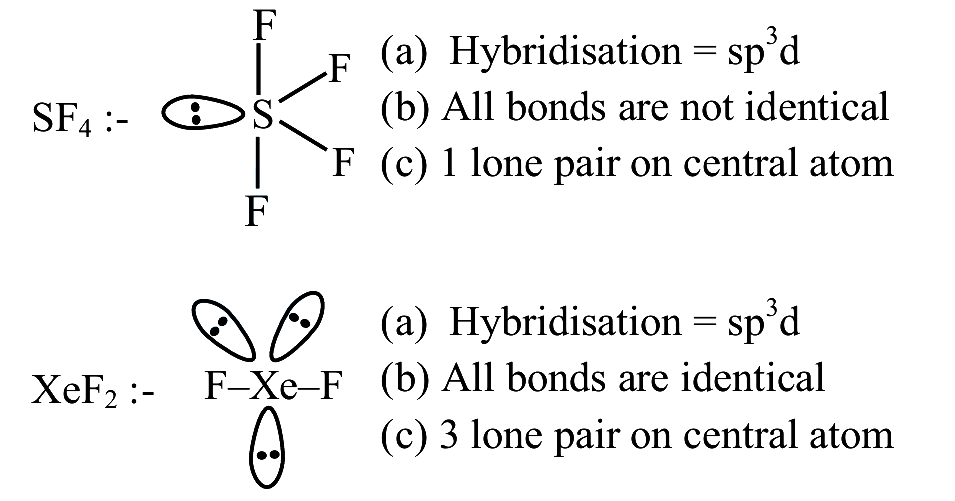
-
- (A) A, B and C Only
- (B) A, D and E Only
- (C) C, D and E Only
- (D) A, B, C and E Only
Show answer and solution
Correct Answer: (A)
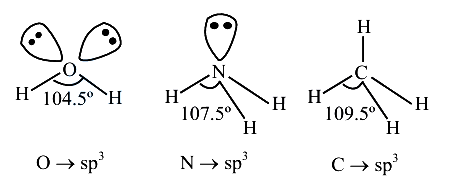
Dipole moment \(\quad \mathrm{H}_2 \mathrm{O}>\mathrm{NH}_3>\mathrm{CH}_4\)
\(\mathrm{H}_2 \mathrm{O} \& \mathrm{NH}_3\) are Lewis Bases
\(\mathrm{NH}_3\) act as Lowry- Bronsted base
Hence, A, B & C are correct -
- (A) Both \((A)\) and \((R)\) are true and \((R)\) is the correct explanation of \((A)\)
- (B) \((A)\) is false but \((R)\) is true
- (C) \((A)\) is true but \((R)\) is false
- (D) Both \((A)\) and \((R)\) are true but \((R)\) is NOT the correct explanation of \((A)\)
Show answer and solution
Correct Answer: (A)
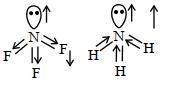
Resultant dipole moment \(=0.80 \times 10^{-30} \mathrm{Cm}\)(Image)
Resultant dipole moment \(=4.90 \times 10^{-30} \mathrm{~cm}\)
(Image)
-
- (A) Statement \(I\) is true but Statement \(II\) is false
- (B) Both Statement \(I\) and Statement \(II\) are true
- (C) Both Statement \(I\) and Statement \(II\) are false
- (D) Statement \(I\) is false but Statement \(II\) is true
Show answer and solution
Correct Answer: (C)
\(\text { Hybridisation } \ \ \ \text { Hybridisation }\)\(\mathrm{PF}_5 - \ \ \mathrm{sp}^3 \mathrm{~d} \ \ \mathrm{SF}_6 -\ \ \mathrm{sp}^3 \mathrm{~d}^2\)
\(\mathrm{BrF}_5 - \ \ \mathrm{sp}^3 \mathrm{~d}^2 \ \ {\left[\mathrm{Co}\left(\mathrm{NH}_3\right)_6\right]^{+3} -} \ \ \mathrm{~d}^2 \mathrm{sp}^3\)
- 20. The correct increasing order for bond angles among \(\mathrm{BF}_3, \mathrm{PF}_3\) and \(\mathrm{C} l \mathrm{F}_3\) is _______. 2024 Medium
- (A) \(\mathrm{PF}_3<\mathrm{BF}_3<\mathrm{C} l\mathrm{F}_3\)
- (B) \(\mathrm{BF}_3<\mathrm{PF}_3<\mathrm{C} l \mathrm{F}_3\)
- (C) \(\mathrm{C} l \mathrm{F}_3<\mathrm{PF}_3<\mathrm{BF}_3\)
- (D) \(\mathrm{BF}_3=\mathrm{PF}_3<\mathrm{C} l\mathrm{F}_3\)
Show answer and solution
Correct Answer: (C)
Order of bond angle is
\(\mathrm{ClF}_3<\mathrm{PF}_3<\mathrm{BF}_3\)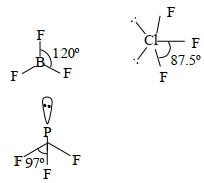
-
- (A) \(\left[\mathrm{Ni}(\mathrm{CN})_4\right]^{2-}\)
- (B) \(\mathrm{PCl}_5\)
- (C) \(\mathrm{BrF}_5\)
- (D) \(\mathrm{PF}_5\)
Show answer and solution
Correct Answer: (C)
\(\mathrm{BrF}_5\) Square Pyramidal.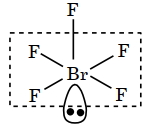
-
- (A) \(3\)
- (B) \(4\)
- (C) \(5\)
- (D) \(6\)
Show answer and solution
Correct Answer: (A)
\(\mathrm{PF}_5, \mathrm{PCl}_5, \mathrm{Fe}(\mathrm{CO})_5\); Trigonal bipyramidal \(\mathrm{BrF}_3\); square pyramidal \(\left[\mathrm{PtCl}_4\right]^{-2}\); square planar \(\mathrm{BF}_3\); Trigonal planar -
- (A) \((A)\) and \((D)\) are correct
- (B) \((C)\) and \((D)\) are correct
- (C) \((A)\) and \((B)\) are correct
- (D) \((B)\) and \((C)\) are correct
Show answer and solution
Correct Answer: (D)
\((A)\) \(NF _3\) has trigonal pyramidal shape.\((B)\) Bond order \(\Rightarrow N _2 > O _2\)
\((D)\) Dipole moment \(H _2 O > H _2 S\)
Due to Electronegativity difference.
-
- (A) Both Statement \(I\) and Statement \(II\) are correct
- (B) Statement \(I\) is correct but Statement \(II\) is incorrect
- (C) Both Statement \(I\) and Statement \(II\) are incorrect
- (D) Statement \(I\) is incorrect but Statement \(II\) is correct
Show answer and solution
Correct Answer: (B)
Both are bent in shape.Bond angle of \(SO _2\left( sp ^2\right)\) is greater than that of \(H _2 O\) \(\left( sp ^3\right)\) due to higher repulsion of multiple bonds.
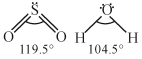
-
- (A) \(A - II, B - III, C - IV, D - I\)
- (B) \(A - IV, B - III, C - II, D - I\)
- (C) \(A - II, B - I, C - IV, D - III\)
- (D) \(A - IV, B - I, C - II, D - III\)
Show answer and solution
Correct Answer: (B)
\(IF _7 \quad\) zero lone pair\(ICl _4^{-} \quad\) two lone pair
\(XeF _6\) one lone pair
\(XeF _2 \quad\) three lone pair
- 26. The number of bent-shaped molecule/s from the following is \(.....\). \(N _3^{-}, NO _2^{-}, I _3^{-}, O _3, SO _2\) 2023 Medium
- (A) \(2\)
- (B) \(3\)
- (C) \(1\)
- (D) \(5\)
Show answer and solution
Correct Answer: (B)
\(N _3^{-}\)linear\(NO _2^{-}\)bent
\(I _3^{-}\)linear
\(O _3\) bent
\(SO _2\) bent
- 27. Amongst \(SF _{4}, XeF _{4}, CF _{4}\) and \(H _{2} O\), the number of species with two lone pairs of electrons ..... . 2022 Easy
- (A) \(2\)
- (B) \(10\)
- (C) \(3\)
- (D) \(4\)
Show answer and solution
Correct Answer: (A)
The species with 2 lone pairs are XeF 4 and H 2 O . Therefore, the number of species with two lone pairs of electrons is \(2 .\)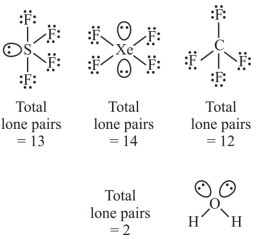
-
- (A) equatorial position and there are two lone pairbond pair repulsions at \(90^{\circ}\)
- (B) equatorial position and there are three lone pair-bond pair repulsions at \(90^{\circ}\)
- (C) axial position and there are three lone pair bond pair repulsion at \(90^{\circ}\).
- (D) axial position and there are two lone pair bond pair repulsion at \(90^{\circ}\).
Show answer and solution
Correct Answer: (A)
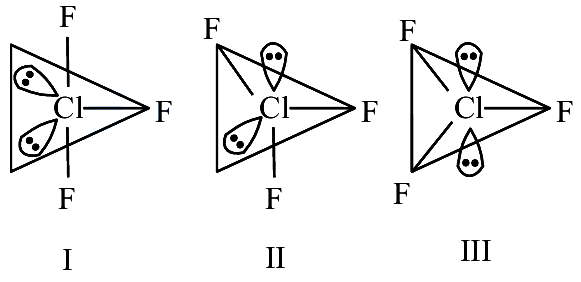
\(sp ^{3} d\), See-Saw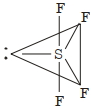
- 29. A central atom in a molecule has two lone pairs of electrons and forms three single bonds. The shape of this molecule is 2021 Medium
- (A) see-saw
- (B) planar triangular
- (C) \(T-\)shaped
- (D) trigonal pyramidal
Show answer and solution
Correct Answer: (C)
\(sp\) \(^{3}\) \(d\) hybridised\(T-\)shaped
-
- (A) \(5\)
- (B) \(22\)
- (C) \(19\)
- (D) \(11\)
Show answer and solution
Correct Answer: (C)
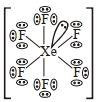
\(XeF _{6}+2 H _{2} O \longrightarrow XeO _{2} F _{2}+4 HF\)\(\quad\)(A) \(\quad\) (Limited water)
Structure of \('A'\)
\([Image]\)
Total \(l.p.\) on \(( A )=19\)
-
- (A) \(2\)
- (B) \(3\)
- (C) \(4\)
- (D) \(1\)
Show answer and solution
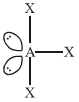
Correct Answer: (A)
\(T-\)shaped molecule means \(3\) sigma bond and \(2\) lone pairs of electron on central atom.
-
- (A) \(108\)
- (B) \(150\)
- (C) \(90\)
- (D) \(60\)
Show answer and solution
Correct Answer: (A)
In gaseous triethyl amine the \("-C-N-C-"\) bond angle is \(108\) degree. -
- (A) Distorted trigonal planar; \(135^{\circ}\) and \(90^{\circ}\)
- (B) \(T-\)shaped; \(180^{\circ}\) and \(90^{\circ}\)
- (C) Trigonal planar; \(120^{\circ}\)
- (D) Linear; \(180^{\circ}\)
Show answer and solution
Correct Answer: (D)
Shape : Linear,\(I-I-I\) Bond angle \(\Rightarrow 180^{\circ}\)
- 34. The number of lone pairs of electrons on the central \(I\) atom in \(I_{3}^{-}\) is \(.......\)
 2021 Medium
- (A) \(3\)
- (B) \(0\)
- (C) \(1\)
- (D) \(2\)
Show answer and solution
Correct Answer: (A)
\(\mathrm{I}_{3}^{-}:\)The number of lone pairs of electron on the central atom is \(3 .\)
-
- (A) \(3\)
- (B) \(2\)
- (C) \(4\)
- (D) \(1\)
Show answer and solution
Correct Answer: (A)
Hence non-pyramidal species are \(\mathrm{SO}_{3}, \mathrm{NO}_{3}^{-}\) and \(\mathrm{CO}_{3}^{2-}\)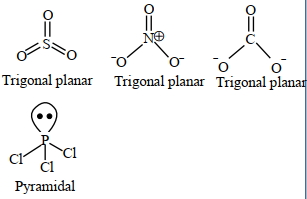
-
- (A) \(BF _{4}^{-}\)
- (B) \(XeF _{4}\)
- (C) \(SF _{4}\)
- (D) \(SiF _{4}\)
Show answer and solution
Correct Answer: (C)
Species
Hybridisation Bond length \(BF _{4}^{\Theta}\) \(sp ^{3}\) (Tetrahedral) All bond lengths equal \(XeF _{4}\) \(sp ^{3} d ^{2}\) (sq. planar) All bond lengths equal \(SF _{4}\) \(sp ^{3} d ( see - saw )\) axial bond length \( > \) equitorial bond length \(SiF _{4}\) \(sp ^{3}\) (Tetrahedral) all bond lengths equal - 37. If \(AB _{4}\) molecule is a polar molecule, a possible geometry of \(AB _{4}\) is : 2020 Medium
- (A) Square pyramidal
- (B) Tetrahedral
- (C) Square planar
- (D) Rectangular planar
Show answer and solution
Correct Answer: (A)
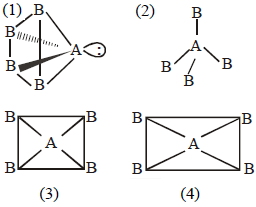
\((1)\) If \(AB _{4}\) molecule is a square pyramidal then it has one lone pair and their structure should be and it should be polar because dipole moment of lone pair of \('A'\) never be cancelled by others.\((2)\) If \(AB _{4}\) molecule is a tetrahedral then it has no lone pair and their structure should be and it should be non polar due to perfect symmetry.
\((3)\) If \(AB _{4}\), molecule is a square planar then it should be non polar because vector sum of dipole moment is zero.
\((4)\) If \(AB _{4}\) molecule is a rectangular planar then it should be non polar because vector sum of dipole moment is zero.
- 38. The molecular geometry of \(S\,F _{6}\) is octahedral. What is the geometry of \(S\,F _{4}\) (including lone pair(s) of electrons, if any)? 2020 Medium
- (A) Trigonal bipyramidal
- (B) Square planar
- (C) Tetrahedral
- (D) Pyramidal
Show answer and solution
Correct Answer: (A)
\(4 \sigma\) bonds \(+1\) lone pairShape (including lone pair of electrons) is Trigonal bipyramidal

-
- (A) \(\underline{N}{H }_{3} \stackrel{ H ^{+}}{\longrightarrow}\)
- (B) \(\underline {Xe}F _{4}+ SbF _{5} \rightarrow\)
- (C) \(H _{2} \underline SO _{4}+ NaCl \xrightarrow{{420\,\,K}}\)
- (D) \(H _{3} \underline PO _{2} \xrightarrow{{ Disproportionation }}\)
Show answer and solution
Correct Answer: (B)
\(XeF _{4}+ SbF _{5} \rightarrow\left[ XeF _{3}\right]^{+}\left[ SbF _{6}\right]^{-}\)\(sp ^{3} d ^{2}\,\,\,\,\, sp ^{3} d\,\,\, \quad sp ^{3} d\,\,\,\,\, \quad sp ^{3} d ^{2}\)
-
- (A) \(NF_3-\) trigonal planar
- (B) \(BF_3-\) trigonal planar
- (C) \(AsF_5-\) trigonal bipyramidal
- (D) \(H_2O-\) bent
Show answer and solution
Correct Answer: (A)
\(NF_3\) has trigonal pyramidal geometry. \(N\) atom has one lone pair and three bond pairs of electrons. The electron pair geometry is tetrahedral and molecular geometry is trigonal pyramidal . The bond angles are lower than tetrahedral bond angles due to lone pair - lone pair and lone pair - bond pair repulsions. \(N\) atom is \(sp^3\) hybridised
-
- (A) \({H_2}O\, \to \,{H_3}{O^ + }\)
- (B) \(B{F_3}\, \to \,BF_4^ - \)
- (C) \(C{H_4}\, \to \,{C_2}{H_6}\)
- (D) \(N{H_3}\, \to \,NH_4^ + \)
Show answer and solution
Correct Answer: (B)
\(B{F_3}\, \to \,BF_4^ - \)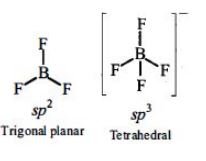
-
- (A) \(BF_3, NF_3, CO_3^{2 - }\)
- (B) \(CO_3^{2 - } , NO_3^- , SO_3\)
- (C) \(NH_3, SO_3, CO_3^{2 - }\)
- (D) \(NCl_3, BCl_3, SO_3\)
Show answer and solution
Correct Answer: (B)
Group Hybridization Shape \((1)\) \(BF_3\)
\(NF_3\)
\(CO_3^{2-}\)
\(sp^2\)
\(sp^3\)
\(sp^2\)
Triangular Planar \((TP)\)
Tetrahedral \((T)\)
\(T.P.\)
\((2)\) \(CO_3^{2-}\)
\(NO_3^-\)
\(SO_3\)
\(sp^2\)
\(sp^2\)
\(sp^2\)
\(\left. \begin{gathered}
T.P. \hfill \\
T.P. \hfill \\
T.P. \hfill \\
\end{gathered} \right\}\) (all have same hybridization)\((3)\) \(NH_3\)
\(SO_3\)
\(CO_3^{2-}\)
\(sp^3\)
\(sp^2\)
\(sp^2\)
\(T\)
\(T.P.\)
\(T.P.\)
\((4)\) \(NCl_3\)
\(BCl_3\)
\(SO_3\)
\(sp^3\)
\(sp^2\)
\(sp^2\)
\(T\)
\(T.P.\)
\(T.P.\)
-
- (A) \(PCl_5,\,IF_5,\, XeO_2F_2\)
- (B) \(BF_3,\,PCl_3,\,XeO_3\)
- (C) \(SF_4,\,XeF_4,\,CCl_4\)
- (D) \(ClF_3,\, XeOF_2,\, XeF_3^+\)
Show answer and solution
Correct Answer: (D)
\(Cl{I_3} \to \) Hybridisation \( = 3 + \frac{1}{2}[7 - 3] = 5\,(s{p^3}d)\)\(XeOF_2 \to \) Hybridisation \( = 3 + \frac{1}{2}[8 - 4] = 5\,(s{p^3}d)\)
\(XeF_3^+ \to \) Hybridisation \( = 3 + \frac{1}{2}[8 - 3 - 1] = 5\,(s{p^3}d)\)
All molecules have \(sp^3d\) hybridization and \(2\) lone pairs. Hence all have identical ( \(T-\) shape).
-
- (A) pentagonal planar
- (B) octahedral
- (C) square pyramidal
- (D) trigonal bipyramidal
Show answer and solution
Correct Answer: (C)
In \(XeOF_4\), \(Xe\) is \(sp^3d^2\), hybridised having \(6\) bond pairs and \(1\) lone pair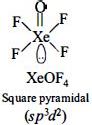
-
- (A) \((CH_3)_3N\)
- (B) \((SiH_3)_3 N\)
- (C) \(P(CH_3)_3\)
- (D) \(P(SiH_3)_3\)
Show answer and solution
Correct Answer: (B)
In case of \(N(SiH_3)_3\, N\) atom is \(sp^2\) hybridised, the lone pair is present in \(2p\) orbital and it is transferred to empty \(d\) orbital of \(Si\) forming \(d\pi -p\pi \) bond . Hence nitrogen with \(sp^2\) hybridization has trigonal planar shape. -
- (A) \(CO_2, NO_2, ClO_2, SiO_2\)
- (B) \(PCl_3,Al Cl_3, BCl_3, SbCl_3\)
- (C) \(BF_3, NF_3, PF_3,Al F_3\)
- (D) \(BF_4^- , CCl_4 , NH_4^+ , PCl_4^+\)
Show answer and solution
Correct Answer: (D)
All have tetrahedral structure -
- (A) \(ONCl\) and \(ONO^-\) are isoelectronic.
- (B) \(O_3\) molecule is bent
- (C) Ozone is violet-black in solid state
- (D) Ozone is diamagnetic gas.
Show answer and solution
Correct Answer: (A)
(a) Number of electrons in\(\begin{array}{l}\mathrm{ONCl}=3.2 \mathrm{e}^{-} \\\mathrm{ONO}^{-}=24 \mathrm{e}^{-}\end{array}\)
Thus, ONCl and ONO- are not isoelectronic.
(b) \(\mathrm{O}_{3}\) has bent shape structure. Central atom O is \(s p^{2}\) hybridised with 1 lone pair of electrons.
(c) Ozone is violet-black in solid state.
(d) \(O_{3}\) has no unpaired electrons, thus it is diamagnetic.
-
- (A) \(XeF_4\)
- (B) \(IF_5\)
- (C) \(SbF_5\)
- (D) \(CF_4\)
Show answer and solution
Correct Answer: (B)
The geometry of \(IF_5\) is square pyramidal with an unsymmetric charge distribution therefore this molecule is polar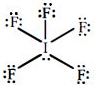
-
- (A) Two \(P\pi - d\pi \) bonds
- (B) One \(P\pi - d\pi \) bonds
- (C) Four \(P\pi - d\pi \) bonds
- (D) Three \(P\pi - d\pi \) bonds
Show answer and solution
Correct Answer: (C)
One \(s\) and three \(p\) orbital undergo \(s p^{3}\) hybridization. Four \(s p^{3}\) hybridorbitals form four \(\sigma\) bonds with oxygen atoms. They are \(\sigma s p^{3}-p .\) Four \(p \pi-d \pi\) bonds are also formed with oxygen atoms by the unpaired electrons.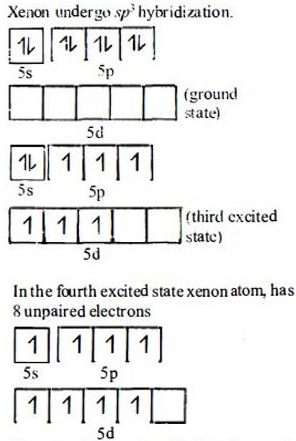
No questions on this page match these filters.
Other STD 11 - Chemical bonding and molecular structure topics
Frequently asked
How many VSEPR Theory questions came in JEE Mains?
49 questions from 2013–2026, each with the correct answer and a full solution.
How difficult are VSEPR Theory questions?
27% are easy, 55% medium and 18% hard.