


Questions
Newest firstShowing 1–21 of 21 questions
- 1. In IUPAC nomenclature, the correct order of decreasing priority of functional group is : 2026 Medium
- (A) \(-CONH_2, >C=O, -CHO, -NH_2, -C\equiv C-\)
- (B) \(-CONH_2, -COOCH_3, -CHO, -NH_2, -OH\)
- (C) \(-CONH_2, -CHO, >C=O, -NH_2, -C\equiv C-\)
- (D) \(-CONH_2, -CHO, -CN, -NH_2, -C\equiv C-\)
Show answer and solution
Correct Answer: (C)
The correct order of decreasing priority for functional groups in IUPAC nomenclature is:
Carboxylic acids (\(-COOH\)) \(>\) Sulphonic acids (\(-SO_3H\)) \(>\) Esters (\(-COOR\)) \(>\) Acid halides (\(-COX\)) \(>\) Amides (\(-CONH_2\)) \(>\) Nitriles (\(-CN\)) \(>\) Aldehydes (\(-CHO\)) \(>\) Ketones (\(>C=O\)) \(>\) Alcohols (\(-OH\)) \(>\) Thiols (\(-SH\)) \(>\) Amines (\(-NH_2\)) \(>\) Alkynes (\(-C\equiv C-\)).
Checking the given options:
Option (A) is incorrect because \(-CHO\) has a higher priority than \(>C=O\).
Option (B) is incorrect because \(-COOCH_3\) has a higher priority than \(-CONH_2\).
Option (C) correctly follows the priority order: \(-CONH_2 > -CHO > >C=O > -NH_2 > -C\equiv C-\).
Option (D) is incorrect because \(-CN\) has a higher priority than \(-CHO\).
Answer: \(-CONH_2, -CHO, >C=O, -NH_2, -C\equiv C-\) -
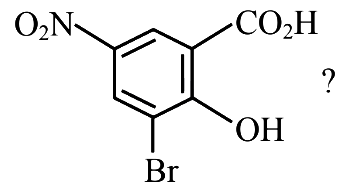
- (A) 3-Bromo-2-hydroxy-5-nitrobenzoic acid
- (B) 3-Bromo-4-hydroxy-1-nitrobenzoic acid
- (C) 2-Hydroxy-3-bromo-5-nitrobenzoic acid
- (D) 5-Nitro-3-bromo-2-hydroxybenzoic acid
Show answer and solution
Correct Answer: (A)
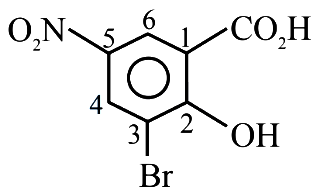
IUPAC 3-Bromo-2-hydroxy-5-nitro-Benzoic acid - 3. Which of the following is the correct IUPAC name of given organic compound \((\mathrm{X})\) ?
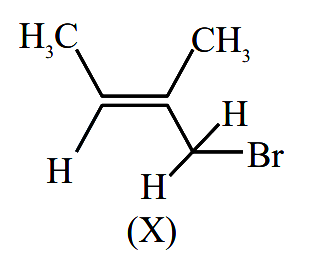
2025 Medium- (A) 2-Bromo-2-methylbut-2-ene
- (B) 3-Bromo-3-methylprop-2-ene
- (C) 1-Bromo-2-methylbut-2-ene
- (D) 4-Bromo-3-methylbut-2-ene
Show answer and solution
Correct Answer: (C)
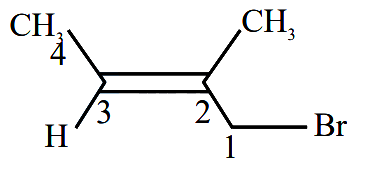
1-Bromo-2-methyl but-2-ene -
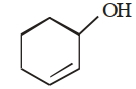
- (A) Cyclohex-\(1\)-en-\(2\)-ol
- (B) \(1\)-Hydroxyhex-\(2\)-ene
- (C) Cyclohex-\(1\)-en-\(3\)-ol
- (D) Cyclohex-\(2\)-en-\(1\)-ol
Show answer and solution
Correct Answer: (D)
Cyclohex-\(2\)-en-\(1\)-ol -
- (A) \(\mathrm{SO}_4 \mathrm{H}\)
- (B) \(\mathrm{SO}_3 \mathrm{H}\)
- (D) \(-\mathrm{SO}_2\)
Show answer and solution
Correct Answer: (B)
Group present in sulphonic acids
-
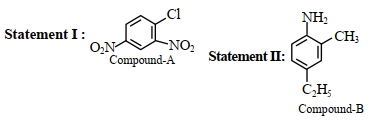
- (A) Both Statement \(I\) and Statement \(II\) are correct
- (B) Statement \(I\) is incorrect but Statement \(II\) is correct
- (C) Statement \(I\) is correct but Statement \(II\) is incorrect
- (D) Both Statement \(I\) and Statement \(II\) are incorrect
Show answer and solution
Correct Answer: (B)
\(IUPAC\) name
\(\Rightarrow \)\(1\)-chloro-\(2, 4-\)dinitrobenzene
\(\Rightarrow \)statement-\(I\) is incorrect
\(\Rightarrow\)\(4\)-ethy\(l-2\)-methylaniline
\(\Rightarrow\)statement-\(II\) is correct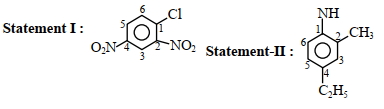
-
- (A) Statement \(I\) is correct but Statement \(II\) is incorrect.
- (B) Both Statement \(I\) and Statement \(II\) are incorrect.
- (C) Both Statement \(I\) and Statement \(II\) are correct.
- (D) Statement \(I\) is incorrect but Statement \(II\) is correct.
Show answer and solution
Correct Answer: (A)
\(7\)-Hydroxyheptan-\(2\)-one is correct \(IUPAC\) name. -
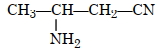
- (A) \(2\)-Aminopentanenitrile
- (B) \(2\)-Aminobutanenitrile
- (C) \(3\)-Aminobutanenitrile
- (D) \(3\)-Aminopropanenitrile
Show answer and solution
Correct Answer: (C)
\(3\)-Aminobutanenitrile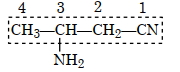
-
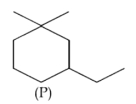
- (A) \(1-\)Ethyl\(-5,\) \(5-\)dimethylcyclohexane
- (B) \(3-\)Ethyl\(-1\),\(1-\)dimethylcyclohexane
- (C) \(1-\)Ethyl\(-3\), \(3-\)dimethylcyclohexane
- (D) \(1\),\(1-\)Dimethyl\(-3-\)ethylcyclohexane
Show answer and solution
Correct Answer: (B)
\(image\)\(3-\) \(1,\) dimenthylcyclohexane
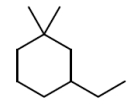
-
- (A) \(2\)-Ethyl-\(3,6\)-dimethylheptane
- (B) \(2\)-Ethyl-\(2,6\)-diethylheptane
- (C) \(2,5,6\)-Trimethyloctane
- (D) \(3,4,7\)-Trimethyloctane
Show answer and solution
Correct Answer: (C)
\(2,5,6-\) trimethyloctane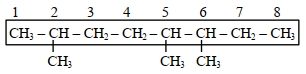
-
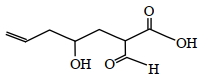
- (A) \(2\)-carboxy-\(4\)-hydroxyhept-\(6\)-enal
- (B) \(2\)-carboxy-\(4\)-hydroxyhept-\(7\)-enal
- (C) \(2\)-formy\(l-4\)-hydroxyhept-\(6\)-enoic acid
- (D) \(2\)-formy\(l-4\)-hydroxyhept-\(7\)-enoic acid
Show answer and solution
Correct Answer: (C)
\(2\)-formly-\(4\)-hydroxyhept-\(6\)-enoic acid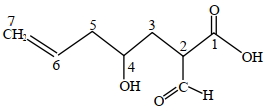
- 12. The molecular formula of second homologue in the homologous series of mono carboxylic acids is___________. 2024 Hard
- (A) \(\mathrm{C}_3 \mathrm{H}_6 \mathrm{O}_2\)
- (B) \(\mathrm{C}_2 \mathrm{H}_4 \mathrm{O}_2\)
- (C) \(\mathrm{CH}_2 \mathrm{O}\)
- (D) \(\mathrm{C}_2 \mathrm{H}_2 \mathrm{O}_2\)
Show answer and solution
Correct Answer: (B)
\(\mathrm{HCOOH}, \mathrm{CH}_3 \mathrm{COOH}\)\(\uparrow\)
Second homologue
-
- (A) \(1\)
- (B) \(10\)
- (C) \(18\)
- (D) \(20\)
Show answer and solution
Correct Answer: (C)
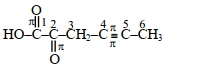
\(2\)-Oxohex-\(4\)-ynoic acid\(\text { Number of } \sigma \text {-bonds }=14\)
\(\text { Number of } \pi \text {-bonds }=4\)
\(=18\)
-
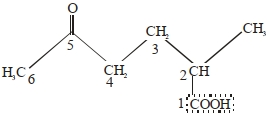
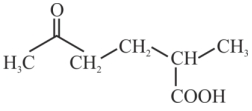
- (A) \(5-\)Formyl\(-2-\)methylhexanoic acid
- (B) \(2-\)Methyl\(-5-\)oxohexanoic acid
- (C) \(2-\)Formyl\(-5-\)methylhexan\(-6-\)oic acid
- (D) \(5-\)Methyl\(-2-\)oxohexan\(-6-\)oic acid
Show answer and solution
Correct Answer: (B)
IUPAC NAME\(2-\)Methyl\(-5-\)oxohexanoic acid
-
- (A) \(- COOH >- CONH _{2}>- COCl >- CHO\)
- (B) \(- SO _{3} H >- COCl >- CONH _{2}>- CN\)
- (C) \(- COOR >- COCl >- NH _{2}> C = O\)
- (D) \(- COOH >- COOR >- CONH _{2}>- COCl\)
Show answer and solution
Correct Answer: (B)
\(- SO _{3} H >- COCl >- CONH { }_{2}>- CN\) -
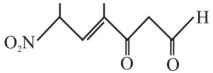
- (A) \(4-\)methyl\(-2-\)nitro\(-5-\)oxohept\(-3-\)enal
- (B) \(4-\)methyl\(-5-\)oxo\(-2-\)nitrohept\(-3-\)enal
- (C) \(4-\)methyl\(-6-\)nitro\(-3-\)oxohept\(-4-\)enal
- (D) \(6-\)formyl\(-4-\)methyl\(-2-\)nitrohex\(-3-\)enal
Show answer and solution
Correct Answer: (C)
\(4-\)methyl\(-6-\)nitro\(-3-\)oxohept\(-4-\)enal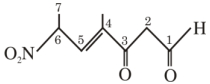
-
- (A) \(1-\)Chloroethene
- (B) \(1-\)Chloroethyne
- (C) \(1,2-\)Dichloroethane
- (D) \(1,1-\)Dichloroethane
Show answer and solution
Correct Answer: (D)
"\(1,1-\)Dichloroethane is Ethylidene chloride"
-
- (A) \(4-\)Bromo\(-2-\)methylcyclopentane carboxylic acid
- (B) \(5-\)Bromo\(-3-\)methylcyclopentanoic acid
- (C) \(3-\)Bromo\(-5-\)methylcyclopentane carboxylic acid
- (D) \(3-\)Bromo\(-5-\)methylcyclopentanoic acid
Show answer and solution
Correct Answer: (A)
\(4-\)bromo\(-2-\)methyl cyclopentane carboxylic Acid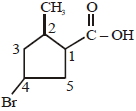
-
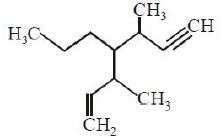
- (A) \(3, 5-\) dimethyl \(-4-\) propylhept \(-1-\) en \(-6-\) yne
- (B) \(3-\) methyl \(-4-\) (\(1-\) methylprop \(-2-\) ynyl) \(-1-\) heptene
- (C) \(3-\) methyl \(-4-\) (\(3-\) methylprop \(-1-\) enyl) \(-1-\) heptyne
- (D) \(3, 5-\) dimethyl \(-4-\) propylhept \(-6-\) en \(-1-\) yne
Show answer and solution
Correct Answer: (A)
According to \(IUPAC\) rules, select the largest chain including functional group, if alkene and alkyne are present at equivalent position then priority is given to alkene. -
- (A) \(2, 2-\) dimethyl \(-4-\) pentene
- (B) \(4, 4- \) dimethyl pentene
- (C) Isopropyl \(-2- \) butene
- (D) \(2, 2-\) dimethyl \(-3-\) pentene
Show answer and solution
Correct Answer: (B)
\(\begin{array}{*{20}{c}}
{\begin{array}{*{20}{c}}
{\,\,\,\,\,\,C{H_3}\,}\\
|
\end{array}\,\,\,\,\,\,\,\,\,\,\,\,\,\,\,\,\,\,\,\,\,\,\,\,\,\,\,\,\,\,\,\,\,\,\,\,\,\,\,\,\,\,}\\
{{H_3}C - C - C{H_2} - CH = C{H_2}}\\
{\,|\,\,\,\,\,\,\,\,\,\,\,\,\,\,\,\,\,\,\,\,\,\,\,\,\,\,\,\,\,\,\,\,\,\,\,\,\,\,\,\,\,\,}\\
{\,C{H_3}\,\,\,\,\,\,\,\,\,\,\,\,\,\,\,\,\,\,\,\,\,\,\,\,\,\,\,\,\,\,\,\,\,\,\,\,\,\,\,}
\end{array}\) This is the hydrocabon with \(7\) carbon atoms containing a neopentyl and a vinyl group. -
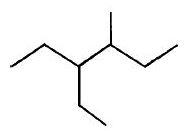
- (A) \(4 -\) methyl \(- 3 -\) ethylhexane
- (B) \(3 -\) ethyl \(- 4 -\) methylhexane
- (C) \(3, 4 -\) ethylmethylhexane
- (D) \(4 -\) ethyl \(- 3 -\) methylhexane
Show answer and solution
Correct Answer: (B)
\(\mathop {\begin{array}{*{20}{c}}
{\,\,\,\,\,\,\,\,\,\,\,\,\,\,\,\,\,\,\,C{H_3}} \\
{\,\,\,\,\,\,\,\,\,\,\,\,\,|} \\
{C{H_3}C{H_2} - CH - CH - C{H_2}C{H_3}} \\
{|\,\,\,\,\,\,\,\,\,\,\,\,\,\,\,\,\,\,} \\
{\,\,\,\,\,\,C{H_2}\,\,\,\,\,\,\,\,\,\,\,\,\,\,} \\
{|\,\,\,\,\,\,\,\,\,\,\,\,\,\,} \\
{\,\,\,\,\,\,\,C{H_3}\,\,\,\,\,\,\,\,\,\,\,\,\,\,\,}
\end{array}}\limits_{3 - ethyl - 4 - methyl\,hexane} \)

No questions on this page match these filters.
Other STD 11 - Organic chemistry Nomenclature of organic compounds topics
Frequently asked
How many Nomenclature of organic compounds questions came in JEE Mains?
21 questions from 2014–2026, each with the correct answer and a full solution.
How difficult are Nomenclature of organic compounds questions?
14% are easy, 48% medium and 38% hard.