


Questions
Newest firstShowing 1–45 of 45 questions
-
- (A) C and E Only
- (B) B and E Only
- (C) C and D Only
- (D) A and D Only
Show answer and solution
Correct Answer: (D)
- Histidine does contain heterocyclic ring.
- Proline is a five membered cyclic ring amino acid.
- Cysteine side chain is \(CH _2- SMe\).
A and D are correct. -
- (A) They can be fibrous or globular in structure.
- (B) The main forces that stabilize the structure are hydrogen bonding, disulphide links, van der Waals and electrostatic forces of attraction.
- (C) The structure remains intact when exposed to pH changes.
- (D) A linear polypeptide chain will convert to a secondary structure and then further folding of the secondary structure will convert to tertiary structure.
Show answer and solution
Correct Answer: (C)
The tertiary structure of proteins represents the overall folding of the polypeptide chains, which is the further folding of the secondary structure. This folding gives rise to two major molecular shapes: fibrous and globular.
The main forces that stabilize the secondary and tertiary structures of proteins are hydrogen bonds, disulphide linkages, van der Waals forces, and electrostatic forces of attraction.
When a protein in its native form is subjected to physical changes like temperature or chemical changes like pH, the hydrogen bonds and other stabilizing forces are disturbed. Due to this, globules unfold and the helix gets uncoiled, causing the protein to lose its biological activity. This process is called denaturation of the protein. Thus, the tertiary structure does not remain intact when exposed to pH changes.
Answer: The structure remains intact when exposed to pH changes. -
- (A) A-IV, B-II, C-I, D-III
- (B) A-IV, B-I, C-II, D-III
- (C) A-III, B-II, C-I, D-IV
- (D) A-IV, B-I, C-III, D-II
Show answer and solution
Correct Answer: (B)
Glutamine contains an amide group in its side chain, which gives a positive Hoffmann bromamide degradation test. Thus, A matches IV.
Lysine contains a primary amine group in its side chain, which gives a positive Hinsberg's test. Thus, B matches I.
Tyrosine contains a phenolic hydroxyl group in its side chain, which gives a positive neutral \(\text{FeCl}_3\) test. Thus, C matches II.
Serine contains an alcoholic hydroxyl group in its side chain, which gives a positive ceric ammonium nitrate test. Thus, D matches III.
The correct match is A-IV, B-I, C-II, D-III.
Answer: A-IV, B-I, C-II, D-III -
- (A) A-II, B-I, C-IV, D-III
- (B) A-IV, B-III, C-II, D-I
- (C) A-III, B-IV, C-I, D-II
- (D) A-II, B-IV, C-I, D-III
Show answer and solution
Correct Answer: (A)
Arginine is an essential amino acid and its one-letter symbol is R. Thus, A matches with II.
Aspartic acid is a non-essential amino acid and its one-letter symbol is D. Thus, B matches with I.
Lysine is an essential amino acid and its one-letter symbol is K. Thus, C matches with IV.
Glutamic acid is a non-essential amino acid and its one-letter symbol is E. Thus, D matches with III.
The correct matching is A-II, B-I, C-IV, D-III.
Answer: A-II, B-I, C-IV, D-III -
- (A) 6
- (B) 3
- (C) 4
- (D) 8
Show answer and solution
Correct Answer: (A)
Gly ala val
Gly val ala
Val gly ala
Val ala gly
Ala val gly
Ala gly val
Total tri peptides = 6 - 6. Which of the following amino acid will give violet coloured complex with neutral ferric chloride solution? 2026 Medium
- (A) Threonine
- (B) Serine
- (C) Tyrosine
- (D) Cysteine
Show answer and solution
Correct Answer: (C)
Neutral ferric chloride (\(\text{FeCl}_3\)) solution gives a characteristic violet coloured complex with compounds containing a phenolic hydroxyl group.
Among the given amino acids, Tyrosine contains a phenolic \(-\text{OH}\) group in its side chain.
Threonine and Serine contain aliphatic \(-\text{OH}\) groups, and Cysteine contains a thiol (\(-\text{SH}\)) group, none of which give a positive neutral \(\text{FeCl}_3\) test.
Therefore, Tyrosine will give a violet coloured complex with neutral ferric chloride solution.
Answer: Tyrosine -
- (A) 16
- (B) 32
- (C) 8
- (D) 24
Show answer and solution
Correct Answer: (D)
The number of tetrapeptides (sequences) possible involving each of these amino acids (glycine, alanine, valine, leucine) ; It has three (3) peptides linkage the number of permutations in which they can be arranged
\(\begin{aligned}
& =4 \times 3 \times 2 \times 1 \\
& =24
\end{aligned}\) -
- (A) Both statement I and statement II are correct
- (B) Statement I is incorrect but Statement II is correct
- (C) Both statement I and statement II are incorrect
- (D) Statement I is correct but Statement II is incorrect
Show answer and solution
Correct Answer: (C)
(i) Protein does not gives \(\beta\)-amino acid on hydrolysis
(ii) Fibrous protein are not water soluble
So both statement's are wrong -
- (A) All naturally occurring amino acids except glycine contain one chiral centre.
- (B) All naturally occurring amino acids are optically active.
- (C) Glutamic acid is the only amino acid that contains a-COOH group at the side chain.
- (D) Amino acid, cysteine easily undergo dimerization due to the presence of free SH group.
Show answer and solution
Correct Answer: (D)
* Isoleucine has 2 chiral centre
* Glycine is optically inactive
* Aspartic acid also contain COOH group at the side chain.
* Cysteine easily dimmerise due to free SH group -
- (A) (A), (C) and (E) only
- (B) (A), (C) and (D) only
- (C) (C), (D) and (E) only
- (D) (B), (C) and (E) only
Show answer and solution
Correct Answer: (B)
Valine, Lysine and Threonine are essential amino acids. -
- (A) 4
- (B) 6
- (C) 8
- (D) 2
Show answer and solution
Correct Answer: (D)
\(\begin{aligned}
\text { Degree of unsaturation } & =\mathrm{C}+1-\frac{\mathrm{H}}{2} \\
& =9+1-6=4
\end{aligned}\)
Benzene shows negative Baeyer's test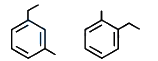
Both compounds have four different non-aliphatic substitution sites. - 12. The \(\alpha\)-Helix and \(\beta\) - Pleated sheet which structures of protein are associated with its? 2025 Easy
- (A) tertiary structure
- (B) quaternary structure
- (C) secondary structure
- (D) primary structure
Show answer and solution
Correct Answer: (C)
\(\alpha\)-helix and \(\beta\)-pleated sheet belongs to secondary structure of protein, which have hydrogen bonds. -
- (A) Denaturation of protein occurs
- (B) The secondary structure of protein remains unchanged
- (C) Breaking of the peptide linkage in the primary structure of protein occurs
- (D) ological property of proten remains unchanged
Show answer and solution
Correct Answer: (A)
Coagulation of egg give primary structure of protein, which is known as denaturation of protein. - 14. The number of tripeptides formed by three different amino acids using each amino acid once is _______. 2024 Hard
- (A) \(4\)
- (B) \(5\)
- (C) \(6\)
- (D) \(7\)
Show answer and solution
Correct Answer: (C)
Let \(3\) different amino acid are \(A, B, C\) then following combination of tripeptides can be formed.\(\mathrm{ABC}, \mathrm{ACB}, \mathrm{BAC}, \mathrm{BCA}, \mathrm{CAB}, \mathrm{CBA}\)
-
- (A) \(8\)
- (B) \(7\)
- (C) \(6\)
- (D) \(9\)
Show answer and solution
Correct Answer: (D)
TyrosineNumber of carbon atoms \(=9\)

-
- (A) \(4\)
- (B) \(5\)
- (C) \(8\)
- (D) \(10\)
Show answer and solution
Correct Answer: (A)
Essential Amino acids are :- \(4\) -
- (A) \(\beta\)
- (B) \(\alpha\)
- (C) \(\delta\)
- (D) \(\gamma\)
Show answer and solution
Correct Answer: (B)
Proteins are natural polymers composed of \(\alpha\)-amino acids which are connected by peptide linkages.Hence proteins upon acidic hydrolysis produce \(\alpha\)-amino acids. -
- (A) Cellulose
- (B) Starch
- (C) Polyvinyl chloride
- (D) Egg albumin
Show answer and solution
Correct Answer: (D)
Ninhydrin test is a test of amino acids. Egg albumin contains protein which is a natural polymer of amino acids which will show positive ninhydrin test -
- (A) Primary
- (B) Tertiary
- (C) Secondary
- (D) Quaternary
Show answer and solution
Correct Answer: (A)
Boiling an egg causes denaturation of its protein resulting in loss of its quarternary, tertiary and secondary structures. -
- (A) \(4\)
- (B) \(2\)
- (C) \(8\)
- (D) \(6\)
Show answer and solution
Correct Answer: (D)
Number of peptide linkage \(=(\) amino acid \(-1)\)\(=7-1=6\)
-
- (A) \(A-II, B-I, C-IV, D-III\)
- (B) \(A-IV, B-III, C-I, D-II\)
- (C) \(A-III, B-I, C-IV, D-II\)
- (D) \(A-III, B-IV, C-I, D-II\)
Show answer and solution
Correct Answer: (C)
\(A-III, B-I, C-IV, D-II\) - 22. The naturally occurring amino acid that contains only one basic functional group in its chemical structure is 2023 Hard
- (A) arginine
- (B) lysine
- (C) asparagine
- (D) histidine
Show answer and solution
Correct Answer: (C)
Asparagine has only one basic functional group in its chemical structure.Others are basic amino acid with more than one basic functional group.

- 23. The one that does not stabilize \(2^{\circ}\) and \(3^{\circ}\) structures of proteins is 2023 Medium
- (A) \(H-\)bonding
- (B) \(-S-S-\)linkage
- (C) \(-O-O-\)linkage
- (D) van der Waals forces
Show answer and solution
Correct Answer: (C)
\(2^{\circ}\) and \(3^{\circ}\) structure of proteins are stabilized by hydrogen bonding, disulphide linkages, Van der Waals force of attraction and electrostatic force of attraction. - 24. Total number of tripeptides possible by mixing of valine and proline is \(............\). 2023 Medium
- (A) \(8\)
- (B) \(4\)
- (C) \(2\)
- (D) \(6\)
Show answer and solution
Correct Answer: (A)
No. of possible tripeptide : Val and Pro is \(2^3\)\((1)\) val - val - val
\((2)\) pro - pro - pro
\((3)\) val - pro - pro
\((4)\) pro - val - pro
\((5)\) val - val - pro
\((6)\) val - pro - val
\((7)\) pro - pro - val
\((8)\) pro - val - val
-
- (A) Primary
- (B) Secondary
- (C) Tertiary
- (D) Quaternary
Show answer and solution
Correct Answer: (A)
Primary structure remains intact during denaturation of proteins. -
- (A) Both \(A\) and \(R\) are correct and \(R\) is the correct explanation of \(A\).
- (B) Both \(A\) and \(R\) are correct and \(R\) is NOT the correct explanation of \(A\).
- (C) \(A\) is correct but \(R\) is not correct.
- (D) \(A\) is not correct but \(R\) is correct.
Show answer and solution
Correct Answer: (D)
\(Amylose\) is water soluble. - 27. In a linear tetrapeptide (Constituted with different amino acids), (number of amino acids) - (number of peptide bonds) is 2022 Medium
- (A) \(3\)
- (B) \(2\)
- (C) \(1\)
- (D) \(0\)
Show answer and solution
Correct Answer: (C)
In Tetrapeptide,No. of Amino Acids \(=4\)
No. of Peptide bonds \(=3\)
Hence
Ans. \(=1\)
-
- (A) \(2\)
- (B) \(4\)
- (C) \(5\)
- (D) \(1\)
Show answer and solution
Correct Answer: (B)
There are Five amino acids and four peptide linkages. -
- (A) secondary structure
- (B) tertiary structure
- (C) primary structure
- (D) quaternary structure
Show answer and solution
Correct Answer: (C)
Primary structure of protein is unaffected by physical 'or' chemical changes. -
- (A) Ionic bonding
- (B) Hydrogen bonding
- (C) Covalent bonding
- (D) vander Waals forces
Show answer and solution
Correct Answer: (B)
Hydrogen bonding is responsible for the stacking of \(\alpha\) -helix structure of protein. - 31. Seliwanoff test and Xanthoproteic test are used for the identification of \(....\) and \(....\) respectively 2021 Easy
- (A) Aldoses, ketoses
- (B) Proteins, ketoses
- (C) Ketoses, proteins
- (D) Ketoses, aldoses
Show answer and solution
Correct Answer: (C)
Seliwanoff test for ketose and Xenthoprotic test for proteins. -
- (A) Peptide bond
- (B) glycosidic bond
- (C) Hydrogen bonding
- (D) van der Waals forces
Show answer and solution
Correct Answer: (C)
The secondary structure of protein includes two type :\((a)\) \(\alpha\) -Helix
\((b)\) \(\beta\) -pleated sheet
In \(\alpha\) -Helix structure, the poly peptide chain is coil around due to presence of Intramolecular H-Bonding.
- 33. The total number of negative charge in the tetrapeptide, \(Gly-Glu-Asp-Tyr,\) at \(\mathrm{pH} 12.5\) will be ...... . 2021 Easy
- (A) \(4\)
- (B) \(3\)
- (C) \(1\)
- (D) \(2\)
Show answer and solution
Correct Answer: (A)
Total negative charge produced \(=4.\)
-
- (A) Fibrin
- (B) Albumin
- (C) Collagen
- (D) Myosin
Show answer and solution
Correct Answer: (B)
Albumin is water soluble. -
- (A) The intermolecular association in primary amines is less than the intermolecular association in secondary amines.
- (B) Primary amines on treating with nitrous acid solution form corresponding alcohols except methyl amine.
- (C) Primary amines are less basic than the secondary amines.
- (D) Primary amines can be prepared by the Gabriel phthalimide synthesis.
Show answer and solution
Correct Answer: (A)
The intermolecular association is more prominent in case of primary amines as compared to secondary, due to the availability of two hydrogen atom. -
- (A) Keratin
- (B) Albumin
- (C) Collagen
- (D) Myosin
Show answer and solution
Correct Answer: (B)
Keratin, collagen and myosin are example of fibrous protein. -
- (A) Valine
- (B) Leucine
- (C) Lysine
- (D) Tyrosine
Show answer and solution
Correct Answer: (D)
Tyrosine is not an essential amino acid. -
- (A) Asparagine
- (B) Lysine
- (C) Serine
- (D) Histidine
Show answer and solution
Correct Answer: (B)
Compound \(Pl\) valueHistidine \(7.6\)
Serine \(5.7\)
Lysine \(9.8\)
Asparagine \(5.4\)
-
- (A) \(A -Q, B -S, C -P\)
- (B) \(A -R, B -Q, C -P\)
- (C) \(A -R, B -S, C -Q\)
- (D) \(A -Q, B -S, C -R\)
Show answer and solution
Correct Answer: (A)
Go through structure of amino acids - 40. The increasing order of \(pKa\) of following amino acids in aqueous solution is \(Gly, \,Asp,\, Lys,\, Arg\) 2019 Hard
- (A) \(Asp < Gly < Arg < Lys\)
- (B) \(Gly < Asp < Arg < Lys\)
- (C) \(Asp < Gly < Lys < Arg\)
- (D) \(Arg < Lys < Gly < Asp\)
Show answer and solution
Correct Answer: (C)
\(\underset{\begin{smallmatrix}
*Ly\sin e \\
(pl\,\,Value\,=\,9.8)
\end{smallmatrix}}{\mathop{\begin{matrix}
\begin{matrix}
\,\,\,\,\,\,CO{{O}^{-}} \\
|\,\,\, \\
{{H}_{3}}\bar{N}-C-H\,\,\,\,\,\,\,\,\, \\
\,\,|\,\,\,\,\, \\
\end{matrix} \\
\,\,\,C{{H}_{2}} \\
\,\,\,|\,\,\,\,\,\, \\
\begin{matrix}
\,\,\,C{{H}_{2}} \\
\,\,\,\,|\,\,\,\,\,\, \\
\,\,\,\,C{{H}_{2}} \\
\begin{matrix}
\,\,\,\,\,\,|\,\,\,\,\,\,\, \\
\,\,\,\,\,C{{H}_{2}} \\
\,\,\,\,|\,\,\,\,\, \\
\,\,\,{}^{+}N{{H}_{3}} \\
\end{matrix} \\
\end{matrix} \\
\end{matrix}}}\,\) \(\underset{\begin{smallmatrix}
*Arginine \\
(pl\,\,Value\,=\,10.8)
\end{smallmatrix}}{\mathop{\begin{matrix}
\begin{matrix}
\,\,\,\,\,\,CO{{O}^{-}} \\
|\,\,\, \\
{{H}_{3}}\overset{+}{\mathop{N}}\,-C-H\,\,\,\,\,\,\,\,\, \\
\,\,|\,\,\,\,\, \\
\end{matrix} \\
\,\,\,C{{H}_{2}} \\
\,\,\,|\,\,\,\,\,\, \\
\begin{matrix}
\,\,\,C{{H}_{2}} \\
\,\,\,\,|\,\,\,\,\,\, \\
\,\,\,\,C{{H}_{2}} \\
\begin{matrix}
\,\,\,\,\,\,|\,\,\,\,\,\,\, \\
\,\,\,\,\,NH \\
\,\,\,\,|\,\,\,\,\, \\
\begin{align}
\,\,\,\,\,\,\,\,\,\,\,\,\,\,\,\,C=\overset{+}{\mathop{N}}\,{{H}_{2}} \\
\,\,\,\,\,\,\,\,\,\,\,\,\,\,\begin{matrix}
|\,\,\,\,\,\,\,\,\,\, \\
\,\,\,\,N{{H}_{2}}\,\,\,\,\, \\
\end{matrix} \\
\end{align} \\
\end{matrix} \\
\end{matrix} \\
\end{matrix}}}\,\) \(\underset{\begin{smallmatrix}
\,\,\,\,\,\,\,\,\,Aspartate \\
(pl\,\,value\,\,=\,3.0)
\end{smallmatrix}}{\mathop{\begin{matrix}
\begin{matrix}
\,\,\,\,\,\,\,\,\,\,\,\,\,\,\,CO{{O}^{-}} \\
\,\,\,\,\,\,| \\
{{H}_{3}}\overset{+}{\mathop{N}}\,-C-H \\
\,\,\,\,\,\,| \\
\end{matrix} \\
\,\,\,\,\,\,\,\,\,\,C{{H}_{2}} \\
\,\,\,\,\,| \\
\,\,\,\,\,\,\,\,\,\,\,\,\,\,\,CO{{O}^{-}} \\
\end{matrix}}}\,\) \(\underset{\begin{smallmatrix}
\,\,\,\,\,\,\,\,\,\,\,Glycine \\
(pl\,\,\,Value\,\,=\,\,6.0)
\end{smallmatrix}}{\mathop{\begin{matrix}
\,\,\,\,\,\,\,\,\,\begin{matrix}
\,\,\,\,\,CO{{O}^{-}} \\
|\,\,\,\, \\
\end{matrix} \\
{{H}_{3}}\overset{+}{\mathop{N}}\,-C-H \\
\,\,\,\,\,\,| \\
\,\,\,\,\,\,\,H \\
\end{matrix}}}\,\) -
- (A) \(Lys - Asp\)
- (B) \(Ser -Lys\)
- (C) \(Gln - Asp\)
- (D) \(Asp -Gln\)
Show answer and solution
Correct Answer: (B)
Due to \(-OH\) group of serine it give cerric ammonium nitrate test whereas due to \(-NH_2\) group lysine give \(+ve\) carbylamine test. -
- (A) Biuret test
- (B) Barfoed test
- (C) Ninhydrin test
- (D) Xanthoproteic test
Show answer and solution
Correct Answer: (B)
Barfoed test is used to detect monosaccirides. -
- (A) Alanine
- (B) Valine
- (C) Aspartic acid
- (D) Serine
Show answer and solution
Correct Answer: (B)
Those amino acids that cannot be synthesized in our body and must be supplied in diet is called esseniial amino acid for ex. valine, Histidine, Isoluecine etc. - 44. Consider the following sequence for aspartic acid The \(pI\) (isoelectric point) of aspartic acid
 2016 Medium
- (A) \(3.65\)
- (B) \(2.77\)
- (C) \(5.74\)
- (D) \(1.88\)
Show answer and solution
Correct Answer: (B)
In the given reaction sequence\(pH\,=\,\frac{p{{K}_{1}}\,+\,p{{K}_{2}}}{2}\,=\,\frac{1.88\,+\,3.65}{2}\)
\(=\frac{5.53}{2}\,=\,2.675\,\approx \,2.77\)
At isoelectric point of aspartic acid both carboxylic as well as amino form co-exist.
-
- (A) Starch
- (B) Reducing sugar
- (C) Protein
- (D) Cupric ion
Show answer and solution
Correct Answer: (C)
Ninhdrin is often used to detect \(\alpha \) - amino acids and also free amino and carboxylic acid group on proteins and peptides. when about \(0.5\,ml\) of a \(0.1\%\) solution of ninhydin is boiled for one or two minutes with a few \(\,ml\) of dilute amino acid or protein solution, a blue colors decelops, ninhydrin degrades amino acids into aldehydes, ammonia, and \(CO_2\) through a series of reactions; the net result is ninhydrin in a partially reduced form hydrindantin;Ninhydrin then condenses with ammonia and hydrin dantin to produce an intensely blue or puple pigment, sometimes called Ruhemann's purple:

No questions on this page match these filters.
Other STD 12 - Biomolecules topics
Frequently asked
How many Amino Acids and Proteins questions came in JEE Mains?
45 questions from 2016–2026, each with the correct answer and a full solution.
How difficult are Amino Acids and Proteins questions?
24% are easy, 49% medium and 27% hard.