


Questions
Newest firstShowing 1–23 of 23 questions
- 1. If two vectors \(\vec{A}\) and \(\vec{B}\) having equal magnitude \(\mathrm{R}\) are inclined at an angle \(\theta\), then... 2024 Hard
- 2. The angle between vector \(\vec{Q}\) and the resultant of \((2 \overrightarrow{\mathrm{Q}}+2 \overrightarrow{\mathrm{P}})\) and \((2 \overrightarrow{\mathrm{Q}}-2 \overrightarrow{\mathrm{P}})\) is _______. 2024 Hard
- 3. Three vectors \(\overrightarrow{\mathrm{OP}}, \overrightarrow{\mathrm{OQ}}\) and \(\overrightarrow{\mathrm{OR}}\) each of magnitude \(A\) are acting as shown in figure. The resultant of the three vectors is \(A \sqrt{x}\). The value of \(x\) is _______.
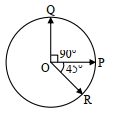 2024 Hard
- 4. Two forces \(\vec{F}_1\) and \(\vec{F}_2\) are acting on a body. One force has magnitude thrice that of the other force and the resultant of the two forces is equal to the force of larger magnitude. The angle between \(\vec{F}_1\) and \(\overrightarrow{\mathrm{F}}_2\) is \(\cos ^{-1}\left(\frac{1}{\mathrm{n}}\right)\). The value of \(|\mathrm{n}|\) is __________. 2024 Hard
- 5. Two forces having magnitude \(A\) and \(\frac{ A }{2}\) are perpendicular to each other. The magnitude of their resultant is 2023 Easy
- 6. When vector \(\overrightarrow{ A }=2 \hat{ i }+3 \hat{ j }+2 \hat{ k }\) is subtracted from vector \(\vec{B}\), it gives a vector equal to \(2 \hat{j}\). Then the magnitude of vector \(\vec{B}\) will be: 2023 Easy
- 7. A person moved from \(A\) to \(B\) on a circular path as shown in figure. If the distance travelled by him is \(60 \,m\), then the magnitude of displacement would be\(.....\,m\) (Given \(\left.\cos 135^{\circ}=-0.7\right)\)
 2022 Hard
- 8. Two vectors \(\overrightarrow{ A }\) and \(\overrightarrow{ B }\) have equal magnitudes. If magnitude of \(\overrightarrow{ A }+\overrightarrow{ B }\) is equal to two times the magnitude of \(\overrightarrow{ A }-\overrightarrow{ B }\), then the angle between \(\overrightarrow{ A }\) and \(\overrightarrow{ B }\) will be ....................... 2022 Medium
- 9. Which of the following relations is true for two unit vectors \(\hat{ A }\) and \(\hat{ B }\) making an angle \(\theta\) to each other\(?\) 2022 Hard
- 10. Assertion \(A\) : If \(A, B, C, D\) are four points on a semi-circular arc with centre at \('O'\) such that \(|\overrightarrow{{AB}}|=|\overrightarrow{{BC}}|=|\overrightarrow{{CD}}|\), then \(\overrightarrow{{AB}}+\overrightarrow{{AC}}+\overrightarrow{{AD}}=4 \overrightarrow{{AO}}+\overrightarrow{{OB}}+\overrightarrow{{OC}}\) Reason \(R\) : Polygon law of vector addition yields \(\overrightarrow{A B}+\overrightarrow{B C}+\overrightarrow{C D}+\overrightarrow{A D}=2 \overrightarrow{A O}\) In the light of the above statements, choose the most appropriate answer from the options given below
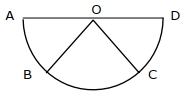 2021 Hard
- 11. In an octagon \(ABCDEFGH\) of equal side, what is the sum of \(\overrightarrow{ AB }+\overrightarrow{ AC }+\overrightarrow{ AD }+\overrightarrow{ AE }+\overrightarrow{ AF }+\overrightarrow{ AG }+\overrightarrow{ AH }\) if, \(\overrightarrow{ AO }=2 \hat{ i }+3 \hat{ j }-4 \hat{ k }\)
 2021 Hard
- 12. Statement \(I:\) If three forces \(\vec{F}_{1}, \vec{F}_{2}\) and \(\vec{F}_{3}\) are represented by three sides of a triangle and \(\overrightarrow{{F}}_{1}+\overrightarrow{{F}}_{2}=-\overrightarrow{{F}}_{3}\), then these three forces are concurrent forces and satisfy the condition for equilibrium. Statement \(II:\) A triangle made up of three forces \(\overrightarrow{{F}}_{1}, \overrightarrow{{F}}_{2}\) and \(\overrightarrow{{F}}_{3}\) as its sides taken in the same order, satisfy the condition for translatory equilibrium. In the light of the above statements, choose the most appropriate answer from the options given below: 2021 Medium
- 13. Statement \(I :\)Two forces \((\overrightarrow{{P}}+\overrightarrow{{Q}})\) and \((\overrightarrow{{P}}-\overrightarrow{{Q}})\) where \(\overrightarrow{{P}} \perp \overrightarrow{{Q}}\), when act at an angle \(\theta_{1}\) to each other, the magnitude of their resultant is \(\sqrt{3\left({P}^{2}+{Q}^{2}\right)}\), when they act at an angle \(\theta_{2}\), the magnitude of their resultant becomes \(\sqrt{2\left({P}^{2}+{Q}^{2}\right)}\). This is possible only when \(\theta_{1}<\theta_{2}\). Statement \(II :\) In the situation given above. \(\theta_{1}=60^{\circ} \text { and } \theta_{2}=90^{\circ}\) In the light of the above statements, choose the most appropriate answer from the options given below 2021 Hard
- 14. The angle between vector \((\overrightarrow{{A}})\) and \((\overrightarrow{{A}}-\overrightarrow{{B}})\) is :
 2021 Hard
- 15. The magnitude of vectors \(\overrightarrow{ OA }, \overrightarrow{ OB }\) and \(\overrightarrow{ OC }\) in the given figure are equal. The direction of \(\overrightarrow{ OA }+\overrightarrow{ OB }-\overrightarrow{ OC }\) with \(x\)-axis will be
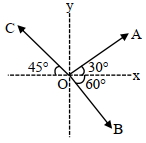 2021 Hard
- 16. The resultant of these forces \(\overrightarrow{O P}, \overrightarrow{O Q}, \overrightarrow{O R}, \overrightarrow{O S}\) and \(\overrightarrow{{OT}}\) is approximately \(\ldots \ldots {N}\). [Take \(\sqrt{3}=1.7, \sqrt{2}=1.4\) Given \(\hat{{i}}\) and \(\hat{{j}}\) unit vectors along \({x}, {y}\) axis \(]\)
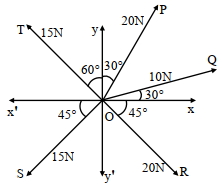 2021 Medium
- 17. Two vectors \(\vec A\) and \(\vec B\) have equal magnitudes. The magnitude of \((\vec A + \vec B)\) is \(‘n’\) times the magnitude of \((\vec A - \vec B)\). The angle between \( \vec A\) and \(\vec B\) is 2021 Hard
- 18. Two vectors \(\overrightarrow{{X}}\) and \(\overrightarrow{{Y}}\) have equal magnitude. The magnitude of \((\overrightarrow{{X}}-\overrightarrow{{Y}})\) is \({n}\) times the magnitude of \((\overrightarrow{{X}}+\overrightarrow{{Y}})\). The angle between \(\overrightarrow{{X}}\) and \(\overrightarrow{{Y}}\) is - 2021 Hard
- 19. The sum of two forces \(\overrightarrow{\mathrm{P}}\) and \(\overrightarrow{\mathrm{Q}}\) is \(\overrightarrow{\mathrm{R}}\) such that \(|\overrightarrow{\mathrm{R}}|=|\overrightarrow{\mathrm{P}}| .\) The angle \(\theta\) (in degrees) that the resultant of \(2 \overrightarrow{\mathrm{P}}\) and \(\overrightarrow{\mathrm{Q}}\) will make with \(\overrightarrow{\mathrm{Q}}\) is 2020 Medium
- 20. A particle is moving along a circular path with a constant speed of \(10\,ms^{-1}.\) What is the magnitude of the change in velocity of the particle, when it moves through an angle of \(60^{o}\) around the centre of the circle .......... \(m/s\) 2019 Medium
- 21. In the cube of side \(a\) shown in the figure, the vector from the central point of the face \(ABOD\) to the central point of the face \(BEFO\) will be
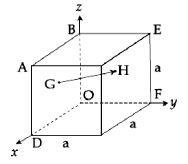 2019 Medium
- 22. Two forces \(P\) and \(Q\), of magnitude \(2F\) and \(3F\), respectively, are at an angle \(\theta \) with each other. If the force \(Q\) is doubled, then their resultant also gets doubled. Then, the angle \(\theta \) is ....... \(^o\) 2019 Medium
- 23. A vector \(\vec A \) is rotated by a small angle \(\Delta \theta\) radian \(( \Delta \theta << 1)\) to get a new vector \(\vec B\) In that case \(\left| {\vec B - \vec A} \right|\) is 2015 Medium
No questions on this page match these filters.
Other STD 11 - Vectors topics
Frequently asked
How many Addition and Subtraction of Vectors questions came in JEE Mains?
23 questions from 2015–2024, each with the correct answer and a full solution.
How difficult are Addition and Subtraction of Vectors questions?
9% are easy, 35% medium and 57% hard.