


Questions
Newest firstShowing 1–40 of 40 questions
- 1. A thin half ring of radius \(35\) cm is uniformly charged with a total charge of \(Q\) coulomb. If the magnitude of the electric field at centre of the half ring is \(100\) V/m, then the value of \(Q\) is _______ nC. (\(\epsilon_o = 8.85 \times 10^{-12}\) C\(^2\)/Nm\(^2\) and \(\pi = 3.14\)) 2026 Medium
- 2. Two point charges \(2 q\) and \(q\) are placed at vertex \(A\) and centre of face CDEF of the cube as shown in figure. The electric flux passing through the cube is :
 2026 Easy
- 3. A line charge of length \(\frac{\text { ' } a \text { ' }}{2}\) is kept at the center of an edge \(B C\) of a cube \(A B C D E F G H\) having edge length ' \(a\) ' as shown in the figure. If the density of line charge is \(\lambda\) C per unit length, then the total electric flux through all the faces of the cube will be _______. (Take, \(\epsilon_0\) as the free space permittivity)

2025 Hard - 4. A point charge causes an electric flux of \(-2 \times 10^4 \mathrm{Nm}^2 \mathrm{C}^{-1}\) to pass through a spherical Gaussian surface of 8.0 cm radius, centred on the charge. The value of the point charge is :
(Given \(\epsilon_0=8.85 \times 10^{-12} \mathrm{C}^2 \mathrm{~N}^{-1} \mathrm{~m}^{-2}\) ) 2025 Easy - 5. A square loop of sides \(a=1 \mathrm{~m}\) is held normally in front of a point charge \(\mathrm{q}=1 \mathrm{C}\). The flux of the electric field through the shaded region is \(\frac{5}{\mathrm{p}} \times \frac{1}{\varepsilon_0} \frac{\mathrm{Nm}^2}{\mathrm{C}}\), where the value of p is _____.

2025 Easy - 6. An infinitely long wire has uniform linear charge density \(\lambda=2 \mathrm{nC} / \mathrm{m}\). The net flux through a Gaussian cube of side length \(\sqrt{3} \mathrm{~cm}\), if the wire passes through any two corners of the cube, that are maximally displaced from each other, would be \(\mathrm{xNm}^2 \mathrm{C}^{-1}\), where x is :
[Neglect any edge effects and use \(\frac{1}{4 \pi \varepsilon_0}=9 \times 10^9\) SI units] 2025 Easy - 7. The electric field in a region is given by \(\overrightarrow{\mathrm{E}}=(2 \hat{\mathrm{i}}+4 \hat{\mathrm{j}}+6 \hat{\mathrm{k}}) \times 10^3 \mathrm{~N} / \mathrm{C}\). The flux of the field through a rectangular surface parallel to \(x-z\) plane is \(6.0 \mathrm{Nm}^2 \mathrm{C}^{-1}\). The area of the surface is ________ \(\mathrm{cm}^2\). 2025 Easy
- 8. A charge \(q\) is placed at the center of one of the surface of a cube. The flux linked with the cube is _______. 2024 Hard
- 9. An electric field, \(\overrightarrow{\mathrm{E}}=\frac{2 \hat{\mathrm{i}}+6 \hat{\mathrm{j}}+8 \hat{\mathrm{k}}}{\sqrt{6}}\) passes through the surface of \(4 \mathrm{~m}^2\) area having unit vector \(\hat{\mathrm{n}}=\left(\frac{2 \hat{\mathrm{i}}+\hat{\mathrm{j}}+\hat{\mathrm{k}}}{\sqrt{6}}\right)\). The electric flux for that surface is _______ \(\mathrm{Vm}\) 2024 Hard
- 10. An electric field \(\overrightarrow{\mathrm{E}}=(2 \mathrm{xi}) \mathrm{NC}^{-1}\) exists in space. \(\mathrm{A}\) cube of side \(2 \mathrm{~m}\) is placed in the space as per figure given below. The electric flux through the cube is _______ \(\mathrm{Nm}^2 / \mathrm{C}\)
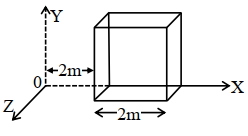 2024 Hard
- 11. An electric field is given by \((6 \hat{i}+5 \hat{j}+3 \hat{k}) \ N / C\). The electric flux through a surface area \(30 \hat{\mathrm{i}}\; m^2\) lying in \(YZ-\)plane (in SI unit) is _______. 2024 Hard
- 12. \(C_1\) and \(C_2\) are two hollow concentric cubes enclosing charges \(2 Q\) and \(3 Q\) respectively as shown in figure. The ratio of electric flux passing through \(C_1\) and \(C_2\) is _______.
 2024 Medium
- 13. Five charges \(+q,+5 q,-2 q,+3 q\) and \(-4 q\) are situated as shown in the figure. The electric flux due to this configuration through the surface \(S\) is _______.
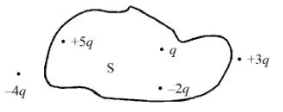 2024 Hard
- 14. Two charges of \(5 Q\) and \(-2 Q\) are situated at the points \((3 a, 0)\) and \((-5 a, 0)\) respectively. The electric flux through a sphere of radius \(4a\) having center at origin is 2024 Hard
- 15. A cubical volume is bounded by the surfaces \(x =0, x = a , y =0, y = a , z =0, z = a\). The electric field in the region is given by \(\overrightarrow{ E }= E _0 \times \hat{ i }\). Where \(E _0=4 \times 10^4 NC ^{-1} m ^{-1}\). If \(a =2 cm\), the charge contained in the cubical volume is \(Q \times 10^{-14} C\). The value of \(Q\) is \(...........\) Take \(\left.\varepsilon_0=9 \times 10^{-12} C ^2 / Nm ^2\right)\) 2023 Medium
- 16. An electron revolves around an infinite cylindrical wire having uniform linear change density \(2 \times 10^{-8}\,Cm ^{-1}\) in circular path under the influence of attractive electrostatic field as shown in the figure. The velocity of electron with which it is revolving is \(.........\times 10^6\,ms ^{-1}\). Given mass of electron \(=9 \times 10^{-31}\,kg\)
 2023 Medium
- 17. As shown in figure, a cuboid lies in a region with electric field \(E=2 x^2 \hat{i}-4 y \hat{j}+6 \hat{k} \quad N / C\). The magnitude of charge within the cuboid is \(n \varepsilon_0 C\). The value of \(n\) is \(............\) (if dimension of cuboid is \(1 \times 2 \times 3 \;m ^3\) )
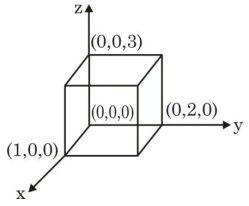 2023 Medium
- 18. Expression for an electric field is given by \(\vec{E}=4000 x^2 \hat{i} \frac{V}{m}\). The electric flux through the cube of side \(20\,cm\) when placed in electric field (as shown in the figure) is \(.........V cm\).
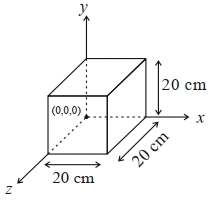 2023 Medium
- 19. Given below are two statement: one is labelled as Assertion \(A\) and the other is labelled as Reason \(R\). Assertion \(A:\) If an electric dipole of dipole moment \(30 \times 10^{-5}\,Cm\) is enclosed by a closed surface, the net flux coming out of the surface will be zero. Reason \(R\) : Electric dipole consists of two equal and opposite charges. In the light of above, statements, choose the correct answer from the options given below: 2023 Medium
- 20. In a cuboid of dimension \(2 L \times 2 L \times L\), a charge \(q\) is placed at the centre of the surface ' \(S\) ' having area of \(4 L ^2\). The flux through the opposite surface to ' \(S\) ' is given by 2023 Medium
- 21. A long cylindrical volume contains a uniformly distributed charge of density \(\rho\). The radius of cylindrical volume is \(R\). A charge particle \((q)\) revolves around the cylinder in a circular path. The kinetic of the particle is 2022 Hard
- 22. A long cylindrical volume contains a uniformly distributed charge of density \(\rho \;Cm ^{-3}\). The electric field inside the cylindrical volume at a distance \(x =\frac{2 \varepsilon_{0}}{\rho} m\) from its axis is \(.......Vm ^{-1}\)
 2022 Hard
- 23. If a charge \(q\) is placed at the centre of a closed hemispherical non-conducting surface, the total flux passing through the flat surface would be
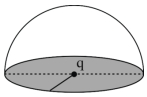 2022 Medium
- 24. A charge \('q'\) is placed at one corner of a cube as shown in figure. The flux of electrostatic field \(\overrightarrow{ E }\) through the shaded area is ...... .
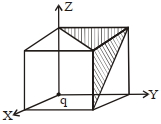 2021 Hard
- 25. A cube is placed inside an electric field, \(\overrightarrow{{E}}=150\, {y}^{2}\, \hat{{j}}\). The side of the cube is \(0.5 \,{m}\) and is placed in the field as shown in the given figure. The charge inside the cube is \(.....\times 10^{-11} {C}\)
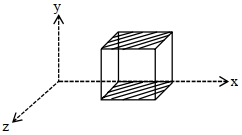 2021 Hard
- 26. A point charge of \(+\,12 \,\mu C\) is at a distance \(6 \,cm\) vertically above the centre of a square of side \(12\, cm\) as shown in figure. The magnitude of the electric flux through the square will be ....... \(\times 10^{3} \,Nm ^{2} / C\)
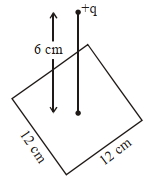 2021 Medium
- 27. Choose the incorrect statement : \((a)\) The electric lines of force entering into a Gaussian surface provide negative flux. \((b)\) A charge ' \(q\) ' is placed at the centre of a cube. The flux through all the faces will be the same. \((c)\) In a uniform electric field net flux through a closed Gaussian surface containing no net charge, is zero. \((d)\) When electric field is parallel to a Gaussian surface, it provides a finite non-zero flux. Choose the most appropriate answer from the options given below 2021 Medium
- 28. Find out the surface charge density at the intersection of point \(x =3\, m\) plane and \(x\) -axis, in the region of uniform line charge of \(8\, nC / m\) lying along the \(z\) -axis in free space. 2021 Hard
- 29. Given below are two statements: Statement \(I :\) An electric dipole is placed at the centre of a hollow sphere. The flux of electric field through the sphere is zero but the electric field is not zero anywhere in the sphere. Statement \(II :\) If \(R\) is the radius of a solid metallic sphere and \(Q\) be the total charge on it. The electric field at any point on the spherical surface of radius \(r ( < R )\) is zero but the electric flux passing through this closed spherical surface of radius \(r\) is not zero. In the light of the above statements, choose the correct answer from the options given below: 2021 Hard
- 30. The electric field in a region is given by \(\vec E = \frac{3}{5}{E_0}\hat i + \frac{4}{5}{E_0}\hat j\) and \(E_0 = 2\times10^3\, N/C\). Then, the flux of this field through a rectangular surface of area \(0.2\, m^2\) parallel to the \(y-z\) plane is......\(\frac{{N - {m^2}}}{C}\) 2021 Medium
- 31. The electric field in a region is given by \(\overrightarrow{ E }=\frac{2}{5} E _{0} \hat{ i }+\frac{3}{5} E _{0} \hat{ j }\) with \(E _{0}=4.0 \times 10^{3}\, \frac{ N }{ C } .\) The flux of this field through a rectangular surface area \(0.4 \,m ^{2}\) parallel to the \(Y - Z\) plane is ....... \(Nm ^{2} C ^{-1}\) 2021 Medium
- 32. The electric field in a region is given \(\overrightarrow{ E }=\left(\frac{3}{5} E _{0} \hat{ i }+\frac{4}{5} E _{0} \hat{ j }\right) \frac{ N }{ C } .\) The ratio of flux of reported field through the rectangular surface of area \(0.2\, m ^{2}\) (parallel to \(y - z\) plane) to that of the surface of area \(0.3\, m ^{2}\) (parallel to \(x - z\) plane \()\) is \(a : b ,\) where \(a =\) ............. [Here \(\hat{ i }, \hat{ j }\) and \(\hat{ k }\) are unit vectors along \(x , y\) and \(z-\)axes respectively] 2021 Hard
- 33. The total charge enclosed in an incremental volume of \(2 \times 10^{-9} \,{m}^{3}\) located at the origin is ...... \(nC,\) if electric flux density of its field is found as \(D=e^{-x} \sin y \hat{i}-e^{-x} \cos y \hat{j}+2 z \hat{k}\, C / m^{2}\) 2021 Hard
- 34. An electric field \(\overrightarrow{\mathrm{E}}=4 \mathrm{x} \hat{\mathrm{i}}-\left(\mathrm{y}^{2}+1\right) \hat{\mathrm{j}}\; \mathrm{N} / \mathrm{C}\) passes through the box shown in figure. The flux of the electric field through surfaces \(A B C D\) and \(BCGF\) are marked as \(\phi_{I}\) and \(\phi_{\mathrm{II}}\) respectively. The difference between \(\left(\phi_{\mathrm{I}}-\phi_{\mathrm{II}}\right)\) is (in \(\left.\mathrm{Nm}^{2} / \mathrm{C}\right)\)
 2020 Medium
- 35. In finding the electric field using Gauss Law the formula \(|\overrightarrow{\mathrm{E}}|=\frac{q_{\mathrm{enc}}}{\varepsilon_{0}|\mathrm{A}|}\) is applicable. In the formula \(\varepsilon_{0}\) is permittivity of free space, \(A\) is the area of Gaussian surface and \(q_{enc}\) is charge enclosed by the Gaussian surface. The equation can be used in which of the following situation? 2020 Medium
- 36. A charge \(Q\) is placed at a distance \(a/2\) above the centre of the square surface of edge \(a\) as shown in the figure. The electric flux through the square surface is
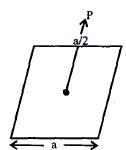 2018 Medium
- 37. Four closed surfaces and corresponding charge distributions are shown below Let the respective electric fluxes through the surfaces be \({\phi _1},{\phi _2},{\phi _3}\) and \({\phi _4}\) . Then
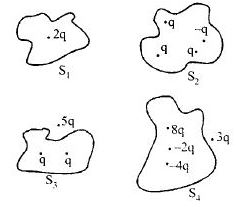 2017 Hard
- 38. A cone of base radius \(R\) and height \(h\) is located in a uniform electric field \(\vec E\) parallel to its base. The electric flux entering the cone is 2014 Medium
- 39. The electric field in a region of space is given by, \(\overrightarrow E = {E_0}\hat i + 2{E_0}\hat j\) where \(E_0\, = 100\, N/C\). The flux of the field through a circular surface of radius \(0.02\, m\) parallel to the \(Y-Z\) plane is nearly 2014 Hard
- 40. The magnitude of the average electric field normally present in the atmosphere just above the surface of the Earth is about \(150\, N/C\), directed inward towards the center of the Earth . This gives the total net surface charge carried by the Earth to be......\(kC\) [Given \({\varepsilon _0} = 8.85 \times {10^{ - 12}}\,{C^2}/N - {m^2},{R_E} = 6.37 \times {10^6}\,m\)] 2014 Hard
No questions on this page match these filters.
Other STD 12 - Electric charges and fields topics
Frequently asked
How many Electric Field Lines, Electric Flux and Gauss's Law questions came in JEE Mains?
40 questions from 2014–2026, each with the correct answer and a full solution.
How difficult are Electric Field Lines, Electric Flux and Gauss's Law questions?
13% are easy, 43% medium and 45% hard.