


Questions
20 questionsShowing 1–20 of 20 questions
-
- (A) \(6\)
- (B) \(5\)
- (C) \(-5\)
- (D) \(10\)
Show answer and solution
Correct Answer: (B)
\(\overrightarrow{ V }=\overrightarrow{ u }+\overrightarrow{ a t}\)\(V =150-10 t\)
\(V (3)=150-30=120\)
\(V (5)=150-50=100\)
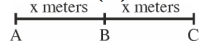
\(\frac{120}{100}=\frac{ x +1}{ x }=\frac{6}{5} \Rightarrow x =5\)
-
- (A) \(\frac{ v _1 v _2}{2\left( v _1+ v _2\right)}\)
- (B) \(\frac{v_1+v_2}{2}\)
- (C) \(\frac{2 x }{ v _1+ v _2}\)
- (D) \(\frac{2 v _1 v _2}{ v _1+ v _2}\)
Show answer and solution
Correct Answer: (D)
\(\text { Average velocity }=\frac{\text { Total displacement }}{\text { Total time }}\)\(=\frac{ x + x }{\frac{ x }{ v _1}+\frac{ x }{ v _2}}=\frac{2 v _1 v _2}{ v _1+ v _2}\)

-
- (A) \(R \sqrt{\left(\pi^2+4\right)}\)
- (B) \(R \sqrt{\left(\pi^2+1\right)}\)
- (C) \(2 R\)
- (D) \(2 R \sqrt{\left(1+4 \pi^2\right)}\)
Show answer and solution
Correct Answer: (A)
Displacement \(=\sqrt{(2 R)^2+(\pi R)^2}=R \sqrt{4+\pi^2}\)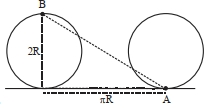
-
- (A) \(25\)
- (B) \(20\)
- (C) \(26\)
- (D) \(50\)
Show answer and solution
Correct Answer: (D)
\(t _{ AB }=\frac{ x }{5 m / s }\)In motion \(BC\)
\(x = d _1+ d _2\)
where \(d _1 , d _2\) we the distance travelled with \(10\,m / s\) and \(15\,m / s\) respectively in equal time intervals
\(\frac{' t^{\prime}}{2} \text { each }\)
\(d_1=\frac{10 t}{2}, d_2=\frac{15 t }{2}\)
\(d_1+d_2=x=\frac{t}{2}(10+15)=\frac{25 t }{2}\)
\(< v >=\frac{2 x }{\frac{ x }{5}+\frac{2 x }{25}}=\frac{2 \times 25}{5+2}=\frac{50}{7} m / s\)
Ans. : \(50\)
-
- (A) \(6\)
- (B) \(3\)
- (C) \(30\)
- (D) \(25\)
Show answer and solution
Correct Answer: (D)
\(v=u+a t\)\(60=10+2\,t\)
\(t=25\,sec\)
-
- (A) \(80\)
- (B) \(200\)
- (C) \(120\)
- (D) \(320\)
Show answer and solution
Correct Answer: (D)
Velocity of train \(A\)\(V _{ A }=90 \frac{ km }{ hr }=90 \times \frac{5}{18}=25\,m / s\)
Velocity of train \(B\)
\(V _{ B }=54 \frac{ km }{ hr }=54 \times \frac{5}{18}=15\,m / s\)
Velocity of train B w.r.t. \(\operatorname{train} A=\overrightarrow{ V }_{ B }-\overrightarrow{ V }_{ A }\)
\(=15-(-25)\,m / s\)
\(=40\,m / s\)
\(\text { Time of crossing }=\frac{\text { length of train }}{\text { relative velocity }}\)
\((8)=\frac{\ell}{40}\)
\(\ell=8 \times 40=320 \text { meter. }\)
-
- (A) \(v=v_1+v_2\)
- (B) \(v =\frac{ v _1+ v _2}{2}\)
- (C) \(\frac{2}{ v }=\frac{1}{ v _1}+\frac{1}{ v _2}\)
- (D) \(\frac{1}{ v }=\frac{1}{ v _1}+\frac{1}{ v _2}\)
Show answer and solution
Correct Answer: (C)
Average velocity \(=\frac{ x + x }{\frac{ x }{ v _1}+\frac{ x }{ v _2}}= v\)\(\frac{1}{ v _1}+\frac{1}{ v _2}=\frac{2}{ v }\)
-
- (A) \(120\)
- (B) \(121\)
- (C) \(122\)
- (D) \(189\)
Show answer and solution
Correct Answer: (A)
Explanation:
1. Find the velocity of the ball just before it strikes the floor (\( v_i \)):
Using the third equation of motion for a freely falling body:
\( v_i = \sqrt{2gh_i} \)
Given initial height, \( h_i = 9.8 \text{ m} \) and \( g = 10 \text{ ms}^{-2} \):
\( v_i = \sqrt{2 \times 10 \times 9.8} = \sqrt{196} = 14 \text{ m/s} \) (directed downwards)
2. Find the velocity of the ball just after it rebounds from the floor (\( v_f \)):
Using the same principle for the rebound height:
\( v_f = \sqrt{2gh_f} \)
Given final height, \( h_f = 5.0 \text{ m} \):
\( v_f = \sqrt{2 \times 10 \times 5.0} = \sqrt{100} = 10 \text{ m/s} \) (directed upwards)
3. Calculate the average acceleration (\( a_{avg} \)):
Let us choose the upward direction as positive and the downward direction as negative:
Initial velocity, \( v_i = -14 \text{ m/s} \)
Final velocity, \( v_f = +10 \text{ m/s} \)
The change in velocity (\( \Delta v \)) is given by:
\( \Delta v = v_f - v_i = 10 - (-14) = 24 \text{ m/s} \)
The average acceleration during the contact time interval \( \Delta t = 0.2 \text{ s} \) is:
\( a_{avg} = \frac{\Delta v}{\Delta t} = \frac{24}{0.2} = 120 \text{ m/s}^2 \)
Hence, Option A is the correct choice. -
- (A) \(4.25\)
- (B) \(3.50\)
- (C) \(4.00\)
- (D) \(3.75\)
Show answer and solution
Correct Answer: (D)
\(\frac{2}{ V _{ av }}=\frac{1}{3}+\frac{1}{5}=\frac{8}{15}\)\(V _{ av }=\frac{15}{4}=3.75\,km / h\)
-
- (A) \(\frac{\left(v_1+v_2+v_3\right)}{3}\)
- (B) \(\frac{v_1 v_2 v_3}{3\left(v_1 v_2+v_2 v_3+v_3 v_1\right)}\)
- (C) \(\frac{3 v_1 v_2 v_3}{v_1 v_2+v_2 v_3+v_3 v_1}\)
- (D) \(\frac{\left(v_1+v_2+v_3\right)}{3 v_1 v_2 v_3}\)
Show answer and solution
Correct Answer: (C)
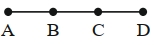
\(AB =x\)\(BC =x\)
\(2 x+ CD =3 x\)
\(CD =x\)
\(\ < v > =\frac{3 x}{\frac{x}{v_1}+\frac{x}{v_2}+\frac{x}{v_3}}=\frac{3 v_1 v_2 v_3}{v_2 v_3+v_1 v_3+v_1 v_2}\)
-
- (A) \(100\)
- (B) \(101\)
- (C) \(520\)
- (D) \(200\)
Show answer and solution
Correct Answer: (D)
\(u =20\,m / s , S _1=500 m , v =0\)By third equation of mation
\(0=(20)^2-2 a .500 \Rightarrow a =\frac{4}{10}\,m / s ^2\)
\(u =20\,m / s , S _2=250 m , v =?\)
\(v ^2=(20)^2-2 a .250\)
\(= v =\sqrt{200}\,m / s\)
\(x =200\)
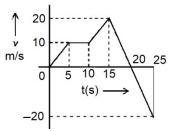
- 12. From the \(v\) - \(t\) graph shown. the ratio of distance to displacement in \(25\,s\) of motion
 2023 Medium
- (A) \(\frac{3}{5}\)
- (B) \(\frac{1}{2}\)
- (C) \(\frac{5}{3}\)
- (D) \(1\)
Show answer and solution
Correct Answer: (C)
Area under the graph from \(t=0\) to \(t=20\,sec =200\,m\)Area under the graph from \(t=20\) to \(t=25\,sec =50\,m\)
So distance covered \(=(200+50) m =250\,m\)
Displacement \(=(200-50) m =150\,m\)
\(\frac{250}{150}=\frac{5}{3}\)
-
- (A) Both Statement \(I\) and Statement \(II\) are true.
- (B) Statement \(I\) is correct but Statement \(II\) is false.
- (C) Statement \(I\) is incorrect but Statement \(II\) is true.
- (D) Both Statement \(I\) and Statement \(II\) are False.
Show answer and solution
Correct Answer: (C)
Area under velocity time graph gives displacement of body in given time.Area under acceleration time graph gives change in velocity in the given time.
So Statement \(I\) false,Statement \(II\) True.
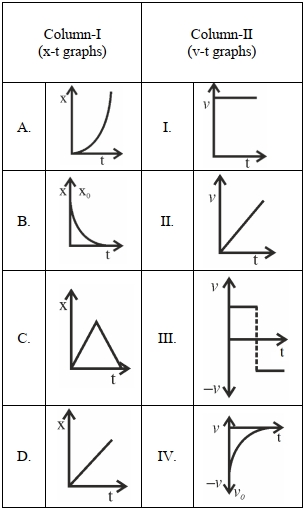
- 14. Match Column\(-I\) with Column\(-II :\) Choose the correct answer from the options given below:
 2023 Medium
- (A) \((A)-(II), (B)-(IV), (C)-(III), (D)-(I)\)
- (B) \((A)-( I), (B)-(II), (C)-(III), (D)-(IV)\)
- (C) \((A)-( II), (B)-(III), (C)-(IV), (D)-(I)\)
- (D) \((A)-(I), (B)-(III), (C)-(IV), (D)-(II)\)
Show answer and solution
Correct Answer: (A)
\(\frac{d x}{d t}=\text { slope } \geq 0 \text { always increasing }\)\(\text { (A - II) }\)
\(\frac{d x}{d t} < 0 \text {; and at } t \rightarrow \infty \frac{ dx }{ dt } \rightarrow 0\)
\(( B - IV )\)
\(\frac{ dx }{ dt } > 0 \text { for first half } \frac{ dx }{ dt } < 0 \text { for second half. }\)
\(\text { (C - III) }\)
\(\frac{ dx }{ dt }=\text { constant }\)
\(\text { (D - I) }\)
-
- (A) \(40\)
- (B) \(25\)
- (C) \(20\)
- (D) \(8\)
Show answer and solution
Correct Answer: (A)
\(x =4 t ^2\)\(v =\frac{ dx }{ dt }=8 t\)
At \(t =5\,sec\)
\(v =8 \times 5=40\,m / s\)
-
- (A) \(12.5\)
- (B) \(62.5\)
- (C) \(5\)
- (D) \(25\)
Show answer and solution
Correct Answer: (D)
Distance \((s)=(2.5) t^2\)Speed \(( v )=\frac{ ds }{ dt }=\frac{ d }{ dt }\left\{(2.5) t ^2\right\}\)
\(v =5\,t\)
At \(t =5, v =5 \times 5=25\,m / s\)
-
- (A) \(10\)
- (B) \(14\)
- (C) \(16\)
- (D) \(06\)
Show answer and solution
Correct Answer: (C)
\(x=5 t^2-4 t+5\)\(v=10 t-4\)
\(\text { At } t=2 s \quad v=16\,m / s\)
-
- (A) \((A)\) and \((E)\) only
- (B) \((B)\) and \((E)\) only
- (C) \((A), (C)\) and \((E)\) only
- (D) \((A), (C)\) and \((D)\) only
Show answer and solution
Correct Answer: (A)
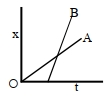
As slope of \(B\) > Slope of \(A\)\(\therefore V_B > V_A\)
Also, \(t _{ B } < t _{ A }\)
-
- (A) \(1: 1\)
- (B) \(1: 4\)
- (C) \(1: 2\)
- (D) \(1: 3\)
Show answer and solution
Correct Answer: (D)
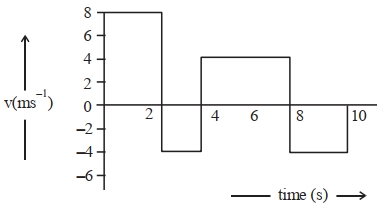
\(Displacement=\Sigma \text { area }=16-8+16-8=16\,m\)\(Distanc =\Sigma \mid \text { area } \mid=48\,m\)
\(\frac{\text { displacement }}{\text { Distance }}=\frac{1}{3}\)
-
- (A) \(1200\)
- (B) \(2700\)
- (C) \(1800\)
- (D) \(900\)
Show answer and solution
Correct Answer: (C)
\(\frac{60 \ell+4 \ell}{20}-\frac{61 \ell}{30}=35\)\(\Rightarrow \ell=\frac{1050}{35}\)
\(\Rightarrow L=60 \ell=\frac{1050}{35} \times 60=1800\,m\)
No questions on this page match these filters.