


Questions
33 questionsShowing 1–33 of 33 questions
-
- (A) \(1.02\)
- (B) \(0.85\)
- (C) \(1.70\)
- (D) \(0.51\)
Show answer and solution
Correct Answer: (C)
Least count \(=0.2\,cm\)\(u =(100 \pm 0.2)-(80 \pm 0.2)=(20 \pm 0.4)\,cm\)
\(v =(180 \pm 0.2)-(100 \pm 0.2)=(80 \pm 0.4)\,cm\)
From lens formula,
\(\frac{1}{v}-\frac{1}{u}=\frac{1}{f} \Rightarrow \frac{1}{f}=\frac{1}{80}-\frac{1}{-20}\)
\(f=16\,cm\)
Also \(\frac{\Delta v}{v^2}+\frac{\Delta u}{u^2}=\frac{\Delta f}{f^2}\)
\(\Rightarrow \frac{\Delta f}{f} \times 100=\left(\frac{\Delta v}{v^2}+\frac{\Delta u}{u^2}\right) \times f \times 100\)
\(\Rightarrow \% f=\left(\frac{0.4}{400}+\frac{0.4}{6400}\right) \times 16 \times 100\)
\(=1.70\)
-
- (A) \(4\)
- (B) \(5\)
- (C) \(3\)
- (D) \(2\)
Show answer and solution
Correct Answer: (B)
Let power of each part is \(P_1\), then\(P _1+ P _1= P =\frac{1}{ f }\)
\(2 P _1=\frac{1}{0.1}=10\)
\(P _1=5\,D\)

-
- (A) \(55\)
- (B) \(53\)
- (C) \(54\)
- (D) \(52\)
Show answer and solution
Correct Answer: (C)
\(\frac{ I }{ f _{ H _2 O }}=\left(\frac{\mu_{ g }}{\mu_{ H _2 O }}-1\right)\left(\frac{2}{ R }\right)\)\(=\frac{1}{8}\left(\frac{2}{ R }\right)\)
\(=\frac{1}{\left(4 f _{\text {air }}\right)}\)
So, \(f _{ H _2 O }=4 f _{ air }=72\,cm\)
So change in focal length \(=72-18=54\,cm\)
-
- (A) \(6\)
- (B) \(9\)
- (C) \(3\)
- (D) \(12\)
Show answer and solution
Correct Answer: (C)
\(\frac{V_{ b / f }}{\frac{4}{3}}=\frac{-8}{\frac{4}{3}}+\frac{(- v )}{1}\)\(\Rightarrow \frac{-12}{\frac{4}{3}}=\frac{-8}{\frac{4}{3}}+\frac{(- v )}{1}\)
\(\Rightarrow v =3\,m / s\)
-
- (A) \(\lambda_2=\lambda_1, v_2=\sqrt{2} v_1\)
- (B) \(\lambda_2=\frac{1}{\sqrt{2}} \lambda_1, v_2=v_1\)
- (C) \(\lambda_2=\sqrt{2} \lambda_1, v_2=v_1\)
- (D) \(\lambda_2=\lambda_1, v_2=\frac{1}{\sqrt{2}} v_1\)
Show answer and solution
Correct Answer: (B)
Snell's law \(\mu_1 \sin 45^{\circ}=\mu_2 \sin 30^{\circ}\)\(\frac{\mu_1}{\mu_2}=\frac{1}{\sqrt{2}}\)
\(\Rightarrow \frac{\mu_1}{\mu_2}=\frac{\lambda_2}{\lambda_1}=\frac{1}{\sqrt{2}}\)
\(\Rightarrow \lambda_2=\frac{\lambda_1}{\sqrt{2}}\)
Frequency doesn't change on change in medium.
-
- (A) \(10\)
- (B) \(40\)
- (C) \(30\)
- (D) \(50\)
Show answer and solution
Correct Answer: (D)
\(\frac{1}{ v }-\frac{1}{ u }=\frac{1}{ f }\)\(P =2 D =2 m ^{-1}\)
\(\Rightarrow \frac{1}{ f }=\frac{2}{100} cm ^{-1}\)
\(\frac{1}{ V }-\left(-\frac{1}{25}\right)=\frac{2}{100}\)
\(\Rightarrow \frac{1}{ V }=\frac{1}{50}-\frac{1}{25}\)
\(\Rightarrow V =-50\,cm\)
-
- (A) \(31\)
- (B) \(32\)
- (C) \(34\)
- (D) \(33\)
Show answer and solution
Correct Answer: (C)
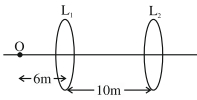
\(\text { From Ist lens } \frac{1}{ v }+\frac{1}{6}=\frac{1}{24}\)\(\frac{1}{ v } =\frac{1}{24}-\frac{1}{6}=-\frac{1}{8}\)
\(v =-8\,cm\)
From \(IInd\) lens \(\frac{1}{ v } +\frac{1}{18}=\frac{1}{9}\)
\(\frac{1}{ v }= \frac{1}{18}\)
\(v =18\)
So distance between object and its image
\(=6+10+18=34\,cm\)
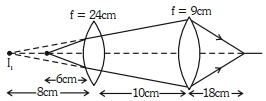
-
- (A) \(49\)
- (B) \(48\)
- (C) \(47\)
- (D) \(50\)
Show answer and solution
Correct Answer: (D)
By Snell's law\(1 \sin 60^{\circ}=\frac{4}{3} \sin r \rightarrow \sin r=\frac{3 \sqrt{3}}{8} \rightarrow \tan r=\frac{3 \sqrt{3}}{\sqrt{37}}\)
By the diagram
\(x \sqrt{3}+1.5 \tan r =2.15\)
\(x \sqrt{3}=2.15-1.5 \times \frac{3 \sqrt{3}}{\sqrt{37}}\)
\(x =\frac{2.15}{\sqrt{3}}-\frac{1.5 \times 3}{\sqrt{37}}\)
\(=1.241-0.739\)
\(=0.502\)
\(\approx 0.50 \text { meter }\)
\(x =50\,cm\)
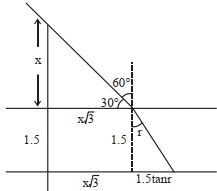
-
- (A) \(21\)
- (B) \(69\)
- (C) \(50\)
- (D) \(52\)
Show answer and solution
Correct Answer: (D)
\(\sin c=\frac{1}{\sqrt{2}}\)\(c=45^{\circ}\)
\(\sin c=\mu \sin \theta\)
\(\frac{1}{\sqrt{2}}=\sqrt{2} \sin \theta\)
\(\theta=30^{\circ}\)
Lateral displacement:
\(x=t \sin (i-r) \sec r\)
\(x=\sqrt{3} \sin \left(45^{\circ}-30^{\circ}\right) \sec 30^{\circ}\)
\(x=\sqrt{3}(0.26)\left(\frac{2}{\sqrt{3}}\right)\)
\(X=0.52\,cm\)
\(x=52 \times 10^{-2}\,cm\)
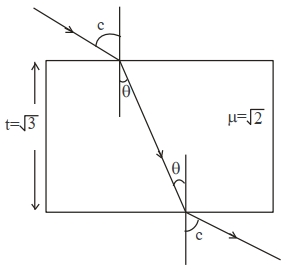
-
- (A) \(30\)
- (B) \(32\)
- (C) \(31\)
- (D) \(59\)
Show answer and solution
Correct Answer: (B)
\(U_A=-45\,cm , f =-20\,cm\)\(V_A=\frac{-45 \times(-20)}{-45-(-20)}=\frac{-900}{25}=-36\,cm\)
\(\text { And } U_B=-35\,cm\)
\(\therefore V_B=\frac{-35 \times(-20)}{-35-(-20)}=\frac{700}{-15}\)
\(\therefore V_A-V_B=\text { length of image }\)
\(=\left(-36+\frac{140}{3}\right)\,cm\)
\(=\frac{-108+140}{3}\,cm\)
\(=\frac{32}{3}\,cm\)
\(\therefore x=32\)
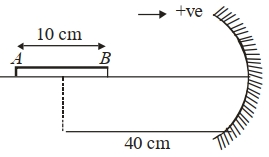
-
- (A) \(6\)
- (B) \(1.3\)
- (C) \(7.8\)
- (D) \(4.5\)
Show answer and solution
Correct Answer: (D)
\(\delta_1=\delta_2 \text { [for no average deviation] }\)\(\Rightarrow 6^{\circ}(1.54-1)= A (1.72-1)\)
\(\Rightarrow A =\frac{6^{\circ} \times 0.54}{0.72}\)
\(=\frac{18^{\circ}}{4}=4.5^{\circ}\)
-
- (A) \(\frac{d n_1 n_2}{\left(n_1+n_2\right)}\)
- (B) \(\frac{d\left(n_1+n_2\right)}{2 n_1 n_2}\)
- (C) \(\frac{d n_1 n_2}{2\left(n_1+n_2\right)}\)
- (D) \(\frac{2 d \left( n _1+ n _2\right)}{ n _1 n _2}\)
Show answer and solution
Correct Answer: (B)
Formula used \(d _{ app }=\frac{ d _1}{ n _1}+\frac{ d _2}{ n _2}\)\(d _{a p p}=\frac{ d }{2}\left\lfloor\frac{ n _1+ n _2}{ n _1 n _2}\right\rfloor\)
-
- (A) \(\frac{4}{3}\)
- (B) \(\frac{3}{2}\)
- (C) \(\frac{2}{3}\)
- (D) \(\frac{6}{5}\)
Show answer and solution
Correct Answer: (B)
\(d _{\text {appprent }}=\frac{ d _{\text {actual }}}{\mu_{\text {rel }}}\)\(12=\frac{ x }{\mu}\)
\(4=\frac{24- x }{\mu}\)
On solving we get \(\mu=1.5\)
-
- (A) \(4\,cm\) towards mirror
- (B) \(8\,cm\) towards mirror
- (C) \(8\,cm\) away from mirror
- (D) \(2\,cm\) towards mirror
Show answer and solution
Correct Answer: (B)
\(\therefore\) Shifting of image will be \(8\,cm\) towards mirror.
-
- (A) \(28\)
- (B) \(30\)
- (C) \(29\)
- (D) \(3.2\)
Show answer and solution
Correct Answer: (B)
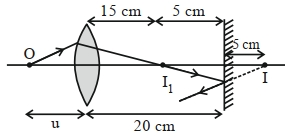
\(f =10\,cm\)\(\frac{1}{ v }-\frac{1}{ u }=\frac{1}{ f }\)
\(\frac{1}{15}-\frac{1}{- u }=\frac{1}{10}\)
\(\Rightarrow \frac{1}{ u }=\frac{1}{10}-\frac{1}{15}\)
On solving we get value of \(u\) as \(30\,cm\).
-
- (A) \(120\)
- (B) \(60\)
- (C) \(40\)
- (D) \(240\)
Show answer and solution
Correct Answer: (A)
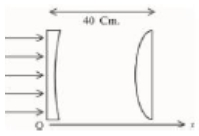
\(\frac{1}{ f _1}=(1.75-1)\left(-\frac{1}{30}\right)\)\(\Rightarrow f _1=-40\,cm\)
\(\frac{1}{ f _2}=(1.75-1)\left(\frac{1}{30}\right) \Rightarrow f _2=40\,cm\)
Image from \(L_1\) will be virtual and on the left of \(L_1\) at focal length \(40 \,cm\). So the object for \(L_2\) will be \(80\,cm\) from \(L _2\) which is \(2 f\). Final image is formed at \(80\,cm\) from \(L _2\) on the right. So \(x=120\)
-
- (A) \(98\)
- (B) \(99\)
- (C) \(97\)
- (D) \(96\)
Show answer and solution
Correct Answer: (A)
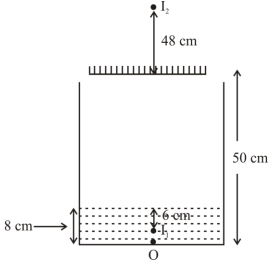
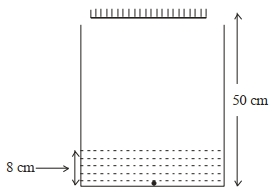
Apparent depth of \(O =\frac{ d }{\mu}=6\)Distance between \(O\) and \(I _2=48+50=98\,cm\)
-
- (A) Both \(A\) and \(R\) are correct but \(R\) is NOT the correct explanation of \(A\)
- (B) \(A\) is correct but \(R\) is not correct
- (C) Both \(A\) and \(R\) are correct and \(R\) is the correct explanation of \(A\)
- (D) \(A\) is not correct but \(R\) is correct
Show answer and solution
Correct Answer: (C)
As medium changes, optical path changes.Also, \(\frac{\Delta x}{\lambda}=\frac{\Delta \phi}{2 \pi}\)
Hence phase difference changes.
-
- (A) \(5\)
- (B) \(4\)
- (C) \(3\)
- (D) \(2\)
Show answer and solution
Correct Answer: (A)
\(V =\frac{ C }{\mu} \Rightarrow \mu=\frac{ C }{ V }=\frac{ C }{0.2 C }\)\(\mu=5\)
\(\mu=\sqrt{\epsilon_{ r } \mu_{ r }}\)
\(\Rightarrow \epsilon_{ r }=\frac{\mu^2}{\mu_{ r }}\)
\(\therefore \frac{\epsilon_{ r }}{\mu}=\frac{\mu}{\mu_{ r }}=5\)
-
- (A) reduce the problem of mechanical support
- (B) remove spherical aberration
- (C) make chromatic aberration zero
- (D) move the eyepiece outside the telescopic tube
Show answer and solution
Correct Answer: (D)
It has advantage of a large focal length in a short telescope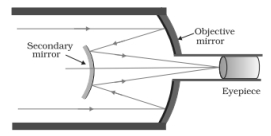
-
- (A) \(30\)
- (B) \(31\)
- (C) \(33\)
- (D) \(32\)
Show answer and solution
Correct Answer: (D)
\(\frac{1}{ v }+\frac{1}{ u }=\frac{1}{ f }\)\(\frac{-1}{120}-\frac{1}{40}=\frac{1}{ f }, \quad f =-30\,cm\)
Now,
\(\frac{-1}{ v ^2} dv -\frac{1}{ u ^2} du =-\frac{1}{ f ^2} df\)
Also \(dv = du =\frac{1}{20} cm\)
\(\frac{\frac{1}{20}}{(120)^2}+\frac{\frac{1}{20}}{(40)^2}=\frac{d f}{(30)^2}\)
On solving
\(df =\frac{1}{32}\,cm\)
\(k =32\)
-
- (A) \(40\)
- (B) \(41\)
- (C) \(42\)
- (D) \(43\)
Show answer and solution
Correct Answer: (B)
\(u =\frac{ h }{ h ^{\prime}}=\frac{5.25}{5.00}\)Least count \(=\frac{1}{20} cm -\frac{49}{50} \cdot \frac{1}{20} cm\)
\(=\frac{1}{50} \times \frac{1}{20} cm =0.01\,mm\)
\(\ln u =\ln h -\ln h ^{\prime}\)
\(\frac{ du }{ u }=\frac{ dh }{ h }-\frac{ dh ^{\prime}}{ h ^{\prime}}\)
\(du =\left[\frac{0.01}{5.25}+\frac{0.01}{5.00}\right] \frac{5.25}{5.00}\)
\(=\frac{41}{10} \times 10^{-3}\)
Ans. \(=41\)
-
- (A) \(5 \times 10^7\,m / s\)
- (B) \(2.12 \times 10^8\,m / s\)
- (C) \(3.12 \times 10^7\,m / s\)
- (D) \(\sqrt{2} \times 10^8\,m / s\)
Show answer and solution
Correct Answer: (B)
\(i _{ C }=\) Critical angle\(\frac{v}{C}=\frac{1}{\mu}=\sin i_C=\sin 45^{\circ}=\frac{1}{\sqrt{2}}\)
\(\Rightarrow v=\frac{ C }{\sqrt{2}}=\frac{3 \times 10^8}{\sqrt{2}}\,m / s =2.12 \times 10^8\,m / s\)
-
- (A) \(B\) and \(D\) only
- (B) \(B\) and \(C\) only
- (C) \(A\) and \(D\) only
- (D) \(A,C\) and \(D\) only
Show answer and solution
Correct Answer: (A)
Plane mirror forms erect, same sized, laterally inverted and virtual image of real object. -
- (A) \(3\)
- (B) \(4\)
- (C) \(2\)
- (D) \(1\)
Show answer and solution
Correct Answer: (B)
\(P=(1.8-1)\left(\frac{1}{20}+\frac{1}{20}\right)\) by lens maker's formula\(P^{\prime}=\left(\frac{1.8}{1.5}-1\right)\left(\frac{1}{20}+\frac{1}{20}\right)\)
Dividing \(\frac{ P }{ P ^{\prime}}=\frac{0.8}{1.2-1}=4\)
-
- (A) \(30\)
- (B) \(20\)
- (C) \(40\)
- (D) \(50\)
Show answer and solution
Correct Answer: (A)
\(\text { As } \mu=\frac{\sin \left(\frac{D_{\min }+A}{2}\right)}{\sin \left(\frac{A}{2}\right)}\)\(\sqrt{2}=\frac{\frac{\sin \left(D_{\min }+60\right)}{2}}{\sin \left(\frac{60}{2}\right)}\)
\(\Rightarrow \frac{1}{\sqrt{2}}=\sin \left(\frac{D_{\min }+60}{2}\right)\)
\(\Rightarrow \frac{D_{\min }+60}{2}=45\)
\(\Rightarrow D_{\min }=30\)
-
- (A) \(99\)
- (B) \(98\)
- (C) \(93\)
- (D) \(100\)
Show answer and solution
Correct Answer: (D)
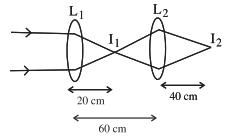
\(1^{\text {st }}\) refraction in \(L _1\left( I _1\right)\)\(\frac{1}{ v }-\frac{1}{ u }=\frac{1}{ f }\)
\(\frac{1}{ v }-\frac{1}{\infty}=\frac{1}{ f }\)
\(\therefore v = f\)
\(2^{2 dr } \text { refraction in } L _2\)
\(I _1 \rightarrow \text { object }\)
\(I _2 \rightarrow \text { image }\)
\(u =-40\,cm \quad f =20\,cm\)
\(\frac{1}{ v }-\frac{1}{ u }=\frac{1}{ f }\)
\(\frac{1}{ v }-\frac{1}{(-40)}=\frac{1}{20}\)
\(\frac{1}{ v }=\frac{1}{20}-\frac{1}{40}=\frac{6-3}{120}\)
\(\frac{1}{ v }=\frac{3}{120}=\frac{1}{40}\)
\(\therefore \quad v =40\,cm\)
Correct Answer is \(100.\)
-
- (A) \(40\)
- (B) \(60\)
- (C) \(160\)
- (D) \(100\)
Show answer and solution
Correct Answer: (C)
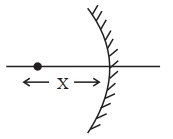
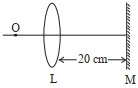
by mirror formula\(\frac{1}{ v }+\frac{1}{ u }=\frac{1}{ f }\)
\(\frac{1}{ v _1}+\frac{1}{-15}=\frac{1}{(-20)}\)
\(\frac{1}{ v _1}=-\frac{1}{20}+\frac{1}{15}\)
\(=\frac{-3+4}{60}\)
\(v _1=60\,cm\)
\(\frac{1}{ v _2}+\frac{1}{(-25)}=\frac{1}{(-20)}\)
\(\frac{1}{ v _2}=\frac{-1}{20}+\frac{1}{25}\)
\(=\frac{-5+4}{100}=\frac{-1}{100}\)
\(v _2=-100\,cm\)
\(d =60+100=160\,cm\)
-
- (A) \(30\)
- (B) \(15\)
- (C) \(7.5\)
- (D) \(66\)
Show answer and solution
Correct Answer: (A)
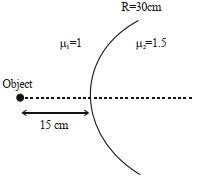
\(\frac{\mu_2}{ v }-\frac{\mu_1}{ u }=\frac{\mu_2-\mu_1}{ R }\)\(\frac{1.5}{ v }-\frac{1}{-15}=\frac{1.5-1}{30}=\frac{1}{60}\)
\(\frac{1.5}{ v }+\frac{1}{15}=\frac{1}{60}\)
\(\frac{1.5}{ v }=\frac{1}{60}-\frac{1}{15}=\frac{-1}{20}\)
\(\frac{1.5}{ v }=-\frac{1}{20} \Rightarrow v =-30\,cm\)
-
- (A) \(16\)
- (B) \(18\)
- (C) \(15\)
- (D) \(14\)
Show answer and solution
Correct Answer: (B)
The desired image is \(18\,cm\) from \(A.\)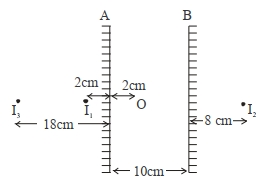
-
- (A) Scattering
- (B) Chromatic aberration
- (C) Spherical aberration
- (D) Polarisation
Show answer and solution
Correct Answer: (B)
Based on fact. -
- (A) \(140\)
- (B) \(120\)
- (C) \(110\)
- (D) \(130\)
Show answer and solution
Correct Answer: (B)
\(\delta=180^{\circ}-60^{\circ}=120^{\circ}\) -
- (A) \(A\) and \(C\) only
- (B) \(B\) and \(D\) only
- (C) \(B\) and \(C\) only
- (D) \(C\) and \(D\) only
Show answer and solution
Correct Answer: (D)
Speed of light does not depend on the motion of source as well as intensity.
No questions on this page match these filters.