


Questions
Newest firstShowing 1–10 of 10 questions
-
- (A) Hept-2-ene
- (B) Hept-1,3,5-triene
- (C) Heptane
- (D) Hept-2,4,6-triene
Show answer and solution
Correct Answer: (C)
Compound (X) undergoes isomerization on heating with anhydrous \(AlCl_3\) and HCl gas to give branched-chain alkanes. The formation of \(2,4\)-dimethylpentane (a \(7\)-carbon branched alkane) indicates that (X) is a \(7\)-carbon straight-chain alkane.
Aromatization of n-heptane at high temperature and pressure in the presence of oxides of V, Mo, or Cr supported over alumina gives toluene.
Cyclisation of n-heptane under similar conditions initially yields methylcyclohexane, which can further undergo dehydrogenation to form toluene.
Since all these reactions are characteristic of n-heptane, compound (X) is heptane.
Answer: Heptane -
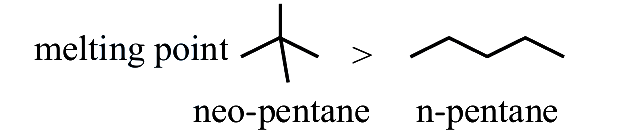
- (A) Statement I is correct but Statement II is incorrect
- (B) Both Statement I and Statement II are correct
- (C) Both Statement I and Statement II are incorrect
- (D) Statement I is incorrect but Statement II is correct
Show answer and solution
Correct Answer: (B)
Both Statement-I and Statement-II are correct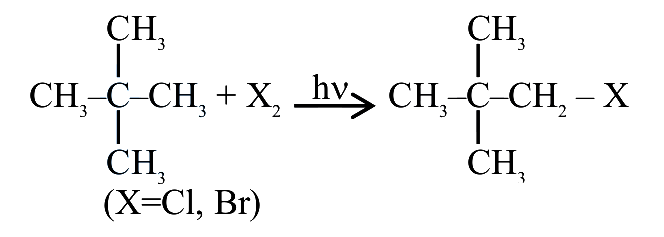
-
- (A) \(2\)
- (B) \(1\)
- (C) \(4\)
- (D) \(3\)
Show answer and solution
Correct Answer: (C)
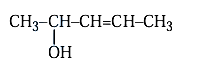
It has 4 stereoisomers \(\left[\begin{array}{ll}R \text { cis } & \mathrm{R} \text { trans } \\ \mathrm{Scis} & \text { Strans }\end{array}\right]\) -
- (A) \(1\)
- (B) \(2\)
- (C) \(3\)
- (D) \(4\)
Show answer and solution
Correct Answer: (C)
\(\mathrm{CH}_3 \mathrm{COONa} \rightarrow \dot{\mathrm{CH}_3}\)\(\mathrm{C}_2 \mathrm{H}_5 \mathrm{COONa} \rightarrow \dot{\mathrm{C}}_2\mathrm{H}_5\)
\(2 \dot{\mathrm{C}}_2 \mathrm{H}_5 \rightarrow \mathrm{CH}_3-\mathrm{CH}_2-\mathrm{CH}_2-\mathrm{CH}_3\)
\(2 \dot{\mathrm{CH}}_3 \rightarrow \mathrm{CH}_3-\mathrm{CH}_3\)
\(\dot{\mathrm{C}} \mathrm{H}_3+\dot{\mathrm{C}}_2 \mathrm{H}_5 \rightarrow \mathrm{CH}_3-\mathrm{CH}_2-\mathrm{CH}_3\)
-
- (A) \(3\)
- (B) \(6\)
- (C) \(9\)
- (D) \(12\)
Show answer and solution
Correct Answer: (A)
Moles of hydrocarbon \(=\frac{17 \times 10^{-3}}{136}=1.25 \times 10^{-4}\)Mole of \(H _2\) gas
\(\Rightarrow 1 \times \frac{8.40}{1000}= n \times 0.0821 \times 273\)
\(\Rightarrow n =3.75 \times 10^{-4}\)
Hydrogen molecule used for 1 molecule of hydrocarbon is 3
\(=\frac{3.75 \times 10^{-4}}{1.25 \times 10^{-4}}=3\)
- 6. In the following reaction ' \(X\) ' is \(CH _3\left( CH _2\right)_4 CH _3 \xrightarrow[HCl,\Delta]{Anhy.AlCl_3} X\) 2023 Medium
- (A) \(CH _3\left( CH _2\right)_4 CH _2 Cl\)
- (B) \(Cl - CH _2-\left( CH _2\right)_4- CH _2- Cl\)
Show answer and solution
Correct Answer: (C)
\(n\)-alkanes on heating in this presence of anhydrous \(AlCl _3\) and hydrogen chloride gas isomerise to branched chain alkanes. The major product has one methyl side chain.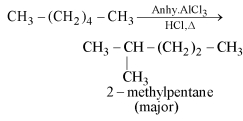
-
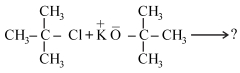
- (A) \(t-\)Butyl ethyl ether
- (B) \(2,2-\)Dimethyl butane
- (C) \(2-\)Methyl pent\(-1-\)ene
- (D) \(2-\)Methyl prop\(-1-\)ene
Show answer and solution
Correct Answer: (D)
We have been given a bulky base, hence elimination will take place \(\&\) not substitution.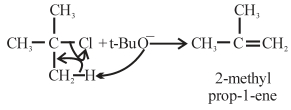
-
- (A) Isobutane
- (B) Ethane
- (C) Butane
- (D) Propane
Show answer and solution
Correct Answer: (D)
Since the compound undergoing combustion is an alkane. Hence the combustion reaction can be written as\(\underset{5L}{\mathop{{{C}_{n}}{{H}_{2n+2}}}}\,+\underset{25L}{\mathop{\left( \frac{3n+1}{2} \right){{O}_{2}}}}\,\to \) \(nC{{O}_{2}}+(n+1){{H}_{2}}O\)
since volumes are measured at constant \(T\) & \(P\). Hence according to Avogadro's law
Volume \(\propto \) mole
\(\therefore \,{{n}_{alkane}}=\left( \frac{2}{3n+1} \right)\times {{n}_{{{O}_{2}}}}\)
\(5 = \frac{2}{{3n + 1}} \times 25\)
\(\therefore \,n = 3\)
Hence alkane is propane \((C_3H_8)\)
-
- (A) \(C_4H_8\)
- (B) \(C_4H_{10}\)
- (C) \(C_3H_6\)
- (D) \(C_3H_8\)
Show answer and solution
Correct Answer: (D)
\(C_{x} H_{y(g)}+\left(\frac{4 x+y}{4}\right) O_{2(g)} \rightarrow x C O_{2(g)}+\frac{y}{2} H_{2} O(l)\)Volume of \(O_{2}\) used
\(=375 \times \frac{20}{100}=75 m l\)
From the reaction of combination
\(m l C_{x} H_{y}\) requires \(=\frac{4 x+y}{4} m l O_{2}\)
\(15\left(\frac{4 x+y}{4}\right)=75\)
So, \(4 x+y=20\)
\(x=3\)
\(y=8\)
\(\therefore C_{3} H_{8}\)
- 10. The major product obtained in the photo catalysed bromination of \(2-\) methylbutane is 2014 Hard
- (A) \(1-\) bromo \(-2-\) methylbutane
- (B) \(1-\) bromo \(-3-\) methylbutane
- (C) \(2-\) bromo \(-3-\) methylbutane
- (D) \(2-\) bromo \(-2-\) methylbutane
Show answer and solution
Correct Answer: (D)
The order of substituion in different alkanes is\(3^o > 2^o > 1^o\)
Thus the bromination of \(2-\) methyl butane mainly gives \(2-\) Bromo \(-2-\) methyl butane
\(\mathop {\begin{array}{*{20}{c}}
{\,\,\,\,\,\,\,\,\,\,\,\,\,\,\,C{H_3}} \\
{\,\,\,\,\,\,\,\,\,\,\,\,\,\,|\,\,\,\,} \\
{C{H_3} - C{H_2} - CH - C{H_3}}
\end{array}}\limits_{2 - methyl\,bu\tan e} \xrightarrow{{B{r_2}}}\)\(\mathop {\mathop {\begin{array}{*{20}{c}}
{\,\,\,\,\,\,\,\,\,\,C{H_3}} \\
{\,\,\,\,\,|} \\
{C{H_3} - C{H_2} - CH - C{H_2}Br}
\end{array}}\limits_{1 - Bromo - 2\,methyl\,bu\tan e} }\limits_{(\min or)} \) \(+\) \(\underset{\begin{smallmatrix}
2-Bromo-2-methyl\,bu\tan e \\
\,\,\,\,\,\,\,\,\,\,\,\,\,\,\,\,\,\,\,\,\,\,\,\,\,\,\,(major)
\end{smallmatrix}}{\mathop{\begin{matrix}
\,\,\,\,\,\,\,\,\,\,\,\,\,\,\,\,\,\,\,C{{H}_{3}} \\
\,\,\,\,\,\,\,\,\,\,\,\,\,\,\,| \\
C{{H}_{3}}-C{{H}_{2}}-C-C{{H}_{3}} \\
\,\,\,\,\,\,\,\,\,\,\,\,\,\,\,| \\
\,\,\,\,\,\,\,\,\,\,\,\,\,\,\,\,Br \\
\end{matrix}}}\,\)

No questions on this page match these filters.
Other STD 11 - Hydricarbon topics
Frequently asked
How many Alkane questions came in JEE Mains?
10 questions from 2014–2026, each with the correct answer and a full solution.
How difficult are Alkane questions?
0% are easy, 50% medium and 50% hard.