


Questions
20 questionsShowing 1–20 of 20 questions
-
- (A) \(2\)
- (B) \(\frac{1}{\sqrt{2}}\)
- (C) \(\sqrt{2}\)
- (D) \(2 \sqrt{2}\)
Show answer and solution
Correct Answer: (A)
\(I_0=\frac{E_0}{x_c}=\frac{E_0}{\frac{1}{\omega_c}}=E_0 \omega_c\)\(\Rightarrow I_0=36 \times 120 \pi \times 150 \times 10^{-6}\)
\(\Rightarrow I_0=2.03\)
\(\simeq 2\,A\)
-
- (A) \(4\)
- (B) \(3\)
- (C) \(2\)
- (D) \(1\)
Show answer and solution
Correct Answer: (A)
\(\text { Quality factor }=\frac{X_L}{R}=\frac{\omega L}{R}\)\(\omega=\frac{1}{\sqrt{ LC }}=\frac{1}{\sqrt{1 \times 6.25 \times 10^{-6}}}=\frac{10^3}{2.5}=400 / sec\)
\(\text { Q-factor }=\frac{400 \times 1}{100}=4\)
-
- (A) \(24\)
- (B) \(23\)
- (C) \(25\)
- (D) \(22\)
Show answer and solution
Correct Answer: (C)
\(X = X_L - X_C = 100 - 40 = 60\,\Omega\)
\(Z = \sqrt{R^2 + X^2} = \sqrt{80^2 + 60^2} = \sqrt{6400 + 3600} = \sqrt{10000} = 100\,\Omega\)
\(I_0 = \frac{V_0}{Z} = \frac{2500}{100} = 25\,A\)
-
- (A) \(4\)
- (B) \(8\)
- (C) \(6\)
- (D) \(2\)
Show answer and solution
Correct Answer: (B)
Explanation:
1. Calculation of Impedance (Z):
The total impedance of a series LCR circuit is determined by the formula:
\( Z = \sqrt{R^2 + (X_C - X_L)^2} \)
Substituting the given values into the equation:
\( Z = \sqrt{80^2 + (130 - 70)^2} = \sqrt{80^2 + 60^2} = \sqrt{6400 + 3600} = 100\ \Omega \)
2. Calculation of Power Factor (\( \cos\phi \)):
The power factor of an alternating current circuit is given by:
\( \cos\phi = \frac{R}{Z} = \frac{80}{100} = 0.8 \)
3. Finding the value of x:
The question defines the power factor as the fraction \( \frac{x}{10} \). Equating the calculated value to this format gives:
\( \frac{x}{10} = 0.8 \implies \frac{x}{10} = \frac{8}{10} \implies x = 8 \)
Hence, Option B is the correct choice. -
- (A) \(35\)
- (B) \(40\)
- (C) \(44\)
- (D) \(48\)
Show answer and solution
Correct Answer: (B)
To maximize the average rate at which energy supplied i.e. power will be maximum.So in \(LCR\) circuit power will be maximum at the condition of resonance and in resonance condition
\(X_L =X_C\)
\(79.6 =\frac{1}{\omega C}\)
\(\therefore C =\frac{1}{2 \pi \times 50 \times 79.6}\)
\(\therefore C =40 \mu F\)
-
- (A) \(3.14\)
- (B) \(6.28\)
- (C) \(0.5\)
- (D) \(0.318\)
Show answer and solution
Correct Answer: (A)
Explanation:
Let us calculate the inductive reactance step-by-step based on the Alternating Current chapter of the NCERT Class 12 Physics textbook:
Step 1: Find the angular frequency (\(\omega\))
The standard equation for an alternating voltage source is given by:
\(V = V_m\sin(\omega t)\)
Comparing this standard expression with the given equation \(V = 260\sin(628t)\), we get:
\(\omega = 628\text{ rad s}^{-1}\)
Step 2: Convert the inductance (\(L\)) into standard SI units
The given inductance value is:
\(L = 5\text{ mH} = 5 \times 10^{-3}\text{ H}\)
Step 3: Calculate the inductive reactance (\(X_L\))
The formula for inductive reactance is:
\(X_L = \omega L\)
Substituting the values into the formula:
\(X_L = 628 \times (5 \times 10^{-3})\)
\(X_L = 3140 \times 10^{-3} = 3.14\ \Omega\)
Hence, Option A is the correct choice. -
- (A) \(242\)
- (B) \(241\)
- (C) \(240\)
- (D) \(236\)
Show answer and solution
Correct Answer: (A)
\(X _{ L }= X _{ C }\)So, \(Z=R=20\,\Omega\)
\(i_{rms}=\frac{220}{20}=11\)
\(i_{\max }=11 \sqrt{2}=\sqrt{242}\)
-
- (A) \(3875\)
- (B) \(3872\)
- (C) \(3800\)
- (D) \(3654\)
Show answer and solution
Correct Answer: (B)
\(\frac{1}{2 \pi fC }=2 \pi fL\)\(C =\frac{1}{4 \pi^2 f ^2 L }=\frac{1}{4 \times \pi^2 \times 49 \times 10^6 \times 2 \times 10^{-6}}\)
\(C =\frac{1}{3872}\,F\)
\(x =3872\)
-
- (A) \(101\)
- (B) \(10\)
- (C) \(995\)
- (D) \(100\)
Show answer and solution
Correct Answer: (D)
\(f =\frac{1}{2 \pi \sqrt{ LC }}\)\(2000\,Hz =\frac{1}{2 \pi \sqrt{ L \times 62.5 \times 10^{-9}}}\)
\(L =\frac{1}{4 \pi^2 \times 2000^2 \times 62.5 \times 10^{-9}}=0.1\,H =100\,mH\)
-
- (A) \(8\)
- (B) \(9\)
- (C) \(6\)
- (D) \(5\)
Show answer and solution
Correct Answer: (B)
Maximum energy stored in capacitor is same as maximum energy stored in inductor.\(\frac{1}{2} Li _{\max }^2=\frac{1}{2} \frac{ Q _{\max }^2}{ C }\)
\(i _{\max }=\sqrt{\frac{1}{ LC }} Q _{\max }\)
\(=\frac{2.7 \times 10^{-6}}{\sqrt{75 \times 10^{-3} \times 1.2 \times 10^{-6}}}=9\,mA\)
-
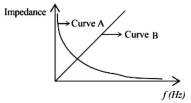
- (A) \(A = X _{ C }, B = R\)
- (B) \(A = X _{ L }, B = Z\)
- (C) \(A = X _{ C }, B = X _{ L }\)
- (D) \(A = X _{ L }, B = R\)
Show answer and solution
Correct Answer: (C)
\(X _{ C }=\frac{1}{\omega C }=\frac{1}{(2 \pi f ) C }\)\(\therefore X _{ C } \propto \frac{1}{ f }\)
\(\therefore \text { Curve } A\)
\(X _{ L }=\omega L =(2 \pi f ) L\)
\(\therefore X _{ L } \propto f\)
\(\therefore \text { Curve B }\)
-
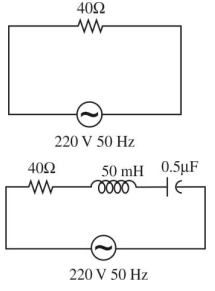
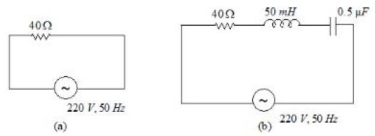
- (A) The rms current in circuit \((b)\) can never be larger than that in \((a)\)
- (B) The rms current in figure \((a)\) is always equal to that in figure \((b)\)
- (C) The rms current in circuit \((b)\) can be larger than that in \((a)\)
- (D) At resonance, current in \((b)\) is less than that in \((a)\)
Show answer and solution
Correct Answer: (A)
\(I _{ rms }=\frac{220}{40}=5.5\,A\)\(X _{ L }\) is not equal to \(X _{ C }\). So rms current in \((b)\) can never be larger than \((a)\).
-
- (A) Both Statement \(I\) and Statement \(II\) are false
- (B) Statement \(I\) is true but Statement \(II\) is false
- (C) Both Statement \(I\) and Statement \(II\) are true
- (D) Statement I is false but Statement \(II\) is true
Show answer and solution
Correct Answer: (A)
For resonance, \(\phi=0\), hence both inductor and capacitor must be present. Also power factor is zero for pure inductor or pure capacitor hence both the component consume zero average power. -
- (A) Statement \(I\) is false but Statement \(II\) is true
- (B) Statement \(I\) is true but Statement \(II\) is false
- (C) Both Statement \(I\) and Statement \(II\) are true
- (D) Both Statement \(I\) and Statement \(II\) are false
Show answer and solution
Correct Answer: (C)
Power will be maximum when impedance is minimum\(Z =\left[ R ^2+\left( X _{ L }- X _{ C }\right)^2\right]^{\frac{1}{2}}\)
At resonance, \(X _{ L }= X _{ C }\)
\(Z_{\min }=R\)
-
- (A) Statement \(I\) is incorrect but Statement \(II\) is true.
- (B) Both Statement \(I\) and Statement \(II\) are false.
- (C) Statement \(I\) is correct but Statement \(II\) is false.
- (D) Both Statement \(I\) and Statement \(II\) are true.
Show answer and solution
Correct Answer: (D)
Both statements are correct. Theory based. -
- (A) \(1: 3\)
- (B) \(1: \sqrt{2}\)
- (C) \(1: 1\)
- (D) \(1: 2\)
Show answer and solution
Correct Answer: (B)
\(P=\frac{R}{Z} \Rightarrow P_1=\frac{R}{\sqrt{R^2+X_L^2}}=\frac{R}{R \sqrt{2}}\left(\text { as } X_L=R\right)\)\(P_1=\frac{1}{\sqrt{2}}\)
\(P_2=\frac{R}{\sqrt{R^2+\left(X_L-X_L\right)^2}}=P_2=1\)
\(\frac{P_1}{P_2}=\frac{1}{\sqrt{2}}\)
-
- (A) \(\frac{1}{4}\)
- (B) \(16\)
- (C) \(\frac{1}{16}\)
- (D) \(4\)
Show answer and solution
Correct Answer: (A)
The resonance frequency of LC oscillations circuit is\(\omega_0=\frac{1}{\sqrt{ LC }}\)
\(L \rightarrow 2 L\)
\(C \rightarrow 8 C\)
\(\omega=\frac{1}{\sqrt{2 L \times 8 C }}=\frac{1}{4 \sqrt{ LC }}\)
\(\omega=\frac{\omega_0}{4}\)
So \(x =\frac{1}{4}\)
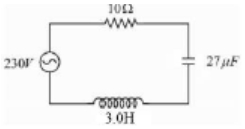
- 18. In the circuit shown in the figure, the ratio of the quality factor and the band width is \(.............\) s.
 2023 Medium
- (A) \(10\)
- (B) \(0.1\)
- (C) \(6\)
- (D) \(8\)
Show answer and solution
Correct Answer: (A)
\(\Delta \omega=\frac{ R }{ L }\)\(Q =\frac{\omega_0}{\Delta \omega}=\omega_0 \frac{ L }{ R }\)
\(\omega_0=\frac{1}{\sqrt{3 \times 27 \times 10^{-6}}}=\frac{1}{9 \times 10^{-3}}\)
\(\frac{ Q }{\Delta \omega}=\frac{\omega_0 \frac{ L }{ R }}{\frac{ R }{ L }}=\omega_0 \frac{ L ^2}{ R ^2}=\sqrt{\frac{1}{ LC } \frac{ L ^2}{ R ^2}}\)
\(=\frac{1}{9 \times 10^{-3}} \times \frac{9}{100}=10\,s\)
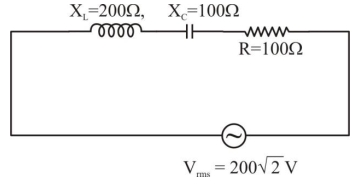
- 19. In the given circuit, rms value of current \(\left( I _{ rms }\right)\) through the resistor \(R\) is :\(..........\,A\)
 2023 Medium
- (A) \(2\)
- (B) \(\frac{1}{2}\)
- (C) \(20\)
- (D) \(2 \sqrt{2}\)
Show answer and solution
Correct Answer: (A)
\(z =\sqrt{100^2+(200-100)^2}\)\(=100 \sqrt{2}\,\Omega\)
\(i _{ rms }=\frac{ V _{ rms }}{ z }=\frac{200 \sqrt{2}}{100 \sqrt{2}}\)
\(=2\,A\)
-
- (A) \(A-IV, B-II, C-I, D-III\)
- (B) \(A-II, B-I, C-III, D-IV\)
- (C) \(A-II, B-IV, C-I, D-III\)
- (D) \(A-IV, B-III, C-I, D-II\)
Show answer and solution
Correct Answer: (C)
Based on theory.
No questions on this page match these filters.