


Questions
Newest firstShowing 1–13 of 13 questions
-
- (A) 52
- (B) 56
- (C) 46
- (D) 40
Show answer and solution
Correct Answer: (A)
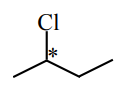 2-Chlorobutane is optically active and chiral molecule
Molecular formula \(\Rightarrow C _4 H _9 Cl\)
Molar mass \(=48+9+35.5=92.5\)
\(\% OC =\frac{48}{92.5} \times 100=51.89 \%\) -
- (A) enantiomers.
- (B) identical molecules.
- (C) diastereomers.
- (D) meso compounds.
Show answer and solution
Correct Answer: (B)
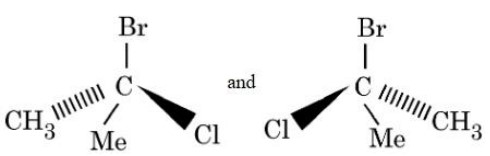
The given structures have a central carbon atom bonded to four groups: \(-\text{Br}\), \(-\text{Cl}\), \(-\text{CH}_3\), and \(-\text{Me}\).
Since \(-\text{CH}_3\) and \(-\text{Me}\) both represent the same alkyl group (methyl), the central carbon atom is bonded to two identical groups.
For a carbon atom to be a chiral center, it must be bonded to four different groups. Because this condition is not met, the central carbon is not a stereocenter and the molecule is achiral.
Both structures represent the same achiral compound (2-bromo-2-chloropropane) drawn in slightly different orientations. Therefore, they are identical molecules.
Answer: identical molecules. -
- (A) 2
- (B) 4
- (C) 6
- (D) 8
Show answer and solution
Correct Answer: (A)
\(\mathrm{FeCl}_3+\mathrm{KOH}+\mathrm{H}_2 \mathrm{SO}_4 \rightarrow \mathrm{~K}_3\left[\mathrm{Fe}\left(\mathrm{C}_2 \mathrm{O}_4\right)_3\right]\)
\(\Rightarrow\left[\mathrm{Fe}\left(\mathrm{C}_2 \mathrm{O}_4\right)_3\right]^{3-}\) is \(\left[\mathrm{M}(\mathrm{AA})_3\right]\) type complex.
So total optical isomers \(=2\) -
- (A) 6
- (B) 5
- (C) 4
- (D) 3
Show answer and solution
Correct Answer: (C)
The given compound is 5-phenylpent-4-en-2-ol. Possible stereoisomers are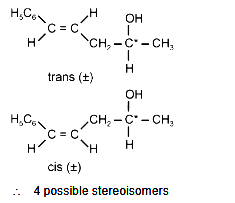
-
- (A) \(2\)
- (B) \(4\)
- (C) \(6\)
- (D) \(8\)
Show answer and solution
Correct Answer: (A)
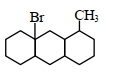
There is one chiral centre present in given compound.So, Total optical isomers \(=2\)
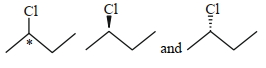
-
- (A) \(30\)
- (B) \(35\)
- (C) \(36\)
- (D) \(32\)
Show answer and solution
Correct Answer: (D)
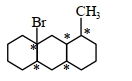
Total chiral centre \(=5\)No. of optical isomers \(=2^5=32\).
-
- (A) \(6\)
- (B) \(5\)
- (C) \(7\)
- (D) \(75\)
Show answer and solution
Correct Answer: (B)
Explanation:
A carbon atom is considered chiral if it is sp3 hybridized and directly bonded to four different atoms or groups. Let us analyze each compound:
1. Compound I: \( \text{CH}_3-\text{CH}_2-\text{CH}^*(\text{NO}_2)-\text{COOH} \) is chiral. The C-2 carbon is bonded to four distinct groups: \( -\text{H} \), \( -\text{NO}_2 \), \( -\text{COOH} \), and \( -\text{CH}_2\text{CH}_3 \).
2. Compound II: \( \text{CH}_3-\text{CH}_2-\text{CHBr}-\text{CH}_2-\text{CH}_3 \) is achiral. The C-3 carbon is attached to two identical ethyl groups, so it lacks a chiral center.
3. Compound III: \( \text{CH}_3-\text{CH}^*(\text{I})-\text{CH}_2-\text{NO}_2 \) is chiral. The C-2 carbon is bonded to four distinct groups: \( -\text{H} \), \( -\text{I} \), \( -\text{CH}_3 \), and \( -\text{CH}_2\text{NO}_2 \).
4. Compound IV: \( \text{CH}_3-\text{CH}_2-\text{CH}^*(\text{OH})-\text{CH}_2\text{OH} \) is chiral. The C-2 carbon is bonded to four distinct groups: \( -\text{H} \), \( -\text{OH} \), \( -\text{CH}_2\text{CH}_3 \), and \( -\text{CH}_2\text{OH} \).
5. Compound V: \( \text{CH}_3-\text{CH}^*(\text{I})-\text{CH}^*(\text{I})-\text{C}_2\text{H}_5 \) (corrected from the incomplete print) is chiral. Both C-2 and C-3 carbons are bonded to four different groups, creating two chiral centers.
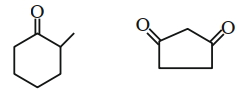
6. Compound VI: 2-Methylcyclohexanone is chiral. The ring carbon bearing the methyl group is attached to four asymmetric paths/groups.
7. Compound VII: Cyclopentane-1,3-dione is achiral due to its internal plane of symmetry and lack of an asymmetric carbon center.
Counting the chiral structures (I, III, IV, V, and VI), we find a total of 5 chiral compounds.
Hence, Option B is the correct choice. -
- (A) \(5\)
- (B) \(8\)
- (C) \(1\)
- (D) \(9\)
Show answer and solution
Correct Answer: (C)
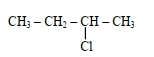
Explanation:
This question requires identifying the number of optically active compounds by analyzing their molecular structures for chiral centers and internal elements of symmetry:
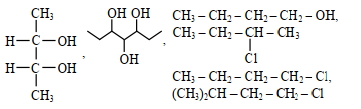
1. Fischer Projection (Butane-2,3-diol):
This structure contains two chiral carbon centers. However, there is a clear horizontal plane of symmetry running through the middle of the molecule that divides it into two mirror-image halves. Due to this internal symmetry, the optical rotation of one half cancels out the other (internal compensation). Therefore, it is a meso compound and is optically inactive.
2. Skeletal Structure (Heptane-3,4,5-triol variant):
This molecule is constitutionally symmetrical from left to right. In the planar zigzag conformation shown, the middle carbon has its \( -\text{OH} \) group pointing downwards, while the two flanking chiral carbons have their \( -\text{OH} \) groups pointing upwards. A vertical plane of symmetry passes directly through the central carbon and its \( -\text{OH} \) group, mirroring the left half perfectly onto the right half. Because of this internal plane of symmetry, it is a meso form and is optically inactive.
3. Analyzing the Condensed Molecular Formulas:
- \( \text{CH}_3-\text{CH}_2-\text{CH}_2-\text{CH}_2-\text{OH} \) (Butan-1-ol): This molecule does not possess any chiral carbon atom (a carbon bonded to four different groups). Thus, it is optically inactive.
- \( \text{CH}_3-\text{CH}_2-\text{CH}(\text{Cl})-\text{CH}_3 \) (2-chlorobutane): The second carbon atom is asymmetric because it is bonded to four completely different groups: \( -\text{H} \), \( -\text{Cl} \), \( -\text{CH}_3 \), and an ethyl group (\( -\text{CH}_2\text{CH}_3 \)). Since it contains a chiral center and lacks any internal symmetry, it is optically active.
- \( \text{CH}_3-\text{CH}_2-\text{CH}_2-\text{CH}_2-\text{Cl} \) (1-chlorobutane): It contains no asymmetric carbon atom, making it optically inactive.
- \( (\text{CH}_3)_2\text{CH}-\text{CH}_2-\text{CH}_2-\text{Cl} \) (1-chloro-3-methylbutane): It contains no asymmetric carbon atom, making it optically inactive.
4. Conclusion:
Out of all the given configurations, only 2-chlorobutane is chiral and lacks internal symmetry elements. Therefore, the total count of optically active compounds is exactly 1.
Hence, Option C is the correct choice. -
- (A) \(8\)
- (B) \(2\)
- (C) \(4\)
- (D) \(3\)
Show answer and solution
Correct Answer: (A)
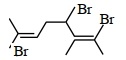
There are three stereo center So No of stereoisomer \(=2^3=8\)
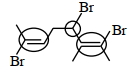
-
- (A) \(41\)
- (B) \(43\)
- (C) \(44\)
- (D) \(42\)
Show answer and solution
Correct Answer: (D)
\(\%\) optical purity \(=\frac{\text { observed rotation of mixture } \times 100}{\text { rotation of pure enantiomer }}\)\(=\frac{+12.6^{\circ}}{+30^{\circ}} \times 100=42\)
-
- (A) \(3,4 -\)dimethylhex\(-3-\)ene
- (B) \(4-\)Methylhex\(-1-\)ene
- (C) \(3-\)Methylhex\(-1-\)ene
- (D) \(3-\)Ethylhex\(-3-\)ene
Show answer and solution
Correct Answer: (D)
\(3-\)Ethylhex\(-3-\)ene will not show stereo isomerism it's diagram is.\([Image]\)\(\longrightarrow(1)\) Not show geometrical isomerism
\(\quad\quad\quad\quad\quad\quad(2)\) Not show optical isomerism

-
- (A) \(2 -\) chloropropanal
- (B) \(2 -\) chlorobutane
- (C) \(2 -\) chloropentane
- (D) \(2 -\) chloro \(- 2-\) methylbutane
Show answer and solution
Correct Answer: (D)
The optically inactive compound must containst achiral carbon atoms \((s)\). Option \((d)\) contains achiral carbon atom\(\underset{2-chloropropanol}{\mathop{\begin{matrix}
\,Cl\, \\
|\,\, \\
C{{H}_{3}}-C-CHO \\
|\,\, \\
H\, \\
\end{matrix}}}\,\) \(\underset{2-chlorobu\tan e\,(chiral)}{\mathop{\begin{matrix}
\,\,\,\,\,\,\,\,\,\,\,\,\,\,\,\,Cl \\
\,\,\,\,\,\,\,\,\,\,\,\,\,\,\,\,\,\,\,\,\,|\,\,\,\,\,\, \\
C{{H}_{3}}-C{{H}_{2}}-C-C{{H}_{3}} \\
\,\,\,\,\,\,\,\,\,\,\,\,\,\,\,| \\
\,\,\,\,\,\,\,\,\,\,\,\,\,\,\,\,H \\
\end{matrix}}}\,\)\(\underset{(chiral)}{\mathop{\underset{2-chloropen\tan e}{\mathop{\begin{matrix}
\,\,\,\,\,\,\,\,\,\,\,\,\,\,\,\,\,\,\,\,\,\,\,\,\,\,\,\,\,\,\,\,\,\,\,\,Cl \\
\,\,\,\,\,\,\,\,\,\,\,\,\,\,\,\,\,\,\,\,\,\,\,\,\,\,\,\,\,\,\,\,\,\,\,| \\
C{{H}_{3}}-C{{H}_{2}}-C{{H}_{2}}-C-C{{H}_{3}} \\
\,\,\,\,\,\,\,\,\,\,\,\,\,\,\,\,\,\,\,\,\,\,\,\,\,\,\,\,\,\,\,\,\,\,| \\
\,\,\,\,\,\,\,\,\,\,\,\,\,\,\,\,\,\,\,\,\,\,\,\,\,\,\,\,\,\,\,\,H \\
\end{matrix}}}\,}}\,\) \(\underset{(achiral)}{\mathop{\underset{2-chloro-2-methylbu\tan e}{\mathop{\begin{matrix}
C{{H}_{3}} \\
| \\
C{{H}_{2}}-C-C{{H}_{3}} \\
| \\
Cl \\
\end{matrix}}}\,}}\,\) -
- (A) Lactic acid
- (B) Tartaric acid
- (C) Maleic acid
- (D) \(\alpha -\) amino acids
Show answer and solution
Correct Answer: (C)
Optical isomers contain an asymmetric (chiral) carbon atom (a carbon atomattached to four different atoms or groups). Therefore all except maleic acid exhibit optical isomerism.
No questions on this page match these filters.
Other STD 11 - Organic chemistry isomerism topics
Frequently asked
How many Optical isomerism questions came in JEE Mains?
13 questions from 2014–2026, each with the correct answer and a full solution.
How difficult are Optical isomerism questions?
0% are easy, 62% medium and 38% hard.