


Chapters asked in 2019
31 chapters- 12Qs STD 11 Units, dimensions and measurement
- 17Qs STD 12 Semicondutor electronics
- 8Qs STD 12 Nuclei
- 10Qs STD 12 Atoms
- 17Qs STD 12 Dual nature of radiation and matter
- 14Qs STD 12 Electromagnetic waves
- 14Qs STD 12 Wave optics
- 20Qs STD 12 Ray optics and optical instruments
- 7Qs STD 12 Alternating current
- 64Qs STD 11 System of particles and rotational motion Most asked
- 28Qs STD 12 Moving charges and magnetism
- 13Qs STD 12 Electromagnetic induction
- 8Qs STD 12 Magnetism and matter
- 39Qs STD 12 Current electricity Most asked
- 29Qs STD 12 Electric potential and capacitance Most asked
- 11Qs STD 12 Electric charges and fields
- 21Qs STD 11 Waves and sound
- 16Qs STD 11 Oscillations
- 18Qs STD 11 Kinetic theory of gases
- 12Qs STD 11 Thermodynamics
- 10Qs STD 11 10.1, thermonetry, thermal expansion and calorimetry
- 6Qs STD 11 Mechanical properties of solids
- 2Qs STD 11 Surface tension
- 11Qs STD 11 Fluid mechanics
- 5Qs STD 11 Newtons laws of motion
- 15Qs STD 11 Gravitation
- 16Qs STD 11 Work, energy, power and collision
- 11Qs STD 11 Motion in plane
- 6Qs STD 11 Motion in straight line
- 4Qs STD 11 Transmission of heat
- 4Qs STD 11 Vectors
All JEE Mains 2019 Physics questions
31 chaptersShowing 1–50 of 468 questions
-
- (A) \(S^{1 /2} I^{1 /2} h^0\)
- (B) \(S^{1 /2} I^{3 /2} h^{-1}\)
- (C) \(S^{3 /2} I^{1 /2} h^0\)
- (D) \(S^{1 /2} I^{1 /2} h^{-1}\)
Show answer and solution
Correct Answer: (A)
\(\begin{array}{l}
P = k\,{s^a}{i^b}{h^c}\\
Where\,k\,is\,{\rm{dimensionless}}\,{\rm{constant}}\\
ML{T^{ - 1}} = {\left( {M{T^{ - 2}}} \right)^a}\left( {M{L^2}} \right){\left( {M{L^2}{T^{ - 1}}} \right)^c}\\
a + b + c = 1\\
2b + 2c = 1\\
- 2a - c = - 1\\
a = \frac{1}{2}\,\,\,\,\,\,\,b = \frac{1}{2}\,\,\,\,\,\,c = 0\\
{S^{1/2}}{i^{1/2}}{h^0}
\end{array}\) -
- (A) \(0.7\)
- (B) \(3.5\)
- (C) \(6.8\)
- (D) \(0.2\)
Show answer and solution
Correct Answer: (C)
\(\begin{array}{l}
T = \frac{{30\,\sec }}{{20}}\,\,\,\,\,\,\,\,\,\,\,\,\,\,\,\,\,\,\,\,\,\,\,\,\,\,\Delta T = \frac{1}{{20}}\sec ,\\
\,\,\,\,\,\,\,L = 55\,cm\,\,\,\,\,\,\,\,\,\,\,\,\,\,\,\,\,\,\,\,\,\Delta L = 1\,mm = 0.1\,cm\\
\,\,\,\,\,\,\,g = \frac{{4{\pi ^2}L}}{{{T^2}}}\\
\,\,\,\,\,\,\,\,percentage\,error\,in\,g\,is\\
\,\,\,\,\,\,\,\,\,\frac{{\Delta g}}{g} \times 100 = \left( {\frac{{\Delta L}}{L} + \frac{{2\Delta T}}{T}} \right)100\% \\
\,\,\,\,\,\,\,\,\,\,\, = \left( {\frac{{0.1}}{{5.5}} + 2\frac{{\left( {\frac{1}{{20}}} \right)}}{{\frac{{30}}{{20}}}}} \right)100\% \simeq 6.8\% .
\end{array}\) - 3. In \(SI\, units\), the dimensions of \(\sqrt {\frac{{{ \varepsilon _0}}}{{{\mu _0}}}} \) is 2019 Medium
- (A) \(A{T^{ - 3}}M{L^{3/2}}\)
- (B) \({A^{ - 1}}TM{L^3}\)
- (C) \({A^2}{T^3}{M^{ - 1}}{L^{ - 2}}\)
- (D) \(A{T^2}{M^{ - 1}}{L^{ - 1}}\)
Show answer and solution
Correct Answer: (C)
\(\begin{array}{l}
Dimension\,of\,\sqrt {\frac{{{\varepsilon _0}}}{{{\mu _0}}}} \\
\left[ {{\varepsilon _0}} \right] = \left[ {{M^{ - 1}}{L^{ - 3}}{T^4}{A^2}} \right]\\
\left[ {{\mu _0}} \right] = \left[ {ML{T^{ - 2}}{A^{ - 2}}} \right]\\
Dimension\,of\,\,\sqrt {\frac{{{\varepsilon _0}}}{{{\mu _0}}}} = {\left[ {\frac{{{M^{ - 1}}{L^{ - 3}}{T^4}{A^2}}}{{ML{T^{ - 2}}{A^{ - 2}}}}} \right]^{\frac{1}{2}}}\\
= {\left[ {{M^{ - 2}}{L^{ - 4}}{T^6}{A^4}} \right]^{1/2}}\\
= \left[ {{M^{ - 1}}{L^{ - 2}}{T^3}{A^2}} \right]
\end{array}\) -
- (A) \(0.10\,\,kg/m^3\)
- (B) \(0.31\,\,kg/m^3\)
- (C) \(0.07\,\,kg/m^3\)
- (D) None of these
Show answer and solution
Correct Answer: (D)
\(\begin{array}{l} \rho = \frac{m}{v}\\ Maximum\,\% \,error\,in\,\rho \,will\,be\,given\,by\\ \frac{{\Delta p}}{p} \times 100\% = \left( {\frac{{\Delta m}}{m}} \right) \times 100\% + 3\left( {\frac{{\Delta L}}{L}} \right) \times 100\% \,\,...\left( i \right)\\ This\,is\,not\,applicable\,as\,error\,is\,big. \end{array}\)\(\begin{array}{l} {\rho _{\min }} = \frac{{{m_{\min }}}}{{{v_{\max }}}} = \frac{{9.9}}{{{{\left( {0.11} \right)}^3}}} = 7438kg/{m^3}\\ and \,{\rho _{\max \,}} = \frac{{{m_{\max }}}}{{{v_{\min }}}} = \frac{{10.1}}{{{{\left( {0.09} \right)}^3}}} = 13854.6kg/{m^3}\\ \Delta \rho = 6416.6\,\,kg/{m^3}\\ \end{array}\)
-
- (A) \([LA^{-2}]\)
- (B) \([A^{-1}]\)
- (C) \([LTA]\)
- (D) \([LT^2]\)
Show answer and solution
Correct Answer: (B)
\(\frac{L}{{RCV}} = [{A^{ - 1}}]\) -
- (A) \(40\)
- (B) \(16\)
- (C) \(640\)
- (D) \(410\)
Show answer and solution
Correct Answer: (A)
Explanation:
To convert the numerical value of density from one system of units to another, the principle of dimensional analysis is applied:
\( n_1 u_1 = n_2 u_2 \)
where \( n \) represents the numerical value and \( u \) represents the unit configuration.
1. Identify the Dimensions of Density:
The dimensional formula for density (\( \rho \)) is expressed as:
\( [\text{Density}] = [M^1 L^{-3} T^0] \)
2. Set up the Conversion Equation:
Using the powers of the fundamental quantities from the dimensional formula, the relation between the two systems is:
\( n_2 = n_1 \left[ \frac{M_1}{M_2} \right]^1 \left[ \frac{L_1}{L_2} \right]^{-3} \)
3. Substitute the Corresponding Values:
- SI System (System 1):
- \( n_1 = 128 \)
- \( M_1 = 1\text{ kg} = 1000\text{ g} \)
- \( L_1 = 1\text{ m} = 100\text{ cm} \)
- New System (System 2):
- \( M_2 = 50\text{ g} \)
- \( L_2 = 25\text{ cm} \)
Plugging these variables into the conversion formula yields:
\( n_2 = 128 \times \left[ \frac{1000\text{ g}}{50\text{ g}} \right]^1 \times \left[ \frac{100\text{ cm}}{25\text{ cm} } \right]^{-3} \)
4. Simplify the Terms:
- Ratio for Mass: \( \frac{1000}{50} = 20 \)
- Ratio for Length: \( \frac{100}{25} = 4 \)
Substituting these simplified values back into the equation:
\( n_2 = 128 \times (20) \times (4)^{-3} \)
\( n_2 = 128 \times 20 \times \frac{1}{64} \)
Since \( \frac{128}{64} = 2 \):
\( n_2 = 2 \times 20 = 40 \)
Hence, Option A is the correct choice. -
- (A) \(4264 \pm 81\,cm^3\)
- (B) \(4260 \pm 80\,cm^3\)
- (C) \(4264 \pm 81.0\,cm^3\)
- (D) \(4300 \pm 80\,cm^3\)
Show answer and solution
Correct Answer: (B)
\(\begin{array}{l}
V = \pi {R^2}h = \frac{\pi }{4}{D^2}h\\
\,\,\,\,\,\,\, = 4260\,c{m^2}\\
\,\,\,\,\,\,\,\,\,\,\,\,\,\,\,\,\,\,\,\,\,\frac{{\Delta V}}{V} = 2\frac{{\Delta D}}{D} + \frac{{\Delta h}}{h}\\
\,\,\,\,\,\,\,\,\,\,\,\,\,\,\,\,\,\,\,\,\,\,\, = \left( {2 \times \frac{{0.1}}{{12.6}} + \frac{{0.1}}{{34.2}}} \right)V\\
\,\,\,\,\,\,\,\,\,\,\,\,\,\,\,\,\,\,\,\,\,\,\, = \frac{{2 \times 426}}{{12.6}} + \frac{{426}}{{34.2}}\\
\,\,\,\,\,\,\,\,\,\,\,\,\,\,\,\,\,\,\,\,\,\,\, = 67.61 + 12.459 = 80.075\\
\therefore \,\,\,\,\,\,\,\,\,\,\,\,\,\,V = 4260 \pm 80\,c{m^3}
\end{array}\) -
- (A) \(M^0L^2T^{-4}\)
- (B) \(M^2LT^{-4}\)
- (C) \(MLT^{-2}\)
- (D) \(M^2L^2T^{-2}\)
Show answer and solution
Correct Answer: (B)
\(\begin{array}{l}
Power\,of\,e\,should\,be\,\dim ensionless.\\
So,\left[ \lambda \right] = \left( {\alpha Tk} \right)\\
\Rightarrow \,\,\,\,\,\,\,\,{L^2} = \left[ \alpha \right]\left( {M{L^2}{T^{ - 2}}} \right)\\
\Rightarrow \,\,\,\,\,\,\,\,\,\left( \alpha \right) = \left( {{M^{ - 1}}{T^2}} \right)\\
\Rightarrow \,\,\,\,\,\,\,\,\,\,\,E = \frac{1}{2}KT\\
\Rightarrow \,\,\,\,\,\,\,\,\,\,\,\left( {M{L^2}{T^{ - 2}}} \right)\,\,;\,\,\left( E \right) = \left[ {KT} \right]\\
\Rightarrow \,\,\,\,\,\,\,\,\,\,\,\left( {\alpha \beta } \right) = \left( F \right)\\
\Rightarrow \,\,\,\,\,\,\,\,\,\,\,\,\left( {{M^{ - 1}}{T^2}} \right)\left( \beta \right) = \left( {ML{T^{ - 2}}} \right)
\end{array}\) -
- (A) \([{M^{ - 2}}\,{L^0}\,{T^{ - 4}}\,{A^{ - 2}}]\)
- (B) \([{M^{ - 3}}\,{L^{-2}}\,{T^8}\,{A^{ 4}}]\)
- (C) \([{M^{ - 2}}\,{L^{-2}}\,{T^6}\,{A^3}]\)
- (D) \([{M^{ - 1}}\,{L^{-2}}\,{T^4}\,{A^2}]\)
Show answer and solution
Correct Answer: (B)
\(X{\kern 1pt} = 5Y{Z^2}\)\(Y{\kern 1pt} = \frac{X}{{5{Z^2}}} = \,{M^{ - 3}}{L^{ - 2}}{T^8}{A^4}\)
-
- (A) \(50\)
- (B) \(200\)
- (C) \(100\)
- (D) \(500\)
Show answer and solution
Correct Answer: (B)
\(\begin{array}{l}
Least\,count = \frac{{Pitch}}{{No.of\,divisions\,on\,circular\,scale}}\\
5 \times {10^{ - 6}} = \frac{{{{10}^{ - 3}}}}{N}\\
N = 200
\end{array}\) -
- (A) \(5.755\,mm\)
- (B) \(5.950\,mm\)
- (C) \(5.725\,mm\)
- (D) \(5.740\,mm\)
Show answer and solution
Correct Answer: (C)
\(L C=\frac{P i t c h}{\text {No.ofdivision}}\)\(L C=0.5 \times 10^{-2} mm\)
+ve error \(=3 \times 0.5 \times 10^{-2} mm\)
\(=1.5 \times 10^{-2} mm =0.015 mm\)
Reading \(= MSR + CSR -(+\text { ve error })\)
\(=5.5 m m+\left(48 \times 0.5 \times 10^{-2}\right)-0.015\)
\(=5.5+0.24-0.015=5.725 mm\)
-
- (A) \(\sqrt {\frac{{{ \varepsilon _0}}}{{{\mu _0}}}} \)
- (B) \({\frac{{{\mu _0}}}{{{ \varepsilon_0}}}}\)
- (C) \(\frac{{{ \varepsilon_0}}}{{{\mu _0}}}\)
- (D) \(\sqrt {\frac{{{\mu _0}}}{{{\varepsilon_0}}}} \)
Show answer and solution
Correct Answer: (D)
\(\begin{array}{l}
\left[ {{\varepsilon _0}} \right] = {M^{ - 1}}{L^{ - 3}}{T^4}{A^2}\\
\left[ {{\mu _0}} \right] = M\,L\,{T^{ - 2}}{A^{ - 2}}\\
\left[ R \right] = \,M\,{L^2}\,{T^{ - 3}}{A^{ - 2}}\\
\left[ R \right] = \left[ {\sqrt {\frac{{{\mu _0}}}{{{\varepsilon _0}}}} } \right]
\end{array}\) -
- (A) \(7\)
- (B) \(40\)
- (C) \(10\)
- (D) \(100\)
Show answer and solution
Correct Answer: (B)
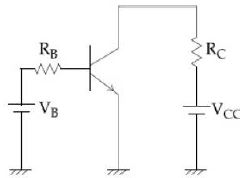
At saturation state, \(V_{CE}\) becomes zero\(\Rightarrow \mathrm{i}_{\mathrm{C}}\) \(=\frac{10 \mathrm{V}}{1000 \Omega}=10 \mathrm{mA}\)
Now current gain factor \(\beta=\frac{\mathrm{i}_{\mathrm{C}}}{\mathrm{i}_{\mathrm{B}}}\)
\(\Rightarrow \mathrm{i}_{B}=\frac{10 \mathrm{mA}}{250}=40 \mu \mathrm{A}\)
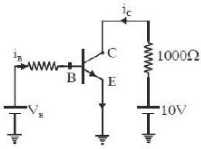
-
- (A) \(0.67\,k\Omega ,300\)
- (B) \(0.67\,k\Omega ,200\)
- (C) \(0.33\,k\Omega ,1.5\)
- (D) \(0.33\,k\Omega ,300\)
Show answer and solution
Correct Answer: (A)
Input current \(=15 \times 10^{-6}\)Output current \(=3 \times 10^{-3}\)
Resistance out put \(=1000\)
\(\mathrm{V}_{\text {input }}=10 \times 10^{-3}\)
Now \(V_{input}\) \(=\) \(r_{input}\) \(\times\) \(i_{input}\)
\(10 \times 10^{-3}=r_{\text {input }} \times 15 \times 10^{-6}\)
\(r_{\text {input }}=\frac{2000}{3}=\) \(0.67\,k\Omega ,\)
Voltage gain \(=\frac{V_{\text {output }}}{V_{\text {input }}}=\frac{1000 \times 3 \times 10^{-3}}{10 \times 10^{-3}}=300\)
-
- (A) \(6\times10^2\)
- (B) \(10^2\)
- (C) \(60\)
- (D) \(10^4\)
Show answer and solution
Correct Answer: (B)
\(\mathrm{A}_{\mathrm{v}} \times \beta=\mathrm{P}_{\text {gain }}\)\(60=10 \log _{10}\left(\frac{P}{P_{0}}\right)\)
\(P=10^{6} =\beta^{2} \times \frac{R_{\text {out }}}{R_{\text {in }}}\)
\(=\beta^{2} \times \frac{10^{4}}{100}\)
\(\beta^{2}=10^{4} ; \quad \beta=100\)
-
- (A) \(2.5\)
- (B) \(3.5\)
- (C) \(7.5\)
- (D) \(1.5\)
Show answer and solution
Correct Answer: (B)
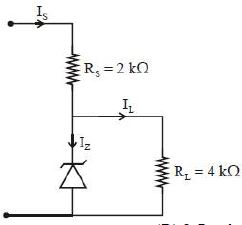
Maximum current will flow from zener if input voltage is maximum.When zener diode works in breakdown state, voltage across the zener will remain same.
\(\therefore \) \({V_{{\text{across}}}}4{\mkern 1mu} K\Omega = 6{\text{V}}\)
\(\therefore \) Current through \(4\, K\Omega = \frac{6}{4000}\,A\) \(=\frac{6}{4}\,mA\)
since input voltage \(=16\,V\)
\(\therefore \) Potential difference across \(2 \mathrm{K} \Omega=10 \mathrm{V}\)
\(\therefore \) Current through \(2 \mathrm{k} \Omega=\frac{10}{2000}=5 \mathrm{mA}\)
\(\therefore \) Current through zener diode \(=\left(I_{s}-\mathrm{I}_{\mathrm{L}}\right)=3.5 \mathrm{mA}\)
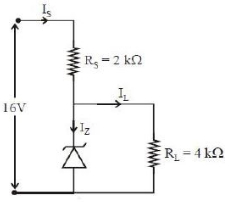
-
- (A) \(9\)
- (B) \(5\)
- (C) \(0\)
- (D) \(14\)
Show answer and solution
Correct Answer: (A)
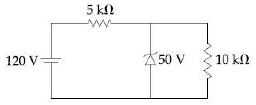
\(\mathrm{I}_{10 \mathrm{k}}=\frac{50}{10 \mathrm{k}}=5\, \mathrm{mA}\)\(\mathrm{i}_{5 \mathrm{k}}=\frac{120-50}{5 \mathrm{k}}=14\, \mathrm{mA}\)
\(\mathrm{i}_{2}=(14-5) \mathrm{mA}=9\, \mathrm{mA}\)
-
- (A) \(0.2\)
- (B) \(0.4\)
- (C) \(0.6\)
- (D) \(0.8\)
Show answer and solution
Correct Answer: (B)
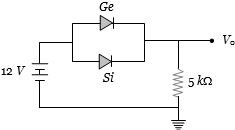
Consider the case when \( Ge\) and \(Si \) diodes are connected as show in the given figure.
Equivalent voltage drop across the combination \(Ge\) and \(Si\) diode \(= 0.3 \,V\)
==> Current \(i = \frac{{12 - 0.3}}{{5\,k\Omega }} = 2.34\,mA\)
Out put voltage \(V_0 = Ri = 5 k \Omega ×2.34 \,mA = 11.7 \,V\)
Now consider the case when diode connection are reversed. In this case voltage drop across the diode's combination \(= 0.7 \,V\)
==> Current \(i = \frac{{12 - 0.7}}{{5\,k\Omega }} = 2.26\,mA\)
\({V_0} = iR = 2.26\,mA \times 5\,k\Omega = 11.3\,V\)
Hence charge in the value of \(V_0 = 11.7 -11.3 = 0.4 V\) -
- (A) \(25\,\mu A\) and \(3.5\,\,V\)
- (B) \(20\,\mu A\) and \(3.5\,\,V\)
- (C) \(25\,\mu A\) and \(2.8\,\,V\)
- (D) \(20\,\mu A\) and \(2.8\,\,V\)
Show answer and solution
Correct Answer: (A)
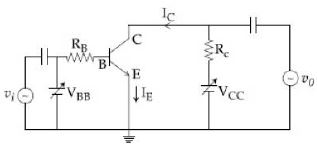
When switched on :\(\mathrm{V}_{\mathrm{CE}}=0\)
\(\mathrm{V}_{\mathrm{CC}}-\mathrm{R}_{\mathrm{C}} \mathrm{I}_{\mathrm{C}}=0\)
\(\mathrm{i}_{\mathrm{C}}=\frac{\mathrm{V}_{\mathrm{CC}}}{\mathrm{R}_{\mathrm{C}}}\) \(=5 \times 10^{-3} \mathrm{A}\)
\(I_C\,=\,Bi_B\)
\(\Rightarrow \mathrm{i}_{\mathrm{B}}=25 \mu \mathrm{A} \)
\( \Rightarrow \mathrm{V}_{\mathrm{BB}}=\mathrm{i}_{\mathrm{B}} \mathrm{R}_{\mathrm{B}}-\mathrm{V}_{\mathrm{BE}}=0\)
\(\Rightarrow V_{\mathrm{BE}}=\mathrm{V}_{\mathrm{BE}}+\mathrm{i}_{\mathrm{BE}}=3.5 \mathrm{V}\)
-
- (A) \(0\)
- (B) \(6.7\)
- (C) \(4\)
- (D) \(6\)
Show answer and solution
Correct Answer: (A)
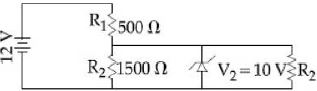
\(12-500\left(2 i_{1}+i_{2}\right)-10=0\)\(\Rightarrow \quad 2 i_{1}+i_{2}=\frac{2}{500}=\frac{1}{250}\)
\(< i_1\) when zenor has break down. \(\mathrm{So}, \mathrm{i}_{2}=0\)
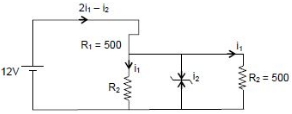
-
- (A) \(2\)
- (B) \(4\)
- (C) \(0.4\)
- (D) \(0.2\)
Show answer and solution
Correct Answer: (B)
Use \(I = neA{v_d}\) and \(\mu = \frac{{{v_d}}}{E}\) -
- (A) \(0.036\)
- (B) \(0.020\)
- (C) \(0.027\)
- (D) \(0.030\)
Show answer and solution
Correct Answer: (B)
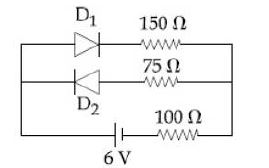
\(I = \frac{6}{{300}} = 0.002\) (\(D_2\) is in reverse bias) -
- (A) \(0.5\,mA;\,\,0.6\,mA\)
- (B) \(1\,mA;\,\,8.5\,mA\)
- (C) \(1.5\,mA;\,\,8.5\,mA\)
- (D) \(0.5\,mA;\,\,8.5\,mA\)
Show answer and solution
Correct Answer: (D)
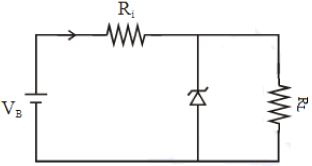
\({{\text{V}}_{{\text{breaddwon }}}} = 6{\text{V}},\) \({{\text{R}}_{\text{L}}} = 4\,{\text{k}}\Omega ,\) \({{\text{R}}_{\text{i}}} = 1{\text{k}}\Omega \)\({{\text{i}}_{\text{L}}} = \frac{6}{4} \times {10^{ - 3}} = \) \(1.5 \times {10^{ - 3}} = 1.5{\text{mA}}\)
\(\mathrm{i}_{\mathrm{i}}=2 \times 10^{-3}\)
\({\text{i}} = {{\text{i}}_1} - {{\text{i}}_{\text{L}}} = 0.5{\text{mA}} - \) minimum current
\(\mathrm{i}_{\mathrm{i}}=10 \times 10^{-3}=10 \mathrm{mA}\)
\(\operatorname{lmax}=8.5 \mathrm{mA}\)
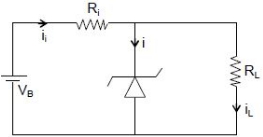
-
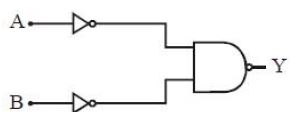
- (A) \(OR\)
- (B) \(AND\)
- (C) \(NOR\)
- (D) \(NAND\)
Show answer and solution
Correct Answer: (A)
Truth table can be formed as\(\begin{array}{|c|c|c|}\hline A & {B} & {\text { Equivalent }} \\ \hline 0 & {0} & {0} \\ \hline 0 & {1} & {1} \\ \hline 1 & {0} & {1} \\ \hline 1 & {1} & {1} \\ \hline\end{array}\)
Hence the equivalent is \("OR"\) gate.
-
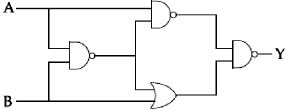
- (A) \(A\bar B + \bar AB\)
- (B) \(AB + \overline {AB} \)
- (C) \(A\bar B\)
- (D) \(\bar AB\)
Show answer and solution
Correct Answer: (C)
\(Y =A \cdot \overline{A B}+A B \cdot \bar{B}\)\(=A \cdot(\bar{A}+\bar{B})+(A B) \cdot \bar{B} \)
\(=A \bar{B}+0\)
-
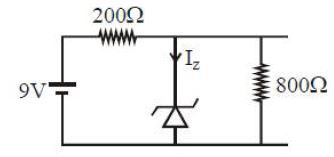
- (A) \(10\)
- (B) \(15\)
- (C) \(7\)
- (D) \(17\)
Show answer and solution
Correct Answer: (A)
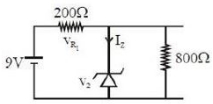
\(9=V_{z}+V_{R_{1}}\)\(V_{z}=5.6 v\)
\(V_{R_1}=9-5.6\)
\(V_{R_1}=3.4\)
\(\mathrm{I}_{\mathrm{R}_{1}}=\frac{\mathrm{V}_{\mathrm{R}_{1}}}{\mathrm{R}}=\frac{3.4}{200} ; \mathrm{I}_{\mathrm{R}_{1}}=17 \mathrm{mA}\)
\({{\text{V}}_{\text{z}}}={{\text{V}}_{{{\text{R}}_{2}}}}={{\text{I}}_{{{\text{R}}_{2}}}}\left( {{\text{R}}_{2}} \right)\)
\(\frac{5.6}{800}={{\text{l}}_{{{\text{R}}_{2}}}}\) ; \({{I}_{{{\text{R}}_{2}}}}=7\text{mA}\)
\({{I}_{\text{z}}}=(17-7)\,\text{mA}=10\,\text{mA}\)
-
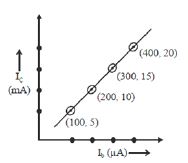
- (A) \(5 \times {10^4}\,,\,2.5 \times {10^6}\)
- (B) \(5 \times {10^4}\,,\,5 \times {10^6}\)
- (C) \(5 \times {10^4}\,,\,5 \times {10^5}\)
- (D) \(2.5 \times {10^4}\,,\,2.5 \times {10^6}\)
Show answer and solution
Correct Answer: (A)
\({V_{\text {gain }}=\left(\frac{\Delta I_{C}}{\Delta I_{B}}\right) \frac{R_{\text {out }}}{R_{\text {in }}}=\left(\frac{5 \times 10^{-3}}{100 \times 10^{-6}}\right) \times 10^{3}}\)\(=\frac{1}{20} \times 10^{8}=5 \times 10^{4} \)
\(P_{\text {gain }} =\left(\frac{\Delta I_{C}}{\Delta I_{b}}\right)\left(V_{\text {gain }}\right) \)
\(=\left(\frac{5 \times 10^{-3}}{100 \times 10^{-6}}\right)\left(5 \times 10^{4}\right)\)
\(=2.5 \times 10^{6}\)
-
- (A) \( {\begin{array}{*{20}{c}}
A&B&Y\\
0&0&1\\
0&1&0\\
1&0&0\\
1&1&0
\end{array}} \) - (B) \( {\begin{array}{*{20}{c}}
A&B&Y\\
0&0&0\\
0&1&0\\
1&0&1\\
1&1&1
\end{array}}\) - (C) \( {\begin{array}{*{20}{c}}
A&B&Y\\
0&0&1\\
0&1&1\\
1&0&1\\
1&1&1
\end{array}}\) - (D) \( {\begin{array}{*{20}{c}}
A&B&Y\\
0&0&1\\
0&1&1\\
1&0&0\\
1&1&0
\end{array}} \)
Show answer and solution
Correct Answer: (D)
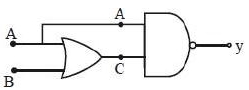
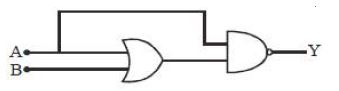
\(C=A+B\)and \(y=\overline{A . C}\)
\(\begin{array}{l|l|l|l|l|}\hline A & {\mathrm{B}} & {\mathrm{C}=(\mathrm{A}+\mathrm{B})} & {\mathrm{A} \mathrm{C}} & {\mathrm{y}=\overline{\mathrm{A} . \mathrm{C}}} \\ \hline 0 & {0} & {0} & {0} & {1} \\ {0} & {1} & {1} & {0} & {1} \\ {1} & {0} & {1} & {1} & {0} \\ {1} & {1} & {1} & {1} & {0} \\ \hline\end{array}\)
- (A) \( {\begin{array}{*{20}{c}}
- 29. To get output ‘\(1\)’ at \(R\), for the given logic gate circuit the input values must be
 2019 Hard
- (A) \(X = 0, Y = 1\)
- (B) \(X = 1, Y = 1\)
- (C) \(X = 1, Y = 0\)
- (D) \(X = 0, Y = 0\)
Show answer and solution
Correct Answer: (C)
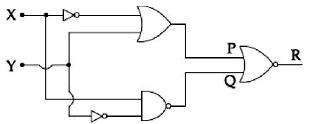
\(\mathrm{R}=\overline{\mathrm{P}+\mathrm{Q}} \) \(=\overline{(\bar{x}+y)+(\overline{x\bar{y}})}\)\(=\overline{(\bar{x}+y)}\cdot (x\bar{y})\)
\(=(x \cdot \bar{y}) \cdot(x \bar{y})\)
\(=x \bar{y}\)
-
- (A) \(5\) days and \(10\) days
- (B) \(10\) days and \(40\) days
- (C) \(20\) days and \(5\) days
- (D) \(20\) days and \(10\) days
Show answer and solution
Correct Answer: (B)
Activity \(=\lambda\) (number of atoms)\(10=\lambda_{A} N_{A}\) ..... \((1)\)
\(20=\lambda_{B} N_{B}\) ..... \((2)\)
\(N_{A}=2 N_{B}\) ..... \((3)\)
Solving we get, \(\frac{\lambda_{A}}{\lambda_{B}}=\frac{1}{4}\)
-
- (A) \(4\,ln2\)
- (B) \(\frac {ln2}{2}\)
- (C) \(\frac {ln2}{4}\)
- (D) \(2\,ln2\)
Show answer and solution
Correct Answer: (C)
\({\text{R}} = {{\text{R}}_{\text{o}}}{{\text{e}}^{ - \lambda {\text{t}}}}\)\(\therefore\) \(\frac{{{\text{R}}_{\text{B}}}}{{{\text{R}}_{\text{A}}}}=\frac{{{\text{R}}_{\text{o}}}{{\text{e}}^{-{{\lambda }_{\text{B}}}\text{t}}}}{{{\text{R}}_{\text{o}}}{{\text{e}}^{-{{\lambda }_{\text{B}}}t}}}\) \(={{\text{e}}^{-\left( {{\lambda }_{B}}-{{\lambda }_{\text{A}}} \right)\text{t}}}={{\text{e}}^{-3\text{t}}}\)
\({\Rightarrow} {\lambda_{B}-\lambda_{A}=3} \)
\(\Rightarrow \) \(\frac{\ell {{n}^{2}}}{{{T}_{B}}}-\frac{\ell n2}{\ell n2}=3\)
\({\Rightarrow \quad T_{B}=\frac{\ell n 2}{4}}\)
-
- (A) energy of \(12.4\, MeV\) will be supplied
- (B) \(8.3\, MeV\) energy will be released
- (C) energy of \(3.6\, MeV\) will be released
- (D) None of these
Show answer and solution
Correct Answer: (D)
\({\text{Q}} = {({\text{B}}.{\text{E}})_{\text{R}}} - {({\text{B}} \cdot {\text{E}} \cdot )_P}\)\( = 20 \times 8.03 - (8 \times 7.07 + 12 \times 7.86)\)
\( = 160.6 - (56.56 + 94.32)\)
\(\therefore {\text{Q}} = + 9.72\,{\text{meV}}\)
\(9.72\,MeV\) released.
-
- (A) \(9 : 8\)
- (B) \(1 : 8\)
- (C) \(8 : 1\)
- (D) \(3 : 8\)
Show answer and solution
Correct Answer: (A)
\({{\text{N}}_{\text{A}}} = {{\text{N}}_{{\text{OA}}}}{{\text{e}}^{ - \lambda {\text{t}}}} = \frac{{{{\text{N}}_{{\text{OA}}}}}}{{{2^{t/{t_{1/2}}}}}} = \frac{{{{\text{N}}_{{\text{OA}}}}}}{{{2^6}}}\)\(\therefore\) Number of nuclei decayed
\( = {N_{OA}} - \frac{{{N_{OA}}}}{{{2^6}}} = \frac{{63{N_{OA}}}}{{64}}\)
\({{\text{N}}_{\text{B}}} = {{\text{N}}_{{\text{OB}}{{\text{e}}^{ - \lambda t}}}} = \) \(\frac{{{{\text{N}}_{{\text{OB}}}}}}{{{2^{t/{t_{1/2}}}}}} = \frac{{{{\text{N}}_{{\text{OB}}}}}}{{{2^3}}}\)
\(\therefore\) Number of nuclei decayed
\( = {N_{OB}} - \frac{{{N_{OB}}}}{{{2^3}}} = \frac{{7{N_{OB}}}}{8}\)
since, \(\mathrm{N}_{\mathrm{OA}}=\mathrm{N}_{\mathrm{OB}}\)
\(\therefore \) Ratio of decayed numbers of nuclei
\(A\) and \(B = \frac{{63{N_{OA}} \times 8}}{{64 \times 7{N_{{\text{OB}}}}}} = \frac{9}{8}\)
-
- (A) \(A = 208;\,\,Z = 80\)
- (B) \(A = 202;\,\,Z = 80\)
- (C) \(A = 208;\,\,Z = 82\)
- (D) \(A = 200;\,\,Z = 81\)
Show answer and solution
Correct Answer: (C)
\({}_{90}^{232}Th\,\,\xrightarrow{{6\alpha }}\,{}_{78}^{208}Y\,\xrightarrow{{4\beta }}\,{}_{82}^{208}X\) -
- (A) \(0.1\)
- (B) \(5\)
- (C) \(2\)
- (D) \(1\)
Show answer and solution
Correct Answer: (D)
Mass densities of all nuclei are same so their ratio is \(1\). -
- (A) \(\frac{1}{{11\lambda }}\)
- (B) \(\frac{1}{{10\lambda }}\)
- (C) \(\frac{1}{{9\lambda }}\)
- (D) \(\frac{11}{{10\lambda }}\)
Show answer and solution
Correct Answer: (C)
\({{\text{N}}_1} = {{\text{N}}_0}{{\text{e}}^{ - 10\lambda t}}\) ; \(\mathrm{N}_{2}=\mathrm{N}_{0} \mathrm{e}^{-\lambda \mathrm{t}}\)\(\frac{1}{e}=\frac{N_{1}}{N_{2}}=e^{-9 \lambda t}\)
\(\Rightarrow 9 \lambda t=1\)
\(\Rightarrow t=\frac{1}{9 \lambda}\)
-
- (A) \(1/\lambda \)
- (B) \(1/4\lambda \)
- (C) \(2/\lambda \)
- (D) \(1/2\lambda \)
Show answer and solution
Correct Answer: (D)
\(\frac{1}{{{e^2}}} = {e^{\lambda t - 5\lambda t}}\)\(t\, = \,\frac{1}{{2\lambda }}\)
-
- (A) \(25\,a_0\)
- (B) \(9\,a_0\)
- (C) \(16\,a_0\)
- (D) \(4\,a_0\)
Show answer and solution
Correct Answer: (C)
Energy supplied\(E=\frac{12400}{900}=12.65 \mathrm{eV}\)
\(\therefore \mathrm{E}_{\mathrm{n}}-\mathrm{E}_{1}=12.65\)
\(\Rightarrow(13.6)\left(1-\frac{1}{n^{2}}\right)=12.65\)
\(\Rightarrow n^{2} \approx 14.3\)
\(\Rightarrow n \approx 4\)
\(r \propto n^{2}\)
-
- (A) \({r_n} \propto \sqrt n ,{E_n} \propto n\)
- (B) \({r_n} \propto \sqrt n ,{E_n} \propto \frac{1}{n}\)
- (C) \({r_n} \propto n,{E_n} \propto n\)
- (D) \({r_n} \propto {n^2},{E_n} \propto \frac{1}{{{n^2}}}\)
Show answer and solution
Correct Answer: (A)
\(\mathrm{U}=\frac{1}{2} \mathrm{kr}^{2}\)Force, \(F=-\frac{d U}{d r}=-k r\)
For circular motion \(\frac{\mathrm{mv}^{2}}{\mathrm{r}}=\mathrm{kr}\) .... \((i)\)
And \({ mvr }=\frac{n h}{2 \pi}\) .... \((ii)\)
\({ \Rightarrow {r^2} = \frac{{{\text{nh}}}}{{2\pi \sqrt {{\text{km}}} }}}\)
\({ \Rightarrow {\text{r}} \propto \sqrt {\text{n}} }\)
Total energy, \(E=k+U\)
\( = \frac{1}{2}m{v^2} + \frac{1}{2}k{r^2}\)
\( = \frac{1}{2}k{r^2} + \frac{1}{2}k{r^2}\) [From equation \((i)\)]
\(E = k{r^2}\)
\( \Rightarrow \,\,E\, \propto \,\,n\)
-
- (A) \({\lambda _x} + {\lambda _y}\)
- (B) \(\frac{{{\lambda _x}{\lambda _y}}}{{{\lambda _x} + {\lambda _y}}}\)
- (C) \(\frac{{{\lambda _x}{\lambda _y}}}{{\left| {{\lambda _x} - {\lambda _y}} \right|}}\)
- (D) \({\lambda _x} - {\lambda _y}\)
Show answer and solution
Correct Answer: (C)
Conservation of momentum\({\overrightarrow {\text{p}} _x} + {\overrightarrow {\text{p}} _y} = {\overrightarrow {\text{p}} _{{\text{final}}}}\)
\(\mathrm{m}_{\mathrm{x}} \mathrm{V}_{\mathrm{x}}-\mathrm{m}_{\mathrm{y}} \mathrm{V}_{\mathrm{y}}=\left(\mathrm{m}_{\mathrm{x}}+\mathrm{m}_{\mathrm{y}}\right) \mathrm{V}\)
\(\frac{\mathrm{h}}{\lambda_{\mathrm{x}}}-\frac{\mathrm{h}}{\lambda_{\mathrm{y}}}=\frac{\mathrm{h}}{\lambda}\)
\(\Rightarrow \lambda=\frac{\lambda_{x} \lambda_{y}}{\left|\lambda_{x}-\lambda_{y}\right|}\)
-
- (A) \(4\)
- (B) \(6\)
- (C) \(5\)
- (D) \(7\)
Show answer and solution
Correct Answer: (C)
\(\frac{1}{\lambda}=R\left(\frac{1}{m^{2}}-\frac{1}{n^{2}}\right) z^{2}\)\(\frac{1}{1085}=R\left(\frac{1}{m^{2}}-\frac{1}{n^{2}}\right) 2^{2}\)
\(\therefore m=2\)
\(\therefore n=5\)
-
- (A) \(12.9\)
- (B) \(9.7\)
- (C) \(6.6\)
- (D) \(3.5\)
Show answer and solution
Correct Answer: (B)
\(2 \pi r_{n}=n \lambda_{n}\)\(\lambda_{3}=\frac{2 \pi\left(4.65 \times 10^{-10}\right)}{3}\)
\(\lambda_{3}=9.7 \mathrm{A}\)
-
- (A) \(\frac{{27}}{{20}}\,\lambda \)
- (B) \(\frac{{16}}{{25}}\,\lambda \)
- (C) \(\frac{{25}}{{16}}\,\lambda \)
- (D) \(\frac{{20}}{{27}}\,\lambda \)
Show answer and solution
Correct Answer: (D)
For \(M \rightarrow L\) steel\(\frac{1}{\lambda}=\mathrm{K}\left(\frac{1}{2^{2}}-\frac{1}{3^{2}}\right)=\frac{\mathrm{K} \times 5}{36}\)
for \(\mathrm{N} \rightarrow \mathrm{L}\)
\(\quad \frac{1}{\lambda^{\prime}}=\mathrm{K}\left(\frac{1}{2^{2}}-\frac{1}{4^{2}}\right)=\frac{\mathrm{K} \times 3}{16}\)
\(\lambda^{\prime}=\frac{20}{27} \lambda\)
-
- (A) \(10.8\)
- (B) \(11.4\)
- (C) \(9.4\)
- (D) \(12.3\)
Show answer and solution
Correct Answer: (A)
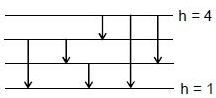
\(\frac{h c}{\lambda}=13.6\, \mathrm{eV}(\mathrm{g})\left\{1-\frac{1}{16}\right\}\)\(\frac{1240\, \mathrm{eV}}{\lambda}=\frac{15}{16} \times 9 \times 13.6\, \mathrm{eV}\)
\(\lambda=\frac{1240 \times 16}{15 \times 9 \times 13.6}=10.8\, \mathrm{nm}\)
-
- (A) \(n = 2 \to n = 4\)
- (B) \(n = 2 \to n = 5\)
- (C) \(n = 2 \to n = 3\)
- (D) \(n = 1 \to n = 4\)
Show answer and solution
Correct Answer: (B)
Energy released for tension \(\mathrm{n}=2\) to \(\mathrm{n}=1\) of hydrogen atom \(E=13.6 Z^{2}\left(\frac{1}{n_{1}^{2}}-\frac{1}{n_{2}^{2}}\right)\)\(z=1, n_{1}=1, n_{2}=2\)
\(E=13.6 \times 1 \times\left(\frac{1}{1^{2}}-\frac{1}{2^{2}}\right)\)
\(\mathrm{E}=13.6 \times \frac{3}{4} \mathrm{eV}\)
For \(\mathrm{He}^{+}\) ion \(z=2\)
\((A)\) \(n=1\) to \(n=4\)
\(E=13.6 \times 2^{2} \times\left(\frac{1}{1^{2}}-\frac{1}{4^{2}}\right)=13.6 \times \frac{15}{4} \mathrm{eV}\)
\((B)\) \(n=2\) to \(n=4\)
\(E=13.6 \times 2^{2} \times\left(\frac{1}{1^{2}}-\frac{1}{4^{2}}\right)=13.6 \times \frac{3}{4} \mathrm{eV}\)
\((C)\) \(n=2\) to \(n=5\)
\(E=13.6 \times 2^{2} \times\left(\frac{1}{2^{2}}-\frac{1}{5^{2}}\right)=13.6 \times \frac{21}{25} \mathrm{eV}\)
\((D)\) \(n=2\) to \(n=5\)
\(E=13.6 \times 2^{2} \times\left(\frac{1}{2^{2}}-\frac{1}{3^{2}}\right)=13.6 \times \frac{5}{9} \mathrm{eV}\)
-
- (A) \(889.2\)
- (B) \(642.7\)
- (C) \(448.9\)
- (D) \(388.9\)
Show answer and solution
Correct Answer: (C)
\(\frac{1}{660}=R\left(\frac{1}{2^{2}}-\frac{1}{3^{2}}\right)=\frac{5 R}{36}\) .... \((1)\)\(\frac{1}{\lambda}=R\left(\frac{1}{2^{2}}-\frac{1}{4^{2}}\right)=\frac{3 \mathrm{R}}{16}\) .... \((2)\)
Divide equation \((1)\) with \((\mathrm{2})\)
\(\frac{\lambda}{660}=\frac{5 \times 16}{36 \times 3}\)
\(\lambda=\frac{4400}{9}=488.88=488.9\, \mathrm{nm}\)
-
- (A) \(20/7\)
- (B) \(7/5\)
- (C) \(9/7\)
- (D) \(27/5\)
Show answer and solution
Correct Answer: (A)
\(\frac{1}{\lambda } = R\left( {\frac{1}{{n_f^2}} - \frac{1}{{n_i^2}}} \right);\) \(\frac{1}{{{\lambda _1}}} = R\left( {\frac{1}{{{3^2}}} - \frac{1}{{{4^2}}}} \right)\)\(\frac{1}{{{\lambda _1}}} = R\left( {\frac{7}{{9 \times 16}}} \right);\) \(\frac{1}{{{\lambda _2}}} = R\left( {\frac{1}{{{2^2}}} - \frac{1}{{{3^2}}}} \right)\)
\(=R\left(\frac{5}{4 \times 9}\right)\)
\(\frac{\lambda_{1}}{\lambda_{2}}=\frac{\frac{5}{36}}{\frac{7}{9 \times 16}}=\frac{20}{7}\)
-
- (A) \(15 \times {10^{ - 8}}\,N\)
- (B) \(35 \times {10^{ - 8}}\,N\)
- (C) \(10 \times {10^{ - 8}}\,N\)
- (D) \(20 \times {10^{ - 8}}\,N\)
Show answer and solution
Correct Answer: (D)
Radiation pressure for \(100 \%\) reflection \(=\frac{2I}{\mathrm{C}}\)Radiation pressure for \(0 \%\) reflection \(=\frac{I}{\mathrm{C}}\)
Hence, in given case, radiation pressure \( = (0.25)\left( {\frac{{2I}}{{\text{C}}}} \right) + (0.75)\left( {\frac{I}{{\text{C}}}} \right)\)
\( = (1.25)\left( {\frac{I}{{\text{C}}}} \right)\)
Force \(=\mathrm{P} \times(\text { Area })\)
\(=20.83 \times 10^{-8}\, \mathrm{N}\)
-
- (A) \(1\,\times 10^{16}\)
- (B) \(1.5\,\times 10^{16}\)
- (C) \(2\,\times 10^{16}\)
- (D) \(5\,\times 10^{15}\)
Show answer and solution
Correct Answer: (D)
\(2 \times {10^{ - 3}} = \frac{{{\text{hc}}}}{\lambda }\frac{{{\text{dn}}}}{{{\text{dt}}}}\)\(\frac{{{\text{dn}}}}{{{\text{dt}}}} = \frac{{2 \times {{10}^{ - 3}}\lambda }}{{{\text{hc}}}}\)
\( = \frac{{2 \times {{10}^{ - 3}} \times 500 \times {{10}^{ - 9}}}}{{6.6 \times {{10}^{ - 34}} \times 3 \times {{10}^8}}}\)
\( = \frac{{1000}}{{6.6 \times 3}} \times {10^{14}}\) \( = 5 \times {10^{15}}\)
-
- (A) \(10^{14}\) and \(10\, eV\)
- (B) \(10^{12}\) and \(5\, eV\)
- (C) \(10^{11}\) and \(5\, eV\)
- (D) \(10^{10}\) and \(5\, eV\)
Show answer and solution
Correct Answer: (C)
\(n = \frac{{16 \times {{10}^{ - 3}} \times {{10}^{ - 4}}}}{{10 \times 10 \times {{10}^{ - 19}}}}\) \( \simeq 1.6 \times {10^{11}}\)\({({\text{K}} \cdot {\text{E}})_{\max }} = (10 - 5)\,{\text{eV}} = 5\,{\text{eV}}\)
No questions on this page match these filters.
Other years
Frequently asked
How many JEE Mains 2019 Physics questions are on ExamBro?
468 questions, each with the correct answer and a full solution.
Which JEE Mains 2019 Physics chapter is asked the most?
System of particles and rotational motion, with 64 questions, followed by Current electricity with 39.
How difficult are JEE Mains 2019 Physics questions?
3% are easy, 47% medium and 50% hard.