


Questions
Newest firstShowing 1–50 of 52 questions
- 1. A moving coil galvanometer of resistance \(100 \Omega\) shows a full scale deflection for a current of 1 mA . The value of resistance required to convert this galvanometer into an ammeter, showing full scale deflection for a current of 5 mA , is _________ \(\Omega\) 2026 Easy
- 2. A moving coil of galvanometer when shunted with \(2\,\Omega\) resistance gives a full scale deflection for a current of \(500\) mA. When a resistance of \(470\,\Omega\) is connected in series it gives a full scale deflection for \(10\) V potential applied on it. The value of resistance of galvanometer coil is __________ \(\Omega\). 2026 Hard
- 3. A voltmeter with internal resistance of \(x\ \Omega\) can be used to measure upto \(20\) V. In order to increase its measuring range to \(30\) V, the required modification is to _____. 2026 Medium
- 4. Two resistors of \(100 \Omega\) each are connected in series with a 9 V battery. A voltmeter of \(400 \Omega\) resistance is connected to measure the voltage drop across one of the resistors. The voltmeter reading is _________ V. 2026 Easy
- 5. A galvanometer having a coil of resistance \(30 \Omega\) need 20 mA of current for full-scale deflection. If a maximum current of 3 A is to be measured using this galvanometer, the resistance of the shunt to be added to the galvanometer should be \(\frac{30}{X} \Omega\), where \(X\) is ________. 2025 Medium
- 6. Consider a moving coil galvanomenter (MCG):
A. The torsional constant in moving coil galvanometer has dimentions \(\left[\mathrm{ML}^2 \mathrm{~T}^{-2}\right]\)
B. Increasing the current sensitivity may not necessarily increase the voltage sensitivity.
C. If we increase number of turns \((\mathrm{N})\) to its double \((2 \mathrm{~N})\), then the voltage sensitivity doubles.
D. MCG can be converted into an ammeter by introducing a shunt resistance of large value in parallel with galvanometer.
E. Current sensitivity of MCG depends inversely on number of turns of coil.
Choose the correct answer from the options given below: 2025 Medium - 7. In a moving coil galvanometer, two moving coils \(M_1\) and \(M_2\) have the following particulars :
\(\begin{aligned}
& \mathrm{R}_1=5 \Omega, \mathrm{~N}_1=15, \mathrm{~A}_1=3.6 \times 10^{-3} \mathrm{~m}^2, \mathrm{~B}_1=0.25 \mathrm{~T} \\
& \mathrm{R}_2=7 \Omega, \mathrm{~N}_2=21, \mathrm{~A}_2=1.8 \times 10^{-3} \mathrm{~m}^2, \mathrm{~B}_2=0.50 \mathrm{~T}
\end{aligned}\)
Assuming that torsional constant of the springs are same for both coils, what will be the ratio of voltage sensitivity of \(M_1\) and \(M_2\) ? 2025 Medium - 8. In the figure shown below, a resistance of \(150.4 \Omega\) is connected in series to an ammeter A of resistance \(240 \Omega\). A shunt resistance of \(10 \Omega\) is connected in parallel with the ammeter. The reading of the ammeter is _____ mA.
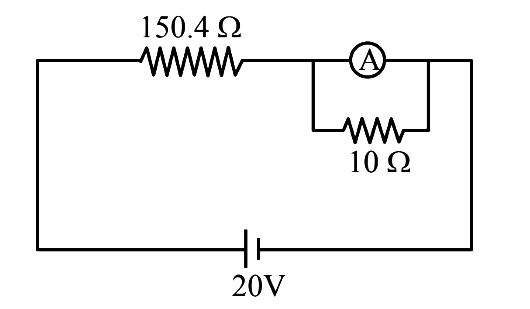 2025 Medium
- 9. A current of \(200\ \mu \mathrm{A}\) deflects the coil of a moving coil galvanometer through \(60^{\circ}\). The current to cause deflection through \(\frac{\pi}{10}\) radian is: 2024 Hard
- 10. A galvanmeter has a coil of resistance \(200 \Omega\) with a full scale deflection at \(20 \mu \mathrm{A}\). The value of resistance to be added to use it as an ammeter of range \((0-20) \mathrm{mA}\) is _______. 2024 Hard
- 11. A galvanometer has a resistance of \(50 \Omega\) and allows a maximum current of \(5 \mathrm{~mA}\) to pass. What is the necessary series resistance to connect to convert it to a voltmeter that can measure \(100 \mathrm{~V}\)? 2024 Hard
- 12. A galvanometer having coil resistance \(10 \ \Omega\) shows a full scale deflection for a current of \(3 \mathrm{~mA}\). For it to measure a current of \(8 \mathrm{~A}\), the value of the shunt should be: 2024 Hard
- 13. A galvanometer of resistance \(100 \Omega\) when connected in series with \(400 \Omega\) measures a voltage of upto \(10 \mathrm{~V}\). The value of resistance required to convert the galvanometer into ammeter to read upto \(10 \mathrm{~A}\) is \(\mathrm{x} \times 10^{-2} \Omega\). The value of \(\mathrm{x}\) is _______. 2024 Hard
- 14. A moving coil galvanometer has \(100\) turns and each turn has an area of \(2.0 \mathrm{~cm}^2\). The magnetic field produced by the magnet is \(0.01 \mathrm{~T}\) and the deflection in the coil is \(0.05\) radian when a current of \(10 \mathrm{~mA}\) is passed through it. The torsional constant of the suspension wire is \(\mathrm{x} \times 10^{-5} \mathrm{~N}-\mathrm{m} / \mathrm{rad}\). The value of \(\mathrm{x}\) is _______. 2024 Hard
- 15. In an ammeter, \(5 \%\) of the main current passes through the galvanometer. If resistance of the galvanometer is G, the resistance of ammeter will be _______. 2024 Hard
- 16. In the experiment to determine the galvanometer resistance by half-deflection method, the plot of \(\frac{1}{\theta}\) vs the resistance \((R)\) of the resistance box is shown in the figure. The figure of merit of the galvanometer is _______ \(\times 10^{-1} \mathrm{~A} /\) division. [The source has emf 2V]
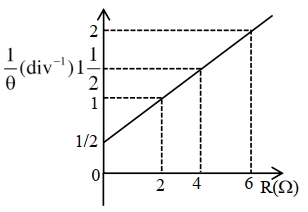 2024 Hard
- 17. In the given figure an ammeter \(A\) consists of a \(240 \Omega\) coil connected in parallel to a \(10 \Omega\) shunt. The reading of the ammeter is _______ \(\mathrm{mA}\).
 2024 Hard
- 18. The deflection in moving coil galvanometer falls from \(25\) divisions to \(5\) division when a shunt of \(24\ \Omega\) is applied. The resistance of galvanometer coil will be : 2024 Hard
- 19. A cell of emf \(90\,V\) is connected across series combination of two resistors each of \(100\,\Omega\) resistance. A voltmeter of resistance \(400\,\Omega\) is used to measure the potential difference across each resistor. The reading of the voltmeter will be \(.........\,V\) 2023 Medium
- 20. For a moving coil galvanometer, the deflection in the coil is \(0.05\,rad\) when a current of \(10\,mA\) is passed through it. If the torsional constant of suspension wire is \(4.0 \times 10^{-5}\,Nm\,rad ^{-1}\), the magnetic field is \(0.01\,T\) and the number of turns in the coil is \(200\),the area of each turn (in \(cm ^2\) ) is : 2023 Medium
- 21. For designing a voltmeter of range \(50\,V\) and an ammeter of range \(10\,mA\) using a galvanometer which has a coil of resistance \(54\,\Omega\) showing a full scale deflection for \(1\,mA\) as in figure. \((A)\) for voltmeter \(R \approx 50\,k\Omega\) \((B)\) for ammeter \(r \approx 0.2\,\Omega\) \((C)\) for ammeter \(r \approx 6\,\Omega\) \((D)\) for voltmeter \(R \approx 5\,k \Omega\) \((E)\) for voltmeter \(R \approx 500 \Omega\) Choose the correct answer from the options given below
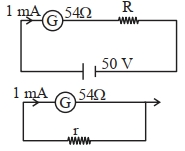 2023 Medium
- 22. Given below are two statement : Statement \(I :\) If the number of turns in the coil of a moving coil galvanometer is doubled then the current sensitivity becomes double. Statement \(II :\) Increasing current sensitivity of a moving coil galvanometer by only increasing the number of turns in the coil will also increase its voltage sensitivity in the same ratio: In the light of the above statement, choose the correct answer from the options given below : 2023 Medium
- 23. Given below are two statements: One is labelled as Assertion \(A\) and the other is labelled as Reason \(R\). Assertion \(A:\) For measuring the potential difference across a resistance of \(600\,\Omega\), the voltmeter with resistance \(1000\,\Omega\) will be preferred over voltmeter with resistance \(4000\,\Omega\). Reason \(R:\) Voltmeter with higher resistance will draw smaller current than voltmeter with lower resistance. In the light of the above statements, choose the most appropriate answer from the options given below. 2023 Medium
- 24. The current sensitivity of moving coil galvanometer is increased by \(25 \%\). This increase is achieved only by changing in the number of turns of coils and area of cross section of the wire while keeping the resistance of galvanometer coil constant. The percentage change in the voltage sensitivity will be \(...........\%\) 2023 Medium
- 25. When a resistance of \(5\,\Omega\) is shunted with a moving coil galvanometer, it shows a full scale deflection for a current of \(250\,mA\), however when \(1050\,\Omega\) resistance is connected with it in series, it gives full scale deflection for \(25\) volt. The resistance of galvanometer is \(......\,\Omega\). 2023 Hard
- 26. A \(72 \; \Omega\) galvanometer is shunted by a resistance of \(8 \; \Omega\). The percentage of the total current which passes through the galvanometer is \(.....\) 2022 Medium
- 27. A teacher in his physics laboratory allotted an experiment to determine the resistance \((G)\) of a galvanometer. Students took the observations for \(\frac{1}{3}\) deflection in the galvanometer. Which of the below is true for measuring value of \(G\) \(?\) 2022 Hard
- 28. If \(n\) represents the actual number of deflections in a converted galvanometer of resistance \(G\) and shunt resistance \(S\). Then the total current I when its figure of merit is \(K\) will be 2022 Medium
- 29. The current sensitivity of a galvanometer can be increased by: \((A)\) decreasing the number of turns \((B)\) increasing the magnetic field \((C)\) decreasing the area of the coil \((D)\) decreasing the torsional constant of the spring Choose the most appropriate answer from the options given below. 2022 Medium
- 30. Consider a galvanometer shunted with \(5\, \Omega\) resistance and \(2\, \%\) of current passes through it. What is the resistance of the given galvanometer? (In \(\Omega\)) 2021 Medium
- 31. For full scale deflection of total \(50\) divisions, \(50\,{mV}\) voltage is required in galvanometer. The resistance of galvanometer if its current sensitivity is \(2\, {div} / {mA}\) will be \(.....\Omega\) 2021 Medium
- 32. A circuit to verify \(Ohm's\) law uses ammeter and voltmeter in series or parallel connected correctly to the resistor. In the circuit 2020 Medium
- 33. A galvanometer having a coil resistance \(100 \;\Omega\) gives a full scale deflection when a current of \(1 \;\mathrm{mA}\) is passed through it. What is the value of the resistance which can convert this galvanometer into a voltmeter giving full scale deflection for a potential difference of \(10\; \mathrm{V} ?\)......\(k\Omega\) 2020 Medium
- 34. A galvanometer is used in laboratory for the null point in electrical experiments. If, on passing a current of \(6 \,m A\) it produces a deflection of \(2^{\circ},\) its figure of merit is close to : 2020 Medium
- 35. A galvanometer of resistance \(G\) is converted into a voltmeter of range \(0-1\, V\) by connecting a resistance \(R _{1}\) in series with it. The additional resistance that should be connected in series with \(R _{1}\) to increase the range of the voltmeter to \(0-2\, V\) will be 2020 Hard
- 36. A galvanometer having a resistance of \(20\,\Omega \) and \(30\, divisions\) on both sides has figure of merit \(0.005\, ampere /division\). The resistance that should be connected in series such that it can be used as a voltmeter upto \(15\, volt\) is ........... \(\Omega\) 2019 Hard
- 37. A galvanometer, whose resistance is \(50\,ohm,\) has \(25\) divisions in it. When a current of \(4\times 10^{-4}\,A\) passes through it, its needle (pointer) deflects by one division. To use this galvanometer as a voltmeter of range \(2.5\,V,\) it should be connected to a resistance of.......\(ohm\) 2019 Medium
- 38. A moving coil galvanometer allows a full scale current of \(10^{-4}\, A\). A series resistance of \(2\, M\,\Omega \) is required to convert the above galvanometer into a voltmeter of range \(0 -5\, V\). Therefore the value of shunt resistance required to convert the above galvanometer into a ammeter of range \(0-10\, mA\) is....\(\Omega \) 2019 Medium
- 39. A moving coil galvanometer has a coil with \(175\, turns\) and area \(1\, cm^2\) It uses a torsion band of torsion constant \(10^{-6}\, N\, -m/rad\). The coil is placed in a magnetic field \(B\) parallel to its plane. The coil deflects by \(10\) for a current of \(1\, mA\). The value of \(B\) (in Tesla) is approximately 2019 Medium
- 40. A moving coil galvanometer has resistance \(50\,\Omega \) and it indicates full deflection at \(4\,mA\) current. A voltmeter is made using this galvanometer and a \(5\,k\Omega \) resistance. The maximum voltage, that can be measured using this voltamenter, will be close to ......\(V\) 2019 Medium
- 41. A moving coil galvanometer, having a resistance \(G\), produces full scale deflection when a current \(I_g\) flows through it. This galvanometer can be converted into \((i)\) an ammeter of range \(0\) to \(I_0 (I_0 > I_g)\) by connecting a shunt resistance \(R_A\) to it and \((ii)\) into a voltmeter of range \(0\) to \(V(V = GI_0)\) by connecting a series resistance \(R_V\) to it. Then, 2019 Hard
- 42. The resistance of a galvanometer is \(50\, ohm\) and the maximum current which can be passed through it is \(0.002\, A\). What resistance must be connected to it in order to convert it into an ammeter of range \(0 -0.5\, A\) ?....\(ohm\) 2019 Medium
- 43. A galvanometer with its coil resistance \(25\,\Omega \) requires a current of \(1\,mA\) for its full deflection. In order to construct an ammeter to read up to a current of \(2\,A,\) the approximate value of the shunt resistance should be 2018 Hard
- 44. In a circuit for finding the resistance of a galvanometer by half deflection method, a \(6\,V\) battery and a high resistance of \(11\,k\Omega \) are used. The figure of merit of the galvanometer \(60\,\mu A/\) division. In the absence of shunt resistance, the galvanometer produces a deflection of \(\theta = 9\) divisions when current flows in the circuit. The value of the shunt resistance that can cause the deflection of \(\theta /2 ,\) is closest to .................. \(\Omega\) 2018 Hard
- 45. When a current of \(5\ mA\) is passed through a galvanometer having a coil of resistance \(15\ \Omega\), it shows full scale deflection. The value of the resistance to be put in series with the galvanometer to convert it into to voltmeter of range \(0 - 10\ V\) is 2017 Medium
- 46. A \(50\,\Omega \) resistance is connected to a battery of \(5\,V\). A galvanometer of resistance \(100\, \Omega \) is to be used as an ammeter to measure current through the resistance, for this a resistance \(r_s\) is connected to the galvanometer. Which of the following connections should be employed if the measured current is within \(1\% \) of the current without the ammeter in the circuit ? 2016 Hard
- 47. A galvanometer has a \(50\) \(division\) scale. Battery has no internal resistance. It is found that there is deflection of \(40\) \(divisions\) when \(R = 2400\,\Omega \). Deflection becomes \(20\) \(divisions\) when resistance taken from resistance box is \(4900\,\Omega \) . Then we can conclude
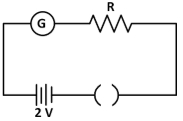 2016 Hard
- 48. A galvanometer having a coil resistance of \(100\ \Omega\). gives a full scale deflection, when a currect of \(I\ mA\) is passed through it. The value of the resistance, which can convert this galvanometer into ammeter giving a full scale deflection for a current of \(10\ A\), is :......\(Ω\) 2016 Medium
- 49. To know the resistance \(G\) of a galvanometer by half deflection method, a battery of \(emf\, V_E\) and resistance \(R\) is used to deflect the galvanometer by angle \(\theta \). If a shunt of resistance \(S\) is needed to get half deflection then \(G, R\) and \(S\) related by the equation 2016 Hard
- 50. In the circuit diagrams \((A, B, C\) and \(D\)) shown below, \(R\) is a high resistance and \(S\) is a resistance of the order of galvanometer resistance \(G\). The correct circuit, corresponding to the half deflection method for finding the resistance and figure of merit of the galvanometer, is the circuit labelled as
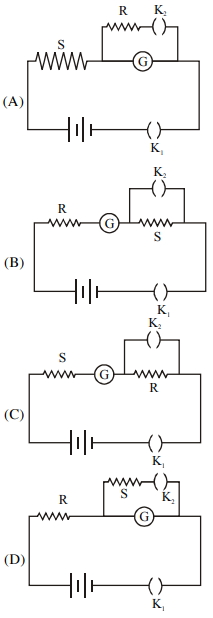 2014 Hard
No questions on this page match these filters.
Other STD 12 - Moving charges and magnetism topics
- 50Qs Biot-Savart's Law and its application
- 60Qs Motion of Charged Particle In Magnetic Field and Lorentz Force
- 29Qs Magnetic Moment of Current Carrying Coil and Torque and Work Done in Rotating the Coil
- 33Qs Force on a Current Carrying Conductor
- 18Qs Ampere's circuital law and its application (Solenoid and Toroid)
- 2Qs Cyclotron
Frequently asked
How many The Moving Coil Galvanometer and Ammeter and Voltmeter Conversion questions came in JEE Mains?
52 questions from 2013–2026, each with the correct answer and a full solution.
How difficult are The Moving Coil Galvanometer and Ammeter and Voltmeter Conversion questions?
6% are easy, 52% medium and 42% hard.