


Chapters asked in 2022
32 chapters- 32Qs STD 11 Units, dimensions and measurement Most asked
- 25Qs STD 12 Semicondutor electronics
- 18Qs STD 12 Nuclei
- 12Qs STD 12 Atoms
- 20Qs STD 12 Dual nature of radiation and matter
- 22Qs STD 12 Electromagnetic waves
- 18Qs STD 12 Wave optics
- 24Qs STD 12 Ray optics and optical instruments
- 27Qs STD 12 Alternating current
- 23Qs STD 11 System of particles and rotational motion
- 31Qs STD 12 Moving charges and magnetism Most asked
- 13Qs STD 12 Electromagnetic induction
- 8Qs STD 12 Magnetism and matter
- 46Qs STD 12 Current electricity Most asked
- 28Qs STD 12 Electric potential and capacitance
- 20Qs STD 12 Electric charges and fields
- 16Qs STD 11 Waves and sound
- 15Qs STD 11 Oscillations
- 20Qs STD 11 Kinetic theory of gases
- 18Qs STD 11 Thermodynamics
- 9Qs STD 11 10.1, thermonetry, thermal expansion and calorimetry
- 13Qs STD 11 Mechanical properties of solids
- 4Qs STD 11 Surface tension
- 15Qs STD 11 Fluid mechanics
- 25Qs STD 11 Newtons laws of motion
- 20Qs STD 11 Gravitation
- 20Qs STD 11 Work, energy, power and collision
- 9Qs STD 11 Friction
- 18Qs STD 11 Motion in plane
- 16Qs STD 11 Motion in straight line
- 6Qs STD 11 Transmission of heat
- 6Qs STD 11 Vectors
All JEE Mains 2022 Physics questions
32 chaptersShowing 1–50 of 597 questions
-
- (A) \(6.8\)
- (B) \(3.4\)
- (C) \(3.9\)
- (D) \(2.4\)
Show answer and solution
Correct Answer: (B)
\( L.C.=\frac{P}{N}=\frac{0.5\,mm}{50}=0.01\,mm\)Length of wire \(=6.8 cm\)
Diameter of wire \(=1.5\,mm +7 \times L.C\)
\(=1.5\, mm +7 \times .01=1.57\,mm\)
Curved surface area \(=\pi Dl\)
\(=3.14 \times 6.8 \times 1.57 \times 10^{-1} cm^{2}\)
\(=3.352\,cm ^{2}=3.4\,cm ^{2}\)
-
- (A) \(4\)
- (B) \(3\)
- (C) \(6\)
- (D) \(7\)
Show answer and solution
Correct Answer: (A)
\(M=(0.6 \pm 0.006) \; g\)\(r=(0.5 \pm 0.005) \; mm\)
\(l=(4 \pm 0.04) \; cm\)
\(\rho=\frac{m}{V}\)
\(\Rightarrow \frac{\Delta \rho}{\rho}=\frac{\Delta m}{m}+\frac{2 \Delta r}{r}+\frac{\Delta l}{l}\)
(Volume of cylinder \(=\pi r^{2} l\) )
\(=\frac{0.006}{0.6}+\frac{2 \times 0.005}{0.5}+\frac{0.04}{4}\)
\(100 \times \frac{\Delta \rho}{\rho}=4 \times 10^{-2} \times 100\)
\(\frac{\Delta \rho}{\rho} \times 100=4 \%\)
-
- (A) \(100\)
- (B) \(150\)
- (C) \(98\)
- (D) \(140\)
Show answer and solution
Correct Answer: (B)
\(X =\frac{1.22 mm +1.23 mm +1.19 mm +1.20 mm }{4}\)\(X =1.21 mm\)
\(\Delta x =\frac{0.01+0.02+0.02+0.01}{4}=\frac{0.06}{4}=0.015\)
Percentage error \(=\frac{0.015}{1.21} \times 100\)
\(X =150\)
-
- (A) \(15\)
- (B) \(25\)
- (C) \(75\)
- (D) \(5\)
Show answer and solution
Correct Answer: (B)
Dimensional formula for Torque\([\tau]=\left[ ML ^{2} T ^{-2}\right]\)
Now
Percentage error in torque \(=\% \tau=\% M +2 \% L+2 \% T\)
\(\% \tau=25 \%\)
-
- (A) \(0.001\)
- (B) \(0.0002\)
- (C) \(0.002\)
- (D) \(0.005\)
Show answer and solution
Correct Answer: (C)
\(1\,MSD =\frac{1}{20}\,cm\)\(1\,VSD =\frac{24}{25}\,MSD =\frac{24}{25} \times \frac{1}{20}\,cm\)
\(\therefore\) Least count \(=\frac{1}{20}\left(1-\frac{24}{25}\right)\,cm\)
\(=\frac{1}{20} \times \frac{1}{25}=\frac{1}{500}\,cm\)
\(=0.002\,cm\)
-
- (A) \(2\)
- (B) \(3\)
- (C) \(4\)
- (D) \(5\)
Show answer and solution
Correct Answer: (D)
\(50 \; VSD =49 \; MSD\)\(1 \; VSD =\frac{49}{50} \; MSD\)
Least count \(=1 MSD -1 VSD\)
\(=\left(1-\frac{49}{50}\right) MSD =\frac{1}{50} \; MSD\)
\(1 \; MSD =\frac{1}{40} \; cm\)
Least count \(=\frac{1}{50 \times 40} \; cm\)
\(=\frac{1}{2000} cm =\frac{1}{2} \times 10^{-5} \; m\)
\(=0.5 \times 10^{-5} \; m\)
\(=5 \times 10^{-6} \; m\)
-
- (A) \([ M ^{0} L ^{-1} T ^{0} ]\)
- (B) \([ ML ^{0} T ^{-2}]\)
- (C) \([ MLT ^{-2}]\)
- (D) \([ ML ^{2} T ^{-2}]\)
Show answer and solution
Correct Answer: (C)
\(P=\frac{\alpha}{\beta} \log _{ e }\left(\frac{ kt }{\beta x }\right)\)\(\frac{ kt }{\beta x }=1 \Rightarrow \beta=\frac{ kt }{ x }=\frac{ ML ^{2} T ^{-2}}{ L }\)
\(\left(\because E =\frac{1}{2} kt \right)\)
\(As \; P\) is dimensionless
\(\Rightarrow[\alpha]=[\beta]=\left[ MLT ^{-2}\right]\)
-
- (A) \(\left[ ML ^{2} T ^{-2} \theta^{-1}\right]\)
- (B) \(\left[ M ^{0} L ^{2} T ^{-2}\right]\)
- (C) \(\left[ M ^{0} L ^{0} T ^{0}\right]\)
- (D) \(\left[ M ^{0} L ^{2} T ^{0}\right]\)
Show answer and solution
Correct Answer: (D)
\(\frac{\alpha[ L ]}{\left[ ML ^{2} T ^{-2}\right]}=\left[ M ^{0} L ^{0} T ^{0}\right]\)\(\alpha=\left[ ML ^{1} T ^{-2}\right]\)
\(\frac{\alpha}{\beta}=\frac{\left[ ML ^{2} T ^{-2}\right]}{\left[ L ^{3}\right]} \Rightarrow \beta=\frac{\left[ ML ^{1} T ^{-2}\right]\left[ L ^{3}\right]}{ ML ^{2} T ^{-2}}\)
-
- (A) \(18\)
- (B) \(188\)
- (C) \(78\)
- (D) \(15\)
Show answer and solution
Correct Answer: (A)
\(z = a ^{2} x ^{3} y ^{1 / 2}\)\(\frac{\Delta z }{ z }=\frac{2 \Delta a }{ a }+\frac{3 \Delta x }{ x }+\frac{1}{2}\frac{\Delta y }{ y }\)
\(a\) is constant
\(\frac{\Delta z}{z} \times 100=3(4 \%)+\frac{1}{2}(12 \%)=18%\)
-
- (A) Both \(A\) and \(R\) true, and \(R\) is correct explanation of \(A\)
- (B) Both \(A\) and \(R\) are true but \(R\) is \(NOT\) the correct explanation of \(A\).
- (C) \(A\) is true but \(R\) is false.
- (D) \(A\) is false but \(R\) is true.
Show answer and solution
Correct Answer: (C)
Pressure and time\(P : \frac{ N }{ m ^{2}}, \text { Time : Sec }\)
\(Pt =\frac{ Nsec }{ m ^{2}}\)
\(\eta=\frac{ F }{6 \pi r v}: \frac{ N }{ m \cdot m / sec }: \frac{ Nsec }{ m ^{2}}\)
-
- (A) Both \((A)\) and \((R)\) are true and \((R)\) is the correct explanation of \((A)\)
- (B) Both \((A)\) and \((R)\) are true but \((R)\) is not the correct explanation of \((A)\)
- (C) \((A)\) is true but \((R)\) is false
- (D) \((A)\) is false but \((R)\) is true
Show answer and solution
Correct Answer: (D)
\(T=k \sqrt{\frac{\rho r^{3}}{s^{3 / 2}}}\)dimensions of \(RHS =\frac{\left[ M ^{1 / 2} L ^{-3 / 2}\right]\left[ L ^{3 / 2}\right]}{\left[ MT ^{-2}\right]^{3 / 4}}= M ^{1 / 3} L ^{0} T ^{3 / 2}\)
dimensions of L.H.S \(\neq\) dimensions of R.H.S
\(\therefore\) option (D)
-
- (A) velocity gradient and decay constant
- (B) wien's constant and Stefan constant
- (C) angular frequency and angular momentum
- (D) wave number and Avogadro number
Show answer and solution
Correct Answer: (A)
Velocity gradient \(=\frac{ dV }{ dx }=\frac{1}{ S }\)\(\lambda=\frac{1}{S}\)
-
- (A) Wave number and Rydberg's constant
- (B) Stress and Coefficient of elasticity
- (C) Coercivity and Magnetisation
- (D) Specific heat capacity and Latent heat
Show answer and solution
Correct Answer: (D)
\(S =\frac{ Q }{ m \Delta T }=\frac{ J }{ Kg ^{\circ} C }\)\(L =\frac{ Q }{ m }=\frac{ J }{ Kg }\)
-
- (A) \(RC\)
- (B) \(\frac{L}{R}\)
- (C) \(\sqrt{ LC }\)
- (D) \(\frac{L}{C}\)
Show answer and solution
Correct Answer: (D)
\(\left(\frac{L}{C}\right)\) does not have dimension of time.\(RC , \frac{ L }{ R }\) are time constant while \(\sqrt{ LC }\) is reciprocal of angular frequency or having dimension of time.
-
- (A) \(\left[ PA ^{-1} T ^{0}\right]\)
- (B) \(\left[ PA T ^{-1}\right]\)
- (C) \(\left[ PA ^{-1} T \right]\)
- (D) \(\left[ PA ^{-1} T ^{-1}\right]\)
Show answer and solution
Correct Answer: (A)
Viscosity \(=\) pascal.second\(P ^{ x } A ^{ y } T ^{z}=\left[ M ^{1} L ^{-1} T ^{-1}\right]\)
\(\left[ M ^{1} L ^{+1} T ^{-1}\right]^{ x }\left[ L ^{2}\right]^{y}\left[ T ^{1}\right]^{z}= M ^{1} L ^{-1} T ^{-1}\)
\(M ^{ x } L ^{+ x +2 y } T ^{- x + z }= M ^{1} L ^{-1} T ^{-1}\)
\(x=1 \quad x+2 y=-1 \quad-x+z=-1\)
\(y=-1\)
\(z=0\)
Viscosity \(= P ^{1} A ^{-1} T ^{0}\)
-
- (A) \(\frac{\Delta A }{ A }+\frac{\Delta B }{ B }+\frac{\Delta C }{ C }\)
- (B) \(\frac{2 \Delta A }{ A }+\frac{3 \Delta B }{ B }-\frac{4 \Delta C }{ C }\)
- (C) \(\frac{2 \Delta A }{ A }+\frac{3 \Delta B }{ B }+\frac{4 \Delta C }{ C }\)
- (D) \(\frac{\Delta A }{ A }+\frac{\Delta B }{ B }-\frac{\Delta C }{ C }\)
Show answer and solution
Correct Answer: (C)
\(Z=\frac{A^{2} B^{3}}{C^{4}}\)In case of error
\(\frac{ dZ }{ Z }=\frac{2 d A}{ A }+\frac{3 dB }{ B }+\frac{4 dC }{ C }\)
\(\frac{\Delta Z }{ Z }=\frac{2 \Delta A }{ A }+\frac{3 \Delta B }{ B }+\frac{4 \Delta C }{ C }\)
-
- (A) \(3.02\)
- (B) \(3.06\)
- (C) \(3.10\)
- (D) \(3.20\)
Show answer and solution
Correct Answer: (C)
\(1 \text { M.S.D }=1\,mm\)\(9 \text { M.S.D }=10 \text { V.S.D }\)
\(\text { 1 V.S.D }=0.9 \text { M.S.D }=0.9\,mm\)
\(\text { L.C of vernier caliper }=1-0.9=0.1\,mm =0.01\,cm\)
\(\text { zero error }=-(10-4) \times 0.1\,mm =-0.6\,mm\)
\(\text { Reading }=\text { M.S.R }+\text { V.S.R }-\text { Zero error }\)
\(=3\,cm +6 \times 0.01-[-0.06]\)
\(=3+0.06+0.06\)
\(=3.12\,cm\)
Nearest given answer in the options is \(3.10\)
-
- (A) \(3\)
- (B) \(5\)
- (C) \(7\)
- (D) \(9\)
Show answer and solution
Correct Answer: (B)
\(20 \; MSD =1 \; cm\)\(1 \; MSD =\frac{1}{20} \; cm\)
\(10 \; VSD =9 \; MSD\)
\(1 \; VSD =\frac{9}{10} \; MSD\)
\(=\frac{9}{10} \times \frac{1}{20} \; cm\)
\(1 VSD =\frac{9}{200} \; cm\)
VC \(=1 MSD -1 \; VSD\)
\(=\frac{1}{20} \; cm -\frac{9}{200} \; cm\)
\(=\frac{1}{200} \times 10 \; mm\)
VC \(=5 \times 10^{-2} \; mm\)
Ans. \(5\)
-
- (A) \(25\)
- (B) \(20\)
- (C) \(2\)
- (D) \(8\)
Show answer and solution
Correct Answer: (C)
\(L =1\,m\)\(\Delta L =0.4 \times 10^{-3} m\)
\(m =1\,kg\)
\(d =0.4 \times 10^{-3}\,m\)
\(\frac{ F }{ A }= Y \frac{\Delta L }{ L }\)
\(Y =\frac{ FL }{ A \Delta L }=\frac{( mg ) \cdot(1)}{\left(\frac{\pi d ^{2}}{4}\right) 0.4 \times 10^{-3}}\)
\(\Rightarrow \frac{10 \times 4}{\pi\left(0.4 \times 10^{-3}\right)^{2} \times 0.4 \times 10^{-3}}\)
\(Y =\frac{40}{\pi\left(0.4 \times 10^{-3}\right)^{3}}\)
\(Y =\frac{40 \times 7}{22 \times 64 \times 10^{-3} \times 10^{-9}}\)
\(Y =0.199 \times 10^{-12} N / m ^{2}\)
\(\frac{\Delta Y }{ Y }=\frac{\Delta F }{ F }+\frac{\Delta L }{ L }+\frac{\Delta A }{ A }+\frac{\Delta(\Delta L )}{(\Delta L )}\)
\(=\frac{0.02}{0.4}+2 \frac{\Delta d }{ d }=\frac{0.2}{4}+2 \times \frac{0.01}{0.4}\)
\(=\frac{0.1}{2}+\frac{0.1}{2}=0.1\)
\(\Rightarrow \Delta Y =0.1 \times Y\)
\(=0.199 \times 10^{11}=1.99 \times 10^{10}\)
-
- (A) \(4\)
- (B) \(5\)
- (C) \(3\)
- (D) \(2\)
Show answer and solution
Correct Answer: (B)
\(T=2 \pi \sqrt{\frac{\ell}{g}}\)\(g=\frac{1}{4 \pi^{2}} \frac{T^{2}}{\ell}\)
\(\frac{\Delta g}{g}=\frac{2 \Delta T }{ T }+\frac{\Delta \ell}{\ell}\)
\(\frac{\Delta g}{g}=2 \cdot \frac{1}{100 \times 0.5}+\frac{1\,mm }{10\,cm }\)
\(\frac{\Delta g}{g}=\frac{5}{100}\)
-
- (A) \(2.92\)
- (B) \(2.54\)
- (C) \(2.98\)
- (D) \(3.45\)
Show answer and solution
Correct Answer: (C)
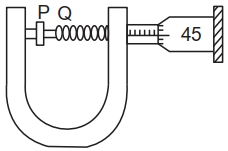
\(MSR =2.5\,mm\)\(CSR =45 \times \frac{0.5}{50}\,mm\)
\(=0.45\,mm\)
Diameter reading \(= MSR + CSR -\) zero error
\(=2.5+0.45-(-0.03)\)
\(=2.98\,mm\)
-
- (A) \(\frac{P}{V}\)
- (B) \(\frac{ V }{ P }\)
- (C) \(PV\)
- (D) \(PV ^{3}\)
Show answer and solution
Correct Answer: (C)
By principle of homogenity\({[ P ]=\left[\frac{ a }{ v ^{2}}\right] \text { and }[ b ]=[ v ]}\)
\(\Rightarrow\left[\frac{ a }{ b }\right]=[ PV ]\)
-
- (A) \((A)-(III), (B)-(II), (C)-(I), (D)-(IV)\)
- (B) \((A)-(III), (B)-(IV), (C)-(II), (D)-(I)\)
- (C) \((A)-(IV), (B)-(I), (C)-(III), (D)-(II)\)
- (D) \((A)-(II), (B)-(III), (C)-(I), (D)-(IV)\)
Show answer and solution
Correct Answer: (B)
Torque \(= F \times r _{\perp} \quad Nm\)Stress \(=\frac{\text { Force }}{\text { Area }} \quad N / m ^{2}\)
Latent heat \(=\frac{\text { Energy }}{\text { Mass }} \quad J Kg ^{-1}\)
Power \(=\frac{\text { Work }}{\text { Time }} \quad N ms ^{-1}\)
-
- (A) \(\left[ ML ^{2} T ^{-2} A ^{-1}\right]\)
- (B) \(\left[ ML ^{2} T ^{-3} A ^{-1}\right]\)
- (C) \(\left[ ML ^{2} T ^{-2} A ^{-2}\right]\)
- (D) \(\left[ ML ^{2} T ^{-3} A ^{-2}\right]\)
Show answer and solution
Correct Answer: (C)
\(e _{2}\) : induced emf in secondary coil\(i _{1}:\) Current in primary coil
\(M\) : Mutual inductance
\(e _{2}=- M \frac{ di _{1}}{ dt }\)
\(M =-\frac{ e _{2}}{\frac{ di }{ dt }}\)
\({[ M ]=\frac{\left[ e _{2}\right]}{\left[\frac{ di _{1}}{ dt }\right]}=\frac{\left[\frac{ W }{ q }\right]}{\left[\frac{ di _{1} }{ dt }\right]}=\frac{\left[ ML ^{2} T ^{-2}\right]}{\left[ \frac {AT}{AT^{-1}}\right]}}\)
\(=\left[ ML ^{2} T ^{-2} A ^{-2}\right]\)
- 25. The dimensions of \(\left(\frac{ B ^{2}}{\mu_{0}}\right)\) will be. (if \(\mu_{0}\) : permeability of free space and \(B\) : magnetic field) 2022 Medium
- (A) \(\left[ ML ^{2} T ^{-2}\right]\)
- (B) \(\left[ ML T ^{-2}\right]\)
- (C) \(\left[ ML ^{-1} T ^{-2}\right]\)
- (D) \(\left[ ML ^{2} T ^{-2} A ^{-1}\right]\)
Show answer and solution
Correct Answer: (C)
\(u =\frac{ B ^{2}}{2 \mu_{0}}\)\(u \rightarrow\) Energy per unit volume
\(\left[\frac{ B ^{2}}{\mu_{0}}\right]=[ u ]=\frac{\left[ ML ^{2} T ^{-2}\right]}{\left[ L ^{3}\right]}=\left[ ML ^{-1} T ^{-2}\right]\)
-
- (A) \(2.45 \times 10^{10} \,m\)
- (B) \(1.45 \times 10^{10} \,m\)
- (C) \(1.45 \times 10^{9} \,m\)
- (D) \(0.14 \times 10^{9} \,m\)
Show answer and solution
Correct Answer: (C)
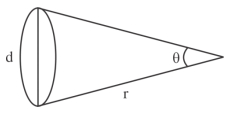
\(\theta=\frac{ d }{ r }\)\(\frac{2000}{60 \times 60} \times \frac{\pi}{180}=\frac{ d }{1.5 \times 10^{\prime \prime}}\)
\(\Rightarrow d =\frac{2000}{60 \times 60} \times \frac{\pi}{180} \times 1.5 \times 10^{\prime \prime}\)
\(=\frac{\pi \times 1.5}{3 \times 6 \times 18} \times 10^{\prime \prime}=1.45 \times 10^{9}\)
-
- (A) \(2\)
- (B) \(4\)
- (C) \(6\)
- (D) \(8\)
Show answer and solution
Correct Answer: (D)
\(E _{ H }= I ^{2} R \times t\)\(\frac{\Delta E }{ E } \times 100=\frac{2 \Delta I }{ I } \times 100+\frac{\Delta R }{ R } \times 100+\frac{\Delta T }{ T } \times 100\)
\(=2 \times 2+1+3=8\)
-
- (A) \(413\)
- (B) \(411\)
- (C) \(141\)
- (D) \(412\)
Show answer and solution
Correct Answer: (D)
\(10\,VSD =9\,MSD\)\(1\,VST =.9\,MSD\)
\(L.C.\) \(=1\,mm =.01\,cm\)
\(+ve\) zero error \(=4\,mm\)
\(=0.04\,cm\)
Negative zero error \(=4.1\,cm +6 \times .01\)
\(=4.12\,cm\)
\(=412 \times 10^{-2}\,cm\)
- 29. The \(SI\) unit of a physical quantity is pascal-second. The dimensional formula of this quantity will be .............. 2022 Medium
- (A) \(\left[ ML ^{-1} T ^{-1}\right]\)
- (B) \(\left[ ML ^{-1} T ^{-2}\right]\)
- (C) \(\left[ ML ^{2} T ^{-1}\right]\)
- (D) \(\left[ M ^{-1} L ^{3} T ^{0}\right]\)
Show answer and solution
Correct Answer: (A)
Pascal second\(\frac{F}{A} t=\frac{M L T^{-2}}{L^{2}} T=M L^{-1} T^{-1}\)
-
- (A) \(160\)
- (B) \(150\)
- (C) \(189\)
- (D) \(180\)
Show answer and solution
Correct Answer: (D)
Measured diameter \(= MSR + VSR \times VC\)\(=1.7+0.01 \times 5\)
\(=1.75\)
Corrected \(=\) Measured - Error
\(=1.75-(-0.05)\)
\(=1.80 \,cm\)
\(=180 \times 10^{-2} \,cm\)
\(180\)
-
- (A) \(\frac{ n ^{3}}{ m ^{3}} L _{1}= L _{2}\) and \(\frac{ n ^{2}}{ m } T _{1}= T _{2}\)
- (B) \(L_{1}=\frac{n^{4}}{m^{2}} L_{2}\) and \(T_{1}=\frac{n^{2}}{m} T_{2}\)
- (C) \(L _{1}=\frac{ n ^{2}}{ m } L _{2}\) and \(T _{1}=\frac{ n ^{4}}{ m ^{2}} T _{2}\)
- (D) \(\frac{ n ^{2}}{ m } L _{1}= L _{2}\) and \(\frac{ n ^{4}}{ m ^{2}} T _{1}= T _{2}\)
Show answer and solution
Correct Answer: (A)
\(\frac{ L _{2}}{ T _{2}}=\frac{ n }{ m ^{2}} \frac{ L _{2}}{ T _{1}}\)\(\frac{ L _{2}}{ T _{2}^{2}}=\frac{ L _{1}}{ T _{1}^{2} \times mn }\)
\(\frac{ n }{ m ^{2}} \times \frac{ T _{2}}{ T _{1}}=\frac{ T _{2}^{2}}{ T _{1}^{2} \times mn }\)
\(\frac{ n ^{2}}{ m }=\frac{ T _{2}}{ T _{1}}\)
\(\frac{ L _{2}}{ L _{1}}=\frac{ n ^{4}}{ m ^{2}} \times \frac{1}{ mn }\)
\(\frac{ L _{2}}{ L _{1}}=\frac{ n ^{5}}{ m ^{3}}\)
-
- (A) Electric displacement \((\overrightarrow{ D })\) and surface charge density
- (B) Displacement current and electric field
- (C) Current density and surface charge density
- (D) Electric potential and energy
Show answer and solution
Correct Answer: (A)
Electric displacement\(\overrightarrow{ D }=\epsilon_{0} \overrightarrow{ E }\)
\([ D ]=\left[\epsilon_{0} E \right]=\left[\epsilon_{0} \frac{\sigma}{\epsilon_{0}}\right]\)
\([ D ]=[\sigma]\)
\(\rightarrow\) Surface change density \(=\sigma\).
-
- (A) \(AND\) gate
- (B) \(OR\) gate
- (C) \(NOR\) gate
- (D) \(NAND\) gate
Show answer and solution
Correct Answer: (A)
By making Truth table\(A\) \(B\) \(Output\) \(0\) \(0\) \(1\) \(1\) \(1\) \(1\) \(0\) \(1\) \(0\) \(1\) \(0\) \(0\) Comparing with output of \(AND\) gate
\(A\) \(B\) \(AND\) \(0\) \(0\) \(0\) \(0\) \(1\) \(0\) \(1\) \(0\) \(0\) \(1\) \(1\) \(1\) -
- (A) \(11\)
- (B) \(13\)
- (C) \(14\)
- (D) \(20\)
Show answer and solution
Correct Answer: (C)
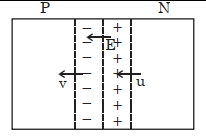
Work done by Electric field \(=K_{ r }- K _{ I }\)\(\frac{1}{2} mv ^{2}-\frac{1}{2} mu ^{2}=-1.6-10^{-19} \times 0.4\)
\(\frac{1}{2} 9 \times 10^{-31}\left( v ^{2}- u ^{2}\right)=-0.64 \times 10^{-19}\)
\(u ^{2}- v ^{2}=\frac{2 \times 0.64 \times 10^{12}}{9}\)
\(v ^{2}=\left(36-\frac{128}{9}\right) \times 10^{10}\)
\(v =\frac{14}{3} \times 10^{5} \,m / s\)
\(x =14\)
-
- (A) \(2\)
- (B) \(5\)
- (C) \(3\)
- (D) \(1\)
Show answer and solution
Correct Answer: (A)
\(\Delta i _{ B }=100 \,\mu A \quad \beta=\frac{\Delta i _{ C }}{\Delta i _{ B }}\)\(\Delta i _{ c }=10 \,mA\)
power \(=\beta^{2} \times \frac{R_{0}}{R_{i n}}\)
Power \(=\left(\frac{10}{0.1}\right)^{2} \times \frac{2}{1}\)
Power \(=100 \times 100 \times 2\)
Gain \(=2 \times 10^{4}\)
-
- (A) \(950\)
- (B) \(750\)
- (C) \(780\)
- (D) \(790\)
Show answer and solution
Correct Answer: (B)
\(I _{ i }=\frac{10 mV }{10 \mu A }=10^{3} \Omega\)\(\beta=\frac{1.5 mA }{10 \mu A }=150\)
\(A _{ V }=\left(\frac{ R _{0}}{ r _{ i }}\right) \beta=\left(\frac{5000}{1000}\right) \times 150=750\)
-
- (A) \(1\)
- (B) \(2\)
- (C) \(3\)
- (D) \(4\)
Show answer and solution
Correct Answer: (B)
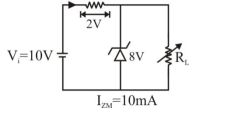
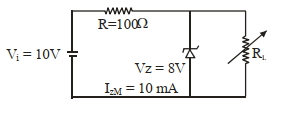
\(I =\frac{2}{100}=20 mA\)\(V _{ L }= I _{ L } R _{ L }\)
\(8=10 \times 10^{-3} \times R _{ L _{\max }}\)
\(\frac{4}{5} \times 10^{3}= R _{ L _{\max }}\)
\(800= R _{ L _{\max }}\)
\(I = I _{ Z }+ I _{ L }\)
\(I _{ L }=10 mA\)
If \(I _{ Z }=0\)
\(I _{ L _{\max }}=20 mA\)
\(V _{ L }= I _{ L _{\max }} \times R _{ L _{\min }}\)
\(\frac{8}{20} \times 10^{3}= R _{ L _{\min }}\)
\(400= R _{ L _{\min }}\)
\(\frac{ R _{ L _{\max }}}{ R _{ L _{\min }}}=\frac{800}{400}=2\)
-
- (A) \(0.1\)
- (B) \(1.0\)
- (C) \(10\)
- (D) \(100\)
Show answer and solution
Correct Answer: (B)
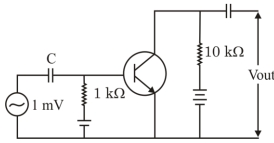
\(\frac{v_{\text {out }}}{v_{\text {in }}}=\beta \frac{R_{\text {out }}}{R_{\text {in }}}\)\(v_{\text {out }}=\frac{100 \times 10 \times 10^{3}}{10^{3}} \times 10^{-3}\)
\(=1\,V\)
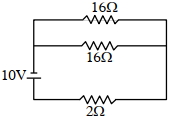
- 39. As per the given circuit, the value of current through the battery will be \(\dots \; A\).
 2022 Medium
- (A) \(0\)
- (B) \(1\)
- (C) \(2\)
- (D) \(3\)
Show answer and solution
Correct Answer: (B)
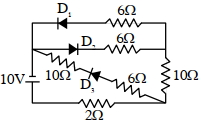
\(V = IR _{\text {net }}\)\(10= I \times 10\)
\(I=1 A\)
Ans. \(1\)
-
- (A) \(240\)
- (B) \(400\)
- (C) \(0.0025\)
- (D) \(200\)
Show answer and solution
Correct Answer: (B)
\(3\,V_{C E}=8\,V = I _{ C }=6\,mA\) from \(4\,mA\)\(I _{ B }=20\, \mu A\) to \(25\, \mu A\)
Current gain \(\beta_{ av }=\frac{ I _{ C }{ }^{\prime}- I _{ C }}{ I _{ B }{ }^{\prime}- I _{ B }}=\frac{2\, mA }{5\, \mu A }\)
\(\beta_{ av }=\frac{2}{5} \times 10^{3}=\frac{2000}{5}=400\)
-
- (A) Active region
- (B) Saturation state only
- (C) Cut-off state only
- (D) Saturation and cut-off state
Show answer and solution
Correct Answer: (D)
Transistor act as a switch in saturation and cut of region. - 42. For using a multimeter to identify diode from electrical components. choose the correct statement out of the following about the diode 2022 Medium
- (A) It is two terminal device which conducts current in both directions
- (B) It is two terminal device which conducts current in one direction only
- (C) It does not conduct current gives an initial deflection which decays to zero
- (D) It is three terminal device which conducts current in ne direction only between central terminal and either of the remaining two terminals
Show answer and solution
Correct Answer: (B)
In forward bias diode conductsIn revers bias it does not conducts
-
- (A) Both \(A\) and \(R\) true. and \(R\) is correct explanation of \(A\)
- (B) Both \(A\) and \(R\) are true but \(R\) is \(NOT\) the correct explanation of \(A\)
- (C) \(A\) is true but \(R\) is false
- (D) \(A\) is false but \(R\) is true
Show answer and solution
Correct Answer: (A)
Theory -
- (A) \(AND\) gate
- (B) \(OR\) gate
- (C) \(OR\) gate
- (D) \(NAND\) gate
Show answer and solution
Correct Answer: (A)
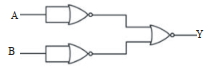
\(=[\overline{[\overline{ A + A }]+[\overline{ B + B }]}]\)\(Y =\overline{\overline{ A }+\overline{ B }}\left( D ^{\prime} \,MORGA\,\, LAW \right)\)
\(Y = AB\)
-
- (A) \(0\)
- (B) \(1\)
- (C) \(10\)
- (D) \(100\)
Show answer and solution
Correct Answer: (B)
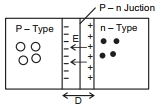
\(E =\frac{ V }{ d }=\frac{\text { Potential barrier Across Junction }}{\text { width of Depletion layer }}\)\(=\frac{0.6\,V }{6 \times 10^{-6}\,m }=1 \times 10^{5}\,V / m\)
\(=1 \times 10^{5}\,N / C\)
-
- (A) \(155\)
- (B) \(78\)
- (C) \(17\)
- (D) \(15\)
Show answer and solution
Correct Answer: (D)
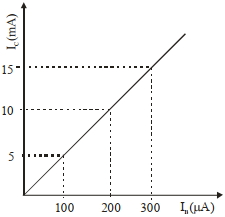
Voltage Gain \(=\frac{ I _{ C }}{ I _{ B }} \times \frac{ R _{0}}{ R _{ I }}=\frac{10 \times 10^{-3}}{200 \times 10^{-6}} \times \frac{60}{200}=15\) -
- (A) \(9\)
- (B) \(90\)
- (C) \(95\)
- (D) \(45\)
Show answer and solution
Correct Answer: (A)
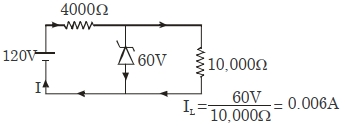
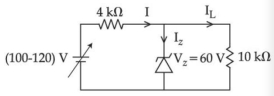
\(I =\frac{(120-60)\,V }{4000\,\Omega}=0.015\,A\)Thus \(\quad I _{2}= I - I _{ L }\)
\(=0.015-0.006=0.009 A =9\,mA\)
-
- (A)
\(A\) \(B\) \(y\) \(0\) \(0\) \(0\) \(1\) \(0\) \(0\) \(0\) \(1\) \(0\) \(1\) \(1\) \(1\) - (B)
\(A\) \(B\) \(y\) \(0\) \(0\) \(0\) \(1\) \(0\) \(1\) \(0\) \(1\) \(1\) \(1\) \(1\) \(1\) - (C)
\(A\) \(B\) \(y\) \(0\) \(0\) \(0\) \(1\) \(0\) \(0\) \(0\) \(1\) \(0\) \(1\) \(1\) \(0\) - (D)
\(A\) \(B\) \(y\) \(0\) \(0\) \(1\) \(1\) \(0\) \(1\) \(0\) \(1\) \(1\) \(1\) \(1\) \(0\)
Show answer and solution
Correct Answer: (A)
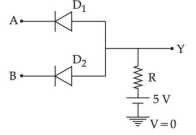
When both \(A\) and \(B\) have logical value \(' 1 '\) both diode are reverse bias and current will flow in resistor hence output will be \(5\) volt i.e. logical value '\(1\)'.In all other case conduction will take place, hence output will be \(zero\) volt i.e. logical value ' \(0\) '.
So truth table is \((AND\,gate)\)
\(A\) \(B\) \(y\) \(0\) \(0\) \(0\) \(0\) \(1\) \(0\) \(1\) \(0\) \(0\) \(1\) \(1\) \(1\) - (A)
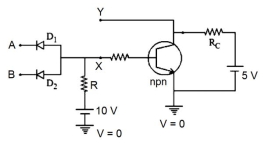
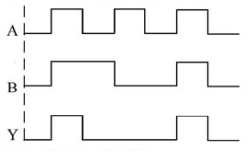
- 49. In the following circuit, the correct relation between output \(( Y )\) and inputs \(A\) and \(B\) will be
 2022 Hard
- (A) \(Y = AB\)
- (B) \(Y = A + B\)
- (C) \(Y =\overline{ AB }\)
- (D) \(Y=\overline{ A + B }\)
Show answer and solution
Correct Answer: (C)
This is \(NAND\) gate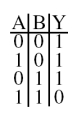
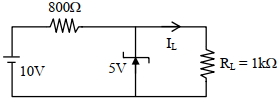
- 50. In the given circuit- the value of current \(I _{ L }\) will be \(mA\). (When \(R _{ L }=1 \,k\, \Omega\) )
 2022 Easy
- (A) \(5\)
- (B) \(55\)
- (C) \(7\)
- (D) \(1\)
Show answer and solution
Correct Answer: (A)
\(I_{L}=\frac{5}{1000}=5 \,mA\)
No questions on this page match these filters.
Other years
Frequently asked
How many JEE Mains 2022 Physics questions are on ExamBro?
597 questions, each with the correct answer and a full solution.
Which JEE Mains 2022 Physics chapter is asked the most?
Current electricity, with 46 questions, followed by Units, dimensions and measurement with 32.
How difficult are JEE Mains 2022 Physics questions?
7% are easy, 66% medium and 26% hard.