


Questions
Newest firstShowing 1–23 of 23 questions
-
- (A) 1.23 atm
- (B) 2.46 atm
- (C) 0.82 atm
- (D) 1.47 atm
Show answer and solution
Correct Answer: (B)
Mass of solute 'A' = 0.3 g
Moles of solute 'A' = \( \frac{0.3g}{60g/mol} = \frac{1}{200} \) mol
Mass of solute 'B' = 0.9 g
Moles of solute 'B' = \( \frac{0.9g}{180g/mol} = \frac{1}{200} \) mol
Total molarity of all solutes
= \( \frac{2/200}{100} \times 1000 = \frac{1}{10}M \)
\( \therefore\pi = \frac{1}{10} \times 0.082 \times 300 \)
\( \pi = 2.46 \) atm. -
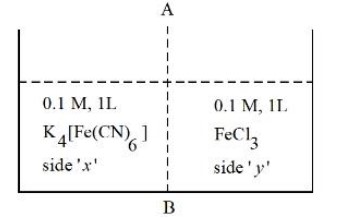
- (A) Blue color is formed on both sides.
- (B) Ionic solutes in aqueous solution can pass through semi-permeable membrane.
- (C) Solution on side '\(y\)' is hypotonic.
- (D) To cause the reverse flow of solvent during osmosis, external pressure (any value) should be applied to side '\(x\)'.
Show answer and solution
Correct Answer: (C)
For complete dissociation, the van 't Hoff factor \(i\) is equal to the number of ions produced per formula unit.
For side 'x' containing \(K_4[Fe(CN)_6]\):
\(K_4[Fe(CN)_6] \rightarrow 4K^+ + [Fe(CN)_6]^{4-}\)
Number of ions, \(i_x = 5\)
Effective concentration (osmolarity) \(= i_x \times C = 5 \times 0.1 = 0.5\) M
For side 'y' containing \(FeCl_3\):
\(FeCl_3 \rightarrow Fe^{3+} + 3Cl^-\)
Number of ions, \(i_y = 4\)
Effective concentration (osmolarity) \(= i_y \times C = 4 \times 0.1 = 0.4\) M
Since the effective concentration of side 'y' (\(0.4\) M) is less than that of side 'x' (\(0.5\) M), the solution on side 'y' has a lower osmotic pressure and is therefore hypotonic with respect to side 'x'.
Evaluating the other options:
A semi-permeable membrane (SPM) only allows solvent molecules to pass, not solute ions. Thus, \(Fe^{3+}\) and \([Fe(CN)_6]^{4-}\) cannot mix, and no blue color is formed.
To cause reverse osmosis, the external pressure applied to the hypertonic side (side 'x') must be strictly greater than the osmotic pressure difference (\(\Delta \pi = \pi_x - \pi_y\)), not just any value.
Answer: Solution on side '\(y\)' is hypotonic. -
- (A) Both Statement I and Statement II are true
- (B) Both Statement I and Statement II are false
- (C) Statement I is true but Statement II is false
- (D) Statement I is false but Statement II is true
Show answer and solution
Correct Answer: (D)
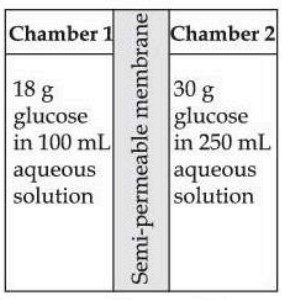
For Statement I:
Molarity of the solution in Chamber 1 (\(M_1\)) = \(\dfrac{18 / 180}{100 / 1000} = 1\) M
Molarity of the solution in Chamber 2 (\(M_2\)) = \(\dfrac{30 / 180}{250 / 1000} = \dfrac{1/6}{1/4} = 0.667\) M
Since \(M_1 > M_2\), the solution in Chamber 1 has a higher solute concentration. During osmosis, the solvent (water) moves from the region of lower solute concentration to the region of higher solute concentration across a semi-permeable membrane. Thus, water will move from Chamber 2 to Chamber 1. Statement I is false.
For Statement II:
The osmotic pressure is given by \(\pi = iCRT\)
For \(K_2SO_4\), assuming complete dissociation (\(K_2SO_4 \rightarrow 2K^+ + SO_4^{2-}\)), the van't Hoff factor \(i = 3\).
Concentration \(C = \dfrac{50 \times 10^{-3}}{174 \times 2}\) mol/L
\(\pi = 3 \times \left( \dfrac{50 \times 10^{-3}}{174 \times 2} \right) \times 0.083 \times 300\)
\(\pi = \dfrac{3 \times 0.05 \times 24.9}{348} = \dfrac{3.735}{348} \approx 0.0107\) bar
Statement II is true.
Therefore, Statement I is false but Statement II is true.
Answer: Statement I is false but Statement II is true -
- (A) 15
- (B) 30
- (C) 7.5
- (D) 58.5
Show answer and solution
Correct Answer: (A)
\(\pi= iCRT\)
\(12=2 \times C \times 0.08 \times 300\)
\(12=2 \times C \times 24\)
\(C =\frac{1}{4} mole / L\)
then strength of NaCl solution
\(=\frac{1}{4} \times 58.5 g / L\)
\(=14.625 g / L\)
\(=15 g / L\) -
- (A) show no change in volume since solution is \(0.9 \%(\omega / \omega)\)
- (B) shrink since solution is \(0.5 \%(\omega / \omega)\)
- (C) swell up since solution is \(1 \%(\omega / \omega)\)
- (D) None of these
Show answer and solution
Correct Answer: (D)
Living cell \(=0.9 \mathrm{gm}\) in 100 gm of solution
\(\% \mathrm{w} / \mathrm{w}=0.9\)
Solution is have equal moles of glucose and water \(=0.5\)
Weight of solution \(=0.5 \times 180+0.5 \times 18=99 \mathrm{gm}\) \(\% \mathrm{w} / \mathrm{w} \simeq 90 \%\)
Concentrated solution = Cell will shrink. -
- (A) B and D only
- (B) A and D only
- (C) A and C only
- (D) C only
Show answer and solution
Correct Answer: (C)
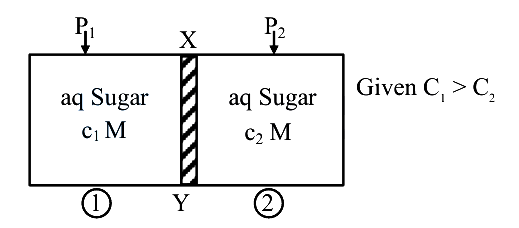
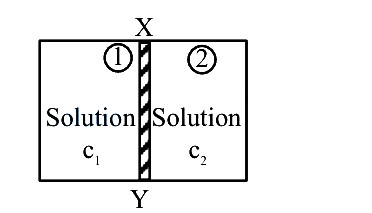
Normal osmosis occurs from (2) to (1)
For reverse osmosis from (1) to (2)
Pressure : \(\mathrm{P}_1 \gt \pi\)
\(\therefore\) Answer [A & C] only -
- (A) Green colour formation observed on side \(Y\).
- (B) Green colour formation observed on side \(\mathrm{X}\).
- (C) Molarity of \(\mathrm{K}_2 \mathrm{Cr}_2 \mathrm{O}_7\) solution is lowered.
- (D) Molarity of \(\mathrm{CuSO}_4\) solution is lowered.
Show answer and solution
Correct Answer: (D)
Only solvent Molecules are allowed to pass through the \(SPM\).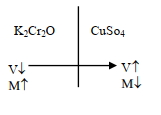
-
- (A) \(10\)
- (B) \(20\)
- (C) \(25\)
- (D) \(30\)
Show answer and solution
Correct Answer: (C)
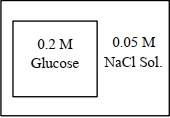
\(\mathrm{NaCl} \longrightarrow \mathrm{Na}^{+}+\mathrm{Cl}^{-}\)\(0.05 \mathrm{M} \quad 0.05 \mathrm{M} \quad 0.05 \mathrm{M}\)
\(\text { Total } \mathrm{C}_1=0.05+0.05=0.1 \mathrm{M}(\mathrm{NaCl})\)
\(\mathrm{C}_2=0.2 \mathrm{M}(\text { glucose })\)
\(\pi=\left(\mathrm{C}_2-\mathrm{C}_1\right) \mathrm{RT}\)
\(=(0.2-0.1) \times 0.083 \times 300\)
\(=2.49 \text { bar }\)
\(=24.9 \times 10^{-1} \text { bar }\)
-
- (A) \(76\)
- (B) \(77\)
- (C) \(79\)
- (D) \(80\)
Show answer and solution
Correct Answer: (A)
\(\mathrm{HX} \rightleftharpoons \mathrm{H}^{+}+\mathrm{X}^{-} \quad \mathrm{K}_{\mathrm{a}}=1.2 \times 10^{-5}\)\(0.03 \mathrm{M}\)
\(0.03-\mathrm{x} \quad \mathrm{x} \quad \mathrm{x}\)
\(\mathrm{K}_{\mathrm{a}}=1.2 \times 10^{-5}=\frac{\mathrm{x}^2}{0.03-\mathrm{x}}\)
\(0.03-\mathrm{x} \approx 0.03\left(\mathrm{~K}_{\mathrm{a}}\right. \text { is very small) }\)
\(\frac{\mathrm{x}^2}{0.03}=1.2 \times 10^{-5}\)
\(\mathrm{x}=6 \times 10^{-4}\)
\(\text { Final solution }: 0.03-\mathrm{x}+\mathrm{x}+\mathrm{x}\)
\(=0.03+\mathrm{x}=0.03+6 \times 10^{-4}\)
\(\Pi=\left(0.03+\left(6 \times 10^{-4}\right)\right) \times 0.083 \times 300\)
\(=76.19 \times 10^{-2} \approx 76 \times 10^{-2}\)
-
- (A) \(36\)
- (B) \(73\)
- (C) \(45\)
- (D) \(15\)
Show answer and solution
Correct Answer: (B)
\( \text { (72.56) or (73) } \)\( \pi=\text { CRT } \)
\( \Rightarrow \frac{\pi_1}{\pi_2}=\frac{\mathrm{T}_1}{\mathrm{~T}_2} \)
\( \Rightarrow \pi_2=\frac{\pi_1 \mathrm{~T}_2}{\mathrm{~T}_1}=\frac{7 \times 10^5 \times 283}{273} \)
\( =72.56 \times 10^4 \mathrm{Nm}^{-2}\)
-
- (A) \(71\)
- (B) \(73\)
- (C) \(74\)
- (D) \(75\)
Show answer and solution
Correct Answer: (D)
Isotonic solutions,\(\pi_{ K _2 SO _4}=\pi_{ Glucose }\)
\(i \times 0.004 \times RT =0.01 \times RT\)
\(i =2.5\)
For \(K _2 SO _4 \quad\{\) for dissociation \(i =1+( n -1) \alpha\}\)
\(\operatorname{DOD}(\alpha)=\frac{ i -1}{ n -1}=\frac{2.5-1}{3-1}=0.75\)
\(\%\) dissociation \(=75\)
-
- (A) \(40536\)
- (B) \(40537\)
- (C) \(40535\)
- (D) \(40538\)
Show answer and solution
Correct Answer: (C)
\(\because \pi= CRT\)\(\pi=\frac{n}{V} R T\)
\(\pi=\frac{\omega}{V} \frac{R T}{M}\)
\(M=\frac{\omega R T}{\pi \times V}\)
\(M=\frac{0.63 \times 0.083 \times 300}{1.29 \times 10^{-3} \times 300 \times 10^{-3}}\)
\(M=40535\,gm / moL\)
-
- (A) \(62240\)
- (B) \(62258\)
- (C) \(62240\)
- (D) \(62250\)
Show answer and solution
Correct Answer: (D)
\(\pi= CRT\)\(\frac{400\,Pa }{10^5}=\frac{\frac{2.5\,g }{ M _o}}{250 / 1000\,L } \times 0.83 \frac{ L - bar }{ K \cdot mol } \times 300\,K\)
\(M _0=62250\)
-
- (A) \(B, D\) and \(E\) only
- (B) \(A, B\) and \(D\) only
- (C) \(A\) and \(C\) only
- (D) \(B\) and \(D\) only
Show answer and solution
Correct Answer: (D)
\((A)\) \(\Delta T _{ b } \propto i \times c\)\((B)\) Azeotropic mixtures have same composition in both liquid and vapour phase.
\((C)\) Osmosis always takes place from hypotonic to hypertonic solution.
\((D)\) \(M =\frac{30 \times 10 \times 1.26}{98} \approx 4.09\,M\)
\((E)\) When \(KI\) solutions is added to \(AgNO _3\) solution, positively charged solution results due to adsorption of \(Ag ^{ F }\) ions from dispersion medium
\(AgI / Ag ^{+}\)
Positively charged
-
- (A) \(241\)
- (B) \(242\)
- (C) \(240\)
- (D) \(243\)
Show answer and solution
Correct Answer: (C)
\(\pi_1=\pi_2\)\(\Rightarrow C_1=C_2\)
\(\frac{12}{ x }=0.05[ x \rightarrow \text { Molar Mass of } A ]\)
\(X =240\)
-
- (A) \(120\)
- (B) \(330\)
- (C) \(450\)
- (D) \(903\)
Show answer and solution
Correct Answer: (B)
\(\pi= CRT\)\(5.03 \times 10^{-3}= C \times 0.083 \times 300\)
\(C =0.202 \times 10^{-3}\, M\)
Moles of protein \(=0.202 \times 10^{-3} \times 0.5\)
\(=10^{-4} \times 1.01\)
\(1.01 \times 10^{-4}=\frac{2.5}{ M }\)
\(M (\) molar mass of protein \()=24752\)
\(\therefore\) No. of glycine units \(=\frac{24752}{75}=330.03\)
-
- (A) \(11\)
- (B) \(33\)
- (C) \(54\)
- (D) \(44\)
Show answer and solution
Correct Answer: (C)
\(\pi= C.R.T\)\(7.47= C \times 0.083 \times 300\)
\(C =0.3 M\)
\(=0.3 \times 180 gL ^{-1}\)
\(=54 gL ^{-1}\)
-
- (A) \(7\)
- (B) \(5\)
- (C) \(91\)
- (D) \(15\)
Show answer and solution
Correct Answer: (D)
\(\pi=\mathrm{CRT}\)\(; \pi=\) osmotic pressure
\(\mathrm{C}=\) molarity
\(T=\) Temperature of solution
let the molar mass be \(\mathrm{M}\, \mathrm{gm} / \mathrm{mol}\)
\(2.42 \times 10^{-3}\, \mathrm{bar}=\frac{\left(\frac{1.46\, \mathrm{~g}}{\mathrm{M\,gm} / \mathrm{mol}}\right)}{0.1\, \ell} \times\left(\frac{0.083\, \ell-\mathrm{bar}}{\mathrm{mol}-\mathrm{K}}\right) \times(300\, \mathrm{~K})\)
\(\Rightarrow \quad \mathrm{M}=15.02 \times 10^{4}\, \mathrm{~g} / \mathrm{mol}\)
-
- (A) \(150\)
- (B) \(167\)
- (C) \(160\)
- (D) \(159\)
Show answer and solution
Correct Answer: (B)
Osmotic pressure \(=\pi= i \times C \times RT\)For \(NaCl i =2\) so
\(\pi_{ NaCl }= i \times C _{ NaCl } \times RT \quad C _{ NaCl }=\) conc. of \(NaCl\)
\(0.1=2 \times C _{ NaCl } \times RT\)
\(C_{ NaCl }=\frac{0.05}{ RT } \quad C_{\text {glucose }}=\) conc. of glucose
For glucose \(i=1\) so
\(\pi_{\text {Glucose }}= i \times C _{\text {glucose }} \times RT\)
\(0.2=1 \times C _{\text {glucose }} \times RT\)
\(C _{\text {Glucose }}=\frac{0.2}{ RT } \quad \eta_{ NaCl }=\) No. of moles \(NaCl\)
\(\eta_{ NaCl }\) in \(1 L = C _{ NaCl } \times V _{\text {Litre }}\)
\(=\frac{0.05}{ RT } \quad \eta_{ glucose }=\) No. of moles glucose
\(\eta_{\text {glucose }}\) in \(2 L = C _{\text {glucose }} \times V _{\text {Litre }}\)
\(=\frac{0.4}{ RT }\)
\(V _{\text {Total }}=1+2=3 L\)
so Final conc. \(NaCl =\frac{0.05}{3 RT }\)
Final conc. glucose \(=\frac{0.4}{3 RT }\)
\(\pi_{\text {Total }}=\pi_{ NaCl }+\pi_{\text {glucose }}\)
\(=\left[i \times C_{ NaCl }+C_{\text {glucose }}\right] \times RT\)
\(=\left(\frac{2 \times 0.05}{3 RT }+\frac{0.4}{3 RT }\right) \times RT\)
\(=\frac{0.5}{3} atm\)
\(=0.1666 atm\)
\(=166.6 \times 10^{-3} atm\)
\(\Rightarrow 167.00 \times 10^{-3} atm\)
so \(x=167.00\)
-
- (A) \(8.2\)
- (B) \(1.64\)
- (C) \(4.92\)
- (D) \(2.46\)
Show answer and solution
Correct Answer: (C)
\(\pi \, = \,CRT\, = \,\left( {\frac{6}{{10}}\, + \,\frac{{18}}{{180}}} \right)\, \times \,0.0821\, \times \,300\)\( = \,0.2\, \times \,0.082\, \times \,300\, = \,4.926\,atm.\)
-
- (A) \(4\times 10^{-4}\)
- (B) \(6\times 10^{-2}\)
- (C) \(16\times 10^{-4}\)
- (D) \(4\times 10^{-2}\)
Show answer and solution
Correct Answer: (B)
\({\pi _{xy}}\, = \,4{\pi _{BaC{l_2}}}\)\({\pi _{xy}}\, = \,iCRT\)
\({\pi _{xy}}\,\, = \,2CRT\)
\({\pi _{BaC{l_2}}}\, = \,3\, \times \,0.01\,RT\)
\(RT\, = \,12\, \times \,0.01RT\)
\(\frac{{12 \times 0.01}}{2}\, = \,0.06\)
-
- (A) They all have the same osmotic pressure.
- (B) \(0.100\, M\, Mg_3(PO_4)_2\,(aq)\) has the highest osmotic pressure.
- (C) \(0.125\, M\, Na_3PO_4\,(aq)\) has the highest osmotic pressure.
- (D) \(0.500\, M\, C_2H_5OH\,(aq)\) has the highest osmotic pressure.
Show answer and solution
Correct Answer: (A)
\(\pi=i C R T\)\(^{\pi} C_{2} H_{3} O H\) \(=1 \times 0.500 \times R \times T=0.5 R T\)
\(^{\pi} M g_{3}\left(P O_{4}\right)_{2}\) \(=5 \times 0.100 \times R \times T=0.5 R T\)
\(^{\pi} K B r=2 \times 0.250 \times R \times T=0.5 R T\)
\(^{\pi} N a_{3} P O_{4}=4 \times 0.125 \times R T=0.5 R T\)
since the osmotic pressure of all the given solutions is equal.
Hence all are isotonic solution.
-
- (A) \(5\) and \(4.42\)
- (B) \(4\) and \(4.00\)
- (C) \(5\) and \(3.42\)
- (D) \(3\) and \(5.42\)
Show answer and solution
Correct Answer: (A)
Given \({\pi _{ob}}\, = \,10.8\,atm\)\({\pi _{nor}}\, = \,CST\, = \,0.10\, \times \,0.0821\, \times \,298\, = \,2.446\)
now experimntal value of \((i)\)
\(=\,\frac {Observed\,osmotic\,pressure}{Normal\,osmotic\,pressure}\)
\(=\,\frac {10.8}{2.446}\,=\,4.42\)
No questions on this page match these filters.
Other STD 12 -Solution and colligative properties topics
- 25Qs Depression of freezing point of the solvent
- 4Qs Colligative properties
- 25Qs Lowering of vapour pressure
- 32Qs Method of expressing concentration of solution
- 25Qs Solubility
- 20Qs Elevation of boiling point of the solvent
- 2Qs Colligative properties of electrolyte
- 28Qs Abnormal molecular mass
- 2Qs Azeotropic mixture
- 2Qs Ideal and Non-ideal solution
Frequently asked
How many Osmosis and Osmotic pressure of the solution questions came in JEE Mains?
23 questions from 2014–2026, each with the correct answer and a full solution.
How difficult are Osmosis and Osmotic pressure of the solution questions?
4% are easy, 52% medium and 43% hard.