


Questions
18 questionsShowing 1–18 of 18 questions
-
- (A) \(\frac{100 \,mv }{ t }\)
- (B) \(\frac{200\, mv }{ t }\)
- (C) \(200\,mvt\)
- (D) \(\frac{ mv }{100 t }\)
Show answer and solution
Correct Answer: (B)
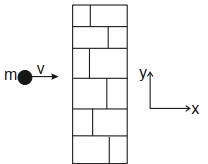
\(P _{ i }= Nm v \hat{ i } \quad \overrightarrow{ P }_{ f }=- Nm v \hat{ i }\)\(N\) is Number of balls strikes with wall
\(N =100\)
\(\Delta \overrightarrow{ P } =\overrightarrow{ P }_{ f }-\overrightarrow{ P }_{ i }=-2 Nmv \hat{ i }\)
\(=-200\,Nm v \hat{ i }\)
\(\overrightarrow{ F }_{\text {Total }} =\frac{\Delta \overrightarrow{ P }}{\Delta t }=-\frac{200 mvt }{ t }\)
\(|\overrightarrow{ F }| =\frac{200\,mv }{ t }\)
-
- (A) \(20\)
- (B) \(25\)
- (C) \(10\)
- (D) \(15\)
Show answer and solution
Correct Answer: (A)
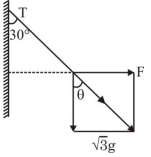
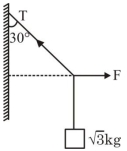
\(\theta=30^{\circ}\)\(\cos \theta=\frac{\sqrt{3} g }{ T }\)
\(\Rightarrow \frac{\sqrt{3}}{2}=\frac{\sqrt{3} g }{ T }\)
\(\Rightarrow T =20\,N\)
-
- (A) \(1: 2\)
- (B) \(1: 1\)
- (C) \(2: 3\)
- (D) \(2: 5\)
Show answer and solution
Correct Answer: (C)
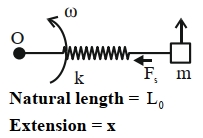
\(kx = m \left( L _0+ x \right) \omega^2\)\(\Rightarrow 12.5 x =\frac{1}{5}\left( L _0+ x \right) 25 \Rightarrow 1.5 x = L _0\) \(\Rightarrow \frac{ x }{ L _0}=\frac{2}{3}\)
-
- (A) \(166\)
- (B) \(25\)
- (C) \(125\)
- (D) \(5\)
Show answer and solution
Correct Answer: (B)
\(v =10 \sqrt{ x } \Rightarrow v ^2=100 x\)\(2 v \frac{ dv }{ dx }=100 \Rightarrow a =50\,m / s ^2\)
\(F =25\,N\)
-
- (A) \(12\)
- (B) \(6\)
- (C) \(36\)
- (D) \(3\)
Show answer and solution
Correct Answer: (B)
By momentum conservation\(0=3(- v )+0.01(600- v )\)
\(V \approx 22 m / s\)
Impulse on gun \(=3 \times 2=6\,Ns\)
-
- (A) \(0.02\)
- (B) \(2.5\)
- (C) \(1.5\)
- (D) \(0.6\)
Show answer and solution
Correct Answer: (D)
\(20 \times 10^{-3} \times \frac{180}{60} \times 100=10\,V\)\(\Rightarrow v =0.6\,m / s\)
-
- (A) \(1.5\)
- (B) \(0.75\)
- (C) \(0.25\)
- (D) \(0.50\)
Show answer and solution
Correct Answer: (B)
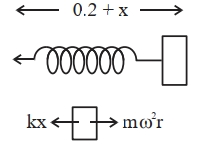
Let extension in length of spring be \(x\).Radius of circle \(r=0.2+ x\)
\(Kx = m \omega^2 r\)
\(7.5 x =\left(\frac{1}{10}\right)\left(5^2\right)(0.2+ x )\)
\(\Rightarrow \frac{15}{2} x =\frac{5}{2}\left( x +\frac{1}{5}\right)\)
\(\Rightarrow x =\frac{1}{10}\)
\(\therefore \text { Tension in spring }= kx =7.5 \times \frac{1}{10}=0.75\,N\)
-
- (A) \(5\)
- (B) \(50\)
- (C) \(100\)
- (D) \(25\)
Show answer and solution
Correct Answer: (B)
\(F = n mv\)where \(n =\) number of bullets fired per second
\(n =\frac{ f }{ mv }=\frac{125}{10 \times 10^{-3} \times 250}=50\)
-
- (A) \((-4 \sqrt{3}+1) N\)
- (B) \(4(\sqrt{3}+1) N\)
- (C) \(-4(\sqrt{3}-1) N\)
- (D) \((4 \sqrt{3}-1) N\)
Show answer and solution
Correct Answer: (B)
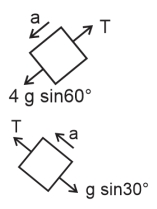
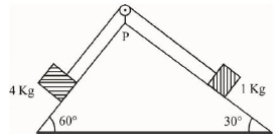
\(4 g \sin 60^{\circ}-T=4 a.....(1)\)\(T - g \sin 30^{\circ}= a.......(2)\)
Solving \((1)\) and \((2)\) we get.
\(20 \sqrt{3}-T=4 T-20\)
\(T=4(\sqrt{3}+1)\,N\)
-
- (A) \(800 \sqrt{2}\)
- (B) \(600\)
- (C) \(800\)
- (D) \(200 \sqrt{3}\)
Show answer and solution
Correct Answer: (C)
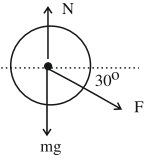
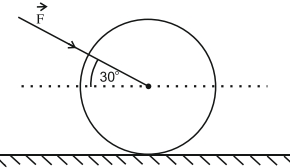
\(N = mg + F \sin 30^{\circ}\)\(=700+200 \times \frac{1}{2}=800 \text { newton }\)
-
- (A) \(3\)
- (B) \(4\)
- (C) \(6\)
- (D) \(2\)
Show answer and solution
Correct Answer: (A)
\(\overrightarrow{ v }=2 t \hat{ i }+3 t ^2 \hat{ j }\)\(\overrightarrow{ a }=2 \hat{i}+6 t \hat{j}\)
at \(t=1, \vec{a}=2 \hat{i}+6 \hat{j}\)
\(\overrightarrow{ F }= ma =0.5(2 \hat{i}+6 \hat{j})=\hat{i}+3 \hat{j}\)
\(\overrightarrow{ F }=\hat{i}+x \hat{j} \quad \text { Hence } x=3\)
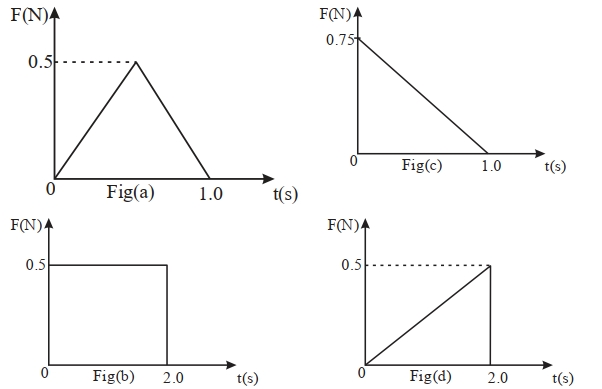
- 12. Figures \((a), (b), (c)\) and \((d)\) show variation of force with time. The impulse is highest in figure.
 2023 Medium
- (A) Fig \((c)\)
- (B) Fig \((b)\)
- (C) Fig \((a)\)
- (D) Fig \((d)\)
Show answer and solution
Correct Answer: (B)
Impulse \(=\) Area under \(F=t\) curve\((a)\) \(\frac{1}{2} \times 1 \times 0.5=\frac{1}{4}\,N . s\)
\((b)\) \(0.5 \times 2=1\) N.s (maximum)
\((c)\) \(\frac{1}{2} \times 1 \times 0.75=\frac{3}{8} N . s\)
\((d)\) \(\frac{1}{2} \times 2 \times 0.5=\frac{1}{2} N . s\)
-
- (A) \(40\)
- (B) \(5\)
- (C) \(20\)
- (D) \(10\)
Show answer and solution
Correct Answer: (B)
\(50= V \times 10\)\(V =5\,m / s\)
\(V =0+ a \times 20\)
\(5= a \times 20\)
\(a =\frac{1}{4}\,m / s ^2\)
\(F = ma =20 \times \frac{1}{4}=5\,N\)
-
- (A) \(A\) is correct but \(R\) is not correct.
- (B) Both \(A\) and \(R\) are correct and \(R\) is the correct explanation of \(A\).
- (C) \(A\) is not correct but \(R\) is correct.
- (D) Both \(A\) and \(R\) are correct but \(R\) is NOT the correct explanation of \(A\).
Show answer and solution
Correct Answer: (B)
Fact -
- (A) Both statement \(I\) and statement \(II\) are false
- (B) Statement \(I\) is true but Statement \(II\) is false
- (C) Both Statement \(I\) and Statement \(II\) are true
- (D) Statement \(I\) is false but Statement \(II\) is true
Show answer and solution
Correct Answer: (B)
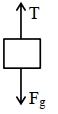
When elevator is moving with uniform speed \(T = F _{ g }\)Statement\(-2\)
When elevator is going down with increasing speed, its acceleration is downward.
Hence
\(W - N =\frac{ W }{ g } \times a\)
\(N = W \left(1-\frac{ a }{ g }\right) \text { i.e. less than weight. }\)
-
- (A) \(c\) and \(a\)
- (B) \(b\) and \(c\)
- (C) \(c\) and \(b\)
- (D) \(a\) and \(b\)
Show answer and solution
Correct Answer: (C)
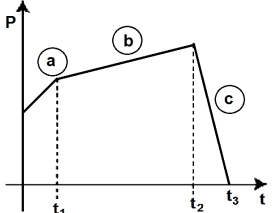
\(\left|\frac{ d \overrightarrow{ p }}{ dt }\right|=|\overrightarrow{ F }| \Rightarrow \frac{ d \overrightarrow{ p }}{ dt }=\text { Slope of curve }\)\(\text { max slope (c) }\)
\(\text { min slope (b) }\)
-
- (A) Positive \(y\)-axis
- (B) Positive \(x\)-axis
- (C) Positive \(z-\)axis
- (D) In \(x-y\) plane
Show answer and solution
Correct Answer: (A)
\(\overrightarrow{ r }=10 t \hat{ i }+15 t ^2 \hat{ j }+7 \hat{ k }\)\(\overrightarrow{ v }=10 \hat{ i }+30 t \hat{ j }\)
\(\overrightarrow{ a }=30 \hat{ j }\)
So Net force is along \(+ y\) direction
-
- (A) \(2\)
- (B) \(0.5\)
- (C) \(4.8\)
- (D) \(7\)
Show answer and solution
Correct Answer: (A)
Resultant of \(\overrightarrow{ F _2}\) and \(\overrightarrow{ F _3}\) should be opposite to \(\overrightarrow{ F _1}\)\(a=\frac{10}{5}=2\,m / s ^2\)
No questions on this page match these filters.