


Questions
Newest firstShowing 1–8 of 8 questions
-
- (A) Both Statement I and Statement II are true
- (B) Both Statement I and Statement II are false
- (C) Statement I is true but Statement II is false
- (D) Statement I is false but Statement II is true
Show answer and solution
Correct Answer: (D)
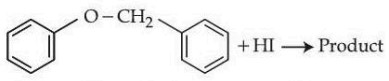
The given reactant is phenyl benzyl ether (\(C_6H_5-O-CH_2-C_6H_5\)).
When it reacts with \(HI\), the ether oxygen is first protonated to form an oxonium ion. The cleavage of the ether linkage then takes place.
The \(C_6H_5-O\) bond has partial double bond character due to the resonance of the oxygen's lone pair with the benzene ring, making it strong and difficult to break. On the other hand, the \(O-CH_2\) bond is a weaker single bond. Moreover, cleavage of the \(O-CH_2\) bond can proceed via a highly stable benzyl carbocation (in an \(S_N1\) mechanism) or undergo facile \(S_N2\) attack by the iodide ion (\(I^-\)) at the less sterically hindered and activated benzylic carbon.
Therefore, the \(I^-\) ion attacks the \(CH_2\) group, cleaving the \(O-CH_2\) bond. The products formed are phenol (\(C_6H_5OH\)) and benzyl iodide (\(C_6H_5CH_2I\)).
Statement I claims the products are benzyl alcohol and iodobenzene, which is incorrect. Thus, Statement I is false.
Statement II claims that the \(-O-CH_2-\) bond is cleaved to give the product, which is correct. Thus, Statement II is true.
Answer: Statement I is false but Statement II is true -
- (A) Statement I is false but Statement II are true
- (B) Both Statement I and Statement II are false
- (C) Statement I is true but Statement II is false
- (D) Both Statement I and Statement II are true
Show answer and solution
Correct Answer: (D)
St-I : - St-I is correct because both given ether are soluble in water \(\rightarrow\) Di ethyl ether and butan-1-ol are miscible to almost same extent i.e., 7.5 and 9 gm per 100 ml water due to H -bonding St-II : - St. II is also correct because sodium metal is not used with ethyl alcohol as \(\mathrm{H}_2\) gas release with ethyl a below -
- (A) Both \(A\) and \(R\) are correct and \(R\) is the correct explanation of \(A.\)
- (B) \(A\) is correct but \(R\) is not correct.
- (C) \(A\) is not correct but \(R\) is correct.
- (D) Both \(A\) and \(R\) are correct but \(R\) is \(NOT\) the correct explanation of \(A.\)
Show answer and solution
Correct Answer: (A)
Butylated hydroxyl anisole is an antioxidant. -
- (A) Both Statement \(I\) and Statement \(II\) are false.
- (B) Statement \(I\) is false but Statement \(II\) is true.
- (C) Statement \(I\) is true but Statement \(I I\) is false.
- (D) Both Statement \(I\) and Statement \(II\) are true.
Show answer and solution
Correct Answer: (C)
Statement \(1\) is trueBut it consume \(3\) moles of \(G\) \(R\)
So statement \(2\) is false.

-
- (A) \(0\)
- (B) \(6\)
- (C) \(4\)
- (D) \(2\)
Show answer and solution
Correct Answer: (C)
The total number of optically active compounds formed is four. The product has two chiral \(C\) atoms. Thus, it has \(2^n\, = 2^2\, = 4\) stereoisomers
-
- (A) Reduction of an acyl halide with \(H_2/Pd\)
- (B) Reduction of an anhydride with \(LiAlH_4\)
- (C) Reduction of an ester with \(Na/C_2H_5OH\)
- (D) Reduction of a carbonyl compound with \(Na/Hg\) and \(HCl\)
Show answer and solution
Correct Answer: (C)
The Bouveault reduction is a reaction in which an ester is reduced to primary alcohol using absolute ethanol and sodium.\(\begin{array}{*{20}{c}}
{\,O\,\,\,\,\,\,\,\,\,\,\,\,\,\,\,\,\,\,\,\,\,\,\,\,\,\,\,\,\,\,\,\,\,\,\,\,\,\,\,\,\,\,\,\,\,\,\,\,\,\,\,\,\,\,\,\,\,\,\,\,\,\,\,\,\,\,\,\,\,\,\,\,\,\,\,\,\,\,\,\,\,\,} \\
{||\,\,\,\,\,\,\,\,\,\,\,\,\,\,\,\,\,\,\,\,\,\,\,\,\,\,\,\,\,\,\,\,\,\,\,\,\,\,\,\,\,\,\,\,\,\,\,\,\,\,\,\,\,\,\,\,\,\,\,\,\,\,\,\,\,\,\,\,\,\,\,\,\,\,\,\,\,\,\,\,\,\,} \\
{R - C - OR\xrightarrow{{Na/{C_2}{H_5}OH}}RC{H_2}OH + ROH}
\end{array}\)Bouveault-Blanc reduction.
-
- (A) \(C_6H_5Br + CH_2 = CH - CH_2 - ONa\)
- (B) \(CH_2 = CH - CH_2 - Br - C_6H_5ONa\)
- (C) \(C_6H_5 - CH =CH - Br - CH_3 - ONa\)
- (D) \(CH_2 =CH - Br - C_6H_5 - CH_2 - ONa\)
Show answer and solution
Correct Answer: (A)
\(C_6H_5Br + NaO - CH_2 - CH = CH_2\) \(\longrightarrow\) \(\begin{array}{l}
{C_6}{H_5} - O - C{H_2} - CH = C{H_2} + NaBr\\
\,\,\,\,\,\,\,\,\,\,\,\,\,\,\,\,\,\,\,\,\,\,\,\,\,\,\,\,\,\,\,\,\,\,\,\,\,\,\,\,\,\,\,\,\,\,\,{\rm{Allyl\, phenyl\, ether}}
\end{array}\) -
- (A) \(2-\) ethoxypropane
- (B) ethoxypropane
- (C) methoxybutane
- (D) \(2-\) methoxybutane
Show answer and solution
Correct Answer: (A)
\(\mathop {C{H_3}C{H_2}OCH{{(C{H_3})}_2}}\limits_{(A)} \xrightarrow{{Conc.\,HI}}\) \(\mathop {C{H_3}C{H_2}I}\limits_{(B)} \, + \,\,\mathop {{{(C{H_3})}_2}CHI}\limits_{(C)} \)\(\mathop {C{H_3}C{H_2}I}\limits_{(B)} \,\xrightarrow{{NaOH}}C{H_3}C{H_2}OH\,\) \(\xrightarrow{{[O]}}C{H_3}COOH\)
\(\,\mathop {{{(C{H_3})}_2}CHI}\limits_{(C)} \xrightarrow{{NaOH}}{(C{H_3})_2}CHOH\) \(\xrightarrow{{[O]}}{(C{H_3})_2}CO\)
hence the \(IUPAC\) name of compound is
\(\begin{array}{*{20}{c}}
{C{H_3} - C{H_2} - O - \mathop {CH}\limits^2 - \mathop {C{H_3}}\limits^1 } \\
{\,\,\,\,\,\,\,\,\,\,\,\,\,\,\,\,\,\,\,\,\,\,\,\,\,\,\,\,\,\,\,\,\,\,\,|\,\,\,\,\,\,\,} \\
{\,\,\,\,\,\,\,\,\,\,\,\,\,\,\,\,\,\,\,\,\,\,\,\,\,\,\,\,\,\,\,\,\,\,\,\,\,\,\,{}^3C{H_3}\,\,\,\,\,\,\,}
\end{array}\)

No questions on this page match these filters.
Other STD 12 - Alcohol, phenol and ethers topics
Frequently asked
How many Properties of Ethers questions came in JEE Mains?
8 questions from 2013–2026, each with the correct answer and a full solution.
How difficult are Properties of Ethers questions?
13% are easy, 38% medium and 50% hard.