


Topics
6 topics- 59Qs First law of thermodynamics and Hess law Most asked
- 48Qs Free energy and Work function
- 15Qs Heat capacity
- 10Qs Basic concepts
- 57Qs Heat of reaction
- 15Qs 2 nd and 3 rd Law of thermodynamics and Entropy
All Thermodynamics and thermochemistry questions
Newest firstShowing 1–50 of 204 questions
-
- (A) \( w=-9.1~kJ, \Delta U=0, \Delta H=0, q=9.1~kJ \)
- (B) \( w=9.1~J, \Delta U=9.1~J, \Delta H=0; q=0 \)
- (C) \( w=+4.1~kJ, \Delta U=0, \Delta H=0; q=-4.1~kJ \)
- (D) \( w=-3.9~kJ, \Delta U=0, \Delta H=0; q=3.9~kJ \)
Show answer and solution
Correct Answer: (A)
For isothermal reversible process \( \Delta U=\Delta H=0 \)
\( w_{iso}=-p_{1}v_{1} \ln \frac{p_1}{p_2} \)
\( W_{iso}=-0.5 \times 10^{6} \times 20 \times 10^{-3} \ln \frac{0.5}{0.2} \)
\( W_{iso}=-0.5 \times 10^{6} \times 20 \times 10^{-3} \times 2.303 \times (0.6989-0.3010) \)
\( w=-9.1~kJ \)
\( q=-w=9.1~kJ \) -
- (A) \(q=+ve, w=0, \Delta U=-ve\)
- (B) \(q=+ve, w=-ve, \Delta U=+ve\)
- (C) \(q=-ve, w=-ve, \Delta U=-ve\)
- (D) \(q=+ve, w=-ve, \Delta U=-ve\)
Show answer and solution
Correct Answer: (B)
\(\underset{5^{\circ} C }{ H _2 O (\ell)} \longrightarrow \underset{100^{\circ} C }{ H _2 O (\ell) \rightleftarrows} \underset{100^{\circ} C }{ H _2 O ( g )}\)
due to expansion \(W=-ve\)
as heat is given to system so \(q = +ve\) and internal energy of gas will be more than internal energy of liquid so \(\Delta U=+ve\) -
- (A) \(|w_B| > |w_A| > |w_C| > |w_D|\)
- (B) \(|w_C| > |w_D| > |w_A| > |w_B|\)
- (C) \(|w_C| > |w_D| > |w_B| > |w_A|\)
- (D) \(|w_B| > |w_A| > |w_D| > |w_C|\)
Show answer and solution
Correct Answer: (C)
Let State \(1\) have pressure \(P_1\) and volume \(V_1\), and State \(2\) have pressure \(P_2\) and volume \(V_2\). For an isothermal expansion, \(V_2 > V_1\) and \(P_1 > P_2\).
For expansion from State \(1\) to State \(2\):
In a single-stage expansion, the external pressure is constant at the final pressure \(P_2\). The magnitude of work is \(|w_A| = P_2(V_2 - V_1)\).
In a multi-stage expansion, the external pressure is reduced in steps, keeping it closer to the internal pressure of the gas. The work done by the gas increases with the number of stages, reaching a maximum for a reversible process (\(|w_{rev}|\)). Thus, \(|w_{rev}| > |w_B| > |w_A|\).
For compression from State \(2\) to State \(1\):
In a single-stage compression, the external pressure is constant at the final pressure \(P_1\). The magnitude of work is \(|w_C| = P_1(V_2 - V_1)\).
In a multi-stage compression, the external pressure is increased in steps. The work done on the gas decreases with the number of stages, reaching a minimum for a reversible process (\(|w_{rev}|\)). Thus, \(|w_C| > |w_D| > |w_{rev}|\).
Since \(P_1 > P_2\), the single-stage compression work \(|w_C|\) is the largest, and the single-stage expansion work \(|w_A|\) is the smallest. The reversible work magnitude \(|w_{rev}|\) is the same for both expansion and compression between the same states.
Combining these inequalities, we get:
\(|w_C| > |w_D| > |w_{rev}| > |w_B| > |w_A|\)
Therefore, the correct order of the magnitude of work is \(|w_C| > |w_D| > |w_B| > |w_A|\).
Answer: \(|w_C| > |w_D| > |w_B| > |w_A|\) -
- (A) 725
- (B) 726
- (C) 727
- (D) 728
Show answer and solution
Correct Answer: (C)
At the transition temperature and \(1\) atm pressure, the two states \(A\) and \(B\) are in equilibrium.
For a phase transition of a pure substance at \(1\) atm, both states are in their standard states, so the reaction quotient \(Q = 1\).
Using the relation \(\Delta G = \Delta G^0 + RT \ln Q\), we get \(\Delta G = \Delta G^0\).
At equilibrium, \(\Delta G = 0\), which implies \(\Delta G^0 = 0\).
Given \(\Delta G^0 = 105 - 35\log T\), we can equate it to zero:
\(105 - 35\log T = 0\)
\(35\log T = 105\)
\(\log T = 3\)
\(T = 10^3 = 1000\) K
Converting the temperature to Celsius:
\(T(^{\circ}\text{C}) = 1000 - 273 = 727^{\circ}\text{C}\)
Answer: \(727\) -
- (A) \(\frac{X+Y+2Z}{4}\)
- (B) \(\frac{X+Y+4Z}{2}\)
- (C) \(X+Y+Z\)
- (D) \(\frac{-X+Y+Z}{4}\)
Show answer and solution
Correct Answer: (A)
\(C ( s )+2 H _2(g) \rightarrow CH _4(g)\)
\(-x=\left(\Delta H_{\text {sub }}\right.\) of carbon \()+2 \times(\) B.E. of \(H-H)\)
\(-4 \times(\) B.E. of \(C - H )\)
\(-x=y+2 z-4(\) B.E. of \(C-H)\)
B.E. of \(C - H =\frac{ y +2 z + x }{4}\). -
- (A) \(-21000\)
- (B) \(-10\)
- (C) \(-1000\)
- (D) \(-9.012\)
Show answer and solution
Correct Answer: (B)
The given reaction is \(X_2(g) + Y_2(g) \rightleftharpoons 2XY(g)\).
The standard enthalpy of reaction, \(\Delta_r H^\circ\), is calculated as:
\(\Delta_r H^\circ = \sum \Delta_f H^\circ(\text{products}) - \sum \Delta_f H^\circ(\text{reactants})\)
\(\Delta_r H^\circ = 2 \Delta_f H^\circ(XY) - [\Delta_f H^\circ(X_2) + \Delta_f H^\circ(Y_2)]\)
\(\Delta_r H^\circ = 2(42) - (8 + 80) = 84 - 88 = -4 \text{ kJ mol}^{-1}\)
The standard entropy of reaction, \(\Delta_r S^\circ\), is calculated as:
\(\Delta_r S^\circ = \sum S^\circ(\text{products}) - \sum S^\circ(\text{reactants})\)
\(\Delta_r S^\circ = 2 S^\circ(XY) - [S^\circ(X_2) + S^\circ(Y_2)]\)
\(\Delta_r S^\circ = 2(200) - (140 + 250) = 400 - 390 = 10 \text{ J K}^{-1} \text{ mol}^{-1}\)
Converting \(\Delta_r S^\circ\) to \(\text{kJ K}^{-1} \text{ mol}^{-1}\):
\(\Delta_r S^\circ = \dfrac{10}{1000} = 0.01 \text{ kJ K}^{-1} \text{ mol}^{-1}\)
Now, using the Gibbs free energy equation:
\(\Delta_r G^\circ = \Delta_r H^\circ - T \Delta_r S^\circ\)
\(\Delta_r G^\circ = -4 - 600 \times 0.01\)
\(\Delta_r G^\circ = -4 - 6 = -10 \text{ kJ mol}^{-1}\)
Answer: \(-10\) -
- (A) \(-648\) kJ mol\(^{-1}\)
- (B) \(-1350\) kJ mol\(^{-1}\)
- (C) \(-2002\) kJ mol\(^{-1}\)
- (D) \(-1527\) kJ mol\(^{-1}\)
Show answer and solution
Correct Answer: (D)
Explanation:
Let us calculate the enthalpy of formation of anhydrous solid \( Al_2Cl_6 \) using Hess's Law of Constant Heat Summation:
1. Identify the Target Reaction:
The standard reaction for the enthalpy of formation of anhydrous solid \( Al_2Cl_6 \) from its constituent elements is:
\( 2Al(s) + 3Cl_2(g) \rightarrow Al_2Cl_6(s) \) ; \( \Delta H_f = ? \)
2. Algebraic Manipulation of Given Equations:
To obtain the target equation, we perform the following mathematical operations on the given equations:
We need \( 2Al(s) \) on the reactant side: Keep Equation (i) as it is.
We need \( 3Cl_2(g) \) on the reactant side: Multiply Equation (ii) by 3.
To cancel out the \( 6HCl(g) \) produced, we need them in aqueous form: Multiply Equation (iii) by 6.
We need anhydrous \( Al_2Cl_6(s) \) on the product side: Reverse Equation (iv) (multiply by -1).
Therefore, the net operation is: Equation (i) + 3 \times Equation (ii) + 6 \times Equation (iii) - Equation (iv)
3. Verification by Adding the Modified Equations:
\( 2Al(s) + 6HCl(aq) \rightarrow Al_2Cl_6(aq) + 3H_2(g) \)
\( 3H_2(g) + 3Cl_2(g) \rightarrow 6HCl(g) \)
\( 6HCl(g) + aq \rightarrow 6HCl(aq) \)
\( Al_2Cl_6(aq) \rightarrow Al_2Cl_6(s) + aq \)
Summing these equations and canceling common species on both sides yields our target equation:
\( 2Al(s) + 3Cl_2(g) \rightarrow Al_2Cl_6(s) \)
4. Calculating the Final Enthalpy (\( \Delta H_f \)):
Applying the same algebraic operations to the respective enthalpy values:
\( \Delta H_f = \Delta H_1 + 3\Delta H_2 + 6\Delta H_3 - \Delta H_4 \)
\( \Delta H_f = -1200 + 3(-164) + 6(-83) - (-663) \)
\( \Delta H_f = -1200 - 492 - 498 + 663 \)
\( \Delta H_f = -2190 + 663 = -1527\text{ kJ/mol} \)
Hence, Option D is the correct choice. -
- (A) 1123
- (B) 1126
- (C) 1128
- (D) 1130
Show answer and solution
Correct Answer: (B)
The standard enthalpy of reaction is given by:
\(\Delta_r H^{\ominus} = \sum \Delta_f H^{\ominus}(\text{products}) - \sum \Delta_f H^{\ominus}(\text{reactants})\)
For the given reaction:
\(2\text{H}_2\text{S}(g) + 3\text{O}_2(g) \rightarrow 2\text{H}_2\text{O}(l) + 2\text{SO}_2(g)\)
\(\Delta_r H^{\ominus} = [2 \Delta_f H^{\ominus}(\text{H}_2\text{O}, l) + 2 \Delta_f H^{\ominus}(\text{SO}_2, g)] - [2 \Delta_f H^{\ominus}(\text{H}_2\text{S}, g) + 3 \Delta_f H^{\ominus}(\text{O}_2, g)]\)
Substituting the given values:
\(\Delta_r H^{\ominus} = [2(-286.0) + 2(-297.0)] - [2(-20.1) + 3(0)]\)
\(\Delta_r H^{\ominus} = [-572.0 - 594.0] - [-40.2]\)
\(\Delta_r H^{\ominus} = -1166.0 + 40.2 = -1125.8 \text{ kJ mol}^{-1}\)
The magnitude of the enthalpy change is \(1125.8 \text{ kJ mol}^{-1}\).
Rounding to the nearest integer, we get \(1126\).
Answer: \(1126\) -
- (A) 30
- (B) 32
- (C) 34
- (D) 36
Show answer and solution
Correct Answer: (C)
The standard Gibbs free energy change is given by:
\(\Delta G^{\theta} = -RT \ln K = -2.3 RT \log K\)
First, calculate \(\log K\):
\(\log K = \log(1.8 \times 10^{-7}) = \log(18 \times 10^{-8})\)
\(\log K = \log 18 - 8 = \log(2 \times 3^2) - 8\)
\(\log K = \log 2 + 2 \log 3 - 8\)
Substituting the given values:
\(\log K = 0.30 + 2(0.48) - 8 = 0.30 + 0.96 - 8 = 1.26 - 8 = -6.74\)
Now, calculate \(\Delta G^{\theta}\):
\(\Delta G^{\theta} = -2.3 \times 8.3 \times 300 \times (-6.74) = 38599.98 \text{ J mol}^{-1}\)
Using the relation \(\Delta G^{\theta} = \Delta H^{\theta} - T \Delta S^{\theta}\):
\(38599.98 = 28400 - 300 \Delta S^{\theta}\)
\(300 \Delta S^{\theta} = 28400 - 38599.98 = -10199.98\)
\(\Delta S^{\theta} = -\dfrac{10199.98}{300} \approx -34 \text{ J K}^{-1} \text{ mol}^{-1}\)
The magnitude of \(\Delta S^{\theta}\) is \(34\).
Answer: \(34\) -
- (A) 30
- (B) 33
- (C) 35
- (D) 38
Show answer and solution
Correct Answer: (B)
\(-1.664 \times 10^3=-8.3 \times 300 \ln K_{ p }\)
\(\ln K _{ p }=0.693\)
\(K_{ p }=2\)
\(2=\frac{4 \alpha^2 P _0}{1-\alpha^2}\)
\(\alpha=\frac{1}{\sqrt{3}}\)
\(\alpha=\left(\frac{100}{3} \times 10^{-2}\right)^{1 / 2}\)
\(=\left(33.33 \times 10^{-2}\right)^{1 / 2}\) -
- (A) \(18\) J of the work is done by the gas 'A'.
- (B) \(2\) J of the work is done by the gas 'A'.
- (C) \(12\) J of the work is done on the gas 'A' by the surrounding.
- (D) \(14\) J of the work is done on the gas 'A' by the surrounding.
Show answer and solution
Correct Answer: (D)
Using the first law of thermodynamics, \(\Delta U = q + w\).
For the process from state X to state Y:
Heat absorbed by the gas, \(q_{X \to Y} = +10\) J
Work done by the gas, \(w_{X \to Y} = -18\) J
Change in internal energy, \(\Delta U_{X \to Y} = q_{X \to Y} + w_{X \to Y} = 10 - 18 = -8\) J
For the reverse process from state Y to state X:
Change in internal energy, \(\Delta U_{Y \to X} = -\Delta U_{X \to Y} = +8\) J
Heat evolved by the gas, \(q_{Y \to X} = -6\) J
Let the work done on the gas be \(w_{Y \to X}\).
\(\Delta U_{Y \to X} = q_{Y \to X} + w_{Y \to X}\)
\(8 = -6 + w_{Y \to X}\)
\(w_{Y \to X} = +14\) J
Since the work done is positive, \(14\) J of work is done on the gas by the surrounding.
Answer: \(14\) J of the work is done on the gas 'A' by the surrounding. -
- (A) Both Statement I and Statement II are true
- (B) Both Statement I and Statement II are false
- (C) Statement I is true but Statement II is false
- (D) Statement I is false but Statement II is true
Show answer and solution
Correct Answer: (D)
For an ideal gas, the relationship between heat capacity at constant pressure (\(C_p\)) and heat capacity at constant volume (\(C_v\)) is given by Mayer's relation:
\(C_p - C_v = R\)
Since the universal gas constant \(R\) is a positive value, \(C_p > C_v\). Thus, Statement I is false.
In a constant volume (isochoric) process, the change in volume \(\Delta V = 0\).
Work done, \(W = P\Delta V = 0\).
According to the first law of thermodynamics:
\(\Delta U = q + W\)
Since \(W = 0\), we get \(\Delta U = q_v\).
This means that in a constant volume process, no work is produced and all the heat absorbed by the system (withdrawn from the surroundings) goes entirely into increasing the internal energy (chaotic motion of the molecules). This increase in internal energy is reflected by an increase in the temperature of the ideal gas. Thus, Statement II is true.
Therefore, Statement I is false but Statement II is true.
Answer: Statement I is false but Statement II is true -
- (A) 3
- (B) 4
- (C) 5
- (D) 6
Show answer and solution
Correct Answer: (A)
Molar mass of ethanol (\(C_2H_5OH\)) \(= 2(12) + 6(1) + 16 = 46\) g mol\(^{-1}\)
Number of moles of ethanol burnt, \(n = \dfrac{3.365}{46} = 0.07315\) mol
Since the combustion occurs in a bomb calorimeter (constant volume), the heat produced corresponds to the change in internal energy (\(\Delta U_c^\circ\)).
\(\Delta U_c^\circ = -\dfrac{99.472}{0.07315} = -1359.8\) kJ mol\(^{-1}\)
The balanced chemical equation for the combustion of ethanol is:
\(C_2H_5OH(l) + 3O_2(g) \rightarrow 2CO_2(g) + 3H_2O(l)\)
Change in the number of gaseous moles, \(\Delta n_g = 2 - 3 = -1\)
Now, calculating the standard enthalpy of combustion (\(\Delta H_c^\circ\)):
\(\Delta H_c^\circ = \Delta U_c^\circ + \Delta n_g RT\)
\(\Delta H_c^\circ = -1359.8 + (-1) \times (8.314 \times 10^{-3} \text{ kJ K}^{-1} \text{ mol}^{-1}) \times 298.15 \text{ K}\)
\(\Delta H_c^\circ = -1359.8 - 2.48 = -1362.28\) kJ mol\(^{-1}\)
The standard enthalpy of combustion can also be written in terms of enthalpies of formation:
\(\Delta H_c^\circ = \sum \Delta H_f^\circ(\text{products}) - \sum \Delta H_f^\circ(\text{reactants})\)
\(\Delta H_c^\circ = [2\Delta H_f^\circ(CO_2, g) + 3\Delta H_f^\circ(H_2O, l)] - [\Delta H_f^\circ(C_2H_5OH, l) + 3\Delta H_f^\circ(O_2, g)]\)
Substituting the given values (note that \(\Delta H_f^\circ\) of \(O_2(g)\) is \(0\)):
\(-1362.28 = [2(-393.5) + 3(-285.8)] - \Delta H_f^\circ(C_2H_5OH, l)\)
\(-1362.28 = [-787.0 - 857.4] - \Delta H_f^\circ(C_2H_5OH, l)\)
\(-1362.28 = -1644.4 - \Delta H_f^\circ(C_2H_5OH, l)\)
\(\Delta H_f^\circ(C_2H_5OH, l) = -1644.4 + 1362.28 = -282.12\) kJ mol\(^{-1}\)
The magnitude is \(|\Delta H_f^\circ| = 282.12\) kJ mol\(^{-1} = 2.8212 \times 10^2\) kJ mol\(^{-1}\)
Rounding to the nearest integer, we get \(3\).
Answer: \(3\) -
- (A) 1000
- (B) 1031
- (C) 1150
- (D) 950
Show answer and solution
Correct Answer: (B)
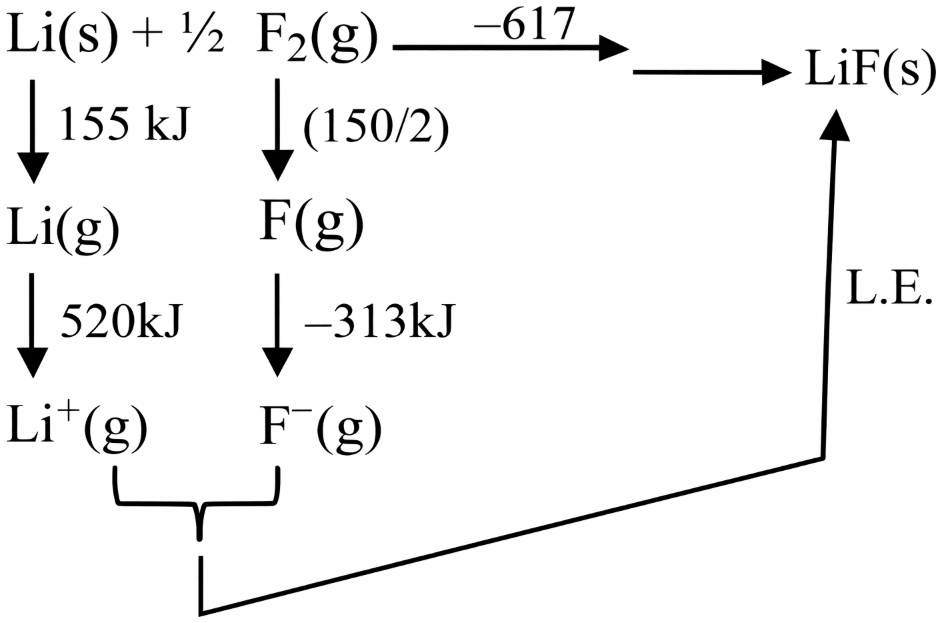
\(-594=155+520+\frac{150}{2}-313+(\) L.E. \()\)
L.E. \(=-1031 kJ / mol\) -
- (A) \( \Delta_{r}G^{\circ}(1) > 0; \Delta_{r}G^{\circ}(2) < 0 \)
- (B) \( \Delta_{r}G^{\circ}(1) < 0; \Delta_{r}G^{\circ}(2) < 0 \)
- (C) \( \Delta_{r}G^{\circ}(1) < 0; \Delta_{r}G^{\circ}(2) > 0 \)
- (D) \( \Delta_{r}G^{\circ}(1) > 0; \Delta_{r}G^{\circ}(2) > 0 \)
Show answer and solution
Correct Answer: (C)
\( PbO_{2} + Pb \rightarrow 2PbO \)
\( Pb^{2+} \) is more stable hence reaction will be spontaneous. So \( \Delta G^{\circ}_{r}(1) \) is negative.
\( SnO_{2} + Sn \rightarrow 2SnO \)
\( Sn^{2+} \) is less stable, so reaction will be non-spontaneous hence \( \Delta G^{\circ}_{r}(2) \) is positive. -
- (A) A-II, B-III, C-I, D-IV
- (B) A-II, B-I, C-IV, D-III
- (C) A-II, B-I, C-III, D-IV
- (D) A-I, B-II, C-III, D-IV
Show answer and solution
Correct Answer: (C)
For an isothermal reversible expansion, the change in internal energy \(\Delta U = 0\). From the first law of thermodynamics, \(q = -w\). The work done is \(w = -nRT \ln\left(\dfrac{V_2}{V_1}\right)\), which gives \(q = nRT \ln\left(\dfrac{V_2}{V_1}\right)\). Thus, A matches II.
For free expansion, the external pressure is zero (\(p_{ext} = 0\)), so the work done \(w = 0\). Since the process is isothermal, \(\Delta U = 0\). Therefore, the heat exchanged \(q = 0\). Thus, B matches I.
For an irreversible compression, the work done against a constant external pressure is given by \(w = -p_{ext}\Delta V\). This corresponds to the expression in III. Thus, C matches III.
For a cyclic reversible process, the initial and final states are the same, so the change in entropy \(\Delta S = 0\). Since \(\Delta S = \dfrac{q_{rev}}{T}\), we get \(\dfrac{q_{rev}}{T} = 0\). Thus, D matches IV.
The correct matching is A-II, B-I, C-III, D-IV.
Answer: A-II, B-I, C-III, D-IV -
- (A) A-IV, B-I, C-III, D-II
- (B) A-IV, B-II, C-III, D-I
- (C) A-I, B-III, C-II, D-IV
- (D) A-II, B-I, C-III, D-IV
Show answer and solution
Correct Answer: (D)
(A) \(W _{ Rev .}=-\int P _{ gas } dV\)
\(W _{\text {Rev. Isot. Exp. }}=- nRT \ln \left[\frac{ V _{ f }}{ V _{ i }}\right]\)
(A) → (II)
(B) Free expansion
\(W _{ irrev. }=- P _{ ext } \Delta V\)
\(P _{ ext }=0\)
\(W =0\)
\(( B ) \rightarrow( I )\)
(C) Irreversible expansion
\(W _{\text {irrev: }}=- P _{\text {ext }} \Delta V\)
\(W_{\text {irrev: }}=-P_{\text {ext }}\left(V_f-V_i\right)\)
(C) → (III)
(D) Irreversible compression
\(W _{\text {irrer: }}=- P _{\text {ext }} \Delta V\)
\(W _{\text {irrer: }}=- P _{\text {ext }}\left( V _{ i }- V _{ f }\right)\) -
- (A) A-III, B-II, C-IV, D-I
- (B) A-II, B-III, C-I, D-IV
- (C) A-I, B-II, C-III, D-IV
- (D) A-II, B-I, C-III, D-IV
Show answer and solution
Correct Answer: (B)
Option (A)
\(
\begin{array}{l}
W=-nRT \ln \frac{V_2}{V_1} \\
=\frac{-2 \times 8.314 \times 300}{1000} \times \ln \left(\frac{20}{2}\right) kJ \\
=-11.5 kJ
\end{array}
\)
Option (B)
\(
\begin{array}{l}
W=-P_{\text {ext }}\left[V_2-V_1\right] \\
=-3[3-1] \\
=-6 kJ
\end{array}
\)
Option (C)
\(
\begin{array}{l}
\Delta U=nC_{v} \Delta T \\
=1 \times \frac{3}{2} \times \frac{8.314 \times 320}{1000} 100 kJ \\
=3.99
\end{array}
\)
Option (D)
\(
\begin{aligned}
\Delta H & =nC_{p} \Delta T \\
& =1 \times \frac{5}{2} \times \frac{8.314 \times 337}{1000} kJ \\
& =7 kJ
\end{aligned}
\) - 19. The correct order of molar heat capacities measured at \(298\text{ K}\) and \(1\text{ bar}\) is : 2026 Medium
- (A) Copper(s) > Bromine(l) > Helium(g)
- (B) Bromine(l) > Copper(s) > Helium(g)
- (C) Helium(g) > Bromine(l) > Copper(s)
- (D) Helium(g) > Bromine(l) = Copper(s)
Show answer and solution
Correct Answer: (B)
The molar heat capacity of Helium (a monatomic gas) at constant pressure is \(C_p = \dfrac{5}{2}R \approx 20.8 \text{ J K}^{-1} \text{ mol}^{-1}\).
The molar heat capacity of Copper (a solid) follows the Dulong-Petit law, which gives \(C_p \approx 3R \approx 24.9 \text{ J K}^{-1} \text{ mol}^{-1}\).
The molar heat capacity of Bromine (a diatomic liquid) is significantly higher due to translational, rotational, and vibrational degrees of freedom along with intermolecular interactions in the liquid state, having \(C_p \approx 75.7 \text{ J K}^{-1} \text{ mol}^{-1}\).
Therefore, the correct order of molar heat capacities is Bromine(l) > Copper(s) > Helium(g).
Answer: Bromine(l) > Copper(s) > Helium(g) -
- (A) \(\frac{hc}{1000}(\frac{y-6x}{4})^{-1}\)
- (B) \(\frac{N_{A}hc}{250(4y-6x)}\)
- (C) \(\frac{N_{A}hc}{250(y-6x)}\)
- (D) \(N_{A}hc(y-\frac{6x}{4})^{-1}\)
Show answer and solution
Correct Answer: (B)
\(CH _4(g) \rightarrow C ( g )+4 H ( g ) ; \quad \Delta_{ r } H = x kJ / mole\)
\(C _2 H _6(g) \rightarrow 2 C ( g )+6 H ( g ) ; \Delta_{ r } H = y kJ / mole\)
\(1000 x =4 \times \varepsilon_{ C - H }\)
\(1000 y =1 \times \varepsilon_{ C - C }+6 \times \varepsilon_{ C - H }\)
\(\varepsilon_{ C - C }=\left[ y -\frac{3 x }{2}\right] \times 1000=\frac{ hc }{\lambda} \cdot N _{ A }\)
\(\left(' \lambda^{\prime}\right)\) wavelength of photon \(=\frac{ hc N _{ A }}{[4 y -6 x ] \times 250}\) -
- (A) 378 K and 500 J
- (B) 368 K and 500 J
- (C) 348 K and 300 J
- (D) 378 K and 300 J
Show answer and solution
Correct Answer: (C)
\(\begin{aligned} & \mathrm{q}_{\mathrm{p}}=\mathrm{n} \times \mathrm{c}_{\mathrm{p}} \times \Delta \mathrm{T} \\ & \Rightarrow 500=0.5 \times \frac{5}{2} \times 8.3\left(\mathrm{~T}_{\mathrm{f}}-298\right) \\ & \Rightarrow \mathrm{T}_{\mathrm{f}} \simeq 346.2 \mathrm{~K} \\ & \frac{\Delta \mathrm{H}}{\Delta \mathrm{U}}=\frac{\mathrm{C}_{\mathrm{p}}}{\mathrm{C}_{\mathrm{v}}}=\left(\frac{5}{3}\right) \\ & \Rightarrow \Delta \mathrm{U}=\frac{3}{5} \times 500=300 \mathrm{~J}\end{aligned}\) -
- (A) \(\Delta \mathrm{U} \lt 0, \mathrm{q}=0, \mathrm{w}\gt0\)
- (B) \(\Delta \mathrm{U}=0, \mathrm{q}=0, \mathrm{w}=0\)
- (C) \(\Delta \mathrm{U}\gt0, \mathrm{q}=0, \mathrm{w}\gt0\)
- (D) \(\Delta \mathrm{U}=0, \mathrm{q} \lt 0, \mathrm{w}\gt0\)
Show answer and solution
Correct Answer: (C)
Thermally insulated \(\Rightarrow q=0\) from \(\mathrm{I}^{\text {st }}\) law
\(\begin{aligned}
& \Delta \mathrm{U}=\mathrm{q}+\mathrm{w} \\
& \Delta \mathrm{U}=\mathrm{w} \\
& \mathrm{w}>0, \Delta \mathrm{U}>0
\end{aligned}\) -
- (A) 304
- (B) 305
- (C) 306
- (D) 307
Show answer and solution
Correct Answer: (A)
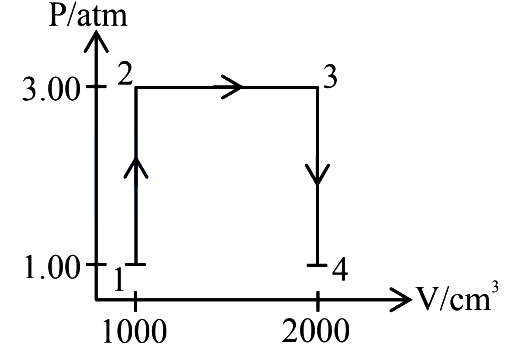
\(\begin{aligned}
& \mathrm{W}_{1 \rightarrow 2}=0 \\
& \mathrm{~W}_{2 \rightarrow 3}=-\mathrm{P} \Delta \mathrm{~V} \\
& =-3[2-1] \\
& =-3 \mathrm{~atm}-\ell
\end{aligned}\)
\(\mathrm{W}_{3 \rightarrow 4}=0\)
Total work done
\(\begin{aligned}
& =-3 \mathrm{~atm}-\ell \\
& =-3 \times 101.3 \text { Joule } \\
& =-304 \text { Joule }
\end{aligned}\) -
- (A) 3000
- (B) 2500
- (C) 200
- (D) 3500
Show answer and solution
Correct Answer: (B)
\(\text { Mole of octane }=\frac{1.14}{114}=0.01 \mathrm{~mole}\)
Heat evolved \(=\mathrm{C} \times \Delta \mathrm{T}\)
\(\begin{aligned}
& =5 \times 5 \mathrm{~kJ} \\
& =25 \mathrm{~kJ}
\end{aligned}\)
\(\therefore\) Magnitude of Heat of combustion \(=\frac{25}{0.01}=2500\) \(\mathrm{kJ} /\) mole -
- (A) \(x+y \mathrm{kcal}\)
- (B) \(y-2 x \mathrm{kcal}\)
- (C) \(\frac{2 x}{y} \mathrm{kcal}\)
- (D) \(2 x+y \mathrm{kcal}\)
Show answer and solution
Correct Answer: (B)
(i) \(\mathrm{S}(\mathrm{g})+\frac{3}{2} \mathrm{O}_2(\mathrm{~g}) \rightarrow \mathrm{SO}_3(\mathrm{~g})+2 x\) kcal \(\Delta \mathrm{H}_1\)
(ii) \(\mathrm{SO}_2(\mathrm{~g})+\frac{1}{2} \mathrm{O}_2(\mathrm{~g}) \rightarrow \mathrm{SO}_3(\mathrm{~g})+y\) kcal \(\Delta \mathrm{H}_2\)
(i) - (ii)
\(\begin{aligned}
& \mathrm{S}(\mathrm{~g})+\mathrm{O}_2(\mathrm{~g}) \rightarrow \mathrm{SO}_2(\mathrm{~g}) \Delta \mathrm{H} \\
& \Delta \mathrm{H}=\Delta \mathrm{H}_1-\Delta \mathrm{H}_2 \\
& =-2 x-(-y)=(y-2 x) \mathrm{kcal}
\end{aligned}\) -
- (A) \(\mathrm{ED}\gt\mathrm{EC}\gt\mathrm{EB}\gt\mathrm{EA}\)
- (B) \(\mathrm{EA}\gt\mathrm{EB}\gt\mathrm{EC}\gt\mathrm{ED}\)
- (C) \(\mathrm{EB}\gt\mathrm{EA}\gt\mathrm{EC}\gt\mathrm{ED}\)
- (D) \(\mathrm{ED}\gt\mathrm{EC}\gt\mathrm{EA}\gt\mathrm{EB}\)
Show answer and solution
Correct Answer: (C)
The element having high value of Electron gain enthalpy (magnitude) will form a compound having higher ionic character so order of ionic character
\(E B>E A>E C>E D\) -
- (A) \(\Delta \mathrm{U}(\) Case-I \()=\Delta \mathrm{U}(\) Case-II \()=\Delta \mathrm{U}(\) Case-III \()\)
- (B) \(\Delta \mathrm{U}(\) Case-I \()\gt\Delta \mathrm{U}(\) Case-III \()\gt\Delta \mathrm{U}(\) Case-II \()\)
- (C) \(\Delta \mathrm{U}(\) Case-III \()\gt\Delta \mathrm{U}(\) Case-II \()\gt\Delta \mathrm{U}(\) Case-I \()\)
- (D) \(\Delta \mathrm{U}(\) Case-I \()\gt\Delta \mathrm{U}(\) Case-II \()\gt\Delta \mathrm{U}(\) Case-III \()\)
Show answer and solution
Correct Answer: (A)
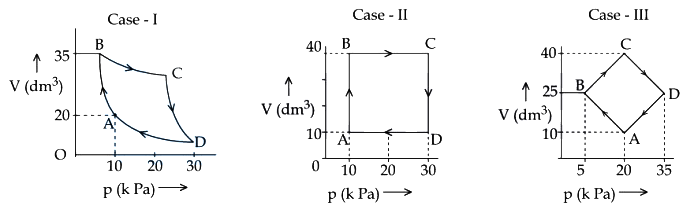
As internal energy ' \(U\) ' is a state function, its cyclic integral must be zero in a cyclic process
\(\therefore \Delta U \text { case }(I)=\Delta U \text { case }(\text { II })=\Delta U \text { case }(\text { III })\) -
- (A) \(a \gt b \gt c \gt d\)
- (B) \(d \gt c=a \gt b\)
- (C) \(c=a \gt d \gt b\)
- (D) \(a \gt c \gt b \gt d\)
Show answer and solution
Correct Answer: (B)
For isothermal process
\(\begin{aligned}
& \left|\mathrm{W}_{\text {reversible }}\right|_{\text {expansion }}=\left|\mathrm{W}_{\text {reversible }}\right|_{\text {compression }} \\
& =-\mathrm{nRT} \ln \frac{\mathrm{~V}_{\mathrm{f}}}{\mathrm{~V}_{\mathrm{i}}} \\
& \left|\mathrm{~W}_{\text {irreversible }}\right|_{\text {expansion }} \lt \left|\mathrm{W}_{\text {irreversible }}\right|_{\text {compression }} \\
& \mathrm{d} \gt \mathrm{c}=\mathrm{a} \gt \mathrm{b} \\
& \left|\mathrm{~W}_{\text {irreversible }}\right|_{\text {expansion }}=-\mathrm{P}_{\text {ext }}\left(\mathrm{V}_{\mathrm{f}}-\mathrm{V}_{\mathrm{i}}\right)
\end{aligned}\)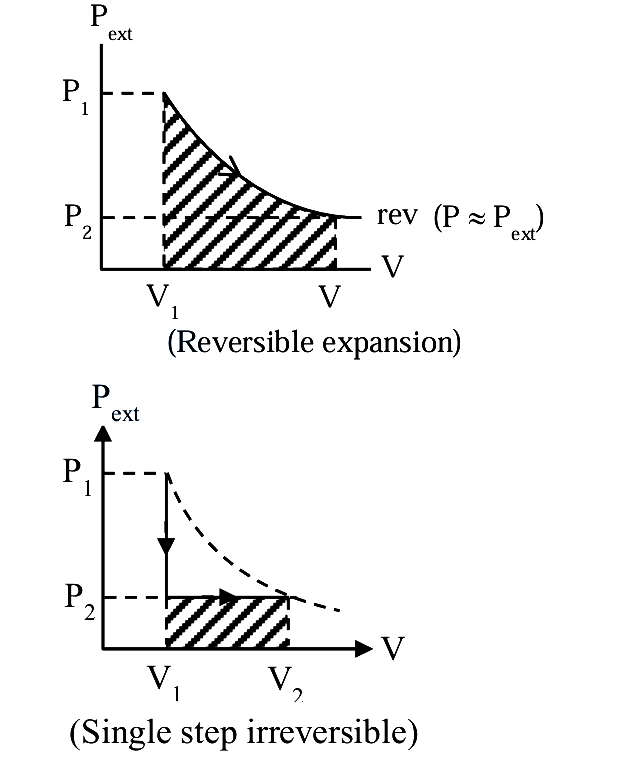
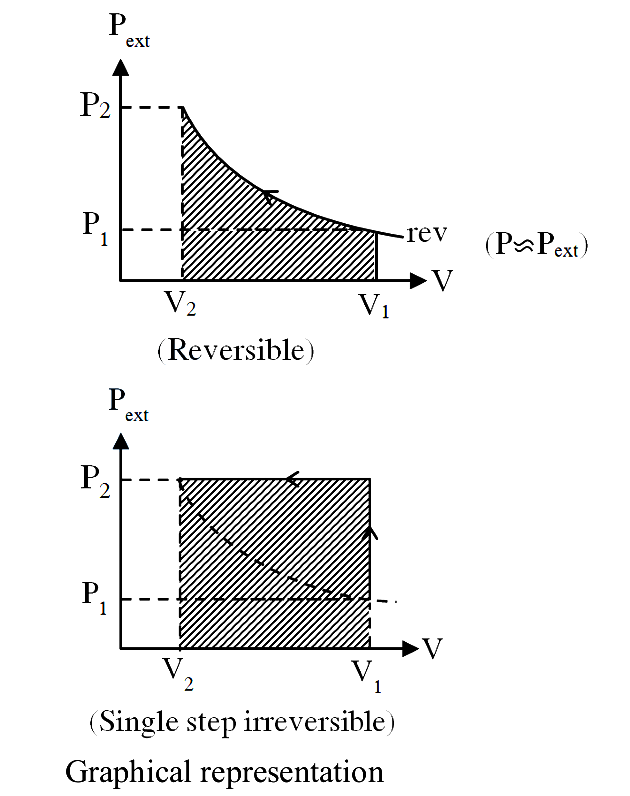
We can compare work by area of PV graph -
- (A) 140
- (B) 147
- (C) 138
- (D) 146
Show answer and solution
Correct Answer: (C)
\(\begin{aligned}
& \mathrm{C}_4 \mathrm{H}_{10}+\frac{13}{2} \mathrm{O}_2 \rightarrow 4 \mathrm{CO}_2+5 \mathrm{H}_2 \mathrm{O} \\
& 3 \times 10^3 \quad 10 \times 10^3
\end{aligned}\)
Moles of \(\mathrm{H}_2 \mathrm{O}\) formed \(=\mathrm{n}_{\mathrm{H}_2 \mathrm{O}}=5 \times \frac{2}{13} \times 10 \times 10^3\)
Then \(\mathrm{w}_{\mathrm{H}_2 \mathrm{O}}=\frac{10^5}{13} \times 18\)
\(=1.3846 \times 10^5 \mathrm{~g}\)
Volume of \(\mathrm{H}_2 \mathrm{O}\) will be \(=138.46\) litre.
Ans. 138 -
- (A) 90
- (B) 100
- (C) 95
- (D) 97
Show answer and solution
Correct Answer: (C)
\(\begin{aligned} & 2 \mathrm{C}_{\text {(graphite) }}+3 \mathrm{H}_2(\mathrm{~g}) \rightarrow \mathrm{C}_2 \mathrm{H}_6(\mathrm{~g}) \quad \Delta \mathrm{H}_{\mathrm{f}}=? \\ & \mathrm{C}_2 \mathrm{H}_6(\mathrm{~g})+\frac{7}{2} \mathrm{O}_2(\mathrm{~g}) \rightarrow 2 \mathrm{CO}_2(\mathrm{~g})+3 \mathrm{H}_2 \mathrm{O}(l) \\ & \quad \Delta \mathrm{H}_1=-1550 \\ & \mathrm{C}_{\text {(graphite) }}+\mathrm{O}_2(\mathrm{~g}) \rightarrow \mathrm{CO}_2(\mathrm{~g}) \Delta \mathrm{H}_2=-393.5 \\ & \mathrm{H}_2(\mathrm{~g})+\frac{1}{2} \mathrm{O}_2(\mathrm{~g}) \rightarrow \mathrm{H}_2 \mathrm{O}(/) \Delta \mathrm{H}_3=-286 \\ & \Delta \mathrm{H}_{\mathrm{f}}=2 \Delta \mathrm{H}_2+3 \Delta \mathrm{H}_3-\Delta \mathrm{H}_1 \\ & \quad=95 \mathrm{~kJ} / \mathrm{mole}^2\end{aligned}\) -
- (A) 46
- (B) 47
- (C) 48
- (D) 49
Show answer and solution
Correct Answer: (C)
\(\begin{aligned} & \Delta \mathrm{H}_{\mathrm{f}}\left[\mathrm{CO}_2(\mathrm{~g})\right]=-393.5 \mathrm{~kJ} / \mathrm{mole} \\ & \Delta \mathrm{H}_{\mathrm{f}}\left[\mathrm{H}_2 \mathrm{O}(\ell)\right]=-286.0 \mathrm{~kJ} / \mathrm{mole} \\ & \Delta \mathrm{H}_{\mathrm{c}}\left[\mathrm{C}_6 \mathrm{H}_6\right]=-3267.0 \mathrm{~kJ} / \mathrm{mole} \\ & \Delta \mathrm{H}_{\mathrm{f}} \mathrm{C}_6 \mathrm{H}_6=(?) \\ & \mathrm{C}_6 \mathrm{H}_6+\frac{15}{2} \mathrm{O}_2(\mathrm{~g}) \longrightarrow 6 \mathrm{CO}_2(\mathrm{~g})+3 \mathrm{H}_2 \mathrm{O}(\ell) \\ & \Delta \mathrm{H}_{\mathrm{R}}=\Delta \mathrm{H}_{\mathrm{C}}=\Sigma \Delta \mathrm{H}_{\mathrm{f}}(\mathrm{P})-\Sigma \Delta \mathrm{H}_{\mathrm{f}}(\mathrm{R}) \\ & -3267=6 \times(-393.5)+3(-286)-\Delta \mathrm{H}_{\mathrm{f}}\left(\mathrm{C}_6 \mathrm{H}_6\right) \\ & \Delta \mathrm{H}_{\mathrm{f}}\left(\mathrm{C}_6 \mathrm{H}_6\right)=48 \mathrm{~kJ} / \mathrm{mole}\end{aligned}\) -
- (A) Dissolution of gas in water is an endothermic process
- (B) The heat of solution depends on the amount of solvent.
- (C) The heat of dilution for the \(\mathrm{HCl}\left(\mathrm{HCl} \cdot 10 \mathrm{H}_2 \mathrm{O}\right.\) to \(\left.\mathrm{HCl}.40 \mathrm{H}_2 \mathrm{O}\right)\) is \(3.78 \mathrm{~kJ} \mathrm{~mol}^{-1}\).
- (D) The heat of formation of HCl solution is represented by both (a) and (b)
Show answer and solution
Correct Answer: (B)
From the given information
\(\Delta \mathrm{H}\) is negative so it means dissolution of gas \(\mathrm{HCl}(\mathrm{g})\) is exothermic.
\(\mathrm{HCl}(\mathrm{g})+10 \mathrm{H}_2 \mathrm{O}(\mathrm{l}) \rightarrow \mathrm{HCl}.10 \mathrm{H}_2 \mathrm{O}\) ...(1)
\(\Delta \mathrm{H}_1=-69.01 \frac{\mathrm{~kJ}}{\mathrm{~mol}}\)
\(\mathrm{HCl}(\mathrm{g})+40 \mathrm{H}_2 \mathrm{O}(\mathrm{l}) \rightarrow \mathrm{HCl}.40 \mathrm{H}_2 \mathrm{O}\) ...(2)
\(\Delta \mathrm{H}_2=-72.79 \frac{\mathrm{~kJ}}{\mathrm{~mol}}\)
Hence heat of solution depends upon amount of solvent
By equation..(2) - equation
\(\mathrm{HCl}.10 \mathrm{H}_2 \mathrm{O}+30 \mathrm{H}_2 \mathrm{O}(\ell) \rightarrow \mathrm{HCl} \cdot 40 \mathrm{H}_2 \mathrm{O}\)
So Heat of dilution \(=-72.79-(-69.01)\)
\(=-3.78 \frac{\mathrm{~kJ}}{\mathrm{~mol}}\)
Hence option (3) is incorrect.
For heat of formation reactant should be in elemental form hence option (4) is incorrect -
- (A) 30
- (B) 35
- (C) 20
- (D) 25
Show answer and solution
Correct Answer: (D)
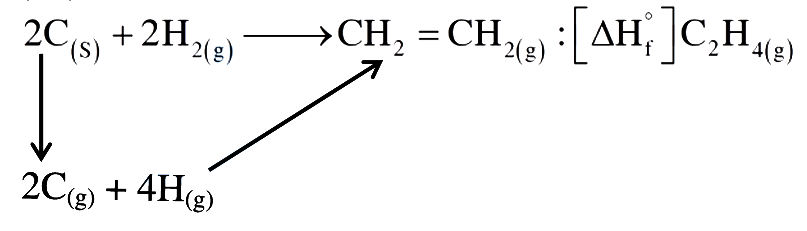
\(\left[\Delta H _{ f }^{ o }\right]_{ C _2 H _{(4)}}=2 \times\left[\Delta H _{ sub }^{ o }\right]_{ C _{( s )}}+2 \times \Delta H _{ H - H }^{ o }\) \(-1 \times \Delta H _{ C = C }^{ o }-4 \times \Delta H _{ CH }^{ o }\)
\(\Rightarrow\left[\Delta H _{ f }^{ o }\right]_{ C _2 H _{4(g)}}=(2 \times 710)+(2 \times 436)\) \(-611-4 \times 414\)
\(\Rightarrow {\left[\Delta \mathrm{H}_{\mathrm{f}}^{\mathrm{o}}\right]_{\mathrm{C}_2 \mathrm{H}_{4(\mathrm{~g})}}=25 \mathrm{~kJ} / \mathrm{mol} }\) -
- (A) \(\mathrm{T}=\mathrm{Te}\)
- (B) \(\mathrm{Te} \gt \mathrm{T}\)
- (C) \(\mathrm{T} \gt \mathrm{Te}\)
- (D) \(\mathrm{Te}=5 \mathrm{~T}\)
Show answer and solution
Correct Answer: (C)
For reaction to be spontaneous according to \(2^{\text {nd }}\) law:
\(\begin{aligned}
& \Delta \mathrm{G} \lt 0 \\
& \Rightarrow \Delta \mathrm{H}-\mathrm{T} \Delta \mathrm{~S} \lt 0 \\
& \Rightarrow \mathrm{~T} \gt \left(\frac{\Delta \mathrm{H}}{\Delta \mathrm{~S}}\right)=\mathrm{T}_{\mathrm{e}} \\
& \Rightarrow \mathrm{~T} \gt \mathrm{T}_{\mathrm{e}}
\end{aligned}\) -
- (A) Both \(\Delta \mathrm{H}\) and \(\Delta \mathrm{S}\) are (-ve)
- (B) \(\Delta \mathrm{H}\) is (-ve) but \(\Delta \mathrm{S}\) is (+ve)
- (C) \(\Delta \mathrm{H}\) is \((+\mathrm{ve})\) but \(\Delta \mathrm{S}\) is \((-\mathrm{ve})\)
- (D) Both \(\Delta \mathrm{H}\) and \(\Delta \mathrm{S}\) are (+ve)
Show answer and solution
Correct Answer: (D)
On increasing temperature, the given endothermic reaction becomes spontaneous.
\(\Delta G=\Delta H-T \Delta S\)
For spontaneity,
\(\Delta \mathrm{G} < 0\)
Given,
\(\Delta \mathrm{H}>0\)
So, \(\Delta \mathrm{S}\) should be +ve. -
- (A) (A)-(II), (B)-(I), (C)-(III), (D)-(IV)
- (B) (A)-(I), (B)-(II), (C)-(IV), (D)-(III)
- (C) (A)-(II), (B)-(I), (C)-(IV), (D)-(III)
- (D) (A)-(II), (B)-(III), (C)-(I), (D)-(IV)
Show answer and solution
Correct Answer: (C)
\(\begin{aligned} & \because \mathrm{dH}=\mathrm{dq} \text { (at } \mathrm{P}=\text { constant) } \\ & \mathrm{dH}=\mathrm{CpdT}^{\mathrm{dT}} \\ & \left(\frac{\mathrm{dH}}{\mathrm{dT}}\right)_{\mathrm{P}}=\mathrm{C}_{\mathrm{P}} \\ & \mathrm{dU}=\mathrm{dq} \quad \text { (at } \mathrm{V}=\text { constant) } \\ & \mathrm{dU}=\mathrm{C}_{\mathrm{V}} \mathrm{dT} \\ & \left(\frac{\mathrm{dU}}{\mathrm{dT}}\right)_{\mathrm{V}}=\mathrm{C}_{\mathrm{V}} \\ & \because \mathrm{dG}=\mathrm{VdP}-\mathrm{SdT} \\ & \text { at } \mathrm{P}=\text { constant, } \mathrm{dP}=0\end{aligned}\)
\(\left(\frac{d G}{d T}\right)_P=-S\)
at \(\mathrm{T}=\) constant
\(\left(\frac{\mathrm{dG}}{\mathrm{dP}}\right)_{\mathrm{T}}=\mathrm{V}\) -
- (A) \(0,21.84 \mathrm{~kJ},-1.26 \mathrm{~kJ}\)
- (B) \(0,-17.18 \mathrm{~kJ}, 1.718 \mathrm{~J}\)
- (C) \(0,21.84 \mathrm{~kJ}, 21,84 \mathrm{~kJ}\)
- (D) \(0,1.78 \mathrm{~kJ},-1.718 \mathrm{~kJ}\)
Show answer and solution
Correct Answer: (D)
\(\begin{aligned} & (10 \mathrm{~L}, 300 \mathrm{~K}) \xrightarrow{\mathrm{n}=1}(20 \mathrm{~L}, 300 \mathrm{~K}) \\ & -\mathrm{q}=\mathrm{w}=-\mathrm{nRT} \ln \frac{\mathrm{V}_2}{\mathrm{~V}_1} \\ & =-8.3 \times 300 \times \ln \left(\frac{20}{10}\right) \\ & =-1.718 \mathrm{~kJ} \\ & \Rightarrow \mathrm{q}=1.718 \mathrm{~kJ} \\ & \mathrm{w}=-1.718 \mathrm{~kJ} \\ & \Delta \mathrm{U}=0(\because \Delta \mathrm{~T}=0)\end{aligned}\) -
- (A) 800
- (B) 900
- (C) 1000
- (D) 700
Show answer and solution
Correct Answer: (D)
\(\begin{aligned} & \frac{1}{2} \mathrm{X}_2+\frac{5}{2} \mathrm{Y}_2 \rightleftharpoons \mathrm{XY}_5 \\ & \Delta \mathrm{~S}_{\mathrm{Rxn}}^0=110-\left[\left(\frac{1}{2} \times 70\right)+\left(\frac{5}{2} \times 50\right)\right] \\ & =110-160=-50 \mathrm{JK}^{-1} \mathrm{~mol}^{-1} \\ & \Delta \mathrm{G}^0=0 \text { at eqb } \\ & \Delta \mathrm{G}^0=\Delta \mathrm{H}^0-\mathrm{T} \Delta \mathrm{S}^0 \\ & 0=-35000-\mathrm{T}(-50) \\ & \mathrm{T}=700 \mathrm{Kelvin}\end{aligned}\) -
- (A) 250
- (B) 100
- (C) 200
- (D) 105
Show answer and solution
Correct Answer: (C)
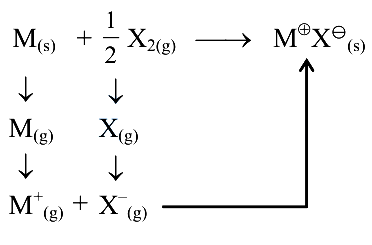
\(\therefore \Delta \mathrm{H}_{\mathrm{f}}(\mathrm{MX})= \)
\( \Delta \mathrm{H}_{\text {sub }}(\mathrm{M})+\text { I.E. }(\mathrm{M})+\frac{1}{2}[\text { B.E. }(\mathrm{X}-\mathrm{X})] +\mathrm{EG}(\mathrm{X})+\text { L.E. }(\mathrm{MX})\)
\( -400=(100)+(500)+\frac{1}{2}(\text { B.E. })+(-300)+(-800)\)
\(\therefore \text { B.E. }=200 \mathrm{~kJ} \mathrm{~mole}^{-1}\) -
- (A) The term 'standard state' implies that the temperature is \(0^{\circ} \mathrm{C}\)
- (B) The standard state of pure gas is the pure gas at a pressure of 1 bar and temperature 273 K
- (C) \(\Delta_{\mathrm{f}} \mathrm{H}_{298}^\theta\) is zero for \(\mathrm{O}(\mathrm{g})\)
- (D) \(\Delta_{\mathrm{f}} \mathrm{H}_{500}^\theta\) is zero for \(\mathrm{O}_2(\mathrm{~g})\)
Show answer and solution
Correct Answer: (D)
For standard state \(\Rightarrow\) pressure \(=1\) bar and temperature is specified only
\(\Rightarrow\left(\Delta \mathrm{H}_{\mathrm{f}}^{\mathrm{o}}\right)_{\mathrm{O}_{2,(\mathrm{~g})}}=0\) -
- (A) (B) and (C) only
- (B) (B) and (D) only
- (C) (A) and (D) only
- (D) (A) and (C) only
Show answer and solution
Correct Answer: (A)
\(\because \Delta \mathrm{G}=\Delta \mathrm{H}-\mathrm{T} \Delta \mathrm{~S}\)
For spontaneity of reaction: \(\Delta \mathrm{G}=-\mathrm{ve}\) -
- (A) 460
- (B) 466
- (C) 450
- (D) 444
Show answer and solution
Correct Answer: (B)
\(\begin{aligned} & \frac{1}{2} \mathrm{H}_{2(\mathrm{~g})} \rightarrow \mathrm{H}(\mathrm{g}) \quad ; \quad \Delta_{\mathrm{f}} \mathrm{H}\left(\mathrm{H}_{(\mathrm{g})}\right)=220 \mathrm{KJ} / \mathrm{mol} \\ & \frac{1}{2} \mathrm{O}_{2(\mathrm{~g})} \rightarrow \mathrm{O}(\mathrm{g}) \quad ; \quad \Delta_{\mathrm{f}} \mathrm{H}\left(\mathrm{O}_{(\mathrm{g})}\right)=250 \mathrm{KJ} / \mathrm{mol}\end{aligned}\)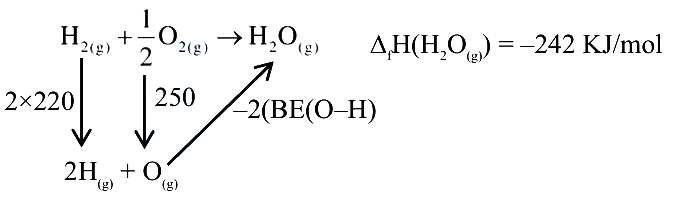
\(\begin{aligned} & \Delta \mathrm{H}_{\mathrm{f}}\left(\mathrm{H}_2 \mathrm{O}_{(\mathrm{l})}\right)=-242=440+250-2(\mathrm{~B} . \mathrm{E} .(\mathrm{O}-\mathrm{H})) \\ & \mathrm{BE}(\mathrm{O}-\mathrm{H})=466 \mathrm{KJ} / \mathrm{mol}\end{aligned}\) -
- (A) \(+x-y-z\)
- (B) \(x+y+z\)
- (C) \(z-(x+y)\)
- (D) \(-\mathrm{z}-(\mathrm{x}+\mathrm{y})\)
Show answer and solution
Correct Answer: (C)
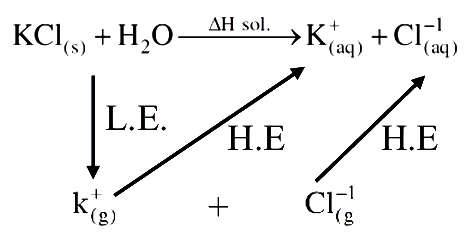
\(\begin{aligned} \Delta \mathrm{H}_{\text {Sol}^{\mathrm{n}}.} & =\mathrm{L} \cdot \mathrm{E} \cdot+(\mathrm{H} \cdot \mathrm{E})_{\mathrm{K}_{(\mathrm{g})}^{+}}+(\mathrm{HE})_{\mathrm{Cl}_{(\mathrm{g})}^{-1}} \\ & =\mathrm{Z}-\mathrm{x}-\mathrm{y} \\ & =\mathrm{z}-(\mathrm{x}+\mathrm{y})\end{aligned}\) -
- (A) 2850
- (B) 2750
- (C) 2950
- (D) 2650
Show answer and solution
Correct Answer: (A)
\(\begin{aligned} & \Delta \mathrm{H}_{\mathrm{rxn}}^{\mathrm{o}}=55 \mathrm{~kJ} / \mathrm{mol}, \quad \mathrm{T}=298 \mathrm{~K} \\ & \Delta \mathrm{~S}_{\mathrm{rxn}}^{\mathrm{o}}=175 \mathrm{~J} / \mathrm{mol} \\ & \Delta \mathrm{G}_{\mathrm{rxn}}^{\mathrm{o}}=\Delta \mathrm{H}_{\mathrm{rxn}}^{\mathrm{o}}-\mathrm{T} \Delta \mathrm{S}_{\mathrm{rxn}}^{\circ} \\ & \Rightarrow \Delta \mathrm{G}_{\mathrm{rxn}}^{\mathrm{o}}=55000 \mathrm{~J} / \mathrm{mol}-298 \times 175 \mathrm{~J} / \mathrm{mol} \\ & \Rightarrow \Delta \mathrm{G}_{\mathrm{rxn}}^{\mathrm{o}}=55000-52150 \\ & \Rightarrow \Delta \mathrm{G}_{\mathrm{rxn}}^{\mathrm{o}}=2850 \mathrm{~J} / \mathrm{mol}\end{aligned}\) -
- (A) \(-x-10 y-10 z\)
- (B) \(-10(100 x+y+z)\)
- (C) \(10(100 x+y+z)\)
- (D) \(x-10 y-10 z\)
Show answer and solution
Correct Answer: (B)
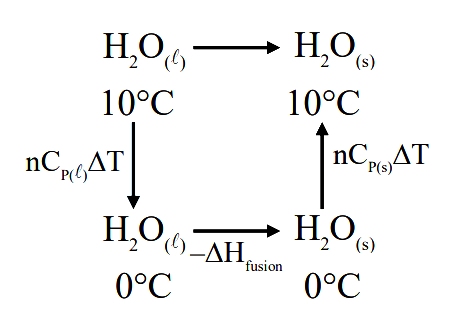
\(\begin{aligned} & \Delta H=1 \times y(0-10)-x \times 1000+1 \times z\left(-10^{\circ}-0^{\circ}\right) \\ & \Delta H=-10(100 x+y+z) \text { Joule. }\end{aligned}\) -
- (A) \(d w \neq 0\)
- (B) \(\mathrm{dq} \neq 0\)
- (C) \(\mathrm{dU} \neq 0\)
- (D) The pressure in the vessel \(B\) before opening the stopcock is zero.
Show answer and solution
Correct Answer: (D)
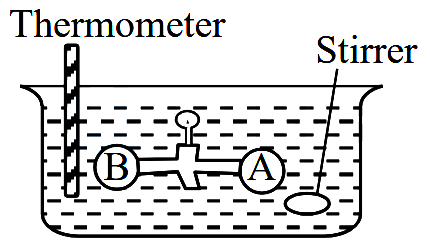
It is free expansion of gas \(\Rightarrow P_{\text {ext }}=0\)
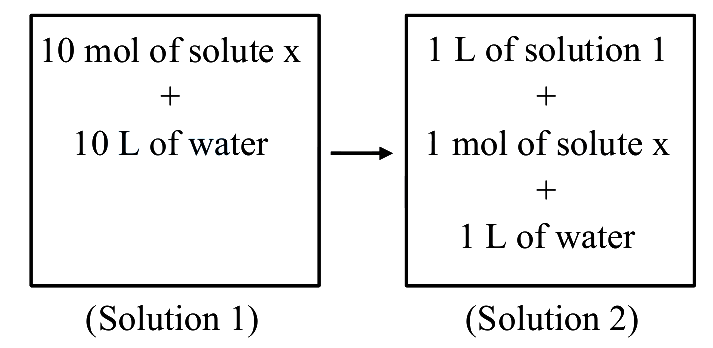
Where \(\mathrm{w}=0, \mathrm{q}=0\) and \(\Delta \mathrm{U}=0\) - 47. Which of the following properties will change when system containing solution 1 will become solution 2?
2025 Easy- (A) Molar heat capacity
- (B) Density
- (C) Concentration
- (D) Gibbs free energy
Show answer and solution
Correct Answer: (D)
Both solutions are having same composition, which is 1 mole of ' \(x\) ' in 1 ' \(\ell\) ' water, so all the intensive properties will remain same, but as total amount is greater in solution ' 1 ' compared to solution ' 2 '. So extensive properties will be different hence Gibbs free energy will be different. -
- (A) \(273\)
- (B) \(274\)
- (C) \(277\)
- (D) \(280\)
Show answer and solution
Correct Answer: (B)
\(\Delta \mathrm{U}=\mathrm{q}+\mathrm{w}(\mathrm{q}=0)\)\(\mathrm{nC}_{\mathrm{V}} \Delta \mathrm{T}=-\mathrm{P}_{\mathrm{ext}}\left(\mathrm{V}_2-\mathrm{V}_1\right)\)
\(\mathrm{V}_2=2 \mathrm{~V}_1\)
\(\frac{\mathrm{nRT}_2}{\mathrm{P}_2}=\frac{2 \mathrm{nRT}_1}{\mathrm{P}_1}\)
\(\mathrm{P}_1=5, \mathrm{~T}_1=298\)
\(\mathrm{P}_2=\frac{5 \mathrm{~T}_2}{2 \times 298}\)
\(\mathrm{n} \frac{5}{2} \mathrm{R}\left(\mathrm{T}_2-\mathrm{T}_1\right)=-1\left(\frac{\mathrm{nRT}_2}{\mathrm{P}_1}-\frac{\mathrm{nRT}_1}{\mathrm{P}_1}\right)\)
\(\mathrm{T}_1=298\)
\(\text { and } \mathrm{P}_2=\frac{5 \mathrm{~T}_2}{2 \times 298}\)
Solve and we get \(T_2=274.16 \mathrm{~K}\)
\(\mathrm{T}_2 \approx 274 \mathrm{~K}\)
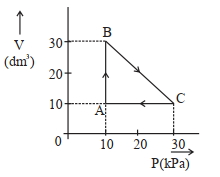
-
- (A) \(100\)
- (B) \(150\)
- (C) \(200\)
- (D) \(250\)
Show answer and solution
Correct Answer: (C)
Work done is given by area enclosed in the \(\mathrm{P}\) vs \(\mathrm{V}\) cyclic graph or \(V\) vs \(P\) cyclic graph.Sign of work is positive for clockwise cyclic process for \(\mathrm{V}\) vs \(\mathrm{P}\) graph.
\(\mathrm{W}=\frac{1}{2} \times(30-10) \times(30-10)=200 \mathrm{kPa}-\mathrm{dm}^3\)
\(=200 \times 1000 \mathrm{~Pa}-\mathrm{L}=2 \mathrm{~L}-\mathrm{bar}=200 \mathrm{~J}\)
- 50. Choose the correct option for free expansion of an ideal gas under adiabatic condition from the following : 2024 Hard
- (A) \(\mathrm{q}=0, \Delta \mathrm{T} \neq 0, \mathrm{w}=0\)
- (B) \(\mathrm{q}=0, \Delta \mathrm{T}<0, \mathrm{w} \neq 0\)
- (C) \(q \neq 0, \Delta T=0, w=0\)
- (D) \(q=0, \Delta T=0, w=0\)
Show answer and solution
Correct Answer: (D)
During free expansion of an ideal gas under adiabatic condition \(\mathrm{q}=0, \Delta \mathrm{T}=0, \mathrm{w}=0\).
No questions on this page match these filters.
About Thermodynamics and thermochemistry PYQs
Thermodynamics and thermochemistry has 204 questions from 2013–2026. The most came in 2025 (27), 2023 (25) and 2022 (23).
The most asked topics are First law of thermodynamics and Hess law, Heat of reaction and Free energy and Work function.
9% are easy, 51% medium and 40% hard.
Thermodynamics and thermochemistry PYQs by year
Frequently asked
How many Thermodynamics and thermochemistry questions came in JEE Mains?
204 questions from 2013–2026, each with the correct answer and a full solution.
Which Thermodynamics and thermochemistry topic is asked the most?
First law of thermodynamics and Hess law, with 59 questions, followed by Heat of reaction with 57.
Which year had the most Thermodynamics and thermochemistry questions?
2025, with 27 questions.
How difficult are Thermodynamics and thermochemistry questions?
9% are easy, 51% medium and 40% hard.