


Questions
Newest firstShowing 1–13 of 13 questions
-
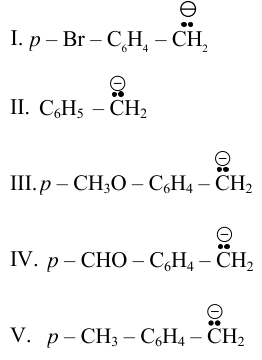
- (A) I > II > IV > V > III
- (B) I > IV > II > V > III
- (C) IV > I > II > V > III
- (D) IV > II > I > III > V
Show answer and solution
Correct Answer: (C)
Electron withdrawing groups increases stability of carbanion and electron donating groups decreases stability of carbanion. - 2. CORRECT order of stability for the following is
\( CH_{2}=CH^{-}, CH_{3}-CH_{2}^{-}, CH\equiv C^{-} \) 2026 Hard- (A) \( CH_{3}-CH_{2}^{-}>CH_{2}=CH^{-}>CH\equiv C^{-} \)
- (B) \( CH_{2}=CH^{-}>CH\equiv C^{-}>CH_{3}-CH_{2}^{-} \)
- (C) \( CH\equiv C^{-}>CH_{2}=CH^{-}>CH_{3}-CH_{2}^{-} \)
- (D) \( CH\equiv C^{-}>CH_{3}-CH_{2}^{-}>CH_{2}=CH^{-} \)
Show answer and solution
Correct Answer: (C)
\(CH _2= C \overline{ H }~CH _3= C _2~CH \equiv \overline{ C }\)
Stability \( \propto \) %S
Order of stability:
\( CH\equiv\overline{C}>CH_{2}=\overline{CH}>CH_{3}-C\overline{H}_{2} \) -
- (A) Statement I is true but Statement II is false
- (B) Both Statement I and Statement II are true
- (C) Both Statement I and Statement II are false
- (D) Statement I is false but Statement II is true
Show answer and solution
Correct Answer: (A)
S-1 : \(\left( CH _3\right)_3 C ^{+}>\stackrel{+}{ C } H _3\); due to hyperconjugation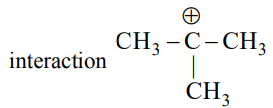
S-2 : False -
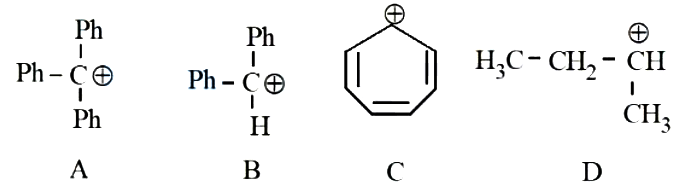
- (A) \(\mathrm{C}\gt\mathrm{B}\gt\mathrm{A}\gt\mathrm{D}\)
- (B) \(\mathrm{A}\gt\mathrm{B}\gt\mathrm{C}\gt\mathrm{D}\)
- (C) \(\mathrm{B}\gt\mathrm{C}\gt\mathrm{A}\gt\mathrm{D}\)
- (D) \(\mathrm{C}\gt\mathrm{A}\gt\mathrm{B}\gt\mathrm{D}\)
Show answer and solution
Correct Answer: (D)
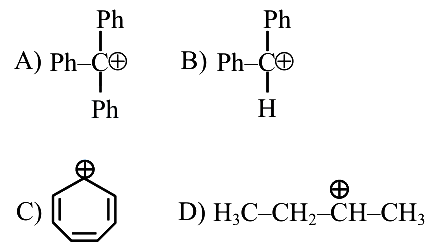
Solution :-
C is aromatic due to \(\oplus \mathrm{ve}\) charge hence it is most stable
A have more resonance structure
B have less resonance structure
D have only hyper conjugation
Consider First Aromaticity \(>\) Resonance \(>\) Hyper conjugation
Ans. D \( < \) B \( < \) A \( < \) C -
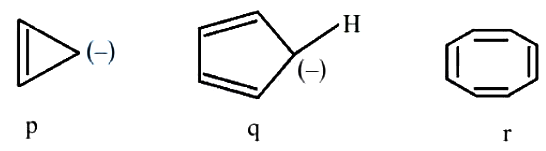
- (A) \(q\gt r\gt p\)
- (B) \(r\gt q\gt p\)
- (C) \(q\gt p\gt r\)
- (D) \(\mathrm{p}\gt\mathrm{q}\gt\mathrm{r}\)
Show answer and solution
Correct Answer: (A)
q is aromatic
r is non-aromatic
p is antiaromatic
\(\mathrm{q}>\mathrm{r}>\mathrm{p}\) (order of stability)
Aromatic > non-aromatic > antiaromatic - 6. Number of carbocations from the following that are not stabilized by hyperconjugation is _______.
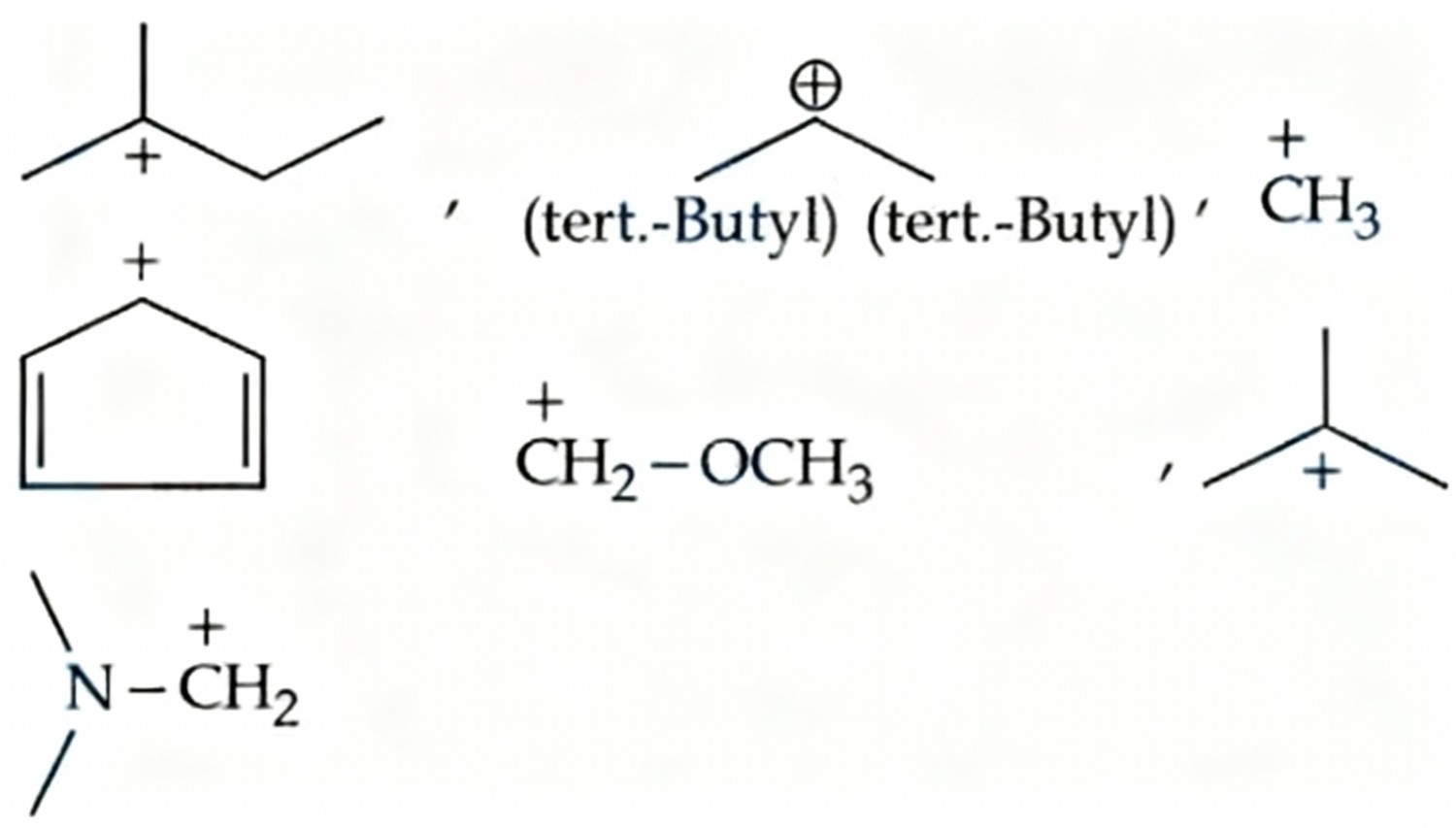 2024 Medium
- (A) 3
- (B) 5
- (C) 7
- (D) 9
Show answer and solution
Correct Answer: (A)
3 -
- (A) \(A-I, B-IV, C-II, D-III\)
- (B) \(A-III, B-II, C-I, D-IV\)
- (C) \(A-III, B-II, C-IV, D-I\)
- (D) \(A-III, B-II, C-IV, D-I\)
Show answer and solution
Correct Answer: (D)
Basic Strength \(\alpha \frac{1}{ pK _{ b }}\) Order for \(pK _{ b }: A > B > D > C\)
- 8. The decreasing order of hydride affinity for following carbocations is: Choose the correct answer from the options given below:
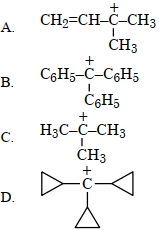 2023 Medium
- (A) \(A,C,B,D\)
- (B) \(C,A,B,D\)
- (C) \(C,A,D,B\)
- (D) \(A,C,D,B\)
Show answer and solution
Correct Answer: (B)
Stability order of cations is: \(C < A < B < D\) -
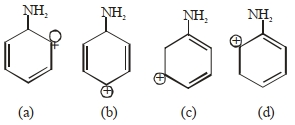
- (A) \(c\)
- (B) \(d\)
- (C) \(b\)
- (D) \(a\)
Show answer and solution
Correct Answer: (A)
The \(+ M\) effect of \(NH _2\) is stabilizing the carbocation.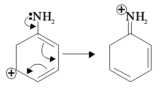
- 10. \(\dot{ Cl }+ CH _{4} \rightarrow A + B\) \(A\) and \(B\) in the above atmospheric reaction step are. 2022 Easy
- (A) \(C _{2} H _{6}\) and \(Cl _{2}\)
- (B) \(\dot{ C } HCl_2\) and \(H _{2}\)
- (C) \(\dot{ C } H _{3}\) and \(HCl\)
- (D) \(C _{2} H _{6}\) and \(HCl\)
Show answer and solution
Correct Answer: (C)
\(Cl + CH _{4} \longrightarrow \dot{ CH }_{3}+ HCl\) -
- (A) \(CH _{3} CH _{2} \stackrel{\oplus}{ CH _{2}}\)
- (B) \(CH _{3} \stackrel{\oplus}{ C } H _{2}\)
- (C) \(CH _{3}-\stackrel{\oplus}{ C } H - CH _{3}\)
Show answer and solution
Correct Answer: (C)
\(CH _{3}-\stackrel{\oplus}{ CH - CH _{3}}\) is formed in the above reaction - 12. On the treatment of the following compound with a strong acid, the most susceptible site for bond cleavage is
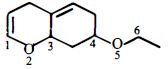 2018 Hard
- (A) \(O2- C3\)
- (B) \(O5 - C6\)
- (C) \(C4- O5\)
- (D) \(C1 - O2\)
Show answer and solution
Correct Answer: (B)
The lone pair of electrons on \(O2\) is involved in resonance with \(C= C\). Hence \(O2\) will not be protonated. The lone pair of electrons on \(O5\) is not involved in resonance with \(C\, = C\). Hence, \(O5\) will be protonated. Chloride ion will then attack least substituted \(C\) atom \((C6)\) -
- (A) carbanion
- (B) carbene
- (C) carbocation
- (D) free radical
Show answer and solution
Correct Answer: (C)
\(\begin{matrix}
Cl-CH-C{{H}_{3}} \\
|\,\,\,\,\,\,\,\,\, \\
\underset{(-)\,\,\,\,\,\,\,\,\,\,\,\,\,\,}{\mathop{Ph\,\,\,\,\,\,\,}}\, \\
\end{matrix}\xrightarrow[Toluene]{SbC{{l}_{5}}}\underset{\begin{smallmatrix}
(Carbocation) \\
(planar)
\end{smallmatrix}}{\mathop{Ph-\overset{\oplus }{\mathop{C}}\,H-C{{H}_{3}}}}\,+SbCl_{6}^{-}\) \(\to \underset{\begin{smallmatrix}
(d\,and\,l)\,mixture \\
+SbC{{l}_{5}}
\end{smallmatrix}}{\mathop{\begin{matrix}
Ph-CH-C{{H}_{3}} \\
\,|\,\,\,\,\,\,\,\,\, \\
Cl\,\,\,\,\,\,\,\,\, \\
\end{matrix}}}\,\)

No questions on this page match these filters.
Other STD 11 - Organic chemistry reaction mechanism topics
Frequently asked
How many Reactive Intermediates questions came in JEE Mains?
13 questions from 2013–2026, each with the correct answer and a full solution.
How difficult are Reactive Intermediates questions?
38% are easy, 31% medium and 31% hard.