


Topics
7 topics- 48Qs Properties of Haloalkanes Most asked
- 10Qs Preparation of Haloalkanes
- 8Qs Introduction of Halogen containing compounds
- 8Qs Properties of Haloarenes
- 5Qs Polyhalogenated compounds
- 2Qs Preparation of Haloarenes
- 1Qs Uses of Halogen containing compounds
All Haloalkanes and Haloarenes questions
Newest firstShowing 1–50 of 82 questions
-
- (A) Haloform test
- (B) Lucas test
- (C) Silver mirror test
- (D) Benedict test
Show answer and solution
Correct Answer: (A)
The optically active alkyl bromide \(\text{C}_4\text{H}_9\text{Br}\) is \(2\)-bromobutane, \(\text{CH}_3\text{CH}(\text{Br})\text{CH}_2\text{CH}_3\).
Reaction with ethanolic \(\text{KOH}\) undergoes dehydrohalogenation to form but-\(2\)-ene as the major product [A] (Zaitsev's rule).
But-\(2\)-ene [A] reacts with \(\text{Br}_2\) to form \(2,3\)-dibromobutane [B], \(\text{CH}_3\text{CH}(\text{Br})\text{CH}(\text{Br})\text{CH}_3\).
Compound [B] undergoes double dehydrohalogenation with ethanolic \(\text{KOH}\) and \(\text{NaNH}_2\) to give but-\(2\)-yne [C], \(\text{CH}_3\text{C}\equiv\text{CCH}_3\).
Hydration of but-\(2\)-yne [C] with \(\text{HgSO}_4\) and dilute \(\text{H}_2\text{SO}_4\) yields butan-\(2\)-one [D], \(\text{CH}_3\text{COCH}_2\text{CH}_3\).
Since compound [D] is a methyl ketone, its functional group is confirmed by the haloform test.
Answer: Haloform test -
- (A) A, C and E only
- (B) B, C and D only
- (C) A, D and E only
- (D) B, C and E only
Show answer and solution
Correct Answer: (D)
Chlorocylohexane is more polar due to - I effect of - Cl,
Whereas chlorobenzene has \(- I >+ M\), so it is less polar & also has partial double bond character. -
- (A) 2
- (B) 3
- (C) 4
- (D) 5
Show answer and solution
Correct Answer: (B)
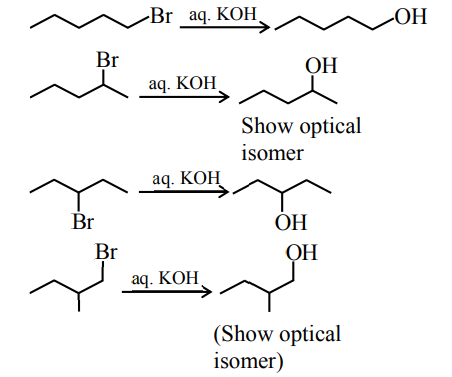
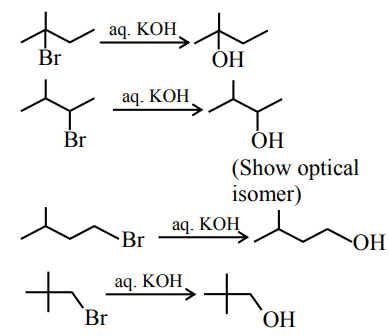
Explanation:
Let us analyze all the structural isomers and their respective substitution products step-by-step to find the ones that exhibit optical isomerism:
1. Understanding the Reaction:
Reaction of alkyl halides with aqueous KOH is a nucleophilic substitution reaction where the bromine atom \((-\text{Br})\) is replaced by a hydroxyl group \((-\text{OH})\) to form an alcohol without any skeletal rearrangement.
2. Identifying all 8 Structural Isomers and their Products:
There are a total of 8 structural isomers for the molecular formula \(C_5H_{11}Br\). Let us check the alcohol products formed by each:
- 1-Bromopentane \(\rightarrow\) Pentan-1-ol (Achiral)
- 2-Bromopentane \(\rightarrow\) Pentan-2-ol (Chiral, contains a stereocenter at C-2) → Product 1
- 3-Bromopentane \(\rightarrow\) Pentan-3-ol (Achiral)
- 1-Bromo-2-methylbutane \(\rightarrow\) 2-Methylbutan-1-ol (Chiral, contains a stereocenter at C-2) → Product 2
- 2-Bromo-2-methylbutane \(\rightarrow\) 2-Methylbutan-2-ol (Achiral)
- 2-Bromo-3-methylbutane \(\rightarrow\) 3-Methylbutan-2-ol (Chiral, contains a stereocenter at C-2) → Product 3
- 1-Bromo-3-methylbutane \(\rightarrow\) 3-Methylbutan-1-ol (Achiral)
- 1-Bromo-2,2-dimethylpropane \(\rightarrow\) 2,2-Dimethylpropan-1-ol (Achiral)
3. Conclusion:
Out of the 8 distinct structural products formed, exactly 3 products contain an asymmetric chiral carbon atom bonded to four different groups, meaning only 3 products can exhibit optical isomerism. Therefore, Option B is absolutely correct.
Hence, Option B is the correct choice. -
- (A) A, B and C Only
- (B) B and D Only
- (C) A and E Only
- (D) D and E Only
Show answer and solution
Correct Answer: (C)
Statement A is correct. Alcoholic KOH provides alkoxide ions which are stronger bases than hydroxide ions. Furthermore, alcohol is a less polar solvent than water, which decreases the solvation of the base, making it more effective for elimination reactions over substitution.
Statement B is incorrect. The reactivity towards the \(S_N^1\) mechanism depends on the stability of the intermediate carbocation. The carbocation \(C_6H_5-\overset{+}{C}H-C_6H_5\) is more stable than \(C_6H_5-\overset{+}{C}H_2\) due to extended resonance stabilization from two phenyl rings. Thus, \(C_6H_5-CHCl-C_6H_5\) is more reactive than \(C_6H_5-CH_2-Cl\).
Statement C is incorrect. Aryl halides are much less reactive towards nucleophilic substitution than alkyl halides due to the partial double bond character of the C-X bond arising from resonance, as well as the \(sp^2\) hybridization of the carbon atom.
Statement D is incorrect. Allyl chloride (\(CH_2=CH-CH_2-Cl\)) contains a carbon-carbon double bond, making it a haloalkene, not a haloalkyne.
Statement E is correct. Alkyl chlorides (\(R-Cl\)) can be easily prepared from alcohols (\(R-OH\)) using \(SOCl_2\). However, phenols (\(Ar-OH\)) do not react with \(SOCl_2\) to give aryl chlorides because the C-O bond in phenol has a partial double bond character due to resonance, making it difficult to cleave.
Therefore, only statements A and E are correct.
Answer: A and E Only -
- (A) Both Statement I and Statement II are true
- (B) Both Statement I and Statement II are false
- (C) Statement I is true but Statement II is false
- (D) Statement I is false but Statement II is true
Show answer and solution
Correct Answer: (C)
Statement I:
When \(3\)-phenylpropene reacts with \(HBr\), protonation of the alkene occurs to form a secondary carbocation.
\(C_6H_5-CH_2-CH=CH_2 + H^+ \rightarrow C_6H_5-CH_2-CH^+-CH_3\)
This secondary carbocation undergoes a \(1,2\)-hydride shift to form a more stable, resonance-stabilized benzylic carbocation.
\(C_6H_5-CH_2-CH^+-CH_3 \rightarrow C_6H_5-CH^+-CH_2-CH_3\)
The bromide ion then attacks this benzylic carbocation to form the major product, \(1\)-bromo-\(1\)-phenylpropane.
\(C_6H_5-CH^+-CH_2-CH_3 + Br^- \rightarrow C_6H_5-CH(Br)-CH_2-CH_3\)
The carbon atom bonded to the bromine is attached to four different groups: a phenyl group (\(-C_6H_5\)), an ethyl group (\(-CH_2CH_3\)), a hydrogen atom (\(-H\)), and a bromine atom (\(-Br\)). Thus, it is a chiral carbon. The product is a secondary alkyl bromide. Therefore, Statement I is true.
Statement II:
The Sandmeyer reaction involves treating a diazonium salt with \(Cu(I)\) salts (\(CuCl\), \(CuBr\), \(CuCN\)) to prepare aryl chlorides, aryl bromides, and aryl cyanides, respectively.
The Gattermann reaction involves treating a diazonium salt with copper powder (\(Cu\)) and halogen acids (\(HCl\), \(HBr\)) to prepare aryl chlorides and aryl bromides. Aryl cyanides are not prepared using the Gattermann reaction. Therefore, Statement II is false.
Conclusion: Statement I is true but Statement II is false.
Answer: Statement I is true but Statement II is false -
- (A) Statement I is false but Statement II is true
- (B) Both Statement I and Statement II are true
- (C) Both Statement I and Statement II are false
- (D) Statement I is true but Statement II is false
Show answer and solution
Correct Answer: (D)
Statement - I :
C - Cl bond is strong in vinyl chloride because of double bond character.
Statement - II :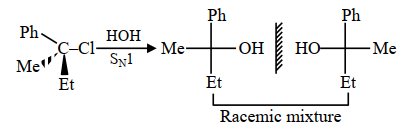
Racemic mixture is optically inactive, which can not rotate PPL. -
- (A) Both Statement I and Statement II are true
- (B) Both Statement I and Statement II are false
- (C) Statement I is true but Statement II is false
- (D) Statement I is false but Statement II is true
Show answer and solution
Correct Answer: (A)
The rate of \(S_N1\) reaction depends on the stability of the carbocation intermediate formed during the rate-determining step.
Benzyl chloride undergoes ionization to form a benzyl carbocation (\(C_6H_5CH_2^+\)), whereas ethyl chloride forms an ethyl carbocation (\(CH_3CH_2^+\)). The benzyl carbocation is highly stabilized by the delocalization of the positive charge over the benzene ring through resonance. On the other hand, the ethyl carbocation is stabilized only by hyperconjugation involving three \(\alpha\)-hydrogens.
Since resonance provides significantly greater stabilization than hyperconjugation, the benzyl carbocation is much more stable than the ethyl carbocation. Consequently, benzyl chloride reacts faster in the \(S_N1\) mechanism than ethyl chloride. Thus, Statement I is true.
Statement II correctly explains that the ethyl carbocation intermediate is less stabilized by hyperconjugation compared to the resonance stabilization of the benzyl carbocation. Thus, Statement II is also true.
Both Statement I and Statement II are true.
Answer: Both Statement I and Statement II are true -
- (A) Both Statement I and Statement II are true
- (B) Both Statement I and Statement II are false
- (C) Statement I is true but Statement II is false
- (D) Statement I is false but Statement II is true
Show answer and solution
Correct Answer: (A)
Statement I is true because as the size of the alkyl group increases, the molecular mass and surface area increase. This leads to an increase in the magnitude of van der Waals forces, which in turn increases the boiling point. Thus, the correct order of boiling points is \(\text{CH}_3\text{CH}_2\text{CH}_2\text{I} > \text{CH}_3\text{CH}_2\text{I} > \text{CH}_3\text{I}\).
Statement II is true because para-dichlorobenzene is more symmetrical than ortho-dichlorobenzene, allowing it to pack more efficiently in the crystal lattice, which results in a higher melting point. However, ortho-dichlorobenzene has a higher dipole moment than para-dichlorobenzene (which has a dipole moment of zero). The stronger dipole-dipole interactions in ortho-dichlorobenzene lead to a higher boiling point compared to para-dichlorobenzene.
Both Statement I and Statement II are true.
Answer: Both Statement I and Statement II are true -
- (A) A-IV, B-I, C-III, D-II
- (B) A-III, B-IV, C-I, D-II
- (C) A-III, B-IV, C-II, D-I
- (D) A-I, B-II, C-IV, D-III
Show answer and solution
Correct Answer: (C)
Explanation:
Let us match the given chloro derivatives with their respective structural formulas:
1. Vinyl Chloride: In vinylic halides, the halogen atom is directly bonded to the \( sp^2 \) hybridized carbon atom of a carbon-carbon double bond. Therefore, Vinyl chloride corresponds to \( \text{CH}_2 = \text{CHCl} \) (A-III).
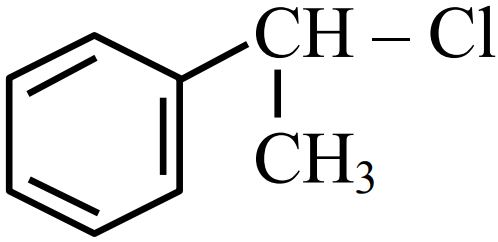
2. Benzylic chloride: In benzylic halides, the halogen atom is bonded to an \( sp^3 \) hybridized carbon atom attached next to an aromatic ring. Therefore, structure IV \( \text{C}_6\text{H}_5 - \text{CH(Cl)} - \text{CH}_3 \) represents a benzylic chloride derivative (B-IV).
3. Alkyl chloride: In alkyl halides, the halogen atom is bonded to a saturated alkyl chain. Isopropyl chloride \( \text{CH}_3 - \text{CH(Cl)} - \text{CH}_3 \) is a standard alkyl chloride (C-II).
4. Allyl chloride: In allylic halides, the halogen atom is bonded to an \( sp^3 \) hybridized carbon atom next to a carbon-carbon double bond. Therefore, Allyl chloride corresponds to \( \text{CH}_2 = \text{CH} - \text{CH}_2\text{Cl} \) (D-I).
Hence, the correct matching is A-III, B-IV, C-II, D-I, which corresponds to Option C. -
- (A) A-I, B-IV, C-III, D-II
- (B) A-III, B-I, C-IV, D-II
- (C) A-IV, B-II, C-I, D-III
- (D) A-I, B-III, C-II, D-IV
Show answer and solution
Correct Answer: (B)
Finkelstein reaction involves the conversion of alkyl chlorides or bromides to alkyl iodides using \(NaI\) in dry acetone. Thus, A matches with III.
Swarts reaction is used for the synthesis of alkyl fluorides by heating an alkyl chloride or bromide in the presence of a metallic fluoride such as \(SbF_3\), \(AgF\), \(Hg_2F_2\), or \(CoF_2\). Thus, B matches with I.
Sandmeyer's reaction involves the conversion of aryl diazonium salts to aryl halides using cuprous halides like \(Cu_2Cl_2\) or \(Cu_2Br_2\). Thus, C matches with IV.
Fittig reaction involves the coupling of two aryl halide molecules in the presence of sodium (\(Na\)) and dry ether to form a diaryl compound. Thus, D matches with II.
The correct matching is A-III, B-I, C-IV, D-II.
Answer: A-III, B-I, C-IV, D-II -
- (A) 20
- (B) 30
- (C) 40
- (D) 50
Show answer and solution
Correct Answer: (B)
The reaction of Grignard reagent with water yields an alkane:
\(RMgI + H_2O \rightarrow RH + Mg(OH)I\)
Given that \(1 \text{ g}\) of the gas \(RH\) occupies \(1.4 \text{ dm}^3\) at STP, we can find its molar mass. Using the standard molar volume at STP (\(22.4 \text{ dm}^3\)):
\(\text{Molar mass of } RH = \dfrac{22.4 \text{ dm}^3 \text{ mol}^{-1}}{1.4 \text{ dm}^3 \text{ g}^{-1}} = 16 \text{ g mol}^{-1}\)
The alkane with a molar mass of \(16 \text{ g mol}^{-1}\) is methane (\(CH_4\)).
Methane reacts with iodine in the presence of an oxidizing agent like \(HIO_3\) (which prevents the backward reaction by consuming the formed \(HI\)) to give methyl iodide:
\(CH_4 + I_2 \xrightarrow{HIO_3} CH_3I + HI\)
Thus, compound (X) is methyl iodide (\(CH_3I\)).
Compound (X) undergoes the Wurtz reaction when treated with sodium and dry ether to form a higher alkane:
\(2CH_3I + 2Na \xrightarrow{\text{dry ether}} CH_3-CH_3 + 2NaI\)
Compound (Y) is ethane (\(C_2H_6\)).
The molar mass of ethane (\(C_2H_6\)) is:
\(2 \times 12 + 6 \times 1 = 30 \text{ g mol}^{-1}\)
Answer: \(30\) -
- (A) \(I^{-}>C_{6}H_{5}O^{-}>F^{-}>C_{2}H_{5}O^{-}\)
- (B) \(I^{-}>C_{2}H_{5}O^{-}>C_{6}H_{5}O^{-}>F^{-}\)
- (C) \(I^{-}>C_{2}H_{5}O^{-}>F^{-}>C_{6}H_{5}O^{-}\)
- (D) \(I^{-}>F^{-}>C_{6}H_{5}O^{-}>C_{2}H_{5}O^{-}\)
Show answer and solution
Correct Answer: (B)
Order of nucleophilicity:
\(I ^{\ominus}> C _2 H _5 O ^{\ominus}> PhO ^{\ominus}> F ^{\ominus}\) -
- (A) 60
- (B) 66
- (C) 70
- (D) 75
Show answer and solution
Correct Answer: (B)
\(C _6 H _{10} \xrightarrow{ Br _2} C _6 H _{10} Br _2\)
Molecular mass of \(C _6 H _{10} Br _2\) is :
\(12 \times 6+10+160\)
\(72+10+160=242\)
\(\%\) of \(Br =\frac{160}{242} \times 100\)
\(\%\) of \(Br =66.11 \% \approx 66 \%\) -
- (A) 180
- (B) 184
- (C) 188
- (D) 192
Show answer and solution
Correct Answer: (B)
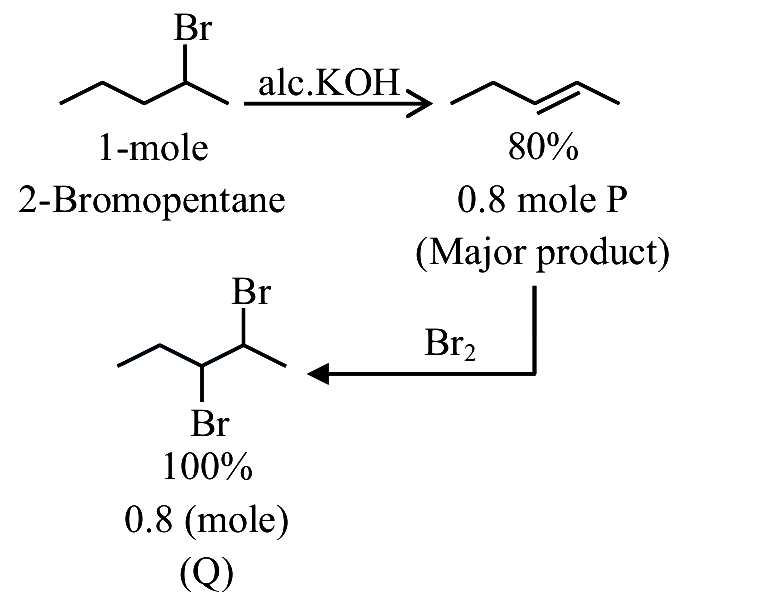
\(\begin{aligned} & \text { Molecular mass of } \mathrm{Q}=230 \mathrm{~g} \mathrm{~mol}^{-1} \\ & \begin{aligned} \text { Mass of } \mathrm{Q} & =0.8 \times 230 \\ & =184 \mathrm{~g}\end{aligned}\end{aligned}\) -
- (A) Both Statement I and Statement II are incorrect
- (B) Statement I is incorrect but Statement II is correct
- (C) Statement I is correct but Statement II is incorrect
- (D) Both Statement I and Statement II are correct
Show answer and solution
Correct Answer: (B)
Statement (I) :
\(\mathrm{R}-\mathrm{Cl} \xrightarrow{(\text { aq. } \mathrm{KOH})} \mathrm{R}-\mathrm{OH}\left(\mathrm{S}_{\mathrm{N}}\right.\) reaction \()\)
Statement (II) :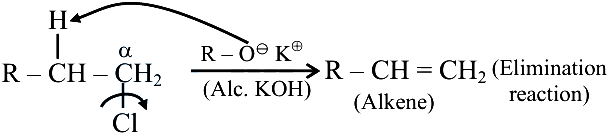
-
- (A) Both Statement I and Statement II are incorrect
- (B) Both Statement I and Statement II are correct
- (C) Statement I is incorrect but Statement II is correct
- (D) Statement I is correct but Statement II is incorrect
Show answer and solution
Correct Answer: (B)
1. Analysis of Statement I (True):
- Generally, primary alkyl halides do not undergo \( \text{S}_\text{N}1 \) reactions because primary carbocations are highly unstable.
- However, for \( \text{CH}_3-\text{O}-\text{CH}_2-\text{Cl} \), the loss of the chloride ion forms the carbocation \( \text{CH}_3-\ddot{\text{O}}-\overset{+}{\text{C}}\text{H}_2 \).
- This specific carbocation is exceptionally stabilized by resonance due to the lone pair of electrons on the adjacent oxygen atom:
\( \text{CH}_3-\ddot{\text{O}}-\overset{+}{\text{C}}\text{H}_2 \longleftrightarrow \text{CH}_3-\overset{+}{\text{O}}=\text{CH}_2 \)
- In the canonical structure on the right, every single atom (including both carbon and oxygen) satisfies the octet rule. This high resonance stabilization lowers the activation energy barrier for the \( \text{S}_\text{N}1 \) pathway remarkably, allowing it to proceed rapidly despite being a primary halide.
2. Analysis of Statement II (True):
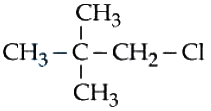
- Neopentyl chloride is a primary alkyl halide. For an \( \text{S}_\text{N}2 \) reaction to occur, a nucleophile must perform a backside attack on the electrophilic carbon carrying the leaving group.
- In neopentyl chloride, the \( \alpha \)-carbon bonded to chlorine is directly attached to a highly bulky tert-butyl group (\( -\text{C(CH}_3)_3 \)).
- This extreme steric hindrance completely shields the backside approach of the nucleophile. Consequently, neopentyl chloride is practically inert to \( \text{S}_\text{N}2 \) substitution reactions under standard laboratory conditions.
Since both Statement I and Statement II are factually correct, Option B is definitively the correct choice. -
- (A) A-II, B-I, C-III, D-IV
- (B) A-II, B-III, C-I, D-IV
- (C) A-IV, B-I, C-III, D-II
- (D) A-IV, B-III, C-I, D-II
Show answer and solution
Correct Answer: (D)
LIST-I
Name reactionLIST-II
Product obtainable(A) Swarts reaction (I) \(Et-I \xrightarrow{KF/DF} Et-F\) (B) Sandmeyer's reaction (II) \(\mathrm{PhN}_2^{\oplus} \mathrm{Cl}^{-} \xrightarrow[\mathrm{CuCN} / \mathrm{KCN}]{\mathrm{PhCN}+\mathrm{N}_2}\) (C) Wurtz Fittig reaction (III) \(Ph-Cl + EtCl \xrightarrow{Na/ether} Ph-Et + Ph-Ph + Et-Et\) (D) Finkelstein reaction (IV) \(Et-Cl \xrightarrow[acetone]{NaI} Et-I + NaCl\)
Explanation:
Let us evaluate each named organic reaction to determine its correct product:
1. Swarts reaction (A): This reaction involves the synthesis of alkyl fluorides by heating alkyl chlorides or bromides in the presence of metallic fluorides such as \( \text{AgF} \). For example, heating ethyl chloride with \( \text{AgF} \) gives Ethyl fluoride (IV).
2. Sandmeyer's reaction (B): This reaction is used to synthesize aryl nitriles or aryl halides from diazonium salts. Treating a benzene diazonium salt with \( \text{CuCN} \) yields Cyanobenzene (III).
3. Wurtz Fittig reaction (C): This reaction involves the coupling of an aryl halide and an alkyl halide when treated with sodium metal in the presence of dry ether to form an alkylbenzene. Reacting chlorobenzene and ethyl chloride with sodium yields Ethyl benzene (I).
4. Finkelstein reaction (D): This is a halogen exchange reaction where alkyl iodides are prepared by reacting alkyl chlorides or bromides with \( \text{NaI} \) in the presence of dry acetone. This gives Ethyl iodide (II).
Matching these correctly gives: A-IV, B-III, C-I, D-II.
Hence, Option D is the correct choice. -
- (A) benzoic acid
- (B) benzoic acid and aniline
- (C) benzoic acid and chlorobenzene
- (D) chlorobenzene and aniline
Show answer and solution
Correct Answer: (D)
Organic layer in funnel are mixture of chloro benzene and aniline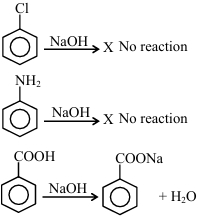
- 19. The ascending order of relative rate of solvolysis of following compounds is _______.
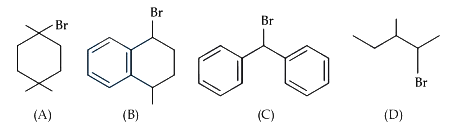
2025 Medium- (A) \((\mathrm{C}) \lt (\mathrm{B}) \lt (\mathrm{A}) \lt (\mathrm{D})\)
- (B) \((\mathrm{D}) \lt (\mathrm{A}) \lt (\mathrm{B}) \lt (\mathrm{C})\)
- (C) \((\mathrm{D}) \lt (\mathrm{B}) \lt (\mathrm{A}) \lt (\mathrm{C})\)
- (D) \((\mathrm{C}) \lt (\mathrm{D}) \lt (\mathrm{B}) \lt (\mathrm{A})\)
Show answer and solution
Correct Answer: (B)
Solvolysis or \(\mathrm{S}_{\mathrm{N}} 1 \propto\) stability of carboccation Stability order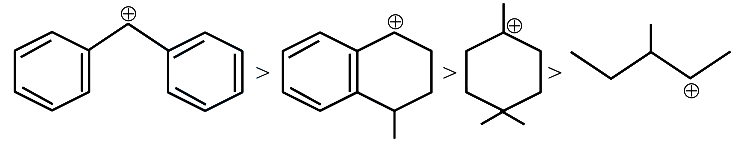
-
- (A) \(\mathrm{NaCN}\)
- (B) \(\mathrm{NH}_4 \mathrm{CN}\)
- (C) \(\mathrm{KCN}\)
- (D) \(\mathrm{AgCN}\)
Show answer and solution
Correct Answer: (D)
Covalent character of \(\mathrm{AgCN}\). - 21. Compound \(\mathrm{A}\) formed in the following reaction reacts with \(B\) gives the product \(C\). Find out \(A\) and \(B\).
 2024 Hard
- (A) \(\mathrm{A}=\mathrm{CH}_5-\mathrm{C} \equiv \overline{\mathrm{CNa}}{ }^{+}, \mathrm{B}=\mathrm{CH}_5-\mathrm{CH}_2-\mathrm{CH}_2-\mathrm{Br}\)
- (B) \(\mathrm{A}=\mathrm{CH}_3-\mathrm{CH}=\mathrm{CH}_2, \mathrm{~B}=\mathrm{CH}_3-\mathrm{CH}_2-\mathrm{CH}_2-\mathrm{Br}\)
- (C) \(\mathrm{A}=\mathrm{CH}_3-\mathrm{CH}_2-\mathrm{CH}_3, \mathrm{~B}=\mathrm{CH}_3-\mathrm{C} \equiv \mathrm{CH}\)
- (D) \(\mathrm{A}=\mathrm{CH}_3-\mathrm{C} \equiv \overline{\mathrm{CN}} \stackrel{+}{+}, \mathrm{B}=\mathrm{CH}_3-\mathrm{CH}_2-\mathrm{CH}_3\)
Show answer and solution
Correct Answer: (A)
\(\mathrm{CH}_3-\mathrm{C}=\mathrm{CH} \xrightarrow{\mathrm{Na}} \mathrm{CH}_3-\mathrm{C}=\mathrm{C}^{-} \mathrm{Na}^{+} \xrightarrow{\mathrm{CH}_3 \mathrm{CH}_2 \mathrm{CH}_2-\mathrm{Br}} \downarrow\)\(\mathrm{NaBr}+\mathrm{CH}_3-\mathrm{C}=\mathrm{C}-\mathrm{CH}_2 \mathrm{CH}_2 \mathrm{CH}_3\)
-
- (A) \((A)\) is true but \((R)\) is false
- (B) Both \((A)\) and \((R)\) are true but \((R)\) is not the correct explanation of \((A)\)
- (C) \((A)\) is false but \((R)\) is true
- (D) Both \((A)\) and \((R)\) are true and \((R)\) is the correctexplanation of \((A)\)
Show answer and solution
Correct Answer: (A)
\(\mathrm{CH}_2=\mathrm{CH}-\mathrm{CH}_2-\mathrm{Cl}\)
It is allyl carbon and \(\mathrm{sp}^3\) hybridized. -
- (A) Both \(\mathrm{A}\) and \(\mathrm{R}\) are true but \(\mathrm{R}\) is \(NOT\) the correct explanation of \(\mathrm{A}\)
- (B) \(A\) is false but \(R\) is true
- (C) \(A\) is true but \(R\) is false
- (D) Both \(\mathrm{A}\) and \(\mathrm{R}\) are true and \(\mathrm{R}\) is the correct explanation of A
Show answer and solution
Correct Answer: (C)
Assertion \((A)\): Given statement is correct because in phenol hydroxyl group cannot be replaced by halogen atom.Reason \((\mathrm{R})\) :
Given reason is false.
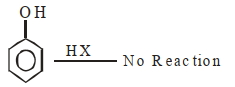
-
- (A) \((A)\) is correct but \((R)\) is not correct
- (B) Both \((A)\) and \((R)\) are correct but \((R)\) is not the correct explanation of \((\mathrm{A})\)
- (C) \((A)\) is not correct but \((R)\) is correct
- (D) Both \((A)\) and \((R)\) are correct and \((R)\) is the correct explanation of \((A)\)
Show answer and solution
Correct Answer: (A)
\(\mathrm{AgCN}\) is mainly covalent in nature and nitrogen is available for attack, so alkyl isocyanide is formed as main product.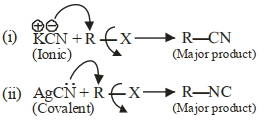
-
- (A) \((A)\) is not correct but \((R)\) is correct
- (B) Both \((A)\) and \((R)\) are correct but \((R)\) is not the correct explanation of \((A)\)
- (C) Both \((A)\) and \((R)\) are correct and \((R)\) is the correct explanation of \((A)\)
- (D) \((A)\) is correct but \((R)\) is not correct
Show answer and solution
Correct Answer: (C)
The benzyl group acts in much the same way using the \(\pi\)-system of the benzene ring for conjugation with the p-orbital in the transition state.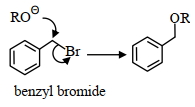
-
- (A) Statement \(I\) is true but Statement \(II\) is false
- (B) Statement \(I\) is false but Statement \(II\) is true.
- (C) Both statement \(I\) and Statement \(II\) are false.
- (D) Both statement \(I\) and Statement \(II\) are true.
Show answer and solution
Correct Answer: (D)
Statement - \(I\): Rate of \(\mathrm{S}_{\mathrm{N}} 2 \propto[\mathrm{R}-\mathrm{X}]\left[\mathrm{Nu}^{-}\right]\)\(\mathrm{S}_{\mathrm{N}} 2\) reaction is favoured by high concentration of nucleophile \(\left(\mathrm{Nu}^{-}\right)\)& less crowding in the substrate molecule.
Statement - \(II\): Solvolysis follows \(\mathrm{S}_{\mathrm{N}} 1\) path.
Both are correct Statements.
-
- (A) Statement \(I\) is true but Statement \(II\) is false
- (B) Statement \(I\) is false but Statement \(II\) is true
- (C) Both Statement \(I\) and Statement \(II\) is true
- (D) Both Statement \(I\) and Statement \(II\) is false
Show answer and solution
Correct Answer: (C)
\(\mathrm{SN}^2 \rightarrow\) Inversion\(\mathrm{SN}^1 \rightarrow\) Racemisation
- 28. Identify the correct set of reagents or reaction conditions ' \(\mathrm{X}\) ' and ' \(\mathrm{Y}\) ' in the following set of transformation.
 2024 Medium
- (A) \(\mathrm{X}=\) conc.alc. \(\mathrm{NaOH}, 80^{\circ} \mathrm{C}, \mathrm{Y}=\mathrm{Br}_2 / \mathrm{CHCl}_3\)
- (B) \(\mathrm{X}=\) dil.aq. \(\mathrm{NaOH}, 20^{\circ} \mathrm{C}, \mathrm{Y}=\mathrm{HBr}\) /acetic acid
- (C) \(\mathrm{X}=\) conc.alc. \(\mathrm{NaOH}, 80^{\circ} \mathrm{C}, \mathrm{Y}=\mathrm{HBr}\) /acetic acid
- (D) \(\mathrm{X}=\) dil.aq. \(\mathrm{NaOH}, 20^{\circ} \mathrm{C}, \mathrm{Y}=\mathrm{Br}_2 / \mathrm{CHCl}_3\)
Show answer and solution
Correct Answer: (C)
\(1\). \(\mathrm{CH}_3-\mathrm{CH}_2-\mathrm{CH}_2-\mathrm{Br} \xrightarrow[80^{\circ} \mathrm{C}]{\mathrm{X}=\text { conc.alc.NaOH }}\)\(\mathrm{CH}_3-\mathrm{CH}=\mathrm{CH}_2 \xrightarrow{\mathrm{Y}=\mathrm{HBr} / \mathrm{Acetic} \text { acid }} \mathrm{CH}_3-\mathrm{CHBr}-\mathrm{CH}_3\)
-
- (A) \({ A-I, B-II, C-III, D-IV }\)
- (B) \({ A-III, B-II, C-IV, D-I }\)
- (C) \({ A-III, B-I, C-IV, D-II }\)
- (D) \({ A-II, B-IV, C-I, D-III }\)
Show answer and solution
Correct Answer: (C)
Iodoform - Antiseptic\(\mathrm{CCl}_4\) - Fire extinguisher
\(CFC\) - Refrigerants
\(DDT\) - Insecticide
-
- (A) \((1) (A)-(I), (B), (II), (C)-(III), (D)-(IV)\)
- (B) \((2) (A)-(III), (B)-(I), (C)-(IV), (D)-( II)\)
- (C) \((A)-(IV), (B)-(III), (C)-(II), (D)-(I)\)
- (D) \((A)-( II), (B)-(III), (C)-(I), (D)-(IV)\)
Show answer and solution
Correct Answer: (B)
\(\mathrm{CCl}_4\) used in fire extinguisher. \(\mathrm{CH}_2 \mathrm{Cl}_2\) used as paint remover. Freons used in refrigerator and \(\mathrm{AC}\). \(DDT\) used as non Biodegradable insecticide. - 31. The correct statement regarding nucleophilic substitution reaction in a chiral alkyl halide is ; 2024 Hard
- (A) Retention occurs in \(\mathrm{S}_{\mathrm{N}} 1\) reaction and inversion occurs in \(\mathrm{S}_{\mathrm{N}} 2\) reaction.
- (B) Racemisation occurs in \(\mathrm{S}_{\mathrm{N}} \mathrm{l}\) reaction and retention occurs in \(\mathrm{S}_{\mathrm{N}} 2\) reaction.
- (C) Racemisation occurs in both \(\mathrm{S}_{\mathrm{N}} 1\) and \(\mathrm{S}_{\mathrm{N}} 2\) reactions.
- (D) Racemisation occurs in \(\mathrm{S}_{\mathrm{N}} 1\) reaction and inversion occurs in \(\mathrm{S}_{\mathrm{N}} 2\) reaction.
Show answer and solution
Correct Answer: (D)
\(\mathrm{SN}^1\) - Racemisation\(\mathrm{SN}^2\) - Inversion
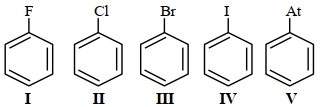
- 32. The number of halobenzenes from the following that can be prepared by Sandmeyer's reaction is _______.
 2024 Medium
- (A) \(8\)
- (B) \(3\)
- (C) \(7\)
- (D) \(2\)
Show answer and solution
Correct Answer: (D)
In Sandmayer reaction only bromobenzene & chlorobenzene are prepared. - 33. The total number of hydrogen atoms in product \(\mathrm{A}\) and product \(B\) is _______.
 2024 Hard
- (A) \(5\)
- (B) \(10\)
- (C) \(15\)
- (D) \(20\)
Show answer and solution
Correct Answer: (B)
Explanation:
This question involves understanding the dual behavior of hydroxide ions (\( \text{OH}^- \)) acting either as a strong base or as a nucleophile depending on the nature of the solvent:
1. Reaction in Ethanol Solvent (Product A):
When sodium hydroxide (\( \text{NaOH} \)) is dissolved in ethanol (\( \text{C}_2\text{H}_5\text{OH} \)), it forms an alcoholic solution. Hydroxide ions react with ethanol to form ethoxide ions (\( \text{C}_2\text{H}_5\text{O}^- \)), which act as a powerful strong base. This environment strongly favors \( \text{E}2 \) elimination (dehydrohalogenation) over substitution. The elimination of \( \text{HBr} \) from ethyl bromide (\( \text{CH}_3\text{CH}_2\text{Br} \)) yields ethene (\( \text{CH}_2=\text{CH}_2 \)) as the major product.
- Molecular formula of Product A (Ethene): \( \text{C}_2\text{H}_4 \)
- Number of hydrogen atoms in Product A = 4
2. Doubt Clearing regarding Ether Formation:
While nucleophilic substitution by ethoxide ions can technically form a small amount of diethyl ether (\( \text{C}_2\text{H}_5\text{OC}_2\text{H}_5 \)) as a side product at lower temperatures, standard textbook and competitive exam conventions treat \( \text{NaOH}/\text{C}_2\text{H}_5\text{OH} \) strictly as an elimination reagent that produces an alkene. Furthermore, if diethyl ether (10 hydrogen atoms) were assumed as Product A, the total number of hydrogens would be \( 10 + 6 = 16 \), which is completely absent from the given options (5, 10, 15, 20). This confirms that ethene is the intended product.
3. Reaction in Water Solvent (Product B):
When \( \text{NaOH} \) is dissolved in water (\( \text{H}_2\text{O} \)), it forms an aqueous solution. In this medium, hydroxide ions are highly stabilized by hydration, which minimizes their basicity while keeping them highly nucleophilic. Thus, the reaction proceeds via nucleophilic substitution (\( \text{S}_\text{N}2 \)), substituting the bromide ion to produce ethanol (\( \text{CH}_3\text{CH}_2\text{OH} \)) as the main product.
- Molecular formula of Product B (Ethanol): \( \text{C}_2\text{H}_5\text{OH} \)
- Number of hydrogen atoms in Product B = 6
4. Total Count of Hydrogen Atoms:
Summing up the hydrogen atoms contained in both major products:
\( \text{Total Hydrogen Atoms} = 4 \text{ (from ethene)} + 6 \text{ (from ethanol)} = 10 \)
Hence, Option B is the correct choice.
-
- (A) \(A\) is false but \(R\) is true
- (B) \(A\) is true but \(R\) is false
- (C) Both \(A\) and \(R\) are true and \(R\) is the correct explanation of \(A\)
- (D) Both \(A\) and \(R\) are true but \(R\) is \(NOT\) the correct explanation of \(A\)
Show answer and solution
Correct Answer: (C)
The rate of hydrolysis of alkyl chloride improves because of better Nucleophilicity of \(I ^{-}\). - 35. Choose the halogen which is most reactive towards \(SN1\) reaction in the given compounds \((A, B, C , D)\)
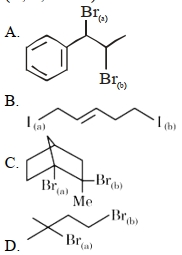 2023 Medium
- (A) \(A - Br _{(b)} ; B - I _{( b )} ; C - Br _{( b )} ; D - Br _{( b )}\)
- (B) \(A - Br _{( a )} ; BI _{( a )} ; C - Br _{( b )} ; D - Br _{( a )}\)
- (C) \(A - Br _{( b )} ; B - I _{( a )} ; C - Br _{( a )} ; D - Br _{( a )}\)
- (D) \(A - Br _{( b )} ; B - I _{( a )} ; C - Br _{( a )} ; D - Br _{( a )}\)
Show answer and solution
Correct Answer: (B)
Stable is the carbocation, faster will be rate of \(SN1\) reaction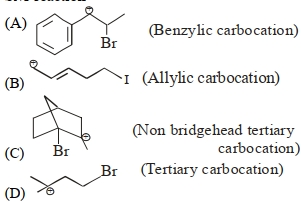
-
- (A) \(a > c > d > b\)
- (B) \(a > b > c > d\)
- (C) \(b > d > c > a\)
- (D) \(d > b > c > a\)
Show answer and solution
Correct Answer: (C)
The rate of \(S_N 1\) reaction depends upon stability of carbocation which follows the order\(\therefore\) Reactivity order
\((b) > (d) > (c) > (a)\)
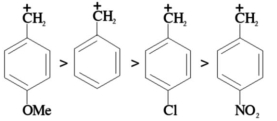
-
- (A) The transition state formed in the above reaction is less polar than the localised anion.
- (B) The reaction can occur in acetic acid also.
- (C) The solvent used in the reaction solvates the ions formed in rate determining step.
- (D) \(Br ^{-}\)can act as competing nucleophile.
Show answer and solution
Correct Answer: (A)
This is finkelstein reactionClearly, the transition state is less polar than free anions. \(Br ^{-}\)and \(I ^{-}\)
Acetic acid is protic which does not support \(S _{ N } 2\)
Acetone does not solvate anion
\(Br ^{-}\)gets precipitated and hence can not compete with \(I\)
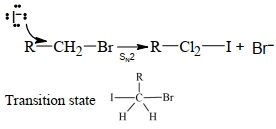
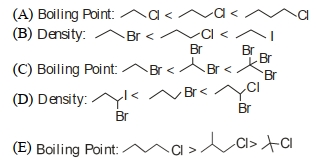
- 38. Identify the correct order for the given property for following compounds.Choose the correct answer from the option given below :-
 2023 Medium
- (A) \((B), (C)\) and \((D)\) only
- (B) \((A), (C)\) and \((E)\) only
- (C) \((A), (C)\) and \((D)\) only
- (D) \((A), (B)\) and \((E)\) only
Show answer and solution
Correct Answer: (B)
Boiling point of alkyl halide increases with increase in size, mass of halogen atom and size of alkyl groupBoiling point of isomeric alkyl halide decreases with increase in branching
Density increases with increase in atomic mass of halogen atom
-
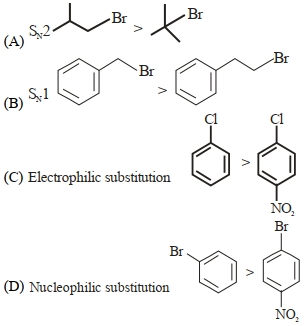
- (A) (A), (B) and (D) only
- (B) (A), (B), (C) and (D)
- (C) (A), (C) and (D) only
- (D) (B), (C) and (D) only
Show answer and solution
Correct Answer: (B)
All are correct\((A)\) \(S _{ N } 2\) reaction decreases with increase in steric crowding.
\((B)\) \(S _{ N } 1\) reaction increases with stability of carbocation.
\((C)\) EAS reaction decreases with decrease in electron density.
\((D)\) Presence of electron withdrawing group at ortho and para-position to a halogen in haloarene increase nucleophilic aryl substitution.
-
- (A) \(A-IV,B-III,C-II,D-I\)
- (B) \(A-III,B-I,C-IV,D-II\)
- (C) \(A-I,B-II,C-III,D-IV\)
- (D) \(A-I,B-III,C-IV,D-II\)
Show answer and solution
Correct Answer: (B)
\(CH _3- CH _2- CH _2- Br + KOH ( Alc ) \rightarrow CH _3-\underset{\text { (Alkene) }}{ CH }= CH _2\)\(CH _3- CH _2- CH _2- Br + KCN ( Alc ) \rightarrow CH _3- CH _2- CH _2- CN\)
\(CH _3- CH _2- CH _2- Br + AgNO _2 \rightarrow CH _3- CH _2- CH _2- COO _2+ AgBr \downarrow\)
\(\left. CH _3- CH _2- CH _2- Br + CH _3- COOAg _2 \rightarrow CH _3- COO - CH _2\right)= CH _2- CH _3+ AgBr \downarrow\)
-
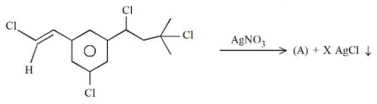
- (A) \(3\)
- (B) \(4\)
- (C) \(5\)
- (D) \(6\)
Show answer and solution
Correct Answer: (A)
Total numbers of isomer \(=03\)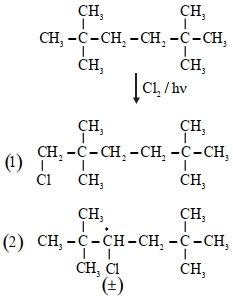
-
- (A) \(4\)
- (B) \(6\)
- (C) \(2\)
- (D) \(8\)
Show answer and solution
Correct Answer: (C)
Benzylic and tertiary carbocations are stable. -
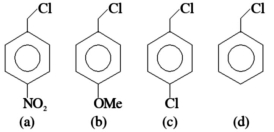
- (A) \(A > B > D > C\)
- (B) \(C > A > D > B\)
- (C) \(D > C > B > A\)
- (D) \(D > B > A > C\)
Show answer and solution
Correct Answer: (D)
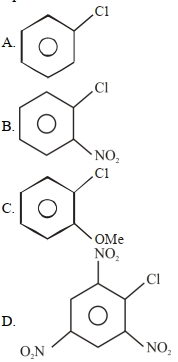
\((-M)\) group increases reactivity where as \((+M)\) group decreases reactivity of Halobenzene towards Nucleophilic substitution reaction.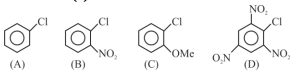
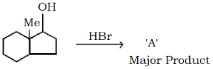
- 44. The number of hyperconjugation structures involved to stabilize carbocation formed in the above reaction is \(.............\).
 2023 Hard
- (A) \(6\)
- (B) \(5\)
- (C) \(4\)
- (D) \(7\)
Show answer and solution
Correct Answer: (A)
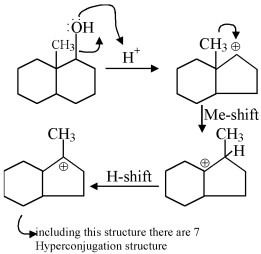
Let's analyze the step-by-step carbocation rearrangement mechanism for the given reaction:
1. Initial Carbocation Formation: Protonation of the alcohol (\( -\text{OH} \)) group followed by the loss of a water molecule (\( \text{H}_2\text{O} \)) forms a secondary (\( 2^\circ \)) carbocation on the 5-membered ring.
2. 1,2-Methyl Shift: To increase stability, the methyl group (\( -\text{CH}_3 \)) on the bridgehead carbon undergoes a 1,2-shift to the adjacent positive carbon. This creates a highly stable tertiary (\( 3^\circ \)) carbocation at the bridgehead position.
Counting Alpha-Hydrogens (\( \alpha \)-H):
For this stable tertiary carbocation, the adjacent (\( \alpha \)) positions relative to the positive charge are:
- The neighboring \( \text{-CH}_2- \) group in the 5-membered ring: contains 2 \( \alpha \)-hydrogens.
- The neighboring \( \text{-CH}_2- \) group in the 6-membered ring: contains 2 \( \alpha \)-hydrogens.
- The adjacent bridgehead \( \text{-CH}- \) carbon: contains 1 \( \alpha \)-hydrogen.
Total number of \( \alpha \)-hydrogens = \( 2 + 2 + 1 = 5 \).
Total Hyperconjugation Structures:
The total number of hyperconjugation structures is given by the formula:
Total structures = \( \text{Number of } \alpha\text{-hydrogens} + 1 \) (including the parent contributing structure).
Total structures = \( 5 + 1 = 6 \).
Therefore, Option A is the correct answer. -
- (A) \(4\)
- (B) \(2\)
- (C) \(1\)
- (D) \(5\)
Show answer and solution
Correct Answer: (A)
Total Possible Isomeric product \(=1+3=4\)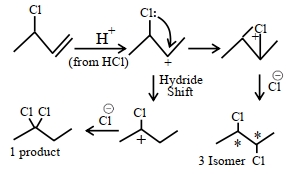
-
- (A) \(C Cl _2 F _2\)
- (B) \(C _2 HF _3\)
- (C) \(C _2 H _2 F _2\)
- (D) \(C _2 F _4\)
Show answer and solution
Correct Answer: (A)
Freons are chlorofluoro carbon. -
- (A) These are chlorofluorocarbon compounds
- (B) These are chemicals causing skin cancer
- (C) These are radicals of chlorine and chlorine monoxide
- (D) All radicals are called freons
Show answer and solution
Correct Answer: (A)
Fact -
- (A) \(2\)
- (B) \(1\)
- (C) \(3\)
- (D) \(4\)
Show answer and solution
Correct Answer: (C)
\(W = n \times M\)\(=10^{-4} \times 30=3\,mg\)

- 49. Consider the above reaction. The number of \(\pi\) electrons present in the product ' \(P\) ' is ...... .
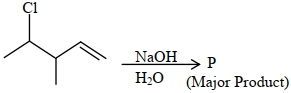 2022 Easy
- (A) \(1\)
- (B) \(2\)
- (C) \(3\)
- (D) \(5\)
Show answer and solution
Correct Answer: (B)
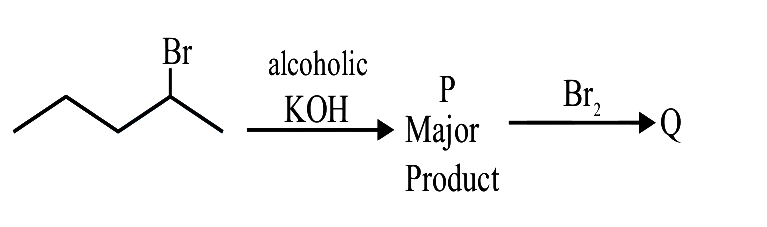
Number of \(\pi\) electron \(=2\)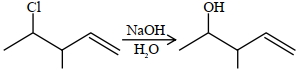
-
- (A) \(1\)
- (B) \(2\)
- (C) \(3\)
- (D) \(5\)
Show answer and solution
Correct Answer: (C)
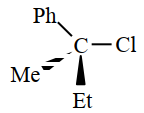
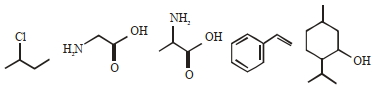
Number of compounds containing asymmetric carbons are three.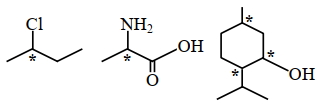
No questions on this page match these filters.
About Haloalkanes and Haloarenes PYQs
Haloalkanes and Haloarenes has 82 questions from 2013–2026. The most came in 2024 (14), 2023 (14) and 2026 (13).
The most asked topics are Properties of Haloalkanes, Preparation of Haloalkanes and Introduction of Halogen containing compounds.
10% are easy, 49% medium and 41% hard.
Haloalkanes and Haloarenes PYQs by year
Frequently asked
How many Haloalkanes and Haloarenes questions came in JEE Mains?
82 questions from 2013–2026, each with the correct answer and a full solution.
Which Haloalkanes and Haloarenes topic is asked the most?
Properties of Haloalkanes, with 48 questions, followed by Preparation of Haloalkanes with 10.
Which year had the most Haloalkanes and Haloarenes questions?
2024, with 14 questions.
How difficult are Haloalkanes and Haloarenes questions?
10% are easy, 49% medium and 41% hard.