


Questions
Newest firstShowing 1–41 of 41 questions
-
- (A) 10
- (B) 15
- (C) 20
- (D) 25
Show answer and solution
Correct Answer: (B)
The conductivity (specific conductance), \(\kappa\), is given by the product of conductance and cell constant:
\(\kappa = G \times G^*\)
\(\kappa = 1.9 \times 10^{-3} \text{ S} \times 1.3 \text{ cm}^{-1} = 2.47 \times 10^{-3} \text{ S cm}^{-1}\)
The molar conductivity, \(\Lambda_m\), is related to the conductivity and molarity \(C\) by the formula:
\(\Lambda_m = \dfrac{\kappa \times 1000}{C}\)
Substituting the given values:
\(123.5 = \dfrac{2.47 \times 10^{-3} \times 1000}{C}\)
\(123.5 = \dfrac{2.47}{C}\)
\(C = \dfrac{2.47}{123.5} = 0.02 \text{ mol L}^{-1}\)
Molarity \(C\) can also be expressed in terms of mass percentage \(x\) (w/w), density \(d\), and molar mass \(M\):
\(C = \dfrac{x \times d \times 10}{M}\)
Substituting the known values (\(d = 1.0 \text{ g mL}^{-1}\), \(M = 75 \text{ g mol}^{-1}\)):
\(0.02 = \dfrac{x \times 1.0 \times 10}{75}\)
\(1.5 = 10x\)
\(x = 0.15\)
Expressing \(x\) in the required format:
\(x = 15 \times 10^{-2}\)
The value is \(15\).
Answer: \(15\) -
- (A) \(\dfrac{10^6 x^2}{\alpha^2(x_1 + x_2 - 2x_3)^2}\)
- (B) \(\dfrac{x^2}{(x_1 + x_2 - 2x_3)^2}\)
- (C) \(\dfrac{\alpha^2(x_1 + x_2 - 2x_3)^2}{10^6 x^2}\)
- (D) \(\dfrac{x^2}{(x_1 + x_2 + 2x_3)^2}\)
Show answer and solution
Correct Answer: (A)
Using Kohlrausch's law of independent migration of ions, the limiting molar conductivity of \(\text{BaSO}_4\) is given by:
\(\Lambda^{\circ}_m(\text{BaSO}_4) = \Lambda^{\circ}_m(\text{BaCl}_2) + \Lambda^{\circ}_m(\text{H}_2\text{SO}_4) - 2\Lambda^{\circ}_m(\text{HCl})\)
Substituting the given values:
\(\Lambda^{\circ}_m(\text{BaSO}_4) = x_1 + x_2 - 2x_3\)
For a sparingly soluble salt, the solubility \(S\) (in mol L\(^{-1}\)) is related to its conductivity \(\kappa\) (in S cm\(^{-1}\)) and molar conductivity \(\Lambda_m\) (in S cm\(^2\) mol\(^{-1}\)) by the relation:
\(\Lambda_m = \dfrac{\kappa \times 1000}{S}\)
Given that \(\kappa = x\) and \(\Lambda_m = \Lambda^{\circ}_m\) (which implies complete dissociation, meaning the degree of dissociation \(\alpha = 1\)), we get:
\(S = \dfrac{1000 x}{x_1 + x_2 - 2x_3}\)
The solubility product \(K_{sp}\) for \(\text{BaSO}_4\) (which dissociates into \(\text{Ba}^{2+}\) and \(\text{SO}_4^{2-}\)) is:
\(K_{sp} = S^2 = \left( \dfrac{1000 x}{x_1 + x_2 - 2x_3} \right)^2 = \dfrac{10^6 x^2}{(x_1 + x_2 - 2x_3)^2}\)
Since \(\alpha = 1\), this expression is equivalent to \(\dfrac{10^6 x^2}{\alpha^2(x_1 + x_2 - 2x_3)^2}\).
Answer: \(\dfrac{10^6 x^2}{\alpha^2(x_1 + x_2 - 2x_3)^2}\) -
- (A) 2
- (B) 4
- (C) 6
- (D) 8
Show answer and solution
Correct Answer: (B)
Using equation : \(\Lambda_{ m }=\Lambda^0{ }_{ m }- A \sqrt{ c }\)
\(96.1=\Lambda_{ m }^0- A \sqrt{0.04}\)
\(96.1=\Lambda_{ m }^0- A \times 0.2 \quad\ldots(1)\)
\(95.7=\Lambda_{ m }^0- A \times \sqrt{0.09}\)
\(95.7=\Lambda_m^0- A \times 0.3 \quad\ldots(2)\)
From eq. (1) and eq. (2)
\(A =4\) -
- (A) 2
- (B) 1
- (C) 3
- (D) 4
Show answer and solution
Correct Answer: (A)
\(K _{ a }( HQ )= C _1 \alpha_1^2 \quad\alpha_1=\frac{\lambda_{ m }( HQ )}{\lambda_{ m }^{\infty}( HQ )}\)
\(K _{ a }( HZ )= C _2 \alpha_2^2 \quad \alpha_2=\frac{\lambda_{ m }( HZ )}{\lambda_{ m }^{\infty}( HZ )}\)
\(\frac{ K _{ a }( HQ )}{ K _{ a }( HZ )}=\frac{ C _1}{ C _2} \cdot\left(\frac{\alpha_1}{\alpha_2}\right)^2=\frac{0.18}{0.02} \cdot\left[\frac{\lambda_{ m }( HQ )}{\lambda_{ m }( HZ )}\right]^2\)
\(\frac{K_a( HQ )}{K_a( HQ )}=9 \times\left(\frac{1}{30}\right)^2=\frac{1}{100}\)
\(pK _3( HQ )- pK _3( HZ )=2\) -
- (A) 2
- (B) 4
- (C) 6
- (D) 8
Show answer and solution
Correct Answer: (C)
\(pH =5\)
\(\left[ H ^{+}\right]=10^{-5}=[ HX ] \cdot \alpha\)
\(=[ HX ] \cdot \frac{\Lambda_{ m }}{\Lambda_{ m }^{\infty}}\)
\(\Lambda_{ m }=\frac{ k \times 1000}{[ HX ]}\)
\(K = G . G ^*=4 \times 10^{-5} \times \frac{15}{1}=6 \times 10^{-4} S . cm ^{-1}\)
\(\left[ H ^{+}\right]=10^{-5}=[ HX ] \times \frac{6 \times 10^{-4} \times 1000}{\Lambda_{ m }^{\infty} \times[ HX ]}\)
\(\Lambda_{ m }^{\infty}=60000 S.cm^2 mol^{-1}\)
\(\Lambda_{ m }^{\infty}=6 S . m^2 mol^{-1}\) -
- (A) 20
- (B) 23
- (C) 26
- (D) 29
Show answer and solution
Correct Answer: (B)
Given : Concentration of \(\mathrm{NaOH}=0.2 \%(\mathrm{w} / \mathrm{v})\)
\(\therefore 0.2 \mathrm{~g}\) of NaOH in 100 ml of solution.
Molarity of NaOH solution
\(\begin{array}{r}
=\frac{\text { moles of solute }}{\mathrm{V}_{\mathrm{ml}}} \times 1000 \\
=\frac{0.2 / 40}{100} \times 1000==\frac{0.2}{40 \times 100} \times 1000=\frac{2}{40} \mathrm{M}
\end{array}\)
Given resistivity of solution \(=870 \mathrm{~m}\) ohm m \(=870 \times 10^{-3} \mathrm{ohm} \mathrm{m}\)
\(=870 \times 10^{-3} \times 10 \mathrm{ohm} \mathrm{dm}\)
\(=870 \times 10^{-2}\) ohm dm
\(=8.7\) ohm dm
Now conductivity
\(\mathrm{K}=\frac{1}{\rho}=\frac{1}{8.7} \mathrm{ohm}^{-1} \mathrm{dm}^{-1}\)
Now molar conductivity of solution is
\(\begin{aligned}
& \lambda_{\mathrm{m}}=\frac{\mathrm{K}}{\mathrm{M}}=\frac{\frac{1}{8.7}}{\frac{2}{40}}=\frac{40}{2 \times 8.7}=2.29 \mathrm{~S} \mathrm{dm}^2 \mathrm{~mol}^{-1} \\
& 2.29 \times 10^3 \mathrm{~m} \mathrm{~S} \mathrm{dm}^2 \mathrm{~mol}^{-1} \\
& =22.9 \times 10^2 \mathrm{~m} \mathrm{~S} \mathrm{dm}^2 \mathrm{~mol}^{-1} \\
& =23 \times 10^2 \mathrm{~m} \mathrm{~S} \mathrm{dm}^2 \mathrm{~mol}^{-1}
\end{aligned}\) -
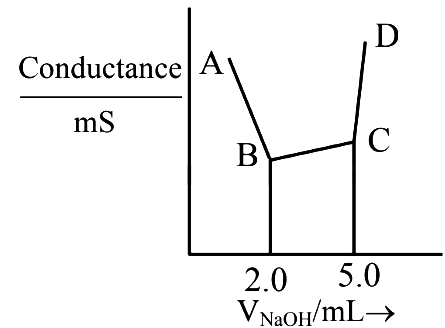
- (A) The concentration of \(\mathrm{CH}_3 \mathrm{COOH}\) in the original mixture is 0.005 M
- (B) The concentration of HCl in the original mixture is 0.005 M
- (C) \(\mathrm{CH}_3 \mathrm{COOH}\) is neutralised first followed by neutralisation of HCl
- (D) Point ' C ' indicates the complete neutralisation HCl
Show answer and solution
Correct Answer: (B)
From the given graph 2 ml NaOH solution is used for neutralisation of HCl and 3 ml NaOH solution is used for neutralisation of \(\mathrm{CH}_3 \mathrm{COOH}\).
\(\therefore\) Mole of \(\mathrm{HCl}=\) Mole of NaOH used
\(\begin{aligned}
& \mathrm{M} \times 40=0.1 \times 2 \\
& \mathrm{M}=0.005
\end{aligned}\)
\(\therefore\) Mole of \(\mathrm{CH}_3 \mathrm{COOH}=\) Mole of NaOaH used
\(\begin{aligned}
& \mathrm{M} \times 40=0.1 \times 3 \\
& \mathrm{M}=0.0075
\end{aligned}\)
HCl is strong acid and will be neutralised first. -
- (A) \(\mathrm{H}^{+} \gt \mathrm{Na}^{+} \gt \mathrm{K}^{+} \gt \mathrm{Ca}^{2+} \gt \mathrm{Mg}^{2+}\)
- (B) \(\mathrm{H}^{+} \gt \mathrm{Ca}^{2+} \gt \mathrm{Mg}^{2+} \gt \mathrm{K}^{+} \gt \mathrm{Na}^{+}\)
- (C) \(\mathrm{Mg}^{2+} \gt \mathrm{H}^{+} \gt \mathrm{Ca}^{2+} \gt \mathrm{K}^{+} \gt \mathrm{Na}^{+}\)
- (D) \(\mathrm{H}^{+} \gt \mathrm{Na}^{+} \gt \mathrm{Ca}^{2+} \gt \mathrm{Mg}^{2+} \gt \mathrm{K}^{+}\)
Show answer and solution
Correct Answer: (B)
Limiting Molar Conductivities of Ions:
- \(\stackrel{\oplus}{\mathrm{H}}: 349.8 \mathrm{Scm}^2 \mathrm{~mol}^{-1}\)
- \(\mathrm{Na}^{+}: 50.11 \mathrm{Scm}^2 \mathrm{~mol}^{-1}\)
- \(\mathrm{K}^{+}: 73.52 \mathrm{Scm}^2 \mathrm{~mol}^{-1}\)
- \(\mathrm{Ca}^{+2}: 119 \mathrm{Scm}^2 \mathrm{~mol}^{-1}\)
- \(\mathrm{Mg}^{+2}: 106.12 \mathrm{Scm}^2 \mathrm{~mol}^{-1}\)
Therefore correct order of limiting molar conductivity of cations will be -
\(\stackrel{\oplus}{\mathrm{H}} \gt \mathrm{Ca}^{+2} \gt \mathrm{Mg}^{+2} \gt \mathrm{K}^{+} \gt \mathrm{Na}^{+}\) -
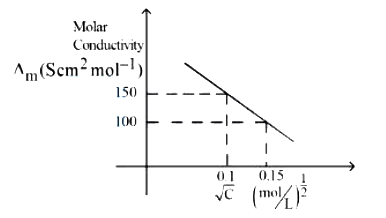
- (A) 100
- (B) 150
- (C) 200
- (D) 250
Show answer and solution
Correct Answer: (B)
\(\begin{aligned} & \mathrm{R}=\rho \frac{\ell}{\mathrm{A}} \\ & \kappa=\mathrm{G} \cdot \mathrm{G}^* \quad \mathrm{G}=\frac{1}{\mathrm{R}} ; \kappa=\frac{1}{\rho}\end{aligned}\)
\(\begin{aligned} \mathrm{G}^*= & \frac{\ell}{\mathrm{A}} \\ \mathrm{R} & =\text { Resistance } \\ \rho & =\text { Resistivity } \\ \frac{\ell}{\mathrm{A}} & =\text { cell constant }\left(\mathrm{G}^*\right)\end{aligned}\)
\(\begin{aligned} & \frac{\kappa_{\mathrm{c}}}{\kappa_{\mathrm{d}}}=\frac{\mathrm{R}_{\mathrm{d}}}{\mathrm{R}_{\mathrm{c}}} ; \lambda_{\mathrm{m}}=\frac{\kappa \times 1000}{\mathrm{C}} \\ & \frac{\kappa_{\mathrm{c}}}{\kappa_{\mathrm{d}}}=\frac{\left(\lambda_{\mathrm{m}} \cdot \mathrm{C}\right)}{\left(\lambda_{\mathrm{m}} \cdot C\right)_{\mathrm{d}}}=\frac{\mathrm{R}_{\mathrm{d}}}{R_{\mathrm{c}}} \quad \\ & \mathrm{c}=\text { concentrated sol. } \quad \mathrm{d} \text { = diluted solution } \\ & \frac{100 \cdot(0.15)^2}{150 .(0.1)^2}=\frac{R_{\mathrm{d}}}{100} \\ & \mathrm{R}_{\mathrm{d}}=150 \Omega\end{aligned}\) -
- (A) 3
- (B) 6
- (C) 9
- (D) 12
Show answer and solution
Correct Answer: (A)
\(\begin{aligned} & \lambda_{\mathrm{m}}^{\circ} \text { of } \mathrm{NH}_4 \mathrm{Cl}=185 \\ & \left(\lambda_{\mathrm{m}}^{\circ}\right)_{\mathrm{NH}_4^{+}}+\left(\lambda_{\mathrm{m}}^{\circ}\right)_{\mathrm{Cl}^{-}}=185 \\ & \left(\lambda_{\mathrm{m}}^{\circ}\right)_{\mathrm{NH}_4^{+}}=185-70=115 \mathrm{Scm}^2 \mathrm{~mol}^{-1} \\ & \left(\lambda_{\mathrm{m}}^{\circ}\right)_{\mathrm{NH}_4 \mathrm{OH}}=\left(\lambda_{\mathrm{m}}^{\circ}\right)_{\mathrm{NH}_4^{+}}+\left(\lambda_{\mathrm{m}}^{\circ}\right)_{\mathrm{OH}^{-}} \\ & =115+170 \\ & \left(\lambda_{\mathrm{m}}^{\circ}\right)_{\mathrm{NH}_4 \mathrm{OH}}=285 \mathrm{Scm}^2 \mathrm{~mol}^{-1}\end{aligned}\)
\(\begin{aligned} \text { degree of dissociation } & =\frac{\left(\lambda_{\mathrm{m}}\right)_{\mathrm{NH}_4 \mathrm{OH}}}{\left(\lambda_{\mathrm{m}}^{\circ}\right)_{\mathrm{NH}_4 \mathrm{OH}}} \\ & =\frac{85.5}{285} \\ & =0.3 \\ & =3 \times 10^{-1}\end{aligned}\) -
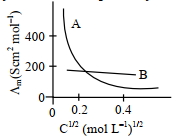
- (A) A small decrease in molar conductivity is observed at infinite dilution.
- (B) Molar conductivity decreases sharply with increase in concentration.
- (C) A small increase in molar conductivity is observed at infinite dilution.
- (D) Molar conductivity increases sharply with increase in concentration.
Show answer and solution
Correct Answer: (B)
For weak electrolyte, variation of \(\wedge_m\) with \(\sqrt{\mathrm{c}}\) is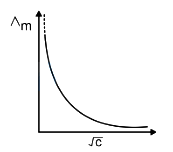
-
- (A) increase sharply
- (B) remain same or can not be measured accurately
- (C) decrease sharply
- (D) depend upon type of electrolyte
Show answer and solution
Correct Answer: (B)
Solution is already infinitely dilute, hence no change in molar conductivity upon addition of water -
- (A) \(\mathrm{S} \mathrm{cm}^2 \mathrm{~mol}^{-3 / 2} \mathrm{~L}^{1 / 2}\)
- (B) \(\mathrm{S} \mathrm{cm}^2 \mathrm{~mol}^{-1} \mathrm{~L}^{1 / 2}\)
- (C) \(\mathrm{S} \mathrm{cm}^2 \mathrm{~mol}^{-3 / 2} \mathrm{~L}\)
- (D) \(\mathrm{S} \mathrm{cm}^2 \mathrm{~mol}^{-3 / 2} \mathrm{~L}^{-1 / 2}\)
Show answer and solution
Correct Answer: (A)
\(\Lambda_{\mathrm{m}}=\Lambda_{\mathrm{m}}^{\circ}-\mathrm{A} \sqrt{\mathrm{C}}\)Units of \(\mathrm{A} \sqrt{\mathrm{C}}=\mathrm{S} \mathrm{cm}^2 \mathrm{~mole}^{-1}\)
Uits of \(\mathrm{A}=\mathrm{S} \mathrm{cm}^2 \mathrm{~mole}^{-3 / 2} \mathrm{~L}^{1 / 2}\)
- 14. Identify the factor from the following that does not affect electrolytic conductance of a solution. 2024 Hard
- (A) The nature of the electrolyte added.
- (B) The nature of the electrode used.
- (C) Concentration of the electrolyte.
- (D) The nature of solvent used.
Show answer and solution
Correct Answer: (B)
Conductivity of electrolytic cell is affected by concentration of electrolyte, nature of electrolyte and nature of solvent. -
- (A) \(65 \mathrm{~S} \mathrm{~cm}^2 \mathrm{~mol}^{-1}\)
- (B) \(130 \mathrm{~s} \mathrm{~cm}^2 \mathrm{~mol}^{-1}\)
- (C) \(187 \mathrm{~S} \mathrm{~cm}^2 \mathrm{~mol}^{-1}\)
- (D) \(260 \mathrm{~s} \mathrm{~cm}^2 \mathrm{~mol}^{-1}\)
Show answer and solution
Correct Answer: (B)
\(\Lambda_{\mathrm{C}}^{+2}=57 \mathrm{Scm}^2 \mathrm{~mol}^{-1}\)\(\Lambda_{\mathrm{A}}^{+2}=73 \mathrm{Scm}^2 \mathrm{~mol}^{-1}\)
\(\Lambda_{\text {Solution }}=\lambda_{\mathrm{C}}^{+2}+\Lambda_{\mathrm{A}}^{-2}\)
\(=57+73=130\)
-
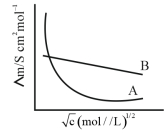
- (A) Weak electrolyte weak electrolyte
- (B) Strong electrolyte strong electrolyte
- (C) Weak electrolyte strong electrolyte
- (D) Strong electrolyte weak electrolyte
Show answer and solution
Correct Answer: (C)
\(\mathrm{A} \rightarrow\) Weak electrolyte\(B\) \(\rightarrow\) Strong electrolyte
-
- (A) \(1\)
- (B) \(2\)
- (C) \(3\)
- (D) \(4\)
Show answer and solution
Correct Answer: (D)
Conductivity \(\left(\mathrm{S} \mathrm{m}^{-1}\right)\)\(2.1\times10^3\)
\(1.2 \times 10\)
\(3.91\) conductors at \(298.15 \mathrm{~K}\)
\(1 \times 10^3\)
\(1 \times 10^{-16}\) Insulator at \(298.15 {~K}\)
\(l1.5 \times 10^{-2}\)
\(110^{-7}\) Semiconductor at \(298.15 \mathrm{~K}\)
Therefore number of conductors is \(4\).
-
- (A) \(\Lambda_{\mathrm{m}}^2 \mathrm{C}-\mathrm{K}_{\mathrm{a}} \Lambda_{\mathrm{m}}^{\circ 2}+\mathrm{K}_{\mathrm{a}} \Lambda_{\mathrm{m}} \Lambda_{\mathrm{m}}^{\circ}=0\)
- (B) \(\Lambda_{\mathrm{m}}-\Lambda_{\mathrm{m}}^{\circ}+\mathrm{AC}^{\frac{1}{2}}=0\)
- (C) \(\Lambda_{\mathrm{m}}-\Lambda_{\mathrm{m}}^{\circ}-\mathrm{AC}^{\frac{1}{2}}=0\)
- (D) \(\Lambda_{\mathrm{m}}^2 \mathrm{C}+\mathrm{K}_{\mathrm{a}} \Lambda_{\mathrm{m}}^{\circ 2}-\mathrm{K}_{\mathrm{a}} \Lambda_{\mathrm{m}} \Lambda_{\mathrm{m}}^{\circ}=0\)
Show answer and solution
Correct Answer: (A)
\( \mathrm{HA}(\mathrm{aq}) \rightleftharpoons \mathrm{H}^{+}(\mathrm{aq})+\mathrm{A}^{-}(\mathrm{aq}) \)\( \mathrm{K}_{\mathrm{a}}=\frac{\alpha^2 \mathrm{C}}{1-\alpha} \)
\( \alpha^2 \mathrm{C}+\mathrm{K}_{\mathrm{a}} \alpha-\mathrm{K}_{\mathrm{a}}=0 \)
\( \left(\frac{\lambda_{\mathrm{m}}}{\lambda_{\mathrm{m}}^{\infty}}\right)^2 \mathrm{C}+\mathrm{K}_{\mathrm{a}} \frac{\lambda_{\mathrm{m}}}{\lambda_{\mathrm{m}}^{\infty}}-\mathrm{K}_{\mathrm{a}}=0 \)
\( \lambda_{\mathrm{m}}^2 \mathrm{C}+\mathrm{K}_{\mathrm{a}} \lambda_{\mathrm{m}} \lambda_{\mathrm{m}}^{\infty}-\mathrm{K}_{\mathrm{a}}\left(\lambda_{\mathrm{m}}^{\infty}\right)^2=0\)
-
- (A) \(12\)
- (B) \(14\)
- (C) \(13\)
- (D) \(15\)
Show answer and solution
Correct Answer: (B)
\({\left[ Ag ^{+}\right]=10^{-5}}\)\({\left[ NO _3^{-}\right]=10^{-5}}\)
\({\left[ Br ^{-}\right]=\frac{ Ksp }{\left[ Ag ^{+}\right]}=4.9 \times 10^{-8}}\)
\(\Lambda_{ m }=\frac{ k }{1000 \times M }\)
For \(Ag ^{+}\)
\(6 \times 10^{-3}=\frac{ K _{ Ag ^{+}}}{1000 \times 10^{-5}}\)
\(K _{ Ag +}=6 \times 10^{-5}\)
\(\Rightarrow 6000 \times 10^{-8}\)
\(\text { for } Br ^{-}\)
\(8 \times 10^{-3}=\frac{ K _{ Br ^{-}}}{1000 \times 4.9 \times 10^{-8}}\)
\(K _{ BI -}=39.2 \times 10^{-8}\)
\(\text { for } NO _3^{-}\)
\(7 \times 10^{-3} =\frac{ K _{ No -}^3}{1000 \times 10^{-5}}\)
\(K _{ No _3} =7 \times 10^{-5}\)
\(=7000 \times 10^{-8}\)
Conductivity of solution
\(\Rightarrow(6000+7000+39.2) \times 10^{-8}\)
\(\Rightarrow 13039.2 \times 10^{-8} S m ^{-1}\)
-
- (A) \(2\)
- (B) \(4\)
- (C) \(6\)
- (D) \(8\)
Show answer and solution
Correct Answer: (A)
Statement \((A)\) and Statement \((C)\) are incorrect -
- (A) \(24\)
- (B) \(23\)
- (C) \(25\)
- (D) \(22\)
Show answer and solution
Correct Answer: (C)
\(\Lambda_{ m }= \frac{\kappa \times 1000}{ M }\)\(\Lambda_{ m }= \frac{1}{\rho} \times \frac{1000}{ M }\)
\(\frac{1}{5 \times 10^{-3}} \times \frac{1000}{0.8}\)
Ans. \(25 \times 10^4\,\Omega^{-1}\, cm ^{-2}\, mol ^{-1}\)
-
- (A) \(65\)
- (B) \(64\)
- (C) \(66\)
- (D) \(63\)
Show answer and solution
Correct Answer: (C)
\(\wedge_{ m }=\frac{ k }{ C } \times 1000\)Given \(k =5 \times 10^{-5} S cm ^{-1}\)
\(C =0.0025\,M\)
\(\wedge_{ m } =\frac{5 \times 10^{-5} \times 10^3}{0.0025}=\frac{5 \times 10^{-2}}{2.5 \times 10^{-3}}\)
\(=20\,S\,cm ^2\,mol ^{-1}\)
\(\alpha =\frac{20}{400}=\frac{1}{20}\)
\(\alpha=\frac{20}{400}=\frac{1}{20}\)
\(K_a=\frac{C \alpha^2}{1-\alpha} =\frac{0.0025 \times \frac{1}{20} \times \frac{1}{20}}{\frac{19}{20}}\)
\(=\frac{0.0025}{19 \times 20}=6.6 \times 10^{-6}\)
\(=66 \times 10^{-7}\)
-
- (A) Both Statement \(I\) and Statement \(II\) are true
- (B) Both Statement \(I\) and Statement \(II\) are false
- (C) Statement \(I\) is true but Statement \(II\) is false
- (D) Statement \(I\) is false but Statement \(II\) is true
Show answer and solution
Correct Answer: (B)
Statement \(I: KI\) is strong electrolyte thus almost constant on dilution.Statement \(II:\) In weak electrolyte it increases, sharply.
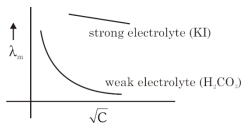
-
- (A) \(1000\)
- (B) \(2000\)
- (C) \(3000\)
- (D) \(4000\)
Show answer and solution
Correct Answer: (A)
\(\frac{\ell}{ A }=129\; m ^{-1}\)\(KCl\) solution \(1\) :
\(74.5\; ppm , R _{1}=100\; \Omega\)
\(KCl\) solution \(2\) :
\(149\; ppm , R _{2}=50 \;\Omega\)
\(149\;ppm , R _{2}=50 \;\Omega\)
Here, \(\frac{ ppm _{1}}{ ppm _{2}}=\frac{ M _{1}}{ M _{2}}\left(=\frac{ W _{1} / M _{0}}{ V } \times \frac{ V }{ W _{2} / M _{0}}\right)\)
\(\frac{\wedge_{1}}{\wedge_{2}}=\frac{\kappa_{1} \times \frac{1000}{M_{1}}}{\kappa_{2} \times \frac{1000}{M_{2}}}\)
\(=\frac{\kappa_{1}}{\kappa_{2}} \times \frac{M_{2}}{M_{1}}\)
\(=\frac{50}{100} \times 2\)
\(=\frac{\wedge_{1}}{\wedge_{2}}=1,000 \times 10^{-3}\)
-
- (A) \(150\)
- (B) \(14\)
- (C) \(89\)
- (D) \(123\)
Show answer and solution
Correct Answer: (B)
Given\((1)\) \(\lambda_{ m }^{\infty}( NaI )=12.7 \,m\,S m ^{2}\, mol ^{-1}\)
\((2)\) \(\lambda_{ m }^{\infty}\left( NaNO _{3}\right)=12.0 \,m\,S m ^{2}\, mol ^{-1}\)
\((3)\) \(\lambda_{ m }^{\infty}\left( AgNO _{3}\right)=13.3\,m\,S m ^{2}\, mol ^{-1}\)
\(\lambda_{ m }^{\infty}( Ag I )=(1)+(3)-(2)\)
\(=12.7+13.3-12.0\)
\(=26.0-12.0\)
\(\lambda_{ m }^{\infty}( Ag I )=14.0\)
-
- (A) \(452\)
- (B) \(312\)
- (C) \(266\)
- (D) \(199\)
Show answer and solution
Correct Answer: (C)
\(K =\frac{1}{ R } \times \text { cell cons } \tan t\)\(0.152 \times 10^{-3}=\frac{1}{1750}\) cell constant
cell constant \(=266 \times 10^{-3}\)
-
- (A) \(133\)
- (B) \(195\)
- (C) \(143\)
- (D) \(241\)
Show answer and solution
Correct Answer: (C)
Given conc \(^{\text {n }}\) of \(KCl =\frac{ m . mol }{ L }\): Conductance \(( G )=0.55 mS\)
: Cell constant \(\left(\frac{\ell}{ A }\right)=1.3 cm ^{-1}\)
To Calculate : Molar conductivity \(\left(\lambda_{ m }\right)\) of sol.
\(\rightarrow\) Since \(\lambda_{ m }=\frac{1}{1000} \times \frac{ k }{ m }\)
\(\rightarrow\) Molarity \(=5 \times 10^{-3} \frac{ mol }{ L }\)
\(\rightarrow\) Conductivity \(= G \times\left(\frac{\ell}{ A }\right)=0.55 \,mS \times \frac{1.3}{\frac{1}{100}} \,m ^{-1}\)
\(=55 \times 1.3 \, mSm ^{-1}\)
eq \(^{ n }(1) \,{\lambda_{ m }}=\frac{1}{1000} \times \frac{55 \times 1.3}{\left(\frac{5}{1000}\right)} \frac{ mSm ^{2}}{ mol }\)
\(\Rightarrow \lambda_{ m }=14.3 \, \frac{ mSm ^{2}}{ mol }\)
-
- (A) \(28\)
- (B) \(107\)
- (C) \(67\)
- (D) \(57\)
Show answer and solution
Correct Answer: (D)
\(\kappa=\frac{1}{R} \cdot G^{*}\)For same conductivity cell, \(G ^{*}\) is constant and hence \(\kappa . R .=\) constant.
\(\therefore 0.14 \times 4.19=\kappa \times 1.03\)
or,\(\kappa\) of HCl solution \(=\frac{0.14 \times 4.19}{1.03}\)
\(=0.5695\, Sm ^{-1}\)
\(=56.95 \times 10^{-2} Sm ^{-1} \approx 57 \times 10^{-2} \,Sm ^{-1}\)
-
- (A) Statement \(I\) is true but Statement \(II\) is false.
- (B) Statement \(I\) is false but Statement \(II\) is true.
- (C) Both Statement \(I\) and Statement \(II\) are true.
- (D) Both Statement \(I\) and Statement \(II\) are false.
Show answer and solution
Correct Answer: (D)
\(Ion\) \(\mathrm{H}^{+}\) \(\mathrm{K}^{+}\) \(\mathrm{Cl}^{-}\) \(\mathrm{CH}_{3} \mathrm{COO}^{-}\) \(\Lambda_{\mathrm{m} \mathrm{Sem}^{2} / \mathrm{mole}}^{\infty}\) \(349.8\) \(73.5\) \(76.3\) \(40.9\) So \(\Lambda_{\mathrm{m} \mathrm{CH}_{3} \mathrm{COOH}}^{\infty}=\Lambda_{\mathrm{m}\left(\mathrm{H}^{+}\right)}^{\infty}+\Lambda_{\mathrm{m} \mathrm{CH}_{3} \mathrm{COO}^{-}}^{\infty}\)
\(=349.8+40.9\)
\(=390.7\, \mathrm{Scm}^{2} / \mathrm{mole}\)
\(\Lambda_{\mathrm{m} \mathrm{KCl}}^{\infty}= \Lambda_{\mathrm{m}\left(\mathrm{K}^{*}\right)}^{\infty}+\Lambda_{\mathrm{m}(\mathrm{Cl}^{-})}^{\infty})\)
\(= 73.5+76.3\)
\(= 149.3\, \mathrm{Scm}^{2} / \mathrm{mole}\)
So statement\(-I\) is wrong or False.
As the concentration decreases, the dilution increases which increases the degree of dissociation, thus increasing the no. of ions, which increases the molar conductance.
So statement\(-II\) is false.

-
- (A) \(260\)
- (B) \(39\)
- (C) \(26\)
- (D) \(13\)
Show answer and solution
Correct Answer: (C)
\(\mathrm{k}=1.07 \times 10^{6}\, \mathrm{Sm}^{-1}, \quad \mathrm{R}=0.243\, \Omega\)\(\mathrm{G}=\frac{1}{\mathrm{R}}=\frac{1}{0.243}\, \Omega^{-1}\)
\(\mathrm{k}=\mathrm{G} \times \mathrm{G}^{*}\)
\(\mathrm{G}^{*}=\frac{\mathrm{k}}{\mathrm{G}}=\frac{1.07 \times 10^{6}}{\frac{1}{0.243}} \simeq 26 \times 10^{4}\, \mathrm{~m}^{-1}\)
-
- (A) \((\mathrm{a})-(\mathrm{iii}),(\mathrm{b})-(\mathrm{i}),(\mathrm{c})-(\mathrm{iv}),(\mathrm{d})-(\mathrm{ii})\)
- (B) \((\mathrm{a})-(\mathrm{iii}),(\mathrm{b})-(\mathrm{i}),(\mathrm{c})-(\mathrm{ii}),(\mathrm{d})-(\mathrm{iv})\)
- (C) \((a)-(i), (b)-(iv), (c)-(iii), (d)-(ii)\)
- (D) \((a)-(ii), (b)-(i), (c)-(iii), (d)-(iv)\)
Show answer and solution
Correct Answer: (A)
Cell constant \(=\left(\frac{\ell}{\mathrm{A}}\right) \Rightarrow\) Units \(=\mathrm{m}^{-1}\)Molar conductivity \(\left(\Lambda_{m}\right) \Rightarrow\) Units \(=\mathrm{Sm}^{2} \,\mathrm{~mole}^{-1}\)
Conductivity \((\mathrm{K}) \Rightarrow\) Units \(=\mathrm{S}\, \mathrm{m}^{-1}\)
Degree of dissociation \((\alpha) \rightarrow\) Dimensionless
\(\therefore\) \((a) - (iii)\)
\(\quad(b) - (i)\)
\(\quad(c) - (iv)\)
\(\quad(d) - (ii)\)
-
- (A) \(18\)
- (B) \(12\)
- (C) \(61\)
- (D) \(14\)
Show answer and solution
Correct Answer: (B)
\(\wedge_{\mathrm{m}}=1000 \times \frac{\kappa}{\mathrm{M}}\)\(=1000 \times \frac{2 \times 10^{-5}}{0.001}=20 \mathrm{~S} \mathrm{~cm}^{2} \mathrm{~mol}^{-1}\)
\(\Rightarrow \alpha=\frac{\wedge_{\mathrm{m}}}{\wedge_{\mathrm{m}}^{\infty}}=\frac{20}{190}=\left(\frac{2}{19}\right)\)
\(\mathrm{HA} \rightleftharpoons \mathrm{H}^{+}+\mathrm{A}^{-}\)
\(0.001(1-\alpha) \,\,0.001 \alpha \,\,0.001 \alpha\)
\(\Rightarrow \quad \mathrm{k}_{\mathrm{a}}=0.001\left(\frac{\alpha^{2}}{1-\alpha}\right)=\frac{0.001 \times\left(\frac{2}{19}\right)^{2}}{1-\left(\frac{2}{19}\right)}\)
\(=12.3 \times 10^{-6}\)
-
- (A) \(102\)
- (B) \(328\)
- (C) \(488\)
- (D) \(288\)
Show answer and solution
Correct Answer: (D)
From Kohlrausch's law\(\Lambda_{ m }^{\infty}\left( BaSO _{4}\right)=\lambda_{ m }^{\infty}\left( Ba ^{2+}\right)+\lambda_{ m }^{\infty}\left( SO _{4}^{2-}\right)\)
\(\Lambda_{ m }^{\infty}\left( BaSO _{4}\right)=\Lambda_{ m }^{\infty}\left( BaCl _{2}\right)+\Lambda_{ m }^{\infty}\left( H _{2} SO _{4}\right)-2\Lambda_{ m }^{\infty}\left( HCl\right)\)
\(=280+860-2(426)\)
\(=288 \,Scm ^{2} mol ^{-1}\)
-
- (A) \(760\)
- (B) \(76\)
- (C) \(7.6\)
- (D) \(141\)
Show answer and solution
Correct Answer: (A)
\(\mathrm{K}=\frac{1}{\mathrm{R}} \times \ell / \mathrm{A}=\left(\left(\frac{1}{1500}\right) \times 1.14\right)\, \mathrm{S}\, \mathrm{cm}^{-1}\)\(\Rightarrow \wedge_{\mathrm{m}}=1000 \times \frac{\left(\frac{1.14}{1500}\right)}{0.001}\, \mathrm{~S}\, \mathrm{~cm}^{2} \,\mathrm{~mol}^{-1}\)
\(=760 \mathrm{~S}\, \mathrm{~cm}^{2} \,\mathrm{~mol}^{-1}\)
\(\Rightarrow 760\)
-
- (A) \(\left(\Lambda_{\mathrm{m}}^{0}\right)_{\mathrm{NaBr}}-\left(\Lambda_{\mathrm{m}}^{0}\right)_{\mathrm{NaI}}=\left(\Lambda_{\mathrm{m}}^{0}\right)_{\mathrm{KBr}}-\left(\Lambda_{\mathrm{m}}^{0}\right)_{\mathrm{NaBr}}\)
- (B) \(\left(\Lambda_{\mathrm{m}}^{0}\right)_{\mathrm{H}_{2} \mathrm{O}}=\left(\Lambda_{\mathrm{m}}^{0}\right)_{\mathrm{HCl}}+\left(\Lambda_{\mathrm{m}}^{0}\right)_{\mathrm{NaOH}}-\left(\Lambda_{\mathrm{m}}^{0}\right)_{\mathrm{NaCl}}\)
- (C) \(\left(\Lambda_{\mathrm{m}}^{0}\right)_{\mathrm{KCl}}-\left(\Lambda_{\mathrm{m}}^{0}\right)_{\mathrm{NaCl}}=\left(\Lambda_{\mathrm{m}}^{0}\right)_{\mathrm{KBr}}-\left(\Lambda_{\mathrm{m}}^{0}\right)_{\mathrm{NaBr}}\)
- (D) \(\left(\Lambda_{\mathrm{m}}^{0}\right)_{\mathrm{NaBr}}-\left(\Lambda_{\mathrm{m}}^{0}\right)_{\mathrm{NaCl}}=\left(\Lambda_{\mathrm{m}}^{0}\right)_{\mathrm{KBr}}-\left(\Lambda_{\mathrm{m}}^{0}\right)_{\mathrm{KCl}}\)
Show answer and solution
Correct Answer: (A)
According to Kohlrausch's law correct expression \(\overline{15}\)\(\left(\Lambda_{\mathrm{m}}^{0}\right)_{\mathrm{KBr}}-\left(\Lambda_{\mathrm{m}}^{0}\right)_{\mathrm{NaI}}=\left(\Lambda_{\mathrm{m}}^{0}\right)_{\mathrm{KBr}}-\left(\Lambda_{\mathrm{m}}^{0}\right)_{\mathrm{KI}}\)
The other statements are correct.
-
- (A) \(CH _{3} COOH\)
- (B) \(KNO _{3}\)
- (C) \(HCl\)
- (D) \(NaCl\)
Show answer and solution
Correct Answer: (A)
Its a weak electrolyte hence : \(CH _{3} COOH\) -
- (A) \(S_1\) is wrong and \(S_2\) is correct
- (B) Both \(S_1\) and \(S_2\) are wrong
- (C) \(S_1\) is correct and \(S_2\) is wrong
- (D) Both \(S_1\) and \(S_2\) are correct
Show answer and solution
Correct Answer: (A)
We know that\(\lambda _m=\frac {K}{C}\) Here \(\lambda _m\,=\) molar conductivity
\(K=\) conductivity
\(C\,=\) concentration
when concentration increase conductivity always increases. The molar conductivity always increase wih the decrease in the concentration
-
- (A) \(C{e^{4 + }} < P{b^{4 + }} < B{i^{3 + }} < C{o^{3 + }}\)
- (B) \(C{o^{3 + }} < P{b^{4 + }} < C{e^{4 + }} < B{i^{3 + }}\)
- (C) \(B{i^{3 + }} < C{e^{4 + }} < P{b^{4 + }} < C{o^{3 + }}\)
- (D) \(C{o^{3 + }} < C{e^{4 + }} < B{i^{3 + }} < P{b^{4 + }}\)
Show answer and solution
Correct Answer: (C)
Lower the standard reduction potential, more the ability to get reduced higher the oxidizing power -
- (A) \(0.50\)
- (B) \(0.25\)
- (C) \(0.125\)
- (D) \(0.75\)
Show answer and solution
Correct Answer: (C)
\(\lambda _{m}^{o}(HA)\,=\,100.5\,+\,425.9\,-\,126.4\,=400\)\(\lambda _{m}^{o}=\,\frac{K\,\times \,1000}{M}\,=\,\frac{5\,\times \,{{10}^{-5}}\,\times \,{{10}^{3}}}{{{10}^{-3}}}\,=50\)
\(\alpha \,=\,\frac{50}{400}\,=\,0.125\)
-
- (A) \(5 \times 10^{-4}\)
- (B) \(5 \times 10^{-3}\)
- (C) \(5 \times 10^{3}\)
- (D) \(5 \times 10^{2}\)
Show answer and solution
Correct Answer: (A)
Given for \(0.2 \mathrm{M}\) solution\(R=50 \Omega\)
\(\kappa=1.45 S m^{-1}=1.4 \times 10^{-2} S \mathrm{cm}^{-1}\)
Now, \(R=\rho {\frac{\ell}{a}}=\frac{1}{\kappa} \times \frac{\ell}{a}\)
\(\Rightarrow \frac{\ell}{a}=R \times \kappa=50 \times 1.4 \times 10^{-2}\)
For \(0.5 M\) solution
\(R=280 \Omega ; \kappa=?\)
\(\frac{\ell}{a}=50 \times 1.4 \times 10^{-2}\)
\(\Rightarrow R=\rho \frac{\ell}{a}=\frac{1}{\kappa} \times \frac{\ell}{a}\)
\(\Rightarrow \quad \kappa=\frac{1}{280} \times 50 \times 1.4 \times 10^{-2}\)
\(=\frac{1}{280} \times 70 \times 10^{-2}=2.5 \times 10^{-3} S c m^{-1}\)
Now, \(\Lambda_{m}=\frac{\kappa \times 1000}{M}=\frac{2.5 \times 10^{-3} \times 1000}{0.5}\)
\(=5 S c m^{2} m o l^{-1}=5 \times 10^{-4} S m^{2} m o l^{-1}\)
-
- (A) \(\lambda _C =\lambda _{\infty} +(B)C\)
- (B) \(\lambda _C =\lambda _{\infty} - (B)C\)
- (C) \(\lambda _C =\lambda _{\infty} -(B) \sqrt{C}\)
- (D) \(\lambda _C =\lambda _{\infty} +(B) \sqrt{C}\)
Show answer and solution
Correct Answer: (C)
According to Debye Huckle onsager equation,\(\lambda_{C}=\lambda_{\infty}-B \sqrt{C}\)

No questions on this page match these filters.
Other STD 12 - Electrochemistry topics
Frequently asked
How many Conductor and Conductance and Cell constant questions came in JEE Mains?
41 questions from 2014–2026, each with the correct answer and a full solution.
How difficult are Conductor and Conductance and Cell constant questions?
5% are easy, 46% medium and 49% hard.