


Questions
Newest firstShowing 1–25 of 25 questions
-
- (A) \(10^{-6}\)
- (B) \(4 \times 10^{-4}\)
- (C) \(3 \times 10^{-5}\)
- (D) \(3 \times 10^{-3}\)
Show answer and solution
Correct Answer: (D)
The molality of the solution is given by:
\(m = \dfrac{\text{Mass of solute}}{\text{Molar mass of solute} \times \text{Mass of solvent in kg}}\)
\(m = \dfrac{19.5}{78 \times 0.5} = 0.5 \text{ mol kg}^{-1}\)
The depression in freezing point is given by:
\(\Delta T_f = i \times K_f \times m\)
Substituting the given values:
\(1 = i \times 1.86 \times 0.5\)
\(1 = i \times 0.93\)
\(i = \dfrac{1}{0.93} = \dfrac{100}{93}\)
For the dissociation of a weak acid \(HA \rightleftharpoons H^+ + A^-\), the van 't Hoff factor is \(i = 1 + \alpha\), where \(\alpha\) is the degree of dissociation.
\(1 + \alpha = \dfrac{100}{93}\)
\(\alpha = \dfrac{100}{93} - 1 = \dfrac{7}{93}\)
The acid dissociation constant \(K_a\) is given by:
\(K_a = \dfrac{C \alpha^2}{1 - \alpha}\)
Since molarity and molality have the same values, \(C = 0.5 \text{ M}\).
\(K_a = \dfrac{0.5 \times \left(\dfrac{7}{93}\right)^2}{1 - \dfrac{7}{93}}\)
\(K_a = \dfrac{0.5 \times \dfrac{49}{93^2}}{\dfrac{86}{93}} = \dfrac{0.5 \times 49}{93 \times 86}\)
\(K_a = \dfrac{24.5}{7998} \approx 3.06 \times 10^{-3}\)
The closest value is \(3 \times 10^{-3}\).
Answer: \(3 \times 10^{-3}\) -
- (A) Statement I is incorrect but Statement II is correct
- (B) Both Statement I and Statement II are incorrect
- (C) Both Statement I and Statement II are correct
- (D) Statement I is correct but Statement II is incorrect
Show answer and solution
Correct Answer: (D)
Statement-I
Molar depression constant \(\mathrm{k}_f=\frac{\mathrm{M}_1 \mathrm{RT}_{\mathrm{f}}^2}{\Delta \mathrm{H}_{\text {fus }}}\)
\(\begin{aligned}
& \mathrm{k}_f=\frac{\mathrm{M}_1 \mathrm{RT}_{\mathrm{f}}}{\left[\frac{\Delta \mathrm{H}_{\text {fus }}}{\mathrm{T}_{\mathrm{f}}}\right]} \\
& \mathrm{k}_f=\frac{\mathrm{M}_1 \mathrm{RT}_f}{\Delta \mathrm{~S}_{\text {fus }}}
\end{aligned}\)
Hence statement-I is correct
\(\text { but } \mathrm{k}_{\mathrm{f}} \text { for benzene }=5.12 \frac{{ }^{\circ} \mathrm{C}}{\mathrm{molal}}\)
\(\mathrm{k}_{\mathrm{f}}\) for water \(=1.86 \frac{{ }^{\circ} \mathrm{C}}{\text { molal }}\) Hence statement- II is incorrect -
- (A) \(31\)
- (B) \(35\)
- (C) \(37\)
- (D) \(40\)
Show answer and solution
Correct Answer: (A)
As moles of water \(>\) moles of \(\mathrm{CH}_3 \mathrm{COOH}\) water is solvent.\(\mathrm{T}_{\mathrm{F}}^{\circ}-\left(\mathrm{T}_{\mathrm{F}}\right)_{\mathrm{S}}=\mathrm{K}_{\mathrm{F}} \times \mathrm{M}\)
\(0-\left(\mathrm{T}_{\mathrm{F}}\right)_{\mathrm{S}}=1.86 \times \frac{2700 / 60}{2700 / 1000}\)
\(\left(\mathrm{~T}_{\mathrm{F}}\right)_{\mathrm{S}}=-31^{\circ} \mathrm{C}.\)
- 4. The solution from the following with highest depression in freezing point/lowest freezing point is _______. 2024 Hard
- (A) \(180 \mathrm{~g}\) of acetic acid dissolved in water
- (B) \(180 \mathrm{~g}\) of acetic acid dissolved in benzene
- (C) \(180 \mathrm{~g}\) of benzoic acid dissolved in benzene
- (D) \(180 \mathrm{~g}\) of glucose dissolved in water
Show answer and solution
Correct Answer: (A)
\(\Delta \mathrm{T}_{\mathrm{f}}\) is maximum when \(\mathrm{i} \times \mathrm{m}\) is maximum.1) \(\mathrm{m}_1=\frac{180}{60}=3, \mathrm{i}=1+\alpha\)
Hence
\(\Delta \mathrm{T}_{\mathrm{f}}=(1+\alpha) \cdot \mathrm{k}_{\mathrm{f}}=3 \times 1.86=5.58^{\circ} \mathrm{C}(\alpha<<1)\)
\(2)\) \(\mathrm{m}_2=\frac{180}{60}=3, \mathrm{i}=0.5, \Delta \mathrm{T}_{\mathrm{f}}=\frac{3}{2} \times \mathrm{k}_{\mathrm{f}}{ }^{\prime}=7.68^{\circ} \mathrm{C}\)
3) \(\mathrm{m}_3=\frac{180}{122}=1.48, \mathrm{i}=0.5, \Delta \mathrm{T}_{\mathrm{f}}=\frac{1.48}{2} \times \mathrm{k}_{\mathrm{f}}^{\prime}=3.8^{\circ} \mathrm{C}\)
4) \(\mathrm{m}_4=\frac{180}{180}=1, \mathrm{i}=1, \Delta \mathrm{T}_{\mathrm{f}}=1 \cdot \mathrm{k}_{\mathrm{f}}^{\prime}=1.86^{\circ} \mathrm{C}\)
As per NCERT, \(\mathrm{k}_{\mathrm{f}}{ }^{\prime}\left(\mathrm{H}_2 \mathrm{O}\right)=1.86 \mathrm{k} \cdot \mathrm{kg} \mathrm{mol}^{-1}\)
\(\mathrm{k}_{\mathrm{f}}{ }^{\prime}(\) Benzene \()=5.12 \mathrm{k} \cdot \mathrm{kg} \mathrm{mol}^{-1}\)
- 5. What happens to freezing point of benzene when small quantity of napthalene is added to benzene? 2024 Hard
- (A) Increases
- (B) Remains unchanged
- (C) First decreases and then increases
- (D) Decreases
Show answer and solution
Correct Answer: (D)
On addition of naphthalene to benzene there is depression in freezing point of benzene. -
- (A) \(540\)
- (B) \(542\)
- (C) \(543\)
- (D) \(550\)
Show answer and solution
Correct Answer: (C)
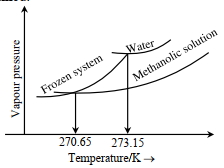
\(\Delta \mathrm{T}_{\mathrm{f}}=273.15-270.65=2.5 \mathrm{~K}\)\(\Delta \mathrm{T}_{\mathrm{f}}=\mathrm{K}_{\mathrm{f}} \mathrm{m} \Rightarrow 2.5=1.86 \times \frac{\mathrm{n}}{0.1}\)
\(\Rightarrow \mathrm{n}=0.1344 \text { moles }\)
\(\Rightarrow \mathrm{w}=0.1344 \times 32=4.3 \mathrm{~g}\)
\(\text { Volume }=\frac{4.3}{0.792}=5.43 \mathrm{ml}=543 \times 10^{-2} \mathrm{ml}\)
-
- (A) \(371\)
- (B) \(372\)
- (C) \(373\)
- (D) \(375\)
Show answer and solution
Correct Answer: (B)
\(i =1+( n -1) \alpha\)\( i =1+0.2(2-1)=1.2\)
\(\Delta T _{ f }= i K _{ f } m\)
\(\Delta T _{ f }=1.2 \times 1.86 \times \frac{5 \times 1000}{60 \times 500}\)
\(\Delta t _{ f }=3.72\)
\(\Delta T _{ f }=372 \times 10^{-2}\)
-
- (A) A and D only
- (B) B and C only
- (C) A and C only
- (D) A only
Show answer and solution
Correct Answer: (A)
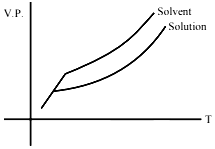
Vapour pressure (V.P.) of solvent is greater than vapour pressure (V.P.) of solution. Only solvent freezes. -
- (A) \(50\)
- (B) \(5\)
- (C) \(45\)
- (D) \(24\)
Show answer and solution
Correct Answer: (B)
\(M = d \times V =1.02 \times 1.2=1.224\, gm\)Moles of acetic acid \(=0.0204\) \(moles\) in \(2\, L\)
So molality \(=0.0102 \,mol / kg\)
Now \(\Delta T _{ f }= i \times K _{ f } \times M\)
\(i=1+\alpha\) for acetic acid
\(0.0198=(1+\alpha) \times 1.85 \times 0.0102\)
\(\alpha=0.04928\)
\(\cong 5\, \%\)
-
- (A) \(81\)
- (B) \(80\)
- (C) \(82\)
- (D) \(83\)
Show answer and solution
Correct Answer: (B)
Mass of \(C _{2} H _{5} OH =62.5 \times 0.8=50\,g\)\(\Delta T _{ f }= K _{ f } \times m\)
\(0.9=2 \times \frac{1.8 \times 1000}{ M _{ \pi } \times 50}\)
\(M _{ w }=\frac{2 \times 1.8 \times 1000}{0.9 \times 50}=80\)
-
- (A) \(0.8\)
- (B) \(1.1\)
- (C) \(1.9\)
- (D) \(2.4\)
Show answer and solution
Correct Answer: (C)
\([ HCOOH ]=0.5\,ml\,1^{-1}\)\(\Rightarrow\left(0.5 ml \times 1.05\,g\,ml ^{-1}\right) HCOOH\) in \(1 L\)
\(\Rightarrow 0.525\,g\,HCOOH\) in \(1\,L\)
\(m =\frac{(0.525 / 46)}{1\,kg } mol\) [Assuming dilute solution]
\(\therefore \Delta T _{ f }= iK _{ f } m \Rightarrow i =\frac{\Delta T _{ f }}{ k _{ f } m }=\frac{0.0405 \times 46}{1.86 \times 0.525}=1.9\)
-
- (A) \(0\)
- (B) \(1\)
- (C) \(2\)
- (D) \(3\)
Show answer and solution
Correct Answer: (B)
\(\Delta T _{ b }= iK _{ b } m _{1} \quad \Delta T _{ f }= iK _{ f } m _{2}\)\(\frac{\Delta T _{ b }}{\Delta T _{ f }}=\frac{ K _{ b } \times 1}{ K _{ f } \times 2}\) \(\Rightarrow \frac{3}{6}=\frac{1}{2}=\frac{ K _{ b }}{ K _{ f }} \times \frac{1}{2}\)
\(\frac{ K _{ b }}{ K _{ f }}=\frac{1}{1} \Rightarrow x =1\)
-
- (A) \(1: 4\)
- (B) \(1: 0.25\)
- (C) \(1: 0.20\)
- (D) \(1: 5\)
Show answer and solution
Correct Answer: (B)
\(\frac{\Delta T _{ ex }}{\Delta T _{ fy }}=\frac{ k _{ f } \cdot m _{ x }}{ k _{ f } \cdot m _{ y }}=\frac{\frac{1 / M _{ x }}{1 / M _{ y }}}{\frac{1}{1}}\)\(\frac{1}{4}=\frac{M_{y}}{M_{x}}\)
\(M _{ x }: M _{ y }=1: 0.25\)
-
- (A) \(342\)
- (B) \(841\)
- (C) \(518\)
- (D) \(277\)
Show answer and solution
Correct Answer: (C)
Let mass of water initially present \(=\mathrm{x\,gm}\)\(\Rightarrow \text { Mass of sucrose }=(1000-\mathrm{x})\, \mathrm{gm}\)
\(\Rightarrow \text { moles of sucrose }=\left(\frac{1000-\mathrm{x}}{342}\right)\)
\(\Rightarrow 0.75=\frac{\left(\frac{1000-\mathrm{x}}{342}\right)}{\left(\frac{\mathrm{x}}{1000}\right)} \Rightarrow \frac{\mathrm{x}}{1000}=\frac{1000-\mathrm{x}}{342 \times 0.75}\)
\(\Rightarrow 256.5 \mathrm{x}=10^{6}-1000 \mathrm{x}\)
\(\Rightarrow \mathrm{x}=795.86\, \mathrm{gm}\)
\(\Rightarrow \text { moles of sucrose }=0.5969\)
New mass of \(\mathrm{H}_{2} \mathrm{O}=\mathrm{a}\, \mathrm{kg}\)
\(\Rightarrow 4=\frac{0.5969}{\mathrm{a}} \times 1.86 \Rightarrow \mathrm{a}=0.2775\, \mathrm{~kg}\)
\(\Rightarrow \text { ice separated }=(795.86-277.5)=518.3 \,\mathrm{gm}\)
-
- (A) \(271\)
- (B) \(370\)
- (C) \(71\)
- (D) \(521\)
Show answer and solution
Correct Answer: (A)
\(\text { molality }=\frac{\left(\frac{40}{180}\right) \,{\text {mol }}}{0.2 \,\mathrm{Kg}}=\left(\frac{10}{9}\right) \,\text { molal }\)\(\Rightarrow \Delta \mathrm{T}_{\mathrm{f}}=\mathrm{T}_{\mathrm{f}}-\mathrm{T}_{\mathrm{f}}^{\prime}=1.86 \times \frac{10}{9}\)
\(\Rightarrow \mathrm{T}_{\mathrm{f}}^{\prime}=273.15-1.86 \times \frac{10}{9}\)
\(=271.08\, \mathrm{~K}\)
\(\simeq 271 \,\mathrm{~K}\) (nearest-integer)
-
- (A) \(369\)
- (B) \(269\)
- (C) \(209\)
- (D) \(296\)
Show answer and solution
Correct Answer: (B)
\(\mathrm{k}_{\mathrm{f}}=1.86\, \mathrm{k} \cdot\, \mathrm{kg} / \mathrm{mol}\)\(\mathrm{T}_{\mathrm{f}}^{\circ}=273\, \mathrm{k}\)
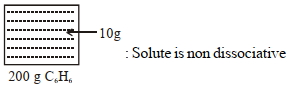
solvent \(: \mathrm{H}_{2} \mathrm{O}(625\, \mathrm{~g})\)
Solute : \(83\, \mathrm{~g}\) \(\mathrm{CH}_{2}OH-\mathrm{CH}_{2}OH \Rightarrow\) Non dissociative
solute
\(\Rightarrow \Delta \mathrm{T}_{\mathrm{f}}=\mathrm{k}_{\mathrm{f}} \times \mathrm{m}\)
\(\Rightarrow\left(\mathrm{T}_{\mathrm{f}}^{\circ}-\mathrm{T}_{\mathrm{f}}^{1}\right)=1.86 \times \frac{83 / 62}{624 / 1000}\)
\(\Rightarrow 273-\mathrm{T}_{\mathrm{f}}^{1}=\frac{1.86 \times 83 \times 1000}{62 \times 625}=\frac{154380}{38750}\)
\(\Rightarrow 273-\mathrm{T}_{\mathrm{f}}^{1}=4\)
\(\Rightarrow \mathrm{T}_{\mathrm{f}}^{1}=259\,\mathrm{~K}\)
-
- (A) \(3\)
- (B) \(1\)
- (C) \(5\)
- (D) \(9\)
Show answer and solution
Correct Answer: (B)
Pure Solvent : \(C _{6} H _{6}(\ell)\)Given : \(T _{ f }^{\circ}=5.5^{\circ} C\)
\(K _{ f }=5.12^{\circ}\,C / m\)
\(\because \Delta T _{ f }= k _{ f } \times m\)
\(\Rightarrow\left( T _{ f }^{0}- T _{ f }^{\prime}\right)=5.12 \times \frac{\left(\frac{10}{58}\right)}{\left(\frac{200}{1000}\right) \,kg } \,mol\)
\(\Rightarrow 5.5- T _{ f }^{\prime}=\frac{5.12 \times 5 \times 10}{58}\)
\(\Rightarrow T _{ f }^{\prime}=1.086^{\circ} C \simeq 1^{\circ} C\)
-
- (A) \(4\)
- (B) \(3\)
- (C) \(1\)
- (D) \(2\)
Show answer and solution
Correct Answer: (A)
As \(0.1 \,\mathrm{M} \mathrm{C}_{2} \mathrm{H}_{5} \mathrm{OH}\) is non-dissociative and rest all salt given are electrolyte so in each case effective molarity \(>\,0.1\) so each will have lower freezing point. -
- (A) \(38\)
- (B) \(42\)
- (C) \(36\)
- (D) \(44\)
Show answer and solution
Correct Answer: (C)
\(ClCH _{2} COOH \rightleftharpoons ClCH _{2} COO ^{\ominus}+ H ^{+}\)\(i =1+(2-1) \alpha\)
\(i =1+\alpha\)
\(\Delta T _{ f }= ik _{ f } m\)
\(0.5=(1+\alpha)(1.86)\left(\frac{\left(\frac{9.45}{94.5}\right)}{\left(\frac{500}{1000}\right)}\right)\)
\(\frac{5}{3.72}=1+\alpha \quad \Rightarrow \alpha=\frac{1.28}{3.72}\)
\(\alpha=\frac{32}{93}\)
\(\begin{array}{*{20}{c}} {ClC{H_2}COOH \rightleftharpoons ClC{H_2}CO{O^ \ominus } + {H^ + }} \\ {\,\,\,\,\,\,\,\,\,C - C\alpha \,\,\,\,\,\,\,\,\,\,\,\,\,\,\,\,\,\,\,\,\,\,\,\,\,\,\,\,C\alpha \,\,\,\,\,\,\,\,\,\,\,\,\,\,\,\,\,\,\,\,\,\,\,\,\,\,\,\,\,\,\,C\alpha \,\,\,\,\,\,\,\,\,\,\,\,\,} \end{array}\)
\(=0.036\)
\(K _{ a }=36 \times 10^{-3}\)
- 20. Which one of the following \(0.10\, \mathrm{M}\) aqueous solutions will exhibit the largest freezing point depression? 2021 Medium
- (A) hydrazine
- (B) glucose
- (C) glycine
- (D) \(\mathrm{KHSO}_{4}\)
Show answer and solution
Correct Answer: (D)
\(\because\) Van't Hoff factor is highest for \(\mathrm{KHSO}_{4}\)\(\therefore\) colligative property \(\left(\Delta \mathrm{T}_{\mathrm{f}}\right)\) will be highest for \(\mathrm{KHSO}_{4}\)
-
- (A) \(2.25\)
- (B) \(2\)
- (C) \(1.75\)
- (D) \(1.5\)
Show answer and solution
Correct Answer: (C)
\(\Delta \mathrm{T}_{\mathrm{f}}=\mathrm{i} \times \mathrm{m} \times \mathrm{K}_{\mathrm{f}}\)\(0.2=2 \times 2 \times \frac{\mathrm{w} / 58.5}{600 / 1000}\)
\(\mathrm{w}=1.755 \mathrm{gm}\)
-
- (A) \(K_b = 1.5K_f\)
- (B) \(K_b = K_f\)
- (C) \(K_b = 0.5K_f\)
- (D) \(K_b = 2K_f\)
Show answer and solution
Correct Answer: (D)
\(\Delta {T_b}\, = \,{K_b}m\)\(\Delta {T_b}\, = \,{K_b}\, \times \,1\, \Rightarrow \,2\, = \,{K_b}\)
\(\Delta {T_f}\, = \,{K_f}m\)
\(2\, = \,2{K_f}\, = \,{K_f}\)
\(\frac{{{K_f}}}{{{K_b}}}\, = \,\frac{1}{2}\)
-
- (A) \(3\)
- (B) \(2\)
- (C) \(1\)
- (D) \(4\)
Show answer and solution
Correct Answer: (A)
\({(\Delta {T_f})_Y}\, = \,{(\Delta {T_f})_Y}\)\({k_f}{m_X}\, = \,{k_t}{m_Y}\)
\(\frac{{4\, \times \,1000}}{{A\, \times \,96}}\, = \,\frac{{12\, \times \,1000}}{{M\, \times \,88}}\)
\(M\, = \,3.27\,A\, = \,3\,A\)
-
- (A) \(1\) cup of water to \(2\) cups of pure milk
- (B) \(3\) cups of water to \(2\) cups of pure milk
- (C) \(1\) cup of water to \(3\) cups of pure milk
- (D) \(2\) cups of water to \(3\) cups of pure milk
Show answer and solution
Correct Answer: (B)
\(0.5\,\, \propto \,\frac{1}{2}\,,\,0.2\, \propto \,\frac{1}{x}\)Here \(\frac{{0.5}}{{0.2}}\, = \,\frac{x}{2}\,;\,x\, = \,5\) , hence \(3\) cup
-
- (A) \(880.07\)
- (B) \(899.04\)
- (C) \(886.02\)
- (D) \(868.06\)
Show answer and solution
Correct Answer: (D)
\(\Delta {T_f}\, = \,{K_f}m\)where \(m\) \(=\) molality
\(273 - 268\, = \,1.86\, \times \,\frac{w}{{M\, \times \,V}}\)
\(5\, = \,1.86\, \times \,\frac{w}{{32\, \times 10}}\)
\(w\, = \,\frac{{5\, \times 32\, \times \,10}}{{1.86}}\)
\( = \,860.2\, \approx \,868.06\,g\)
No questions on this page match these filters.
Other STD 12 -Solution and colligative properties topics
- 4Qs Colligative properties
- 23Qs Osmosis and Osmotic pressure of the solution
- 25Qs Lowering of vapour pressure
- 32Qs Method of expressing concentration of solution
- 25Qs Solubility
- 20Qs Elevation of boiling point of the solvent
- 2Qs Colligative properties of electrolyte
- 28Qs Abnormal molecular mass
- 2Qs Azeotropic mixture
- 2Qs Ideal and Non-ideal solution
Frequently asked
How many Depression of freezing point of the solvent questions came in JEE Mains?
25 questions from 2013–2026, each with the correct answer and a full solution.
How difficult are Depression of freezing point of the solvent questions?
0% are easy, 76% medium and 24% hard.