


Chapters asked in 2026
31 chapters- 26Qs STD 11 Units, dimensions and measurement
- 19Qs STD 12 Semicondutor electronics
- 14Qs STD 12 Nuclei
- 10Qs STD 12 Atoms
- 16Qs STD 12 Dual nature of radiation and matter
- 18Qs STD 12 Electromagnetic waves
- 23Qs STD 12 Wave optics
- 35Qs STD 12 Ray optics and optical instruments Most asked
- 9Qs STD 12 Alternating current
- 30Qs STD 11 System of particles and rotational motion Most asked
- 23Qs STD 12 Moving charges and magnetism
- 20Qs STD 12 Electromagnetic induction
- 4Qs STD 12 Magnetism and matter
- 23Qs STD 12 Current electricity
- 29Qs STD 12 Electric potential and capacitance Most asked
- 12Qs STD 12 Electric charges and fields
- 9Qs STD 11 Waves and sound
- 14Qs STD 11 Oscillations
- 13Qs STD 11 Kinetic theory of gases
- 18Qs STD 11 Thermodynamics
- 6Qs STD 11 10.1, thermonetry, thermal expansion and calorimetry
- 14Qs STD 11 Mechanical properties of solids
- 9Qs STD 11 Surface tension
- 13Qs STD 11 Fluid mechanics
- 14Qs STD 11 Newtons laws of motion
- 10Qs STD 11 Gravitation
- 14Qs STD 11 Work, energy, power and collision
- 4Qs STD 11 Friction
- 10Qs STD 11 Motion in plane
- 9Qs STD 11 Motion in straight line
- 1Qs STD 11 Transmission of heat
All JEE Mains 2026 Physics questions
31 chaptersShowing 1–50 of 469 questions
-
- (A) 1
- (B) 2
- (C) -1
- (D) 0
Show answer and solution
Correct Answer: (A)
\(T=\left(ML^{-3}\right)^{a} L^{b}\left(ML^{-1} T^{-1}\right)^{c}\left(ML^{-3}\right)^{d}\)
\(T = M ^{ a + cd d} L^{-3 a - c - adb } T ^{- c }\)
on comparing
\(c =-1 ; a + c + d =0 ;-3 a - c -3 d+ b =0\)
\(b =2 ; a + d =1\)
\(b+c=1\) -
- (A) \(200\,\alpha\)
- (B) \(400\,\alpha\)
- (C) \(300\,\alpha\)
- (D) \(500\,\alpha\)
Show answer and solution
Correct Answer: (B)
Given that the new unit of length \(\alpha\) is chosen such that the speed of light in vacuum is \(1\,\alpha/\text{s}\).
Time taken by light to cover the distance, \(t = 6\text{ min } 40\text{ s}\)
\(t = 6 \times 60\text{ s} + 40\text{ s} = 400\text{ s}\)
Distance between Venus and Earth is given by \(d = c \times t\)
\(d = 1\,\alpha/\text{s} \times 400\text{ s} = 400\,\alpha\)
Answer: \(400\,\alpha\) -
- (A) \( [ML^{0}T^{-1}] \) and \( [M^{0}LT] \)
- (B) \( [ML^{0}T^{-1}] \) and \( [M^{0}LT^{-1}] \)
- (C) \( [ML^{0}T^{-2}] \) and \( [M^{0}LT^{-2}] \)
- (D) \( [ML^{0}T^{-2}] \) and \( [M^{0}LT^{-1}] \)
Show answer and solution
Correct Answer: (B)
\(\Rightarrow\lfloor P \rfloor=\left[\frac{ A }{ Bt ^2}\right]\)....(1)
\(\Rightarrow[ h ]=[ Bt ]\) ....(2)
\(\Rightarrow\lfloor B \rfloor=\left[\frac{ h }{ t }\right]=\left[\frac{ L }{ T }\right]=\left[ LT ^{-1}\right]\)
Putting B is equation (1)
\(\left[ ML ^{-1} T^{-2}\right]=\left[\frac{ A }{ LT ^{-1} \times T ^2}\right]\)
\([ A ]=\left[ ML ^0 T^{-1}\right]\) -
- (A) \(1, 1, 1, 1\)
- (B) \(-1, 1, 2, 1\)
- (C) \(1, -1, -2, 1\)
- (D) \(-1, -2, -2, 1\)
Show answer and solution
Correct Answer: (A)
The dimensional formulas for the given physical quantities are:
Magnetic field intensity \([H] = [M^0 L^{-1} T^0 A^1]\)
Distance \([x] = [M^0 L^1 T^0 A^0]\)
Permittivity \([\epsilon] = [M^{-1} L^{-3} T^4 A^2]\)
Electric field \([E] = [M^1 L^1 T^{-3} A^{-1}]\)
Time \([t] = [M^0 L^0 T^1 A^0]\)
Given the equation \(H = \dfrac{x^p \epsilon^q E^r}{t^s}\), we can write it in terms of dimensions as:
\([M^0 L^{-1} T^0 A^1] = [L]^p [M^{-1} L^{-3} T^4 A^2]^q [M L T^{-3} A^{-1}]^r [T]^{-s}\)
Combining the powers of \(M, L, T\), and \(A\) on the right side:
\([M^0 L^{-1} T^0 A^1] = [M^{-q+r} L^{p-3q+r} T^{4q-3r-s} A^{2q-r}]\)
Equating the powers of corresponding fundamental quantities from both sides:
For \(M\): \(0 = -q + r \implies q = r\)
For \(A\): \(1 = 2q - r\)
Substituting \(r = q\) into the equation for \(A\):
\(1 = 2q - q \implies q = 1\)
Since \(q = r\), we get \(r = 1\).
For \(L\): \(-1 = p - 3q + r\)
Substituting \(q = 1\) and \(r = 1\):
\(-1 = p - 3(1) + 1 \implies -1 = p - 2 \implies p = 1\)
For \(T\): \(0 = 4q - 3r - s\)
Substituting \(q = 1\) and \(r = 1\):
\(0 = 4(1) - 3(1) - s \implies 0 = 1 - s \implies s = 1\)
Thus, the values are \(p = 1\), \(q = 1\), \(r = 1\), and \(s = 1\).
Answer: \(1, 1, 1, 1\) -
- (A) \([hTLM^{-2}]\)
- (B) \([hT^{-1}LM^{-2}]\)
- (C) \([hTL^2 M^{-2}]\)
- (D) \([h^{-1}T^{-1}LM^{-2}]\)
Show answer and solution
Correct Answer: (B)
The dimensional formula of the universal gravitational constant \(G\) is obtained from Newton's law of gravitation \(F = \dfrac{G m_1 m_2}{r^2}\).
\([G] = \dfrac{[F][r^2]}{[m_1 m_2]} = \dfrac{[MLT^{-2}][L^2]}{[M^2]} = [M^{-1}L^3T^{-2}]\)
The dimensional formula of Planck's constant \(h\) is obtained from the energy of a photon \(E = h\nu\).
\([h] = \dfrac{[E]}{[\nu]} = \dfrac{[ML^2T^{-2}]}{[T^{-1}]} = [ML^2T^{-1}]\)
Let the dimensions of \(G\) be expressed as \([G] = [h]^a [L]^b [M]^c [T]^d\).
Substituting the dimensions, we get:
\([M^{-1}L^3T^{-2}] = [ML^2T^{-1}]^a [L]^b [M]^c [T]^d\)
\([M^{-1}L^3T^{-2}] = [M^{a+c} L^{2a+b} T^{-a+d}]\)
Equating the powers of \(M\), \(L\), and \(T\) on both sides:
\(a + c = -1\)
\(2a + b = 3\)
\(-a + d = -2\)
Assuming \(a = 1\) (as per the given options), we get:
\(c = -1 - 1 = -2\)
\(b = 3 - 2(1) = 1\)
\(d = -2 + 1 = -1\)
Therefore, the dimensions of \(G\) are \([h^1 L^1 M^{-2} T^{-1}]\), which can be written as \([hT^{-1}LM^{-2}]\).
Answer: \([hT^{-1}LM^{-2}]\) -
- (A) 0.24
- (B) 0.18
- (C) 0.06
- (D) 0.08
Show answer and solution
Correct Answer: (C)
\(\ell_{\text {mean }}=\frac{\ell_1+\ell_2+\ell_3+\ell_4}{4}\)
\(\ell_{\text {mean }}=\frac{20.00+19.75+17.01+18.25}{4}\)
\(=18.75\)
\(\Delta \ell_{\text {mean }}=\frac{\left|\Delta \ell_1\right|+\left|\Delta \ell_2\right|+\left|\Delta \ell_3\right|+\left|\Delta \ell_4\right|}{4}\)
\(=\frac{1.25+1+1.74+0.5}{4}=1.12\)
So, relative error
\(=\frac{\Delta \ell_{\text {mean }}}{\ell_{\text {mean }}}=\frac{1.12}{18.75}=0.06\) -
- (A) Am
- (B) \(Am ^2\)
- (C) \(A / m ^2\)
- (D) A/m
Show answer and solution
Correct Answer: (C)
\( \frac{\epsilon E}{t}=\frac{\epsilon}{t}\frac{1}{4\pi\epsilon}\frac{q}{r^{2}} \)
\( \Rightarrow\frac{AT}{TL^{2}}=(AL^{-2}) \)
\( \Rightarrow A/m^{2} \) -
- (A) \(5.045\)
- (B) \(5.055\)
- (C) \(5.450\)
- (D) \(5.550\)
Show answer and solution
Correct Answer: (A)
Least count of the screw gauge is given by:
\(\text{LC} = \dfrac{\text{Pitch}}{\text{Number of divisions on circular scale}}\)
\(\text{LC} = \dfrac{0.1}{100} = 0.001 \text{ mm}\)
When the two studs are in contact, the \(5^{\text{th}}\) division of the circular scale coincides with the reference line. This indicates a positive zero error.
\(\text{Zero error} = +5 \times \text{LC} = +5 \times 0.001 = +0.005 \text{ mm}\)
For the measurement of the sphere's diameter:
\(\text{Main scale reading (MSR)} = 5 \text{ mm}\)
\(\text{Circular scale reading (CSR)} = 50\)
\(\text{Measured diameter} = \text{MSR} + \text{CSR} \times \text{LC}\)
\(\text{Measured diameter} = 5 + 50 \times 0.001 = 5.050 \text{ mm}\)
The true diameter is obtained by subtracting the zero error from the measured value:
\(\text{True diameter} = \text{Measured diameter} - \text{Zero error}\)
\(\text{True diameter} = 5.050 - 0.005 = 5.045 \text{ mm}\)
Answer: \(5.045\) -
- (A) 1.50
- (B) 1.48
- (C) 1.54
- (D) 1.51
Show answer and solution
Correct Answer: (C)
Zero error \( e=-3\times LC=-0.03 \) mm
Reading taken =1mm + 51(0.01mm)
= 1.51 mm
So, Correct reading \( = 1.51 - (-0.03)\)
= 1.54 mm -
- (A) \(1 \times 10^{-2}\)
- (B) \(1 \times 10^{-3}\)
- (C) \(5 \times 10^{-2}\)
- (D) \(5 \times 10^{-3}\)
Show answer and solution
Correct Answer: (D)
Pitch of the screw gauge is the linear distance moved in one complete rotation.
\(\text{Pitch} = \dfrac{2.5}{5} = 0.5 \text{ mm}\)
Least count of the screw gauge is given by the ratio of the pitch to the total number of divisions on the circular scale.
\(\text{Least count} = \dfrac{\text{Pitch}}{\text{Number of divisions on circular scale}}\)
\(\text{Least count} = \dfrac{0.5}{100} = 0.005 \text{ mm}\)
\(\text{Least count} = 5 \times 10^{-3} \text{ mm}\)
Answer: \(5 \times 10^{-3}\) -
- (A) \(0.07\) cm negative zero error
- (B) \(0.7\) cm negative zero error
- (C) \(0.07\) cm positive zero error
- (D) \(0.7\) cm positive zero error
Show answer and solution
Correct Answer: (C)
Least count of the Vernier calipers is given by \(\text{LC} = \dfrac{1 \text{ MSD}}{\text{Number of VSD}}\).
Substituting the given values, \(\text{LC} = \dfrac{1 \text{ mm}}{10} = 0.1 \text{ mm} = 0.01 \text{ cm}\).
Since the zero of the Vernier scale is shifted to the right of the zero of the main scale, the zero error is positive.
The zero error is calculated as \(+ (n \times \text{LC})\), where \(n\) is the coinciding Vernier division.
Given that the \(7^{\text{th}}\) Vernier division coincides with a main scale reading, \(n = 7\).
Zero error \(= + (7 \times 0.01 \text{ cm}) = + 0.07 \text{ cm}\).
Therefore, the Vernier caliper has a \(0.07 \text{ cm}\) positive zero error.
Answer: \(0.07\) cm positive zero error -
- (A) 0.002
- (B) 0.05
- (C) 0.02
- (D) 0.005
Show answer and solution
Correct Answer: (A)
\(LC =1 MSD -1 MSD =1 MSD -\frac{48}{50} MSD\)
\(=\frac{2}{50} MSD =\frac{2}{50} \times .05 mm=0.002 mm\) -
- (A) 0.01
- (B) 0.001
- (C) 0.1
- (D) 0.05
Show answer and solution
Correct Answer: (A)
Least count will be 0.01 mm. -
- (A) 2.67%
- (B) 2.33%
- (C) 1.33%
- (D) 1.67%
Show answer and solution
Correct Answer: (D)
For parallel combination of spring,
\( K_{eq} = K_{1} + K_{2} = 30 N/m \)
\( \Delta K_{eq} = \Delta K_{1} + \Delta K_{2} = 0.2 + 0.3 = 0.5 N/m \)
\(\therefore \quad\) %Error in \(K =\frac{0.5}{30} \times 100=1.67 \%\) -
- (A) \(0.25\)
- (B) \(2\)
- (C) \(2.5\)
- (D) \(0.18\)
Show answer and solution
Correct Answer: (D)
Given \(V = 10\text{ V}\) and \(I = 5\text{ A}\)
Least count of voltmeter, \(\Delta V = 500\text{ mV} = 0.5\text{ V}\)
Least count of ammeter, \(\Delta I = 200\text{ mA} = 0.2\text{ A}\)
Resistance is given by Ohm's law:
\(R = \dfrac{V}{I} = \dfrac{10}{5} = 2\text{ }\Omega\)
The maximum permissible relative error in resistance is:
\(\dfrac{\Delta R}{R} = \dfrac{\Delta V}{V} + \dfrac{\Delta I}{I}\)
\(\dfrac{\Delta R}{2} = \dfrac{0.5}{10} + \dfrac{0.2}{5}\)
\(\dfrac{\Delta R}{2} = 0.05 + 0.04 = 0.09\)
\(\Delta R = 2 \times 0.09 = 0.18\text{ }\Omega\)
Answer: \(0.18\) - 16. Keeping the significant figures in view, the sum of the physical quantities \(52.01 m, 153.2 m\) and 0.123 m is : 2026 Medium
- (A) 205 m
- (B) 205.333 m
- (C) 205.33 m
- (D) 205.3 m
Show answer and solution
Correct Answer: (D)
\(L =52.01+153.2+0.123\)
\(=205.333\)
\(=205.3\) -
- (A) \(\dfrac{R}{\sqrt{LC}}\)
- (B) \(\dfrac{R}{LC}\)
- (C) \(\dfrac{C}{\sqrt{LR}}\)
- (D) \(\dfrac{1}{R}\sqrt{\dfrac{L}{C}}\)
Show answer and solution
Correct Answer: (A)
Dimensional formula of inductance \(L\) is obtained from \(E = \dfrac{1}{2}LI^2\):
\([L] = \dfrac{[E]}{[I]^2} = \dfrac{ML^2T^{-2}}{A^2} = ML^2T^{-2}A^{-2}\)
Dimensional formula of capacitance \(C\) is obtained from \(E = \dfrac{1}{2}\dfrac{Q^2}{C}\):
\([C] = \dfrac{[Q]^2}{[E]} = \dfrac{A^2T^2}{ML^2T^{-2}} = M^{-1}L^{-2}T^4A^2\)
Dimensional formula of resistance \(R\) is obtained from \(P = I^2R\):
\([R] = \dfrac{[P]}{[I]^2} = \dfrac{ML^2T^{-3}}{A^2} = ML^2T^{-3}A^{-2}\)
The dimensional formula of \(\sqrt{LC}\) is:
\([\sqrt{LC}] = \sqrt{(ML^2T^{-2}A^{-2})(M^{-1}L^{-2}T^4A^2)} = \sqrt{T^2} = T\)
Evaluating the dimensional formula of \(\dfrac{R}{\sqrt{LC}}\):
\(\left[\dfrac{R}{\sqrt{LC}}\right] = \dfrac{ML^2T^{-3}A^{-2}}{T} = ML^2T^{-4}A^{-2}\)
This matches the given dimensional formula.
Answer: \(\dfrac{R}{\sqrt{LC}}\) -
- (A) A-I, B-II, C-III, D-IV
- (B) A-IV, B-III, C-II, D-I
- (C) A-III, B-IV, C-II, D-I
- (D) A-II, B-I, C-IV, D-III
Show answer and solution
Correct Answer: (C)
Boltzmann constant \(k\): \(E = k T \Rightarrow [k] = \dfrac{[ML^2T^{-2}]}{[K]} = [ML^2T^{-2}K^{-1}]\)
Stefan's constant \(\sigma\): \(\dfrac{E}{At} = \sigma T^4 \Rightarrow [\sigma] = \dfrac{[ML^2T^{-2}]}{[L^2][T][K^4]} = [ML^0T^{-3}K^{-4}]\)
Planck's constant \(h\): \(E = h\nu \Rightarrow [h] = \dfrac{[ML^2T^{-2}]}{[T^{-1}]} = [ML^2T^{-1}]\)
Gravitational constant \(G\): \(F = \dfrac{Gm_1m_2}{r^2} \Rightarrow [G] = \dfrac{[MLT^{-2}][L^2]}{[M^2]} = [M^{-1}L^3T^{-2}]\)
Thus, A-III, B-IV, C-II, D-I.
Answer: A-III, B-IV, C-II, D-I -
- (A) A-II, B-IV, C-I, D-III
- (B) A-IV, B-II, C-I, D-III
- (C) A-IV, B-I, C-II, D-III
- (D) A-III, B-I, C-II, D-IV
Show answer and solution
Correct Answer: (B)
The dimensional formulas for the given fundamental constants are:
\([h] = M L^2 T^{-1}\)
\([c] = L T^{-1}\)
\([G] = M^{-1} L^3 T^{-2}\)
Evaluating the dimensions of the expressions in List-II:
For I: \(\sqrt{\dfrac{hc}{G}} = \sqrt{\dfrac{(M L^2 T^{-1})(L T^{-1})}{M^{-1} L^3 T^{-2}}} = \sqrt{M^2} = M\) (Kilogram).
Thus, C \(\rightarrow\) I.
For II: \(\sqrt{\dfrac{Gh}{c^5}} = \sqrt{\dfrac{(M^{-1} L^3 T^{-2})(M L^2 T^{-1})}{(L T^{-1})^5}} = \sqrt{\dfrac{L^5 T^{-3}}{L^5 T^{-5}}} = \sqrt{T^2} = T\) (Second).
Thus, B \(\rightarrow\) II.
For IV: \(\sqrt{\dfrac{Gh}{c^3}} = \sqrt{\dfrac{(M^{-1} L^3 T^{-2})(M L^2 T^{-1})}{(L T^{-1})^3}} = \sqrt{\dfrac{L^5 T^{-3}}{L^3 T^{-3}}} = \sqrt{L^2} = L\) (Meter).
Thus, A \(\rightarrow\) IV.
For III: Substituting \(L^2 = \dfrac{Gh}{c^3}\) from IV into the expression gives \(\sqrt{\dfrac{K^2 L^2 c^3}{Gh}} = \sqrt{K^2 \left(\dfrac{Gh}{c^3}\right) \dfrac{c^3}{Gh}} = \sqrt{K^2} = K\) (Kelvin).
Thus, D \(\rightarrow\) III.
The correct matching is A-IV, B-II, C-I, D-III.
Answer: A-IV, B-II, C-I, D-III -
- (A) A-II, B-I, C-IV, D-III
- (B) A-I, B-IV, C-II, D-III
- (C) A-III, B-II, C-IV, D-I
- (D) A-II, B-IV, C-I, D-III
Show answer and solution
Correct Answer: (D)
(A) F=Kx
\(\begin{array}{l}{\left[ MLT ^{-2}\right]=[ K ][ L ]} \\ {[ K ]= ML ^0 T^{-2}}\end{array}\)
(B) Thermal conductivity
\(\frac{ dQ }{ dt }=\frac{ kA }{\ell} \Delta T\)
\(ML ^2 T^{-3}=\frac{[ k ] L ^2 K}{ L }\)
\(\left[ K ^1\right]= MLT ^{-3} K^{-1}\)
(C) Boltzman constant
\([ K ]= ML ^2 T^{-2} K^{-1}\)
(D) Inductive reactance
\(\begin{array}{l}\frac{[ V ]}{[ I ]}=\frac{ ML ^2 T^{-3} A^{-1}}{A} \\ = ML ^2 T^{-3} A^{-2}\end{array}\) -
- (A) A-III, B-IV, C-I, D-II
- (B) A-I, B-II, C-III, D-IV
- (C) A-IV, B-III, C-I, D-II
- (D) A-I, B-IV, C-III, D-II
Show answer and solution
Correct Answer: (A)
The dimensional formula for Planck's constant \(h\) is obtained from \(E = h\nu\).
\([h] = \dfrac{[E]}{[\nu]} = \dfrac{ML^2T^{-2}}{T^{-1}} = ML^2T^{-1}\)
The dimensional formula for stopping potential \(V_0\) is obtained from \(eV_0 = E\).
\([V_0] = \dfrac{[E]}{[e]} = \dfrac{ML^2T^{-2}}{AT} = ML^2T^{-3}A^{-1}\)
Work function is a form of energy, so its dimensional formula is the same as that of energy.
\([\text{Work function}] = ML^2T^{-2}\)
Threshold frequency has the dimensional formula of frequency.
\([\text{Threshold frequency}] = T^{-1}\)
Therefore, the correct matching is A-III, B-IV, C-I, D-II.
Answer: A-III, B-IV, C-I, D-II -
- (A) \(0.63\%\)
- (B) \(0.82\%\)
- (C) \(0.72\%\)
- (D) \(0.25\%\)
Show answer and solution
Correct Answer: (B)
The density of a uniform cylinder is given by \(\rho = \dfrac{m}{V} = \dfrac{4m}{\pi d^2 l}\)
The percentage fractional error in density is given by:
\(\dfrac{\Delta \rho}{\rho} \times 100 = \left( \dfrac{\Delta m}{m} + 2\dfrac{\Delta d}{d} + \dfrac{\Delta l}{l} \right) \times 100\)
Substituting the given values:
\(\dfrac{\Delta \rho}{\rho} \times 100 = \left( \dfrac{0.02}{97.42} + 2 \times \dfrac{0.02}{20.20} + \dfrac{0.05}{8.35} \right) \times 100\)
\(\dfrac{\Delta \rho}{\rho} \times 100 = \left( 0.000205 + 0.00198 + 0.005988 \right) \times 100\)
\(\dfrac{\Delta \rho}{\rho} \times 100 = 0.008173 \times 100 = 0.8173\%\)
Rounding off to two decimal places, the percentage error is \(0.82\%\).
Answer: \(0.82\%\) -
- (A) \(1.3\)
- (B) \(1.65\)
- (C) \(0.13\)
- (D) \(0.25\)
Show answer and solution
Correct Answer: (B)
The formula for Young's modulus is given by:
\(Y = \dfrac{F L_0}{A \Delta L} = \dfrac{4 F L_0}{\pi d^2 \Delta L}\)
Substituting the given values into the formula:
\(Y = \dfrac{4 \times 100 \times 1.5}{\pi \times (0.08 \times 10^{-2})^2 \times (0.5 \times 10^{-2})}\)
\(Y = \dfrac{600}{\pi \times 64 \times 10^{-8} \times 5 \times 10^{-3}} = \dfrac{15}{8\pi} \times 10^{11} \text{ N/m}^2\)
The relative error in Young's modulus is:
\(\dfrac{\Delta Y}{Y} = \dfrac{\Delta L_0}{L_0} + 2\dfrac{\Delta d}{d} + \dfrac{\Delta (\Delta L)}{\Delta L}\)
Substituting the least counts as absolute errors and the measured values:
\(\dfrac{\Delta Y}{Y} = \dfrac{0.1}{150} + 2 \times \dfrac{0.001}{0.08} + \dfrac{0.001}{0.5}\)
\(\dfrac{\Delta Y}{Y} = \dfrac{1}{1500} + \dfrac{1}{40} + \dfrac{1}{500}\)
\(\dfrac{\Delta Y}{Y} = \dfrac{2 + 75 + 6}{3000} = \dfrac{83}{3000}\)
The absolute error in Young's modulus is:
\(\Delta Y = Y \times \dfrac{\Delta Y}{Y} = \left(\dfrac{15}{8\pi} \times 10^{11}\right) \times \dfrac{83}{3000}\)
\(\Delta Y = \dfrac{15 \times 83}{24000 \pi} \times 10^{11} = \dfrac{83}{1600 \pi} \times 10^{11} = \dfrac{83}{16\pi} \times 10^9 \text{ N/m}^2\)
Using \(\pi \approx 3.14\):
\(\Delta Y = \dfrac{83}{16 \times 3.14} \times 10^9 = \dfrac{83}{50.24} \times 10^9 \approx 1.65 \times 10^9 \text{ N/m}^2\)
Comparing this with \(\alpha \times 10^9 \text{ N/m}^2\), we get \(\alpha = 1.65\).
Answer: \(1.65\) -
- (A) \([M^1 L^{5/2} T^{-2}]\)
- (B) \([M^{3/2} L^{5/2} T^{-2}]\)
- (C) \([M^1 L^2 T^{-2}]\)
- (D) \([M^1 L^{7/2} T^{-2}]\)
Show answer and solution
Correct Answer: (D)
By the principle of dimensional homogeneity, quantities added or subtracted must have the same dimensions. In the denominator, \(B\) is added to \(x\) (distance).
\([B] = [x] = [L]\)
The dimensions of potential energy \(V\) are \([M^1 L^2 T^{-2}]\).
From the given equation \(V = \dfrac{A\sqrt{x}}{x + B}\), we can write the dimensional formula as:
\([V] = \dfrac{[A][x]^{1/2}}{[x + B]}\)
\([M^1 L^2 T^{-2}] = \dfrac{[A][L]^{1/2}}{[L]}\)
\([M^1 L^2 T^{-2}] = [A][L]^{-1/2}\)
\([A] = [M^1 L^2 T^{-2}][L]^{1/2} = [M^1 L^{5/2} T^{-2}]\)
Now, the dimensions of \(AB\) are:
\([AB] = [A][B] = [M^1 L^{5/2} T^{-2}][L] = [M^1 L^{7/2} T^{-2}]\)
Answer: \([M^1 L^{7/2} T^{-2}]\) -
- (A) 3.43
- (B) 3.35
- (C) 7.60
- (D) 6.76
Show answer and solution
Correct Answer: (D)
\(\frac{\Delta K}{K}=\frac{2\Delta T}{T}+\frac{\Delta m}{m}\)
\(T=\frac{60}{50}=1.2~sec\)
\(\Delta T=\frac{2}{50}\)
\(\therefore \frac{\Delta K}{K}=\frac{2\times2}{50\times1.2}+\frac{10\times10^{-3}}{10}=0.0676\)
\(\therefore \%Error=6.76\%\) -
- (A) 15.4
- (B) 15.1
- (C) 15.5
- (D) 15.9
Show answer and solution
Correct Answer: (B)
\(Reading = MSR + (VSR \times LC) - (Zero\ Error)\)
\(= 15\ mm + (5 \times 0.1\ mm) - (4 \times 0.1\ mm)\)
\(Reading = 15.1\ mm\)
\(\therefore \ell=15.1 mm\) -
- (A) 300
- (B) 600
- (C) 900
- (D) 1200
Show answer and solution
Correct Answer: (A)
Given Zener voltage \(V_Z = 10\) V and maximum power dissipation \(P_{max} = 0.5\) W.
The maximum safe current through the Zener diode is given by \(I_{max} = \dfrac{P_{max}}{V_Z} = \dfrac{0.5}{10} = 0.05\) A.
The voltage drop across the series resistor is \(V_R = V_S - V_Z = 25 - 10 = 15\) V.
For safety, the current through the circuit should not exceed \(I_{max}\). Thus, the minimum resistance \(R\) is \(R = \dfrac{V_R}{I_{max}} = \dfrac{15}{0.05} = 300\) \(\Omega\).
Answer: \(300\) -
- (A) 100
- (B) 150
- (C) 125
- (D) 200
Show answer and solution
Correct Answer: (C)
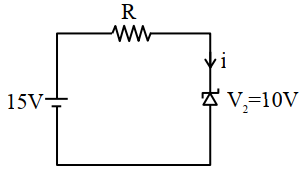
\(P_D=0.4 W=10 i\)
\(i =0.04 A\)
\(R =\frac{15-10}{0.04}=\frac{5}{0.04}=125 \Omega\) -
- (A) 20.15
- (B) 11.7
- (C) 17.6
- (D) 18.8
Show answer and solution
Correct Answer: (D)
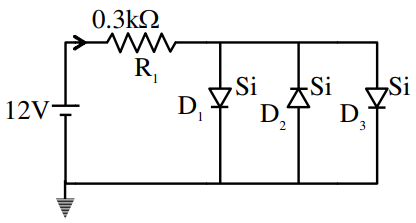
\(12-0.3 \times 10^3 I -0.7=0\)
\(\frac{11.3}{0.3 \times 10^3}= I\)
\(37.66 \times 10^{-3} A= I\)
Current through diode \(D _1, I _1= I / 2\)
\(I _1=18.83 mA\) -
- (A) \(2.2\)
- (B) \(2.0\)
- (C) \(2.1\)
- (D) \(2.4\)
Show answer and solution
Correct Answer: (A)
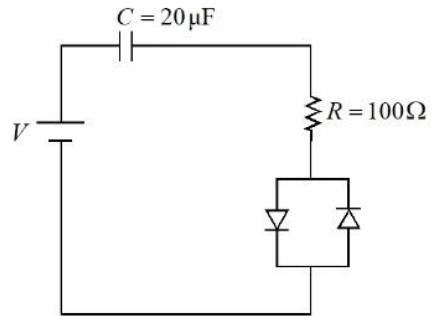
From the given circuit diagram, the battery is connected such that its positive terminal is upwards. This means the current will flow in the clockwise direction during the charging of the capacitor.
In the parallel combination of the two diodes, the left diode is pointing downwards (in the direction of the current) and will be forward-biased. The right diode is pointing upwards (opposite to the current) and will be reverse-biased.
The reverse-biased diode offers infinite resistance and acts as an open circuit. The forward-biased diode offers a resistance of \(10\ \Omega\).
The total equivalent resistance of the circuit is the sum of the resistor \(R\) and the resistance of the forward-biased diode:
\(R_{eq} = 100\ \Omega + 10\ \Omega = 110\ \Omega\)
The time constant \(\tau\) of the \(RC\) circuit is given by:
\(\tau = R_{eq}C\)
\(\tau = 110 \times 20 \times 10^{-6}\ \text{s}\)
\(\tau = 2200 \times 10^{-6}\ \text{s} = 2.2 \times 10^{-3}\ \text{s}\)
Comparing this with the given time constant \(\alpha \times 10^{-3}\ \text{s}\), we get:
\(\alpha = 2.2\)
Answer: \(2.2\) -
- (A) 0100
- (B) 0011
- (C) 1000
- (D) 1101
Show answer and solution
Correct Answer: (D)
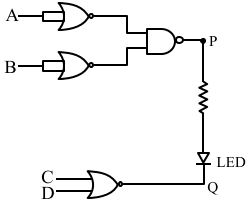
LED will glow in forward biasing:
P higher potential - 1
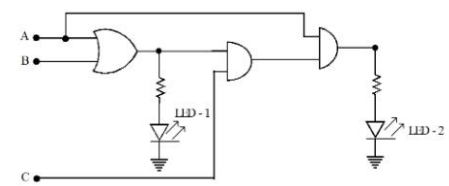
Q lower potential - 0 - 32. For the given logic circuit, which of the following inputs combination will make both LED\(-1\) and LED\(-2\) to glow?
 2026 Medium
- (A) \(A = 0, B = 1, C = 1\)
- (B) \(A = 1, B = 0, C = 0\)
- (C) \(A = 1, B = 0, C = 1\)
- (D) \(A = 1, B = 1, C = 0\)
Show answer and solution
Correct Answer: (C)
Let the output of the OR gate be \(Y_1\).
\(Y_1 = A + B\)
For LED-1 to glow, \(Y_1\) must be \(1\), which means \(A + B = 1\).
Let the output of the first AND gate be \(Y_2\).
\(Y_2 = Y_1 \cdot C = (A + B) \cdot C\)
Let the output of the second AND gate be \(Y_3\).
\(Y_3 = A \cdot Y_2 = A \cdot (A + B) \cdot C\)
For LED-2 to glow, \(Y_3\) must be \(1\).
Simplifying the Boolean expression for \(Y_3\):
\(Y_3 = (A \cdot A + A \cdot B) \cdot C\)
\(Y_3 = (A + AB) \cdot C\)
\(Y_3 = A(1 + B) \cdot C\)
\(Y_3 = A \cdot C\)
For \(Y_3 = 1\), we require \(A = 1\) and \(C = 1\).
If \(A = 1\), then \(Y_1 = 1 + B = 1\) for any value of \(B\), satisfying the condition for LED-1 to glow.
From the given options, the combination \(A = 1, B = 0, C = 1\) satisfies these conditions.
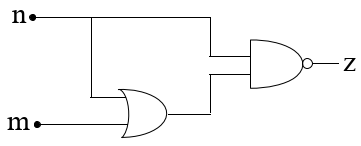
Answer: \(A = 1, B = 0, C = 1\) - 33. For the given logic gate circuit, which of the following is the correct truth table?
 2026 Medium
- (A)
n m z 0 0 1 0 1 0 1 1 0 1 0 0 - (B)
n m z 0 0 0 0 1 1 1 1 0 1 0 1 - (C)
n m z 0 0 1 0 1 0 1 1 1 1 0 0 - (D)
n m z 0 0 1 0 1 1 1 1 0 1 0 0
Show answer and solution
Correct Answer: (D)
Gate 1 : At bottom there is an OR gate with inputs n & m
out put \(=n+m\)
Gate 2 : A NAND gate, its Input are direct n & the output of OR gate ( \(n+m\) )
out put \(z =\overline{ n \cdot( n + m )}\)
since \(n .( n + m )=( n . n )+( n . m )\)
\(= n + n \cdot m = n (1+ m )= n\)
∴ output \(z =\overline{ n \cdot( n + m )}=\overline{ n }\)n m \(Z =\overline{ n }\) 0 0 1 0 1 1 1 1 0 1 0 0 - (A)
-
- (A) Both A and R are true and R is the correct explanation of A
- (B) Both A and R are true but R is NOT the correct explanation of A
- (C) A is true but R is false
- (D) A is false but R is true
Show answer and solution
Correct Answer: (C)
In a reverse-biased diode, the current is very small and remains almost constant (known as reverse saturation current) until the breakdown voltage is reached. At the breakdown voltage (critical limit), the current increases drastically. Thus, Assertion A is true.
The small current in reverse bias is due to the flow of minority charge carriers, not majority charge carriers. The drastic increase in current at breakdown is due to the generation of a large number of electron-hole pairs (avalanche or Zener breakdown). Thus, Reason R is false.
Answer: A is true but R is false -
- (A)
A B Y 0 0 0 0 1 1 1 0 1 1 1 0 - (B)
A B Y 0 0 1 0 1 0 1 0 1 1 1 0 - (C)
A B Y 0 0 1 0 1 1 1 0 1 1 1 0 - (D)
A B Y 0 0 0 0 1 0 1 0 1 1 1 0
Show answer and solution
Correct Answer: (D)
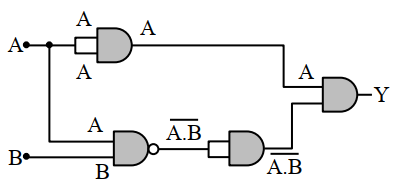
\(y = A \cdot \overline{ A \cdot B }\)
\(= A \cdot(\overline{ A }+\overline{ B })=0+ A \overline{ B }\)A B Y 0 0 0 0 1 0 1 0 1 1 1 0 - (A)
-
- (A) OR gate
- (B) AND gate
- (C) NAND gate
- (D) NOR gate
Show answer and solution
Correct Answer: (D)
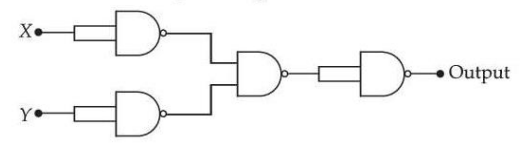
The circuit consists of four NAND gates.
The first two NAND gates have their inputs tied together, acting as NOT gates. Their outputs are \(\overline{X}\) and \(\overline{Y}\).
These outputs are fed into the third NAND gate. The output of this gate is:
\(y' = \overline{\overline{X} \cdot \overline{Y}}\)
Using De Morgan's theorem:
\(y' = \overline{\overline{X}} + \overline{\overline{Y}} = X + Y\)
This output is fed into the fourth NAND gate, which also has its inputs tied together, acting as a NOT gate. The final output is:
Output \(= \overline{X + Y}\)
This represents the Boolean expression for a NOR gate.
Answer: NOR gate -
- (A) Widths of depletion region on either side of the interface are equal
- (B) The depletion region width is more on p-side compared to that in n-side
- (C) The depletion region width is more on n-side compared to that in p-side
- (D) No depletion region forms because of unequal doping concentrations on p and n-sides
Show answer and solution
Correct Answer: (B)
In a p-n junction diode, the total charge on both sides of the depletion region must be equal to maintain charge neutrality.
Let \(x_p\) and \(x_n\) be the widths of the depletion region on the p-side and n-side, respectively. Let \(N_A\) and \(N_D\) be the doping concentrations on the p-side and n-side.
The charge neutrality condition is given by:
\(N_A x_p = N_D x_n\)
Given \(N_A = 10^{15} \text{ atoms/cm}^3\) and \(N_D = 10^{18} \text{ atoms/cm}^3\).
Substituting the values, we get:
\(10^{15} x_p = 10^{18} x_n\)
\(x_p = 10^3 x_n\)
Since \(x_p > x_n\), the depletion region penetrates more into the lightly doped side. Therefore, the depletion region width is more on the p-side compared to that in the n-side.
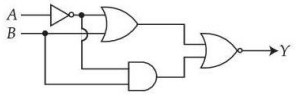
Answer: The depletion region width is more on p-side compared to that in n-side - 38. Refer to the logic circuit given below. For two inputs \((A=1, B=1)\) and \((A=0, B=1)\), output \((Y)\) will be __________.
 2026 Medium
- (A) \(1, 0\) respectively
- (B) \(0, 1\) respectively
- (C) \(0, 0\) respectively
- (D) \(1, 1\) respectively
Show answer and solution
Correct Answer: (C)
From the given logic circuit, we can determine the Boolean expression for the output \(Y\).
The output of the NOT gate is \(\bar{A}\).
The inputs to the OR gate are \(\bar{A}\) and \(B\), so its output is \(\bar{A} + B\).
The inputs to the AND gate are \(\bar{A}\) and \(B\), so its output is \(\bar{A} \cdot B\).
These two outputs are fed into a NOR gate. The final output \(Y\) is given by:
\(Y = \overline{(\bar{A} + B) + (\bar{A} \cdot B)}\)
Simplifying the Boolean expression:
\(Y = \overline{\bar{A} + B + \bar{A}B}\)
\(Y = \overline{\bar{A} + B(1 + \bar{A})}\)
\(Y = \overline{\bar{A} + B}\)
Using De Morgan's laws:
\(Y = \overline{\bar{A}} \cdot \bar{B} = A \cdot \bar{B}\)
Now, we evaluate \(Y\) for the given input combinations:
For \(A = 1, B = 1\):
\(Y = 1 \cdot \bar{1} = 1 \cdot 0 = 0\)
For \(A = 0, B = 1\):
\(Y = 0 \cdot \bar{1} = 0 \cdot 0 = 0\)
Therefore, the outputs are \(0\) and \(0\) respectively.
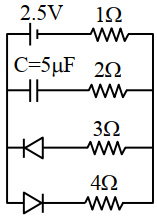
Answer: \(0, 0\) respectively - 39. The charge stored by the capacitor C in the given circuit in the steady state is _________ \(\mu C\).
 2026 Medium
- (A) \(12.5\)
- (B) 10
- (C) 7.5
- (D) 5
Show answer and solution
Correct Answer: (B)
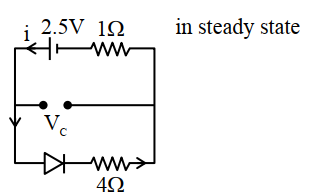
\(i =2.5 / 5=0.5 A\)<br>
\(V _{ c }=4 \times 0.5\)
\(V_C=2 V\)
charge
\(Q=C V_c\)
\(=5 \times 2\)
\(=10 \mu C\) -
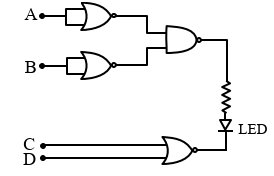
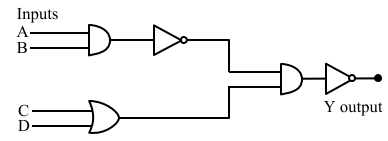
- (A)
Inputs Output A B C D Y 1 1 0 1 1 0 0 1 1 0 1 0 1 0 1 1 1 1 1 0 - (B)
Inputs Output A B C D Y 1 1 0 1 1 0 0 1 1 0 1 0 1 0 0 1 1 1 1 1 - (C)
Inputs Output A B C D Y 1 1 0 1 0 0 0 1 1 0 1 0 1 0 1 1 1 1 1 1 - (D)
Inputs Output A B C D Y 1 1 0 1 0 0 0 1 1 1 1 0 1 0 1 1 1 1 1 1
Show answer and solution
Correct Answer: (B)
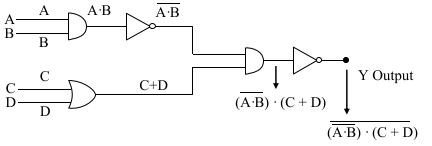
\(\begin{aligned} Y & =(\overline{(\overline{A \cdot B}) \cdot(C+D)}=\overline{\overline{A \cdot B}}+(\overline{C+D}) \\ Y & =(A \cdot B)+(\overline{C+D})\end{aligned}\) - (A)
-
- (A) 4000 \( \Omega \)
- (B) 10 \( \Omega \)
- (C) 100 \( \Omega \)
- (D) 800 \( \Omega \)
Show answer and solution
Correct Answer: (D)
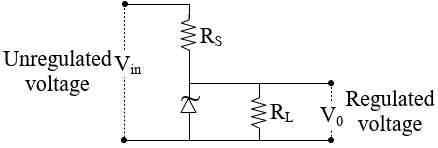
Given \(V_z=5 V\), desired load current \(I_L=5 mA\).
Maximum Zener current \(I_Z=4 I_L=4 \times 5 mA=20 mA\).
Total current through series resistor \(I=I_L+I_Z=5 mA+20 mA= 25 mA\).
Maximum input voltage \(V_{\text {in }}=25 V\).
Voltage across resistor \(R_S=(25-5) V =20 V\).
Therefore \(R_S=\frac{20}{25 \times 10^{-3}}=800 \Omega\). -
- (A) AND gate
- (B) NOR gate
- (C) NAND gate
- (D) OR gate
Show answer and solution
Correct Answer: (C)
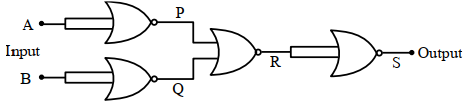
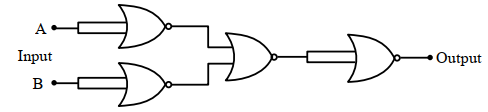
\(P =\overline{ A }\)
\(Q =\overline{ B }\)
\(R =\overline{\overline{ A }+\overline{ B }}=\overline{\overline{ AB }}= AB\)
\(S =\overline{ AB } \quad \Rightarrow\) NAND Gate -
- (A) \(6\)
- (B) \(2\)
- (C) \(4\)
- (D) \(5\)
Show answer and solution
Correct Answer: (B)
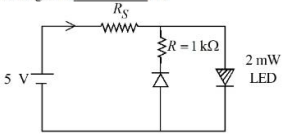
Since the reverse-biased diode branch acts as an open circuit, the entire current through the series resistor \(R_S\) flows through the LED:
\(I_{\text{LED}} = I_{R_S} = 0.5\text{ mA}\)
At the boundary condition where the LED dissipates its maximum rated power of \(2\text{ mW}\):
\(P_{\text{LED}} = V_{\text{LED}} \cdot I_{\text{LED}}\)
\(V_{\text{LED}} = \dfrac{P_{\text{LED}}}{I_{\text{LED}}} = \dfrac{2\text{ mW}}{0.5\text{ mA}} = 4\text{ V}\)
Applying Kirchhoff's voltage law to the loop:
\(V_{\text{input}} - V_{R_S} - V_{\text{LED}} = 0\)
\(5 - (I_{R_S} \cdot R_S) - 4 = 0\)
\(I_{R_S} \cdot R_S = 1\text{ V}\)
\(R_S = \dfrac{1\text{ V}}{0.5 \times 10^{-3}\text{ A}} = 2000\ \Omega = 2\text{ k}\Omega\)
Hence, the correct option is \((2)\ 2\). -
- (A) \(Y = 1101\)
- (B) \(Y = 0010\)
- (C) \(Y = 0111\)
- (D) \(Y = 1000\)
Show answer and solution
Correct Answer: (A)
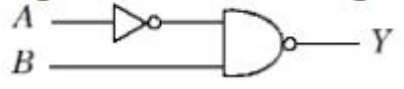
From the given logic circuit, the input \(A\) passes through a NOT gate, giving \(\overline{A}\).
This output \(\overline{A}\) and the input \(B\) are then fed into a NAND gate.
The Boolean expression for the final output \(Y\) is:
\(Y = \overline{\overline{A} \cdot B}\)
Given the \(4\)-bit binary inputs:
\(A = 1101\)
\(B = 1010\)
First, find the bitwise NOT of \(A\):
\(\overline{A} = \overline{1101} = 0010\)
Next, find the bitwise AND of \(\overline{A}\) and \(B\):
\(\overline{A} \cdot B = 0010 \cdot 1010 = 0010\)
Finally, apply the NOT operation for the NAND gate:
\(Y = \overline{0010} = 1101\)
Alternatively, using De Morgan's laws:
\(Y = \overline{\overline{A} \cdot B} = A + \overline{B}\)
\(Y = 1101 + \overline{1010} = 1101 + 0101 = 1101\)
Therefore, the output \(Y\) is \(1101\).
Answer: \(Y = 1101\) -
- (A) OR Gate
- (B) NOR Gate
- (C) NAND Gate
- (D) AND Gate
Show answer and solution
Correct Answer: (D)
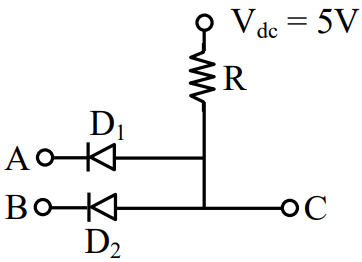
If either A or B is zero, in that case current flow and \(v_{c}=0.\)
Hence the Gate will be AND Gate -
- (A) \( 5.76\times10^{-14} \)
- (B) \( 1.44\times10^{-13} \)
- (C) \( 2.88\times10^{-14} \)
- (D) \( 1.69\times10^{-12} \)
Show answer and solution
Correct Answer: (A)
By mechanical energy conservation
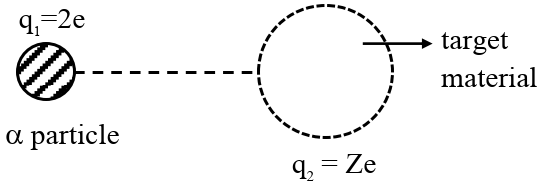
\(( Me )_{ i }=( Me )_{ f }\)
\(P E_i+K E_i=P E_f+K E_f\)
\(0+7.9 \times 10^6 \times 1.6 \times 10^{-19}=\frac{ k (2 e )( Ze )}{ r }+0\)
\(r =\frac{9 \times 10^9 \times 2 \times\left(1.6 \times 10^{-19}\right)^2 \times 79}{7.9 \times 10^6 \times 1.6 \times 10^{-19}}=2.88 \times 10^{-14} m\)
For diameter ⇒ \(D=2 r=5.76 \times 10^{-14} m\) -
- (A) 2
- (B) 8
- (C) 1
- (D) 0.5
Show answer and solution
Correct Answer: (D)
\(R_{\alpha}=R_{0}\alpha^{1/3}\)
\(R_{\beta}=R_{0}\beta^{1/3}\)
\(\frac{R_{\alpha}}{R_{\beta}}=(\frac{\alpha}{\beta})^{1/3}=\frac{1}{2}\) -
- (A) 250%
- (B) 150%
- (C) 225%
- (D) 900%
Show answer and solution
Correct Answer: (C)
Surface area \(x \propto A ^{2 / 3}\)
\(X_i=8^{2 / 3} K=4 K\)
\(X_f=(8+10+9)^{2 / 3} K=9 K\)
% increase in surface area of nucleus
\(x_i=\frac{9 K-4 K}{4 K} \times 100=125\) % -
- (A) \(127.5\)
- (B) \(89.03\)
- (C) \(272.0\)
- (D) \(92.0\)
Show answer and solution
Correct Answer: (B)
The mass of \(6\) protons is \(6 \times 1.00727\text{ u} = 6.04362\text{ u}\).
The mass of \(6\) neutrons is \(6 \times 1.00866\text{ u} = 6.05196\text{ u}\).
Total mass of the constituent nucleons is \(6.04362\text{ u} + 6.05196\text{ u} = 12.09558\text{ u}\).
The mass defect \(\Delta m\) is the difference between the total mass of the nucleons and the experimental mass of the atom (ignoring electron mass as per the given data):
\(\Delta m = 12.09558\text{ u} - 12\text{ u} = 0.09558\text{ u}\)
Converting the mass defect into \(\text{MeV}/c^2\):
\(\Delta m = 0.09558 \times 931.5\text{ MeV}/c^2 = 89.03277\text{ MeV}/c^2 \approx 89.03\text{ MeV}/c^2\)
Answer: \(89.03\) -
- (A) Both Statement I and Statement II are true
- (B) Statement I is true but Statement II is false
- (C) Both Statement I and Statement II are false
- (D) Statement I is false but Statement II is true
Show answer and solution
Correct Answer: (D)
Theoretical

No questions on this page match these filters.
Other years
Frequently asked
How many JEE Mains 2026 Physics questions are on ExamBro?
469 questions, each with the correct answer and a full solution.
Which JEE Mains 2026 Physics chapter is asked the most?
Ray optics and optical instruments, with 35 questions, followed by System of particles and rotational motion with 30.
How difficult are JEE Mains 2026 Physics questions?
20% are easy, 46% medium and 33% hard.