


Questions
Newest firstShowing 1–30 of 30 questions
-
- (A) 2
- (B) 3
- (C) 4
- (D) 5
Show answer and solution
Correct Answer: (B)
The chemical reaction of phenol with zinc dust is given by:
\(C_6H_5OH + Zn \xrightarrow{\Delta} C_6H_6 + ZnO\)
Product X is benzene (\(C_6H_6\)).
Molar mass of phenol (\(C_6H_5OH\)) = \(6 \times 12 + 6 \times 1 + 16 = 94\) g mol\(^{-1}\)
Number of moles of phenol taken = \(\dfrac{4.7}{94} = 0.05\) mol
From the stoichiometry of the reaction, 1 mole of phenol produces 1 mole of benzene.
Theoretical moles of X formed = \(0.05\) mol
Since the reaction goes to \(60\%\) completion, the actual moles of X formed is:
\(0.05 \times \dfrac{60}{100} = 0.03\) mol
This can be written as \(3 \times 10^{-2}\) mol.
Answer: \(3\) -
- (A) 3
- (B) 5
- (C) 2
- (D) 4
Show answer and solution
Correct Answer: (D)
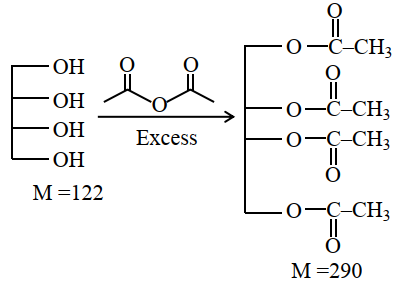
No. of OH groups \(=\frac{290-122}{42}=4\) -
- (A) Both compounds x and y will dissolve in NaOH.
- (B) Compound y will dissolve in \(NaHCO _3\) and evolve a gas.
- (C) Compound x is more acidic than compound y.
- (D) Both compounds x and y will burn with sooty flame.
Show answer and solution
Correct Answer: (C)
\(( X ) \xrightarrow[(2)_3 H _3 O ^{\oplus}]{\text { (1) } CO _2 / NaOH } Y _{\text {Major }}\)
\(76.6 \% C\)
\(6.38 \% H\)
Vapour Density 47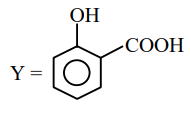
Salicylic acid
Gives colour with \(FeCl _3\)
Soluble in \(NaHCO _3\)
Soluble in NaOH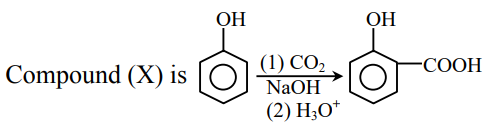
-
- (A) Both Statement I and Statement II are false
- (B) Statement I is true but Statement II is false
- (C) Both Statement I and Statement II are true
- (D) Statement I is false but Statement II is true
Show answer and solution
Correct Answer: (D)
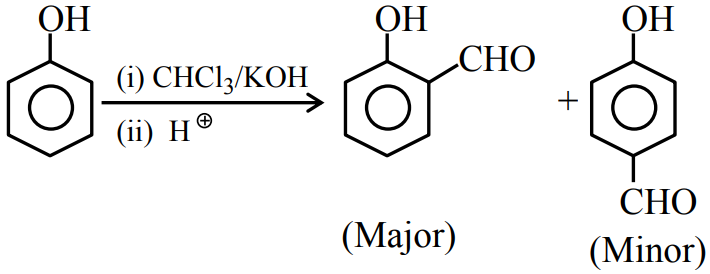
(can be separated by steam distillation) -
- (A) 165
- (B) 170
- (C) 175
- (D) 180
Show answer and solution
Correct Answer: (C)
When phenol is treated with dilute \(\text{HNO}_3\) at \(298\text{ K}\), it undergoes electrophilic aromatic substitution to give a mixture of ortho-nitrophenol and para-nitrophenol.
The mixture is separated by steam distillation. Ortho-nitrophenol is steam volatile due to intramolecular hydrogen bonding, whereas para-nitrophenol is not steam volatile due to intermolecular hydrogen bonding. Thus, the steam volatile compound (X) is ortho-nitrophenol.
Molecular formula of phenol: \(\text{C}_6\text{H}_6\text{O}\)
Molar mass of phenol \(= (6 \times 12) + (6 \times 1) + 16 = 94\text{ g mol}^{-1}\)
Percentage of oxygen in phenol \(= \dfrac{16}{94} \times 100 \approx 17.02\%\)
Molecular formula of ortho-nitrophenol (X): \(\text{C}_6\text{H}_5\text{NO}_3\)
Molar mass of ortho-nitrophenol \(= (6 \times 12) + (5 \times 1) + 14 + (3 \times 16) = 139\text{ g mol}^{-1}\)
Percentage of oxygen in ortho-nitrophenol \(= \dfrac{48}{139} \times 100 \approx 34.53\%\)
Increase in percentage of oxygen \(= 34.53\% - 17.02\% = 17.51\%\)
We need to express this as \(y \times 10^{-1} \%\).
\(17.51\% = 175.1 \times 10^{-1} \%\)
Rounding to the nearest integer, we get \(175\).
Answer: \(175\) - 6. The steam volatile compounds among the following are _______.
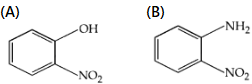
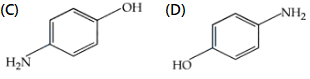
Choose the correct answer from the options given below : 2025 Medium- (A) (B) and (D) Only
- (B) (A) and (C) Only
- (C) (A), (B) and (C) Only
- (D) (A) and (B) Only
Show answer and solution
Correct Answer: (D)
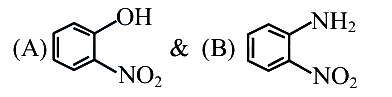
are steam volatile due to intramolecular hydrogen bonding. -
- (A) 20.44 g
- (B) 4.0 g
- (C) 6.0 g
- (D) 10.22 g
Show answer and solution
Correct Answer: (D)
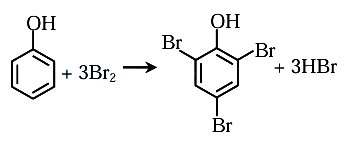
\(\begin{aligned} & \text { Moles of phenol }=\frac{2}{94}=0.021 \\ & \therefore \text { Moles of bromine }=0.021 \times 3=0.064 \\ & \therefore \text { Mass of bromine }=0.064 \times 160=10.22 \mathrm{~g}\end{aligned}\) - 8. Consider the given chemical reaction sequence : Total sum of oxygen atoms in Product \(A\) and Product \(B\) are _______.
 2024 Medium
- (A) \(10\)
- (B) \(11\)
- (C) \(15\)
- (D) \(14\)
Show answer and solution
Correct Answer: (D)
Picric acid is prepared by treating phenol first with concentrated sulphuric acid which converts it to phenol\(-2,4-\)disulphonic acid and then with concentrated nitric acid to get \(2,4,6\) trinitrophenol. -
- (A) Statement \(I\) is true but Statement \(II\) is false.
- (B) Both Statement \(I\) and Statement \(II\) are true
- (C) Both Statement \(I\) and Statement \(II\) are false.
- (D) Statement \(I\) is false but Statement \(II\) is true.
Show answer and solution
Correct Answer: (D)
Phenol is a highly activated compound which can undergo bromination directly with Bromine without any lewis acid. -
- (A) \(A\) is true but \(R\) is false.
- (B) A is false but \(R\) is true.
- (C) Both \(A\) and \(R\) are true and \(R\) is the correct explanation of \(A\).
- (D) Both \(A\) and \(R\) are true but \(R\) is NOT the correct explanation of \(A\).
Show answer and solution
Correct Answer: (A)
Phenol is more acidic than ethanol because conjugate base of phenoxide is more stable than ethoxide. -
- (A) Statement \(I\) is true but Statement \(II\) is false
- (B) Both Statement \(I\) and Statement \(II\) are true
- (C) Both Statement \(I\) and Statement \(II\) are false
- (D) Statement \(I\) is false but Statement \(II\) is true
Show answer and solution
Correct Answer: (A)
Acidic strength
Ethanol give lucas test after long time
Statement\((I)\) \(\rightarrow\) correct
Statement \((II)\) \(\rightarrow\) incorrect
-
- (A) Statement \(I\) is incorrect but Statement \(II\) is correct.
- (B) Both Statement \(I\) and Statement \(II\) are incorrect.
- (C) Statement \(I\) is correct but Statement \(II\) is incorrect.
- (D) Both Statement \(I\) and Statement \(II\) are correct.
Show answer and solution
Correct Answer: (A)
picric acid\((2,4,6\) - trinitrophenol \()\)

- 13. Match List-\(I\) with List-\(II.\) Choose the correct answer from the options given below:
 2024 Hard
- (A) \((A)-(IV)\), \((B)-(I)\), \((C)-(III)\), \((D)-(II)\)
- (B) \((A)-(II)\), \((B)-(III)\), \((C)-(I)\), \((D)-(IV)\)
- (C) \((A)-(II)\), \((B)-(I)\), \((C)-(III)\), \((D)-(IV)\)
- (D) \((A)-(IV)\), \((B)-(III)\), \((C)-(I)\), \((D)-(II)\)
Show answer and solution
Correct Answer: (D)
A \(\rightarrow\) Kolbe Schmidt Reaction
B \(\rightarrow\) Reimer Tiemann Reaction
C \(\rightarrow\) Oxidation of phenol to p-benzoquinone
D \(\rightarrow \mathrm{PhOH}+\mathrm{NaOH} \rightarrow \mathrm{H}_2 \mathrm{O}+\mathrm{PhO}^{-}\)
-
- (A) \(A-I\), \(B-II\), \(C-III\), \(D-IV\)
- (B) \(A-IV\), \(B-I\), \(C-II\), \(D-III\)
- (C) \(A-III\), \(B-IV\), \(C-I\), \(D-II\)
- (D) \(A-II\), \(B-I\), \(C-IV\), \(D-III\)
Show answer and solution
Correct Answer: (D)
Ethanol \(\rightarrow 15.9\)Phenol \(\rightarrow 10\)
M-Nitrophenol \(\rightarrow 8.3\)
P-Nitrophenol \(\rightarrow 7.1\)
-
- (A) Phthalein dye test
- (B) Lucas test
- (C) Tollen’s test
- (D) Carbylamine test
Show answer and solution
Correct Answer: (A)
Carbylamine Test-Identification of primary amines
Lucas Test - Differentiation between \(1^{\circ}, 2^{\circ}\) and \(3^{\circ}\) alcohols
Tollen's Test - Identification of Aldehydes
Phthalein Dye Test - Identification of phenols
Phenol on heating with phthalic anhydride in the presence of concentrated sulphuric acid forms a colourless condensation compound called phenolphthalein. On further reaction with dilute sodium hydroxide solution gives a pink colour fluorescent compound called fluorescein. Characteristic colours are produced by different phenolic compounds which can be viewed under white background. -
- (A) Salicyclic acid
- (B) Benzene-\(1\),\(2\)-diol
- (C) Benzene-\(1\), \(3\)-diol
- (D) \(2\)-Hydroxybenzaldehyde
Show answer and solution
Correct Answer: (D)
It is Reimer Tiemann Reaction
- 17. Which one the following compounds will readily react with dilute \(\mathrm{NaOH}\) ? 2024 Medium
- (A) \(\mathrm{C}_6 \mathrm{H}_5 \mathrm{CH}_2 \mathrm{OH}\)
- (B) \(\mathrm{C}_2 \mathrm{H}_5 \mathrm{OH}\)
- (C) \(\left(\mathrm{CH}_3\right)_3 \mathrm{COH}\)
- (D) \(\mathrm{C}_6 \mathrm{H}_5 \mathrm{OH}\)
Show answer and solution
Correct Answer: (D)
Stronger \(ACID\) than \(\mathrm{H}_2 \mathrm{O}\)
- 18. The correct order for acidity of the following hydroxyl compound is: Choose the correct answer from the options given below:
 2023 Medium
- (A) \(E > C > D > A > B\)
- (B) \(D > E > C > A > B\)
- (C) \(C > E > D > B > A\)
- (D) \(E > D > C > B > A\)
Show answer and solution
Correct Answer: (A)
\(E > C > D > A > B\) -
- (A) \(c > a > d > b\)
- (B) \(b > d > a > c\)
- (C) \(b > a > d > c\)
- (D) \(a > b > c > d\)
Show answer and solution
Correct Answer: (B)
Due to \(- M\) effect of \(- NO _2\) group, it increases acidity \(+ M\) effect of \(N \left( CH _3\right)_2\) decreases acidity.Hyperconjugation of isopropyl decrease acidity
\(\therefore\) order of acidic strength
\((c) > (a) > (d) > (b)\)
-
- (A) \((C), (D), (E), (B), (A)\)
- (B) \((A), (B), (E), (D), (C)\)
- (C) \((A), (E), (B), (D), (C)\)
- (D) \((C), (E), (D), (B), (A)\)
Show answer and solution
Correct Answer: (B)
Order of acidity for following phenol is\(-M\) and \(-I\) increases acidity
\(+ M\) and \(+ I\) decreases acidity

-
- (A) Both Statement \(I\) and Statement \(II\) are correct.
- (B) Both Statement \(I\) and Statement \(II\) are incorrect.
- (C) Statement \(I\) is correct but Statement \(II\) is incorrect.
- (D) Statement \(I\) is incorrect but Statement \(I I\) is correct.
Show answer and solution
Correct Answer: (C)
Phenol are weakly acidic. Phenol is more acidic than alcohol and \(H _{2} O\) statement \((I)\) is correct. \((II)\) is incorrect. - 22. The difference in the reaction of phenol with bromine in chloroform and bromine in water medium is due to. 2022 Medium
- (A) Hyperconjugation in substrate
- (B) Polarity of solvent
- (C) Free radical formation
- (D) Electromeric effect of the substrate
Show answer and solution
Correct Answer: (B)
Difference in reactions is observed due to solvent polarity, which\((i)\) Ionizes phenol to make more reactive phenoxide ion
\((ii)\) Increases electrophilicity of bromine.

- 23. Which technique among the following, is most appropriate in separation of a mixture of \(100\,\,mg\) of p-nitrophenol and picric acid? 2022 Medium
- (A) Steam distillation
- (B) \(2-5\) ft long column of silica gel
- (C) Sublimation
- (D) Preparative \(TLC\) (Thin Layer Chromatography)
Show answer and solution
Correct Answer: (D)
Solvent polarity has been related to \(R _{ f }\) value of nitrocompounds.\(100\,mg\) p-nitrophenol and picric acid have different \(R _{ f }\) value on silica gel plate\(\therefore\) Preparative TLC is best to separate \(100\,mg\) of

-
- (A) \((a)\) and \((c)\) only
- (B) \((b), (c)\) and \((d)\) only
- (C) \((a), (b)\) and \((d)\) only
- (D) \((b)\) and \((d)\) only
Show answer and solution
Correct Answer: (B)
Bromine water gives tribromo products, other gives monbromo products in which para is major product. -
- (A) \(70.56\)
- (B) \(68.85\)
- (C) \(65.52\)
- (D) \(60.75\)
Show answer and solution
Correct Answer: (B)
Molecular weight of \(C _{7} H _{6} O _{2}=122\)\(\% C =\frac{12 \times 7 \times 100}{122}=68.85 \approx 69\)

- 26. Arrange the following compounds in increasing order of \(C-OH\) bond length methanol, phenol, \(p-\)ethoxyphenol 2020 Medium
- (A) phenol < methanol < \(p-\)ethoxyphenol
- (B) phenol < \(p-\)ethoxyphenol < methanol
- (C) methanol < \(p-\)ethoxyphenol < phenol
- (D) methanol < phenol < \(p-\)ethoxyphenol
Show answer and solution
Correct Answer: (B)
\(CH_3 -OH\) (\(100\%\) single bond)
-
- (A) Oleic acid
- (B) \(o -\) Toluidine
- (C) Benzamide
- (D) \(m -\) Cresol
Show answer and solution
Correct Answer: (D)
Oletic acid is also soluble in \(NaHCO_3\)\(o\,-\) toluidine is not soluble in \(NaOH\) as well as \(NaHCO_3\)
Benzamide is also not soluble in \(NaOH\) and \(NaHCO_3\).
\(\therefore \) \(m\,-\) cresol is the right answer.

-
- (A) \(C < B < A < D\)
- (B) \(B < C < D < A\)
- (C) \(D < A < C < B\)
- (D) \(B < C < A< D\)
Show answer and solution
Correct Answer: (D)
Higher the \(Ka\) value lower the \(pKa\) value -
- (A) \(2, 4, 6 -\) Trinitrophenol
- (B) Benzoic acid
- (C) \(o -\) Nitrophenol
- (D) Benzene sulphonic acid
Show answer and solution
Correct Answer: (C)
Due to intramolecular hydrogen bonding this will not be soluble in sodium bicarbonate
- 30. Which one of the following substituents at para position is most effective in stabilizing the phenoxide ion ?
 2014 Hard
- (A) \(- CH_3\)
- (B) \(- OCH_3\)
- (C) \(- COCH_3\)
- (D) \(- CH_2OH\)
Show answer and solution
Correct Answer: (C)
Electron with drawing group stabilises the benzene ring due to delocalisation of charge. \(-CH_3\) and \(-CH_2OH\) are electron donating group and hence decrease the stability of benzene ring \(-OCH_3\) is weaker electron with drawing group than \(-COCH_3\) . Hence \(-COCH_3\) group more stabilize the phenoxide ion at \(p-\) position.


No questions on this page match these filters.
Other STD 12 - Alcohol, phenol and ethers topics
Frequently asked
How many Properties of Phenols questions came in JEE Mains?
30 questions from 2014–2026, each with the correct answer and a full solution.
How difficult are Properties of Phenols questions?
3% are easy, 50% medium and 47% hard.