


Questions
Newest firstShowing 1–20 of 20 questions
-
- (A) 3
- (B) 1
- (C) 5
- (D) 2
Show answer and solution
Correct Answer: (A)
\(\Delta T _{ b }= i \times K _{ b } \times m\)
\(0.5= i \times m \times 5\)
\(i \times m =\frac{0.5}{5}=0.1\)
\(i \times a =\frac{15}{1000}\)
(where \(a=\) moles of solute)
Now,
\(\frac{P_o-P_S}{P^o}=i X_{\text {solute }}=i \times \frac{a}{a+\frac{150}{300}}\)
\(= i \times \frac{ a }{1 / 2}=\frac{15 / 1000}{1 / 2}=\frac{30}{1000}=3 \times 10^{-2}=3\) -
- (A) I < II < III < IV
- (B) III < II < I < IV
- (C) II < III < IV < I
- (D) II < III < I < IV
Show answer and solution
Correct Answer: (A)
\(\Delta T_{b} = i \cdot k_{b} \cdot m\)
For dilute solution ( \(M=m\) )Molarity \(i \times m\) (I) \(M _{\text {glucose }}=\frac{2.2}{180} \times \frac{1000}{125}=0.098\) \(0.098 \times 1\) (II) \(M _{ CaCl _2}=\frac{1.9}{111} \times \frac{1000}{250}=0.068\) \(0.068 \times 3\) (III) \(M _{\text {urea }}=\frac{9}{60} \times \frac{1000}{500}=0.3\) \(0.3 \times 1\) (IV) \(M _{ Al _2\left( SO _4\right)_2}=\frac{20.5}{342} \times \frac{1000}{750} \simeq 0.08\) \(0.08 \times 5\)
Order of \(\Delta T _{ b }= Al _2\left( SO _4\right)_3>\) Urea \(> CaCl _2>\) Glucose
So order of \(BP = Al _2\left( SO _4\right)_3>\) Urea \(> CaCl _2>\) Glucose
So Answer will be I \(<\) II \(<\) III \(<\) IV -
- (A) 70, 110
- (B) 65, 145
- (C) 60, 25
- (D) 25, 60
Show answer and solution
Correct Answer: (D)
\( (\Delta T_{b})_{PQ} = K_{b}m \)
\( 1.176 = 5 \times \frac{1}{M_{1}} \times \frac{1000}{50} \)
\( M_{1} = 85.03 \)
\( (\Delta T_{b})_{PQ_{2}} = 5 \times \frac{1}{M_{2}} \times \frac{1000}{50} = 0.689 \)
\( M_{2} = 145.13 \)
Let molar mass of \(P \& Q\) are \(M_P\) and \(M_Q\) respectively
\( M_{P} + M_{Q} = 85.03 \)
\( M_{P} + 2M_{Q} = 145.13 \)
\( M_{P} = 24.93 \approx 25 \)
\( M_{Q} = 60.1 \approx 60 \), -
- (A) \(\mathrm{AX}_2\) is fully ionised while \(\mathrm{AY}_2\) is completely unionised.
- (B) \(\mathrm{AX}_2\) is completely unionised while \(\mathrm{AY}_2\) is fully ionised.
- (C) \(\mathrm{AX}_2\) and \(\mathrm{AY}_2\) (both) are completely unionised.
- (D) \(\mathrm{AX}_2\) and \(\mathrm{AY}_2\) (both) are fully ionised.
Show answer and solution
Correct Answer: (A)
For \(\mathrm{AX}_2\)
\(\begin{aligned}
& \Delta \mathrm{T}_{\mathrm{b}}=\mathrm{i} \mathrm{~K} \mathrm{~m} \\
& 0.0156=\mathrm{i} \times 0.52 \times \frac{1.24}{124 \times 1} \\
& 3=\mathrm{i} \\
& 3=1+2 \alpha \\
& 1=\alpha
\end{aligned}\)
For \(\mathrm{AY}_2\)
\(\begin{aligned}
& \Delta \mathrm{T}_{\mathrm{b}}=\mathrm{i} \mathrm{~K}_{\mathrm{b}} \mathrm{~m} \\
& 0.0260=\mathrm{i} \times 0.52 \times \frac{25.4}{250 \times 2} \\
& \mathrm{i} \approx 1
\end{aligned}\)
\(\therefore A X_2\) is completely ionised \(\& A Y_2\) is completely unionised -
- (A) 379.2 K
- (B) 377.3 K
- (C) 375.3 K
- (D) 277.3 K
Show answer and solution
Correct Answer: (B)
\(\begin{aligned} & \Delta \mathrm{T}_{\mathrm{b}}=\mathrm{i}_1 \mathrm{~m}_1 \mathrm{k}_{\mathrm{b}}+\mathrm{i}_2 \mathrm{~m}_2 \mathrm{k}_{\mathrm{b}} \\ & =1 \times \frac{2}{0.5} \times 0.52+\frac{1 \times 2}{0.5} \times 0.52=4.16 \\ & \left(\mathrm{~T}_{\mathrm{b}}\right)_{\text {solution }}=373.16+4.16=377.3 \mathrm{~K}.\end{aligned}\) -
- (A) (i) < (ii) < (iii) < (iv)
- (B) (iv) < (iii) < (i) < (ii)
- (C) (ii) < (i\() \equiv(\)iii) < (iv)
- (D) (ii) < (i) < (iii) < (iv)
Show answer and solution
Correct Answer: (D)
\(\Delta \mathrm{T}_{\mathrm{b}}=\mathrm{i} \mathrm{~K}_{\mathrm{b}} . \mathrm{m} . \propto \mathrm{i} . \mathrm{C} .\)
where \(\mathrm{C}=\) concentration
\(\begin{array}{|l|c|}
\hline \text { Options } & \text { i.C. } \\
\hline \text { (i) } & 2 \times 10^{-4} \\
\hline \text { (ii) } & 1 \times 10^{-4} \\
\hline \text { (iii) } & 2 \times 10^{-3} \\
\hline \text { (iv) } & 2 \times 10^{-2} \\
\hline
\end{array}\)
B.P. order :
\(\text { (ii) } < \text { (i) } < \text { (iii) } < \text { (iv) }\) -
- (A) Both Statement I and Statement II are false
- (B) Statement I is false but Statement II is true
- (C) Statement I is true but Statement II is false
- (D) Both Statement I and Statement II are true
Show answer and solution
Correct Answer: (D)
A mixture of salt and ice is known as freezing mixture. Freezing mixture decreases freezing point of ice. Both statements are true. -
- (A) 20
- (B) 30
- (C) 35
- (D) 25
Show answer and solution
Correct Answer: (D)
For AB
\(\begin{aligned}
& \Delta \mathrm{T}_{\mathrm{b}}=2.7 \mathrm{~K} \\
& 2.7=1 \times 0.5 \times \mathrm{m} \\
& \mathrm{~m}=\frac{27}{5}
\end{aligned}\)
Let molar mass of \(\mathrm{AB}=\mathrm{x}\).
\(\begin{aligned}
& \text { So } \frac{1 / x}{15} \times 1000=\frac{27}{5} \\
& x=12.34
\end{aligned}\)
For \(\mathrm{AB}_2\)
\(\begin{aligned}
& \Delta \mathrm{T}_{\mathrm{b}}=1.5 \mathrm{~K} \\
& 1.5=1 \times 0.5 \times \mathrm{m} \\
& \mathrm{~m}=3
\end{aligned}\)
Let molar mass of \(\mathrm{AB}_2=\mathrm{y}\)
So \(\frac{1 / \mathrm{y}}{15} \times 1000=3\)
\(\begin{aligned}
& y=\frac{1000}{45} \\
& y=22.22
\end{aligned}\)
Now let a and b be atomic masses of A and B respectively, then
\(\begin{aligned}
& \mathrm{A}+\mathrm{b}=12.34 \quad...(i)\\
& \mathrm{~A}+2 \mathrm{~b}=22.22 \quad...(ii) \\
& \mathrm{~B}=22.22-12.34=9.88 \\
& \text { Now } \mathrm{a}=12.34-9.88=2.46 \\
& =24.6 \times 10^{-1}=25 \times 10^{-1}
\end{aligned}\) -
- (A) \(702\)
- (B) \(704\)
- (C) \(705\)
- (D) \(707\)
Show answer and solution
Correct Answer: (D)
\( 2=0.52 \times \mathrm{m}\)\(\mathrm{m}=\frac{2}{0.52}\)
According to question, solution is much diluted
\(\text { so } \frac{\Delta \mathrm{P}}{\mathrm{P}^{\circ}}=\frac{\mathrm{n}_{\text {solate }}}{\mathrm{n}_{\text {soltron: }}}\)
\(\frac{\Delta \mathrm{P}}{\mathrm{P}^{\circ}}=\frac{\mathrm{m}}{1000} \times \mathrm{M}_{\text {solvent }}\)
\(\Delta \mathrm{P}=\mathrm{P}^{\circ} \times \frac{\mathrm{m}}{1000} \times \mathrm{M}_{\text {sohtwat }}\)
\(=760 \times \frac{\frac{2}{0.52}}{1000} \times 18=52.615\)
\(P_5=760-52.615=707.385 \mathrm{~mm} \text { of } \mathrm{Hg}\)
-
- (A) \(3\)
- (B) \(5\)
- (C) \(6\)
- (D) \(8\)
Show answer and solution
Correct Answer: (B)
\(\mathrm{AB}_2 \rightarrow \mathrm{A}^{+2}+2 \mathrm{~B}^{\ominus}\)\(\mathrm{i}=1+(3-1) \alpha\)
\(\mathrm{i}=1+2 \alpha\)
\(\Delta \mathrm{T}_{\mathrm{b}}=\mathrm{k}_{\mathrm{b}} \mathrm{im}\)
\(0.52=0.52(1+2 \alpha) \frac{\frac{10}{200}}{\frac{100}{1000}}\)
\(1=(1+2 \alpha) \frac{10}{20}\)
\(2=1+2 \alpha\)
\(\alpha=0.5\)
Ans. \(\alpha=5 \times 10^{-1}\)
-
- (A) \(10\)
- (B) \(100\)
- (C) \(80\)
- (D) \(90\)
Show answer and solution
Correct Answer: (B)
\(\Delta T _{ b }=373.52-373\)\(=0.52\)
\(\Delta T _{ b }= Kb \cdot m\)
\(0.52=0.52 \times \frac{2}{\text { Molar Mass }} \times \frac{1}{20 \times 10^{-3}}\)
\(\text { Molar Mass }=100\,g / mol\)
-
- (A) \(8\)
- (B) \(6\)
- (C) \(4\)
- (D) \(2\)
Show answer and solution
Correct Answer: (A)
\(\frac{\left( T _{ B }\right)_{ x }}{\left( T _{ B }\right)_{ y }}=\frac{2}{1} \quad \frac{(\Delta H )_{ x }}{(\Delta H )_{ y }}=\frac{1}{2}\)\(\frac{\left(\Delta T _{ B }\right)_{ x }}{\left(\Delta T _{ B }\right)_{ y }}= m =\frac{\left( K _{ B }\right)_{ x } \times \text { molality }}{\left( K _{ B }\right)_{ y } \times \text { molality }}\)
\(=\frac{( T \cdot B )_{ x }^2}{( T \cdot B )_{ y }^2} \times \frac{\Delta H _{ y }}{\left(\Delta H _{ x }\right.}=(2)^2 \times 2=8\)
-
- (A) \(115\)
- (B) \(114\)
- (C) \(113\)
- (D) \(116\)
Show answer and solution
Correct Answer: (D)
\(\text { Amount of solvent }=100-(29.25+19)=51.75\,g\)\(\Delta T _{ b }=\left[\frac{2 \times 29.25 \times 1000}{58.5 \times 51.75}+\frac{3 \times 19 \times 1000}{95 \times 51.75}\right] \times 0.52\)
\(\Delta Tb =16.075\)
\(\Delta Tb =\left( T _{ b }\right)_{\text {solution }}-\left( T _{ b }\right)_{\text {solvent }}\)
\(\left( T _{ b }\right)_{\text {solution }}=100+16.07\)
-
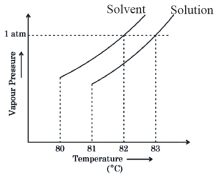
- (A) \(81\)
- (B) \(82\)
- (C) \(83\)
- (D) \(84\)
Show answer and solution
Correct Answer: (B)
Boiling point of solvent is \(82^{\circ} C\)Boiling point of solution is \(83^{\circ} C\)
-
- (A) \(50\)
- (B) \(93\)
- (C) \(10\)
- (D) \(45\)
Show answer and solution
Correct Answer: (D)
\(w =2.5\, g\quad\quad\) \(K _{ b }=0.52\)\(w _{solvent}=75 g\quad\quad\) \(M =\) Mol . Wt .of solute
\(T _{ B }^{\prime}=373.535\, K\)
\(T _{ B }^{o}=373.15\, K\)
\(\Delta T _{ B }=0.385= K _{ b } \text { molality }\)
\(0.385=0.52 \times\left(\frac{2.5}{ M } \times \frac{1000}{75}\right)\)
\(M =45 \,g\, mol ^{-1}\)
-
- (A) \(M _{ A }=4 M _{ B }\)
- (B) \(M _{ B }=4 M _{ A }\)
- (C) \(M _{ A }=8 M _{ B }\)
- (D) \(M _{ B }=8 M _{ A }\)
Show answer and solution
Correct Answer: (B)
For A: \(100 gm\) solution \(\rightarrow 2\,gm\) solute \(A\)\(\therefore \text { Molality }=\frac{2 / M _{ A }}{0.098}\)
For \(B\) : \(100\,gm\) solution \(\rightarrow 8\,gm\) solute \(B\)
\(\therefore \text { Molality }=\frac{8 / M _{ B }}{0.092}\)
\(\because\left(\Delta T _{ B }\right)_{ A }=\left(\Delta T _{ B }\right)_{ B }\)
\(\therefore\) Molality of \(A=\) Molality of \(B\)
\(\therefore \frac{2}{0.098 M _{ A }}=\frac{8}{0.092 M _{ B }}\)
\(\frac{2}{98} \times \frac{92}{8}=\frac{M_{A}}{M_{B}}\)
\(\frac{1}{4.261}=\frac{ M _{ A }}{ M _{ B }}\)
\(\therefore M_{B}=4.261 \times M_{A}\)
-
- (A) \(12\)
- (B) \(13\)
- (C) \(10\)
- (D) \(11\)
Show answer and solution
Correct Answer: (B)
With benzene as solvent\(\Delta \mathrm{T}_{b}=\mathrm{i} \mathrm{K}_{\mathrm{b}} \mathrm{m}\)
\(\Delta \mathrm{T}_{\mathrm{b}}=\frac{1}{2} \times 2.6 \times \frac{1.22 / \mathrm{M}_{\mathrm{w}}}{100 / 1000}...(1)\)
With Acetone as solvent
\(\Delta \mathrm{T}_{\mathrm{b}}=\mathrm{i} \mathrm{K}_{6} \mathrm{~m}\)
\(0.17=1 \times 1.7 \times \frac{1.22 / \mathrm{M}_{\mathrm{w}}}{100 / 1000}...(2)\)
\((1) /(2)\)
\(\frac{\Delta \mathrm{T}_{\mathrm{b}}}{0.17}=\frac{\frac{1}{2} \times 2.6+\frac{1.22 / \mathrm{M}_{\mathrm{w}}}{100 / 1000}}{1 \times 1.7 \times \frac{1.22 / \mathrm{M}_{\mathrm{w}}}{100 / 1000}}\)
\(\Delta \mathrm{T}_{\mathrm{b}}=\frac{0.26}{2}\)
\(\Delta \mathrm{T}_{\mathrm{b}}=13 \times 10^{-2}\)
\(\Rightarrow \mathrm{x}=13\)
-
- (A) \(201\)
- (B) \(105\)
- (C) \(102\)
- (D) \(106\)
Show answer and solution
Correct Answer: (D)
\(AB _{2} \rightarrow A ^{2+}+2 B ^{-}\)\(\begin{array}{llll} t =0 a 0 0\end{array}\)
\(\begin{array}{llll} t = t a - a \alpha a \alpha 2 a \alpha\end{array}\)
\(n _{ T }= a - a \alpha+ a \alpha+2 a \alpha\)
\(= a (1+2 \alpha)\)
so \(i =1+2 \alpha\)
Now \(\Delta T _{ b }= i \times m \times K _{ b }\)
\(\Delta T _{ b }=(1+2 \alpha) \times m \times K _{ b }\)
\(\alpha=0.1 \quad m =10 \quad K _{ b }=0.5\)
\(\Delta T _{ b }=1.2 \times 10 \times 0.5\)
\(=6\)
So boiling point \(=106\)
-
- (A) \(4\)
- (B) \(3\)
- (C) \(6\)
- (D) \(5\)
Show answer and solution
Correct Answer: (B)
\(\alpha=0.75, n =2\)\(i =1-\alpha+ n \alpha=1-0.75+2 \times 0.75=1.75\)
\(\Delta T _{ b }= ik _{ b } m\)
or, \(2.5=1.75 \times 0.52 \times m\)
or, \(m =\frac{2.5}{1.75 \times 0.52}=2.74\)
\(\therefore\) nearest integer answer will be \(3\)
-
- (A) \(5:1\)
- (B) \(10:1\)
- (C) \(1:5\)
- (D) \(1:0.2\)
Show answer and solution
Correct Answer: (C)
\(\Delta \,{T_b}\, = \,{K_b}\, \times \,m\)\(\therefore \,\,\frac{{\Delta {T_{b\,(A)}}}}{{\Delta {T_{b\,(B)}}}}\, = \,\frac{{{K_{b(A)}}}}{{{K_{b(B)}}}}\) as \({m_A}\, = \,{m_B}\)
\(\therefore \,\,\frac{{\Delta {T_{b\,(A)}}}}{{\Delta {T_{b\,(B)}}}}\, = \frac{1}{5}\)
No questions on this page match these filters.
Other STD 12 -Solution and colligative properties topics
- 25Qs Depression of freezing point of the solvent
- 4Qs Colligative properties
- 23Qs Osmosis and Osmotic pressure of the solution
- 25Qs Lowering of vapour pressure
- 32Qs Method of expressing concentration of solution
- 25Qs Solubility
- 2Qs Colligative properties of electrolyte
- 28Qs Abnormal molecular mass
- 2Qs Azeotropic mixture
- 2Qs Ideal and Non-ideal solution
Frequently asked
How many Elevation of boiling point of the solvent questions came in JEE Mains?
20 questions from 2019–2026, each with the correct answer and a full solution.
How difficult are Elevation of boiling point of the solvent questions?
15% are easy, 65% medium and 20% hard.