


All JEE Mains 2023 Physics questions
32 chaptersShowing 451–500 of 644 questions
-
- (A) Statement \(I\) is true but Statement \(II\) is false
- (B) Both Statement \(I\) and Statement \(II\) are true
- (C) Both Statement \(I\) and Statement \(II\) are false
- (D) Statement \(I\) is false but Statement \(II\) is true
Show answer and solution
Correct Answer: (D)
Statement \(I:\) \(\Delta Q > 0\)According to \(1^{\text {st }}\) law of thermodynamics
\(\Delta Q =\Delta U + W\)
If \(\Delta Q > 0, \Delta U < 0\) and \(W > 0\) is also possible.
Hence \(\Delta T < 0\), so \(T\) decreases.
Statement \(I\) is false
Statement \(II:\) W \( > 0\)
\(\therefore \int Pdv > 0\)
Therefore volume of system must increase during positive work done by the system.
Statement \(II\) is true
-
- (A) \(A\) and \(E\) only
- (B) \(B\) and \(D\) only
- (C) \(B\) and \(D\) only
- (D) \(C\) and \(D\) only
Show answer and solution
Correct Answer: (D)
\(dQ = dU + dW \Rightarrow dU = nC _{ V } dT\)\(dU =0 \quad \text { (for isothermal) }\)
\(U =\text { constant }\)
\(Also dQ > 0 \quad \text { (supplied) }\)
Hence,\(dW > 0\)
-
- (A) \(A-II, B-I, C-III, D-IV\)
- (B) \(A-II, B-I, C-IV, D-III\)
- (C) \(A-I, B-II, C-IV, D-III\)
- (D) \(A-I, B-II, C-III, D-IV\)
Show answer and solution
Correct Answer: (B)
\(\Delta U = nC _{ v } \Delta T\)For isothermal process \(T\) is constant
So \(\Delta U =0\)
\(A \longrightarrow II\)
Adiabatic process
\(\Delta Q =0\)
\(\Delta Q =\Delta U +\Delta W\)
\(\quad \Delta U =-\Delta W\)
Work done by gas is positive
So \(\Delta U\) is negative
\(B \longrightarrow I\)
For Isochoric process \(\Delta W =0\)
\(C \longrightarrow IV\)
For Isobaric process
\(\Delta W = P \Delta V \neq 0\)
\(\Delta U = nC _{ V } \Delta T \neq 0\)
Heat absorbed goes partly to increase internal energy and partly do work.
-
- (A) \(P _0(4)^{\frac{1}{\gamma}}\)
- (B) \(P _0(4)^\gamma\)
- (C) \(P _0\)
- (D) \(4 P _0\)
Show answer and solution
Correct Answer: (B)
As gas is suddenly compressed, the processes is adiabatic.Equation of gas for adiabatic process is
\(PV ^\gamma=\text { constant. }\)
\(\Rightarrow P _1 V _1^\gamma= P _2 V _2^\gamma\)
\(\Rightarrow P _0 V _0^\gamma= P _2\left(\frac{ V _0}{4}\right)^\gamma\)
\(\Rightarrow P _2= P _0(4)^\gamma\)
-
- (A) \(6\)
- (B) \(0\)
- (C) \(-4.5\)
- (D) \(4.5\)
Show answer and solution
Correct Answer: (D)
\(\text { As } \Delta q =0\)\(\Delta u =- W\)
\(W =\int PdV\)
\(\Delta u =- W =30 \times 10^3 \times 150 \times 10^{-6}\)
\(=4500 \times 10^{-3}\)
\(=4.5\,J\)
- 456. The thermodynamic process, in which internal energy of the system remains constant is ........... 2023 Easy
- (A) Isochoric
- (B) Isothermal
- (C) Adiabatic
- (D) Isobaric
Show answer and solution
Correct Answer: (B)
\(T =\) constant \(\Rightarrow U =\) constant -
- (A) \(0.5\)
- (B) \(3\)
- (C) \(2\)
- (D) \(1\)
Show answer and solution
Correct Answer: (B)
\(B =-\frac{ dP }{ dv / v }\)\(Pv ^3= a\)
Differentiating w.r.t to pressure
\(v^3+P 3 v^2 \frac{d v}{d P}=0\)
\(v=-3 \frac{P d v}{d P}=0\)
\(v=-3 \frac{P d v}{d P}\)
\(\frac{d P . v}{d v}=-3 P\)
\(B=-\left(\frac{d P v}{d v}\right)=-(-3 P)=3 P\)
-
- (A) \(4\)
- (B) \(2\)
- (C) \(8\)
- (D) \(2.67\)
Show answer and solution
Correct Answer: (C)
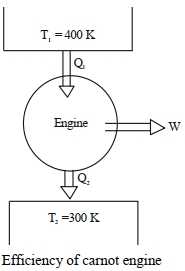
\(\eta=1-\frac{ T _2}{ T _1}=\frac{ W }{ Q _1}\)\(\Rightarrow \frac{ W }{ Q _1}=1-\frac{300}{400}=\frac{1}{4}\)
\(\Rightarrow \frac{2 kJ }{ Q _1}=\frac{1}{4}\)
\(\Rightarrow Q _1=8\,kJ\)
-
- (A) \(312\)
- (B) \(311\)
- (C) \(313\)
- (D) \(310\)
Show answer and solution
Correct Answer: (C)
\(\frac{41^{\circ}-5^{\circ}}{95^{\circ}-5^{\circ}}=\frac{ C -0^{\circ}}{100^{\circ}-0^{\circ}}\)\(\Rightarrow C =\frac{36}{90} \times 100=40^{\circ} C =313\,K\)
-
- (A) 12
- (B) 14
- (C) 16
- (D) 18
Show answer and solution
Correct Answer: (A)
\(d _0\) at \(27^{\circ} C \& d_1\) at \(177^{\circ} C\)
\(d _1= d _0(1+\alpha \Delta T )\)
\(d _1- d _0=5 \times 1.6 \times 10^{-5} \times 150 cm\)
\(=12 \times 10^{-3} cm\) -
- (A) \(60\)
- (B) \(59\)
- (C) \(58\)
- (D) \(57\)
Show answer and solution
Correct Answer: (A)
If \(\Delta l\) is decease in length of rod due to decease in temperature\(\Delta l=l \alpha \Delta T\)
\(\alpha=2 \times 10^{-5}\,K ^{-1}, \Delta T =(210-160)=50\,K\)
\(\Delta l=1 \times 2 \times 10^{-5} \times 50=10^{-3}\,m\)
\(\text { Young Modulus }= Y =\frac{ F / A }{\Delta l / l} \quad A =3 \times 10^{-6}\,m ^2\)
\(2 \times 10^{11}=\frac{ Mg / 3 \times 10^{-6}}{10^{-3} / 1}\)
\(Mg =2 \times 10^{11} \times 3 \times 10^{-9}=6 \times 10^{-2}\)
\(M =60\,kg\)
-
- (A) \(301\)
- (B) \(302\)
- (C) \(300\)
- (D) \(303\)
Show answer and solution
Correct Answer: (C)
\(Q = mc\Delta T = 2 \times 4200 \times (60 - 10) = 420000\,J\)
\(t = \frac{Q}{\eta P} = \frac{420000}{0.70 \times 2000} = 300\,s\)
-
- (A) \(A\) and \(D\) only
- (B) \(B\) and \(D\) only
- (C) \(A\) and \(E\) only
- (D) \(A\) and \(C\) only
Show answer and solution
Correct Answer: (A)
\(\Delta Q =184 \times 10^3\)\(m =0.600\,kg \text { at }-12^{\circ}\,C\)
\(S =222.3\,J / kg /{ }^{\circ}\,C\)
\(L =336 \times 10^3 \,J / kg\)
\(Q _1=0.600 \times 2222.3 \times 12=16000.56\,J\)
Remaining heat \(\Delta Q _1=184000-16000.56\)
\(=167999.44\,J\)
For meeting at \(0^{\circ}\,C\)
\(\Delta Q _2=0.600 \times 336000=201600\,J \text { needed }\)
\(\therefore 100 \%\) ice is not melted
Amount of ice melted
\(167999.44= m \times 336000=0.4999\,kg\)
\(\therefore\) mass of water \(=0.4999\,kg\)
Mass of ice \(=0.1001\)
\(\therefore\) Ratio \(=\frac{0.1001}{0.4999} \approx 1: 5\)
-
- (A) \(-63\)
- (B) \(-112\)
- (C) \(-48\)
- (D) \(-148\)
Show answer and solution
Correct Answer: (D)
\(\frac{X-X_{\text {freez }}}{X_{\text {boil }}-X_{\text {freez }}}=\frac{t-32}{212-32}\)\(\frac{-95-(-15)}{65-(-15)}=\frac{t-32}{180}\)
\(\frac{-80}{80}=\frac{t-32}{180}\)
\(t=-180+32\)
\(t=-148^{\circ} f\)
-
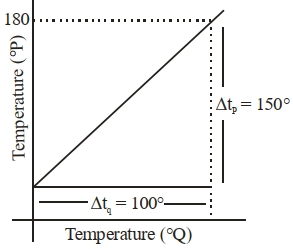
- (A) \(\frac{t_Q}{150}=\frac{t_P-180}{100}\)
- (B) \(\frac{t_Q}{100}=\frac{t_P-30}{150}\)
- (C) \(\frac{t_P}{180}=\frac{t_Q-40}{100}\)
- (D) \(\frac{t_P}{100}=\frac{t_Q-180}{150}\)
Show answer and solution
Correct Answer: (B)
\(\frac{\text { reading on scale }-\text { Lower fixed point }}{\text { upper fixed point }-\text { lower fixed point }}=\text { constant }\)\(\frac{t_P-30}{180-30}=\frac{t_Q-0}{100-0}\)
\(\frac{t_P-30}{150}=\frac{t_Q}{100}\)
-
- (A) \(3 T ^2\)
- (B) \(\frac{3}{ T ^2}\)
- (C) \(\frac{3}{ T ^3}\)
- (D) \(\frac{3}{T}\)
Show answer and solution
Correct Answer: (D)
\(PT ^2=\text { constant, Using } PV = nRT\)\(P =\frac{ nRT }{ V } \)
\( PT ^2=\frac{ nRT }{ V } \times T ^2=\text { constant }\)
\(\Rightarrow T ^3= KV \)
\(\text { So, } \frac{ d }{ dT }( KV )=3 T ^2\)
\(\Rightarrow \frac{ KdV }{ dT }=3 T ^2\)
\(\Rightarrow dV =\frac{3 T ^2}{ K } dT\)
\(dV = V \gamma dT \quad \Rightarrow \gamma=\frac{3 T ^2}{ KV ^2}=\frac{3 T ^2}{ T ^3}=\frac{3}{ T }\)
\(\Rightarrow \gamma V =\frac{3 T ^2}{ K }\)
-
- (A) \(6.25 \times 10^{-3}\,m\)
- (B) \(4 \times 10^{-4}\,m\)
- (C) \(6.25 \times 10^{-6}\,m\)
- (D) \(4 \times 10^{-3}\,m\)
Show answer and solution
Correct Answer: (D)
Elongation in wire \(\delta=\frac{ F \ell}{ AY }\)\(\delta=\frac{250 \times 100}{6.25 \times 10^{-4} \times 10^{10}}\)
\(\delta=4 \times 10^{-3}\,m\)
-
- (A) \(0.5\)
- (B) \(1\)
- (C) \(2\)
- (D) \(3\)
Show answer and solution
Correct Answer: (B)
\(B_{\text {water }}=\frac{-\Delta P}{\left(\frac{\Delta V}{V}\right)}=\frac{-\Delta P}{\frac{0.01}{100}}\)\(B_{\text {liquid }}=\frac{-\Delta P}{\frac{0.03}{100}}\)
\(\frac{B_{\text {water }}}{B_{\text {liquid }}}=3\)
\(x=1\)
-
- (A) \(6.06\)
- (B) \(2.77\)
- (C) \(3.0\)
- (D) \(6.9\)
Show answer and solution
Correct Answer: (D)
\(Y =\frac{ F / A }{\frac{\Delta \ell}{\ell}}\)\(\Rightarrow F =\frac{ YA }{\ell} \Delta \ell\)
\(\left(\frac{ A \Delta \ell}{\ell}\right)_1=\left(\frac{ A \Delta \ell}{\ell}\right)_2\) \(\Rightarrow \frac{\Delta \ell_2}{\Delta \ell_1}=\frac{ A _1}{ A _2} \times \frac{\ell_2}{\ell_1}\)
\(\Rightarrow \frac{\Delta \ell_2}{0.2}=\frac{1}{2.4 \times 2.4} \times \frac{2}{1}\) \(\Rightarrow \Delta \ell_2=6.9 \times 10^{-2}\,mm\)
-
- (A) \(10\)
- (B) \(9\)
- (C) \(11\)
- (D) \(7\)
Show answer and solution
Correct Answer: (C)
Tensile stress, \(\sigma=\frac{F}{A}=\frac{4 m g}{\pi D^2}\)\(\therefore m=\frac{\pi D^2 \sigma}{4 g}\)
\(=\frac{22}{7} \times \frac{\left(14 \times 10^{-3}\right)^2 \times 7 \times 10^5}{4 \times 9.8}\)
\(=11\,kg\)
-
- (A) \(24\)
- (B) \(23\)
- (C) \(22\)
- (D) \(25\)
Show answer and solution
Correct Answer: (D)
\(\text {Strain}=\frac{\text { stress }}{Y}=\frac{\frac{62.8 \times 10^3}{\pi \times(0.02)^2}}{2 \times 10^{11}}\)\(=\frac{62.8 \times 10^3}{3.14 \times 4 \times 10^{-4} \times 2 \times 10^{11}}\)
\(=2.5 \times 10^{-4}\)
\(=25 \times 10^{-5}\)
-
- (A) \(2\,l\)
- (B) \(l\)
- (C) \(4 \ l\)
- (D) \(l / 2\)
Show answer and solution
Correct Answer: (B)
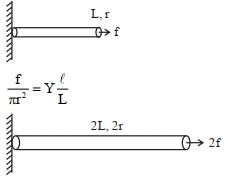
\(\frac{2 f }{\pi(2 r )^2}= Y \frac{\ell^{\prime}}{2 L }\)\(\Rightarrow \frac{2}{1}=\frac{2 \ell^{\prime}}{\ell} \Rightarrow \ell^{\prime}=\ell\)
-
- (A) \(5600\)
- (B) \(8400\)
- (C) \(2800\)
- (D) \(11200\)
Show answer and solution
Correct Answer: (A)
\(Y =7 \times 10^{10}\,N / m ^2\)\(\text { Strain }=\frac{0.04}{100}\)
\(\text { Energy }=\frac{1}{2}\left(\frac{ YA }{l}\right) \Delta x ^2\)
\(\text { Energy }=\frac{1}{2} YA \left(\frac{\Delta x }{l}\right)^2 \times l\)
\(\frac{ E }{ V }=\frac{1}{2} \times Y \times \operatorname{strain}{ }^2\)
\(=\frac{1}{2} \times 7 \times 10^{10} \times \frac{0.04 \times 0.04}{10^4}=56 \times 10^2\)
-
- (A) \(4\)
- (B) \(3\)
- (C) \(2\)
- (D) \(5\)
Show answer and solution
Correct Answer: (D)
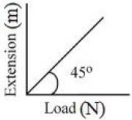
From graph:\(F =\Delta L\)
\(Y =\frac{ FL }{ A \Delta L }\)
\(Y =\frac{ L }{ A }\)
\(Y =\frac{62.8 \times 10^{-2}}{\pi\left(2 \times 10^{-3}\right)^2}\)
\(Y =5 \times 10^4\,N / m ^2\)
- 475. Choose the correct relationship between Poisson ratio \((\sigma)\). bulk modulus \(( K )\) and modulus of rigidity \((\eta)\) of a given solid object: 2023 Medium
- (A) \(\sigma=\frac{3 K -2 \eta}{6 K +2 \eta}\)
- (B) \(\sigma=\frac{6 K +2 \eta}{3 K -2 \eta}\)
- (C) \(\sigma=\frac{3 K+2 \eta}{6 K+2 \eta}\)
- (D) \(\sigma=\frac{6 K -2 \eta}{3 K -2 \eta}\)
Show answer and solution
Correct Answer: (A)
\(Y =3 \eta(1+\sigma)\)\(Y =3 K (1-\sigma)\)
\(\Rightarrow 2 \eta(1+\sigma)=3 K (1-2 \sigma)\)
\(\Rightarrow \sigma=\left(\frac{3 K -2 \eta}{6 K +2 \eta}\right)\)
-
- (A) Both \(A\) and \(R\) are correct but \(R\) is NOT the correct explanation of \(A\)
- (B) \(A\) is not correct but \(R\) is correct
- (C) Both \(A\) and \(R\) are correct and \(R\) is the correct explanation of \(A\)
- (D) \(A\) is correct but \(R\) is not correct
Show answer and solution
Correct Answer: (C)
Assertion A states that steel is used in the construction of buildings and bridges, which is true. Steel is a widely used material for construction due to its high strength, durability, and resistance to corrosion.
Reason R states that steel is more elastic and has a higher elastic limit compared to other common construction materials like concrete, and this is why it is preferred in construction. This statement is also true. Steel's high elasticity and high elastic limit make it an ideal material for use in construction as it can withstand greater stress before it becomes permanently deformed.
Therefore, both Assertion A and Reason R are true statements. However, to determine the most appropriate answer, we need to see if Reason R explains Assertion A.
Reason R does indeed explain why steel is used in the construction of buildings and bridges. Its high elasticity and high elastic limit allow it to withstand greater stress than other common construction materials before becoming permanently deformed, making it a preferred material for construction.
So, the correct answer is Both A and R are correct, and R is the correct explanation of A -
- (A) \(38\)
- (B) \(36\)
- (C) \(40\)
- (D) \(34\)
Show answer and solution
Correct Answer: (C)
Energy per unit volume \(=\frac{1}{2} \text { stress } \times \text { strain }\)Energy \(=\frac{1}{2} \text { stress } \times \text { strain } \times \text { volume }\)
\(80=\frac{1}{2} \times Y \times \text { strain }^2 A \times \ell\)
\(80=\frac{1}{2} \times 2 \times 10^{11} \times \frac{\left(2 \times 10^{-2}\right)^2}{400} \times A \times 20\)
\(20=\frac{10^{+\prime}}{20} \times A\)
\(40 \times 10^{-6} m ^2=A\)
\(A=40\,mm ^2\)
-
- (A) \(8\)
- (B) \(2\)
- (C) \(6\)
- (D) \(4\)
Show answer and solution
Correct Answer: (B)
Let the original length be ' \(\ell_0\) 'When \(T _1=100\,N\), Extension \(=\ell_1-\ell_0\)
When \(T _2=120\,N\), Extension \(=\ell_2-\ell_0\)
Then \(100= K \left(\ell_1-\ell_0\right)\)
And \(120= K \left(\ell_2-\ell_0\right)\)
\(\frac{1}{2} \Rightarrow \frac{5}{6}=\frac{\ell_1-\ell_0}{\ell_2-\ell_0}\)
\(5 \ell_2-5 \ell_0=6 \ell_1-6 \ell_0\)
\(\ell_0=6 \ell_1-5 \ell_2\)
\(\ell_0=6 \ell_1-5\left(\frac{11 \ell_1}{10}\right)\)
\(\ell_0=6 \ell_1-\frac{11 \ell_1}{2}\)
\(\ell_0=\frac{\ell_1}{2}\)
\(\therefore x=2\)
-
- (A) \(1\,cm\)
- (B) \(1\,mm\)
- (C) \(0.1\,mm\)
- (D) \(0.1\,cm\)
Show answer and solution
Correct Answer: (C)
\(\text { Tension }( F )= mg\)\(=4 \times \frac{10}{4}=10\,N\)
\(\Delta L =\frac{ FL }{ AY }\)
\(=\frac{10 \times 6}{3 \times 10^{-6} \times 2 \times 10^{11}}\)
\(=10^{-4}\,m =0.1\,mm\)
-
- (A) \(10\)
- (B) \(5\)
- (C) \(4\)
- (D) \(20\)
Show answer and solution
Correct Answer: (D)
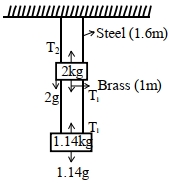
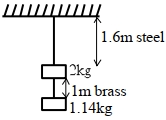
Tension in steel wire \(\quad T _2=2 g + T _1\)\(T _2=20+11.4\)
\(=31.4\,N\)
Elongation in steel wire \(\Delta L =\frac{ T _2 L }{ Ay }\)
\(\Delta L =\frac{31.4 \times 1.6}{\pi\left(0.2 \times 10^{-2}\right)^2 \times 2 \times 10^{11}}\)
\(\Delta L =\frac{16}{2 \times 4 \times 10^{-5} \times 10^{11}}\)
\(=2 \times 10^{-5}\,m\)
\(=20 \times 10^{-6}\,m\)
-
- (A) \(36: 1\)
- (B) \(12: 1\)
- (C) \(1: 36\)
- (D) \(1: 12\)
Show answer and solution
Correct Answer: (B)
\(\Delta L =\frac{ FL }{ AY }\)\(\frac{\Delta L_{ A }}{\Delta L _{ B }}=\frac{ A _{ B }}{ A _{ A }} \frac{Y_{ B }}{Y_{ A }}=12\)
-
- (A) \(2.26\)
- (B) \(28\)
- (C) \(17.5\)
- (D) \(5\)
Show answer and solution
Correct Answer: (A)
Initial surface energy \(=0.45 \times 4 \pi\left(10^{-3}\right)^2\)\(\frac{4}{3} \pi\left(10^{-3}\right)^3=125 \times \frac{4 \pi}{3} R_{\text {new }}^3\)
\(10^{-3}=5 R_{\text {new }}\)
\(R_{\text {new }}=\frac{10^{-3}}{5}\,m\)
So, final surface energy \(=0.45 \times 125 \times 4 \pi\left(\frac{10^{-3}}{5}\right)^2\)
Increase in energy \(=0.45 \times 4 \pi \times\left(10^{-3}\right)^2\left[\frac{125}{25}-1\right]\)
\(=4 \times 0.45 \times 4 \pi \times 10^{-6}\)
\(=2.26 \times 10^{-5}\,J\)
-
- (A) \(2\)
- (B) \(1\)
- (C) \(3\)
- (D) \(4\)
Show answer and solution
Correct Answer: (B)
Surface Tension \(= T\)\(R\) : Radius of bigger drop
\(r :\) Radius of smaller drop
Volume will remain same
\(\frac{4}{3} \pi R ^3=1000 \times \frac{4}{3} \pi r^3\)
\(R =10 r\)
\(u _{ i }= T \cdot 4 \pi R ^2\)
\(u _{ f }= T .4 \pi r ^2 \times 1000\)
\(\frac{ u _{ f }}{ u _{ i }}=\frac{1000 r ^2}{ R ^2}\)
\(\frac{ u _{ f }}{ u _{ i }}=\frac{10}{1}\)
So, \(x =1\)
-
- (A) \(7.92 \times 10^{-6}\,J\)
- (B) \(7.92 \times 10^{-4}\,J\)
- (C) \(9.68 \times 10^{-4}\,J\)
- (D) \(8.8 \times 10^{-5}\,J\)
Show answer and solution
Correct Answer: (B)
\(1000 \times \frac{4 \pi}{3}(1)^3=\frac{4 \pi}{3} R ^3\)\(R =10\,mm\)
\(T \times 1000 \times 4 \pi\left(10^{-3}\right)^2- T \times 4 \pi\left(10 \times 10^{-3}\right)^2=\Delta E\)
\(\Delta E =4 \times \pi \times 7 \times 10^{-2}[1000-100] \times 10^{-6}\)
\(\Delta E =7.92 \times 10^{-4}\,J\)
-
- (A) \(0.72\)
- (B) \(5.76\)
- (C) \(18.48\)
- (D) \(9.24\)
Show answer and solution
Correct Answer: (C)
Surface area of soap bubble \(=2 \times 4 \pi R^2\)Work done \(=\) change in surface energy \(\times T_S\)
\(= T _{ S } \times 8 \pi \times\left( R _2^2- R _1^2\right)\)
\(=2 \times 10^{-2} \times 8 \times \frac{22}{7} \times 49 \times \frac{3}{4} \times 10^{-4}\)
\(=18.48 \times 10^{-4}\,J\)
-
- (A) \(0.20\)
- (B) \(0.5\)
- (C) \(0.05\)
- (D) \(0.10\)
Show answer and solution
Correct Answer: (C)
\(h =\frac{2 S \cos \theta}{ r \rho g }\)\(\frac{ h _1}{ h _2}=\frac{ S _1}{ S _2} \frac{\rho_2}{\rho_1}\)
\(\frac{5}{ h _2}=\left[\frac{1}{2}\right]\left[\frac{2}{1}\right] \Rightarrow h _2=5\,cm =0.05\,m\)
Info about angle of contact not there so most appropriate is \(3\)
-
- (A) \(264\)
- (B) \(263\)
- (C) \(262\)
- (D) \(265\)
Show answer and solution
Correct Answer: (A)
\(W = T .(\Delta A )\)\(W = T \left(8 \pi\left( r _2^2- r _1^2\right)\right)\)
\(W =264 \times 10^{-4}\,J\)
-
- (A) \(1150\)
- (B) \(1151\)
- (C) \(1152\)
- (D) \(1153\)
Show answer and solution
Correct Answer: (A)
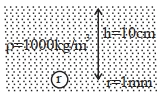
Pressure inside the bubble\(P=P_0+h \rho g+\frac{2 T}{r}\)
\(P-P_0=h \rho g+\frac{2 T}{r}\)
\(=0.1 \times 1000 \times 10+\frac{2 \times .075}{10^{-3}}\)
\(=1000+(0.15)(1000)\)
\(=1150\,Pa\)
-
- (A) \(16\)
- (B) \(6\)
- (C) \(8\)
- (D) \(10\)
Show answer and solution
Correct Answer: (D)
\(P _2 A - P _1 A =5.4 \times 10^5 \times g\)\(P _2- P _1=\frac{5.4 \times 10^6}{500}=5.4 \times 2 \times 10^2 \times 10\)
\(=10.8 \times 10^3\)
\(P _2+0+\frac{1}{2} \rho V _2^2= P _1+0+\frac{1}{2} \rho V _1^2\)
\(P_2-P_1=\frac{1}{2} \rho\left(V_1^2-V_2^2\right)=\frac{1}{2} \rho\left(V_1-V_2\right)\left(V_1+V_2\right)\)
\(10.8 \times 10^3=\frac{1}{2} \times 1.2\left( V _1- V _2\right) \times 2 \times 3 \times 10^2\)
\(10.8 \times 10=3.6\left( V _1- V _2\right)\)
\(V _1- V _2=30\)
\(\left(\frac{ V _1- V _2}{ V }\right) \times 100=\frac{30}{300} \times 100=10 \%\)
-
- (A) \(200 \times 10^{+6}\,Pa\)
- (B) \(20 \times 10^{+6}\,Pa\)
- (C) \(2 \times 10^{+6}\,Pa\)
- (D) \(2 \times 10^{+5}\,Pa\)
Show answer and solution
Correct Answer: (C)
\(\text { Force }= mg =5000\,g\)\(\text { Area of cross section }=250\,cm ^2=250 \times 10^{-4}\,m ^2\)
\(\text { max imum pressure }=\frac{\text { Force }}{\text { area of cross section }}\)
\(\quad=\frac{5000\,g }{250 \times 10^{-4}}=\frac{20 \times g }{10^{-4}}=2 \times 10^6\,Pa\)
-
- (A) \(12\)
- (B) \(25\)
- (C) \(30\)
- (D) \(40\)
Show answer and solution
Correct Answer: (B)
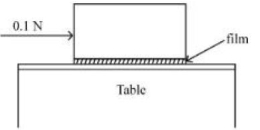
\(| F |=\eta A \frac{\Delta v }{\Delta h }: 0.1=5 \times 10^{-3} \times 0.2 \times \frac{ v }{.25 \times 10^{-3}}\)\(v =0.025\,m / s \text { or } v =25 \times 10^{-3}\,m / s\)
-
- (A) \(F=\mathrm{Mg}\left(1-\frac{\rho_0}{\rho}\right)\)
- (B) \(F=M g\left(1+\frac{\rho}{\rho_0}\right)\)
- (C) \(F=\mathrm{Mg}\left(1+\frac{\rho_0}{\rho}\right)\)
- (D) \(F=\mathrm{Mg}\left(\mathrm{l} \pm \rho \rho_0\right)\)
Show answer and solution
Correct Answer: (A)
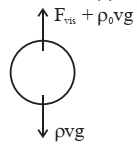
For constant velocity \(F_{\text {net }}=0\)\(\mathrm{F}_{\mathrm{vis}}+\rho_0 \mathrm{vg}=\rho \mathrm{vg}\)
\(\mathrm{F}_{\mathrm{vis}}=\left(\rho-\rho_0\right) \mathrm{vg}\)
\(=\rho \mathrm{vg}\left(1-\frac{\rho_0}{\rho}\right)\)
\(=\mathrm{Mg}\left(1-\frac{\rho_0}{\rho}\right)\)
-
- (A) \(4\)
- (B) \(5\)
- (C) \(7\)
- (D) \(6\)
Show answer and solution
Correct Answer: (C)
When the ball attain terminal velocity\(F _r=\left( mg - F _{ B }\right)(\because a =0)\)
\(= V \sigma_{ b } g - V \rho_{\ell} g\)
\(= Vg \left(\sigma_{ b }-\rho_{\ell}\right)\)
\(=\frac{4}{3} \pi\left(10^{-3}\right)^3 \times 9.8(10.5-1.5) \times 10^3\)
\(=3696 \times 10^{-7}\,N\)
So, \(x=7\)
-
- (A) \(5\)
- (B) \(10\)
- (C) \(8\)
- (D) \(9\)
Show answer and solution
Correct Answer: (B)
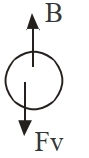
Since the bubble is moving at constant speed the force acting on it is zero.\(B = F _{ V }\)
\(\frac{4}{3} \pi R ^3 \rho g =6 \pi \eta Rv\)
\(\eta=\frac{2 R ^2 \rho g }{9 v }=\frac{2 \times\left(3 \times 10^{-3}\right)^2 \times 1750 \times 10}{9 \times 0.35 \times 10^{-2}}=10\,Pas\)
-
- (A) \(5\mathrm{~cm}^3\)
- (B) \(2\mathrm{~cm}^3\)
- (C) \(4\mathrm{~cm}^3\)
- (D) \(3\mathrm{~cm}^3\)
Show answer and solution
Correct Answer: (A)
\(P = P _0+\rho gh =10^5\,Pa +10^3 \times 10 \times 40=5 \times 10^5\,Pa\)At \(T\) is constant
\(PV = P _0 V _0\)
\(\Rightarrow 5 \times 10^5\,Pa \times 1\,cm ^3=10^5 Pa \times V _0 \Rightarrow V _0=5\,cm ^3\)
-
- (A) \(10\)
- (B) \(40\)
- (C) \(16\)
- (D) \(5\)
Show answer and solution
Correct Answer: (B)
\(v \propto r ^2\)\(\frac{ v _1}{ v _2}=\left(\frac{ r }{ R }\right)^2\)
\(8 \cdot \frac{4}{3} \pi r ^3=\frac{4}{3} \pi R ^3\)
\(R =2 r\)
\(\frac{10}{ v _2}=\left(\frac{1}{2}\right)^2\)
\(v _2=40\,cm / s\)
-
- (A) \(70\)
- (B) \(60\)
- (C) \(80\)
- (D) \(50\)
Show answer and solution
Correct Answer: (C)
By equation of continuity\(A _1 V _1= A _2 V _2\)
\(V _2=\frac{2 \times 4}{10 \times 10^{-2}}=80\,cm / s\)
-
- (A) \(A\) is not correct but \(R\) is correct.
- (B) \(A\) is correct but \(R\) is not correct.
- (C) Both \(A\) and \(R\) are correct and \(R\) is the correct explanation of \(A\).
- (D) Both \(A\) and \(R\) are correct but \(R\) is NOT the correct explanation of \(A\).
Show answer and solution
Correct Answer: (C)
\((R)\) is the statement of Pascal's principle and which explains the assertion \((S)\) -
- (A) Statement \(I\) is false but Statement \(II\) is true
- (B) Both Statement \(I\) and Statement \(II\) are true
- (C) Statement \(I\) is true but Statement \(II\) is false
- (D) Both Statement \(I\) and Statement \(II\) are false
Show answer and solution
Correct Answer: (B)
Pressure in a static liquid will be same at each point on same horizontal level.\(\therefore P=P_{a m}+\rho g h\)
As per Pascal law, same pressure applied to enclosed water is transmitted in all directions equally.
-
- (A) \(2\)
- (B) \(6\)
- (C) \(8\)
- (D) \(4\)
Show answer and solution
Correct Answer: (D)
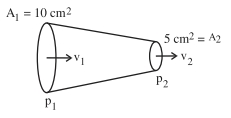
\(\Delta P = P _1- P _2=3 N / m ^2 \text { (given) }\)By continuity \(eq ^{ n }\)
\(A _1 v _1= A _2 v _2\)
\(\therefore \quad v_1=\frac{A_2}{A_1} v_2-(1)\)
By Bernoulli's equation.
\(P _1+\frac{1}{2} \rho v _1{ }^2= P _2+\frac{1}{2} \rho v _2{ }^2\)
\(P _1- P _2=\frac{1}{2} \rho\left( v _2^2- v _1^2\right)\)
\(\Delta P =\frac{1}{2} \rho\left( v _2^2-\frac{ A _2^2}{ A _1^2} v _2^2\right)\)
\(\Delta P =\frac{1}{2} \rho\left[1-\left(\frac{ A _2}{ A _1}\right)^2\right] v _2^2\)
\(3=\frac{1}{2} \times 1.25 \times 10^3\left[1-\left(\frac{5}{10}\right)^2\right] v _2^2\)
\(3=\frac{1}{2} \times 1.25 \times 10^3\left[1-\frac{1}{4}\right] v _2^2\)
\(3=\frac{1}{2} \times 1.25 \times 10^3 \times \frac{3}{4} v_2^2\)
So discharge rate \(= A _2 V _2\)
\(=5 \times 10^{-4} \times 8 \times 10^{-2}\)
\(=4 \times 10^{-5}\,m ^3 / s\)
Correct ans is \(x=4\)
No questions on this page match these filters.