


Questions
Newest firstShowing 1–50 of 59 questions
-
- (A) \( w=-9.1~kJ, \Delta U=0, \Delta H=0, q=9.1~kJ \)
- (B) \( w=9.1~J, \Delta U=9.1~J, \Delta H=0; q=0 \)
- (C) \( w=+4.1~kJ, \Delta U=0, \Delta H=0; q=-4.1~kJ \)
- (D) \( w=-3.9~kJ, \Delta U=0, \Delta H=0; q=3.9~kJ \)
Show answer and solution
Correct Answer: (A)
For isothermal reversible process \( \Delta U=\Delta H=0 \)
\( w_{iso}=-p_{1}v_{1} \ln \frac{p_1}{p_2} \)
\( W_{iso}=-0.5 \times 10^{6} \times 20 \times 10^{-3} \ln \frac{0.5}{0.2} \)
\( W_{iso}=-0.5 \times 10^{6} \times 20 \times 10^{-3} \times 2.303 \times (0.6989-0.3010) \)
\( w=-9.1~kJ \)
\( q=-w=9.1~kJ \) -
- (A) \(q=+ve, w=0, \Delta U=-ve\)
- (B) \(q=+ve, w=-ve, \Delta U=+ve\)
- (C) \(q=-ve, w=-ve, \Delta U=-ve\)
- (D) \(q=+ve, w=-ve, \Delta U=-ve\)
Show answer and solution
Correct Answer: (B)
\(\underset{5^{\circ} C }{ H _2 O (\ell)} \longrightarrow \underset{100^{\circ} C }{ H _2 O (\ell) \rightleftarrows} \underset{100^{\circ} C }{ H _2 O ( g )}\)
due to expansion \(W=-ve\)
as heat is given to system so \(q = +ve\) and internal energy of gas will be more than internal energy of liquid so \(\Delta U=+ve\) -
- (A) \(-648\) kJ mol\(^{-1}\)
- (B) \(-1350\) kJ mol\(^{-1}\)
- (C) \(-2002\) kJ mol\(^{-1}\)
- (D) \(-1527\) kJ mol\(^{-1}\)
Show answer and solution
Correct Answer: (D)
Explanation:
Let us calculate the enthalpy of formation of anhydrous solid \( Al_2Cl_6 \) using Hess's Law of Constant Heat Summation:
1. Identify the Target Reaction:
The standard reaction for the enthalpy of formation of anhydrous solid \( Al_2Cl_6 \) from its constituent elements is:
\( 2Al(s) + 3Cl_2(g) \rightarrow Al_2Cl_6(s) \) ; \( \Delta H_f = ? \)
2. Algebraic Manipulation of Given Equations:
To obtain the target equation, we perform the following mathematical operations on the given equations:
We need \( 2Al(s) \) on the reactant side: Keep Equation (i) as it is.
We need \( 3Cl_2(g) \) on the reactant side: Multiply Equation (ii) by 3.
To cancel out the \( 6HCl(g) \) produced, we need them in aqueous form: Multiply Equation (iii) by 6.
We need anhydrous \( Al_2Cl_6(s) \) on the product side: Reverse Equation (iv) (multiply by -1).
Therefore, the net operation is: Equation (i) + 3 \times Equation (ii) + 6 \times Equation (iii) - Equation (iv)
3. Verification by Adding the Modified Equations:
\( 2Al(s) + 6HCl(aq) \rightarrow Al_2Cl_6(aq) + 3H_2(g) \)
\( 3H_2(g) + 3Cl_2(g) \rightarrow 6HCl(g) \)
\( 6HCl(g) + aq \rightarrow 6HCl(aq) \)
\( Al_2Cl_6(aq) \rightarrow Al_2Cl_6(s) + aq \)
Summing these equations and canceling common species on both sides yields our target equation:
\( 2Al(s) + 3Cl_2(g) \rightarrow Al_2Cl_6(s) \)
4. Calculating the Final Enthalpy (\( \Delta H_f \)):
Applying the same algebraic operations to the respective enthalpy values:
\( \Delta H_f = \Delta H_1 + 3\Delta H_2 + 6\Delta H_3 - \Delta H_4 \)
\( \Delta H_f = -1200 + 3(-164) + 6(-83) - (-663) \)
\( \Delta H_f = -1200 - 492 - 498 + 663 \)
\( \Delta H_f = -2190 + 663 = -1527\text{ kJ/mol} \)
Hence, Option D is the correct choice. -
- (A) 1123
- (B) 1126
- (C) 1128
- (D) 1130
Show answer and solution
Correct Answer: (B)
The standard enthalpy of reaction is given by:
\(\Delta_r H^{\ominus} = \sum \Delta_f H^{\ominus}(\text{products}) - \sum \Delta_f H^{\ominus}(\text{reactants})\)
For the given reaction:
\(2\text{H}_2\text{S}(g) + 3\text{O}_2(g) \rightarrow 2\text{H}_2\text{O}(l) + 2\text{SO}_2(g)\)
\(\Delta_r H^{\ominus} = [2 \Delta_f H^{\ominus}(\text{H}_2\text{O}, l) + 2 \Delta_f H^{\ominus}(\text{SO}_2, g)] - [2 \Delta_f H^{\ominus}(\text{H}_2\text{S}, g) + 3 \Delta_f H^{\ominus}(\text{O}_2, g)]\)
Substituting the given values:
\(\Delta_r H^{\ominus} = [2(-286.0) + 2(-297.0)] - [2(-20.1) + 3(0)]\)
\(\Delta_r H^{\ominus} = [-572.0 - 594.0] - [-40.2]\)
\(\Delta_r H^{\ominus} = -1166.0 + 40.2 = -1125.8 \text{ kJ mol}^{-1}\)
The magnitude of the enthalpy change is \(1125.8 \text{ kJ mol}^{-1}\).
Rounding to the nearest integer, we get \(1126\).
Answer: \(1126\) -
- (A) \(18\) J of the work is done by the gas 'A'.
- (B) \(2\) J of the work is done by the gas 'A'.
- (C) \(12\) J of the work is done on the gas 'A' by the surrounding.
- (D) \(14\) J of the work is done on the gas 'A' by the surrounding.
Show answer and solution
Correct Answer: (D)
Using the first law of thermodynamics, \(\Delta U = q + w\).
For the process from state X to state Y:
Heat absorbed by the gas, \(q_{X \to Y} = +10\) J
Work done by the gas, \(w_{X \to Y} = -18\) J
Change in internal energy, \(\Delta U_{X \to Y} = q_{X \to Y} + w_{X \to Y} = 10 - 18 = -8\) J
For the reverse process from state Y to state X:
Change in internal energy, \(\Delta U_{Y \to X} = -\Delta U_{X \to Y} = +8\) J
Heat evolved by the gas, \(q_{Y \to X} = -6\) J
Let the work done on the gas be \(w_{Y \to X}\).
\(\Delta U_{Y \to X} = q_{Y \to X} + w_{Y \to X}\)
\(8 = -6 + w_{Y \to X}\)
\(w_{Y \to X} = +14\) J
Since the work done is positive, \(14\) J of work is done on the gas by the surrounding.
Answer: \(14\) J of the work is done on the gas 'A' by the surrounding. -
- (A) 3
- (B) 4
- (C) 5
- (D) 6
Show answer and solution
Correct Answer: (A)
Molar mass of ethanol (\(C_2H_5OH\)) \(= 2(12) + 6(1) + 16 = 46\) g mol\(^{-1}\)
Number of moles of ethanol burnt, \(n = \dfrac{3.365}{46} = 0.07315\) mol
Since the combustion occurs in a bomb calorimeter (constant volume), the heat produced corresponds to the change in internal energy (\(\Delta U_c^\circ\)).
\(\Delta U_c^\circ = -\dfrac{99.472}{0.07315} = -1359.8\) kJ mol\(^{-1}\)
The balanced chemical equation for the combustion of ethanol is:
\(C_2H_5OH(l) + 3O_2(g) \rightarrow 2CO_2(g) + 3H_2O(l)\)
Change in the number of gaseous moles, \(\Delta n_g = 2 - 3 = -1\)
Now, calculating the standard enthalpy of combustion (\(\Delta H_c^\circ\)):
\(\Delta H_c^\circ = \Delta U_c^\circ + \Delta n_g RT\)
\(\Delta H_c^\circ = -1359.8 + (-1) \times (8.314 \times 10^{-3} \text{ kJ K}^{-1} \text{ mol}^{-1}) \times 298.15 \text{ K}\)
\(\Delta H_c^\circ = -1359.8 - 2.48 = -1362.28\) kJ mol\(^{-1}\)
The standard enthalpy of combustion can also be written in terms of enthalpies of formation:
\(\Delta H_c^\circ = \sum \Delta H_f^\circ(\text{products}) - \sum \Delta H_f^\circ(\text{reactants})\)
\(\Delta H_c^\circ = [2\Delta H_f^\circ(CO_2, g) + 3\Delta H_f^\circ(H_2O, l)] - [\Delta H_f^\circ(C_2H_5OH, l) + 3\Delta H_f^\circ(O_2, g)]\)
Substituting the given values (note that \(\Delta H_f^\circ\) of \(O_2(g)\) is \(0\)):
\(-1362.28 = [2(-393.5) + 3(-285.8)] - \Delta H_f^\circ(C_2H_5OH, l)\)
\(-1362.28 = [-787.0 - 857.4] - \Delta H_f^\circ(C_2H_5OH, l)\)
\(-1362.28 = -1644.4 - \Delta H_f^\circ(C_2H_5OH, l)\)
\(\Delta H_f^\circ(C_2H_5OH, l) = -1644.4 + 1362.28 = -282.12\) kJ mol\(^{-1}\)
The magnitude is \(|\Delta H_f^\circ| = 282.12\) kJ mol\(^{-1} = 2.8212 \times 10^2\) kJ mol\(^{-1}\)
Rounding to the nearest integer, we get \(3\).
Answer: \(3\) -
- (A) A-II, B-III, C-I, D-IV
- (B) A-II, B-I, C-IV, D-III
- (C) A-II, B-I, C-III, D-IV
- (D) A-I, B-II, C-III, D-IV
Show answer and solution
Correct Answer: (C)
For an isothermal reversible expansion, the change in internal energy \(\Delta U = 0\). From the first law of thermodynamics, \(q = -w\). The work done is \(w = -nRT \ln\left(\dfrac{V_2}{V_1}\right)\), which gives \(q = nRT \ln\left(\dfrac{V_2}{V_1}\right)\). Thus, A matches II.
For free expansion, the external pressure is zero (\(p_{ext} = 0\)), so the work done \(w = 0\). Since the process is isothermal, \(\Delta U = 0\). Therefore, the heat exchanged \(q = 0\). Thus, B matches I.
For an irreversible compression, the work done against a constant external pressure is given by \(w = -p_{ext}\Delta V\). This corresponds to the expression in III. Thus, C matches III.
For a cyclic reversible process, the initial and final states are the same, so the change in entropy \(\Delta S = 0\). Since \(\Delta S = \dfrac{q_{rev}}{T}\), we get \(\dfrac{q_{rev}}{T} = 0\). Thus, D matches IV.
The correct matching is A-II, B-I, C-III, D-IV.
Answer: A-II, B-I, C-III, D-IV -
- (A) 378 K and 500 J
- (B) 368 K and 500 J
- (C) 348 K and 300 J
- (D) 378 K and 300 J
Show answer and solution
Correct Answer: (C)
\(\begin{aligned} & \mathrm{q}_{\mathrm{p}}=\mathrm{n} \times \mathrm{c}_{\mathrm{p}} \times \Delta \mathrm{T} \\ & \Rightarrow 500=0.5 \times \frac{5}{2} \times 8.3\left(\mathrm{~T}_{\mathrm{f}}-298\right) \\ & \Rightarrow \mathrm{T}_{\mathrm{f}} \simeq 346.2 \mathrm{~K} \\ & \frac{\Delta \mathrm{H}}{\Delta \mathrm{U}}=\frac{\mathrm{C}_{\mathrm{p}}}{\mathrm{C}_{\mathrm{v}}}=\left(\frac{5}{3}\right) \\ & \Rightarrow \Delta \mathrm{U}=\frac{3}{5} \times 500=300 \mathrm{~J}\end{aligned}\) -
- (A) \(\Delta \mathrm{U} \lt 0, \mathrm{q}=0, \mathrm{w}\gt0\)
- (B) \(\Delta \mathrm{U}=0, \mathrm{q}=0, \mathrm{w}=0\)
- (C) \(\Delta \mathrm{U}\gt0, \mathrm{q}=0, \mathrm{w}\gt0\)
- (D) \(\Delta \mathrm{U}=0, \mathrm{q} \lt 0, \mathrm{w}\gt0\)
Show answer and solution
Correct Answer: (C)
Thermally insulated \(\Rightarrow q=0\) from \(\mathrm{I}^{\text {st }}\) law
\(\begin{aligned}
& \Delta \mathrm{U}=\mathrm{q}+\mathrm{w} \\
& \Delta \mathrm{U}=\mathrm{w} \\
& \mathrm{w}>0, \Delta \mathrm{U}>0
\end{aligned}\) -
- (A) 304
- (B) 305
- (C) 306
- (D) 307
Show answer and solution
Correct Answer: (A)
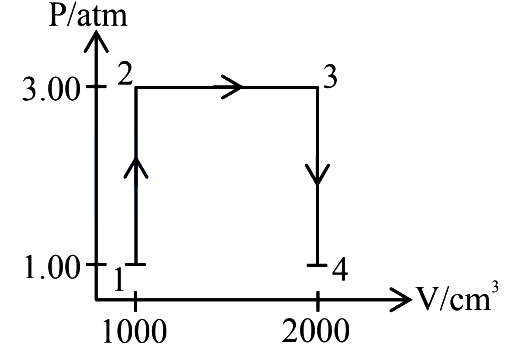
\(\begin{aligned}
& \mathrm{W}_{1 \rightarrow 2}=0 \\
& \mathrm{~W}_{2 \rightarrow 3}=-\mathrm{P} \Delta \mathrm{~V} \\
& =-3[2-1] \\
& =-3 \mathrm{~atm}-\ell
\end{aligned}\)
\(\mathrm{W}_{3 \rightarrow 4}=0\)
Total work done
\(\begin{aligned}
& =-3 \mathrm{~atm}-\ell \\
& =-3 \times 101.3 \text { Joule } \\
& =-304 \text { Joule }
\end{aligned}\) -
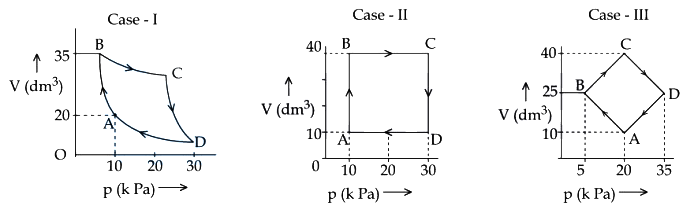
- (A) \(\Delta \mathrm{U}(\) Case-I \()=\Delta \mathrm{U}(\) Case-II \()=\Delta \mathrm{U}(\) Case-III \()\)
- (B) \(\Delta \mathrm{U}(\) Case-I \()\gt\Delta \mathrm{U}(\) Case-III \()\gt\Delta \mathrm{U}(\) Case-II \()\)
- (C) \(\Delta \mathrm{U}(\) Case-III \()\gt\Delta \mathrm{U}(\) Case-II \()\gt\Delta \mathrm{U}(\) Case-I \()\)
- (D) \(\Delta \mathrm{U}(\) Case-I \()\gt\Delta \mathrm{U}(\) Case-II \()\gt\Delta \mathrm{U}(\) Case-III \()\)
Show answer and solution
Correct Answer: (A)
As internal energy ' \(U\) ' is a state function, its cyclic integral must be zero in a cyclic process
\(\therefore \Delta U \text { case }(I)=\Delta U \text { case }(\text { II })=\Delta U \text { case }(\text { III })\) -
- (A) \(a \gt b \gt c \gt d\)
- (B) \(d \gt c=a \gt b\)
- (C) \(c=a \gt d \gt b\)
- (D) \(a \gt c \gt b \gt d\)
Show answer and solution
Correct Answer: (B)
For isothermal process
\(\begin{aligned}
& \left|\mathrm{W}_{\text {reversible }}\right|_{\text {expansion }}=\left|\mathrm{W}_{\text {reversible }}\right|_{\text {compression }} \\
& =-\mathrm{nRT} \ln \frac{\mathrm{~V}_{\mathrm{f}}}{\mathrm{~V}_{\mathrm{i}}} \\
& \left|\mathrm{~W}_{\text {irreversible }}\right|_{\text {expansion }} \lt \left|\mathrm{W}_{\text {irreversible }}\right|_{\text {compression }} \\
& \mathrm{d} \gt \mathrm{c}=\mathrm{a} \gt \mathrm{b} \\
& \left|\mathrm{~W}_{\text {irreversible }}\right|_{\text {expansion }}=-\mathrm{P}_{\text {ext }}\left(\mathrm{V}_{\mathrm{f}}-\mathrm{V}_{\mathrm{i}}\right)
\end{aligned}\)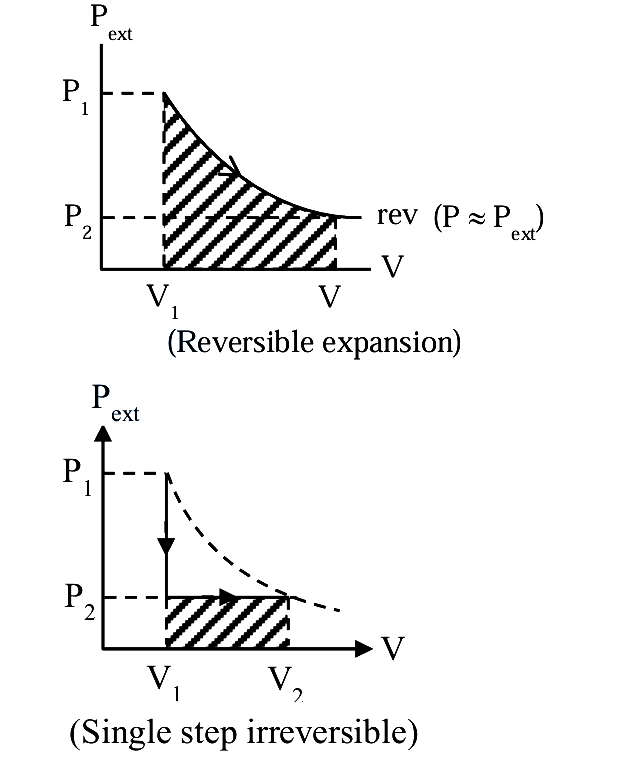
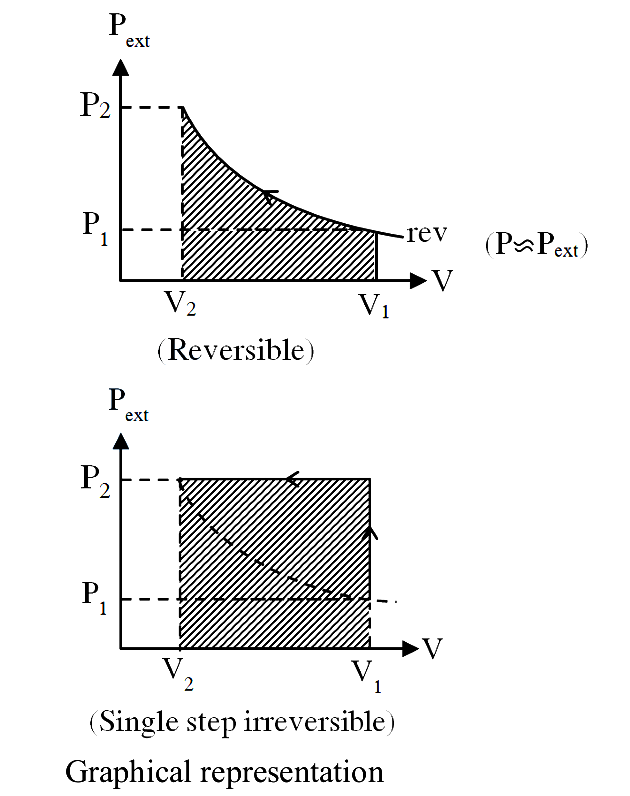
We can compare work by area of PV graph -
- (A) \(0,21.84 \mathrm{~kJ},-1.26 \mathrm{~kJ}\)
- (B) \(0,-17.18 \mathrm{~kJ}, 1.718 \mathrm{~J}\)
- (C) \(0,21.84 \mathrm{~kJ}, 21,84 \mathrm{~kJ}\)
- (D) \(0,1.78 \mathrm{~kJ},-1.718 \mathrm{~kJ}\)
Show answer and solution
Correct Answer: (D)
\(\begin{aligned} & (10 \mathrm{~L}, 300 \mathrm{~K}) \xrightarrow{\mathrm{n}=1}(20 \mathrm{~L}, 300 \mathrm{~K}) \\ & -\mathrm{q}=\mathrm{w}=-\mathrm{nRT} \ln \frac{\mathrm{V}_2}{\mathrm{~V}_1} \\ & =-8.3 \times 300 \times \ln \left(\frac{20}{10}\right) \\ & =-1.718 \mathrm{~kJ} \\ & \Rightarrow \mathrm{q}=1.718 \mathrm{~kJ} \\ & \mathrm{w}=-1.718 \mathrm{~kJ} \\ & \Delta \mathrm{U}=0(\because \Delta \mathrm{~T}=0)\end{aligned}\) -
- (A) \(d w \neq 0\)
- (B) \(\mathrm{dq} \neq 0\)
- (C) \(\mathrm{dU} \neq 0\)
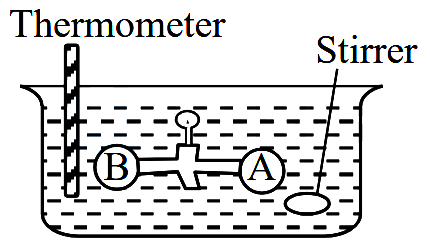
- (D) The pressure in the vessel \(B\) before opening the stopcock is zero.
Show answer and solution
Correct Answer: (D)
It is free expansion of gas \(\Rightarrow P_{\text {ext }}=0\)
Where \(\mathrm{w}=0, \mathrm{q}=0\) and \(\Delta \mathrm{U}=0\) -
- (A) \(273\)
- (B) \(274\)
- (C) \(277\)
- (D) \(280\)
Show answer and solution
Correct Answer: (B)
\(\Delta \mathrm{U}=\mathrm{q}+\mathrm{w}(\mathrm{q}=0)\)\(\mathrm{nC}_{\mathrm{V}} \Delta \mathrm{T}=-\mathrm{P}_{\mathrm{ext}}\left(\mathrm{V}_2-\mathrm{V}_1\right)\)
\(\mathrm{V}_2=2 \mathrm{~V}_1\)
\(\frac{\mathrm{nRT}_2}{\mathrm{P}_2}=\frac{2 \mathrm{nRT}_1}{\mathrm{P}_1}\)
\(\mathrm{P}_1=5, \mathrm{~T}_1=298\)
\(\mathrm{P}_2=\frac{5 \mathrm{~T}_2}{2 \times 298}\)
\(\mathrm{n} \frac{5}{2} \mathrm{R}\left(\mathrm{T}_2-\mathrm{T}_1\right)=-1\left(\frac{\mathrm{nRT}_2}{\mathrm{P}_1}-\frac{\mathrm{nRT}_1}{\mathrm{P}_1}\right)\)
\(\mathrm{T}_1=298\)
\(\text { and } \mathrm{P}_2=\frac{5 \mathrm{~T}_2}{2 \times 298}\)
Solve and we get \(T_2=274.16 \mathrm{~K}\)
\(\mathrm{T}_2 \approx 274 \mathrm{~K}\)
-
- (A) \(100\)
- (B) \(150\)
- (C) \(200\)
- (D) \(250\)
Show answer and solution
Correct Answer: (C)
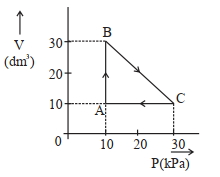
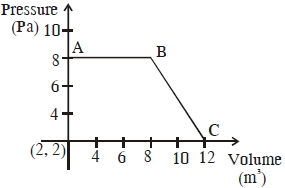
Work done is given by area enclosed in the \(\mathrm{P}\) vs \(\mathrm{V}\) cyclic graph or \(V\) vs \(P\) cyclic graph.Sign of work is positive for clockwise cyclic process for \(\mathrm{V}\) vs \(\mathrm{P}\) graph.
\(\mathrm{W}=\frac{1}{2} \times(30-10) \times(30-10)=200 \mathrm{kPa}-\mathrm{dm}^3\)
\(=200 \times 1000 \mathrm{~Pa}-\mathrm{L}=2 \mathrm{~L}-\mathrm{bar}=200 \mathrm{~J}\)
- 17. Choose the correct option for free expansion of an ideal gas under adiabatic condition from the following : 2024 Hard
- (A) \(\mathrm{q}=0, \Delta \mathrm{T} \neq 0, \mathrm{w}=0\)
- (B) \(\mathrm{q}=0, \Delta \mathrm{T}<0, \mathrm{w} \neq 0\)
- (C) \(q \neq 0, \Delta T=0, w=0\)
- (D) \(q=0, \Delta T=0, w=0\)
Show answer and solution
Correct Answer: (D)
During free expansion of an ideal gas under adiabatic condition \(\mathrm{q}=0, \Delta \mathrm{T}=0, \mathrm{w}=0\). -
- (A) \(50\)
- (B) \(55\)
- (C) \(60\)
- (D) \(65\)
Show answer and solution
Correct Answer: (B)
\(\omega=-\mathrm{nRT} \ln \left(\frac{\mathrm{V}_2}{\mathrm{~V}_1}\right)\)\(=-1 \times .08206 \times 291.15 \ln \left(\frac{100}{10}\right)\)
\(=-55.0128\)
Work done by system \(\approx 55 \mathrm{~atm}\) lit.
-
- (A) \(28719\)
- (B) \(28721\)
- (C) \(28722\)
- (D) \(28725\)
Show answer and solution
Correct Answer: (B)
It is isothermal reversible expansion, so work done negative\(\mathrm{W}=-2.303 \mathrm{nRT} \log \left(\frac{\mathrm{V}_2}{\mathrm{~V}_1}\right)\)
\(=-2.303 \times 5 \times 8.314 \times 300 \log \left(\frac{100}{10}\right)\)
\(=-28720.713 \mathrm{~J}\)
\(\equiv-28721 \mathrm{~J}\)
-
- (A) \(1100\)
- (B) \(3200\)
- (C) \(4700\)
- (D) \(1200\)
Show answer and solution
Correct Answer: (D)
Using, first law of thermodynamics,\( \Delta \mathrm{U}=\mathrm{Q}+\mathrm{W}, \)
\( \Delta \mathrm{U}=0: \text { Process is isothermal } \)
\( \mathrm{Q}=-\mathrm{W} \)
\( \mathrm{W}=-\mathrm{P}_{\text {ext }} \Delta \mathrm{V}: \text { Irreversible } \)
\( =-80 \times 10^3(45-30) \times 10^{-3} \)
\( =-1200 \mathrm{~J}\)
-
- (A) \(199\)
- (B) \(100\)
- (C) \(200\)
- (D) \(300\)
Show answer and solution
Correct Answer: (C)
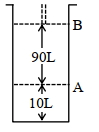
As isothermal \(\Delta \mathrm{U}=0\)and process is irreversible
\(\mathrm{Q}=-\mathrm{W}=-\left[-\mathrm{P}_{\mathrm{ext}}\left(\mathrm{V}_2-\mathrm{V}_1\right)\right]\)
\(\mathrm{Q}=5(20-60)=-200 \mathrm{~atm}-\mathrm{L}\)
-
- (A) \(470\)
- (B) \(495\)
- (C) \(492\)
- (D) \(499\)
Show answer and solution
Correct Answer: (C)
\(2\mathrm{Fe}_{(\mathrm{s})}+\frac{3}{2} \mathrm{O}_{2(\mathrm{~g})} \rightarrow \mathrm{Fe}_2 \mathrm{O}_{3(\mathrm{~s})}, \Delta \mathrm{H}^{\mathrm{o}}=-822 \mathrm{~kJ} / \mathrm{mol}\) \(......(1)\)\(\mathrm{C}_{(\mathrm{s})}+\frac{1}{2} \mathrm{O}_{2(\mathrm{~g})} \rightarrow \mathrm{CO}_{(\mathrm{g})}, \Delta \mathrm{H}^{\mathrm{o}}=-110 \mathrm{~kJ} / \mathrm{mol}\) \(.......(2)\)
\(3\mathrm{C}_{(\mathrm{s})}+\mathrm{Fe}_2 \mathrm{O}_{3(\mathrm{~s})} \rightarrow 2 \mathrm{Fe}_{(\mathrm{s})}+3 \mathrm{CO}_{(\mathrm{g})}, \Delta \mathrm{H}_3=\text { ? }\)
\(\text { (3) }=3 \times(2)-(1)\)
\(\Delta \mathrm{H}_3=3 \times \Delta \mathrm{H}_2-\Delta \mathrm{H}_1\)
\(=3(-110)+822\)
\(=492 \mathrm{~kJ} / \mathrm{mole}\)+
-
- (A) \(1005\)
- (B) \(1006\)
- (C) \(1004\)
- (D) \(1003\)
Show answer and solution
Correct Answer: (B)
Bomb calorimeter \(\rightarrow\) const volumeHeat released
By combustion of \(1\) mole
\(C _2 H _6(\Delta U )=-\frac{20 \times 0.5}{0.3} \times 30=-1000\,kJ\)
\(C _2 H _6( g )+7 / 2 O _2( g ) \rightarrow 2 CO _2( g )+3 H _2 O (l)\)
\(\Delta ng =2-(2+7 / 2)=-(7 / 2)\)
\(\Delta H =\Delta U +\Delta nRT\)
\(=-1000-7 / 2 \times 8.3 \times 300\,kJ\)
\(=-1000-6.225\)
\(=-1006\,kJ\)
So heat released \(=1006\,kJ\,mol ^{-1}\)
-
- (A) \(120\)
- (B) \(130\)
- (C) \(140\)
- (D) \(150\)
Show answer and solution
Correct Answer: (D)
\(q =0\)\(\Delta U = w\)
\(1 \times 20 \times\left[ T _2-300\right]=-3000\)
\(T _2-300=-150\)
\(T _2=150\,K\)
-
- (A) \(\frac{x-2 y}{2}\)
- (B) \(\frac{x+2 y}{2}\)
- (C) \(\frac{2 x - y }{2}\)
- (D) \(2 y-x\)
Show answer and solution
Correct Answer: (A)
Target equation\(C \text { (graphite) }+\frac{1}{2} O _{2( g )} \rightarrow CO _{( g )} \ldots \text {.(i) } \Delta H\)
\(C \left(\text { graphite) }+ O _{2( g )} \rightarrow CO _{2( g )} \text {.(ii) } \Delta H _1=- y\,kJ / mole \right.\)
\(CO _{2( g )} \rightarrow CO _{( g )}+\frac{1}{2} O _{2( g )} \ldots \text { (iii) } \Delta H _2=\frac{ x }{2}\,kJ / mole\)
\(\text { eq. (i) }=\text { eq.(ii) }+ \text { eq (iii) }\)
\(\therefore \Delta H =\frac{ x }{2}- y =\frac{ x -2 y }{2}\)
-
- (A) \(620\)
- (B) \(621\)
- (C) \(623\)
- (D) \(624\)
Show answer and solution
Correct Answer: (A)
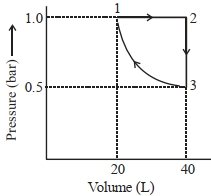
\(1 \rightarrow 2 \Rightarrow \text { Isobaric process }\)\(2 \rightarrow 3 \Rightarrow \text { Isochoric process }\)
\(3 \rightarrow 1 \Rightarrow \text { Isothermal process }\)
\(W = W _{1 \rightarrow 2}+ W _{2 \rightarrow 3}+ W _{3 \rightarrow 1}\)
\(=\left(- P \left( V _2- V _1\right)+0\left[- P _1 V _1 \ln \left(\frac{ V _2}{ V _1}\right)\right]\right)\)
\(=\left[-1 \times(40-20)+0+\left[-1 \times 20 \ln \left(\frac{20}{40}\right)\right]\right]\)
\(=-20+20 \ln 2\)
\(=-20+20 \times 2.3 \times 0.3\)
\(=-6.2 \text { bar } L\)
\(| W |=6.2 \text { bar } 1=620\,J\)
-
- (A) \(1\)
- (B) \(0\)
- (C) \(2\)
- (D) \(3\)
Show answer and solution
Correct Answer: (B)
For ideal gas \(U = f ( T )\)and for isothermal process, \(\Delta U =0\)
-
- (A) \(455\)
- (B) \(45\)
- (C) \(95\)
- (D) \(195\)
Show answer and solution
Correct Answer: (D)
\(N _{2} O\) moles \(=\frac{2.2}{44}=\frac{1}{20}\)\(\Delta H = nC _{ p } \Delta T =\frac{1}{20} \times 100(-40)=-200\, J\)
\(\Delta U = q _{ p }+ w\)
\(w =- P _{\text {ext. }} \Delta\, V\)
\(W =-1 \frac{(167.75-217.1)}{1000} \times 101.3 \,J\)
\(W =+5 \,J\)
\(\Delta U =-200+5=-195\, J\)
-
- (A) \(10\)
- (B) \(20\)
- (C) \(0\)
- (D) \(1\)
Show answer and solution
Correct Answer: (C)
For free expansion:\(P _{\text {ext }}=0, w =0\)
\(q =0, \Delta U =0\)
-
- (A) \(66\)
- (B) \(96\)
- (C) \(50\)
- (D) \(38\)
Show answer and solution
Correct Answer: (D)
\(H _{2} O (l) \rightarrow H _{2} O\, ( g )\)\(n =\frac{36}{18}=2\, mol\)
\(\Delta U =\Delta H -\Delta n _{ g } RT\)
\(=41.1-\frac{1 \times 8.31 \times 373}{1000} \,kJ / mol\)
\(=38\, kJ / mol\)
-
- (A) \(35\)
- (B) \(34\)
- (C) \(33\)
- (D) \(32\)
Show answer and solution
Correct Answer: (A)
Let \(x g\) is burnt\(\text { moles }=\frac{ x }{280}\)
heat released by \(\frac{ x }{280}\) mole \(=2.5 \times 0.45\,kJ\)
heat released by \(1\,mole\) \(=\frac{2.5 \times 0.45 \times 280}{ x } kJ\)
\(\Delta H =\Delta U +\Delta ngRT\)
\(\Delta H \simeq \Delta U\)
\(9=\frac{2.5 \times 280 \times 0.45}{ x }\)
\(x =35\,g\)
-
- (A) \(1200\)
- (B) \(600\)
- (C) \(120\)
- (D) \(900\)
Show answer and solution
Correct Answer: (B)
\(Mg ( s )+\frac{1}{2} O _{2}( g ) \rightarrow MgO ( s )\)\(\Delta H =\Delta U +\Delta n _{ g } RT\)
\(-601.70 \times 10^{3}=\Delta U -\frac{1}{2} \times 8.3 \times 300\)
\(-601.70\, kJ =\Delta U -1.245\, kJ\)
\(\Delta U =-600.455\, kJ\)
-
- (A) \(314\)
- (B) \(632\)
- (C) \(552\)
- (D) \(727\)
Show answer and solution
Correct Answer: (D)
\(\Delta U =-726\, KJ / mol\)\(\Delta ng =1-3 / 2=\frac{-1}{2}\)
\(\Delta H =\Delta U +\Delta ngRT\)
\(=-726-\frac{1}{2} \times \frac{8.3 \times 300}{1000}\)
\(=-727.245\)
-
- (A) \(57\)
- (B) \(55\)
- (C) \(56\)
- (D) \(54\)
Show answer and solution
Correct Answer: (A)
\(\Delta H =\Delta U +\Delta n _{ g } RT\)\(\Delta H =-59.6+1 \times 8.314 \times 300 \times 10^{-3}=-57.10\)
-
- (A) \(6574\)
- (B) \(1245\)
- (C) \(9130\)
- (D) \(8630\)
Show answer and solution
Correct Answer: (D)
\(n =5 \,mol\)\(T =300\, K\)
\(V _{1}=10\, L\)
\(V _{2}=20 \,L\)
\(W =- nRT \ell n \frac{ V _{2}}{ V _{1}}\)
\(=-5 \times 8.3 \times 300 \times \ell n \frac{20}{10}\)
\(=-8630.38\, J\)
-
- (A) \(50\)
- (B) \(55\)
- (C) \(60\)
- (D) \(40\)
Show answer and solution
Correct Answer: (A)
\(w=-200\, J, q=+150: \Delta U=q+w\)\(\Delta U=150-200=-50\, \mathrm{~J}\)
\(\text { magnitude }=50 \,\mathrm{~J}=|\Delta \mathrm{U}|\)
-
- (A) \(2218\)
- (B) \(2222\)
- (C) \(2988\)
- (D) \(3418\)
Show answer and solution
Correct Answer: (A)
\(T =298 \,K , R =8.314\, \frac{ J }{ molK }\)\(\rightarrow\) Chemical reaction is
\(Fe +2 HCl \rightarrow FeCl _{2}+ H _{2}( g )\)
\(50\,g\) \(\quad\quad\quad\quad P =1\, bar\)
\(=\frac{50}{55.85} \,mol\)
\(\rightarrow\) Work done for \(1 \,mol\) gas \(=- P _{ ext } \times \Delta\, V\)
\(=\Delta ng \,RT\)
\(=-1 \times 8.314 \times 298\, J\)
\(\rightarrow\) Work done for \(\frac{50}{55.85}\, mol\) of gas
\(=-1.8314 \times 298 \times \frac{50}{55.85}\, J\)
\(=-2218.059 \,J\)
\(\simeq-2218\, J\)
-
- (A) \(70\)
- (B) \(89\)
- (C) \(40\)
- (D) \(31\)
Show answer and solution
Correct Answer: (D)
\(\mathrm{H}_{2} \mathrm{O}_{(\ell)} \rightleftharpoons \mathrm{H}_{2} \mathrm{O}_{(\mathrm{v})}\)\(\Delta \mathrm{H}=\Delta \mathrm{U}+\Delta \mathrm{n}_{\mathrm{g}} \mathrm{RT}\)
for \(1\, mole\) waters;
\(\Delta \mathrm{n}_{\mathrm{g}}=1\)
\(\therefore \Delta \mathrm{n}_{\mathrm{g}} \mathrm{RT}=1 \,\mathrm{~mol} \times 8.31\, \mathrm{~J} / \mathrm{mol}-\mathrm{k} \times 373\, \mathrm{~K}\)
\(=3099.63\, \mathrm{~J} \cong 31 \times 10^{2}\, \mathrm{~J}\)
-
- (A) \(3.8\)
- (B) \(38\)
- (C) \(380\)
- (D) \(410\)
Show answer and solution
Correct Answer: (B)
Given equation is\(\mathrm{H}_{2} \mathrm{O}(\ell) \longrightarrow \mathrm{H}_{2} \mathrm{O}(\mathrm{g}): \Delta \mathrm{H}=41\, \frac{\mathrm{kJ}}{\mathrm{mol}}\)
\(\Rightarrow \text { From the relation : } \Delta \mathrm{H}=\Delta \mathrm{U}+\Delta \mathrm{n}_{\mathrm{g}} \mathrm{RT}\)
\(\qquad \Rightarrow 41\, \frac{\mathrm{kJ}}{\mathrm{mol}}=\Delta \mathrm{U}+(1) \times \frac{8.3}{1000} \times 373\)
\(\Rightarrow \mathrm{DU}=41-3.0959\)
\(=38\, \mathrm{~kJ} / \mathrm{mol}\)
-
- (A) \(343\)
- (B) \(741\)
- (C) \(783\)
- (D) \(561\)
Show answer and solution
Correct Answer: (B)
\(\Delta H =\Delta U +\Delta n _{ g } RT\)\(=-742.24+\frac{1}{2} \times \frac{8.314}{1000} \times 298\)
\(=-741 kJ / mol\)
-
- (A) \(7.25\)
- (B) \(6.75\)
- (C) \(7\)
- (D) \(6.25\)
Show answer and solution
Correct Answer: (D)
For ideal gas:\(\Delta \mathrm{U}=\mathrm{nC}_{\mathrm{V}}\left[\mathrm{T}_{2}-\mathrm{T}_{1}\right]\)
\(\Rightarrow \quad 5000=4 \times \mathrm{C}_{\mathrm{V}}[500-300]\)
\(\Rightarrow \quad \mathrm{C}_{\mathrm{v}}=\frac{5000}{800}=6.25 \mathrm{J}\) \(mole\) \(^{-1} \mathrm{K}^{-1}\)
-
- (A) \(326400\)
- (B) \(312400\)
- (C) \(322425\)
- (D) \(322500\)
Show answer and solution
Correct Answer: (A)
\(C _{2} H _{5} OH _{(\ell)}+3 O _{2( g )} \longrightarrow 2 CO _{2( g )}+3 H _{2} O _{(\ell)}\)\(\Delta n _{ g }=2-3=-1\)
\(\Delta_{ C } H =\Delta_{ c } U +\left(\Delta n _{ g }\right) RT\)
\(\Delta_{ c } H =\Delta_{ c } U - RT\)
\(\Delta_{ c } U =\Delta_{ c } H + RT\)
\(=-327 \times 10^{3}+2 \times 300\)
\(=-326400 cal\)
: Heat evolved
\(=326400 cal\)
-
- (A) \(40\)
- (B) \(48\)
- (C) \(45\)
- (D) \(96\)
Show answer and solution
Correct Answer: (B)
Area enclosed under\(P V\) curve \(= 48\)
\(= 48\; Joule\)
-
- (A) \(\Delta U = 2.8\,k\,J ; \Delta (pV) = 0.8\,k\,J\)
- (B) \(\Delta U = 14\,k\,J ; \Delta (pV) = 4\,k\,J\)
- (C) \(\Delta U = 14\,k\,J ; \Delta (pV) = 18\,k\,J\)
- (D) \(\Delta U = 14\,k\,J ; \Delta (pV) = 0.8\,J\)
Show answer and solution
Correct Answer: (B)
\(\Delta U = n{C_v}m \times \Delta T\)\( = 5 \times 28 \times 100 = 14\,k\,J\)
\(\Delta PV = nR\Delta T\)
\( = 5 \times 8 \times 100\)
\( = 4\,k\,J\)
-
- (A) \(8\)
- (B) \(12\)
- (C) \(-12\)
- (D) \(-8\)
Show answer and solution
Correct Answer: (A)
Work done on system \(= +10\, kJ\)
Heat escaped \(= -2\,kJ\)
\(\Delta U = q + w\)
\(= 10 -2 = 8\, kJ\) -
- (A) \(13\)
- (B) \(62\)
- (C) \(16\)
- (D) \(21\)
Show answer and solution
Correct Answer: (B)
\(\Delta H = n\int\limits_{{T_1}}^{{T_2}} {{C_{p.m}}dT = 3 \times \int\limits_{300}^{1000} {(23 + 0.01\,T)} } dT\)\( = 3[23(1000 - 300)] + \frac{{0.01}}{2}[{(1000)^2} - {(300)^2}]\)
\( = 61950\,J \approx 62\,kJ\)
-
- (A) \(x = y + z\)
- (B) \(z = x + y\)
- (C) \(y = 2z -x\)
- (D) \(x = y -z\)
Show answer and solution
Correct Answer: (A)
\((ii) + (iii) = (i)\)\(Y + z = x\)
-
- (A) \(-4\,RT\)
- (B) \(-3\,RT\)
- (C) \(3\,RT\)
- (D) \(4\,RT\)
Show answer and solution
Correct Answer: (A)
\({C_7}{H_{16}}(l) + 11{O_2}(g) \to 7C{O_2}(g) + 8{H_2}O(l)\)\(\Delta {n_g} = {n_p} - {n_r}\)
\( = 7 - 11 = - 4\)
\(\because \,\Delta H = \Delta U + \Delta {n_g}RT\)
\(\therefore \,\Delta H - \Delta U = - 4\,RT\)
-
- (A) Isochoric process: \(\Delta U = q\)
- (B) Adiabatic process: \(\Delta U = - w\)
- (C) Cyclic process: \(q = -w\)
- (D) Isothermal process: \(q = -w\)
Show answer and solution
Correct Answer: (B)
According to the first law of thermodynamics \(q=\Delta U-w\)For cyclic process : \(\Delta U = 0 \Rightarrow q = - w\)
For isothermal process : \(\Delta U = 0 \Rightarrow q = - w\)
For adiabatic process : \(q = 0 \Rightarrow \Delta U = W\)
For isochoric process : \(w = 0 \Rightarrow \Delta U = q\)
-
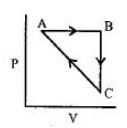
- (A) \( - 5\)
- (B) \( + 5\)
- (C) \( 18\)
- (D) \( -18\)
Show answer and solution
Correct Answer: (B)
\(\Delta {U_{AB}} = {q_{AB}} + {W_{AB}} = 2 + ( - 5) = - 3\,kJ/mol\)\(\Delta {U_{BC}} = - 5\,kJ/mol\)
For cyclic procrss, \(\Delta U=0\)
\(\Delta {U_{AB}} + \Delta {U_{BC}} + \Delta {U_{CA}} = 0\)
\(\Delta {U_{CA}} = - \Delta {U_{AB}} - \Delta {U_{BC}}\)
\(\Delta {U_{CA}} = - ( - 3) - ( - 5) = 8\,kJ/mol\)
\(\Delta {U_{CA}} = {q_{CA}} + {W_{CA}}\)
\(8 = {q_{CA}} + 3\)
\({q_{CA}} = + 5\,kJ/mol\)
Heat absorbed has positive sign.
No questions on this page match these filters.
Other STD 11 - Thermodynamics and thermochemistry topics
Frequently asked
How many First law of thermodynamics and Hess law questions came in JEE Mains?
59 questions from 2013–2026, each with the correct answer and a full solution.
How difficult are First law of thermodynamics and Hess law questions?
7% are easy, 41% medium and 53% hard.