


Questions
Newest firstShowing 1–28 of 28 questions
- 1. A body of mass \(m\) is taken from the surface of earth to a height equal to twice the radius of earth (\(R_e\)). The increase in potential energy will be _______.
(\(g\) is acceleration due to gravity at the surface of earth) 2026 Medium - 2. A satellite of \(10^3 \mathrm{~kg}\) mass is revolving in circular orbit of radius \(2 \mathrm{R}\). If \(\frac{10^4 \mathrm{R}}{6} \mathrm{~J}\) energy is supplied to the satellite, it would revolve in a new circular orbit of radius _______.
(use \(\mathrm{g}=10 \mathrm{~m} / \mathrm{s}^2, \mathrm{R}=\) radius of earth) 2024 Hard - 3. An astronaut takes a ball of mass \(m\) from earth to space. He throws the ball into a circular orbit about earth at an altitude of \(318.5 \mathrm{~km}\). From earth's surface to the orbit, the change in total mechanical energy of the ball is \(x \frac{\mathrm{GM}_e \mathrm{~m}}{21 R_e}\). The value of \(x\) is _______. (take \(R_{\mathrm{e}}=6370 \mathrm{~km}\) ) 2024 Hard
- 4. Correct formula for height of a satellite from earths surface is _______. 2024 Hard
- 5. Match list-\(I\) with list-\(II\):
(Where \(\mathrm{a}=\) radius of planet orbit, \(\mathrm{r}=\) radius of planet, \(M=\) mass of Sun, \(m=\) mass of planet)List-\(I\) List-\(II\) \((A)\)Kinetic energy of plant \((I)\) \(-\frac{\mathrm{GMm}}{\mathrm{a}}\) \((B)\) Gravaitatioin potentiyal energy of sun -plant system \((II)\) \(\frac{\mathrm{GMm}}{2 \mathrm{a}}\) \((C)\)Total mecaniacal energy of palnt \((III)\) \(\frac{\mathrm{Gm}}{\mathrm{r}}\) \((D)\)Escap energyat the surface of plant for unit mass object \((IV)\) \(-\frac{\mathrm{GMm}}{2 \mathrm{a}}\)
Choose the correct answer from the options given below: 2024 Hard - 6. To project a body of mass \(m\) from earth's surface to infinity, the required kinetic energy is _______. (assume, the radius of earth is \(R_E, g=\) acceleration due to gravity on the surface of earth) 2024 Hard
- 7. A body is released from a height equal to the radius ( \(R\) ) of the earth. The velocity of the body when it strikes the surface of the earth will be : (Given \(g\) = acceleration due to gravity on the earth.) 2023 Medium
- 8. An object is allowed to fall from a height \(R\) above the earth, where \(R\) is the radius of earth. Its velocity when it strikes the earth's surface, ignoring air resistance, will be : 2023 Medium
- 9. Given below are two statements: Statement \(I:\) If \(E\) be the total energy of a satellite moving around the earth, then its potential energy will be \(\frac{E}{2}\). Statement \(II:\) The kinetic energy of a satellite revolving in an orbit is equal to the half the magnitude of total energy \(E\). In the light of the above statements, choose the most appropriate answer from the options given below 2023 Medium
- 10. Two satellites \(A\) and \(B\) move round the earth in the same orbit. The mass of \(A\) is twice the mass of \(B\). The quantity which is same for the two satellites will be : 2023 Medium
- 11. An object of mass \(1 kg\) is taken to a height from the surface of earth which is equal to three times the radius of earth. The gain in potential energy of the object will be \(....MJ\)[If, \(g =10\,ms ^{-2}\) and radius of earth \(=6400\,km\) ] 2022 Medium
- 12. Four spheres each of mass \(m\) form a square of side \(d\) (as shown in figure). A fifth sphere of mass \(M\) is situated at the centre of square. The total gravitational potential energy of the system is
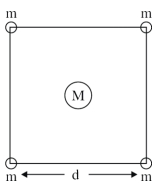 2022 Medium
- 13. Two satellites \(A\) and \(B\) having masses in the ratio \(4: 3\) are revolving in circular orbits of radii \(3\,r\) and \(4\,r\) respectively around the earth. The ratio of total mechanical energy of \(A\) to \(B\) is. 2022 Medium
- 14. A body is projected vertically upwards from the surface of earth with a velocity sufficient enough to carry it to infinity. The time taken by it to reach height \(h\) is \(....\,S.\) 2021 Hard
- 15. A body of mass (\(2 {M}\)) splits into four masses \(\{{m}, {M}-{m}, {m}, {M}-{m}\}\), which are rearranged to form a square as shown in the figure. The ratio of \(\frac{{M}}{{m}}\) for which, the gravitational potential energy of the system becomes maximum is \({x}: 1\). The value of \(x\) is ..... .
 2021 Hard
- 16. If one wants to remove all the mass of the earth to infinity in order to break it up completely. The amount of energy that needs to be supplied will be \(\frac{x}{5}\, \frac{ GM ^{2}}{ R }\) where \(x\) is \(\quad\,..........\) (Round off to the Nearest Integer) (\(M\) is the mass of earth, \(R\) is the radius of earth, \(G\) is the gravitational constant) 2021 Hard
- 17. The masses and radii of the earth and moon are \(\left({M}_{1}, {R}_{1}\right)\) and \(\left({M}_{2}, {R}_{2}\right)\) respectively. Their centres are at a distance ' \({r}\) ' apart. Find the minimum escape velocity for a particle of mass ' \({m}\) ' to be projected from the middle of these two masses: 2021 Hard
- 18. A satellite of mass \(\mathrm{m}\) is launched vertically upwards with an initial speed \(u\) from the surface of the earth. After it reaches height \(\mathrm{R}\) (\(R =\) radius of the earth), it ejects a rocket of mass \(\frac{\mathrm{m}}{10}\) so that subsequently the satellite moves in a circular orbit. The kinetic energy of the rocket is (\(G\) is the gravitational constant: \(\mathrm{M}\) is the mass of the earth) 2020 Hard
- 19. An asteroid is moving directly towards the centre of the earth. When at a distance of \(10 \mathrm{R}\) (\(R\) is the radius of the earth) from the earths centre, it has a speed of \(12 \;\mathrm{km} / \mathrm{s}\). Neglecting the effect of earths atmosphere, what will be the speed of the asteroid when it hits the surface of the earth (escape velocity from the earth is \(11.2 \;\mathrm{km} / \mathrm{s}\) ) \(?\) Give your answer to the nearest integer in \(km/s\) 2020 Hard
- 20. Two planets have masses \(M\) and \(16\, M\) and their radii are \(a\) and \(2\, a\) respectively. The separation between the centres of the planets is \(10\, a.\) A body of mass \(m\) is fired from the surface of the larger planet towards the smaller planet along the line joining their centres. For the body to be able to reach at the surface of smaller planet, the minimum firing speed needed is 2020 Hard
- 21. A rocket has to be launched from each in such a way that it never returns. If \(E\) is the minimum energy delivered by the rocket launcher, what should be the minimum energy that the launcher should have if the same rocket is to be launched from the surface of the moon ? Assume that the density of the earth and the moon are equal and that the earth’s volume is \(64\) times the volume of the moon. 2019 Hard
- 22. A satellite is moving with a constant speed \(v\) in circular orbit around the earth. An object of mass \(‘m’\) is ejected from the satellite such that it just escapes from the gravitational pull of the earth. At the time of ejection, the kinetic energy of the object is 2019 Medium
- 23. The energy required to take a satellite to a height \(‘h’\) above Earth surface (radius of Earth \(= 6.4 \times 10^3\,km\) ) is \(E_1\) and kinetic energy required for the satellite to be in a circular orbit at this height is \(E_2.\) The value of \(h\) for which \(E_1\) and \(E_2\) are equal is 2019 Hard
- 24. Two satellites, \(A\) and \(B,\) have masses \(m\) and \(2\,m\) respectively. \(A\) is in a circular orbit of radius \(R,\) and \(B\) is in a circular orbit of radius \(2R\) around the earth. The ratio of their kinetic energies, \(K.E._A / K.E._B ,\) is 2019 Medium
- 25. Two stars of masses \(3\times10^{31}\, kg\) each, and at distance \(2\times10^{11}\, m\) rotate in a plane about their common centre of mass \(O. A\) meteorite passes through \(O\) moving perpendicular to the star’s rotation plane. In order to escape from the gravitational field of this double star, the minimum speed that meteorite should have at \(O\) is : (Take Gravitational constant \(G = 6.67\times10^{-11}\, Nm^2\, kg^{-2}\)) 2019 Medium
- 26. A body of mass \(m\) is moving in a circular orbit of radius \(R\) about a planet of mass \(M\). At some instant, it splits into two equal masses. The first mass moves in a circular orbit of radius \(\frac{R}{2}\) , and the other mass, in a circular orbit of radius \(\frac{3R}{2}\). The difference between the final and initial total energies is 2018 Hard
- 27. Two hypothetical planets of masses \(m_1\) and \(m_2\) are at rest when they are infinite distance apart. Because of the gravitational force they move towards each other along the line joining their centres . What is their speed when their separation is \('d'\) ? (Speed of \(m_1\) is \(v_1\) and that of \(m_2\) is \(v_2\) )
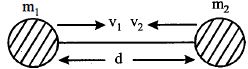 2014 Hard
- 28. What is the minimum energy required to launch a satellite of mass \(m\) from the surface of a planet of mass \(M\) and radius \(R\) in a circular orbit at an altitude of \(2R\)? 2013 Medium
No questions on this page match these filters.
Other STD 11 - Gravitation topics
Frequently asked
How many Gravitational Potential Energy, Energy Conservation questions came in JEE Mains?
28 questions from 2013–2026, each with the correct answer and a full solution.
How difficult are Gravitational Potential Energy, Energy Conservation questions?
0% are easy, 43% medium and 57% hard.