


Questions
Newest firstShowing 1–50 of 75 questions
-
- (A) Both Statement I and Statement II are true
- (B) Both Statement I and Statement II are false
- (C) Statement I is true but Statement II is false
- (D) Statement I is false but Statement II is true
Show answer and solution
Correct Answer: (A)
Statement I:
The third ionization energy (\(IE_3\)) corresponds to the removal of the third valence electron. Let us look at the electronic configurations of the divalent cations for the given metals:
\(Sc^{2+}\): \([Ar] 3d^{1}\)
\(Mn^{2+}\): \([Ar] 3d^{5}\)
\(Cu^{2+}\): \([Ar] 3d^{9}\)
\(Zn^{2+}\): \([Ar] 3d^{10}\)
For \(Sc\), removing the third electron involves taking it from the \(3d^{1}\) state, which results in a highly stable noble gas core (\([Ar]\)). Hence, \(Sc\) has the lowest \(IE_3\).
For \(Zn\), the third electron must be removed from a completely filled, highly stable \(3d^{10}\) subshell. Combined with its high effective nuclear charge (\(Z_{eff}\)) across the 3d series, \(Zn\) requires the highest energy for the removal of the third electron.
Thus, Statement I is true.
Statement II:
The Crystal Field Stabilization Energy (CFSE) depends on the magnitude of the crystal field splitting energy (\(\Delta_o\)), which in turn depends on the oxidation state of the central metal ion and the strength of the ligand.
1. Oxidation state: A higher oxidation state on the central metal ion leads to a larger \(\Delta_o\). Therefore, the splitting for \(Co^{3+}\) complexes is significantly greater than for \(Co^{2+}\) complexes. This makes the CFSE of \([Co(H_2O)_6]^{3+}\) greater than that of \([Co(H_2O)_6]^{2+}\).
2. Nature of the ligand: Ethylenediamine (\(en\)) is a strong field bidentate ligand, whereas \(H_2O\) is a weak field ligand. According to the spectrochemical series, \(en\) causes a much larger splitting than \(H_2O\). Thus, the \(\Delta_o\) and CFSE for \([Co(en)_3]^{3+}\) are greater than those for \([Co(H_2O)_6]^{3+}\).
The overall order of CFSE is:
\([Co(H_2O)_6]^{2+} < [Co(H_2O)_6]^{3+} < [Co(en)_3]^{3+}\)
Thus, Statement II is true.
Since both statements are correct, the correct option is (1).
Answer: Both Statement I and Statement II are true -
- (A) Both Statement I and Statement II are false
- (B) Statement I is true but Statement II is false
- (C) Statement I is false but Statement II is true
- (D) Both Statement I and Statement II are true
Show answer and solution
Correct Answer: (B)
Statement 1 (True)
Strength of ligand: \(Cl^{-}>Br^{-}\)
\(\Delta_{t}:[CoCl_{4}]^{2}>[CoBr_{4}]^{2-}\)
\(E_{absorbed}:[CoCl_{4}]^{2-}>[CoBr_{4}]^{2-}\)
Statement 2 (False)
Strength of ligand : \(I ^{-}< Cl ^{-}\)
\(\Delta_{t}:[CoI_{4}]^{2-}<[CoCl_{4}]^{2-}\) -
- (A) Both Statement I and Statement II are true
- (B) Both Statement I and Statement II are false
- (C) Statement I is true but Statement II is false
- (D) Statement I is false but Statement II is true
Show answer and solution
Correct Answer: (A)
\(\left[ Mn \left( H _2 O \right)_6\right]^{2+} \Rightarrow\) CFSE value is zero because of \(d ^5\) configuraiton with WFL in coordination number 6 \(\left[ Cr \left( H _2 O \right)_6\right]^{2+}\).
\(\left[ Cr \left( H _2 O \right)_6\right]^{2+} \Rightarrow\) CFSE value is \(-0.6 \Delta_0\) because of \(d ^4\) configuraiton with WFL in coordination number 6.
For : \(K _3\left[ Fe ( CN )_6\right], \mu=\sqrt{1(1+2)}=\sqrt{3}\) B.M.
For : \(Na _4\left[ Fe ( CN )_6\right], \mu=\sqrt{0}\) B.M. -
- (A) Both Statement I and Statement II are correct
- (B) Both Statement I and Statement II are incorrect
- (C) Statement I is correct but Statement II is incorrect
- (D) Statement I is incorrect but Statement II is correct
Show answer and solution
Correct Answer: (A)
In an octahedral crystal field, the five degenerate d-orbitals split into two sets: a lower energy \(t_{2g}\) set and a higher energy \(e_g\) set.
The energy of the \(t_{2g}\) orbitals is lowered by \(0.4\Delta_o\) (stabilization of \(-0.4\Delta_o\)) and the energy of the \(e_g\) orbitals is raised by \(0.6\Delta_o\) (destabilization of \(+0.6\Delta_o\)) relative to the barycenter. Hence, Statement I is correct.
In the free atomic or ionic state, all five d-orbitals of a transition metal are degenerate (have the same energy). When ligands approach the central metal ion to form a complex, the spherically symmetrical field is disrupted, which destroys the degeneracy of the d-orbitals and causes them to split. Hence, Statement II is correct.
Both Statement I and Statement II are correct.
Answer: Both Statement I and Statement II are correct -
- (A) A-I, B-II, C-III, D-IV
- (B) A-II, B-III, C-IV, D-I
- (C) A-III, B-IV, C-I, D-II
- (D) A-IV, B-I, C-II, D-III
Show answer and solution
Correct Answer: (D)
The crystal field splitting energy \(\Delta_0\) depends on the strength of the ligand.
According to the spectrochemical series, the order of ligand strength is \(F^- < H_2O < en < CN^-\).
Thus, the order of \(\Delta_0\) for the given complexes is \([CrF_6]^{3-} < [Cr(H_2O)_6]^{3+} < [Cr(en)_3]^{3+} < [Cr(CN)_6]^{3-}\).
Matching with the given values:
\([CrF_6]^{3-}\) has the minimum \(\Delta_0 = 15,060\) cm\(^{-1}\) (B \(\rightarrow\) I).
\([Cr(H_2O)_6]^{3+}\) has \(\Delta_0 = 17,400\) cm\(^{-1}\) (C \(\rightarrow\) II).
\([Cr(en)_3]^{3+}\) has \(\Delta_0 = 22,300\) cm\(^{-1}\) (D \(\rightarrow\) III).
\([Cr(CN)_6]^{3-}\) has the maximum \(\Delta_0 = 26,600\) cm\(^{-1}\) (A \(\rightarrow\) IV).
This corresponds to A-IV, B-I, C-II, D-III.
Answer: A-IV, B-I, C-II, D-III -
- (A) A-I, B-III, C-IV, D-II
- (B) A-II, B-I, C-III, D-IV
- (C) A-IV, B-II, C-I, D-III
- (D) A-III, B-I, C-IV, D-II
Show answer and solution
Correct Answer: (D)
The spin-only magnetic moment is given by the formula \(\mu = \sqrt{n(n+2)}\) BM, where \(n\) is the number of unpaired electrons.
A. \([Cr(H_2O)_6]^{2+}\): Chromium is in the \(+2\) oxidation state. The electronic configuration of \(Cr^{2+}\) is \([Ar] 3d^4\). Since \(H_2O\) is a weak field ligand, no pairing occurs. The number of unpaired electrons is \(n = 4\).
\(\mu = \sqrt{4(4+2)} = \sqrt{24} \approx 4.90\) BM. (A \(\rightarrow\) III)
B. \([Co(H_2O)_6]^{2+}\): Cobalt is in the \(+2\) oxidation state. The electronic configuration of \(Co^{2+}\) is \([Ar] 3d^7\). With \(H_2O\) as a weak field ligand, the configuration is \(t_{2g}^5 e_g^2\). The number of unpaired electrons is \(n = 3\).
\(\mu = \sqrt{3(3+2)} = \sqrt{15} \approx 3.87\) BM. (B \(\rightarrow\) I)
C. \([Cu(H_2O)_6]^{2+}\): Copper is in the \(+2\) oxidation state. The electronic configuration of \(Cu^{2+}\) is \([Ar] 3d^9\). The number of unpaired electrons is \(n = 1\).
\(\mu = \sqrt{1(1+2)} = \sqrt{3} \approx 1.73\) BM. (C \(\rightarrow\) IV)
D. \([Mn(H_2O)_6]^{2+}\): Manganese is in the \(+2\) oxidation state. The electronic configuration of \(Mn^{2+}\) is \([Ar] 3d^5\). With \(H_2O\) as a weak field ligand, the configuration is \(t_{2g}^3 e_g^2\). The number of unpaired electrons is \(n = 5\).
\(\mu = \sqrt{5(5+2)} = \sqrt{35} \approx 5.92\) BM. (D \(\rightarrow\) II)
The correct matching is A-III, B-I, C-IV, D-II.
Answer: A-III, B-I, C-IV, D-II -
- (A) A-III, B-IV, C-II, D-I
- (B) A-III, B-I, C-IV, D-II
- (C) A-III, B-IV, C-I, D-II
- (D) A-II, B-I, C-IV, D-III
Show answer and solution
Correct Answer: (C)
In a tetrahedral crystal field, the d-orbitals split into a lower energy \(e\) set and a higher energy \(t_2\) set. The energy of an electron in the \(e\) orbital is \(-0.6 \Delta_t\) and in the \(t_2\) orbital is \(+0.4 \Delta_t\). Since \(\Delta_t\) is generally small, tetrahedral complexes form high-spin configurations.
The Crystal Field Stabilization Energy (CFSE) is given by:
\(\text{CFSE} = (-0.6 n_e + 0.4 n_{t_2}) \Delta_t\)
For \(d^2\): The configuration is \(e^2 t_2^0\).
\(\text{CFSE} = 2 \times (-0.6) + 0 = -1.2 \Delta_t\) (A \(\rightarrow\) III)
For \(d^4\): The configuration is \(e^2 t_2^2\).
\(\text{CFSE} = 2 \times (-0.6) + 2 \times (0.4) = -1.2 + 0.8 = -0.4 \Delta_t\) (B \(\rightarrow\) IV)
For \(d^6\): The configuration is \(e^3 t_2^3\).
\(\text{CFSE} = 3 \times (-0.6) + 3 \times (0.4) = -1.8 + 1.2 = -0.6 \Delta_t\) (C \(\rightarrow\) I)
For \(d^8\): The configuration is \(e^4 t_2^4\).
\(\text{CFSE} = 4 \times (-0.6) + 4 \times (0.4) = -2.4 + 1.6 = -0.8 \Delta_t\) (D \(\rightarrow\) II)
Therefore, the correct match is A-III, B-IV, C-I, D-II.
Answer: A-III, B-IV, C-I, D-II -
- (A) A and B only
- (B) A, B and D only
- (C) C and D only
- (D) C, D and E only
Show answer and solution
Correct Answer: (B)
\(\left[ Ni \left( PPh _3\right)_2 Cl _2\right]\)
Given : Paramagnetic complex hence it must be tetrahedral so
Crystal field splitting :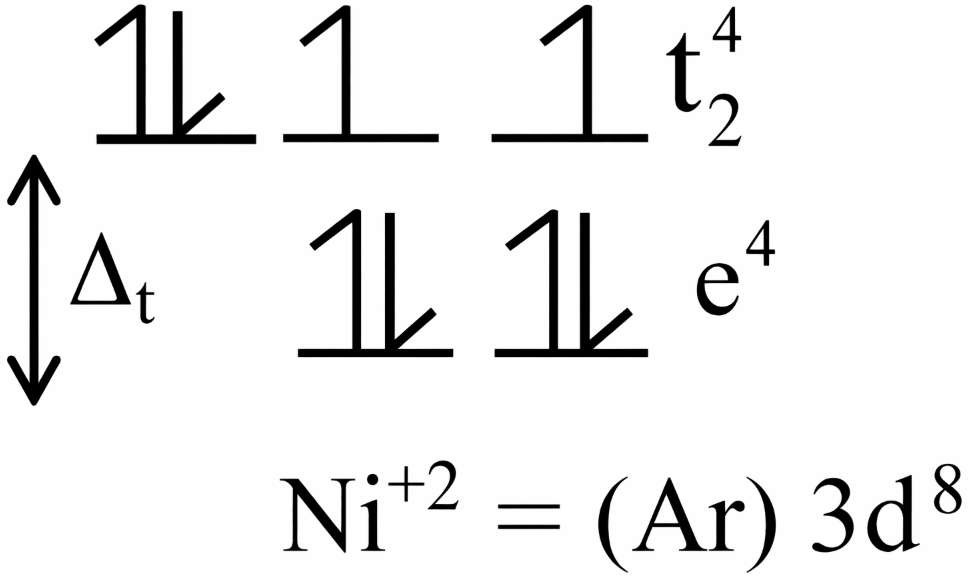
(A) Tetrahedral complex not show geometrical isomerism.
(B) Complex is Blue colour
(C) Calculated spin only magnetic moment of the complex is \(2.84 B . M\).
(D) \({C.F.S.E }=-0.6 \Delta_t(4)+0.4 \Delta_t(4)\)
\(=-0.8 \Delta_t\left(\text { not }-0.8 \Delta_0\right)\)
(E) \(Ni ( CO )_4\) also tetrahedral
Hence only A, B, D correct. -
- (A) 1
- (B) 2
- (C) 3
- (D) 4
Show answer and solution
Correct Answer: (B)
Pairing energy neglected w.r.t. \(\Delta_0\)
\(\left[ Co ( ox )_3\right]^{3-}: Co ^{+3}: d ^6 ; t _2 g^{2,2,2} eg ^{0,0}\)
\(CFSE =6 \times\left(-0.4 \Delta_0\right)=-2.4 \Delta_0\)
\(\left[ Cr \left( ox _3\right)\right]^{3-}: Cr ^{+3}: d ^3 ; t _2 g^{1,1,1} eg ^{0,0}\)
\(CFSE =3 \times\left(-0.4 \Delta_0\right)=-1.2 \Delta_0\)
\(\frac{( CFSE )_{ Co ^{+3}}}{( CFSE )_{ Cr ^{+3}}}=2\) -
- (A) 4
- (B) 6
- (C) 8
- (D) 10
Show answer and solution
Correct Answer: (B)
\(Sc ^{+3}\) 18 \(Cr ^{+2}\) 22 \(Mn ^{+3}\) 22 \(Co ^{+3}\) 24 \(Fe ^{+3}\) 23
\(Cr ^{2+}\) and \(Mn ^{3+}\) are isoelectronic
\(n =2\)
Complex is : \(\left[ Co ( en )_2 NH _3 Cl \right] Cl _2\)
\(\Rightarrow Co ^{3+} \quad 3 d^6 \quad t _{2 g}^{2,2,2} \quad e _{ g }^{0,0}\) -
- (A) C and E only
- (B) A, D and B only
- (C) B, C and E only
- (D) C and D only
Show answer and solution
Correct Answer: (C)
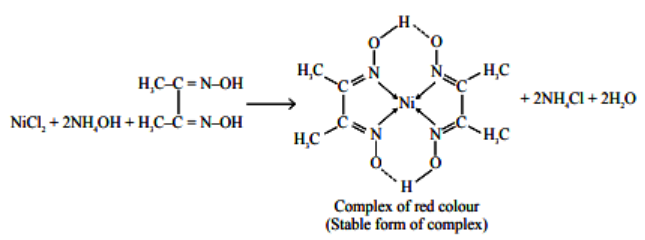
In the above complex, Ni is present in +2 oxidation number.
A) It is rosy red ppt
B) It is precipitated in basic medium
C) \(Ni ^{+2}: 3 d^8\)
Hybridisation : \(dsp ^2\)
Unpaired \(e ^{-}=0\)
Geometry : Square planar
D) \(N - Ni - N\) Bond angle is close to \(90^{\circ}\)
E) 2 five membered metal containing rings are formed. -
- (A) 15
- (B) 25
- (C) 35
- (D) 45
Show answer and solution
Correct Answer: (A)
In an octahedral complex, the d-orbitals split into \(t_{2g}\) and \(e_g\) levels.
For \(d^3\): Configuration is \(t_{2g}^3 e_g^0\). Number of unpaired electrons = \(3\).
For \(d^4\) (low spin): Configuration is \(t_{2g}^4 e_g^0\). Number of unpaired electrons = \(2\).
For \(d^5\) (high spin): Configuration is \(t_{2g}^3 e_g^2\). Number of unpaired electrons = \(5\).
For \(d^6\) (high spin): Configuration is \(t_{2g}^4 e_g^2\). Number of unpaired electrons = \(4\).
For \(d^7\) (low spin): Configuration is \(t_{2g}^6 e_g^1\). Number of unpaired electrons = \(1\).
Total number of unpaired electrons = \(3 + 2 + 5 + 4 + 1 = 15\).
Answer: \(15\) -
- (A) III < I < II < IV < V
- (B) III < I < IV < V < II
- (C) III < IV < I < II < V
- (D) III < I < IV < II < V
Show answer and solution
Correct Answer: (D)
Wavelength of light absorbed increases as C.F.S.E of complex decreases.
\([Co(CN)_{6}]^{3-}\) has maximum CFSE
\([CoF_{6}]^{3-}\) has least CFSE
Ligand field strength\(\uparrow\) ; C.F.S.E\(\uparrow\)
Correct wavelength order :
V > II > IV > I > III -
- (A) Only A, B and D
- (B) Only A and B
- (C) Only B and D
- (D) Only B, C and D
Show answer and solution
Correct Answer: (A)
In a tetrahedral complex, due to the crystal field created by ligands, the five d-orbitals split into two sets.
Ligands approach the central metal ion from in between the axes. The \(d_{xy}\), \(d_{yz}\), and \(d_{xz}\) orbitals (which form the \(t_2\) set) lie in between the axes, experience more repulsion from the ligands, and therefore have higher energy.
The \(d_{x^2-y^2}\) and \(d_{z^2}\) orbitals (which form the \(e\) set) lie along the axes, experience less repulsion, and therefore have lower energy.
Therefore, the order of energy is \(d_{xy} = d_{yz} = d_{xz} > d_{x^2-y^2} = d_{z^2}\).
Evaluating the given statements:
A. \(d_{xy} = d_{xz} > d_{x^2-y^2}\) is correct.
B. \(d_{xy} = d_{yz} > d_{z^2}\) is correct.
C. \(d_{x^2-y^2} > d_{z^2} > d_{xz}\) is incorrect.
D. \(d_{x^2-y^2} = d_{z^2} < d_{xz}\) is correct.
Hence, statements A, B, and D are correct.
Answer: Only A, B and D -
- (A) 2
- (B) 3
- (C) 4
- (D) 1
Show answer and solution
Correct Answer: (D)
Co has highest standard electrode potential \(\left(\mathrm{M}^{+3} / \mathrm{M}^{+2}\right)\) among \(\mathrm{Mn}, \mathrm{Cr}, \mathrm{Co}, \mathrm{Fe}\)
\(\therefore\) Complex is \(\left[\mathrm{Co}(\mathrm{CN})_6\right]^{4-}\) and its splitting is as follows.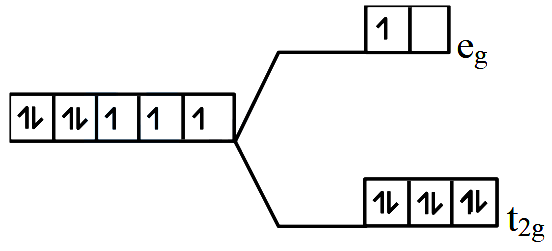
\(\therefore\) electron in \(\mathrm{e}_{\mathrm{g}}\) orbital is one. -
- (A) \(0\)
- (B) 1
- (C) 2
- (D) 3
Show answer and solution
Correct Answer: (A)
\(\mathrm{K}_3\left[\mathrm{Co}\left(\mathrm{NO}_2\right)_6\right]=\) Yellow \(\Rightarrow \mathrm{Co}^{3+}=3 \mathrm{~d}^6 \Rightarrow \mathrm{t}_{2 \mathrm{~g}}^6 \mathrm{e}_{\mathrm{g}}^0\)
\(\begin{aligned}
& \mathrm{K}_4\left[\mathrm{Fe}(\mathrm{CN})_8\right]=\text { Yellow } \Rightarrow \mathrm{Fe}^{2+}=3 \mathrm{~d}^6 \Rightarrow \mathrm{t}_{2 \mathrm{~g}}^6 \mathrm{e}_{\mathrm{g}}^0 \\
& \mathrm{~K}_3\left[\mathrm{Fe}(\mathrm{CN})_8\right]=\text { Bright Red } \Rightarrow \mathrm{Fe}^{3+}=3 \mathrm{~d}^5 \Rightarrow \mathrm{t}_{2 \mathrm{~g}}^5 \mathrm{e}_{\mathrm{g}}^0 \\
& \mathrm{Cu}_2\left[\mathrm{Fe}(\mathrm{CN})_8\right]=\text { Chocolate brown } \\
& \mathrm{Zn}_2\left[\mathrm{Fe}(\mathrm{CN})_8\right]=\text { White }
\end{aligned}\)
Spin only magnetic moment of complex having Yellow colour is zero. -
- (A) Statement I is correct but Statement II is incorrect.
- (B) Both Statement I and Statement II are incorrect
- (C) Statement I is incorrect but Statement II is correct
- (D) Both Statement I and Statement II are correct
Show answer and solution
Correct Answer: (D)
In octahedral complex \((\mathrm{CN}=6)\)
If \(\Delta_0 \lt \) P.E., then high spin complexes are formed
If \(\Delta_0 \gt \) P.E., then low spin complexes are formed But in tetrahedral complex \((\mathrm{CN}=4)\)
\(\Delta_t \lt \) P.E., then mainly high spin complexes are formed and rarely low spin complexes are formed. -
- (A) (B), (C) and (D) only
- (B) (C) and (E) only
- (C) (B) and (D) only
- (D) (A), (B) and (E) only
Show answer and solution
Correct Answer: (C)
\(\begin{aligned} & \mathrm{Fe}^{+6}=[\mathrm{Ar}] 3 \mathrm{~d}^2 \\ & \mathrm{Mn}^{+3}=[\mathrm{Ar}] 3 \mathrm{~d}^4 \\ & \mathrm{Fe}^{+3}=[\mathrm{Ar}] 3 \mathrm{~d}^5 \\ & \mathrm{Cr}^{+2}=[\mathrm{Ar}] 3 \mathrm{~d}^4 \\ & \mathrm{Ni}^{+4}=[\mathrm{Ar}] 3 \mathrm{~d}^6\end{aligned}\) -
- (A) (C) only
- (B) (C) and (D) only
- (C) (A) and (C) only
- (D) (B) and (E) only
Show answer and solution
Correct Answer: (B)
(A) \(\left[\mathrm{Fe}(\mathrm{CN})_5 \mathrm{NO}\right]^{-2} \rightarrow\) Heteroleptic, \(\mathrm{Fe}^{+2}, 3 \mathrm{~d}^6\), \(\mathrm{t}_{2 \mathrm{~g}}{ }^6 \mathrm{e}_{\mathrm{g}}{ }^0, \mathrm{~d}^2 \mathrm{sp}^3\), Low spin ( 3 d series +SFL )
(B) \(\left[\mathrm{CoF}_6\right]^{-3} \rightarrow\) Homoleptic, \(\mathrm{sp}^3 \mathrm{~d}^2\), High spin, \(\mathrm{Co}^{+3}, 3 \mathrm{~d}^6(3 \mathrm{~d}\) series + WFL \()\)
(C) \(\left[\mathrm{Fe}(\mathrm{CN})_6\right]^{-4} \rightarrow\) Homoleptic
\(\mathrm{Fe}^{+2}, 3 \mathrm{~d}^6, \mathrm{~d}^2 \mathrm{sp}^3, \mathrm{t}_{2 \mathrm{~g}}{ }^6 \mathrm{eg}^0\) Low spin
\((3 \mathrm{~d}\) series +SFL\()\)
(D) \(\left[\mathrm{Co}\left(\mathrm{NH}_3\right)_6\right]^{+3} \rightarrow\) Homoleptic, \(\mathrm{Co}^{+3} 3 \mathrm{~d}^6, \mathrm{~d}^2 \mathrm{sp}^3\),
\(\mathrm{t}_{2 \mathrm{~g}}{ }^6 \mathrm{eg}^0\), Low spin (3d series + SFL)
(E) \(\left[\mathrm{Cr}\left(\mathrm{H}_2 \mathrm{O}\right)_6\right]^{+2} \rightarrow\) Homoleptic
\(\mathrm{Cr}^{+2} 3 \mathrm{~d}^4, \mathrm{~d}^2 \mathrm{sp}^3\), High spin \(\mathrm{t}_{2 \mathrm{~g}}{ }^3 \mathrm{e}_{\mathrm{g}}{ }^1\)
(3d series + WFL) - 20. In which of the following complexes the CFSE, \(\Delta_{\mathrm{o}}\) will be equal to zero? 2025 Medium
- (A) \(\left[\mathrm{Fe}(\mathrm{en})_3\right] \mathrm{Cl}_3\)
- (B) \(\mathrm{K}_4\left[\mathrm{Fe}(\mathrm{CN})_6\right]\)
- (C) \(\left[\mathrm{Fe}\left(\mathrm{NH}_3\right)_6\right] \mathrm{Br}_2\)
- (D) \(\mathrm{K}_3\left[\mathrm{Fe}(\mathrm{SCN})_6\right]\)
Show answer and solution
Correct Answer: (D)
For complex \(\mathrm{K}_3\left[\mathrm{Fe}(\mathrm{SCN})_6\right]\)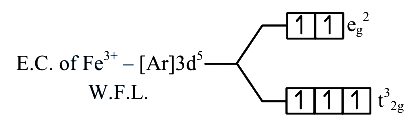
Calculation of CFSE
\(\begin{aligned}
& =(-0.4 \times 3+0.6 \times 2) \Delta_0 \\
& =0 \Delta_0
\end{aligned}\) - 21. The conditions and consequence that favours the \(t_{2 g}^3 e_g^1\) configuration in a metal complex are _______. 2025 Medium
- (A) weak field ligand, low spin complex
- (B) weak field ligand, high spin complex
- (C) strong field ligand, high spin complex
- (D) strong field ligand, low spin complex
Show answer and solution
Correct Answer: (B)
The conditions and consequence that favour \(t_{2 g}^3 e_g^1\) configuration in a metal complex are
(i) weak field ligand, and
(ii) high spin complex
For weak field ligands, splitting energy ( \(\Delta_0\) ) is lower than pairing energy \((P)\). As a result distribution of electrons for \(3 \mathrm{~d}^4\) will be \(t_{2 \mathrm{~g}}^3 \mathrm{e}_{\mathrm{g}}^1\). It results in high spin complex due to maximum number of unpaired electrons. -
- (A) D > A > B > C
- (B) C > B > D > A
- (C) D > C > B > A
- (D) C > B > A > D
Show answer and solution
Correct Answer: (A)
We know \(\mathrm{E}=\mathrm{h} v=\frac{\mathrm{hC}}{\lambda}\)
\(\mathrm{E} \propto \frac{1}{\lambda}\)
Here all Co in +3 oxidation state.
So, as the ligand field strength \(\uparrow, \operatorname{CFSE} \uparrow\)
Order of field strength of ligand :
\(\mathrm{CN} \gt \mathrm{NH}_3 \gt \mathrm{H}_2 \mathrm{O} \gt \mathrm{Cl}^{-}\)
CFSE order : \(\mathrm{C} \gt \mathrm{B} \gt \mathrm{A} \gt \mathrm{D}\)
Wavelength order: \(\mathrm{D} \gt \mathrm{A} \gt \mathrm{B} \gt \mathrm{C}\) - 23. The correct order of the following complexes in terms of their crystal field stabilization energies is _______. 2025 Hard
- (A) \(\left[\mathrm{Co}\left(\mathrm{NH}_3\right)_4\right]^{2+} \lt \left[\mathrm{Co}\left(\mathrm{NH}_3\right)_6\right]^{2+} \lt \left[\mathrm{Co}(\mathrm{en})_3\right]^{3+} \lt \left[\mathrm{Co}\left(\mathrm{NH}_3\right)_6\right]^{3+}\)
- (B) \(\left[\mathrm{Co}\left(\mathrm{NH}_3\right)_6\right]^{2+} \lt \left[\mathrm{Co}\left(\mathrm{NH}_3\right)_6\right]^{3+} \lt \left[\mathrm{Co}\left(\mathrm{NH}_3\right)_4\right]^{2+} \lt \left[\mathrm{Co}(\mathrm{en})_3\right]^{3+}\)
- (C) \(\left[\mathrm{Co}(\mathrm{en})_3\right]^{3+} \lt \left[\mathrm{Co}\left(\mathrm{NH}_3\right)_6\right]^{3+} \lt \left[\mathrm{Co}\left(\mathrm{NH}_3\right)_6\right]^{2+} \lt \left[\mathrm{Co}\left(\mathrm{NH}_3\right)_4\right]^{2+}\)
- (D) \(\left[\mathrm{Co}\left(\mathrm{NH}_3\right)_4\right]^{2+} \lt \left[\mathrm{Co}\left(\mathrm{NH}_3\right)_6\right]^{2+} \lt \left[\mathrm{Co}\left(\mathrm{NH}_3\right)_6\right]^{3+} \lt \left[\mathrm{Co}(\mathrm{en})_3\right]^{3+}\)
Show answer and solution
Correct Answer: (D)
Crystal field splitting energy \((\Delta) \propto\) charge or oxidation state of central metal atom.
Crystal field splitting energy \((\Delta) \propto\) Field strength of ligand (and chelation)
Crystal field stabilisation energy (CFSE) \(=\left[-0.4 \mathrm{t}_{\mathrm{g}_g}\right.\) +0.6 eg] \(\Delta_{\circ}\) (for octahedral)
For,
\(\begin{aligned} & {\left[\mathrm{Co}(\mathrm{en})_3\right]^{3+}: \mathrm{Co}^{3+}: \mathrm{t}_{2 \mathrm{~g}}^6 \mathrm{eg}^0 ; \mathrm{CFSE}=-2.4\left(\Delta_0\right)_1} \\ & {\left[\mathrm{Co}\left(\mathrm{NH}_3\right)_6\right]^{3+}: \mathrm{Co}^{3+}: \mathrm{t}_{2 \mathrm{~g}}^6 \mathrm{eg}^0 ; \mathrm{CFSE}=-2.4\left(\Delta_0\right)_2} \\ & {\left[\mathrm{Co}\left(\mathrm{NH}_3\right)_6\right]^{2+}: \mathrm{Co}^{2+}: \mathrm{t}_{2 g}^5 \mathrm{eg}^2 ; \mathrm{CFSE}=-0.8\left(\Delta_0\right)_3} \\ & {\left[\mathrm{Co}\left(\mathrm{NH}_3\right)_4\right]^{2+}: \mathrm{Co}^{2+}: \mathrm{e}^4 \mathrm{t}_2^3 ; \mathrm{CFSE}=-1.2 \Delta_{\mathrm{t}}} \\ & \left(\mathrm{as}:\left(\Delta_{\mathrm{t}}\right)=\frac{4}{9}\left(\Delta_0\right)_3\right) \\ & \because \Delta_{\mathrm{t}} < \left(\Delta_0\right)_3 < \left(\Delta_0\right)_2 < \left(\Delta_0\right)_1\end{aligned}\) - 24. The d- electronic configuration of an octahedral Co(II) complex having magnetic moment of 3.95 BM is _______. 2025 Medium
- (A) \(\mathrm{t}_{2 \mathrm{~g}}{ }^3 \mathrm{e}_{\mathrm{g}}{ }^0\)
- (B) \(\mathrm{t}_{2 \mathrm{~g}}{ }^6 \mathrm{e}_{\mathrm{g}}{ }^1\)
- (C) \(\mathrm{t}_{2 \mathrm{~g}}{ }^5 \mathrm{e}_{\mathrm{g}}{ }^2\)
- (D) \(\mathrm{e}^4 \mathrm{t}_2{ }^3\)
Show answer and solution
Correct Answer: (C)
\(\mathrm{Co}^{2+}\) complex having \(\mu=3.95 \mathrm{BM}\)
Hence number of unpaired electron \(=3\)
\(\mathrm{Co}^{2+} \Rightarrow 3 d^7=\mathrm{t}_{2 \mathrm{~g}}^5 \mathrm{e}_{\mathrm{g}}^2\) -
- (A) \(t_2^6 g_g^0\)
- (B) \(t_2^6 e_g^4\)
- (C) \(t_{2 g}^3 e_g^2\)
- (D) \(t_2^4 e_g^2\)
Show answer and solution
Correct Answer: (A)
In \(\left[\mathrm{Co}(\mathrm{en})_3\right]^{+3}\) S.F.L. is present and hence highest value of CFSE
In rest all complexes WFL is present hence CFSE will be low.
\(\left[\mathrm{Co}(\mathrm{en})_3\right]^{+3} \Rightarrow \mathrm{Co}^{+3}\) and en (SFL)
\(\mathrm{Co}^{+3} \Rightarrow[\mathrm{Ar}] 3 \mathrm{~d}^6\)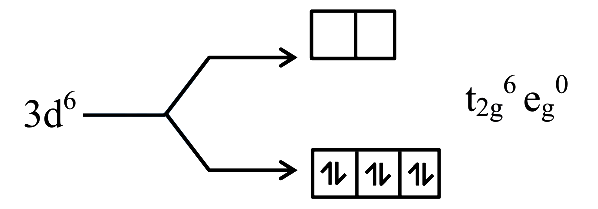
- 26. When Ethane-1,2-diamine is added progressively to an aqueous solution of Nickel (II) chloride, the sequence of colour change observed will be : 2025 Medium
- (A) Violet → Blue → Pale Blue → Green
- (B) Pale Blue → Blue → Green → Violet
- (C) Green → Pale Blue → Blue → Violet
- (D) Pale Blue → Blue → Violet → Green
Show answer and solution
Correct Answer: (C)
\(\left[ Ni \left( H _2 O \right)_6\right]_{( aq )}^{+2}+ en _{( aq )} \rightarrow\left[ Ni \left( H _2 O \right)_4( en )\right]_{( aq )}^{+2}+2 H _2 O\)
Green
\(\left[ Ni \left( H _2 O \right)_4( en )\right]_{( aq )}^{+2}+ en _{( aq )} \rightarrow\left[ Ni \left( H _2 O \right)_2( en )_2\right]_{( aq )}^{+2}+2 H _2 O\)
Pale Blue
\(\left[ Ni \left( H _2 O \right)_2( en )\right]_{( aq )}^{+2}+ en _{( aq )} \rightarrow\left[ Ni ( en )_3\right]_{( aq )}^{+2}+2 H _2 O\)
Blue / purple -
- (A) \(\left[\mathrm{Fe}(\mathrm{CN})_6\right]^4\)
- (B) \(\left[\mathrm{CO}\left(\mathrm{NH}_3\right)_6\right]^{3+}\)
- (C) \(\left[\mathrm{FeF}_6\right]^4\)
- (D) \(\left[\mathrm{Mn}(\mathrm{SCN})_6\right]^4\)
Show answer and solution
Correct Answer: (D)
(1) \(\left[\mathrm{Co}\left(\mathrm{NH}_3\right)_6\right]^{3+} \quad \mathrm{Co}^{3+} \Rightarrow 3 \mathrm{~d}^6 4 \mathrm{~s}^0\)
\(=[-0.4 \times 6+0.6 \times(0)] \Delta_0=-2.4 \Delta_0\)
(2)
\(\begin{aligned}
& {\left[\mathrm{Mn}(\mathrm{SCN})_6\right]^4} \\
& \mathrm{Mn}^{2+} \Rightarrow 3 \mathrm{~d}^5 4 \mathrm{~s}^0
\end{aligned}\)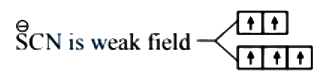
\(\begin{aligned}
& \mu=\sqrt{35} \text { B.M. }=5.96 \text { B.M. } \\
& \mathrm{CFSE}=(-0.4 \times 3+0.6 \times 2) \Delta_0
\end{aligned}\)
So \(\Delta_0=0\)
(3)
\(\begin{aligned}
& {\left[\mathrm{Fe}(\mathrm{CN})_6\right]^{-4} \quad \mathrm{Fe}^{2+} \Rightarrow 3 \mathrm{~d}^6 4 \mathrm{~s}^0}
\end{aligned}\)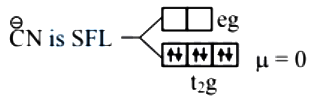
\(\mathrm{CFSE}=-2.4 \Delta_0\)
(4) \(\left[\mathrm{FeF}_6\right]^{4-}\)
\(\mathrm{Fe}^{2+} \Rightarrow 3 \mathrm{~d}^6 4 \mathrm{~s}^0\)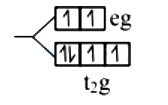
\(\begin{aligned}
& \mu=\sqrt{24} \text { B.M. }=4.89 \text { B.M. } \\
& \text { CFSE }=(-0.4 \times 4+0.6 \times 2) \Delta_0=-1.2 \Delta_0
\end{aligned}\) -
- (A) Spin free Complex, Spin paired Complex
- (B) Spin paired Complex, Spin free Complex
- (C) Outer orbital Complex, Inner orbital Complex
- (D) Inner orbital Complex, Spin paired Complex
Show answer and solution
Correct Answer: (B)
\({\left[\mathrm{Co}\left(\mathrm{NH}_3\right)_6\right]^{3+}}\)\(\mathrm{Co}^{3+}(\text { strong field ligand }) \Rightarrow 3 \mathrm{~d}^6\left(\mathrm{t}_{2 \mathrm{~g}}^6, \mathrm{e}_{\mathrm{g}}^0\right),\)
Hybridisation : \(d^2 \mathrm{sp}^3\)
Inner obital complex (spin paired complex) Pairing will take place.
\(\left[\mathrm{CoF}_6\right]^{3-}\)
\(\mathrm{Co}^{3+}\) (weak field ligand) \(\Rightarrow 3 \mathrm{~d}^6\left(\mathrm{t}_{2 \mathrm{~g}}^4, \mathrm{e}_{\mathrm{g}}^2\right)\)
Hybridisation : \(\mathrm{sp}^3 \mathrm{~d}^2\)
Outer orbital complex (spin free complex) no pairing will take place.
-
- (A) \(5\)
- (B) \(6\)
- (C) \(3\)
- (D) \(4\)
Show answer and solution
Correct Answer: (B)
Complex is\(\left[\mathrm{III}\left(\mathrm{NH}_3\right)_2(\mathrm{CN})_4\right]^{\Theta}\)\( x=2\)
\(y=4\)
\(\text { so } x+y=6\)
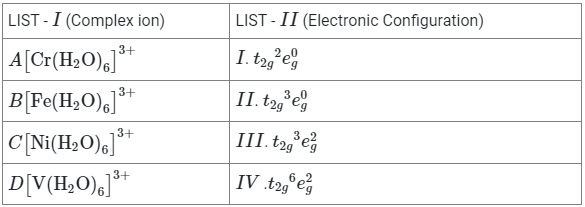
- 30. Match List \(I\) with List \(II\).Choose the correct answer from the options given below :
 2024 Hard
- (A) \(A-III, B-II, C-IV, D-I\)
- (B) \(A-IV, B-I, C-II, D-III\)
- (C) \(A-IV, B-III, C-I, D-II\)
- (D) \(A-II, B-III, C-IV, D-I\)
Show answer and solution
Correct Answer: (D)
\({\left[\mathrm{Cr}\left(\mathrm{H}_2 \mathrm{O}\right)_6\right]^{3+} \text { Contains } \mathrm{Cr}^{3+}:[\mathrm{Ar}] 3 \mathrm{~d}^3: \mathrm{t}_{2 \mathrm{~g}}^3 \mathrm{e}_{\mathrm{g}}^{\mathrm{o}}}\)\({\left[\mathrm{Fe}\left(\mathrm{H}_2 \mathrm{O}\right)_6\right]^{3+} \text { Contains } \mathrm{Fe}^{3+}:[\mathrm{Ar}] 3 \mathrm{~d}^5: \mathrm{t}_{2 \mathrm{~g}}^3 \mathrm{e}_{\mathrm{g}}^2}\)
\({\left[\mathrm{Ni}\left(\mathrm{H}_2 \mathrm{O}\right)_6\right]^{2+} \text { Contains } \mathrm{Ni}^{2+}:[\mathrm{Ar}] 3 \mathrm{~d}^8: \mathrm{t}_{2 \mathrm{~g}}^6 \mathrm{e}_{\mathrm{g}}^2}\)
\({\left[\mathrm{~V}\left(\mathrm{H}_2 \mathrm{O}\right)_6\right]^{3+} \text { Contains } \mathrm{V}^{3+}:[\mathrm{Ar}] 3 \mathrm{~d}^2: \mathrm{t}_{2 \mathrm{~g}}^2 \mathrm{e}_{\mathrm{g}}^{\circ}}\)
-
- (A) (A)-(III), (B)-(IV), (C)-(II), (D)-(I)
- (B) (A)-(IV), (B)-(III), (C)-(I), (D)-(II)
- (C) (A)-(III), (B)-(I), (C)-(IV), (D)-(II)
- (D) (A)-(I), (B)-(III), (C)-(IV), (D)-(II)
Show answer and solution
Correct Answer: (C)
(A)-(III), (B)-(I), (C)-(IV), (D)-(II) -
- (A) \(2\)
- (B) \(4\)
- (C) \(5\)
- (D) \(1\)
Show answer and solution
Correct Answer: (A)
\({\left[\mathrm{V}\left(\mathrm{H}_2 \mathrm{O}\right)_6\right]^{3+} \rightarrow \mathrm{d}^2 \mathrm{sp}^3}\)\({ }_{23} \mathrm{~V}:-[\mathrm{Ar}] 3 \mathrm{~d}^3 4 \mathrm{~s}^2\)
\(\mathrm{~V}^{+j}:-[\mathrm{Ar}] 3 \mathrm{~d}^2, \mathrm{n}=2 \text { (even number of unpaired e) }\)
\({\left[\mathrm{Cr}\left(\mathrm{H}_2 \mathrm{O}\right)_6\right]^{2+} \rightarrow \mathrm{sp}^3 \mathrm{~d}^2}\)
\({ }_{24} \mathrm{Cr}:-[\mathrm{Ar}] 3 \mathrm{~d}^5 4 \mathrm{~s}^1\)
\(\left.\mathrm{Cr}^{+2}:-[\mathrm{Ar}] 3 \mathrm{~d}^4, \mathrm{n}=4 \text { (even number of unpaired } \mathrm{e}^{-}\right)\)
\({\left[\mathrm{Fe}\left(\mathrm{H}_2 \mathrm{O}\right)_6\right]^{3+} \rightarrow \mathrm{sp}^3 \mathrm{~d}^2}\)
\(\mathrm{Fe}^{3+}:-[\mathrm{Ar}] 3 \mathrm{~d}^5 4 \mathrm{~s}^0\)
\(\mathrm{n}=5 \text { (odd number of unpaired } \mathrm{e}^{-} \text {) }\)
\({\left[\mathrm{Ni}\left(\mathrm{H}_2 \mathrm{O}\right)_6\right]^{3+} \rightarrow \mathrm{sp}^3 \mathrm{~d}^2}\)
\(\mathrm{Ni}:-[\mathrm{Ar}] 3 \mathrm{~d}^8 4 \mathrm{~s}^2\)
\(\mathrm{Ni}^{+3}:-[\mathrm{Ar}] 3 \mathrm{~d}^7, \mathrm{n}=3 \text { (odd number of unpaired } \mathrm{e}^{-} \text {) }\)
\({\left[\mathrm{Cu}\left(\mathrm{H}_2 \mathrm{O}\right)_6\right]^{2+} \rightarrow \mathrm{sp}^3 \mathrm{~d}^2}\)
\(\mathrm{Cu}:-[\mathrm{Ar}] 3 \mathrm{~d}^9 4 \mathrm{~s}^0\)
\(\mathrm{n}=1 \text { (odd number of unpaired } \mathrm{e}^{-} \text {) }\)

-
- (A) \(3\)
- (B) \(1\)
- (C) \(4\)
- (D) \(2\)
Show answer and solution
Correct Answer: (A)
\(\mathrm{TiCl}_4 \Rightarrow \mathrm{Ti}^{+4} \mathrm{e}^0 \mathrm{t}_2^0\)\(\mathrm{MnO}_4^{-} \Rightarrow \mathrm{Mn}^{+7} \mathrm{e}^0 \mathrm{t}_2^0\)
\(\mathrm{FeO}_4^{2-} \Rightarrow \mathrm{Fe}^{+6} \mathrm{e}^2 \mathrm{t}_2^0\)
\(\mathrm{FeCl}_4^{2-} \Rightarrow \mathrm{Fe}^{+2} \mathrm{e}^3 \mathrm{t}_2^3\)
\(\mathrm{CoCl}_4^{2-} \Rightarrow \mathrm{Co}^{+2} \mathrm{e}^4 \mathrm{t}_2^3\)
- 34. The number of unpaired d-electrons in \(\left[\mathrm{Co}\left(\mathrm{H}_2 \mathrm{O}\right)_6\right]^{3+}\) is _______. 2024 Medium
- (A) \(4\)
- (B) \(2\)
- (C) \(0\)
- (D) \(1\)
Show answer and solution
Correct Answer: (C)
\(\Rightarrow\left[\mathrm{Co}\left(\mathrm{H}_2 \mathrm{O}\right)_6\right]^{+3}\)No unpaired electrons

-
- (A) \(5\)
- (B) \(3\)
- (C) \(1\)
- (D) \(2\)
Show answer and solution
Correct Answer: (D)
\(\mathrm{Co}^{+3}: 3 d^6 \quad t_{2 g}^{2,2,2} e_g^{0,0}\)\(\text { Unpaired } e^{-}=0\)
\(\mathrm{Ni}^{+2}: 3 d^8 \quad e^{2,2} t_2^{2,1,1}\)
\(\text { Unpaired } e^{-}=2\)
-
- (A) \(481\)
- (B) \(482\)
- (C) \(480\)
- (D) \(483\)
Show answer and solution
Correct Answer: (C)
\(\left( Ti ^{+3}\left( H _2 O \right)_6\right)^{3+}\)\(Ti ^{+3}: 3 d ^1\)
\(C.F.S.E.\) \(=-0.4 \times \Delta_0\)
\(=-\frac{96 \times 10^3}{ N _0}\,J\)
\(\Delta_0=\frac{96 \times 10^3}{0.4 \times 6 \times 10^{23}}\)
\(\frac{ hc }{\lambda}=\frac{96 \times 10^3}{0.4 \times 6 \times 10^{23}}\)
\(\lambda=\frac{0.4 \times 6 \times 10^{23} \times 6.4 \times 10^{-34} \times 3 \times 10^8}{96 \times 10^3}\)
\(=0.48 \times 10^{-6}\,m\)
\(=480 \times 10^{-9}\,m\)
\(=480\,nm\)
- 37. In potassium ferrocyanide, there are \(..........\) pairs of electrons in the \(t _{2 g }\) set of orbitals 2023 Medium
- (A) \(4\)
- (B) \(3\)
- (C) \(2\)
- (D) \(1\)
Show answer and solution
Correct Answer: (B)
\(K _4\left[ Fe ( CN )_6\right]\)\(Fe ^{+2}=[ Ar ] 3 d ^6\)
\(CN ^{-}= SFL\)
\(t _{2 g }\) contain \(6\) electron so it become \(3\) pairs:-

-
- (A) \(A-I, B-IV, C-II, D-III\)
- (B) \(A-II, B-III, C-I, D-IV\)
- (C) \(A-I, B-II, C-IV, D-III\)
- (D) \(A-III, B-IV, C-I, D-II\)
Show answer and solution
Correct Answer: (A)
CFSE \(=\left(-0.4 nt _{2 g }+0.6 n _{ eg }\right) \Delta_0\)\(nt _{2 g }=\) number of electrons in \(t _{2 g }\) orbital
\(n_{ eg }=\) number of electrons in eg orbital
-
- (A) \(A-II, B-IV, C-I, D-III\)
- (B) \(A-IV, B-I, C-II, D-III\)
- (C) \(A-IV, B-I, C-III, D-II\)
- (D) \(A-II, B-IV, C-III, D-I\)
Show answer and solution
Correct Answer: (B)
(A) \({\left[ Ti \left( H _2 O \right)_6\right]^{2+}}\)\(Ti ^{2+} \Rightarrow 3 d ^2 4 s ^0\)
\(t _{2 g } e ^{-}=2\)
\(e _{ g } e ^{-}=0\)
\(CFSE =[-0.4 \times 2+0.6 \times 0] \Delta_0\)
\(-0.8\,\Delta\)
(B) \({\left[ V \left( H _2 O \right)_6\right]^{2+}}\)
\(V ^{2+} \Rightarrow 3 d ^3 4 s ^0\)
\(t _{2 g } e ^{-}=3\)
\(e _{ g } e ^{-}=0\)
\(CFSE =[-0.4 \times 3+0.6 \times 0] \Delta_0\)
\(-1.2 \Delta_0\)
(C) \({\left[ Mn \left( H _2 O \right)_6\right]^{3+}}\)
\(Mn ^{3+} \Rightarrow 3 d ^4 4 s ^0\)
\(t _{2 g } e ^{-}=3\)
\(e _{ g } e ^{-}=1\)
\(CFSE =[-0.4 \times 3+0.6 \times 1] \Delta_0\)
\(=-0.6 \Delta_0\)
(D) \({\left[ Fe \left( H _2 O \right)_6\right]^{3+}}\)
\(Fe ^{3+} \Rightarrow 3 d ^5 4 s ^0\)
\(t _{2 g } e ^{-}=3 \quad e _{ g }=2\)
\(CFSE =[-0.4 \times 3+0.6 \times 2] \Delta_0\)
\(=0 \Delta_0\)
-
- (A) \(A-IV, B-I, C-III, D-II\)
- (B) \(A-III, B-II, C-I, D-IV\)
- (C) \(A-III, B-I, C-II, D-IV\)
- (D) \(A- II, B-III, C-IV, D-I\)
Show answer and solution
Correct Answer: (B)
List \(I\) (Coordination entity) List \(II\) (Wavelength of light absorbed in \(nm\)) \(A\) \({\left[ CoCl \left( NH _3\right)_5\right]^{2+}}\) \(I\) \(535\) \(B\) \({\left[ Co \left( NH _3\right)_6\right]^{3+}}\) \(II\) \(475\) \(C\) \({\left[ Co ( CN )_6\right]^{3-}}\) \(III\) \(310\) \(D\) \({\left[ Cu \left( H _2 O \right)_4\right]^{2+}}\) \(IV\) \(600\) \(E =\frac{ hc }{\lambda} \Rightarrow E \propto \frac{1}{\lambda}\)
\(\Rightarrow \Delta( CFSE ) \propto \frac{1}{\lambda_{\text {absorb }}} \propto \text { strength of ligand. }\)
- 41. The complex with highest magnitude of crystal field splitting energy \(\left(\Delta_0\right)\) is 2023 Medium
- (A) \(\left[ Cr \left( OH _2\right)_6\right]^{3+}\)
- (B) \(\left[ Ti \left( OH _2\right)_6\right]^{3+}\)
- (C) \(\left[ Fe \left( OH _2\right)_6\right]^{3+}\)
- (D) \(\left[ Mn \left( OH _2\right)_6\right]^{3+}\)
Show answer and solution
Correct Answer: (A)
\(Ti ^{+3}=67\,pm\) radius\(Cr ^{3+}=62\,pm\) radius
\(Mn ^{+3}=65\, pm\) radius
\(Fe ^{+3}=65\, pm\) radius
So, \(Cr ^{3+}\) has highest tendency to attract ligand.
-
- (A) \(6\)
- (B) \(5\)
- (C) \(7\)
- (D) \(8\)
Show answer and solution
Correct Answer: (C)
\(Co ^{2+}: 3 d ^7 4 s ^0, Cl ^{-}: WFL\)Configuration \(e ^4 t _2^3: m =4\)
Number of unpaired electrons \(=3\)
So, answer \(=7\)

-
- (A) \(1\)
- (B) \(2\)
- (C) \(3\)
- (D) \(4\)
Show answer and solution
Correct Answer: (A)
\(Co ^{2+}: 3 d ^7\) configuration\(t _{2 g }^{221} e _{ g }^{11}\)
-
- (A) The order of spectrochemical series
- (B) Magnetic properties of transition metal complexes
- (C) Colour of metal complexes
- (D) Stability of metal complexes
Show answer and solution
Correct Answer: (D)
Crystal field theory introduce spectrochemical series based upon the experimental values of \(\Delta\) but can't explain it's order. While other three points are explained by \(CFT\). Specially when the \(CFSE\) increases thermodynamic stability of the complex increases. - 45. Which of the following complexes will exhibit maximum attraction to an applied magnetic field? 2023 Medium
- (A) \(\left[ Zn \left( H _2 O \right)_6\right]^{2+}\)
- (B) \(\left[ Co \left( H _2 O \right)_6\right]^{2+}\)
- (C) \(\left[ Co ( en )_3\right]^{3+}\)
- (D) \(\left[ Ni \left( H _2 O _6\right]^{2+}\right.\)
Show answer and solution
Correct Answer: (B)
Complex with maximum number of unpaired electron will exhibit maximum attraction to an applied magnetic field\({\left[ Zn \left( H _2 O \right)_6\right]^{2+} \rightarrow d ^{10} \text { system } \rightarrow t _{2 g }^6 eg ^4, 0 \text { unpaired } e ^{-}}\)
\({\left[ Co \left( H _2 O \right)_6\right]^{2+} \rightarrow d ^7 \text { system } \rightarrow t _{2 g }^5 eg ^2, 3 \text { unpaired } e ^{-}}\)
\({\left[ Co ( en )_3\right]^{3+} \rightarrow d ^6 \text { system } \rightarrow t _{2 g }^6 eg ^0, 0 \text { unpaired } e ^{-}}\)
\({\left[ Ni \left( H _2 O _6\right]^{2+} \rightarrow d ^8 \text { system } \rightarrow t _{2 g }^6 \text { eg }^2, 2 \text { unpaired } e ^{-}\right.}\)
-
- (A) \(3\)
- (B) \(0\)
- (C) \(2\)
- (D) \(1\)
Show answer and solution
Correct Answer: (B)
\(\Delta_{0} \propto \frac{1}{\lambda}\)Here, \(CN\) being SFL will have maximum \(CFSE\) So, \(\left[ Co ( CN )_{6}\right]^{3-}\) will be \(d ^{2} sp ^{3}, \mu=0\)
-
- (A) \(5\)
- (B) \(4\)
- (C) \(3\)
- (D) \(2\)
Show answer and solution
Correct Answer: (D)
\(\left[ Fe ( CN )_{6}\right]^{3-}\)\(CN ^{-}\)is strong field ligand
\(Fe ^{+3}\; 3 d ^{5}\;(t_{2 g}^{5} e_{g}^{0})\)
\(\text { CFSE }=5\left(-0.4 \Delta_{0}\right)=-2.0 \Delta_{0}\)

-
- (A) \(766\)
- (B) \(852\)
- (C) \(412\)
- (D) \(344\)
Show answer and solution
Correct Answer: (A)
\(\Delta_{ t }=\frac{ hc }{\lambda}=\frac{6.63 \times 10^{-34} \times 3.08 \times 10^{8}}{600 \times 10^{-9}}\)\(=\frac{6.63 \times 3.08 \times 10^{-17}}{600}\)
\(=0.034034 \times 10^{-17}\)
\(=340.34 \times 10^{-21} \,J\)
\(\Delta_{0}=\frac{9}{4} \Delta_{ t }\)
\(=\frac{9}{4} \times 340.34 \times 10^{-21}\)
\(=765.765 \times 10^{-21}\, J\)
\(\approx 766 \times 10^{-21} \,J\)
-
- (A) \([ Cu ( H _{2} O )_{6}] SO _{4}\)
- (B) \([ Cu ( en )( H _{2} O )_{4}] SO _{4}\)
- (C) cis- \([ Cu ( en )_{2} Cl _{2}]\)
- (D) trans- \([ Cu ( en )_{2} Cl _{2}]\)
Show answer and solution
Correct Answer: (A)
There is unsymmetric filling of \(e_{g}\) subset of \(Cu ^{+2} \;ion\), while there is symmetrical distribution in \(t _{2 g }\) set, if the complex has same ligand there will be equal repulsion which leads to symmetrical bond length along \(t _{2 g }\) , but due to uneven filling of electron in \(e _{ g }\) subset, either octahedral will be elongated or compressed. -
- (A) \(4\)
- (B) \(6\)
- (C) \(3\)
- (D) \(2\)
Show answer and solution
Correct Answer: (B)
\(\left[ Co \left( H _{2} O \right)_{6}\right]^{2+}+ NH _{3}(\) excess \() \rightarrow\left[ Co \left( NH _{3}\right)_{6}\right]^{3+}+6 H _{2} O\)Diamagnetic \(\rightarrow\) Low spin complex
\(Co ^{3+} \Rightarrow 3 d ^{6} 4 s ^{0}\)
\(\Rightarrow t _{2 g }{ }^{6} e _{ g }{ }^{0}\)
Total number electrons \(=6\)
No questions on this page match these filters.
Other STD 12 - Co-ordination chemistry topics
Frequently asked
How many Crystal Field theory questions came in JEE Mains?
75 questions from 2013–2026, each with the correct answer and a full solution.
How difficult are Crystal Field theory questions?
13% are easy, 47% medium and 40% hard.