


Questions
Newest firstShowing 1–24 of 24 questions
-
- (A) Statement I is true but Statement II is false
- (B) Both Statement I and Statement II are true
- (C) Both Statement I and Statement II are false
- (D) Statement I is false but Statement II is true
Show answer and solution
Correct Answer: (D)
Statement-I : False but Statement-II is true.
On moving left to right in periodic table nonmetallic character increases and we know that nonmetal oxides are acidc in nature.
Non metallic character \(\uparrow\) Acidic strength of oxide \(\uparrow\) - 2. The element that does not belong to the same period of the remaining elements (modern periodic table) is _______. 2025 Easy
- (A) Iridium
- (B) Platinum
- (C) Osmium
- (D) Palladium
Show answer and solution
Correct Answer: (D)
Palladium \(\Rightarrow 5^{\text {th }}\) period
Iridium, Osmium, Platinum \(\Rightarrow 6^{\text {th }}\) Period -
- (A) \(\mathrm{A}, \mathrm{C}\) and E Only
- (B) A and E Only
- (C) \(\mathrm{B}, \mathrm{C}\) and E Only
- (D) D and E Only
Show answer and solution
Correct Answer: (A)
Properties of elements are function of atomic numbers.
Elements having similar outer electronic configuration are arranged in same group.
Number of elements in a period is double of number of atomic orbitals available in energy level that is being filled. -
- (A) Statement \(I\) is false but Statement \(II\) is true
- (B) Both Statement \(I\) and Statement \(II\) are true
- (C) Statement \(I\) is true but Statement \(II\) is false
- (D) Both Statement \(I\) and Statement \(II\) are false
Show answer and solution
Correct Answer: (C)
s-block elements are highly reactive and found in combined state. - 5. If \(IUPAC \) name of an element is \("unununium"\) then correct statement regarding element is 2024 Hard
- (A) It is a inner transition element
- (B) It belongs to \(8^{th}\) period in periodic table
- (C) It is transition element
- (D) It is a non-transition element
Show answer and solution
Correct Answer: (C)
\((c)\) \("Unununium"\) : At number \(= 111\)
It is a transition element. Period number \(= 7^{th}\); Group number \(= 11\) - 6. If IUPAC name of an element is "Unununnium" then the element belongs to nth group of periodic table. The value of n is _______. 2024 Medium
- (A) 11
- (B) 22
- (C) 33
- (D) 44
Show answer and solution
Correct Answer: (A)
111 belongs to \(11^{\text {th }}\) group -
- (A) \(1\)
- (B) \(2\)
- (C) \(0.5\)
- (D) \(3\)
Show answer and solution
Correct Answer: (C)
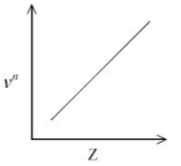
According to Henry Moseley \(\sqrt{v}\,\alpha z - b\)So \(n =\frac{1}{2}\)
-
- (A) \(A - II, B - IV, C - I, D - III\)
- (B) \(A - I, B - III, C - IV, D - II\)
- (C) \(A - IV, B - III, C - II, D - I\)
- (D) \(A - IV, B - II, C - I, D - III\)
Show answer and solution
Correct Answer: (D)
Atomic number Block \(37\) \((K)\) \(s-\)block \(78\) \((Pt)\) \(d-\)block \(52\) \((Te)\) \(p-\)block \(65\) \((Tb)\) \(f-\)block -
- (A) \(3 s ^{2} \cdot 3 p ^{4}\)
- (B) \(3 d ^{10} \cdot 4 s ^{2}, 4 p ^{4}\)
- (C) \(4 d ^{10} \cdot 5 s ^{2}, 5 p ^{4}\)
- (D) \(2 s ^{2}, p 4\)
Show answer and solution
Correct Answer: (A)
\(E \Rightarrow[ Ar ] 3 d ^{10} 4 s ^{2} 4 p ^{4}\)Element above \(E \Rightarrow[ Ne ] 3 s ^{2} 3 p ^{4}\)
- 10. The \(IUPAC\) nomenclature of an element with electronic configuration \([ Rn ] 5 f ^{14} 6 d ^{1} 7 s ^{2}\) is. 2022 Medium
- (A) \(Unnilbium\)
- (B) \(Unnilunium\)
- (C) \(Unnilquadium\)
- (D) \(Unniltrium\)
Show answer and solution
Correct Answer: (D)
Atomic Number \(103\) -
- (A) \((a)-(i), (b)-(ii), (c)-(iii), (d)-(iv)\)
- (B) \((a)-(iii), (b)-(iv), (c)-(ii), (d)-(i)\)
- (C) \((a)-(i), (b)-(iv), (c)-(ii), (d)-(iii)\)
- (D) \((a)-(iv), (b)-(ii), (c)-(iii), (d)-(i)\)
Show answer and solution
Correct Answer: (B)
\(\mathrm{Mn}^{2+} \rightarrow\) \(III\) group\(\mathrm{As}^{3+} \rightarrow\) \(IIB\) group
\(\mathrm{Cu}^{2+} \rightarrow\) \(IIA\) group
\(\mathrm{Al}^{3+} \rightarrow\) \(IV\) group
- 12. In general, the property (magnitudes only) that shows an opposite trend in comparison to other properties across a period is 2020 Medium
- (A) Electronegativity
- (B) Electron gain enthalpy
- (C) Ionization enthalpy
- (D) Atomic radius
Show answer and solution
Correct Answer: (D)
In general across a period atomic radius decreases while ionisation enthalpy, electron gain enthalpy and electronegativity increases because effective nuclear charge \(\left(Z_{\text {eff }}\right)\) increases. -
- (A) \(119\)
- (B) \(108\)
- (C) \(102\)
- (D) \(109\)
Show answer and solution
Correct Answer: (D)
Explanation:
According to the IUPAC systematic nomenclature for elements with atomic numbers \( Z > 100 \), the name is derived directly from the numerical roots of the constituent digits of the atomic number:
- \( 1 = \text{un} \)
- \( 0 = \text{nil} \)
- \( 9 = \text{enn} \)
Combining these roots sequentially along with the standard suffix "-ium", we get:
\( \text{un} + \text{nil} + \text{enn} + \text{ium} = \text{unnilennium} \)
Therefore, the atomic number corresponding to the name unnilennium is \( 109 \).
Hence, Option D is the correct choice. -
- (A) \(101\)
- (B) \(95\)
- (C) \(98\)
- (D) \(106\)
Show answer and solution
Correct Answer: (A)
Explanation:
According to the IUPAC systematic nomenclature rules for elements with atomic numbers greater than 100, the name is derived directly from the numerical roots of the digits composing the atomic number:
1. Numerical Roots for Digits:
- 1 = un
- 0 = nil
- 1 = un
2. Assembling the Name:
The systematic name is formed by combining these roots in sequence and appending the suffix "-ium" at the end:
\( \text{un} + \text{nil} + \text{un} + \text{ium} = \text{Unnilunium} \)
3. Identification:
The digits 1, 0, and 1 construct the atomic number 101 (Mendelevium). Note that atomic number 100 uses the digits 1, 0, 0 and is systematically named Unnilnilium (\( \text{un} + \text{nil} + \text{nil} + \text{ium} \)). Therefore, the question and the original answer key are completely correct.
Hence, Option A is the correct choice. - 15. In general, the properties that decrease and increase down a group in the periodic table respectively are 2019 Medium
- (A) atomic radius and electronegativity
- (B) electron gain enthalpy and electronegativity
- (C) electronegativity and atomic radius
- (D) electronegativity and electron gain enthalpy
Show answer and solution
Correct Answer: (C)
On moving down a group, electronegativity decreases and atomic radius increases for representative elements. - 16. The \(71^{st}\) electron of an element \(X\) with an atomic number of \(71\) enters into the orbital: 2019 Medium
- (A) \(6p\)
- (B) \(4f\)
- (C) \(5d\)
- (D) \(6s\)
Show answer and solution
Correct Answer: (C)
The electron configuration is \([Xe]4f^{14}\,5d^1\,6s^2\) -
- (A) Inner transition metal
- (B) Alkaline earth metal
- (C) Alkali metal
- (D) Transition metal
Show answer and solution
Correct Answer: (B)
\([Og_{118}]\, 8s^2\) is configuration for \(Z = 120\), where \(Og\) is oganesson
As per the configuration it is in \(II^{nd}\) group. -
- (A) \(Uun\)
- (B) \(Uue\)
- (C) \(Uuh\)
- (D) \(Uub\)
Show answer and solution
Correct Answer: (B)
The \(IUPAC\) name of element having atomic number \(119\) is “Ununennium”. So its symbol is \(uue\) - 19. The size of the iso-electronic species \(Cl^-\) , \(Ar\) and \(Ca^{2+}\) is affected by 2019 Easy
- (A) Principal quantum number of valence shell
- (B) Azimuthal quantum number of valence shell
- (C) electron -electron interaction in the outer orbitals
- (D) nuclear charge
Show answer and solution
Correct Answer: (D)
For isoelectronic species the size is compared by nuclear charge.Size \( \propto \frac{1}{{{\rm{Z}}\,{\rm{ (Nuclear\, Charge)}}}}\)
- 20. Aqueous solution of which salt will not contain ions with the electronic configuration \(1s^2\,2s^2\,2p^6\,3s^2\,3p^6\) ? 2016 Medium
- (A) \(NaF\)
- (B) \(KBr\)
- (C) \(NaCl\)
- (D) \(CaI_2\)
Show answer and solution
Correct Answer: (A)
\(NaF\) is composed of \(Na^+\) and \(F^-\)\(N{a^ + } \to [He]\,2{s^2}\,2{p^6}\)
\({F^ - } \to [He]\,2{s^2}\,2{p^6}\)
Hence do not match with the configuration given in the question.
- 21. The following statements concern elements in the periodic table. Which of the following is true ? 2016 Medium
- (A) For Group \(15\) elements, the stability of \(+5\) oxidation state increases down the group
- (B) Elements of Group \(16\) have lower ionization enthalpy values compared to those of Group \(15\) in the corresponding periods
- (C) The Group \(13\) elements are all metals
- (D) All the elements in Group \(17\) are gases
Show answer and solution
Correct Answer: (B)
Due to extra stable half-filled \(p-\) orbital electronic configurations of Group \(15\) elements, larger amount of energy is required to remove electrons compared to Group \(16\) elements - 22. In the long form of the periodic table, the valence shell electronic configuration of \(5s^2\,5p^4\) corresponds to the element present in 2015 Medium
- (A) Group \(16\) and period \(6\)
- (B) Group \(17\) and period \(6\)
- (C) Group \(16\) and period \(5\)
- (D) Group \(17\) and period \(5\)
Show answer and solution
Correct Answer: (C)
Tellurium \((Te)\) has \(5s^2\,5p^4\) valence shell configuration. It belongs to group \(16\) and present in period \(5\) of the periodic table. - 23. Similarity in chemical properties of the atoms of elements in a group of the Periodic table is most closely related to 2014 Easy
- (A) atomic numbers
- (B) atomic masses
- (C) number of principal energy levels
- (D) number of valence electrons
Show answer and solution
Correct Answer: (A)
If elements are arranged in order of their increasing atomic numbers, element coming at intervals of \(2, 8, 8, 1 8, 1 8, 32\) and \(32\) will have similar physical and chemical properties and thus grouped in one particular group. -
- (A) \(NO^+\) is isoelectronic with \(O_2\)
- (B) \(B\) is always covalent in its compounds
- (C) In aqueous solution, the \(Ti^+\) ion is much more stable than \(Ti (III)\)
- (D) \(LiAlH_4\) is a versatile reducing agent in organic synthesis
Show answer and solution
Correct Answer: (A)
\((a)\, NO^+\, =7+8-1\,=14\,e^-\). \(O_2\, = 16\,e^-\). i.e. not isoelectronic
\((b)\) Boron forms only covalent compounds. This is due to its extremely high ionisation energy.
\((c)\) Compounds of \(Ti^+\) are much more stable than those of \(Ti^{3+}\).
\((d)\, LiAlH_4\) is a versatile reducing agent in organic synthesis
No questions on this page match these filters.
Other STD 11 - Classification of elements and periodicity in properties topics
Frequently asked
How many Extended or long form of periodic table questions came in JEE Mains?
24 questions from 2014–2025, each with the correct answer and a full solution.
How difficult are Extended or long form of periodic table questions?
21% are easy, 67% medium and 13% hard.