


Questions
Newest firstShowing 1–50 of 56 questions
-
- (A) 17.41
- (B) 1.741
- (C) 3.482
- (D) 0.1741
Show answer and solution
Correct Answer: (B)
\( \frac{K_{catalyst}}{K_{uncatalyst}} = e^{\frac{\Delta E_{a}}{RT}} \)
\(\ln \frac{ K _{\text {catalyst }}}{ K _{\text {uncatalyst }}}=\frac{\Delta E _{ a }}{ RT }\)
\(\log \frac{ K _{\text {catalyst }}}{ K _{\text {uncatalyst }}}=\frac{\Delta E _{ a }}{2.303 RT }\)
\(=\frac{10 \times 1000}{2.303 \times 8.314 \times 300}\)
\(\log \frac{ K _{\text {catalyst }}}{ K _{\text {uncatalyst }}}=1.741\) -
- (A) 287
- (B) 57
- (C) 114
- (D) 43
Show answer and solution
Correct Answer: (B)
\(\frac{ E _{ a _1}}{2.303 R }=1.5 \times 10^4\)
\(Ea_{1} = 1.5 \times 10^{4} \times 2.303 \times 8.314\)
\(E _{ a _1}=28.7207 \times 10^4 J\)
\(E _{ a _1}=287.207 kJ\)
\(E _{ a _2}=\frac{ E _{ a _1}}{5}=\frac{287.207}{5}=57.44 kJ\) -
- (A) B and D only
- (B) A and B only
- (C) A and C only
- (D) B and C only
Show answer and solution
Correct Answer: (D)
Fact based. -
- (A) 230
- (B) 232
- (C) 234
- (D) 236
Show answer and solution
Correct Answer: (B)
According to the Arrhenius equation, \(k = A e^{-\dfrac{E_a}{RT}}\).
The given equation is \(k = (5.5 \times 10^{11} \text{ s}^{-1}) e^{-\dfrac{28000}{T}}\).
Comparing the exponent of \(e\) in both equations:
\(\dfrac{E_a}{RT} = \dfrac{28000}{T}\)
\(E_a = 28000 \times R\)
Substituting the value of \(R = 8.3 \text{ J K}^{-1} \text{ mol}^{-1}\):
\(E_a = 28000 \times 8.3 \text{ J mol}^{-1}\)
\(E_a = 232400 \text{ J mol}^{-1}\)
\(E_a = 232.4 \text{ kJ mol}^{-1}\)
Rounding to the nearest integer, the activation energy is \(232\).
Answer: \(232\) -
- (A) 41
- (B) 42
- (C) 43
- (D) 44
Show answer and solution
Correct Answer: (A)
Using the Arrhenius equation:
\(\log \left( \dfrac{k_2}{k_1} \right) = \dfrac{E_a}{2.3 R} \left( \dfrac{1}{T_1} - \dfrac{1}{T_2} \right)\)
Given:
\(k_1 = 1.5 \times 10^3 \text{ s}^{-1}\)
\(k_2 = 4.5 \times 10^3 \text{ s}^{-1}\)
\(T_1 = 27^\circ\text{C} = 300 \text{ K}\)
\(E_a = 60 \text{ kJ mol}^{-1} = 60000 \text{ J mol}^{-1}\)
\(R = 8.3 \text{ J K}^{-1} \text{ mol}^{-1}\)
Substituting the values into the equation:
\(\log \left( \dfrac{4.5 \times 10^3}{1.5 \times 10^3} \right) = \dfrac{60000}{2.3 \times 8.3} \left( \dfrac{1}{300} - \dfrac{1}{T_2} \right)\)
\(\log 3 = \dfrac{60000}{19.09} \left( \dfrac{1}{300} - \dfrac{1}{T_2} \right)\)
\(0.48 = \dfrac{60000}{19.09} \left( \dfrac{1}{300} - \dfrac{1}{T_2} \right)\)
\(\dfrac{1}{300} - \dfrac{1}{T_2} = \dfrac{0.48 \times 19.09}{60000}\)
\(\dfrac{1}{300} - \dfrac{1}{T_2} = \dfrac{9.1632}{60000} = 1.5272 \times 10^{-4}\)
\(\dfrac{1}{T_2} = \dfrac{1}{300} - 1.5272 \times 10^{-4}\)
\(\dfrac{1}{T_2} = 3.3333 \times 10^{-3} - 0.1527 \times 10^{-3} = 3.1806 \times 10^{-3} \text{ K}^{-1}\)
\(T_2 = \dfrac{1}{3.1806 \times 10^{-3}} \approx 314.4 \text{ K}\)
Converting to Celsius:
\(T_2 = 314.4 - 273 = 41.4^\circ\text{C}\)
The nearest integer is \(41\).
Answer: \(41\) -
- (A) 4
- (B) 6
- (C) 8
- (D) 10
Show answer and solution
Correct Answer: (C)
\(A \xrightarrow{ RX ^{ n }(1)}\) product \(E _1\)
\(B \xrightarrow{ RX ^{ n }(2)}\) product \(E _2\)
Assuming 'A' same for both reaction.
\(\ln k _1=\ln A -\frac{ E _1}{300 R }\)
\( ln(\frac{k_{2}}{k_{1}}) = \frac{E_{1}-E_{2}}{RT} = \frac{20 \times 1000}{300 \times 8.3}\)
\(=8.032\) -
- (A) \(\frac{2.303R}{\Delta H^{\circ}}, \frac{2.303R}{\Delta S^{\circ}}\)
- (B) \(\frac{\Delta S^{\circ}}{2.303R}, -\frac{\Delta H^{\circ}}{2.303R}\)
- (C) -\(\frac{\Delta S^{\circ}R}{2.303}, \frac{\Delta H^{\circ}R}{2.303}\)
- (D) \(-\frac{\Delta H ^{\circ}}{2.303 R }, \frac{\Delta S ^{\circ}}{2.303 R }\)
Show answer and solution
Correct Answer: (B)
\(log_{10} K = -\frac{\Delta H^{\circ}}{2.303RT} + \frac{\Delta S^{\circ}}{2.303 R}\)
\(y-intercept = \frac{\Delta S^{\circ}}{2.303 R}\)
\(Slope = -\frac{\Delta H^{\circ}}{2.303 R}\) -
- (A) 1100
- (B) 1200
- (C) 1303
- (D) 1405
Show answer and solution
Correct Answer: (C)
\(10^4 e ^{\frac{-24000}{T}}=10^6 e ^{\frac{-30000}{T}}\)
\(e ^{\frac{6000}{T}}=100\)
\(\frac{6000}{T}=2 \ln 10\)
\(T =\frac{6000}{2 \times 2.303}\)
\(T =1302.64 K\)
\(T \approx 1303 K\) -
- (A) \(\mathrm{k}=\frac{1}{\mathrm{t}} \ln \frac{2\left(\mathrm{p}_{\infty}-\mathrm{P}_{\mathrm{t}}\right)}{\mathrm{P}_{\mathrm{t}}}\)
- (B) \(\mathrm{k}=\frac{1}{\mathrm{t}} \ln \frac{\mathrm{p}_{\infty}}{\mathrm{P}_{\mathrm{t}}}\)
- (C) \(\mathrm{k}=\frac{1}{\mathrm{t}} \ln \frac{\mathrm{p}_{\infty}}{2\left(\mathrm{p}_{\infty}-\mathrm{P}_{\mathrm{t}}\right)}\)
- (D) \(\mathrm{k}=\frac{1}{\mathrm{t}} \ln \frac{\mathrm{p}_{\infty}}{\left(\mathrm{p}_{\infty}-\mathrm{P}_{\mathrm{t}}\right)}\)
Show answer and solution
Correct Answer: (C)
\(\begin{aligned}
& \begin{array}{lllll}
& A_{(g)} & \rightarrow & B_{(g)} & +
C_{(g)} \\
t=0 & P^o & & 0 & 0 \\
t=t & P^o-x & & x & x \\
t=\infty & 0 & & P^o & P^o
\end{array} \\
& \mathrm{P}_{\mathrm{t}}=\mathrm{P}^{\mathrm{o}}+\mathrm{x} \Rightarrow \mathrm{x}=\mathrm{P}_{\mathrm{t}}-\mathrm{P}^{\mathrm{o}}=\mathrm{P}_{\mathrm{t}}-\frac{\mathrm{P}_{\infty}}{2} \\
& \mathrm{P}_{\infty}=2 \mathrm{P}^{\mathrm{o}} \Rightarrow \mathrm{P}^0=\frac{\mathrm{P} \infty}{2} \\
& \mathrm{k}=\frac{1}{\mathrm{t}} \ell \ln \frac{\mathrm{P}^{\mathrm{o}}}{\mathrm{P}^{\mathrm{o}}-\mathrm{x}} \\
& k=\frac{1}{t} \ell n \frac{P_{\infty}}{2\left(P_{\infty}-P_t\right)}
\end{aligned}\) -
- (A) \(\mathrm{Ea}_2 \gt \mathrm{Ea}_1 \gt \mathrm{Ea}_3\)
- (B) \(\mathrm{Ea}_1 \gt \mathrm{Ea}_3 \gt \mathrm{Ea}_2\)
- (C) \(\mathrm{Ea}_1 \gt \mathrm{Ea}_2 \gt \mathrm{Ea}_3\)
- (D) \(\mathrm{Ea}_3 \gt \mathrm{Ea}_2 \gt \mathrm{Ea}_1\)
Show answer and solution
Correct Answer: (A)
\(\begin{aligned}
& \mathrm{K}=\mathrm{A} \mathrm{e}^{-\mathrm{E} a \mathrm{RT}} \\
& \operatorname{logk}=\log \mathrm{A}-\frac{\mathrm{Ea}}{2.303 \mathrm{RT}}
\end{aligned}\)
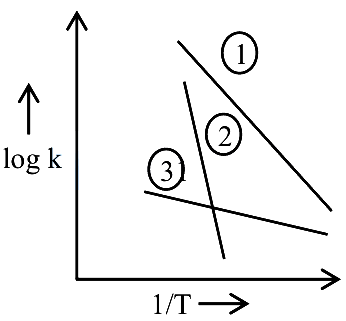
For graph between logk with \(\frac{1}{\mathrm{~T}}\)
\(\mid \text { Slope of curve } \left\lvert\,=\frac{\mathrm{Ea}}{2.303 \mathrm{R}}\right.\)
From given graph
Magnitude of slope \(\Rightarrow(2) \gt (1) \gt (3)\)
Hence \(\mathrm{Ea}_2 \gt \mathrm{Ea}_1 \gt \mathrm{Ea}_3\) -
- (A) A, C and D Only
- (B) B , D and E Only
- (C) B and C Only
- (D) A and B Only
Show answer and solution
Correct Answer: (C)
Arrhenious equation hold true for elementary as well as complex reactions.
Unit of A is same as unit of k. Rate of reaction is high if activation energy is low,
A and Ea are temperature independent. -
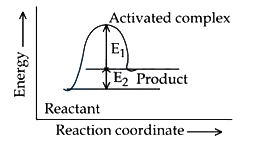
- (A) Activation energy of both forward and backward reaction is \(\mathrm{E}_1+\mathrm{E}_2\) and reactant is more stable than product.
- (B) Activation energy of forward reaction is \(\mathrm{E}_1+\mathrm{E}_2\) and product is less stable than reactant.
- (C) Activation energy of backward reaction is \(\mathrm{E}_1\) and product is more stable than reactant.
- (D) Activation energy of forward reaction is \(\mathrm{E}_1+\mathrm{E}_2\) and product is more stable than reactant.
Show answer and solution
Correct Answer: (B)
Activation energy of forward reaction \(=E_1+E_2\)
Energy of product \(>\) Energy of reactant
Stability
Reactant \(>\) Product -
- (A) Catalyst does not alter the Gibbs energy change of a reaction.
- (B) Catalyst can cause non-spontaneous reactions to occur.
- (C) The enthalpy change for the reaction is \(+20 \mathrm{~kJ} \mathrm{~mol}^{-1}\).
- (D) The enthalpy change for the catalysed reaction is different from that of uncatalysed reaction.
Show answer and solution
Correct Answer: (A)
\(\mathrm{A}_2+\mathrm{B}_2 \rightleftharpoons 2 \mathrm{AB}\)
\(\mathrm{E}_{\mathrm{f}}=180 \mathrm{~kJ} \mathrm{~mol}^{-1}\)
\(\mathrm{E}_{\mathrm{b}}=200 \mathrm{~kJ} \mathrm{~mol}^{-1}\)
\(\Delta \mathrm{H}=\mathrm{E}_{\mathrm{f}}-\mathrm{E}_{\mathrm{b}}=-20 \mathrm{~kJ} \mathrm{~mol}^{-1}\)
In presence of catalyst :
\(\begin{aligned}
& \mathrm{E}_{\mathrm{f}}=180-100=80 \mathrm{~kJ} \mathrm{~mol}^{-1} \\
& \mathrm{E}_{\mathrm{b}}=200-100=100 \mathrm{~kJ} \mathrm{~mol}^{-1}
\end{aligned}\)
Catalyst does not change \(\Delta \mathrm{H}\) or \(\Delta \mathrm{G}\) of a reaction. -
- (A) 800
- (B) 547
- (C) 897
- (D) 874
Show answer and solution
Correct Answer: (C)
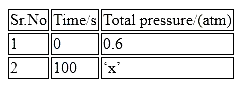
\(2 \mathrm{~N}_2 \mathrm{O}_5(\mathrm{~g}) \rightarrow 2 \mathrm{~N}_2 \mathrm{O}_4(\mathrm{~g})+\mathrm{O}_2(\mathrm{~g})\)
\(\begin{aligned} & k=\frac{2.303}{t} \log \frac{0.9-0.6}{(0.9-x)} \\ & 2 \times 10^{-2} \times 100=\log \frac{0.3}{(0.9-x)} \\ & 100=\frac{0.3}{(0.9-x)} \\ & =\frac{0.9-x}{0.3}=0.01 \\ & 0.9-X=0.003 \\ & =897 \times 10^{-3}\end{aligned}\) -
- (A) 60 min
- (B) 80 min
- (C) 20 min
- (D) 40 min
Show answer and solution
Correct Answer: (D)
Given : \([\mathrm{A}]_0=8[\mathrm{~B}]_0\)
\(\left[\mathrm{t}_{1 / 2}\right]_{\mathrm{A}}=10 \mathrm{~min}\).
\(\left[\mathrm{t}_{1 / 2}\right]_{\mathrm{B}}=40 \mathrm{~min}\).
\(\mathrm{I}^{\text {st }}\) order kinetics
\(\mathrm{t}=\) ?
\([\mathrm{A}]_{\mathrm{t}}=[\mathrm{B}]_{\mathrm{t}}\)
\(-\mathrm{k}_{\mathrm{A}} \times \mathrm{t} \quad-\mathrm{k}_{\mathrm{B}} \times \mathrm{t}\)
\(\Rightarrow \quad[\mathrm{A}]_0 \mathrm{e}=[\mathrm{B}]_0 \mathrm{e}\)
\(\Rightarrow \quad \frac{[\mathrm{A}]_0}{[\mathrm{~B}]_0}=\mathrm{e}^{\left(\mathrm{k}_{\mathrm{A}}-\mathrm{k}_{\mathrm{B}}\right) \mathrm{t}}\)
\(\Rightarrow \quad 8=\mathrm{e}^{\left(\mathrm{k}_{\mathrm{A}}-\mathrm{k}_{\mathrm{B}}\right) \times \mathrm{t}}\)
\(\Rightarrow \quad \ell \mathrm{n} 8=\left(\mathrm{k}_{\mathrm{A}}-\mathrm{k}_{\mathrm{B}}\right) \times \mathrm{t}\)
\(\Rightarrow \quad \ln 8=\ln 2\left(\frac{1}{\left(\operatorname{ta}_2\right)_{\mathrm{A}}}-\frac{1}{\left(\operatorname{ta}_2\right)_{\mathrm{B}}}\right) \times \mathrm{t}\) -
- (A) Initial pressure of A is 80 mm Hg
- (B) The reaction never goes to completion
- (C) Rate constant of the reaction is \(1.693 \mathrm{~min}^{-1}\)
- (D) Partial pressure of A after 10 minute is 40 mm Hg
Show answer and solution
Correct Answer: (C)
\(\mathrm{A}(\mathrm{g}) \longrightarrow 2 \mathrm{~B}(\mathrm{~g})+\mathrm{C}(\mathrm{g})\)
\(\begin{array}{llll}\mathrm{t}=0 & \mathrm{P}_0 & & \\ \mathrm{t} \rightarrow \infty & 0 & 2 \mathrm{P}_0 & \mathrm{P}_0\end{array}\)
\(\begin{aligned} \mathrm{P}_{\infty}=3 \mathrm{P}_0 & =240 \\ \mathrm{P}_0 & =80 \mathrm{~mm} \text { of } \mathrm{Hg}\end{aligned}\)
\(\mathrm{Kt}=\ln \left(\frac{\mathrm{P}_{\infty}-\mathrm{P}_0}{\mathrm{P}_{\infty}-\mathrm{Pt}}\right)\)
\(K \times 10=\ln \left(\frac{240-80}{240-160}\right)\)
\(\mathrm{K}=\frac{\ell \mathrm{n} 2}{10}=0.0693 \mathrm{~min}^{-1}\)
Option (3) is incorrect -
- (A) \(70\)
- (B) \(98\)
- (C) \(100\)
- (D) \(90\)
Show answer and solution
Correct Answer: (C)
\(\mathrm{K}=\frac{\mathrm{K}_1 \mathrm{~K}_2}{\mathrm{~K}_3}\)\(A \mathrm{e}^{\frac{-\mathrm{E}_2}{\mathrm{RT}}}=\frac{\mathrm{A}_1 \mathrm{e}^{\frac{-\mathrm{E}_{\mathrm{a}_1}}{\mathrm{RT}}} \mathrm{A}_2 \mathrm{e}^{\frac{-\mathrm{E}_{2_2}}{\mathrm{RT}}}}{\mathrm{A}_3 \mathrm{e}^{\frac{-\mathrm{E}_{\mathrm{a}_1}}{\mathrm{RT}}}}\)
\(A \mathrm{e}^{\frac{-\mathrm{E}_2}{\mathrm{RT}}}=\frac{\mathrm{A}_1 \mathrm{~A}_2}{\mathrm{~A}_3} \mathrm{e}^{\frac{-\left(\mathrm{E}_{\mathrm{a}_2}+\mathrm{E}_{\mathrm{a}_2}-\mathrm{E}_{\mathrm{E}_3}\right)}{\mathrm{RT}}}\)
\(\mathrm{E}_{\mathrm{a}}=\mathrm{E}_{\mathrm{a}_1}+\mathrm{E}_{\mathrm{a}_2}-\mathrm{E}_{\mathrm{a}_3}\)
\(400=300+200-\mathrm{E}_{\mathrm{a}_3}\)
\(\mathrm{E}_{\mathrm{a}_3}=100 \mathrm{~kJ} / \mathrm{mole}\)
-
- (A) \(7\)
- (B) \(8\)
- (C) \(10\)
- (D) \(15\)
Show answer and solution
Correct Answer: (B)
\(\mathrm{r}=\mathrm{K}[\mathrm{A}]^2|\mathrm{~B}|\)if conc. are doubled
\(\mathrm{r}^{\prime}=\mathrm{K}[2 \mathrm{~A}]^2[2 \mathrm{~B}]^1\)
\(\mathrm{r}^{\prime}=8 \mathrm{r} \Rightarrow \mathrm{x}=8\)
(Image)
\(\Rightarrow \text { Zero order, } y=0\)
\(x+y=8\)
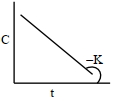
-
- (A) B only
- (B) A only
- (C) B and C only
- (D) A and D only
Show answer and solution
Correct Answer: (D)
\(2 Fe ^{3+}+2 I ^{-} \rightarrow 2 Fe ^{2+}+ I _2\)
\(2 Fe ^{2+}+ S _2 O _8^{2-} \rightarrow 2 Fe ^{3+}+2 SO _4^{2-}\)
\(Fe ^{+3}\) oxidises \(I ^{-}\)to \(I _2\) and convert itself into \(Fe ^{+2}\).
This \(Fe ^{+2}\) reduces \(S _2 O _8{ }^{2-}\) to \(SO _4{ }^{2-}\) and converts itself into \(Fe ^{+3}\). -
- (A) \(2510\)
- (B) \(2530\)
- (C) \(2540\)
- (D) \(2520\)
Show answer and solution
Correct Answer: (D)
\(\log \frac{ K _{300}}{ K _{200}}=\frac{ E _{ a }}{2.3 \times 8.314}\left(\frac{1}{ T _1}-\frac{1}{ T _2}\right)\)\(\log \frac{0.05}{0.03}=\frac{ Ea }{2.305 \times 8.314} \times\left[\frac{1}{200}-\frac{1}{300}\right]\)
\(E _{ a }=2519.88\,J \Rightarrow E _{ a }=2520\,J\)
-
- (A) \(4\)
- (B) \(6\)
- (C) \(8\)
- (D) \(2\)
Show answer and solution
Correct Answer: (D)
\(K = Ae ^{-\frac{ E _{ a }}{ RT }}\)\(K _1= Ae ^{-\frac{\left( E _{ a }\right)_1}{ RT }}\)
\(K _2= Ae ^{-\frac{\left( E _{ a }\right)_2}{ RT }}\)
\(\frac{ K _2}{ K _1}= e ^{\frac{\left( E _{ a }\right)_1-\left( E _{ a }\right)_2}{ RT }}\)
\(\log \frac{ K _2}{ K _1}=\frac{\left( E _{ a }\right)_1-\left( E _{ a }\right)_2}{2.3 RT }\)
\(=\frac{(41.4-30) \times 1000}{2.3 \times 8.3 \times 300}=1.99\)
\(\approx 2\)
-
- (A) 1
- (B) 2
- (C) 3
- (D) 4
Show answer and solution
Correct Answer: (C)
\[
A: k=A e^{-\frac{F a}{R T}}
\]
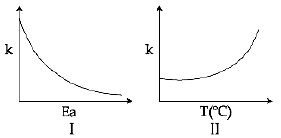
As Ea increases k decreases
B : Temperature coefficient \(=\frac{ k _{T+10}}{ k _T}\)
Option ( C ) is wrong. \(\Delta k\) may be greater or lesser depending on temperature.
\(D : \ln k=\operatorname{In} A-\frac{E a}{R T}\) -
- (A) \(1\)
- (B) \(2\)
- (C) \(3\)
- (D) \(4\)
Show answer and solution
Correct Answer: (B)
\(k = A \cdot e ^{- Ea / RT }\)\(\log k =\log A -\frac{ Ea }{2.303 R } \cdot \frac{1}{T}\)
Higher is Ea, stronger is the temperature dependence of \(k\) (i.e. steeper the slope)
\(\Rightarrow \frac{1}{ k } \frac{ dk }{ dT }=\frac{ Ea }{ R } \frac{1}{ T ^2}\)
\(\Rightarrow \frac{ dk }{ dT }= A \times e ^{-\frac{ Ea }{ R }} \cdot \frac{ Ea }{ RT ^2}\)
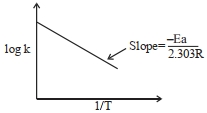
-
- (A) \(855\)
- (B) \(400\)
- (C) \(200\)
- (D) \(300\)
Show answer and solution
Correct Answer: (C)
\(k _{ A }=\frac{\ln 2}{100} ; k _{ B }=\frac{\ln 2}{50}\)\(A _{ t }= A _{0} \times e ^{- k _{ A } t }\)
\(A _{ t }= A _{0} \times e ^{\left(\frac{-\ln 2}{100} \times t \right)}\)
\(B _{ t }= B _{0} \times e ^{\left(\frac{-\ln 2}{50} \times t \right)}\)
\(A _{0}= B _{0}\)
\(At =4 B _{ t }\)
\(e ^{-\frac{\ln 2}{100} \times t }=4 \times e ^{-\frac{\ln 2}{50} \times t }\)
\(e ^{\frac{\ln 2}{100} \times t}=4\)
\(e ^{\frac{\ln 2}{100} \times t}=4\)
\(\frac{\ln 2}{100} \times t=\ln 4=2 \ln 2\)
\(t=200 \,sec\)
-
- (A) \(88\)
- (B) \(12\)
- (C) \(4\)
- (D) \(40\)
Show answer and solution
Correct Answer: (C)
\(K =A e ^{\frac{- Ea }{ RT }}\)\(K _{\text {cat }}= Ae ^{-\frac{ E _{ a }{ }^{1}}{ RT }}, \quad K _{\text {uncat. }}= Ae\)
\(\frac{ K _{\text {cat }}}{ K _{\text {uncat. }}}= e ^{\frac{ E _{ a }- E _{ a }{ }^{1}}{ RT }}= e ^{\frac{10 \times 1000}{8.31 \times 300}}= e ^{4.009}= e ^{ x }\)
\(\therefore x =4\)
-
- (A) \(8\)
- (B) \(5\)
- (C) \(4\)
- (D) \(3\)
Show answer and solution
Correct Answer: (A)
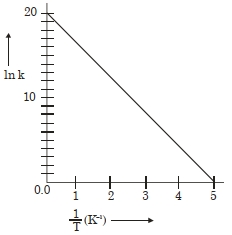
\(K = Ae ^{- Ea / RT }\)\(\ln k =\frac{- Ea }{ RT }+\ln A\)
Slope \(=\frac{ Ea }{ R }=\frac{20}{5}\)
\(E _{ a }=4\,R =8\,Cal / mol\)
-
- (A) \(66\)
- (B) \(12\)
- (C) \(59\)
- (D) \(78\)
Show answer and solution
Correct Answer: (C)
\(\log _{10} \frac{ K _{2}}{ K _{1}}=\frac{ E _{ a }}{2.303 R }\left(\frac{1}{300}-\frac{1}{309}\right)\)\(0.3=\frac{ E _{ a }}{2.303 \times 8.3}\left(\frac{9}{300 \times 309}\right)\)
\(E _{ a }=\frac{0.3 \times 2.303 \times 8.3 \times 300 \times 309}{9}\)
\(=59065.04\, J\)
\(E _{ a }=59.06\, kJ\)
-
- (A) \(1\)
- (B) \(10\)
- (C) \(45\)
- (D) \(985\)
Show answer and solution
Correct Answer: (A)
\(\ln \left(\frac{ K _{2}}{ K _{1}}\right)=\frac{ E _{ a }}{ R }\left(\frac{1}{ T _{1}}-\frac{1}{ T _{2}}\right)\)\(\operatorname{\ell n}\left(\frac{ K _{2}}{ K _{1}}\right)=\frac{532611}{8.3}\times\left(\frac{10}{310 \times 300}\right)\)
where \(K _{2}\) is at \(310 \,K\) and \(K _{1}\) is at \(300 \,K\) \(\ln \left(\frac{ K _{2}}{ K _{1}}\right)=6.9\)
\(=3 \times \ell n 10\)
\(\ell n \frac{ K _{2}}{ K _{1}}=\ell n 10^{3}\)
\(K _{2}= K _{1} \times 10^{3}\)
\(K _{1}= K _{2} \times 10^{3}\)
So \(K=1\)
-
- (A) \(2160\)
- (B) \(216\)
- (C) \(26\)
- (D) \(674\)
Show answer and solution
Correct Answer: (B)
\(K = Ae ^{- Ea / RT }=\left(6.5 \times 10^{12} s ^{-1}\right) e ^{-26000\, K / T }\)\(\frac{ Ea }{8.314}=26000\)
\(Ea =216.164 \,kJ / mol\)
-
- (A) \(234\)
- (B) \(154\)
- (C) \(701\)
- (D) \(185\)
Show answer and solution
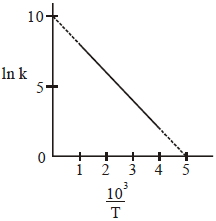
Correct Answer: (B)
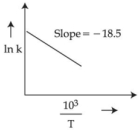
\(\ln k =\ln A -\frac{ Ea }{10^{3} RT } \times 10^{3}=\ln A+\frac{10^{3}}{ T }\left[-\frac{ Ea }{10^{3} RT }\right]\)From the graph
\(\frac{- Ea }{10^{3} \times R }=-18.5\)
\(Ea =153.735 \,k\,J / mol\)
\(\sim 154\)
-
- (A) \(20\)
- (B) \(65\)
- (C) \(50\)
- (D) \(45\)
Show answer and solution
Correct Answer: (D)
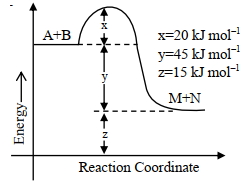
\(\Delta \mathrm{H}=\mathrm{E}_{\mathrm{a}_{\mathrm{f}}}-\mathrm{E}_{\mathrm{a}_{\mathrm{b}}}\)\(=20-65\)
\(=-45\, \mathrm{KJ} / \mathrm{mol}\)
\(|\Delta \mathrm{H}|=45\, \mathrm{KJ} / \mathrm{mol}\)
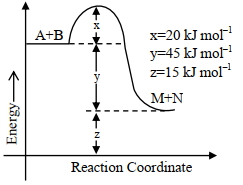
-
- (A) \(40\)
- (B) \(250\)
- (C) \(50\)
- (D) \(150\)
Show answer and solution
Correct Answer: (C)
\(X \longrightarrow Y\)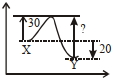
-
- (A) \(85\)
- (B) \(47\)
- (C) \(12\)
- (D) \(4.7\)
Show answer and solution
Correct Answer: (B)
Given \(\log \mathrm{K}=20.35-\frac{2.47 \times 10^{3}}{\mathrm{~T}}\)We know \(\log K=\log A-\frac{E_{a}}{2.303 R T}\)
\(\Rightarrow \quad \frac{\mathrm{E}_{\mathrm{a}}}{2.303 \mathrm{RT}}=2.47 \times 10^{3}\)
\(\mathrm{E}_{\mathrm{a}}=2.47 \times 10^{3} \times 2.303 \times \frac{8.314}{1000} \,\mathrm{KJ} / \mathrm{mole}\)
\(=47.29=47(\mathrm{Nearest} \text { integer })\)
-
- (A) \(500\)
- (B) \(526\)
- (C) \(426\)
- (D) \(486\)
Show answer and solution
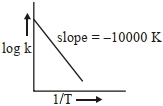
Correct Answer: (B)
\(\log K =\log A -\frac{ Ea }{2.303 RT }\)\(\mid\)Slope\(\mid=\frac{E a}{2.303 R }=10,000\)
\(\log \left(\frac{ K _{2}}{ K _{1}}\right)=\frac{ Ea }{2.303 R }\left(\frac{1}{ T _{1}}-\frac{1}{ T _{2}}\right)\)
\(\log \left(\frac{10^{-4}}{10^{-5}}\right)=10,000\left[\frac{1}{500}-\frac{1}{ T _{2}}\right]\)
\(T _{2}=526.31 \simeq 526 K\)
Hence answer is \((526)\)
-
- (A) \(17\)
- (B) \(16\)
- (C) \(14\)
- (D) \(15\)
Show answer and solution
Correct Answer: (C)
Fraction of molecules to have enough energy to react \(= e ^{- E / RT }\)So, \(x=\frac{E_{a}}{R T}\)
\(=\frac{80.9 \times 10^{3}}{8.31 \times 700}\)\(=13.9\)
-
- (A) \(10\)
- (B) \(8\)
- (C) \(14\)
- (D) \(16\)
Show answer and solution
Correct Answer: (A)
\(K _{300}=10^{-4} \quad K _{200}=?\)\(E _{ a }=11.488 KJ / mole \quad R =8.314 J / mole - K\)
so \(\ell n \left(\frac{ K _{300}}{ K _{200}}\right)=\frac{ E _{ a }}{ R }\left(\frac{1}{200}-\frac{1}{300}\right)\)
\(\ell n \left(\frac{ K _{300}}{ K _{200}}\right)=\frac{11.488 \times 1000 \times 100}{8.314 \times 200 \times 300}\)
\(=2.303\)
\(=\ell n 10\)
so \(\frac{ K _{300}}{ K _{200}}=10\)
\(K _{200}=\frac{1}{10} \times K _{300}=10^{-4}\)
\(=10 \times 10^{-5} sec ^{-1}\)
-
- (A) \(16\)
- (B) \(1.6\)
- (C) \(0.16\)
- (D) \(160\)
Show answer and solution
Correct Answer: (A)
\(\mathrm{K}_{700}=6.36 \times 10^{-3} \mathrm{~s}^{-1}\)\(\mathrm{~K}_{600}=x \times 10^{-6} \mathrm{~s}^{-1}\)
\(\mathrm{E}_{\mathrm{a}}=209 \mathrm{~kJ} / \mathrm{mol}\)
Applying ;
\(\log \left(\frac{\mathrm{K}_{\mathrm{T}_{2}}}{\mathrm{~K}_{\mathrm{T}_{1}}}\right)=\frac{-\mathrm{E}_{\mathrm{a}}}{2.303 \mathrm{R}}\left(\frac{1}{\mathrm{~T}_{2}}-\frac{1}{\mathrm{~T}_{1}}\right)\)
\(\log \left(\frac{\mathrm{K}_{700}}{\mathrm{~K}_{600}}\right)=\frac{-\mathrm{E}_{\mathrm{a}}}{2.303 \mathrm{R}}\left(\frac{1}{700}-\frac{1}{600}\right)\)
\(\log \left(\frac{6.36 \times 10^{-3}}{\mathrm{~K}_{600}}\right)=\frac{+209 \times 1000}{2.303 \times 8.31}\left(\frac{100}{700 \times 600}\right)\)
\(\log \left(6.36 \times 10^{-3}\right)-\log \mathrm{K}_{600}=2.6\)
\(\Rightarrow \log \mathrm{K}_{600}=-2.19-2.6=-4.79\)
\(\Rightarrow \mathrm{K}_{600}=10^{-4.79}\)
\(=1.62 \times 10^{-5}\)
\(=16.2 \times 10^{-6}\)
\(=x \times 10^{-6}\)
\(\Rightarrow \mathrm{x}=16\)
-
- (A) \(26\)
- (B) \(10\)
- (C) \(52\)
- (D) \(48\)
Show answer and solution
Correct Answer: (C)
\(T _{1}=300 \,K , T _{2}=325\, K , K _{2}=5\, K\)\(\ln \frac{ K _{2}}{ K _{1}}=\frac{ Ea }{ R }\left[\frac{1}{ T _{1}}-\frac{1}{ T _{2}}\right]\)
or, \(\ln 5=\frac{ Ea }{8.314}\left[\frac{1}{300}-\frac{1}{325}\right]\)
or, \(Ea =0.7 \times 2.303 \times 8.314 \times 12 \times 325\)
\(=52271 \,J =52.271\, kJ\)
Nearest integer answer will be \(52\,kJ\)
-
- (A) \(2.88\)
- (B) \(2.52\)
- (C) \(1.96\)
- (D) \(3.98\)
Show answer and solution
Correct Answer: (D)
\(\ln \left(\frac{t_{1}}{t_{2}}\right)=\frac{-\operatorname{Ea}}{R}\left[\frac{1}{T_{2}}-\frac{1}{T_{1}}\right]\)\(\ln \left(\frac{60}{40}\right)=\frac{-\operatorname{Ea}}{8.3}\left[\frac{1}{400}-\frac{1}{300}\right]\)
\(\mathrm{E}=0.4 \times 1200 \times 8.3\)
\(=3.984\; \mathrm{kJ} / \mathrm{mole}\)
-
- (A) \(E_{\mathrm{b}}>E_{\mathrm{d}}>E_{\mathrm{c}}>E_{\mathrm{a}}\)
- (B) \(E_{\mathrm{a}}>E_{\mathrm{c}}>E_{\mathrm{d}}>E_{\mathrm{b}}\)
- (C) \(E_{\mathrm{c}}>E_{\mathrm{a}}>E_{\mathrm{d}}>E_{\mathrm{b}}\)
- (D) \(E_{\mathrm{b}}>E_{\mathrm{a}}>E_{\mathrm{d}}>E_{\mathrm{c}}\)
Show answer and solution
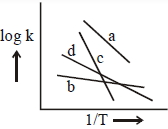
Correct Answer: (C)
\(\log \mathrm{K}=\frac{-\mathrm{Ea}}{2.303 \mathrm{RT}}+\log \mathrm{A}\)Acrroding to Arrhenius equation plot of \(\operatorname{log } \mathrm { K }\) Vs. \(\frac{1}{\mathrm{T}}\) is linear with.
slope \(=\frac{-\mathrm{Ea}}{2.303 \mathrm{R}}\)
From plot we conclude:
\(|\) slope \(| \quad: c>a>d>b\)
\(\therefore \mathrm{E}_{\mathrm{c}}>\mathrm{E}_{\mathrm{a}}>\mathrm{E}_{\mathrm{d}}>\mathrm{E}_{\mathrm{b}}\)
-
- (A) \(135\)
- (B) \(105\)
- (C) \(198\)
- (D) \(75\)
Show answer and solution
Correct Answer: (D)
\(\mathrm{K}_{1}=\mathrm{Ae}^{-\frac{\mathrm{Ea}}{\mathrm{R} \times 700}}\)\(\mathrm{K}_{2}=\mathrm{A} \times \mathrm{e}^{-\frac{(\mathrm{Ea}-30)}{\mathrm{R} \times 500}}\)
For same rate
\(\mathrm{K}_{1}=\mathrm{K}_{2}\)
\(e^{-\frac{\mathrm{Ea}}{700 \mathrm{R}}}=e^{-\frac{(\mathrm{Ea}-30)}{\mathrm{R} \times 500}}\)
\(\frac{\mathrm{Ea}}{700 \mathrm{R}}=\frac{\mathrm{Ea}-30}{\mathrm{R} \times 500}\)
\(5 \mathrm{Ea}=7 \mathrm{Ea}-210\)
\(210=2 \mathrm{Ea}\)
\(\mathrm{E}_{\mathrm{a}}=105 \mathrm{kJ} / \mathrm{mole}\)
\(\mathrm{E}_{\mathrm{a}}-30=75\)
-
- (A) \(84297.5\)
- (B) \(84280\)
- (C) \(84294.7\)
- (D) \(84285.6\)
Show answer and solution
Correct Answer: (A)
\(T _{1}=300 K \quad T _{2}=315 K\)As per question \(K _{ T _{2}}=5 K _{ T _{1}}\) as molecules activated are increased five times so k will increases \(5\) times
Now
\(\ln \left(\frac{ K _{ T _{2}}}{ K _{ T _{1}}}\right)=\frac{ Ea }{ R }\left(\frac{1}{ T _{1}}-\frac{1}{ T _{2}}\right)\)
\(\ln 5=\frac{ Ea }{ R }\left(\frac{15}{300 \times 315}\right)\)
So \(\quad Ea =\frac{1.6094 \times 8.314 \times 300 \times 315}{15}\)
\(Ea =84297.47\) Joules/mole
-
- (A) \(2\, R\)
- (B) \(R\)
- (C) \(1 / R\)
- (D) \(2 / R\)
Show answer and solution
Correct Answer: (A)
Slope \(=-\frac{E_{a}}{R}\)\(-\frac{10}{5}=-\frac{E_{a}}{R}\)
\(E_{a}=2 R\)
-
- (A) \(-6 \mathrm{RT}\)
- (B) \(+6 \mathrm{RT}\)
- (C) \(+6(2.303) \mathrm{RT}\)
- (D) \(-6(2.303) \mathrm{RT}\)
Show answer and solution
Correct Answer: (D)
\(\mathrm{K}=\mathrm{A} \mathrm{e}^{\frac{-\mathrm{E}_{\mathrm{a}}}{\mathrm{RT}}}\)\(\mathrm{K}^{\prime}=\mathrm{Ae}^{\frac{-\mathrm{E}_{\mathrm{a}}}{\mathrm{RT}}}=10^{6} \mathrm{K}\)
Ae \(\frac{-\mathrm{E}}{\mathrm{RT}}=10^{6} \times \mathrm{Ae}^{\frac{-\mathrm{E}_{\mathrm{a}}}{\mathrm{RT}}}\)
\(\frac{-\mathrm{E}_{\mathrm{a}}}{\mathrm{RT}}=\frac{-\mathrm{E}_{\mathrm{a}}}{\mathrm{RT}}+\ln 10^{6}\)
\(\mathrm{E}_{\mathrm{a}}^{\prime}=\mathrm{E}_{\mathrm{a}}-\mathrm{RT} \ln 10^{6}\)
\(\mathrm{E'}_{\mathrm{a}}-\mathrm{E}_{\mathrm{a}}=-\mathrm{RT} \ln 10^{6}\)
\(=-6 \mathrm{RT} \times 2.303\)
-
- (A) \(85\)
- (B) \(94\)
- (C) \(110\)
- (D) \(100\)
Show answer and solution
Correct Answer: (D)
\(\ell n \left(\frac{ K _{ T _{2}}}{ K _{ T _{1}}}\right)=\frac{ E _{ a }}{ R }\left[\frac{1}{ T _{1}}-\frac{1}{ T _{2}}\right]\)\(T _{1}=303 K ; T _{2}=313 K\)
\(\frac{ K _{ T _{2}}}{ K _{ T _{1}}}=3.555\)
\(\ell E (3.555)=\frac{ E _{ a }}{8.314}\left[\frac{1}{303}-\frac{1}{313}\right]\)
\(E_a=99980.715\)
\(E _{ a }=99.98 \frac{ kJ }{ mole }\)
-
- (A) \(C\) is the thermodynamically stable product
- (B) Formation of \(A\) and \(B\) from \(C\) has highest enthalpy of activation
- (C) \(D\) is kinetically stable product
- (D) Activation enthalpy to form \(C\) is \(5\,kJ\, mol^{-1}\) less than that to form \(D\)
Show answer and solution
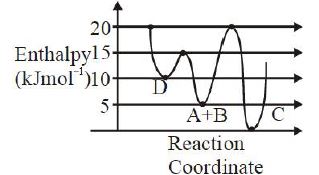
Correct Answer: (D)
\({E_a} = (D \to C)\)\( = 15 - 0 = 15\,kJ\,mo{l^{ - 1}}\)
\({E_a} = (A + B) \to C = 15\,kJ\,mo{l^{ - 1}}\)
\({E_a} = (A + B) \to D = 10\,kJ\,mo{l^{ - 1}}\)
\({E_a} = C \to (A + B) = 20\,kJ\,mo{l^{ - 1}}\) (high activation enthalpy in the reaction)
\(\therefore \) Activation enthalpy to form \(C\) is \(5\,kJ\,mol^{-1}\) more than that of form \(D\).
-
- (A) \(I\) is right but \(II\) is wrong
- (B) Both \(I\) and \(II\) are correct
- (C) \(I\) is wrong but \(II\) is right
- (D) Both \(I\) and \(II\) are wrong
Show answer and solution
Correct Answer: (A)
\(K = A{e^{ - {E_a}/RT}}\)
\((i)\) is true but \((ii)\) is false
\((ii)\) should be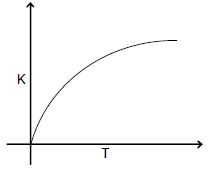
-
- (A) \(72\)
- (B) \(166\)
- (C) \(150\)
- (D) \(59\)
Show answer and solution
Correct Answer: (B)
\({H_2}(g)\, + \,{I_2}(g)\, \to \,2HI\,(g)\)Apply Arrhenius equation
\(\log \,\frac{{{K_2}}}{{{K_1}}}\, = \,\frac{{{E_a}}}{{2.303\,R}}\left( {\frac{1}{{600}} - \frac{1}{{800}}} \right)\)
\(\log \,\frac{1}{{2.5 \times {{10}^{ - 4}}}}\, = \,\frac{{{E_a}}}{{2.303 \times 8.31}}\,\left( {\frac{{200}}{{600 \times 800}}} \right)\)
\(\therefore \,\,{E_a}\, \approx \,166\,\,kJ\,/\,mol\)
-
- (A) \(y/R\,\)unit
- (B) \(y\,\)unit
- (C) \(yR\,\)unit
- (D) \(-y\,\)unit
Show answer and solution
Correct Answer: (B)
\(\ln \,k = - \frac{{{E_a}}}{{RT}} + \ln \,A\)\(\therefore \) Slope \(= - E_a = -y\)
-
- (A) \(9.84\)
- (B) \(4.92\)
- (C) \(2.45\)
- (D) \(19.67\)
Show answer and solution
Correct Answer: (B)
In order to calculate the enthalpy change for \(H_2O\) at \(5\,^oC\) to ice at \(-\,5\,^oC\) , we need to calculated the enthalpy change of all the transformation involved in the process.\((a)\) Energy change of \(1\,mol\), \(H_2O\,(l)\), at \(5\,^oC\)
\(\to \,1\,mol\), \(H_2O\,(l)\) , \(0\,^oC\)
\((b)\) Energy change of \(1\,mol\), \(H_2O\,(l)\), at \(0\,^oC\)
\(\to \,1\,mol\), \(H_2O\,(s)\) (ice) , \(0\,^oC\)
\((c)\) Energy change of \(1\,mol\), Ice \((s)\), at \(0\,^oC\)
\(\to \,1\,mol\), Ice \((s)\) , \(-5\,^oC\)
Total \(\Delta H\)
\( = \,{C_P}\,[{H_2}O\,(l)]\,\,\Delta T\,\, + \,\Delta H\) freezing \( + \,\,{C_P}\,[{H_2}O\,(s)]\,\,\Delta T\)
\( = \,(75.3\,\,J\,\,mo{l^{ - 1}}\,{K^{ - 1}})\,( - 5)\,K\, + ( - \,6\, \times \,{10^3}\,\,J\,mo{l^{ - 1}}\,{K^{ - 1}})\) \(+ \,(36.8\,\,J\,mo{l^{ - 1}}\,{K^{ - 1}})\,( - 5)\,K\)
\(\Delta H\,\, = \,\, - \,6.56\,\,kJ\,mo{l^{ - 1}}\) (exothermic process)
So, \(\Delta H\,\, = \,\,6.56\,\,kJ\,mo{l^{ - 1}}\)
\( \Rightarrow \,{T_2}\, = \,304.92\,\,K\)
\({T_1}\, = \,300\,\,K,\,\) \({T_2}\, = 304.92\,\,K\)
\(\Delta T\, = \,\,{T_1}\, - {T_2}\, = 4.92\,\,K\)

No questions on this page match these filters.
Other STD 12 - Chemical kinetics topics
Frequently asked
How many Collision theory, Energy of activation and Arrhenius equation questions came in JEE Mains?
56 questions from 2013–2026, each with the correct answer and a full solution.
How difficult are Collision theory, Energy of activation and Arrhenius equation questions?
18% are easy, 46% medium and 36% hard.