


Questions
Newest firstShowing 1–24 of 24 questions
-
- (A) Both statement - I and statement - II are false
- (B) Statement I is false but statement - II is true
- (C) Both statement - I and statement - II are true
- (D) Statement - I is true but statement - II is false
Show answer and solution
Correct Answer: (C)
In \( K_{3}[Co(CO_{3})_{3}] \Rightarrow sp^{3}d^{2} \) hybridized, octahedral
\( \Rightarrow 4 \) unpaired electron
\( \Rightarrow 4.9~B.M. \)
\( [Ni(CN)_{4}]^{2-} \)\( \Rightarrow \) \( dsp^{2} \) hybridized, square planar
\( \Rightarrow 0 \) unpaired electron
\( \Rightarrow 0~B.M. \)
\( [MnBr_{4}]^{2-} \)\( \Rightarrow \) \( sp^{3} \) hybridized, tetrahedral
\( \Rightarrow 5 \) unpaired electron
\( \Rightarrow 5.9~B.M. \)
\( [CoF_{6}]^{3-} \)\(\Rightarrow sp ^3 d^2\) hybridized, octahedral
\( \Rightarrow 4 \) unpaired electron
\( \Rightarrow 4.9~B.M. \) -
- (A) Both statement - I and statement - II are true
- (B) Both statement - I and statement - II are false
- (C) Statement - I is true but statement - II is false
- (D) Statement - I is false but statement - II is true
Show answer and solution
Correct Answer: (A)
Paramagnetic species :
\(\left[ CoF _6\right]^3,\left[ TiF _6\right]^3,\left[ Fe ( CN )_6\right]^3\)
Diamagnetic species : \(V _2 O _5\)
In \(K _4\left[ Fe ( CN )_6\right] \Rightarrow\) No. of unpaired electron \(=0\)
\(K _3\left[ Fe ( CN )_6\right] \Rightarrow\) No. of unpaired electron \(=1\)
\(\left[ Fe \left( H _2 O \right)_6\right] SO _4 \cdot H _2 O \Rightarrow\) No. of unpaired electron \(=4\)
\(\left[ Fe \left( H _2 O \right)_6\right] Cl _3 \Rightarrow\) No. of unpaired electron \(=5\) -
- (A) C & D only
- (B) A, B & D only
- (C) A, C & E only
- (D) A, B, C, D & E
Show answer and solution
Correct Answer: (B)
(A) \( Co^{3+}:-3d^{6} \),
\( NH_{3} \Rightarrow S.F.L \)
Hybridisation \( \Rightarrow d^{2}sp^{3} \), Inner orbital complex.
(B) \( Mn^{3+}:-3d^{4} \),
\( Cl^{-} \Rightarrow W.F.L\)
Hybridisation \( \Rightarrow sp^{3}d^{2} \), Outer orbital complex.
(C) \( Co^{3+}:-3d^{6} \),
\( F^{-} \Rightarrow W.F.L \)
Hybridisation \(\Rightarrow sp^{3}d^{2} \), Outer orbital complex.
(D) \( Fe^{3+}:-3d^{5} \),
\( F^{-} \Rightarrow W.F.L \)
Hybridisation \( \Rightarrow sp^{3}d^{2} \), Outer orbital complex.
(E) \( Ni^{2+}:-3d^{8} \),
\( CN^{-} \Rightarrow S.F.L \).
Hybridisation \(\Rightarrow dsp^{2} \), Inner orbital complex. -
- (A) \(\left[ Ni ( CN )_4\right]^{2-}\) and \(\left[ NiCl _4\right]^{2-}\) are diamagnetic and \(Ni ( CO )_4\) is paramagnetic.
- (B) \(Ni ( CO )_4\) and \(\left[ NiCl _4\right]^{2-}\) are diamagnetic and \(\left[ Ni ( CN )_4\right]^{2-}\) is paramagnetic.
- (C) \(Ni ( CO )_4\) and \(\left[ Ni ( CN )_4\right]^{2-}\) are diamagnetic and \(\left[ NiCl _4\right]^{2-}\) is paramagnetic.
- (D) \(Ni ( CO )_4\) is diamagnetic and \(\left[ NiCl _4\right]^{2-}\) and \(\left[ Ni ( CN )_4\right]^{2-}\) are paramagnetic.
Show answer and solution
Correct Answer: (C)
\(\left[ Ni ( CN )_4\right]^{2-} \rightarrow 3 d^8 \rightarrow\) diamagnetic \(\rightarrow dsp ^2\)
\(\left[ Ni ( CO )_4\right] \rightarrow 3 d^{10} \rightarrow\) diamagnetic \(\rightarrow sp ^3\)
\(\left[ NiCl _4\right]^{2-} \rightarrow 3 d^8 \rightarrow e ^{2,2} t _2^{2,1,1} \rightarrow sp ^3 \rightarrow\) paramagnetic. -
- (A) 0
- (B) 2
- (C) 4
- (D) 6
Show answer and solution
Correct Answer: (B)
In \( [Ni(CO)_{4}] \) \( Ni^{0}: 3d^{8} 4s^{2} \)
Hybridisation state :\( sp^{3} \)
Unpaired electron = 0
In \( [NiCl_{4}]^{2-} \),: \( Ni^{2+}: 3d^{8} \)
Hybridisation state \( sp^{3} \)
Unpaired electron = 2
In \( [PtCl_{4}]^{2-} \), \( Pt^{2+}: 5d^{8} \)
Hybridisation state : \( dsp^{2} \)
Unpaired electron = 0
In \( [Ni(CN)_{4}]^{2-} \), \( Ni^{2+}: 3d^{8} \)
Hybridisation state : \( dsp^{2} \)
Unpaired electron = 0
In \( [Pt(NH_{3})_{2}Cl_{2}] \), \( Pt^{2+}: 5d^{8} \)
Hybridisation state :\( dsp^{2} \)
Unpaired electron = 0 -
- (A) 4
- (B) 6
- (C) 8
- (D) 2
Show answer and solution
Correct Answer: (D)
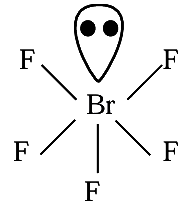
1 lone pair hence 1 mole AgCl.
Complex is \(\left[\mathrm{M}\left(\mathrm{NH}_3\right)_3 \mathrm{Cl}_3\right] \mathrm{Cl}\).
It shows 2 geometrical isomers \(\left(\mathrm{Ma}_3 \mathrm{~b}_3\right.\) type) facial (fac) & meridional (Mer) -
- (A) A-II, B-III, C-IV, D-I
- (B) A-IV, B-I, C-II, D-III
- (C) A-I, B-II, C-III, D-IV
- (D) A-III, B-I, C-IV, D-II
Show answer and solution
Correct Answer: (A)
\(\begin{aligned}
& \mathrm{PF}_5: 5 \sigma+0 \ell \mathrm{p} \rightarrow \mathrm{sp}^3 \mathrm{~d} \\
& \mathrm{SF}_6: 6 \sigma+0 \ell \mathrm{p} \rightarrow \mathrm{sp}^3 \mathrm{~d}^2 \\
& \mathrm{Ni}(\mathrm{CO})_4: \mathrm{Ni} \rightarrow 0
\end{aligned}\)
In presence of ligand field :-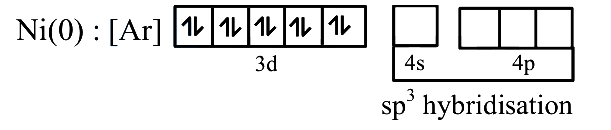
\(\left[\mathrm{PtCl}_4\right]^{2-}: \mathrm{Pt} \rightarrow+2\)
In presence of ligand field :-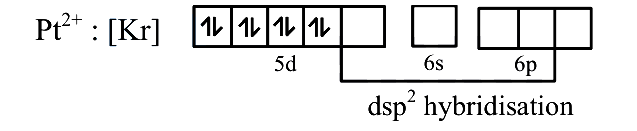
-
- (A) 2
- (B) 4
- (C) 6
- (D) 8
Show answer and solution
Correct Answer: (A)
\(\left[\mathrm{FeF}_6\right]^{3-} \quad\quad\) Paramagnetic \(\quad\quad \mathrm{sp}^3 \mathrm{~d}^2\)
\(\left[\mathrm{Fe}(\mathrm{CN})_6\right]^{3-} \quad\) Paramagnetic \(\quad\quad \mathrm{d}^2 \mathrm{sp}^3\)
\(\left[\mathrm{Mn}(\mathrm{CN})_6\right]^{3-} \quad\) Paramagnetic \(\quad\quad \mathrm{d}^2 \mathrm{sp}^3\)
\(\left[\mathrm{Co}\left(\mathrm{C}_2 \mathrm{O}_4\right)_3\right]^{3-} \quad\) Diamagnetic \(\quad\quad \mathrm{d}^2 \mathrm{sp}^3\)
\(\left[\mathrm{MnCl}_6\right]^{3-} \quad\) Paramagnetic \(\quad \mathrm{sp}^3 \mathrm{~d}^2\)
\(\left[\mathrm{CoF}_6\right]^{3-} \quad\) Paramagnetic \(\quad \mathrm{sp}^3 \mathrm{~d}^2\)
Only \(\quad\left[\mathrm{Fe}(\mathrm{CN})_6\right]^{3-}\) and \(\left[\mathrm{Mn}(\mathrm{CN})_6\right]^{3-}\) are paramagnetic and \(\mathrm{d}^2 \mathrm{sp}^3\) hybridisation of metal. -
- (A) \(5\)
- (B) \(6\)
- (C) \(4\)
- (D) \(3\)
Show answer and solution
Correct Answer: (D)
In \(\left[\mathrm{Co}\left(\mathrm{NH}_3\right]_6\right]^{3+}, \mathrm{Co}^{+3}:[\mathrm{Ar}] 3 \mathrm{~d}^6, \mathrm{NH}_3\) is S.F.L
Hybridisation state of \(\mathrm{Co}^{3+}\) is \(\mathrm{d}^2 \mathrm{sp}^3\)
In \(\mathrm{SF}_6\), Hybridisation state of sulphur is \(\mathrm{sp}^3 \mathrm{~d}^2\)
In \(\left[\mathrm{CrF}_6\right]^{3-}, \mathrm{Cr}^{+3}:[\mathrm{Ar}] 3 \mathrm{~d}^3\)
Hybridisation state of \(\mathrm{Cr}^{3+}\) is \(\mathrm{d}^2 \mathrm{sp}^3\)
\(\left[\mathrm{CoF}_6\right]^{3-}, \mathrm{Co}^{+3}:[\mathrm{Ar}] 3 \mathrm{~d}^6 \mathrm{~F}^{-}\)is W.F.L
Hybridisation state of \(\mathrm{Co}^{3+}\) is \(\mathrm{sp}^3 \mathrm{~d}^2\)
\(\left[\mathrm{Mn}(\mathrm{CN})_6\right]^{3-}, \mathrm{Mn}^{+3}:[\mathrm{Ar}] 3 \mathrm{~d}^4 \mathrm{CN}^{-}\)is S.F.L Hybridisation state of \(\mathrm{Mn}^{3+}\) is \(\mathrm{d}^2 \mathrm{sp}^3\)
\(\left[\mathrm{MnCl}_6\right]^{3-}, \mathrm{Mn}^{+3}:[\mathrm{Ar}] 3 \mathrm{~d}^4 \mathrm{Cl}^{-}\)is W.F.L
Hybridisation state of \(\mathrm{Cl}^{-}\)is \(\mathrm{sp}^3 \mathrm{~d}^2\)
Total number of \(\mathrm{sp}^3 \mathrm{~d}^2\) hybridized molecules is 3 - 10. The type of hybridization and the magnetic property of \(\left[\mathrm{MnCl}_6\right]^{3-}\) are _______. 2025 Medium
- (A) \(d^2 s p^3\), paramagnetic with four unpaired electrons
- (B) \(\mathrm{sp}^3 \mathrm{~d}^2\), paramagnetic with four unpaired electrons
- (C) \(\mathrm{d}^2 \mathrm{sp}^3\), paramagnetic with two unpaired electrons
- (D) \(\mathrm{sp}^3 \mathrm{~d}^2\), paramagnetic with two unpaired electrons
Show answer and solution
Correct Answer: (B)
\(\begin{aligned} & {\left[\mathrm{MnCl}_6\right]^{3-} \text { contains } \mathrm{Mn}^{+3}} \\ & \mathrm{Mn}^{+3}:-[\mathrm{Ar}] 3 \mathrm{~d}^4 \\ & \text { Ligand } \Rightarrow \mathrm{Cl}^{-}(\mathrm{WFL})\end{aligned}\)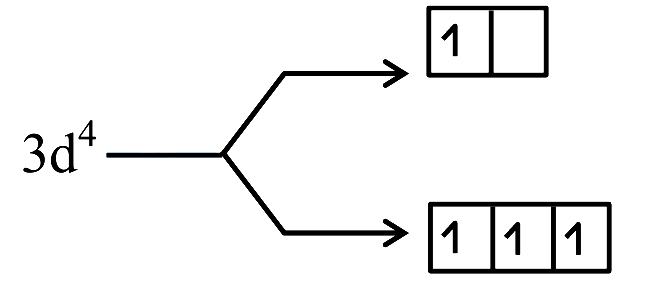
\(\text { Hybridisation }=\mathrm{sp}^3 \mathrm{~d}^2\)
4 unpaired electrons - 11. Identify from the following species in which \(\mathrm{d}^2 \mathrm{sp}^3\) hybridization is shown by central atom: 2024 Hard
- (A) \(\left[\mathrm{Co}\left(\mathrm{NH}_3\right)_6\right]^{3+}\)
- (B) \(\mathrm{BrF}_5\)
- (C) \(\left[\mathrm{Pt}(\mathrm{Cl})_4\right]^{2-}\)
- (D) \(\mathrm{SF}_6\)
Show answer and solution
Correct Answer: (A)
\(\left[\mathrm{Co}\left(\mathrm{NH}_3\right)_6\right]^{+3}-d^2 \mathrm{sp}^3\) hybridization\(\mathrm{BrF}_5-\mathrm{sp}^3 \mathrm{~d}^2\) hybridization
\(\left[\mathrm{PtCl}_4\right]^{-2}-\mathrm{dsp}^2\) hybridization
\(\mathrm{SF}_6-\mathrm{sp}^3 \mathrm{~d}^2\) hybridization
-
- (A) \(A-III, B-I, C-II, D-IV\)
- (B) \(A-III, B-II, C-IV, D-I\)
- (C) \(A-I, B-III, C-II, D-IV\)
- (D) \(A-III, B-I, C-IV, D-II\)
Show answer and solution
Correct Answer: (D)
\(\begin{gathered}+2 \\ \text { (A) } \mathrm{K}_2\left[\mathrm{Ni}(\mathrm{CN})_4\right] \\ \mathrm{Ni}^{2+}:[\mathrm{Ar}] 3 \mathrm{~d}^8 4 \mathrm{~s}^{\circ},\left(\mathrm{CN}^{-} \text {is S.F.L) }\right. \\ \text { Pre hybridization state of } \mathrm{Ni}^{+2}\end{gathered}\)
(B) \(\left[\mathrm{Ni}(\mathrm{CO})_4\right]\)
\(\mathrm{Ni}:[\mathrm{Ar}] 3 \mathrm{~d}^8 4 \mathrm{~s}^2\)
\(CO\) is \(S.F.L,\) so pairing occur
Pre hybridization state of \(\mathrm{Ni}\)
\(\begin{aligned} & \text { (C) }\left[\mathrm{Co}\left(\mathrm{NH}_3\right)_6\right] \mathrm{Cl}_3 \\ & \mathrm{Co}^{+3}:[\mathrm{Ar}] 3 \mathrm{~d}^6 4 \mathrm{~s}^0 \\ & \text { With } \mathrm{Co}^{3+}, \mathrm{NH}_3 \text { act as S.F.L }\end{aligned}\)
\(\begin{aligned} & \text { (d) } \mathrm{Na}_3\left[\mathrm{CoF}_6\right] \\ & \mathrm{Co}^{3+}:[\mathrm{Ar}] 3 \mathrm{~d}^6\left(\mathrm{~F}^{\Theta}: \text { W.F.L }\right)\end{aligned}\)
- 13. The coordination environment of \(\mathrm{Ca}^{2+}\) ion in its complex with \(EDTA\) \(^{4-}\) is _______. 2024 Medium
- (A) tetrahedral
- (B) octahedral
- (C) square planar
- (D) trigonal prismatic
Show answer and solution
Correct Answer: (B)
\(EDTA\) \(^{4-} \rightarrow\) Hexadentate ligand\([\mathrm{Ca}(\mathrm{EDTA})]^{2-}\)
So Coordination environment is octahedral
-
- (A) Octahedral
- (B) Trigonal bipyramidal
- (C) Square pyramidal
- (D) Square planar
Show answer and solution
Correct Answer: (A)
\(\mathrm{Mn}_2(\mathrm{CO})_{10}\)Octahedral around Mn
-
- (A) \(A - II, B - I, C - III, D - IV\)
- (B) \(A - I, B - II, C - III, D - IV\)
- (C) \(A - II, B - I, C - IV, D - III\)
- (D) \(A - I, B- II, C - IV, D - III\)
Show answer and solution
Correct Answer: (D)
For \(\left[ Fe \left( NH _3\right)_6\right]^{+2}, \Delta_0 < P\), hence the pairing of electrons does not occur in \(t_{2 g}\). Therefore complex is outer orbital and its hybridisation is \(sp ^3 d ^2\).List \(I\) (Complexes) List \(II\) (Hybridisation) \(A\) \(\left[ Ni ( CO )_4\right]\) \(I\) \(sp ^3\) \(B\) \(\left[ Cu \left( NH _3\right)_4\right]^{2+}\) \(II\) \(dsp^2\) \(C\) \(\left[ Fe \left( NH _3\right)_6\right]^{2+}\) \(III\) \(sp^3d^2\) \(D\) \(\left[ Fe \left( H _2 O \right)_6\right]^{2+}\) \(IV\) \(d^2sp^3\) - 16. The hybridization and magnetic behaviour of cobalt ion in \(\left[ Co \left( NH _3\right)_6\right]^{3+}\) complex, respectively is 2023 Medium
- (A) \(sp ^3 d _3^2\) and diamagnetic
- (B) \(d ^2 sp _3^3\) and paramagnetic
- (C) \(d ^2 sp _3^3\) and diamagnetic
- (D) \(sp ^{3^1} d ^2\) and paramagnetic
Show answer and solution
Correct Answer: (C)
\(\left[ Co \left( NH _3\right)_6\right]^{+3}- d ^2 sp ^3\), diamagnetic -
- (A) Both Statement \(I\) and Statement \(II\) are true.
- (B) Both Statement \(I\) and Statement \(II\) are false.
- (C) Statement \(I\) is correct but statement \(II\) is false.
- (D) Statement \(I\) is incorrect but statement \(II\) is true.
Show answer and solution
Correct Answer: (B)
\(\left[ Ni ( CN )_{4}\right]^{2-}: d ^{8}\) configuration, \(SFL,\) sq. planar splitting \(\left( dsp ^{2}\right)\), diamagnetic.\(\left[ Ni ( CO )_{4}\right]: d ^{10}\) config (after excitation), \(SFL,\) tetrahedral splitting \(\left( sp ^{3}\right)\), diamagnetic.
\(\left[ NiCl _{4}\right]^{2-}: d ^{8}\) config, WFL, tetrahedral splitting \(\left( sp ^{3}\right)\), paramagnetic(\(2\) unpaired \(e ^{-}\)).
-
- (A) \((A)\) \(\rightarrow\) \((II), (B)\) \(\rightarrow\) \((IV), (C)\) \(\rightarrow\) \((I), (D)\) \(\rightarrow\) \((III)\)
- (B) \((A)\) \(\rightarrow\) \((III), (B)\) \(\rightarrow\) \((IV), (C)\) \(\rightarrow\) \((I), (D)\) \(\rightarrow\) \((II)\)
- (C) \((A)\) \(\rightarrow\) \((III), (B)\) \(\rightarrow\) \((I), (C)\) \(\rightarrow\) \((IV), (D)\) \(\rightarrow\) \((II)\)
- (D) \((A)\) \(\rightarrow\) \((II), (B)\) \(\rightarrow\) \((I), (C)\) \(\rightarrow\) \((IV), (D)\) \(\rightarrow\) \((III)\)
Show answer and solution
Correct Answer: (B)
List \(- I\) List \(- II\) \((A)\) \(\left[ PtCl _{4}\right]^{2-}\) \((III)\) \(dsp ^{2}\) \((B)\) \(BrF _{5}\) \((IV)\) \(sp ^{3} d ^{2}\) \((C)\) \(PCl _{5}\) \((I)\) \(sp ^{3} d\) \((D)\) \(\left[ Co \left( NH _{3}\right)_{6}\right]^{3+}\) \((II)\) \(d ^{2} sp ^{3}\) -
- (A) \(A-IV, B-I, C-III, D-II\)
- (B) \(A-I. B-IV, C-III, D-II\)
- (C) \(A-I. B-IV, C-II, D-III\)
- (D) \(A-IV, B-I, C-II. D-III\)
Show answer and solution
Correct Answer: (B)
\(Ni ( CO )_{4}\) Hybridisation \(sp ^{3}\)\(\left[ Ni ( CN )_{4}\right]^{2-}\) Hybridisation \(dsp ^{2}\)
\(\left[ Co ( CN )_{6}\right]^{3-}\) Hybridisation \(d ^{2} sp ^{3}\)
\(\left[ Co ( F )_{6}\right]^{3-}\) Hybridisation \(sp ^{3} d ^{2}\)
-
- (A) Both statement \(I\) and statement \(II\) are false
- (B) Statement \(I\) is incorrect but statement \(II\) is true
- (C) Statement \(I\) is correct but statement \(II\) is false
- (D) Both statement \(I\) and statement \(II\) are true
Show answer and solution
Correct Answer: (D)
\(\left[\begin{array}{cc}{\left[\mathrm{Mn}(\mathrm{CN})_{6}\right]^{3-}} \quad {\left[\mathrm{Fe}(\mathrm{CN})_{6}\right.}\end{array}\right]^{3-} \quad\left[\mathrm{Co}\left(\mathrm{C}_{2} \mathrm{O}_{4}\right)_{3}\right]^{3-}\)\(\quad\quad\downarrow\)
\(\mathrm{Mn}^{3+} \mathrm{CN}^{-} \quad \mathrm{Fe}^{3+}, \mathrm{CN}^{-} \quad \mathrm{Co}^{3+}, \mathrm{C}_{2} \mathrm{O}_{4}^{2-}\)
\(\mathrm{d}^{4}\) configuration, \(SFLd^{5}\) configuration, \(SFL d^6\) configuration, Chelatingligand
\(\Rightarrow\) All will have larger splitting hence \(d^{2} \mathrm{sp}^{3}\) hybridisation.
\(\left[\mathrm{MnCl}_{6}\right]^{3-} \quad\) and \(\quad\left[\mathrm{FeF}_{6}\right]^{3-}\)
\(\mathrm{d}^{4}\) configuration, \(\mathrm{Cl}^{-} \quad \mathrm{d}^{5}\) configuration, \(\mathrm{F}^{-}\)
\(\underline1\, \underline{} \quad\quad\quad\quad\quad\quad\quad\quad\quad\quad\quad\quad \underline1\, \underline{1}\)
\(\underline1\, \underline{1}\,\underline{1} \quad\quad\quad\quad\quad\quad\quad\quad\quad\quad\quad \underline1\, \underline{1}\,\underline{1}\)
\(4 \text { unpaired electrons } \quad\quad5 \text { unpaired electrons }\)
- 21. The type of hybridisation and magnetic property of the complex \(\left[\mathrm{MnCl}_{6}\right]^{3-}\), respectively, are : 2021 Medium
- (A) \(\mathrm{d}^{2} \mathrm{sp}^{3}\) and paramagnetic
- (B) \(\mathrm{d}^{2} \mathrm{sp}^{3}\) and diamagnetic
- (C) \(\mathrm{sp}^{3} \mathrm{~d}^{2}\) and paramagnetic
- (D) \(\mathrm{sp}^{3} \mathrm{~d}^{2}\) and diamagnetic
Show answer and solution
Correct Answer: (C)
\(\left[\mathrm{MnCl}_{6}\right]^{3-}\)Paramagnetic and having \(4\) unpaired electrons.

-
- (A) the spin-only magnetic moments of \([Fe(H_2O)_6]^{2+}\) and \([Cr(H_2O)_6]^{2+}\) are nearly similar.
- (B) the spin-only magnetic moment of \([Ni(NH_3)_4(H_2O)_2]^{2+}\) is \(2.83\,BM.\)
- (C) the gemstone, ruby, has \(Cr^{3+}\) ions occupying the octahedral sites of beryl.
- (D) the color of \([CoCl(NH_3)_5]^{2+}\) is violet as it absorbs the yellow light.
Show answer and solution
Correct Answer: (C)
In gemstone, ruby has \(Cr^{3+}\) ion occupying the octahedral sites of aluminium oxide \((Al_2O_3)\) normally occupied by \(Al^{3+}\) ion. - 23. In Wilkinson's catalyst, the hybridization of central metal ion and its shape are respectively 2018 Hard
- (A) \(sp^3d,\) trigonal bipyramidal
- (B) \(d^2sp^3,\) octahedral
- (C) \(dsp^2,\) square planar
- (D) \(sp^3,\) tetrahedral
Show answer and solution
Correct Answer: (C)
Wilkinson catalyst is \([RhCl(PPh_3)_3].\) -
- (A) \([NiCl_4]^{2-} -\) square-planar; \([Ni(CN)_4]^{2-} -\) paramagnetic
- (B) \([Ni( CN)_4]^{2-} -\) tetrahedral; \([Ni(CO)_4] -\) paramagnetic
- (C) \([NiCl_4]^{2-} -\) paramagnetic; \([Ni(CO)_4] -\) tetrahedral
- (D) \([NiCl_4]^{2-} -\) dimagnetic; \([Ni(CO)_4] -\) squareplanar
Show answer and solution
Correct Answer: (C)
\([Ni(CN)]^{2-}\) is square planar, diamagnetic (\(0\) unpaired electrons) with \(dsp^2\) hybridisation.\([Ni(CO)_4] -\) is tetrahedral,diamagnetic (\(0\) unpaired electrons) with \(sp^3\) hybridisation. \([NiCl_4]^{2-}\) is tetrahedral, paramagnetic (\(2\) unpaired electrons) with \(sp^3\) hybridisation.Hence, the option \((c)\) is the correct answer
No questions on this page match these filters.
Other STD 12 - Co-ordination chemistry topics
Frequently asked
How many Hybridisation and Geometry questions came in JEE Mains?
24 questions from 2018–2026, each with the correct answer and a full solution.
How difficult are Hybridisation and Geometry questions?
8% are easy, 46% medium and 46% hard.