


All JEE Mains 2026 Physics questions
31 chaptersShowing 51–100 of 469 questions
-
- (A) 114
- (B) 228
- (C) 190
- (D) 456
Show answer and solution
Correct Answer: (B)
Total numbers of U-235 atom is
\(47 g=\frac{47}{235}\) moles \(=\frac{1}{5}\) moles
∴ Total energy released \(=\frac{1}{5} \times 6 \times 10^{23} \times 190 MeV\)
\(=228 \times 10^{23} MeV\) -
- (A) \(X_4>X_5>X_3\)
- (B) \(X_{4}=X_{5}=X_{3}\)
- (C) \(X_{4} > X_{5} < X_{3}\)
- (D) \(X_{4} < X_{5} < X_{3}\)
Show answer and solution
Correct Answer: (A)
\(BE_{He^{4}}-BE_{He^{3}}=20MeV\) ...(1)
\(BE_{He^{5}}-BE_{He^{4}}=-0.9MeV\) ...(2)
From eq (1) & (2)
\(BE_{He^{4}}>BE_{He^{5}}>BE_{He^{3}}\)
\(X_{4}>X_{5}>X_{3}\) -
- (A) \(7.48\)
- (B) \(7.84\)
- (C) \(8.79\)
- (D) \(6.94\)
Show answer and solution
Correct Answer: (B)
For the nucleus \(^{209}_{83}Bi\), the number of protons is \(Z = 83\) and the number of neutrons is \(N = 209 - 83 = 126\).
Mass of \(83\) protons \(= 83 \times 1.007825 = 83.649475 \, u\)
Mass of \(126\) neutrons \(= 126 \times 1.008665 = 127.091790 \, u\)
Total mass of the nucleons \(= 83.649475 + 127.091790 = 210.741265 \, u\)
The mass defect \(\Delta m\) is given by:
\(\Delta m = \text{Total mass of nucleons} - \text{Mass of nucleus}\)
\(\Delta m = 210.741265 - 208.980388 = 1.760877 \, u\)
The total binding energy (\(BE\)) is:
\(BE = \Delta m \times 931 \, \text{MeV}\)
\(BE = 1.760877 \times 931 = 1639.376 \, \text{MeV}\)
The binding energy per nucleon is:
\(\dfrac{BE}{A} = \dfrac{1639.376}{209} \approx 7.84 \, \text{MeV}\)
Answer: \(7.84\) -
- (A) \(6.1\)
- (B) \(24.4\)
- (C) \(26.6\)
- (D) \(5\)
Show answer and solution
Correct Answer: (B)
The fusion reaction is given by:
\(2 ^{2}_{1}\text{H} \rightarrow ^{4}_{2}\text{He}\)
Binding energy of one \(^{2}_{1}\text{H}\) nucleus = \(2 \times 1.1 = 2.2\) MeV
Total initial binding energy = \(2 \times 2.2 = 4.4\) MeV
Binding energy of \(^{4}_{2}\text{He}\) nucleus = \(4 \times 7.2 = 28.8\) MeV
Energy released \(\Delta E\) = Final binding energy - Initial binding energy
\(\Delta E = 28.8 - 4.4 = 24.4\) MeV
Answer: \(24.4\) -
- (A) 6
- (B) 12
- (C) 18
- (D) 24
Show answer and solution
Correct Answer: (A)
The nuclear reaction for the proton bombardment of Lithium is:
\(^{7}_{3}\text{Li} + ^{1}_{1}\text{H} \rightarrow 2 ^{4}_{2}\text{He}\)
The mass defect (\(\Delta m\)) for the reaction is:
\(\Delta m = m(^{7}_{3}\text{Li}) + m(^{1}_{1}\text{H}) - 2m(^{4}_{2}\text{He})\)
\(\Delta m = 7.0183 + 1.008 - 2(4.004)\)
\(\Delta m = 8.0263 - 8.008 = 0.0183 \text{ u}\)
Energy released per reaction (\(Q\)) is:
\(Q = \Delta m \times 931 \text{ MeV} = 0.0183 \times 931 \text{ MeV} = 17.0373 \text{ MeV}\)
Number of moles of \(^{7}_{3}\text{Li}\) in \(\dfrac{7}{17.13} \text{ kg}\):
\(n = \dfrac{\dfrac{7}{17.13} \times 10^3 \text{ g}}{7 \text{ g/mol}} = \dfrac{1000}{17.13} \text{ mol}\)
Number of atoms of \(^{7}_{3}\text{Li}\):
\(N = n \times N_A = \dfrac{1000}{17.13} \times 6.0 \times 10^{23} = \dfrac{6}{17.13} \times 10^{26}\)
Total energy released (\(E\)) is:
\(E = N \times Q = \left(\dfrac{6}{17.13} \times 10^{26}\right) \times (17.0373 \times 10^6 \text{ eV})\)
\(E = \dfrac{102.2238}{17.13} \times 10^{32} \text{ eV} \approx 5.967 \times 10^{32} \text{ eV}\)
Rounding to the nearest integer, we get \(\alpha = 6\).
Answer: \(6\) -
- (A) \(9 \times 10^{19}\)
- (B) \(9 \times 10^{20}\)
- (C) \(14.94 \times 10^{20}\)
- (D) \(14.94 \times 10^{19}\)
Show answer and solution
Correct Answer: (D)
\( hv=(4\times4.002-15.348)\times1.66\times10^{-27}\times(3\times10^{8})^{2} \)
\( v=14.94\times10^{19}kHz \) -
- (A) \(6.9\)
- (B) \(7.9\)
- (C) \(2.2\)
- (D) \(4.3\)
Show answer and solution
Correct Answer: (C)
The nuclear reaction is given by:
\(2 X^{3} + Y^{4} \rightarrow Z^{10}\)
The total binding energy of the reactants is the sum of the binding energies of the two nuclei of mass number \(3\) and the nucleus of mass number \(4\).
Binding energy of reactants \(= 2 \times (3 \times 5.6) + (4 \times 7.4)\)
\(= 33.6 + 29.6 = 63.2\) MeV
The total binding energy of the product nucleus of mass number \(10\) is:
Binding energy of product \(= 10 \times 6.1 = 61.0\) MeV
The change in mass energy \(\Delta M c^2\) is equal to the difference in the total binding energies of the reactants and the product.
\(\Delta M c^2 = |63.2 - 61.0| = 2.2\) MeV
Answer: \(2.2\) -
- (A) \(\dfrac{2548}{2650}\)
- (B) \(\dfrac{2706}{2646}\)
- (C) \(\dfrac{2597}{2600}\)
- (D) \(\dfrac{2862}{2499}\)
Show answer and solution
Correct Answer: (C)
In an \(\alpha\)-decay, the kinetic energy of the emitted \(\alpha\)-particle is given by the conservation of momentum and energy as:
\(K_{\alpha} = \dfrac{A - 4}{A} Q\)
where \(A\) is the mass number of the parent nucleus.
For substance A (\(A = 200\)):
\(K_{\alpha, A} = \dfrac{200 - 4}{200} Q = \dfrac{196}{200} Q\)
For substance B (\(A = 212\)):
\(K_{\alpha, B} = \dfrac{212 - 4}{212} Q = \dfrac{208}{212} Q\)
The ratio of the energies of the \(\alpha\)-rays produced by A and B is:
\(\dfrac{K_{\alpha, A}}{K_{\alpha, B}} = \dfrac{\dfrac{196}{200} Q}{\dfrac{208}{212} Q} = \dfrac{196}{200} \times \dfrac{212}{208}\)
Simplifying the fractions:
\(\dfrac{K_{\alpha, A}}{K_{\alpha, B}} = \dfrac{49}{50} \times \dfrac{53}{52} = \dfrac{2597}{2600}\)
Answer: \(\dfrac{2597}{2600}\) -
- (A) \({}_{1}^{2}H\) and \({}_{1}^{3}H\)
- (B) \({}_{92}^{236}U\) and \({}_{92}^{238}U\)
- (C) \({}_{80}^{198}Hg\) and \({}_{79}^{197}Au\)
- (D) \({}_{1}^{3}H\) and \({}_{2}^{3}He\)
Show answer and solution
Correct Answer: (D)
Isobars are nuclei that have the same mass number \({ }_1^3 H \&{ }_2^3 He\) have same mass number. - 60. Angular momentum of an electron in a hydrogen atom is \(\dfrac{3h}{\pi}\), then the energy of the electron is _______ eV. 2026 Easy
- (A) \(-1.51\)
- (B) \(-0.85\)
- (C) \(-0.38\)
- (D) \(-0.28\)
Show answer and solution
Correct Answer: (C)
The angular momentum of an electron in the \(n\)-th orbit of a hydrogen atom is given by Bohr's quantization rule:
\(L = \dfrac{nh}{2\pi}\)
Given that the angular momentum is \(\dfrac{3h}{\pi}\), we can equate the two expressions:
\(\dfrac{nh}{2\pi} = \dfrac{3h}{\pi}\)
Solving for \(n\), we get:
\(n = 6\)
The energy of an electron in the \(n\)-th orbit of a hydrogen atom is given by the formula:
\(E_n = -\dfrac{13.6}{n^2} \text{ eV}\)
Substituting \(n = 6\) into the energy formula:
\(E_6 = -\dfrac{13.6}{6^2} \text{ eV}\)
\(E_6 = -\dfrac{13.6}{36} \text{ eV}\)
\(E_6 \approx -0.377 \text{ eV} \approx -0.38 \text{ eV}\)
Answer: \(-0.38\) -
- (A) \(2.95 \times 10^{-14}\)
- (B) \( 2.95 \times 10^{-16} \)
- (C) \( 3.85 \times 10^{-16} \)
- (D) \( 3.85 \times 10^{-14} \)
Show answer and solution
Correct Answer: (A)
Energy conservation
\(K _{ i }+ U _{ i }= K _{ f }+ U _{ f }\)
\(7.7 \times 10^6 \times 1.6 \times 10^{-19}+0\)
\(=0+\frac{9 \times 10^9\left(1.6 \times 10^{-19}\right)\left(79 \times 1.6 \times 10^{-19}\right)}{ r }\)
\(r =2.95 \times 10^{-14}\) -
- (A) B, D Only
- (B) A, B and C Only
- (C) A, B and D Only
- (D) A, B Only
Show answer and solution
Correct Answer: (B)
\( \frac{1}{\lambda}=R(1-\frac{1}{4})\)
\(\lambda=\frac{4}{3R} \)
\( \frac{1}{\lambda'}=R(\frac{1}{9})\)
\( \lambda'=\frac{9}{R} \) -
- (A) A, B Only
- (B) B, E Only
- (C) C, D Only
- (D) A, C, E Only
Show answer and solution
Correct Answer: (D)
In Rutherford's alpha-particle scattering experiment, the rebounding of alpha particles (scattering angle \(\approx 180^{\circ}\)) occurs when they undergo a head-on collision with the gold nucleus.
A head-on collision corresponds to an impact parameter close to zero. Since the size of the gold nucleus (\(\approx 10^{-15}\) m) is extremely small compared to the size of the gold atom (\(\approx 10^{-10}\) m), the effective target area is very small. Consequently, the probability of an alpha particle having a minimum impact parameter is very low.
Thus, only a few alpha particles undergo head-on collisions and rebound back. This makes statements A, C, and E correct.
Statement B is incorrect because the charge of an alpha particle is \(+2e\) while the charge of a gold nucleus is \(+79e\).
Statement D is incorrect because the alpha particles emitted from the radioactive source have nearly the same kinetic energy.
Answer: A, C, E Only -
- (A) \(121\)
- (B) \(242\)
- (C) \(486\)
- (D) \(974\)
Show answer and solution
Correct Answer: (C)
The radius of the \(n\)-th orbit in a hydrogen atom is proportional to the square of the principal quantum number \(n\), i.e., \(r_n \propto n^2\).
Given the ratio of the radii of the initial and final orbits:
\(\dfrac{r_i}{r_f} = \dfrac{16}{4}\)
This implies:
\(\dfrac{n_i^2}{n_f^2} = \dfrac{16}{4} \Rightarrow n_i = 4 \text{ and } n_f = 2\)
The wavelength \(\lambda\) of the emitted photon is given by the Rydberg formula:
\(\dfrac{1}{\lambda} = R \left( \dfrac{1}{n_f^2} - \dfrac{1}{n_i^2} \right)\)
Substituting the values:
\(\dfrac{1}{\lambda} = 1.0973 \times 10^7 \left( \dfrac{1}{2^2} - \dfrac{1}{4^2} \right)\)
\(\dfrac{1}{\lambda} = 1.0973 \times 10^7 \left( \dfrac{1}{4} - \dfrac{1}{16} \right)\)
\(\dfrac{1}{\lambda} = 1.0973 \times 10^7 \times \dfrac{3}{16}\)
\(\lambda = \dfrac{16}{3 \times 1.0973 \times 10^7} \text{ m}\)
\(\lambda \approx 4.86 \times 10^{-7} \text{ m} = 486 \text{ nm}\)
Answer: \(486\) -
- (A) 2
- (B) 4
- (C) 5
- (D) 6
Show answer and solution
Correct Answer: (C)
Angular momentum \(L =\frac{ nh }{2 \pi}\)
\(n =\frac{2 \pi L}{ h }\)
Energy \(E =-\frac{13.6}{ n ^2} \cdot z ^2\)
\(E \Rightarrow-\frac{ E _0}{ n ^2}=-0.04 E _0\)
\(n ^2=25, n =5\) -
- (A) \(27\) and \(20\)
- (B) \(3\) and \(16\)
- (C) \(5\) and \(36\)
- (D) \(20\) and \(27\)
Show answer and solution
Correct Answer: (D)
The momentum of a photon is given by \(p = \dfrac{h}{\lambda}\).
From Rydberg's formula, the wave number is \(\dfrac{1}{\lambda} = R \left( \dfrac{1}{n_1^2} - \dfrac{1}{n_2^2} \right)\).
For the first line of the Balmer series, the transition is from \(n_2 = 3\) to \(n_1 = 2\).
\(p_1 = \dfrac{h}{\lambda_1} = hR \left( \dfrac{1}{2^2} - \dfrac{1}{3^2} \right) = hR \left( \dfrac{1}{4} - \dfrac{1}{9} \right) = \dfrac{5hR}{36}\)
For the second line of the Balmer series, the transition is from \(n_2 = 4\) to \(n_1 = 2\).
\(p_2 = \dfrac{h}{\lambda_2} = hR \left( \dfrac{1}{2^2} - \dfrac{1}{4^2} \right) = hR \left( \dfrac{1}{4} - \dfrac{1}{16} \right) = \dfrac{3hR}{16}\)
The ratio of the momenta is:
\(\dfrac{p_1}{p_2} = \dfrac{\dfrac{5hR}{36}}{\dfrac{3hR}{16}} = \dfrac{5}{36} \times \dfrac{16}{3} = \dfrac{20}{27}\)
Comparing with \(\dfrac{\alpha}{\beta}\), the possible values are \(\alpha = 20\) and \(\beta = 27\).
Answer: \(20\) and \(27\) -
- (A) 1875
- (B) 1550
- (C) 1217
- (D) 1784
Show answer and solution
Correct Answer: (C)
N = 4 __________
N = 3 __________ paschen
n = 2 __________ Balmer
n = 1 __________ Lyman
Smallest wavelength of lyman
\( \frac{1}{\lambda}=R(\frac{1}{12}-\frac{1}{\infty^{2}}) \)
\( R=\frac{1}{\lambda}=\frac{1}{91}nm^{-1} \)
\( \lambda_{max} \)
for balmer series
\( n_{1}=2\rightarrow n_{2}=3 \)
\( \frac{1}{\lambda_{B}}=R(\frac{1}{4}-\frac{1}{9}) \)
\( \frac{1}{\lambda_{B}}=\frac{1}{91}(\frac{5}{36}) \)
\( \lambda_{B}=(\frac{91\times36}{5})=655.2nm \)
\( \lambda_{max} \) paschen
\( n_{1}=3\rightarrow n_{2}=4 \)
\( \frac{1}{\lambda_{p}}=\frac{1}{91}(\frac{1}{3^{2}}-\frac{1}{4^{2}})=\frac{1}{91}\times\frac{7}{144} \)
\( \lambda_{p}=(\frac{91\times144}{7})=1872nm \)
\( \Delta\lambda=\lambda_{p}-\lambda_{B}=1872-655.2 \)
\( \Delta\lambda=1216.8 \)
\( \Delta\lambda\approx1217 \) -
- (A) 6 and 5
- (B) 9 and 8
- (C) 8 and 10
- (D) 10 and 12
Show answer and solution
Correct Answer: (A)
\( V\propto\frac{Z}{n} \)
\( r\propto\frac{n^{2}}{Z} \)
Thus; \( r\propto\frac{n}{v} \)
Radii are same then
\( \frac{n_{1}}{V_{1}}=\frac{n_{2}}{V_{2}} \)
\( \frac{n_{1}}{n_{2}}=\frac{3\times10^{5}}{2.5\times10^{5}}=\frac{6}{5} \)
Possible order is 6 and 5 -
- (A) 8
- (B) 16
- (C) 32
- (D) 40
Show answer and solution
Correct Answer: (C)
The magnetic field at the center of a circular orbit is given by \(B = \dfrac{\mu_0 I}{2r}\).
The equivalent current due to the revolving electron is \(I = \dfrac{e}{T} = \dfrac{ev}{2\pi r}\).
Substituting \(I\) into the expression for \(B\), we get \(B = \dfrac{\mu_0 ev}{4\pi r^2}\).
According to Bohr's model for a hydrogen atom, the velocity of the electron in the \(n^{\text{th}}\) orbit is \(v \propto \dfrac{1}{n}\) and the radius of the orbit is \(r \propto n^2\).
Therefore, the magnetic field \(B\) depends on the principal quantum number \(n\) as \(B \propto \dfrac{1/n}{(n^2)^2} \Rightarrow B \propto \dfrac{1}{n^5}\).
The ratio of the magnetic fields in the \(2^{\text{nd}}\) and \(4^{\text{th}}\) orbits is \(\dfrac{B_2}{B_4} = \left(\dfrac{n_4}{n_2}\right)^5 = \left(\dfrac{4}{2}\right)^5 = 2^5 = 32\).
Answer: \(32\) -
- (A) 5.1
- (B) 3.8
- (C) 6
- (D) 7.8
Show answer and solution
Correct Answer: (A)
\(\omega_1=3 \times 10^{15} rad / sec\)
\(\omega_2=12 \times 10^{15} rad / sec\)
\(\because \quad v=\frac{\omega}{2 \pi}\)
\(E_{\text {photon }}=h v=6.6 \times 10^{-34} \times 1.91 \times 10^{15}\)
\(=1.26 \times 10^{-18} J\)
\(E _{\max }=\frac{1.26 \times 10^{-18}}{1.6 \times 10^{-19}} \simeq 7.9 eV\)
\(K _{\max }= E _{\max }-\phi_0\)
\(=7.9-2.8\)
\(K _{\max }=5.1 eV\) -
- (A) Microwave
- (B) Infrared
- (C) Visible
- (D) Ultraviolet
Show answer and solution
Correct Answer: (D)
Power of the source, \(P = 15 \text{ kW} = 15 \times 10^3 \text{ J/s}\)
Number of photons emitted per second, \(n = 2.5 \times 10^{22} \text{ s}^{-1}\)
Energy of one photon, \(E = \dfrac{P}{n} = \dfrac{15 \times 10^3}{2.5 \times 10^{22}} = 6 \times 10^{-19} \text{ J}\)
Using \(E = \dfrac{hc}{\lambda}\), we get \(\lambda = \dfrac{hc}{E}\)
\(\lambda = \dfrac{6.6 \times 10^{-34} \times 3 \times 10^8}{6 \times 10^{-19}} = 3.3 \times 10^{-7} \text{ m} = 330 \text{ nm}\)
The wavelength \(330 \text{ nm}\) lies in the ultraviolet region of the electromagnetic spectrum.
Answer: Ultraviolet -
- (A) 5
- (B) 15
- (C) 10
- (D) 20
Show answer and solution
Correct Answer: (C)
\( \lambda=\frac{h}{\sqrt{2mqV}} \)
\( \lambda=\frac{6.6\times10^{-34}}{\sqrt{2\times18\times10^{-46}\times1.21}} \)
\( \lambda=10^{-11}m=10\times10^{-12}m \)
\( \alpha=10 \) -
- (A) \(1.20\)
- (B) \(1.0\)
- (C) \(1.25\)
- (D) \(0.75\)
Show answer and solution
Correct Answer: (C)
The de Broglie wavelength of an electron in free space is given by \(\lambda_0 = \dfrac{h}{mv}\).
When the electron enters the medium, its velocity is reduced by \(20\%\). The new velocity is \(v' = v - 0.20v = 0.80v\).
The de Broglie wavelength in the medium is \(\lambda' = \dfrac{h}{mv'}\).
Substituting \(v' = 0.80v\), we get \(\lambda' = \dfrac{h}{m(0.80v)} = \dfrac{1}{0.80} \left(\dfrac{h}{mv}\right)\).
Since 1 / 0.80 = 100 / 80 = 1.25,
we have λ' = 1.25λ_0.
Comparing this with λ' = αλ_0, we get α = 1.25. Answer: 1.25 -
- (A) \(\dfrac{4\lambda_0}{\left[1 - \dfrac{E_0 e}{2m}\dfrac{t}{v_0}\right]}\)
- (B) \(\dfrac{4\lambda_0}{\left[1 + \dfrac{E_0 e}{2m}\dfrac{t}{v_0}\right]}\)
- (C) \(\dfrac{4\lambda_0}{\left[1 + \dfrac{2E_0 e}{m}\dfrac{t}{v_0}\right]}\)
- (D) \(\dfrac{4\lambda_0}{\left[1 - \dfrac{2E_0 e}{m}\dfrac{t}{v_0}\right]}\)
Show answer and solution
Correct Answer: (C)
The force experienced by the electron in the electric field is given by \(\vec{F} = q\vec{E}\).
Since the charge of an electron is \(-e\) and the electric field is \(\vec{E} = -2E_0\hat{i}\), the force is:
\(\vec{F} = (-e)(-2E_0\hat{i}) = 2eE_0\hat{i}\)
The acceleration of the electron is:
\(\vec{a} = \dfrac{\vec{F}}{m} = \dfrac{2eE_0}{m}\hat{i}\)
Using the first equation of motion, the velocity of the electron at time \(t\) is:
\(\vec{v}(t) = \vec{V} + \vec{a}t = \left(v_0 + \dfrac{2eE_0}{m}t\right)\hat{i}\)
The de Broglie wavelength of the electron at time \(t\) is:
\(\lambda = \dfrac{h}{m|\vec{v}(t)|} = \dfrac{h}{m\left(v_0 + \dfrac{2eE_0}{m}t\right)}\)
We are given that \(\lambda_0 = \dfrac{h}{4mv_0}\), which implies \(h = 4mv_0\lambda_0\). Substituting this into the expression for \(\lambda\):
\(\lambda = \dfrac{4mv_0\lambda_0}{m\left(v_0 + \dfrac{2eE_0}{m}t\right)}\)
Dividing the numerator and the denominator by \(mv_0\), we get:
\(\lambda = \dfrac{4\lambda_0}{1 + \dfrac{2E_0 e}{m}\dfrac{t}{v_0}}\)
Answer: \(\dfrac{4\lambda_0}{\left[1 + \dfrac{2E_0 e}{m}\dfrac{t}{v_0}\right]}\) -
- (A) \(1\)
- (B) \(4\)
- (C) \(2\)
- (D) \(3\)
Show answer and solution
Correct Answer: (B)
Using Einstein's photoelectric equation:
\(eV_s = \dfrac{hc}{\lambda} - \Phi\)
For the first case:
\(3eV_0 = \dfrac{hc}{\lambda} - \Phi\)
For the second case:
\(eV_0 = \dfrac{hc}{2\lambda} - \Phi\)
Multiplying the second equation by \(3\) and equating with the first equation:
\(\dfrac{hc}{\lambda} - \Phi = \dfrac{3hc}{2\lambda} - 3\Phi\)
\(2\Phi = \dfrac{3hc}{2\lambda} - \dfrac{hc}{\lambda}\)
\(2\Phi = \dfrac{hc}{2\lambda}\)
\(\Phi = \dfrac{hc}{4\lambda}\)
Since the work function \(\Phi = \dfrac{hc}{\lambda_0}\), where \(\lambda_0\) is the threshold wavelength:
\(\dfrac{hc}{\lambda_0} = \dfrac{hc}{4\lambda}\)
\(\lambda_0 = 4\lambda\)
Given \(\lambda_0 = \alpha\lambda\), we get \(\alpha = 4\).
Answer: \(4\) -
- (A) \(K_2+2K_1\)
- (B) \(2K_2-K_1\)
- (C) \(K_1-2K_2\)
- (D) \(K_2-2K_1\)
Show answer and solution
Correct Answer: (D)
Using Einstein's photoelectric equation:
\(K_1 = \dfrac{hc}{\lambda_1} - \phi\)
\(K_2 = \dfrac{hc}{\lambda_2} - \phi\)
Given \(\lambda_1 = 2\lambda_2\), the first equation becomes:
\(K_1 = \dfrac{hc}{2\lambda_2} - \phi\)
Multiplying by \(2\):
\(2K_1 = \dfrac{hc}{\lambda_2} - 2\phi\)
Substituting \(\dfrac{hc}{\lambda_2} = K_2 + \phi\) from the second equation:
\(2K_1 = (K_2 + \phi) - 2\phi\)
\(2K_1 = K_2 - \phi\)
\(\phi = K_2 - 2K_1\)
Answer: \(K_2-2K_1\) -
- (A) \( 1.04\times10^{16} \)
- (B) \( 1.04\times10^{13} \)
- (C) \( 1.66\times10^{16} \)
- (D) \( 1.66\times10^{15} \)
Show answer and solution
Correct Answer: (A)
\( \phi=h\nu \)
\( \nu=\frac{\phi}{h} \)
\( \omega=2\pi \nu=\frac{2\pi\phi}{h}=\frac{2\times3.14\times110\times10^{-20}}{6.63\times10^{-34}} \)
\( \omega=1.04\times10^{16}\,rad/sec \) -
- (A) \(3.68\)
- (B) \(4.68\)
- (C) \(5.68\)
- (D) \(2.68\)
Show answer and solution
Correct Answer: (C)
Using Einstein's photoelectric equation:
\(\dfrac{hc}{\lambda} = \Phi + eV_0\)
The energy of the incident photon is:
\(E = \dfrac{hc}{\lambda} = \dfrac{6.62 \times 10^{-34} \times 3 \times 10^8}{331 \times 10^{-9}}\)
\(E = \dfrac{19.86 \times 10^{-26}}{331 \times 10^{-9}} = 6 \times 10^{-19}\) J
The maximum kinetic energy of the photoelectrons is:
\(K_{\text{max}} = eV_0 = 1.6 \times 10^{-19} \times 0.2 = 0.32 \times 10^{-19}\) J
The work function \(\Phi\) is:
\(\Phi = E - K_{\text{max}}\)
\(\Phi = 6 \times 10^{-19} - 0.32 \times 10^{-19} = 5.68 \times 10^{-19}\) J
Comparing with \(\alpha \times 10^{-19}\) J, we get \(\alpha = 5.68\).
Answer: \(5.68\) -
- (A) \(5\times10^{16}\)
- (B) \(5\times10^{15}\)
- (C) \(10\times10^{15}\)
- (D) \(2\times10^{16}\)
Show answer and solution
Correct Answer: (D)
\(P=\frac{nhC}{\lambda}\)
\(6\times10^{-3}=\frac{n\times6.63\times10^{-34}\times3\times10^{8}}{663\times10^{-9}}\)
\(n=2\times10^{16}\) photons -
- (A) \(\sqrt{\dfrac{m_p}{m_e}}\)
- (B) \(\sqrt{\dfrac{m_e}{m_p}}\)
- (C) \(\dfrac{m_p}{m_e}\)
- (D) \(\left(\dfrac{m_p}{m_e}\right)^2\)
Show answer and solution
Correct Answer: (A)
The de Broglie wavelength of a particle accelerated through a potential difference \(V\) is given by \(\lambda = \dfrac{h}{\sqrt{2mqV}}\).
For an electron, the charge is \(e\) and mass is \(m_e\). Its de Broglie wavelength is \(\lambda_e = \dfrac{h}{\sqrt{2m_e eV}}\).
For a proton, the charge is \(e\) and mass is \(m_p\). Its de Broglie wavelength is \(\lambda_p = \dfrac{h}{\sqrt{2m_p eV}}\).
Taking the ratio of the two wavelengths, we get \(\dfrac{\lambda_e}{\lambda_p} = \dfrac{\dfrac{h}{\sqrt{2m_e eV}}}{\dfrac{h}{\sqrt{2m_p eV}}} = \sqrt{\dfrac{m_p}{m_e}}\).
Answer: \(\sqrt{\dfrac{m_p}{m_e}}\) -
- (A) 1
- (B) 2
- (C) 3
- (D) 4
Show answer and solution
Correct Answer: (D)
The de Broglie wavelength of an electron accelerated through a potential difference \(V\) is given by \(\lambda = \dfrac{h}{\sqrt{2meV}}\).
This implies \(\lambda \propto \dfrac{1}{\sqrt{V}}\).
Given that the new wavelength \(\lambda_2\) is increased by \(50\%\), we have \(\lambda_2 = \lambda_1 + 0.5\lambda_1 = \dfrac{3}{2}\lambda_1\).
Taking the ratio of the wavelengths, we get \(\dfrac{\lambda_1}{\lambda_2} = \sqrt{\dfrac{V_2}{V_1}}\).
Substituting \(\lambda_2 = \dfrac{3}{2}\lambda_1\), we get \(\dfrac{2}{3} = \sqrt{\dfrac{V_2}{V_1}}\).
Squaring both sides yields \(\dfrac{V_2}{V_1} = \dfrac{4}{9}\), which gives \(\dfrac{V_1}{V_2} = \dfrac{9}{4}\).
Comparing this with the given relation \(\dfrac{V_1}{V_2} = \dfrac{9}{\alpha}\), we find \(\alpha = 4\).
Answer: \(4\) -
- (A) 26
- (B) 24
- (C) 30
- (D) 20
Show answer and solution
Correct Answer: (A)
\( \lambda=\frac{h}{\sqrt{2mK}}=\frac{h}{\sqrt{2m(\frac{3}{2}kT)}} \)
\( \lambda=\frac{h}{\sqrt{3mkT}} \)
\( =\frac{6.63\times10^{-34}}{\sqrt{3\times5.31\times10^{-26}\times1.38\times10^{-23}\times300}} \)
\( =2.58\times10^{-11}=25.8\times10^{-12} \)
So, \( x=26 \) -
- (A) \(X_1\)
- (B) \(X_2\)
- (C) \(X_3\)
- (D) All the metals will give out photo electrons with same kinetic energies.
Show answer and solution
Correct Answer: (A)
From Einstein's photoelectric equation, the maximum kinetic energy of emitted photoelectrons is given by:
\(K_{\text{max}} = \dfrac{hc}{\lambda} - \Phi\)
where \(\lambda\) is the wavelength of incident radiation and \(\Phi\) is the work function of the metal.
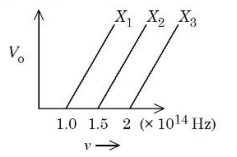
The work function is related to the threshold frequency \(\nu_0\) by \(\Phi = h\nu_0\). From the given graph, the x-intercept represents the threshold frequency. We can observe that:
\(\nu_0(X_1) < \nu_0(X_2) < \nu_0(X_3)\)
Therefore, the work functions of the metals follow the order:
\(\Phi(X_1) < \Phi(X_2) < \Phi(X_3)\)
For the same wavelength \(\lambda\) of incident radiation, the term \(\dfrac{hc}{\lambda}\) is constant. Thus, the kinetic energy \(K_{\text{max}}\) will be greatest for the metal with the smallest work function.
Since metal \(X_1\) has the minimum work function, it will emit electrons with the greatest kinetic energy.
Answer: \(X_1\) -
- (A) 1
- (B) 2
- (C) 4
- (D) \(\sqrt{2}\)
Show answer and solution
Correct Answer: (B)
\(\lambda=\frac{ h }{ mv }=\frac{ h }{\sqrt{2 m \cdot KE }}\)
\(\frac{\lambda_{d}}{\lambda_{\alpha}} = \sqrt{\frac{m_{\alpha} \cdot KE_{\alpha}}{m_{d} \cdot KE_{d}}} = \sqrt{\frac{4m \cdot 2E}{2m \cdot E}} = 2:1\) -
- (A) \(2.9 \times 10^{-8}\)
- (B) \(2.2 \times 10^{-8}\)
- (C) \(3.1 \times 10^{-7}\)
- (D) \(2.5 \times 10^{-7}\)
Show answer and solution
Correct Answer: (D)
\(q.(3.2)=\frac{hc}{\lambda}-\phi\) ...(1)
\(q(0.7)=\frac{hc}{2\lambda}-\phi\) ...(2)
Eq. (1) - Eq. (2)
\(q.(2.5)=\frac{hc}{2\lambda}\)
\(2.5=(\frac{hc}{e})(\frac{1}{2\lambda})\)
\(2.5=\frac{12400}{2(\lambda)}\)
\(\lambda=\frac{12400}{5}\text{\AA}\)
\(\lambda=2480~\text{\AA}\)
\(\lambda=2.48\times10^{-7}m\) -
- (A) \(0.58\)
- (B) \(0.67\)
- (C) \(0.82\)
- (D) \(0.75\)
Show answer and solution
Correct Answer: (B)
The displacement current \(I_d\) between the plates of a capacitor is given by the formula:
\(I_d = C \dfrac{dV}{dt}\)
Substituting the given values of displacement current and capacitance:
\(4.0 = 6 \times 10^{-6} \times \dfrac{dV}{dt}\)
\(\dfrac{dV}{dt} = \dfrac{4.0}{6 \times 10^{-6}}\)
\(\dfrac{dV}{dt} = \dfrac{2}{3} \times 10^6 \approx 0.67 \times 10^6\) V/s
Comparing this with the given rate of change of potential difference \(\alpha \times 10^6\) V/s, we get \(\alpha = 0.67\).
Answer: \(0.67\) -
- (A) 2.0
- (B) 18.3
- (C) 5.5
- (D) 1.83
Show answer and solution
Correct Answer: (D)
\(I =\frac{1}{2} \epsilon_0 E _0^2 \cdot C\)
\(\therefore E _0=\sqrt{\frac{2 I }{\epsilon_0 C }}\)
\(\& \frac{ E _0}{B_0}= C\)
\(\therefore B_0=\frac{E_0}{C}=\frac{1}{C} \sqrt{\frac{2 I}{\epsilon_0 C}}\)
\(\therefore B _0=\frac{1}{3 \times 10^8} \sqrt{\frac{2 \times 4 \times 10^{14}}{8.85 \times 10^{-12} \times 3 \times 10^8}}\)
\(B _0=\frac{10}{3} \sqrt{\frac{8}{8.85 \times 3}}\)
\(B _0=1.83 T\) -
- (A) \(\vec{E}=-v\lambda B_0\sin\left(2\pi vt-\dfrac{2\pi x}{\lambda}\right)\hat{k}\)
- (B) \(\vec{E}=-v\lambda B_0\sin\left(2\pi vt-\dfrac{2\pi x}{\lambda}\right)\hat{i}\)
- (C) \(\vec{E}=v\lambda B_0\sin\left(2\pi vt-\dfrac{2\pi x}{\lambda}\right)\hat{k}\)
- (D) \(\vec{E}=v\lambda B_0\sin\left(2\pi vt-\dfrac{2\pi x}{\lambda}\right)\hat{i}\)
Show answer and solution
Correct Answer: (A)
The direction of propagation of the electromagnetic wave is determined by the phase term \(2\pi vt - \dfrac{2\pi x}{\lambda}\), which indicates that the wave is travelling along the \(+x\) direction (\(\hat{i}\)).
The direction of the magnetic field \(\vec{B}\) is given as \(\hat{j}\).
In an electromagnetic wave, the direction of propagation is given by the direction of the cross product \(\vec{E} \times \vec{B}\).
Let the direction of the electric field \(\vec{E}\) be \(\hat{n}\).
\(\hat{n} \times \hat{j} = \hat{i}\)
Since \((-\hat{k}) \times \hat{j} = \hat{i}\), the direction of the electric field must be \(-\hat{k}\).
The amplitude of the electric field is related to the magnetic field by \(E_0 = c B_0\), where \(c\) is the speed of the wave.
The speed of the wave is \(c = v \lambda\), where \(v\) is the frequency.
\(E_0 = v \lambda B_0\)
Therefore, the electric field vector is \(\vec{E} = -v \lambda B_0 \sin\left(2\pi vt - \dfrac{2\pi x}{\lambda}\right) \hat{k}\).
Answer: \(\vec{E}=-v\lambda B_0\sin\left(2\pi vt-\dfrac{2\pi x}{\lambda}\right)\hat{k}\) -
- (A) \(-1.8\times10^{-7}sin(kz-\omega t)\hat{i}T\)
- (B) \(1.4\times10^{-7}sin(kz-ot)\hat{k}T\)
- (C) \(1.4\times10^{-7}sin(kz-\omega t)\hat{i}T\)
- (D) \(+1.8\times10^{-7}sin(kz-\omega t)\hat{i}T\)
Show answer and solution
Correct Answer: (A)
\(\hat{B}=\hat{C}\times\hat{E}=\hat{k}\times\hat{j}=-\hat{i}\)
.. \(\vec{B}=\frac{54}{3\times10^{8}}sin(kz-cot)(-\hat{i})\)
\(=-1.8\times10^{-7}sin(kz-\omega t)\hat{i}\) -
- (A) \(\dfrac{I_o}{4}\)
- (B) \(I_o\)
- (C) \(\dfrac{I_o}{\sqrt{2}}\)
- (D) \(\dfrac{I_o}{2}\)
Show answer and solution
Correct Answer: (B)
For a point light source, the intensity of electromagnetic waves at a distance \(r\) is given by \(I = \dfrac{P}{4\pi r^2}\), where \(P\) is the power of the source.
Since the detector is moved to a new location on the same spherical surface, the distance from the source remains \(L\).
The emission from a point source is isotropic, meaning the intensity depends only on the radial distance from the source and is independent of the angular position.
Therefore, the intensity at the new location remains unchanged, which is \(I_o\).
Answer: \(I_o\) -
- (A) 1800
- (B) 900
- (C) 1000
- (D) 2000
Show answer and solution
Correct Answer: (A)
\(j _{ c }=\sigma E\)
\(E \Rightarrow E _0 \sin (\omega t - kx )\)
\(j _{ c }=\sigma E _0 \sin (\omega t - kx )\)
\(\Rightarrow\left( j _{ c }\right)_{\max }=\sigma E _0\)....(i)
\(J_d \Rightarrow \frac{i_d}{A}=\frac{1}{A} \times \varepsilon_0 \frac{A d E}{d t}\)
\(\Rightarrow \varepsilon_0 \times E _0 \omega \cos (\omega t- kx )\)
\(\left( j _{ d }\right)_{\max } \Rightarrow \varepsilon_0 E _0 \omega\)....(ii)
(i)/(ii)
\(\frac{\left( j _{ c }\right)_{\max }}{\left( j _{ d }\right)_{\max }}=\frac{\sigma E _0}{\varepsilon_0 \omega E _0} \Rightarrow \frac{\sigma}{\varepsilon_0 \omega}\)
\(\Rightarrow \frac{10 \times 4 \pi \times 9 \times 10^9}{2 \pi \times 100 \times 10^6}\)
\(\Rightarrow 1800\) -
- (A) \(200\)
- (B) \(150\)
- (C) \(400\)
- (D) \(300\)
Show answer and solution
Correct Answer: (A)
The maximum electric force acting on the electron is \(F_e = eE_0\).
The maximum magnetic force acting on the electron is \(F_m = evB_0\), where \(v\) is the speed of the electron and \(B_0\) is the maximum magnetic field.
The ratio of the maximum electric force to the maximum magnetic force is given by \(\dfrac{F_e}{F_m} = \dfrac{eE_0}{evB_0} = \dfrac{E_0}{vB_0}\).
For an electromagnetic wave, the ratio of the amplitudes of the electric and magnetic fields is \(\dfrac{E_0}{B_0} = c\), where \(c\) is the speed of light in vacuum.
Substituting this into the ratio of forces yields \(\dfrac{F_e}{F_m} = \dfrac{c}{v}\).
Given \(c = 3 \times 10^8\) m/s and \(v = 1.5 \times 10^6\) m/s, we get \(\dfrac{F_e}{F_m} = \dfrac{3 \times 10^8}{1.5 \times 10^6} = 200\).
Answer: \(200\) -
- (A) \(60 \hat{k}\)
- (B) \(-60 \hat{k}\)
- (C) \(30 \hat{k}\)
- (D) \(-600 \hat{k}\)
Show answer and solution
Correct Answer: (B)
The direction of propagation of an electromagnetic wave is given by the direction of \(\vec{E} \times \vec{B}\).
Given that the wave travels along the \(x\)-direction, the direction of propagation is \(\hat{i}\).
The magnetic field is given as \(\vec{B} = 2 \times 10^{-7} \hat{j}\) T, so its direction is \(\hat{j}\).
Let the direction of the electric field be \(\hat{n}\). We must have:
\(\hat{n} \times \hat{j} = \hat{i}\)
Since \((-\hat{k}) \times \hat{j} = \hat{i}\), the direction of the electric field is \(-\hat{k}\).
The magnitude of the electric field is related to the magnetic field by \(E = cB\), where \(c = 3 \times 10^8\) m/s is the speed of light in free space.
\(E = (3 \times 10^8) \times (2 \times 10^{-7}) = 60\) V/m
Therefore, the electric field vector is \(\vec{E} = -60 \hat{k}\) V/m.
Answer: \(-60 \hat{k}\) -
- (A) \(\dfrac{\vec{E} \times \vec{k}}{\omega}\)
- (B) \(\dfrac{\vec{k} \times \vec{E}}{\omega}\)
- (C) \(\omega(\vec{E} \times \vec{k})\)
- (D) \(\omega(\vec{k} \times \vec{E})\)
Show answer and solution
Correct Answer: (B)
For an electromagnetic wave, the direction of wave propagation \(\hat{k}\) is along the direction of \(\vec{E} \times \vec{B}\).
Since \(\vec{E}\), \(\vec{B}\), and \(\vec{k}\) form a mutually perpendicular right-handed system, the direction of the magnetic field is given by \(\hat{B} = \hat{k} \times \hat{E}\).
The magnitudes of the electric and magnetic fields are related by \(B = \dfrac{E}{c}\).
Using the relation for the speed of light \(c = \dfrac{\omega}{k}\), we get \(B = \dfrac{kE}{\omega}\).
Combining the magnitude and direction gives:
\(\vec{B} = B\hat{B} = \dfrac{kE}{\omega} (\hat{k} \times \hat{E})\)
Since \(\vec{k} = k\hat{k}\) and \(\vec{E} = E\hat{E}\), this simplifies to:
\(\vec{B} = \dfrac{\vec{k} \times \vec{E}}{\omega}\)
Answer: \(\dfrac{\vec{k} \times \vec{E}}{\omega}\) -
- (A) Both (A) and (R) are true and (R) is the correct explanation of (A)
- (B) Both (A) and (R) are true but (R) is not the correct explanation of (A)
- (C) (A) is true but (R) is false
- (D) (A) is false but (R) is true
Show answer and solution
Correct Answer: (B)
Assertion (A) is true because electromagnetic waves carry energy and momentum. When they strike a surface, they transfer momentum to it, which results in a force and consequently exerts radiation pressure on the surface.
Reason (R) is true because electromagnetic waves consist of photons, which have zero rest mass. Thus, there is no rest mass associated with electromagnetic waves.
However, the pressure exerted by electromagnetic waves is due to the momentum they carry (\(p = \dfrac{E}{c}\)), not because they are massless. Therefore, both (A) and (R) are true, but (R) is not the correct explanation of (A).
Answer: Both (A) and (R) are true but (R) is not the correct explanation of (A) -
- (A) A-II, B-III, C-I, D-IV
- (B) A-II, B-III, C-IV, D-I
- (C) A-I, B-IV, C-III, D-II
- (D) A-IV, B-I, C-II, D-III
Show answer and solution
Correct Answer: (B)
Theoretical
A-II, B-III, C-IV, D-I -
- (A) A-II, B-IV, C-III, D-I
- (B) A-IV, B-III, C-I, D-II
- (C) A-IV, B-I, C-II, D-III
- (D) A-IV, B-II, C-I, D-III
Show answer and solution
Correct Answer: (C)
Radio wave ⇒ Produced by rapid acceleration of electrons
Micro wave ⇒ By magnetron valve
Infrared wave ⇒ Change in vibrational modes
\(X\) ray ⇒ Transition of inner shell electrons from high energy level to low energy level.
A - IV, B - I, C - II, D - III -
- (A) \(0\)
- (B) \(1\)
- (C) \(-1\)
- (D) \(2\)
Show answer and solution
Correct Answer: (B)
The quantity \(\dfrac{1}{2}\epsilon_0 E^2\) represents the energy density of an electric field.
Energy density is defined as energy per unit volume.
Dimensional formula of energy is \([M L^2 T^{-2}]\).
Dimensional formula of volume is \([L^3]\).
Dimensional formula of energy density \(= \dfrac{[M L^2 T^{-2}]}{[L^3]} = [M L^{-1} T^{-2}]\).
Comparing this with \(M^a L^b T^c\), we get:
\(a = 1\)
\(b = -1\)
\(c = -2\)
The value of \(2a - b + c = 2(1) - (-1) + (-2) = 2 + 1 - 2 = 1\).
Answer: \(1\) -
- (A) \( B_{z} = 2.3 \times 10^{-7} \sin[0.6 \times 10^{3}x - 1.8 \times 10^{11}t] \)
- (B) \(B _z=2.3 \times 10^{-7} \sin \left[0.6 \times 10^3 x +1.8 \times 10^{11} t \right]\)
- (C) \(B_y=69 \sin \left[0.6 \times 10^3 x+1.8 \times 10^{11} t\right]\)
- (D) \(B_y=2.3 \times 10^{-7} \sin \left[0.6 \times 10^3 x-1.8 \times 10^{11} t\right]\)
Show answer and solution
Correct Answer: (A)
\(\hat{ B }=\hat{ c } \times \hat{ E }\)
\(\Rightarrow \quad \hat{ c }=\hat{ i }\) because phase of electric field is function of \(x\).
\(\Rightarrow \quad \hat{ E }=\hat{ j }\) (given)
\(\Rightarrow \quad \hat{ B }=\hat{ i } \times \hat{ j }=\hat{ k }\)
\(| B |=\frac{| E |}{ c }=\frac{69 \times 0.6 \times 10^3}{1.8 \times 10^{11}}=\frac{69}{3 \times 10^8}\)
\(| B |=2.9 \times 10^{-7}\)
\(\overrightarrow{ B }_2=2.9 \times 10^{-j} \sin \left(0.6 \times 10^3 x -1.8 \times 10^{11} t \right)\)
(phase is same as that of electric field) -
- (A) 1
- (B) 2
- (C) 3
- (D) 4
Show answer and solution
Correct Answer: (D)
\(n =\frac{ C }{ V }\)
\(V =\frac{\omega}{ k }=\frac{4.5 \times 10^{14}}{3 \times 10^6}=\frac{3}{2} \times 10^8\)
\(n =2\)
\(n =\sqrt{\mu_{ r } \varepsilon_{ r }} \quad\left(\mu_{ r }=1\right)\)
\(2=\sqrt{\varepsilon_{ r }}\)
\(\varepsilon_{ r }=4\)
No questions on this page match these filters.