


Questions
14 questionsShowing 1–14 of 14 questions
-
- (A) \(2 \pi \sqrt{\frac{ M }{\rho Ag }}\)
- (B) \(\pi \sqrt{\frac{2 M }{\rho Ag }}\)
- (C) \(\pi \sqrt{\frac{\rho A }{ Mg }}\)
- (D) \(2 \pi \sqrt{\frac{\rho A}{ Mg }}\)
Show answer and solution
Correct Answer: (A)
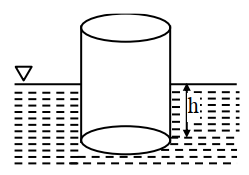
At equilibrium
\(\rho Ahg = Mg\)
After displacing by x ,
\(M a=-\rho A(h+x) g+M g\)
\(M a=-\rho A h g-\rho A x g+M g\)
\(Ma =-\rho Axg\)
\(a=\left(\frac{-\rho A g}{M}\right) x\)
on comparing with,
\(a=-\omega^2 x\)
\(\omega=\sqrt{\frac{\rho Ag }{ M }}\)
\(T =\frac{2 \pi}{\omega}=2 \pi \sqrt{\frac{ M }{\rho Ag }}\) -
- (A) \(1/4\)
- (B) \(5/4\)
- (C) \(5/8\)
- (D) \(3/8\)
Show answer and solution
Correct Answer: (C)
The equation of simple harmonic motion for a particle starting from the extreme position \(x = A\) is given by:
\(x = A \cos(\omega t)\)
We need to find the time \(t\) when the particle reaches \(x = \dfrac{A}{\sqrt{2}}\). Substituting this value into the equation:
\(\dfrac{A}{\sqrt{2}} = A \cos(\omega t)\)
\(\cos(\omega t) = \dfrac{1}{\sqrt{2}}\)
\(\omega t = \dfrac{\pi}{4}\)
Since the angular frequency \(\omega = \dfrac{2\pi}{T}\), we have:
\(\dfrac{2\pi}{T} t = \dfrac{\pi}{4}\)
\(t = \dfrac{T}{8}\)
Given the time period \(T = 5\) sec, the required time is:
\(t = \dfrac{5}{8}\) sec
Answer: \(5/8\) -
- (A) 120
- (B) 0.75
- (C) 7.5
- (D) 15
Show answer and solution
Correct Answer: (C)
Time period becomes half
and \( T\propto\sqrt{\ell} \)
So, length becomes \( \frac{\ell}{4} \)
So, \( \frac{\ell}{4}=\frac{30}{4}=7.5 \) -
- (A) 15
- (B) 20
- (C) 60
- (D) 45
Show answer and solution
Correct Answer: (C)
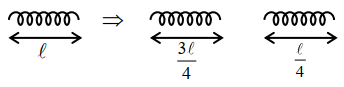
\(K \ell=\) constant
\(K \ell= K ^{\prime}\left(\frac{\ell}{4}\right)\)
\(K ^{\prime}=4 K\)
\(K ^{\prime}=60 N / m\) -
- (A) \(\dfrac{5\sqrt{50}}{\pi}\) and \(8 \times 10^{-3}\)
- (B) \(\dfrac{5\sqrt{50}}{\pi}\) and \(8\)
- (C) \(10\sqrt{50}\) and \(2 \times 10^{-3}\)
- (D) \(\dfrac{5\sqrt{50}}{\pi}\) and \(16 \times 10^{-3}\)
Show answer and solution
Correct Answer: (A)
At equilibrium, the restoring force of the spring balances the weight of the mass:
\(mg = kx_0\)
\(k = \dfrac{mg}{x_0} = \dfrac{0.2 \times 10}{2 \times 10^{-3}} = 1000\) N/m
The frequency of oscillation is given by:
\(f = \dfrac{1}{2\pi} \sqrt{\dfrac{k}{m}}\)
\(f = \dfrac{1}{2\pi} \sqrt{\dfrac{1000}{0.2}} = \dfrac{1}{2\pi} \sqrt{5000} = \dfrac{10\sqrt{50}}{2\pi} = \dfrac{5\sqrt{50}}{\pi}\) Hz
The maximum energy in the spring corresponds to its maximum elastic potential energy, which occurs at the maximum extension.
Maximum extension \(x_{max} = x_0 + A = 2 \text{ mm} + 2 \text{ mm} = 4 \text{ mm} = 4 \times 10^{-3}\) m
Maximum energy in the spring \(U_{max} = \dfrac{1}{2} k x_{max}^2\)
\(U_{max} = \dfrac{1}{2} \times 1000 \times (4 \times 10^{-3})^2\)
\(U_{max} = 500 \times 16 \times 10^{-6} = 8000 \times 10^{-6} = 8 \times 10^{-3}\) J
Answer: \(\dfrac{5\sqrt{50}}{\pi}\) and \(8 \times 10^{-3}\) -
- (A) \(2\pi\sqrt{\dfrac{5R}{4g}}\)
- (B) \(2\pi\sqrt{\dfrac{2R}{3g}}\)
- (C) \(2\pi\sqrt{\dfrac{3R}{2g}}\)
- (D) \(2\pi\sqrt{\dfrac{3R}{g}}\)
Show answer and solution
Correct Answer: (A)
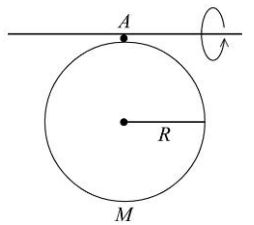
From the given figure, the axis of rotation is a horizontal line passing through the point \(A\) on the edge of the disc. The circular arrow around the axis indicates that the disc oscillates out of its plane, meaning the axis of rotation is a tangent to the disc in its own plane.
The moment of inertia of a uniform disc about its diameter is \(I_{cm} = \dfrac{1}{4}MR^2\).
Using the parallel axis theorem, the moment of inertia of the disc about the given axis of rotation is:
\(I = I_{cm} + MR^2 = \dfrac{1}{4}MR^2 + MR^2 = \dfrac{5}{4}MR^2\)
The distance from the center of mass of the disc to the axis of rotation is \(d = R\).
The time period of a physical pendulum is given by:
\(T = 2\pi\sqrt{\dfrac{I}{Mgd}}\)
Substituting the values of \(I\) and \(d\):
\(T = 2\pi\sqrt{\dfrac{\dfrac{5}{4}MR^2}{MgR}} = 2\pi\sqrt{\dfrac{5R}{4g}}\)
Answer: \(2\pi\sqrt{\dfrac{5R}{4g}}\) -
- (A) solid cylinder
- (B) ring
- (C) disc
- (D) solid sphere
Show answer and solution
Correct Answer: (D)
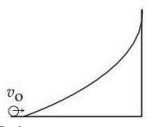
By the law of conservation of mechanical energy, the total initial kinetic energy of the rolling object is converted into potential energy at the maximum height.
Total initial kinetic energy for an object rolling without slipping is given by:
\(K = K_{\text{translational}} + K_{\text{rotational}}\)
\(K = \dfrac{1}{2}mv_0^2 + \dfrac{1}{2}I\omega^2\)
Substituting \(\omega = \dfrac{v_0}{R}\) and \(I = mk^2\) (where \(k\) is the radius of gyration):
\(K = \dfrac{1}{2}mv_0^2 + \dfrac{1}{2}(mk^2)\left(\dfrac{v_0}{R}\right)^2 = \dfrac{1}{2}mv_0^2\left(1 + \dfrac{k^2}{R^2}\right)\)
The potential energy at the maximum height \(h\) is:
\(U = mgh\)
Given \(h = \dfrac{7v_0^2}{10g}\), we have:
\(U = mg\left(\dfrac{7v_0^2}{10g}\right) = \dfrac{7}{10}mv_0^2\)
Equating kinetic and potential energy (\(K = U\)):
\(\dfrac{1}{2}mv_0^2\left(1 + \dfrac{k^2}{R^2}\right) = \dfrac{7}{10}mv_0^2\)
\(1 + \dfrac{k^2}{R^2} = \dfrac{14}{10} = \dfrac{7}{5}\)
\(\dfrac{k^2}{R^2} = \dfrac{7}{5} - 1 = \dfrac{2}{5}\)
The moment of inertia is \(I = \dfrac{2}{5}mR^2\), which corresponds to a solid sphere.
Answer: solid sphere -
- (A) 30
- (B) 27
- (C) 20
- (D) 5
Show answer and solution
Correct Answer: (A)
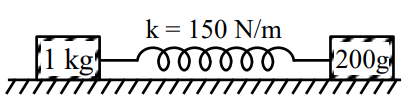
\(\mu=\frac{m_{1}m_{2}}{m_{1}+m_{2}}=\frac{1\times0.2}{1.2}\)
\(\mu=\frac{1}{6}\)
\(\omega=\sqrt{\frac{k}{\mu}}=\sqrt{\frac{150}{1/6}}=30\) -
- (A) A-III, B-I, C-IV, D-II
- (B) A-II, B-I, C-III, D-IV
- (C) A-III, B-II, C-IV, D-I
- (D) A-II, B-I, C-IV, D-III
Show answer and solution
Correct Answer: (A)
For A: \(y = \sin^2 \omega t = \dfrac{1 - \cos 2\omega t}{2} = \dfrac{1}{2} - \dfrac{1}{2} \cos 2\omega t\)
This represents simple harmonic motion (SHM) about the mean position \(y = \dfrac{1}{2}\) with an angular frequency of \(2\omega\). The time period is \(T = \dfrac{2\pi}{2\omega} = \dfrac{\pi}{\omega}\). Thus, A matches III.
For B: \(y = \sin^3(2\omega t) = \dfrac{3\sin 2\omega t - \sin 6\omega t}{4}\)
This is a superposition of two SHMs with angular frequencies \(2\omega\) and \(6\omega\). It is periodic but not SHM. The time period is the LCM of \(T_1 = \dfrac{2\pi}{2\omega} = \dfrac{\pi}{\omega}\) and \(T_2 = \dfrac{2\pi}{6\omega} = \dfrac{\pi}{3\omega}\), which is \(T = \dfrac{\pi}{\omega}\). Thus, B matches I.
For C: \(y = \sin(\omega t) + \cos(\pi \omega t)\)
The angular frequencies are \(\omega_1 = \omega\) and \(\omega_2 = \pi \omega\). The ratio \(\dfrac{\omega_1}{\omega_2} = \dfrac{1}{\pi}\) is an irrational number. Therefore, the function is non-periodic. Thus, C matches IV.
For D: \(y = \cos \omega t + \cos 2\omega t\)
This is a superposition of two SHMs with angular frequencies \(\omega\) and \(2\omega\). It is periodic but not SHM. The time period is the LCM of \(T_1 = \dfrac{2\pi}{\omega}\) and \(T_2 = \dfrac{2\pi}{2\omega} = \dfrac{\pi}{\omega}\), which is \(T = \dfrac{2\pi}{\omega}\). Thus, D matches II.
The correct matching is A-III, B-I, C-IV, D-II.
Answer: A-III, B-I, C-IV, D-II -
- (A) 1
- (B) 2
- (C) 4
- (D) 8
Show answer and solution
Correct Answer: (B)
Potential energy is maximum at extreme position The particle starting at mean position reaches extreme position in time \(\frac{ T }{4}\).
So \(T/2\beta = T/4 \Rightarrow 2\beta = 4 \Rightarrow \beta = 2\) -
- (A) \(\dfrac{\pi}{300} \, s, \dfrac{\pi}{75} \, s\)
- (B) \(\dfrac{\pi}{75} \, s, \dfrac{\pi}{300} \, s\)
- (C) \(\dfrac{\pi}{300} \, s, \dfrac{\pi}{25} \, s\)
- (D) \(\dfrac{\pi}{50} \, s, \dfrac{\pi}{100} \, s\)
Show answer and solution
Correct Answer: (A)
The equation of motion is given by \(x = a \sin\left(50t + \dfrac{\pi}{3}\right)\).
Velocity is the rate of change of displacement:
\(v = \dfrac{dx}{dt} = 50a \cos\left(50t + \dfrac{\pi}{3}\right)\)
The particle comes to rest when \(v = 0\). For the first time it comes to rest:
\(\cos\left(50t_1 + \dfrac{\pi}{3}\right) = 0\)
\(50t_1 + \dfrac{\pi}{3} = \dfrac{\pi}{2}\)
\(50t_1 = \dfrac{\pi}{2} - \dfrac{\pi}{3} = \dfrac{\pi}{6}\)
\(t_1 = \dfrac{\pi}{300} \text{ s}\)
Acceleration is the rate of change of velocity:
\(A = \dfrac{dv}{dt} = -2500a \sin\left(50t + \dfrac{\pi}{3}\right)\)
The particle has zero acceleration when \(A = 0\). For the first time it has zero acceleration:
\(\sin\left(50t_2 + \dfrac{\pi}{3}\right) = 0\)
\(50t_2 + \dfrac{\pi}{3} = \pi\)
\(50t_2 = \pi - \dfrac{\pi}{3} = \dfrac{2\pi}{3}\)
\(t_2 = \dfrac{2\pi}{150} = \dfrac{\pi}{75} \text{ s}\)
Answer: \(\dfrac{\pi}{300} \, s, \dfrac{\pi}{75} \, s\) -
- (A) \(1\)
- (B) \(2\)
- (C) \(\sqrt{2}\)
- (D) \(\sqrt{3}\)
Show answer and solution
Correct Answer: (C)
The frequency of oscillation of a spring-mass system is given by \(v = \dfrac{1}{2\pi} \sqrt{\dfrac{k}{m}}\), where \(k\) is the spring constant and \(m\) is the mass.
The spring constant \(k\) is inversely proportional to the length of the spring \(L\), so \(k \propto \dfrac{1}{L}\).
When the length of the spring is cut to half, the new length is \(L' = \dfrac{L}{2}\). The new spring constant becomes \(k' = 2k\).
The new frequency of oscillation is \(v_2 = \dfrac{1}{2\pi} \sqrt{\dfrac{k'}{m}} = \dfrac{1}{2\pi} \sqrt{\dfrac{2k}{m}} = \sqrt{2} v_1\).
Therefore, the ratio \(\dfrac{v_2}{v_1} = \sqrt{2}\).
Answer: \(\sqrt{2}\) -
- (A) 14
- (B) 88
- (C) 28
- (D) 176
Show answer and solution
Correct Answer: (A)
\( \omega=176~rad/sec \)
\( f_{k}=\frac{\omega}{2\pi}=\frac{176}{2\times22}\times7 \)
\( =\frac{176}{44}\times7 \)
\( =4\times7=28~Hz \)
So frequency of oscillator
\( =\frac{f_{k}}{2}=14Hz \) -
- (A) 40
- (B) 44
- (C) 48
- (D) 52
Show answer and solution
Correct Answer: (B)
The given equation is \(v^2 = 50 - x^2\)
Differentiating with respect to \(x\):
\(2v \dfrac{dv}{dx} = -2x\)
\(v \dfrac{dv}{dx} = -x\)
Since acceleration \(a = v \dfrac{dv}{dx}\), we get:
\(a = -x\)
Comparing this with the standard equation of SHM \(a = -\omega^2 x\), we get:
\(\omega^2 = 1 \Rightarrow \omega = 1\) rad/s
The time period of the motion is given by:
\(T = \dfrac{2\pi}{\omega} = 2\pi\)
Taking \(\pi = \dfrac{22}{7}\), we get:
\(T = 2 \times \dfrac{22}{7} = \dfrac{44}{7}\) s
Given that the time period is \(\dfrac{x}{7}\) s, comparing the two gives:
\(x = 44\)
Answer: \(44\)
No questions on this page match these filters.