


Questions
23 questionsShowing 1–23 of 23 questions
-
- (A) 165
- (B) 168
- (C) 170
- (D) 171
Show answer and solution
Correct Answer: (D)
The magnetic force acting on a moving charge is given by \(\vec{F} = q(\vec{v} \times \vec{B})\).
Given:
\(q = 1 \, \mu\text{C} = 10^{-6} \text{ C}\)
\(\vec{v} = \hat{i} - 2\hat{j} + 3\hat{k}\)
\(\vec{B} = 2\hat{i} + 3\hat{j} - 5\hat{k}\)
Calculating the cross product \(\vec{v} \times \vec{B}\):
\(\vec{v} \times \vec{B} = \begin{vmatrix} \hat{i} & \hat{j} & \hat{k} \\ 1 & -2 & 3 \\ 2 & 3 & -5 \end{vmatrix}\)
\(\vec{v} \times \vec{B} = \hat{i}(10 - 9) - \hat{j}(-5 - 6) + \hat{k}(3 + 4)\)
\(\vec{v} \times \vec{B} = \hat{i} + 11\hat{j} + 7\hat{k}\)
The magnitude of \(\vec{v} \times \vec{B}\) is:
\(|\vec{v} \times \vec{B}| = \sqrt{1^2 + 11^2 + 7^2} = \sqrt{1 + 121 + 49} = \sqrt{171}\)
The magnitude of the force is:
\(|\vec{F}| = q |\vec{v} \times \vec{B}| = 10^{-6} \times \sqrt{171} = \sqrt{171} \times 10^{-6} \text{ N}\)
Comparing this with the given expression \(\sqrt{\alpha} \times 10^{-6} \text{ N}\), we get:
\(\alpha = 171\)
Answer: \(171\) -
- (A) 2
- (B) 4
- (C) 6
- (D) 8
Show answer and solution
Correct Answer: (A)
Given:
Mass of the particle, \(m = 5 \text{ mg} = 5 \times 10^{-6} \text{ kg}\)
Charge, \(q = 5\pi \times 10^{-6} \text{ C}\)
Velocity, \(\vec{v} = (3\hat{i} + 2\hat{k}) \times 10^{-2} \text{ m/s}\)
Magnetic field, \(\vec{B} = 0.1\hat{k} \text{ Wb/m}^2\)
The velocity component parallel to the magnetic field is \(v_{\parallel} = 2 \times 10^{-2} \text{ m/s}\).
The time period of one revolution is given by:
\(T = \dfrac{2\pi m}{qB}\)
Substituting the given values:
\(T = \dfrac{2\pi \times 5 \times 10^{-6}}{5\pi \times 10^{-6} \times 0.1} = \dfrac{2}{0.1} = 20 \text{ s}\)
The time taken to complete \(5\) revolutions is:
\(t = 5T = 5 \times 20 = 100 \text{ s}\)
The distance moved along the \(\hat{k}\) direction (pitch for \(5\) revolutions) is:
\(\alpha = v_{\parallel} \times t\)
\(\alpha = 2 \times 10^{-2} \times 100 = 2 \text{ m}\)
Answer: \(2\) -
- (A) 3.14
- (B) 314
- (C) 0.0314
- (D) 0.003
Show answer and solution
Correct Answer: (B)
The magnetic moment of the coil is given by \(M = NIA\).
The torque acting on the coil is \(\tau = MB \sin\theta = NIAB \sin\theta\).
Substituting the given values:
\(\tau = 125 \times 1 \times (\pi \times (0.02)^2) \times 0.4 \times \sin 30^\circ\)
\(\tau = 125 \times 1 \times 4\pi \times 10^{-4} \times 0.4 \times 0.5\)
\(\tau = 100\pi \times 10^{-4}\)
\(\tau = 100 \times 3.14 \times 10^{-4} = 314 \times 10^{-4}\) N.m
Comparing with \(\alpha \times 10^{-4}\) N.m, we get \(\alpha = 314\).
Answer: \(314\) -
- (A) \(16\times 10^{-5}\,\hat{k}\)
- (B) \(5024\times 10^{-7}\,\hat{k}\)
- (C) \(5024\times 10^{-7}\,\hat{i}\)
- (D) \(5024\times 10^{-7}\,\hat{j}\)
Show answer and solution
Correct Answer: (D)
Explanation:
1. Magnetic Dipole Moment (\( \vec{M} \)): The magnetic dipole moment of a current-carrying loop is given by the formula:
\( \vec{M} = I \cdot A \cdot \hat{n} \)
2. Area of the Circular Loop (\( A \)):
Given radius, \( r = 2\text{ cm} = 2 \times 10^{-2}\text{ m} \)
\( A = \pi r^2 = \pi \left(2 \times 10^{-2}\text{ m}\right)^2 = 4\pi \times 10^{-4}\text{ m}^2 \)
3. Calculating \( \vec{M} \):
Substitute \( I = 100\sqrt{2}\text{ A} \) and \( \hat{n} = \frac{\hat{i} + \hat{k}}{\sqrt{2}} \):
\( \vec{M} = \left(100\sqrt{2}\right) \times \left(4\pi \times 10^{-4}\right) \times \left(\frac{\hat{i} + \hat{k}}{\sqrt{2}}\right) \)
\( \vec{M} = 4\pi \times 10^{-2}(\hat{i} + \hat{k})\text{ A}\cdot\text{m}^2 \)
4. Torque (\( \vec{\tau} \)): The torque experienced by a magnetic dipole in a uniform magnetic field is given by:
\( \vec{\tau} = \vec{M} \times \vec{B} \)
Given, \( \vec{B} = 4 \times 10^{-3}(3\hat{i} + 2\hat{k})\text{ T} \)
Substituting the values:
\( \vec{\tau} = \left[4\pi \times 10^{-2}(\hat{i} + \hat{k})\right] \times \left[4 \times 10^{-3}(3\hat{i} + 2\hat{k})\right] \)
\( \vec{\tau} = 16\pi \times 10^{-5} \left[ (\hat{i} + \hat{k}) \times (3\hat{i} + 2\hat{k}) \right] \)
5. Evaluating Cross Product:
Using the cross product rules (\( \hat{i}\times\hat{i}=0 \), \( \hat{i}\times\hat{k}=-\hat{j} \), \( \hat{k}\times\hat{i}=\hat{j} \), \( \hat{k}\times\hat{k}=0 \)):
\( (\hat{i} + \hat{k}) \times (3\hat{i} + 2\hat{k}) = 2(\hat{i} \times \hat{k}) + 3(\hat{k} \times \hat{i}) = -2\hat{j} + 3\hat{j} = \hat{j} \)
Therefore:
\( \vec{\tau} = 16\pi \times 10^{-5}\hat{j} \)
6. Substituting \( \pi = 3.14 \):
\( \vec{\tau} = 16 \times 3.14 \times 10^{-5}\hat{j} = 50.24 \times 10^{-5}\hat{j} = 5024 \times 10^{-7}\hat{j}\text{ Wb}\cdot\text{A} \)
Hence, Option D is the correct choice. -
- (A) \( a = g \)
- (B) \( a > g \)
- (C) \( a = 0 \)
- (D) \( 0 < a < g \)
Show answer and solution
Correct Answer: (A)
Since the solenoid is placed vertically, the magnetic field inside the solenoid will be either along - y or + y axis.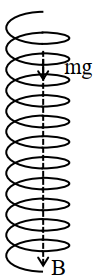
⇒ Particle will gain velocity along -y axis.
\(\Rightarrow \quad \overrightarrow{ F }_{ B }= q (\overrightarrow{ v } \times \overrightarrow{ B })\)
\(\Rightarrow \quad \overrightarrow{ F }_{ B }=0\)
\(\Rightarrow \quad \overrightarrow{ F }_{\text {net }}= mg\)
\(\Rightarrow \quad a _{\text {net }}= g\) -
- (A) \(30\)
- (B) \(300\)
- (C) \(150\)
- (D) \(0.0\)
Show answer and solution
Correct Answer: (B)
Let the distance between the wires be \(d = 8\text{ cm}\). The distance of the midpoint from each wire is \(r = \dfrac{d}{2} = 4\text{ cm} = 0.04\text{ m}\).
The current in each wire is \(I = 30\text{ A}\).
Since the currents flow in opposite directions, the magnetic fields produced by both wires at the midpoint point in the same direction and add up.
The total magnetic field at the midpoint is:
\(B_{\text{net}} = B_1 + B_2 = \dfrac{\mu_0 I}{2\pi r} + \dfrac{\mu_0 I}{2\pi r} = \dfrac{\mu_0 I}{\pi r}\)
Substituting the given values:
\(B_{\text{net}} = \dfrac{4\pi \times 10^{-7} \times 30}{\pi \times 0.04}\)
\(B_{\text{net}} = \dfrac{120 \times 10^{-7}}{0.04}\)
\(B_{\text{net}} = 3000 \times 10^{-7}\text{ T}\)
\(B_{\text{net}} = 300 \times 10^{-6}\text{ T} = 300\ \mu\text{T}\)
Answer: \(300\) -
- (A) D Only
- (B) A, D Only
- (C) B, C Only
- (D) E Only
Show answer and solution
Correct Answer: (A)
Solid cylinder
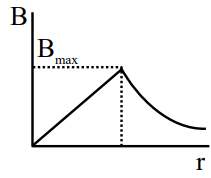
\(B_{max}\) at surface
\(B_{min}\) at Axis -
- (A) 25
- (B) 10
- (C) 0.5
- (D) 2.5
Show answer and solution
Correct Answer: (A)
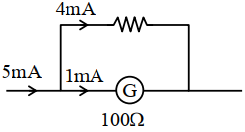
\(G =100 \Omega\)
\(i _{ g }=1 mA\)
\(i =5 mA\)
\(r_s=\frac{G}{\left(\frac{i}{i_g}-1\right)}\)
\(=\frac{100}{\left(\frac{5}{1}-1\right)}=25 \Omega\) -
- (A) 25
- (B) 50
- (C) 75
- (D) 100
Show answer and solution
Correct Answer: (B)
Let \(G\) be the resistance of the galvanometer and \(I_g\) be the current required for full scale deflection.
When the galvanometer is shunted with \(S = 2\,\Omega\), it acts as an ammeter of range \(I = 500\text{ mA} = 0.5\text{ A}\). The potential difference across the galvanometer and the shunt is equal:
\(I_g G = (I - I_g) S\)
\(I_g G = (0.5 - I_g) \times 2\)
\(I_g G + 2 I_g = 1\)
\(I_g = \dfrac{1}{G + 2}\)
When a resistance \(R = 470\,\Omega\) is connected in series, it acts as a voltmeter of range \(V = 10\text{ V}\). The total voltage is the sum of the voltage drops:
\(V = I_g (G + R)\)
\(10 = I_g (G + 470)\)
\(I_g = \dfrac{10}{G + 470}\)
Equating the two expressions for \(I_g\):
\(\dfrac{1}{G + 2} = \dfrac{10}{G + 470}\)
\(G + 470 = 10(G + 2)\)
\(G + 470 = 10G + 20\)
\(9G = 450\)
\(G = 50\,\Omega\)
Answer: \(50\) -
- (A) \(50\hat{i} + 100\hat{j}\)
- (B) \(100\hat{i} + 50\hat{j}\)
- (C) \(-50\hat{i} + 100\hat{j}\)
- (D) \(50\hat{i} - 100\hat{j}\)
Show answer and solution
Correct Answer: (A)
The Lorentz force experienced by a charged particle is given by \(\vec{F} = q(\vec{E} + \vec{v} \times \vec{B})\).
Given that the particle moves in the \(x\)-\(y\) plane, its velocity can be written as \(\vec{v} = v_x \hat{i} + v_y \hat{j}\).
Substituting the given values into the force equation:
\(\vec{F} = 10^{-9} [0.4\hat{j} + (v_x \hat{i} + v_y \hat{j}) \times (4 \times 10^{-3} \hat{k})]\)
Using the cross product rules \(\hat{i} \times \hat{k} = -\hat{j}\) and \(\hat{j} \times \hat{k} = \hat{i}\):
\(\vec{F} = 10^{-9} [0.4\hat{j} - 4 \times 10^{-3} v_x \hat{j} + 4 \times 10^{-3} v_y \hat{i}]\)
\(\vec{F} = 10^{-9} [4 \times 10^{-3} v_y \hat{i} + (0.4 - 4 \times 10^{-3} v_x) \hat{j}]\)
The given force is \(\vec{F} = (4\hat{i} + 2\hat{j}) \times 10^{-10}\) N, which can be rewritten as:
\(\vec{F} = 10^{-9} (0.4\hat{i} + 0.2\hat{j})\) N
Comparing the coefficients of \(\hat{i}\) and \(\hat{j}\) from both expressions:
For the \(\hat{i}\) component:
\(4 \times 10^{-3} v_y = 0.4\)
\(v_y = \dfrac{0.4}{4 \times 10^{-3}} = 100\) m/s
For the \(\hat{j}\) component:
\(0.4 - 4 \times 10^{-3} v_x = 0.2\)
\(4 \times 10^{-3} v_x = 0.2\)
\(v_x = \dfrac{0.2}{4 \times 10^{-3}} = 50\) m/s
Therefore, the velocity of the particle is \(\vec{v} = 50\hat{i} + 100\hat{j}\) m/s.
Answer: \(50\hat{i} + 100\hat{j}\) -
- (A) \(\dfrac{qE_0}{\lambda}[1 - e^{-\lambda L}]\)
- (B) \(\left(\dfrac{v_0 q B_0}{2\lambda}\right)[2 - e^{-2\lambda L}]\)
- (C) \(\dfrac{qE_0}{\lambda}[1 + e^{-\lambda L}]\)
- (D) \(q\left(\dfrac{E_0 + v_0 B_0}{\lambda}\right)[1 - e^{-\lambda L/2}]\)
Show answer and solution
Correct Answer: (A)
According to the work-energy theorem, the change in kinetic energy of a particle is equal to the total work done by all the forces acting on it.
The forces acting on the particle are the electric force and the magnetic force. The magnetic force is given by \(\vec{F}_B = q(\vec{v} \times \vec{B})\). Since the magnetic force is always perpendicular to the velocity vector of the particle, the work done by the magnetic field is zero.
The change in kinetic energy is equal to the work done by the electric field alone. The electric force is \(\vec{F}_E = q\vec{E} = qE_0 e^{-\lambda x}\hat{x}\).
The work done by the electric field as the particle moves from \(x = 0\) to \(x = L\) is given by
\(W_E = \int_{0}^{L} \vec{F}_E \cdot d\vec{r} = \int_{0}^{L} qE_0 e^{-\lambda x} dx\)
Evaluating the integral, we get
\(W_E = qE_0 \left[ \dfrac{e^{-\lambda x}}{-\lambda} \right]_{0}^{L}\)
\(W_E = -\dfrac{qE_0}{\lambda} (e^{-\lambda L} - e^{0})\)
\(W_E = \dfrac{qE_0}{\lambda} [1 - e^{-\lambda L}]\)
Thus, the change in kinetic energy is \(\dfrac{qE_0}{\lambda} [1 - e^{-\lambda L}]\).
Answer: \(\dfrac{qE_0}{\lambda}[1 - e^{-\lambda L}]\) -
- (A) \(6.28\)
- (B) \(6.28 \times 10^{-6}\)
- (C) \(628\)
- (D) \(6.28 \times 10^{-4}\)
Show answer and solution
Correct Answer: (A)
The magnetic field at the centre of the circular loop is given by \(B = \dfrac{\mu_0 I}{2R}\)
Substituting the given values, \(B = \dfrac{4\pi \times 10^{-7} \times 2}{2 \times 0.1} = 4\pi \times 10^{-6}\) T
The magnetic energy density is \(u = \dfrac{B^2}{2\mu_0}\)
\(u = \dfrac{(4\pi \times 10^{-6})^2}{2 \times 4\pi \times 10^{-7}} = \dfrac{16\pi^2 \times 10^{-12}}{8\pi \times 10^{-7}} = 2\pi \times 10^{-5}\) J/m\(^3\)
The volume of the small cube is \(V = (1 \text{ mm})^3 = (10^{-3} \text{ m})^3 = 10^{-9}\) m\(^3\)
The magnetic energy stored inside the cube is \(U = u \times V\)
\(U = 2\pi \times 10^{-5} \times 10^{-9} = 2\pi \times 10^{-14}\) J
Using \(\pi = 3.14\), we get \(U = 2 \times 3.14 \times 10^{-14} = 6.28 \times 10^{-14}\) J
Comparing with \(\alpha \times 10^{-14}\) J, we get \(\alpha = 6.28\)
Answer: \(6.28\) -
- (A) connect resistor of \(\dfrac{x}{2}\ \Omega\), in series with voltmeter.
- (B) connect resistor of \(\dfrac{x}{2}\ \Omega\), in parallel to voltmeter.
- (C) connect a resistor of \(x\ \Omega\) in series with voltmeter.
- (D) connect resistor of \(2x\ \Omega\) in parallel to voltmeter.
Show answer and solution
Correct Answer: (A)
Let the maximum current for full-scale deflection of the voltmeter be \(I_g\).
\(I_g = \dfrac{V_1}{R_v} = \dfrac{20}{x}\)
To increase the measuring range to \(V_2 = 30\) V, a resistance \(R\) must be connected in series with the voltmeter.
\(V_2 = I_g(R_v + R)\)
\(30 = \dfrac{20}{x}(x + R)\)
\(30x = 20x + 20R\)
\(10x = 20R\)
\(R = \dfrac{x}{2}\ \Omega\)
Thus, a resistor of \(\dfrac{x}{2}\ \Omega\) should be connected in series with the voltmeter.
Answer: connect resistor of \(\dfrac{x}{2}\ \Omega\), in series with voltmeter. -
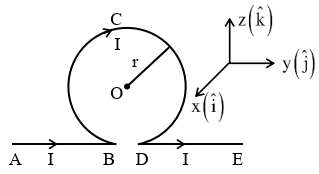
- (A) \(\frac{\mu_0}{2 \pi} \frac{ I }{ r }(\pi+1) \hat{ i }\)
- (B) \(-\frac{\mu_0}{2 \pi} \frac{ I }{ r }(\pi-1) \hat{ i }\)
- (C) \(\frac{\mu_0}{2 \pi} \frac{ I }{ r }(\pi-1) \hat{ i }\)
- (D) \(-\frac{\mu_0}{2 \pi} \frac{ I }{ r }(\pi+1) \hat{ i }\)
Show answer and solution
Correct Answer: (B)
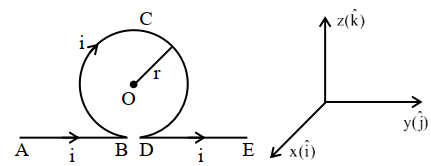
\(\overrightarrow{ B}_0=\overrightarrow{ B }_{ AB }+\overrightarrow{ B }_{ DE }+\overrightarrow{ B }_{ BCD }\)
\(=\frac{\mu_0 i }{4 \pi r } \hat{ i }+\frac{\mu_0 i }{4 \pi r } \hat{ i }-\frac{\mu_0 i }{2 r } \hat{ i }\)
\(=\frac{\mu_0 i }{2 \pi r } \hat{ i }-\frac{\mu_0 i }{2 r } \hat{ i }\)
\(=\frac{\mu_0 i }{2 \pi r }(1-\pi) \hat{ i }\)
\(=-\frac{\mu_0 i }{2 \pi r}(\pi-1) \hat{ i }\) -
- (A) \(4.4\)
- (B) \(2.64\)
- (C) \(3.25\)
- (D) \(1.2\)
Show answer and solution
Correct Answer: (B)
Let the number of turns per unit radial width be \(n = \dfrac{N}{r_2 - r_1}\).
Consider an elemental ring of radius \(r\) and width \(dr\). The number of turns in this element is \(dN = n \, dr\).
The magnetic moment of this elemental ring is \(dM = I \, dN \, A = I \left( \dfrac{N}{r_2 - r_1} \, dr \right) (\pi r^2)\).
Integrating from \(r_1\) to \(r_2\) to find the total magnetic moment \(M\):
\(M = \int_{r_1}^{r_2} \dfrac{I \pi N}{r_2 - r_1} r^2 \, dr = \dfrac{I \pi N}{3(r_2 - r_1)} (r_2^3 - r_1^3)\)
Substituting the given values: \(I = 20 \times 10^{-3}\) A, \(N = 200\), \(r_1 = 0.03\) m, and \(r_2 = 0.06\) m:
\(M = \dfrac{20 \times 10^{-3} \times \pi \times 200}{3(0.06 - 0.03)} \left( (0.06)^3 - (0.03)^3 \right)\)
\(M = \dfrac{4\pi}{0.09} (216 \times 10^{-6} - 27 \times 10^{-6})\)
\(M = \dfrac{4\pi}{0.09} \times 189 \times 10^{-6} = 4\pi \times 2100 \times 10^{-6}\)
\(M = 84\pi \times 10^{-4} \approx 84 \times 3.14 \times 10^{-4} = 263.76 \times 10^{-4} \approx 2.64 \times 10^{-2}\) A.m\(^2\)
Comparing with \(\alpha \times 10^{-2}\) A.m\(^2\), we get \(\alpha = 2.64\).
Answer: \(2.64\) -
- (A) 12
- (B) 24
- (C) 36
- (D) 48
Show answer and solution
Correct Answer: (A)
The magnetic force on a moving charged particle is given by \(\vec{F} = q(\vec{v} \times \vec{B})\).
Since the acceleration \(\vec{a}\) is in the direction of the magnetic force, it must be perpendicular to the magnetic field \(\vec{B}\).
Therefore, the dot product of acceleration and magnetic field is zero:
\(\vec{a} \cdot \vec{B} = 0\)
Substituting the given vectors:
\(\left(4\hat{i} - \dfrac{x}{2}\hat{j}\right) \cdot (3\hat{i} + 2\hat{j}) = 0\)
\((4)(3) + \left(-\dfrac{x}{2}\right)(2) = 0\)
\(12 - x = 0\)
\(x = 12\)
Answer: \(12\) -
- (A) \(2 \sqrt{3}\)
- (B) \(\sqrt{3}\)
- (C) \(3 \sqrt{3}\)
- (D) \(\frac{\sqrt{3}}{2}\)
Show answer and solution
Correct Answer: (C)
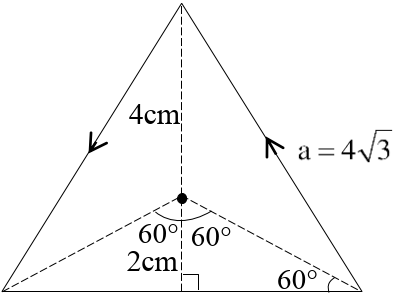
\(B =\frac{\mu_0}{4 \pi} \times \frac{ I }{ d }\left[\sin 60^{\circ}+\sin 60^{\circ}\right] \times 3\)
\(B =10^{-7} \times \frac{2}{2 \times 10^{-2}}\left(\frac{\sqrt{3}}{2}+\frac{\sqrt{3}}{2}\right) \times 3\)
\(=\sqrt{3} \times 10^{-5} \times 3=3 \sqrt{3} \times 10^{-5}\) -
- (A) \(2\sqrt{2}\)
- (B) 4
- (C) 2
- (D) 8
Show answer and solution
Correct Answer: (C)
\(\frac{\mu_{0}I}{2R} = 16 \mu T\)
\(\frac{\mu_0 I R^2}{2\left(x^2+R^2\right)^{3 / 2}}=\frac{\mu_0 I R^2}{2 \times 8 R^3}=2 \mu T\) -
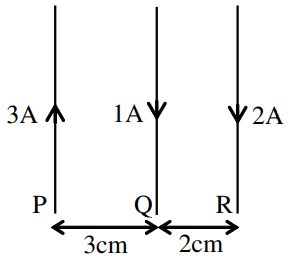
- (A) \(6 \times 10^{-7}\) N towards P
- (B) \(6 \times 10^{-6}\) N towards R
- (C) \(6 \times 10^{-7}\) N towards R
- (D) \(6 \times 10^{-6}\) N towards P
Show answer and solution
Correct Answer: (B)
\(F _{ net }=\frac{\mu_0}{2 \pi} I _0\left(\frac{ I _1}{d_1}+\frac{ I _2}{d_2}\right) \ell\)
\(F _{ net }=2 \times 10^{-7} \times 1\left(\frac{3}{3}+\frac{2}{2}\right) \times \frac{15 \times 10^{-2}}{10^{-2}}\)
\(=4 \times 15 \times 10^{-7}\)
\(F _{\text {net }}=6 \times 10^{-6} N\) -
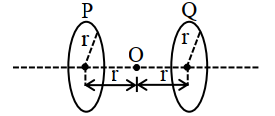
- (A) \(\frac{3\mu_{0}I}{4\sqrt{2}r}\) toward P
- (B) \(\frac{\mu_{0}I}{4\sqrt{2}r}\) toward P
- (C) \(\frac{\mu_{0}I}{4\sqrt{2}r}\) towards Q
- (D) \(\frac{3\mu_{0}I}{4\sqrt{2}r}\) towards Q
Show answer and solution
Correct Answer: (D)
\(B _{ net }= B _1- B _2\)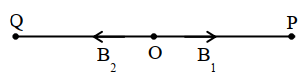
\(=\frac{4 \mu_0 i R^2}{2\left(R^2+R^2\right)^{3 / 2}}-\frac{\mu_0 i R^2}{2\left(R^2+R^2\right)^{3 / 2}}\)
\(=\frac{3 \mu_0 i }{4 \sqrt{2} R}\) -
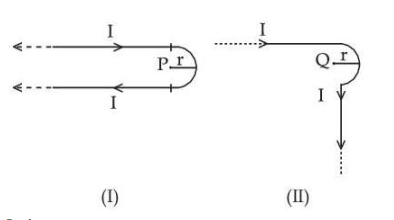
- (A) \(\dfrac{2 + \pi}{1 + \pi}\)
- (B) \(\dfrac{1 + \pi}{1 - \pi}\)
- (C) \(\dfrac{2 + \pi}{1 - \pi}\)
- (D) \(\dfrac{1 + \pi}{2 - \pi}\)
Show answer and solution
Correct Answer: (A)
For the first figure, the magnetic field at the centre P is the vector sum of the magnetic fields due to two semi-infinite straight wires and one semicircular arc.
The magnetic field due to the top semi-infinite wire at P is \(B_{1a} = \dfrac{\mu_0 I}{4\pi r}\) directed into the plane.
The magnetic field due to the bottom semi-infinite wire at P is \(B_{1b} = \dfrac{\mu_0 I}{4\pi r}\) directed into the plane.
The magnetic field due to the semicircular arc at P is \(B_{1c} = \dfrac{\mu_0 I}{4r} = \dfrac{\pi \mu_0 I}{4\pi r}\) directed into the plane.
The total magnetic field at P is \(B_1 = B_{1a} + B_{1b} + B_{1c} = \dfrac{\mu_0 I}{4\pi r} (1 + 1 + \pi) = \dfrac{\mu_0 I}{4\pi r} (2 + \pi)\).
For the second figure, the magnetic field at the centre Q is the vector sum of the magnetic fields due to one horizontal semi-infinite wire, one semicircular arc, and one vertical semi-infinite wire.
The magnetic field due to the horizontal semi-infinite wire at Q is \(B_{2a} = \dfrac{\mu_0 I}{4\pi r}\) directed into the plane.
The magnetic field due to the semicircular arc at Q is \(B_{2c} = \dfrac{\mu_0 I}{4r} = \dfrac{\pi \mu_0 I}{4\pi r}\) directed into the plane.
Since the arc is semicircular, it ends at a point directly below Q. The vertical semi-infinite wire starts from this point and extends downwards, meaning its line of action passes through Q. Therefore, the magnetic field due to this vertical wire at Q is \(B_{2b} = 0\).
The total magnetic field at Q is \(B_2 = B_{2a} + B_{2b} + B_{2c} = \dfrac{\mu_0 I}{4\pi r} (1 + 0 + \pi) = \dfrac{\mu_0 I}{4\pi r} (1 + \pi)\).
The ratio of the magnetic fields is \(\dfrac{B_1}{B_2} = \dfrac{\dfrac{\mu_0 I}{4\pi r} (2 + \pi)}{\dfrac{\mu_0 I}{4\pi r} (1 + \pi)} = \dfrac{2 + \pi}{1 + \pi}\).
Answer: \(\dfrac{2 + \pi}{1 + \pi}\) -
- (A) 3
- (B) 4.5
- (C) 4
- (D) 2
Show answer and solution
Correct Answer: (C)
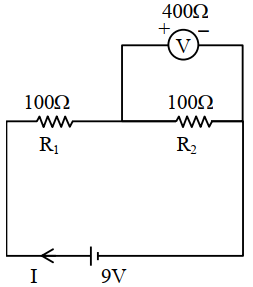
Current in circuit.
\(I=\frac{E}{\operatorname{Req}}\)
Req \(=100+\frac{400 \times 100}{400+100}=180 \Omega\)
\(\therefore I =\frac{9}{180}=\frac{1}{20} A\)
Reading of voltmeter \(= V = I \times 80=\frac{1}{20} \times 80=4 V\) -
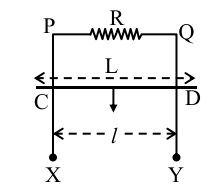
- (A) \( \frac{2mgR}{B^{2}l^{2}} \)
- (B) \( \frac{8mgR}{B^{2}l^{2}} \)
- (C) \( \frac{2mgR}{B^{2}L^{2}} \)
- (D) \( \frac{mgR}{B^{2}l^{2}} \)
Show answer and solution
Correct Answer: (D)
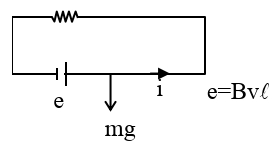
at equilibrium (Or for terminal velocity)
\( mg=iBl\Rightarrow mg=(\frac{Bvl}{R})Bl \)
\( V=\frac{mgR}{B^{2}l^{2}} \)
No questions on this page match these filters.