


Questions
14 questionsShowing 1–14 of 14 questions
-
- (A) 33
- (B) 34
- (C) 35
- (D) 36
Show answer and solution
Correct Answer: (A)
Given parameters:
\(L = 3\text{ m}\)
\(\Delta L = 3 \times 10^{-3}\text{ m}\)
\(V = 600 \times 10^{-6}\text{ m}^3\)
\(Y = 1.1 \times 10^{11}\text{ N/m}^2\)
Strain is given by:
\(\text{Strain} = \dfrac{\Delta L}{L} = \dfrac{3 \times 10^{-3}}{3} = 10^{-3}\)
Elastic potential energy stored in the wire is:
\(U = \dfrac{1}{2} \times \text{Stress} \times \text{Strain} \times \text{Volume}\)
Since \(\text{Stress} = Y \times \text{Strain}\):
\(U = \dfrac{1}{2} \times Y \times (\text{Strain})^2 \times V\)
Substituting the values:
\(U = \dfrac{1}{2} \times (1.1 \times 10^{11}) \times (10^{-3})^2 \times (600 \times 10^{-6})\)
\(U = \dfrac{1}{2} \times 1.1 \times 10^{11} \times 10^{-6} \times 600 \times 10^{-6}\)
\(U = \dfrac{1}{2} \times 1.1 \times 600 \times 10^{-1}\)
\(U = \dfrac{1}{2} \times 66 = 33\text{ J}\)
Answer: \(33\) -
- (A) 2
- (B) 3
- (C) 4
- (D) 5
Show answer and solution
Correct Answer: (A)
Given:
Side length of the cube, \(L = 5\) cm \(= 0.05\) m
Modulus of rigidity, \(\eta = 10^5\) N/m\(^2\)
Force applied on the upper face, \(F = 10\) N
Area of the upper face, \(A = L^2 = (0.05)^2 = 2.5 \times 10^{-3}\) m\(^2\)
Shear stress is given by:
\(\text{Stress} = \dfrac{F}{A} = \dfrac{10}{2.5 \times 10^{-3}} = 4000\) N/m\(^2\)
Shear strain is given by:
\(\text{Strain} = \dfrac{\Delta x}{L}\)
Modulus of rigidity is defined as the ratio of shear stress to shear strain:
\(\eta = \dfrac{\text{Stress}}{\text{Strain}} = \dfrac{F/A}{\Delta x/L}\)
Rearranging for displacement \(\Delta x\):
\(\Delta x = \dfrac{F \cdot L}{A \cdot \eta}\)
Substituting the values:
\(\Delta x = \dfrac{10 \times 0.05}{2.5 \times 10^{-3} \times 10^5}\)
\(\Delta x = \dfrac{0.5}{250} = 0.002\) m
Converting to millimeters:
\(\Delta x = 0.002 \times 1000 = 2\) mm
Answer: \(2\) -
- (A) \(1\)
- (B) \(4\)
- (C) \(8\)
- (D) \(6\)
Show answer and solution
Correct Answer: (D)
Tension in string \(B\) is due to the block of mass \(2M\):
\(T_B = 2Mg\)
Tension in string \(A\) is due to both blocks of mass \(M\) and \(2M\):
\(T_A = Mg + 2Mg = 3Mg\)
The elongation in a string is given by Hooke's law as \(\Delta L = \dfrac{TL}{AY}\).
The ratio of elongations in string \(A\) to string \(B\) is:
\(\dfrac{\Delta L_A}{\Delta L_B} = \left(\dfrac{T_A}{T_B}\right) \left(\dfrac{L_A}{L_B}\right) \left(\dfrac{A_B}{A_A}\right) \left(\dfrac{Y_B}{Y_A}\right)\)
Given that \(\dfrac{L_A}{L_B} = 2\), \(\dfrac{A_B}{A_A} = 1\), and \(\dfrac{Y_A}{Y_B} = 0.5 \Rightarrow \dfrac{Y_B}{Y_A} = 2\).
Substituting the values into the ratio equation:
\(\dfrac{\Delta L_A}{\Delta L_B} = \left(\dfrac{3Mg}{2Mg}\right) \times (2) \times (1) \times (2)\)
\(\dfrac{\Delta L_A}{\Delta L_B} = \dfrac{3}{2} \times 4 = 6\)
Answer: \(6\) -
- (A) \(3\)
- (B) \(2\)
- (C) \(1.9\)
- (D) \(1\)
Show answer and solution
Correct Answer: (B)
Given:
Length of string A, \(L_A = 0.314\) m
Young's modulus of string A, \(Y_A = 2 \times 10^{10}\) N/m\(^2\)
Radius of both strings, \(r = 0.2\) mm \(= 2 \times 10^{-4}\) m
Length of string B, \(L_B = 2L_A = 0.628\) m
Young's modulus of string B, \(Y_B = 2Y_A = 4 \times 10^{10}\) N/m\(^2\)
Mass of load, \(m = 0.8\) kg
Acceleration due to gravity, \(g = 10\) m/s\(^2\)
Tension in both strings, \(T = mg = 0.8 \times 10 = 8\) N
Cross-sectional area of both strings:
\(A = \pi r^2 = 3.14 \times (2 \times 10^{-4})^2 = 3.14 \times 4 \times 10^{-8}\) m\(^2\)
Elongation in string A:
\(\Delta L_A = \dfrac{T L_A}{A Y_A}\)
\(\Delta L_A = \dfrac{8 \times 0.314}{3.14 \times 4 \times 10^{-8} \times 2 \times 10^{10}}\)
\(\Delta L_A = \dfrac{8 \times 0.314}{8 \times 3.14 \times 10^2} = \dfrac{0.1}{10^2} = 10^{-3}\) m \(= 1\) mm
Elongation in string B:
\(\Delta L_B = \dfrac{T L_B}{A Y_B}\)
\(\Delta L_B = \dfrac{8 \times (2 \times 0.314)}{A \times (2 Y_A)} = \dfrac{T L_A}{A Y_A} = 1\) mm
Net change in length of the combination:
\(\Delta L = \Delta L_A + \Delta L_B = 1 + 1 = 2\) mm
Answer: \(2\) -
- (A) 6
- (B) 9
- (C) 12
- (D) 3
Show answer and solution
Correct Answer: (D)
Let \(T\) be the tension in the wire at a distance \(\dfrac{l}{3}\) from the top.
The length of the wire below this point is \(l - \dfrac{l}{3} = \dfrac{2l}{3}\).
The weight of this lower part of the wire is \(\dfrac{w}{l} \times \dfrac{2l}{3} = \dfrac{2w}{3}\).
The total downward force (tension \(T\)) at this point is the sum of the weight \(W\) attached at the bottom and the weight of the lower part of the wire:
\(T = W + \dfrac{2w}{3}\)
The stress at this point is given by the tension divided by the cross-sectional area \(A\):
\(\text{Stress} = \dfrac{T}{A} = \dfrac{W + \dfrac{2w}{3}}{A} = \dfrac{W}{A} + \dfrac{2}{3}\dfrac{w}{A}\)
Comparing this with the given expression for stress, \(\dfrac{W}{A} + \dfrac{2}{\gamma}\dfrac{w}{A}\), we get:
\(\gamma = 3\)
Answer: \(3\) -
- (A) \(1.0 \times 10^{11}\)
- (B) \(2.0 \times 10^{10}\)
- (C) \(1.0 \times 10^{10}\)
- (D) \(2.0 \times 10^{11}\)
Show answer and solution
Correct Answer: (C)
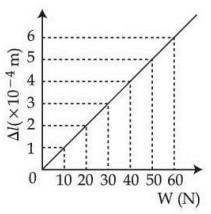
From the given graph, we can observe that for a load \(W = 20\) N, the extension is \(\Delta l = 2 \times 10^{-4}\) m.
The formula for Young's modulus \(Y\) is:
\(Y = \dfrac{\text{Stress}}{\text{Strain}} = \dfrac{W / A}{\Delta l / L} = \dfrac{W L}{A \Delta l}\)
Given:
Length of the wire, \(L = 1\) m
Cross-sectional area, \(A = 10^{-5}\) m\(^2\)
Substituting the values into the formula:
\(Y = \dfrac{20 \times 1}{10^{-5} \times 2 \times 10^{-4}}\)
\(Y = \dfrac{20}{2 \times 10^{-9}}\)
\(Y = 10 \times 10^9 = 1.0 \times 10^{10}\) N/m\(^2\)
Answer: \(1.0 \times 10^{10}\) -
- (A) 920
- (B) 922
- (C) 924
- (D) 926
Show answer and solution
Correct Answer: (B)
Heat extracted to cool \(x\) gram of water from \(50^{\circ}\text{C}\) to \(0^{\circ}\text{C}\) is given by:
\(Q_1 = m_1 c \Delta T_1\)
\(Q_1 = x \times 4.2 \times (50 - 0) = 210x \text{ J}\)
Heat required to raise the temperature of \((1000 - x)\) gram of water from \(50^{\circ}\text{C}\) to \(100^{\circ}\text{C}\) and evaporate it is given by:
\(Q_2 = m_2 c \Delta T_2 + m_2 L\)
\(Q_2 = (1000 - x) \times [4.2 \times (100 - 50) + 2256]\)
\(Q_2 = (1000 - x) \times (210 + 2256) = 2466(1000 - x) \text{ J}\)
Equating the heat extracted and the heat required:
\(Q_1 = Q_2\)
\(210x = 2466(1000 - x)\)
\(210x = 2466000 - 2466x\)
\(2676x = 2466000\)
\(x = \dfrac{2466000}{2676} \approx 921.52\)
The closest integer value for \(x\) is \(922\).
Answer: \(922\) -
- (A) \(2\%\)
- (B) \(3\%\)
- (C) \(6\%\)
- (D) \(4\%\)
Show answer and solution
Correct Answer: (B)
Bulk modulus is given by \(B = \dfrac{\Delta P}{-\dfrac{\Delta V}{V}}\)
The fractional decrease in volume is \(-\dfrac{\Delta V}{V} = \dfrac{\Delta P}{B}\)
Substituting the given values:
\(-\dfrac{\Delta V}{V} = \dfrac{6.3 \times 10^7}{2.1 \times 10^9} = 3 \times 10^{-2}\)
The percentage decrease in volume is \(\left(-\dfrac{\Delta V}{V}\right) \times 100\)
Percentage decrease \(= 3 \times 10^{-2} \times 100 = 3\%\)
Answer: \(3\%\) -
- (A) 399
- (B) 398
- (C) 402
- (D) 401
Show answer and solution
Correct Answer: (D)
\(V_{sound}=\sqrt{\frac{Y}{\rho}}\)
\(\frac{\Delta V}{V}\times100=\frac{1}{2}(\frac{\Delta Y}{Y}\times100)-\frac{1}{2}(\frac{\Delta\rho}{\rho}\times100)\)
\(=\frac{1}{2}\times1-\frac{1}{2}\times0.5\)
\(\frac{\Delta V}{V}\times100=\frac{1}{4}\)
\(\Delta V=\frac{1}{4}\times\frac{V}{100}\)
\(\Delta V=1m/s\)
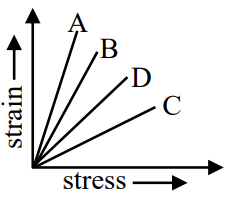
\(V_{final}=400+1=401~m/s\) - 10. The strain-stress plot for materials A, B, C and D is shown in the figure. Which material has the largest Young's modulus?
 2026 Medium
- (A) C
- (B) D
- (C) A
- (D) B
Show answer and solution
Correct Answer: (A)
\(\frac{\text { Strain }}{\text { Stress }}=\frac{1}{ Y }=\) Slope -
- (A) \(1.1\)
- (B) \(2.22\)
- (C) \(1.21\)
- (D) \(4.44\)
Show answer and solution
Correct Answer: (C)
Given that the wires have equal cross-sectional area \(A\) and are under the same tension \(F\), the elongation \(\Delta L\) is given by:
\(\Delta L = \dfrac{F L}{A Y}\)
Since the elongations in both wires are equal (\(\Delta L_A = \Delta L_B\)):
\(\dfrac{F L_A}{A Y_A} = \dfrac{F L_B}{A Y_B}\)
\(\dfrac{L_A}{Y_A} = \dfrac{L_B}{Y_B}\)
\(L_B = L_A \times \dfrac{Y_B}{Y_A}\)
Substituting the given values \(L_A = 2.2\) m and \(\dfrac{Y_A}{Y_B} = \dfrac{20}{11}\):
\(L_B = 2.2 \times \dfrac{11}{20}\)
\(L_B = \dfrac{24.2}{20} = 1.21\) m
Answer: \(1.21\) -
- (A) increases by two times
- (B) reduces by half
- (C) remains unchanged
- (D) becomes one fourth
Show answer and solution
Correct Answer: (C)
Young's modulus \(Y\) is an intrinsic property of the material of the wire.
It depends only on the nature of the material and its temperature, and is independent of the dimensions of the wire such as length \(L\) and radius \(r\).
Therefore, when the radius and length of the steel wire are doubled, its Young's modulus remains unchanged.
Answer: remains unchanged -
- (A) 1
- (B) 4
- (C) 2
- (D) 5
Show answer and solution
Correct Answer: (D)
\(T =\frac{ F / A }{\Delta \ell / \ell} \Rightarrow Y =\frac{ F \ell}{ A \Delta \ell}\)
\(\frac{Y_{A}}{Y_{B}} = \frac{l_{A}}{l_{B}} (\frac{A_{B}}{A_{A}})\)
\(= \frac{6}{5.4} (\frac{4.5 \times 10^{-5}}{3 \times 10^{-5}}) = \frac{9}{5.4} = \frac{5}{3}\)\(\Rightarrow \frac{x}{3} = \frac{5}{3}\)
\(\Rightarrow x = 5\) -
- (A) \(56\)
- (B) \(38\)
- (C) \(96\)
- (D) \(5.6\)
Show answer and solution
Correct Answer: (B)
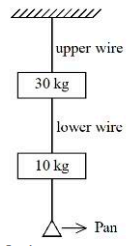
Let the maximum mass that can be added to the pan be \(m\).
The breaking stress for both wires is \(\sigma_{max} = 12 \times 10^8 \text{ N/m}^2\).
For the upper wire:
Area of cross-section, \(A_u = 0.008 \text{ cm}^2 = 8 \times 10^{-7} \text{ m}^2\)
Maximum tension the upper wire can withstand is:
\(T_{u,max} = \sigma_{max} \times A_u = (12 \times 10^8) \times (8 \times 10^{-7}) = 960 \text{ N}\)
The total mass supported by the upper wire is \((30 + 10 + m) = (40 + m) \text{ kg}\).
Tension in the upper wire, \(T_u = (40 + m)g = (40 + m) \times 10\)
To avoid breaking the upper wire:
\((40 + m) \times 10 \le 960\)
\(40 + m \le 96 \implies m \le 56 \text{ kg}\)
For the lower wire:
Area of cross-section, \(A_l = 0.004 \text{ cm}^2 = 4 \times 10^{-7} \text{ m}^2\)
Maximum tension the lower wire can withstand is:
\(T_{l,max} = \sigma_{max} \times A_l = (12 \times 10^8) \times (4 \times 10^{-7}) = 480 \text{ N}\)
The total mass supported by the lower wire is \((10 + m) \text{ kg}\).
Tension in the lower wire, \(T_l = (10 + m)g = (10 + m) \times 10\)
To avoid breaking the lower wire:
\((10 + m) \times 10 \le 480\)
\(10 + m \le 48 \implies m \le 38 \text{ kg}\)
To ensure neither wire breaks, the added mass \(m\) must satisfy both conditions. Therefore, the maximum mass that can be added is the smaller of the two values:
\(m = 38 \text{ kg}\)
Answer: \(38\)
No questions on this page match these filters.