


Questions
12 questionsShowing 1–12 of 12 questions
-
- (A) 45
- (B) 90
- (C) 180
- (D) 60
Show answer and solution
Correct Answer: (B)
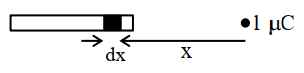
Explanation:
Let us calculate the electrostatic force between the point charge and the uniformly charged wire step-by-step using calculus:
1. Convert Given Values to SI Units:
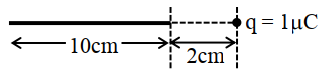
- Point charge, \(q = 1\ \mu\text{C} = 10^{-6}\text{ C}\)
- Total charge on wire, \(Q = 24\ \mu\text{C} = 24 \times 10^{-6}\text{ C}\)
- Length of the wire, \(L = 10\text{ cm} = 10 \times 10^{-2}\text{ m} = 10^{-1}\text{ m}\)
- Distance of point charge from nearest end = \(2\text{ cm} = 2 \times 10^{-2}\text{ m}\)
- Distance from furthest end = \(2\text{ cm} + 10\text{ cm} = 12\text{ cm} = 12 \times 10^{-2}\text{ m}\)
2. Define Linear Charge Density (\(\lambda\)):
The charge per unit length of the wire is:
\(\lambda = \frac{Q}{L} = \frac{24 \times 10^{-6}}{10^{-1}}\text{ C/m}\)
3. Set Up the Integration:
Consider a small element of length \(dx\) on the wire at a distance \(x\) from the point charge \(q\). The small charge on this element is \(dq = \lambda dx\).
The small electrostatic force \(dF\) between \(q\) and \(dq\) is given by Coulomb's Law:
\(dF = \frac{k \cdot q \cdot dq}{x^2} = \frac{k \cdot q \cdot \lambda \cdot dx}{x^2}\)
Integrating this expression from the nearest end (\(x = 2\text{ cm}\)) to the farthest end (\(x = 12\text{ cm}\)):
\(F = \int_{2 \times 10^{-2}}^{12 \times 10^{-2}} \frac{k \cdot q \cdot \lambda}{x^2} dx\)
\(F = k \cdot q \cdot \lambda \left[ -\frac{1}{x} \right]_{2 \times 10^{-2}}^{12 \times 10^{-2}}\)
\(F = k \cdot q \cdot \lambda \left( \frac{1}{2 \times 10^{-2}} - \frac{1}{12 \times 10^{-2}} \right)\)
\(F = k \cdot q \cdot \lambda \cdot \left( \frac{5}{12 \times 10^{-2}} \right)\)
4. Substitute the Values:
\(F = (9 \times 10^9) \times (10^{-6}) \times \left( \frac{24 \times 10^{-6}}{10^{-1}} \right) \times \left( \frac{5}{12} \right) \times 10^2\)
\(F = 9 \times 24 \times \frac{5}{12} = 9 \times 2 \times 5 = 90\text{ N}\)
Hence, Option B is the correct choice. -
- (A) \(73\%\)
- (B) \(63\%\)
- (C) \(83\%\)
- (D) \(53\%\)
Show answer and solution
Correct Answer: (A)
The frequency of oscillation of a rigid dipole in an electric field is given by \(f = \dfrac{1}{2\pi} \sqrt{\dfrac{pE}{I}}\), where \(p\) is the dipole moment, \(E\) is the magnitude of the electric field, and \(I\) is the moment of inertia.
This implies \(f \propto \sqrt{E}\).
The initial electric field is \(\vec{E}_1 = E_0 \hat{x}\), so its magnitude is \(E_1 = E_0\).
The initial frequency is \(f_1 \propto \sqrt{E_0}\).
When the second electric field \(\vec{E}_2 = 2E_0(\hat{y} + \hat{z})\) is introduced, the net electric field becomes \(\vec{E}_{net} = \vec{E}_1 + \vec{E}_2 = E_0 \hat{x} + 2E_0 \hat{y} + 2E_0 \hat{z}\).
The magnitude of the net electric field is \(E_{net} = \sqrt{E_0^2 + (2E_0)^2 + (2E_0)^2} = \sqrt{E_0^2 + 4E_0^2 + 4E_0^2} = 3E_0\).
The new frequency is \(f_2 \propto \sqrt{3E_0}\).
The percentage change in the frequency is given by \(\dfrac{f_2 - f_1}{f_1} \times 100\%\).
Substituting the values, we get \(\left( \dfrac{\sqrt{3E_0}}{\sqrt{E_0}} - 1 \right) \times 100\% = (\sqrt{3} - 1) \times 100\%\).
Using \(\sqrt{3} \approx 1.732\), the percentage change is \((1.732 - 1) \times 100\% = 73.2\%\).
The approximate percentage change is \(73\%\).
Answer: \(73\%\) -
- (A) \( mg-qE \)
- (B) \( mg+qE \)
- (C) \( \sqrt{m^{2}g^{2}+q^{2}E^{2}} \)
- (D) \( \sqrt{m^{2}g^{2}-q^{2}E^{2}} \)
Show answer and solution
Correct Answer: (C)
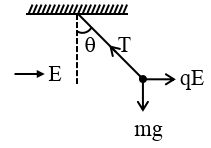
\( T=\sqrt{(qE)^{2}+(mg)^{2}} \) -
- (A) \(2.14\)
- (B) \(2.44\)
- (C) \(3.25\)
- (D) \(0.7\)
Show answer and solution
Correct Answer: (A)
The electric field at the center of a uniformly charged half ring is given by:
\(E = \dfrac{2k\lambda}{R}\)
where \(\lambda = \dfrac{Q}{\pi R}\) is the linear charge density.
Substituting \(\lambda\), we get:
\(E = \dfrac{2kQ}{\pi R^2} = \dfrac{2Q}{4\pi\epsilon_0 \pi R^2} = \dfrac{Q}{2\pi^2\epsilon_0 R^2}\)
Rearranging for \(Q\):
\(Q = 2\pi^2\epsilon_0 R^2 E\)
Given values:
\(E = 100\) V/m
\(R = 35\) cm \(= 0.35\) m
\(\epsilon_0 = 8.85 \times 10^{-12}\) C\(^2\)/Nm\(^2\)
\(\pi = 3.14\)
Substituting the values:
\(Q = 2 \times (3.14)^2 \times 8.85 \times 10^{-12} \times (0.35)^2 \times 100\)
\(Q = 2 \times 9.8596 \times 8.85 \times 10^{-12} \times 0.1225 \times 100\)
\(Q \approx 2137.8 \times 10^{-12}\) C
\(Q \approx 2.14 \times 10^{-9}\) C \(= 2.14\) nC
Answer: \(2.14\) -
- (A) A, B, D, E Only
- (B) A, B, C, D Only
- (C) B, C, D, E Only
- (D) A, C, E Only
Show answer and solution
Correct Answer: (C)
Theoretical -
- (A) \( -\frac{5Q}{8\pi\epsilon_{o}R^{2}}(\hat{i}+\sqrt{3j}) \)
- (B) \( -\frac{Q}{4\pi\epsilon_{0}R^{2}}(\sqrt{3}\hat{i}-\hat{j}) \)
- (C) \( -(\frac{5Q}{8\pi\epsilon_{0}R^{2}})(\hat{i}-3\hat{j}) \)
- (D) \( \frac{Q}{4\pi\epsilon_{0}R^{2}}(\sqrt{3}\hat{i}-\hat{j}) \)
Show answer and solution
Correct Answer: (B)
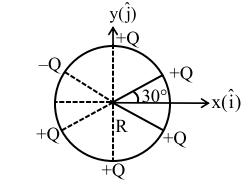
Let \( \frac{KQ}{r^{2}}=E_{0} \)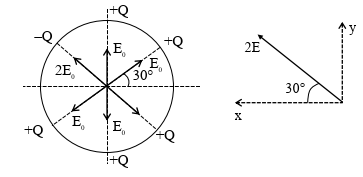
\( \vec{E}_{net}=2E_{0}cos~30^{\circ}(-\hat{i})+2E_{0}sin~30^{\circ}(\hat{j}) \)
\( =\frac{2kQ}{r^{2}}[\frac{\sqrt{3}}{2}(-\hat{i})+\frac{1}{2}\hat{j}] \)
\( =\frac{-1Q}{4\pi\epsilon_{0}{r^{2}}}(\sqrt{3}\hat{i}-\hat{j}) \) -
- (A) \( 2qa(3\hat{j}-\hat{i}) \)
- (B) \( 2qa(3\hat{i}-7\hat{j}) \)
- (C) \(2 qa (7 \hat{ i }-3 \hat{ j })\)
- (D) \(2 q a(3 \hat{j}-7 \hat{i})\)
Show answer and solution
Correct Answer: (C)
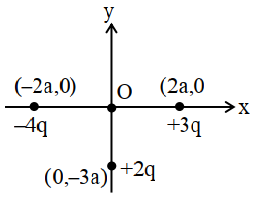
\(\overrightarrow{ p }= q _1 \overrightarrow{ r }_1+ q _2 \overrightarrow{ r }_2+ q _3 \overrightarrow{ r }_3\)
\(\overrightarrow{ p }=(2 q)(-3 a) \hat{j}+(3 q)(2 a) \hat{i}+(-4 q)(-2 a) \hat{i}\)
\(\overrightarrow{ p }=2 qa (7 \hat{ i }-3 \hat{ j })\) -
- (A) \(\frac{3 q}{\varepsilon_0}\)
- (B) \(\frac{ q }{\varepsilon_0}\)
- (C) \(\frac{3 q}{2 \varepsilon_0}\)
- (D) \(\frac{3 q}{4 \varepsilon_0}\)
Show answer and solution
Correct Answer: (D)
Explanation:
To find the total electric flux passing through the cube, we apply Gauss's Law and the Principle of Superposition. We will calculate the flux contribution of each charge individually and sum them up.
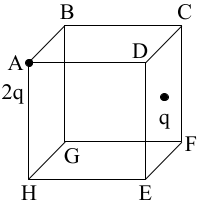
1. Contribution of charge \( 2q \) at vertex A:
A charge placed at the corner (vertex) of a cube is shared equally among 8 such adjacent cubes. Therefore, only \( \frac{1}{8} \) of the charge is effectively "inside" our cube.
Flux due to the vertex charge, \( \phi_1 = \frac{1}{8} \left( \frac{2q}{\epsilon_0} \right) = \frac{q}{4\epsilon_0} \)
2. Contribution of charge \( q \) at the centre of face CDEF:
A charge placed at the centre of a face is shared equally between 2 adjacent cubes. Therefore, only \( \frac{1}{2} \) of the charge is effectively "inside" our cube.
Flux due to the face-centred charge, \( \phi_2 = \frac{1}{2} \left( \frac{q}{\epsilon_0} \right) = \frac{q}{2\epsilon_0} \)
3. Total electric flux (\( \phi \)) through the cube:
\( \phi = \phi_1 + \phi_2 \)
\( \phi = \frac{q}{4\epsilon_0} + \frac{q}{2\epsilon_0} \)
\( \phi = \frac{q + 2q}{4\epsilon_0} = \frac{3q}{4\epsilon_0} \)
Hence, Option D is the correct choice. -
- (A) \(4 : 1\)
- (B) \(3 : 4\)
- (C) \(4 : 3\)
- (D) \(4 : 5\)
Show answer and solution
Correct Answer: (C)
According to Gauss's law, the electric flux through a closed surface is given by \(\Phi = \dfrac{q_{\text{enclosed}}}{\varepsilon_0}\).
For the first sphere of radius \(r_1 = 3\) cm centered at the origin, only the charge at \(x = 2\) cm is enclosed.
\(q_{\text{enclosed}, 1} = 8 \, \mu\text{C}\)
\(\Phi_1 = \dfrac{8 \, \mu\text{C}}{\varepsilon_0}\)
For the second sphere of radius \(r_2 = 5\) cm centered at the origin, both charges at \(x = 2\) cm and \(x = 4\) cm are enclosed.
\(q_{\text{enclosed}, 2} = 8 \, \mu\text{C} - 2 \, \mu\text{C} = 6 \, \mu\text{C}\)
\(\Phi_2 = \dfrac{6 \, \mu\text{C}}{\varepsilon_0}\)
The ratio of the electric flux is:
\(\dfrac{\Phi_1}{\Phi_2} = \dfrac{8}{6} = \dfrac{4}{3}\)
Answer: \(4 : 3\) -
- (A) \((12\hat{i}+24\hat{j}+24\hat{k})\times 10^{-3}\)
- (B) \((4\hat{i}+8\hat{j}+8\hat{k})\times 10^{-3}\)
- (C) \((3\hat{i}+6\hat{j}+6\hat{k})\times 10^{-3}\)
- (D) \((-4\hat{i}-8\hat{j}-8\hat{k})\times 10^{-3}\)
Show answer and solution
Correct Answer: (B)
Position vector of \(q_1\), \(\vec{r}_1 = 2\hat{i} + 3\hat{j} + 3\hat{k}\)
Position vector of \(q_2\), \(\vec{r}_2 = \hat{i} + \hat{j} + \hat{k}\)
Vector from \(q_1\) to \(q_2\) is \(\vec{r}_{21} = \vec{r}_2 - \vec{r}_1 = (\hat{i} + \hat{j} + \hat{k}) - (2\hat{i} + 3\hat{j} + 3\hat{k}) = -\hat{i} - 2\hat{j} - 2\hat{k}\)
Magnitude \(|\vec{r}_{21}| = \sqrt{(-1)^2 + (-2)^2 + (-2)^2} = \sqrt{9} = 3\)
Force on \(q_2\) due to \(q_1\) is given by Coulomb's law in vector form:
\(\vec{F}_{21} = \dfrac{1}{4\pi\epsilon_0} \dfrac{q_1 q_2}{|\vec{r}_{21}|^3} \vec{r}_{21}\)
Substituting the given values:
\(\vec{F}_{21} = \dfrac{9 \times 10^9 \times (3 \times 10^{-6}) \times (-4 \times 10^{-6})}{3^3} (-\hat{i} - 2\hat{j} - 2\hat{k})\)
\(\vec{F}_{21} = \dfrac{-108 \times 10^{-3}}{27} (-\hat{i} - 2\hat{j} - 2\hat{k})\)
\(\vec{F}_{21} = -4 \times 10^{-3} (-\hat{i} - 2\hat{j} - 2\hat{k})\)
\(\vec{F}_{21} = (4\hat{i} + 8\hat{j} + 8\hat{k}) \times 10^{-3} \text{ N}\)
Answer: \((4\hat{i}+8\hat{j}+8\hat{k})\times 10^{-3}\) -
- (A) \(\dfrac{\sqrt{3}}{2}\)
- (B) \(2\sqrt{3}\)
- (C) \(\dfrac{1}{\sqrt{3}}\)
- (D) \(\sqrt{3}\)
Show answer and solution
Correct Answer: (B)
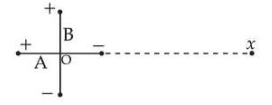
Let the distance of point \(x\) from the origin \(O\) be \(r\).
Point \(x\) lies on the axial line of dipole A. The electric field at \(x\) due to dipole A is directed along the horizontal axis and its magnitude is given by:
\(E_A = \dfrac{1}{4\pi\epsilon_0} \dfrac{2p_1}{r^3}\)
Point \(x\) lies on the equatorial line of dipole B. The electric field at \(x\) due to dipole B is directed perpendicular to the horizontal axis and its magnitude is given by:
\(E_B = \dfrac{1}{4\pi\epsilon_0} \dfrac{p_2}{r^3}\)
The resultant electric field makes an angle of \(60^{\circ}\) with the line \(Ox\) (the horizontal axis). Therefore, the tangent of this angle is the ratio of the perpendicular component of the electric field to the parallel component:
\(\tan 60^{\circ} = \dfrac{E_B}{E_A}\)
Substituting the expressions for \(E_A\) and \(E_B\):
\(\sqrt{3} = \dfrac{\dfrac{1}{4\pi\epsilon_0} \dfrac{p_2}{r^3}}{\dfrac{1}{4\pi\epsilon_0} \dfrac{2p_1}{r^3}}\)
\(\sqrt{3} = \dfrac{p_2}{2p_1}\)
\(\dfrac{p_2}{p_1} = 2\sqrt{3}\)
Answer: \(2\sqrt{3}\) -
- (A) \(\frac{9}{16}\sqrt{2}\times10^{5}\)
- (B) \(4.5 \sqrt{2}\times10^{4}\)
- (C) \(9\sqrt{2}\times10^{4}\)
- (D) \(\frac{9}{16}\sqrt{2}\times10^{4}\)
Show answer and solution
Correct Answer: (D)
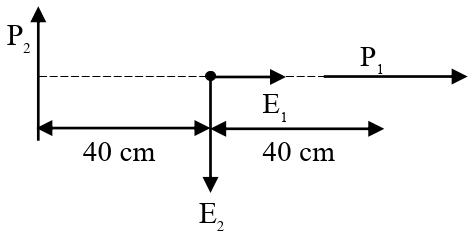
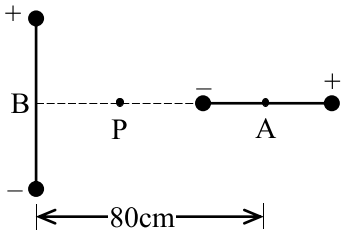
\(\overrightarrow{ E }_2=-\frac{ KP _2}{ r ^3} ; E _1=-\frac{2 KP _1}{ r ^3}\)
\(P_1=2 \times 10^{-6} \times 10^{-2}=2 \times 10^{-8}\)
\(P_2=4 \times 10^{-6} \times 10^{-2}=4 \times 10^{-8}\)
\(\overrightarrow{ E }_{\text {net }} \frac{2 \times 9 \times 10^9 \times 2 \times 10^{-8}}{(0.4)^3} \hat{ i }-\frac{9 \times 10^9 \times 4 \times 10^{-8}}{(0.4)^3} \hat{ j }\)
\(\overrightarrow{ E }_{\text {net }}=\frac{9 \times 10^9 \times 4 \times 10^{-8}}{(0.4)^3}[\hat{ i }-\hat{ j }]\)
\(\left|\overrightarrow{ E }_{\text {net }}\right|=\frac{9 \times 10^4}{16}(\sqrt{2})\)
No questions on this page match these filters.