


All JEE Mains 2026 Physics questions
31 chaptersShowing 301–350 of 469 questions
-
- (A) \(73\%\)
- (B) \(63\%\)
- (C) \(83\%\)
- (D) \(53\%\)
Show answer and solution
Correct Answer: (A)
The frequency of oscillation of a rigid dipole in an electric field is given by \(f = \dfrac{1}{2\pi} \sqrt{\dfrac{pE}{I}}\), where \(p\) is the dipole moment, \(E\) is the magnitude of the electric field, and \(I\) is the moment of inertia.
This implies \(f \propto \sqrt{E}\).
The initial electric field is \(\vec{E}_1 = E_0 \hat{x}\), so its magnitude is \(E_1 = E_0\).
The initial frequency is \(f_1 \propto \sqrt{E_0}\).
When the second electric field \(\vec{E}_2 = 2E_0(\hat{y} + \hat{z})\) is introduced, the net electric field becomes \(\vec{E}_{net} = \vec{E}_1 + \vec{E}_2 = E_0 \hat{x} + 2E_0 \hat{y} + 2E_0 \hat{z}\).
The magnitude of the net electric field is \(E_{net} = \sqrt{E_0^2 + (2E_0)^2 + (2E_0)^2} = \sqrt{E_0^2 + 4E_0^2 + 4E_0^2} = 3E_0\).
The new frequency is \(f_2 \propto \sqrt{3E_0}\).
The percentage change in the frequency is given by \(\dfrac{f_2 - f_1}{f_1} \times 100\%\).
Substituting the values, we get \(\left( \dfrac{\sqrt{3E_0}}{\sqrt{E_0}} - 1 \right) \times 100\% = (\sqrt{3} - 1) \times 100\%\).
Using \(\sqrt{3} \approx 1.732\), the percentage change is \((1.732 - 1) \times 100\% = 73.2\%\).
The approximate percentage change is \(73\%\).
Answer: \(73\%\) -
- (A) \( mg-qE \)
- (B) \( mg+qE \)
- (C) \( \sqrt{m^{2}g^{2}+q^{2}E^{2}} \)
- (D) \( \sqrt{m^{2}g^{2}-q^{2}E^{2}} \)
Show answer and solution
Correct Answer: (C)
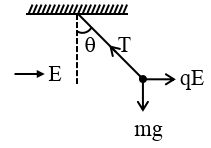
\( T=\sqrt{(qE)^{2}+(mg)^{2}} \) -
- (A) \(2.14\)
- (B) \(2.44\)
- (C) \(3.25\)
- (D) \(0.7\)
Show answer and solution
Correct Answer: (A)
The electric field at the center of a uniformly charged half ring is given by:
\(E = \dfrac{2k\lambda}{R}\)
where \(\lambda = \dfrac{Q}{\pi R}\) is the linear charge density.
Substituting \(\lambda\), we get:
\(E = \dfrac{2kQ}{\pi R^2} = \dfrac{2Q}{4\pi\epsilon_0 \pi R^2} = \dfrac{Q}{2\pi^2\epsilon_0 R^2}\)
Rearranging for \(Q\):
\(Q = 2\pi^2\epsilon_0 R^2 E\)
Given values:
\(E = 100\) V/m
\(R = 35\) cm \(= 0.35\) m
\(\epsilon_0 = 8.85 \times 10^{-12}\) C\(^2\)/Nm\(^2\)
\(\pi = 3.14\)
Substituting the values:
\(Q = 2 \times (3.14)^2 \times 8.85 \times 10^{-12} \times (0.35)^2 \times 100\)
\(Q = 2 \times 9.8596 \times 8.85 \times 10^{-12} \times 0.1225 \times 100\)
\(Q \approx 2137.8 \times 10^{-12}\) C
\(Q \approx 2.14 \times 10^{-9}\) C \(= 2.14\) nC
Answer: \(2.14\) -
- (A) A, B, D, E Only
- (B) A, B, C, D Only
- (C) B, C, D, E Only
- (D) A, C, E Only
Show answer and solution
Correct Answer: (C)
Theoretical -
- (A) \( -\frac{5Q}{8\pi\epsilon_{o}R^{2}}(\hat{i}+\sqrt{3j}) \)
- (B) \( -\frac{Q}{4\pi\epsilon_{0}R^{2}}(\sqrt{3}\hat{i}-\hat{j}) \)
- (C) \( -(\frac{5Q}{8\pi\epsilon_{0}R^{2}})(\hat{i}-3\hat{j}) \)
- (D) \( \frac{Q}{4\pi\epsilon_{0}R^{2}}(\sqrt{3}\hat{i}-\hat{j}) \)
Show answer and solution
Correct Answer: (B)
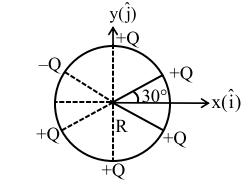
Let \( \frac{KQ}{r^{2}}=E_{0} \)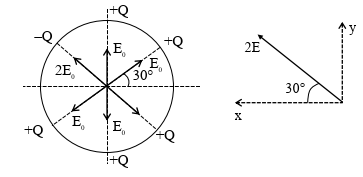
\( \vec{E}_{net}=2E_{0}cos~30^{\circ}(-\hat{i})+2E_{0}sin~30^{\circ}(\hat{j}) \)
\( =\frac{2kQ}{r^{2}}[\frac{\sqrt{3}}{2}(-\hat{i})+\frac{1}{2}\hat{j}] \)
\( =\frac{-1Q}{4\pi\epsilon_{0}{r^{2}}}(\sqrt{3}\hat{i}-\hat{j}) \) -
- (A) \( 2qa(3\hat{j}-\hat{i}) \)
- (B) \( 2qa(3\hat{i}-7\hat{j}) \)
- (C) \(2 qa (7 \hat{ i }-3 \hat{ j })\)
- (D) \(2 q a(3 \hat{j}-7 \hat{i})\)
Show answer and solution
Correct Answer: (C)
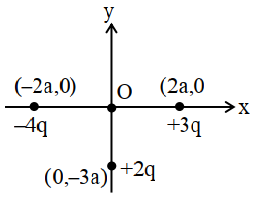
\(\overrightarrow{ p }= q _1 \overrightarrow{ r }_1+ q _2 \overrightarrow{ r }_2+ q _3 \overrightarrow{ r }_3\)
\(\overrightarrow{ p }=(2 q)(-3 a) \hat{j}+(3 q)(2 a) \hat{i}+(-4 q)(-2 a) \hat{i}\)
\(\overrightarrow{ p }=2 qa (7 \hat{ i }-3 \hat{ j })\) -
- (A) \(\frac{3 q}{\varepsilon_0}\)
- (B) \(\frac{ q }{\varepsilon_0}\)
- (C) \(\frac{3 q}{2 \varepsilon_0}\)
- (D) \(\frac{3 q}{4 \varepsilon_0}\)
Show answer and solution
Correct Answer: (D)
Explanation:
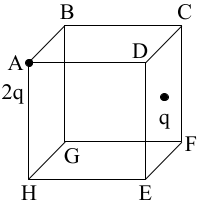
To find the total electric flux passing through the cube, we apply Gauss's Law and the Principle of Superposition. We will calculate the flux contribution of each charge individually and sum them up.
1. Contribution of charge \( 2q \) at vertex A:
A charge placed at the corner (vertex) of a cube is shared equally among 8 such adjacent cubes. Therefore, only \( \frac{1}{8} \) of the charge is effectively "inside" our cube.
Flux due to the vertex charge, \( \phi_1 = \frac{1}{8} \left( \frac{2q}{\epsilon_0} \right) = \frac{q}{4\epsilon_0} \)
2. Contribution of charge \( q \) at the centre of face CDEF:
A charge placed at the centre of a face is shared equally between 2 adjacent cubes. Therefore, only \( \frac{1}{2} \) of the charge is effectively "inside" our cube.
Flux due to the face-centred charge, \( \phi_2 = \frac{1}{2} \left( \frac{q}{\epsilon_0} \right) = \frac{q}{2\epsilon_0} \)
3. Total electric flux (\( \phi \)) through the cube:
\( \phi = \phi_1 + \phi_2 \)
\( \phi = \frac{q}{4\epsilon_0} + \frac{q}{2\epsilon_0} \)
\( \phi = \frac{q + 2q}{4\epsilon_0} = \frac{3q}{4\epsilon_0} \)
Hence, Option D is the correct choice. -
- (A) \(4 : 1\)
- (B) \(3 : 4\)
- (C) \(4 : 3\)
- (D) \(4 : 5\)
Show answer and solution
Correct Answer: (C)
According to Gauss's law, the electric flux through a closed surface is given by \(\Phi = \dfrac{q_{\text{enclosed}}}{\varepsilon_0}\).
For the first sphere of radius \(r_1 = 3\) cm centered at the origin, only the charge at \(x = 2\) cm is enclosed.
\(q_{\text{enclosed}, 1} = 8 \, \mu\text{C}\)
\(\Phi_1 = \dfrac{8 \, \mu\text{C}}{\varepsilon_0}\)
For the second sphere of radius \(r_2 = 5\) cm centered at the origin, both charges at \(x = 2\) cm and \(x = 4\) cm are enclosed.
\(q_{\text{enclosed}, 2} = 8 \, \mu\text{C} - 2 \, \mu\text{C} = 6 \, \mu\text{C}\)
\(\Phi_2 = \dfrac{6 \, \mu\text{C}}{\varepsilon_0}\)
The ratio of the electric flux is:
\(\dfrac{\Phi_1}{\Phi_2} = \dfrac{8}{6} = \dfrac{4}{3}\)
Answer: \(4 : 3\) -
- (A) \((12\hat{i}+24\hat{j}+24\hat{k})\times 10^{-3}\)
- (B) \((4\hat{i}+8\hat{j}+8\hat{k})\times 10^{-3}\)
- (C) \((3\hat{i}+6\hat{j}+6\hat{k})\times 10^{-3}\)
- (D) \((-4\hat{i}-8\hat{j}-8\hat{k})\times 10^{-3}\)
Show answer and solution
Correct Answer: (B)
Position vector of \(q_1\), \(\vec{r}_1 = 2\hat{i} + 3\hat{j} + 3\hat{k}\)
Position vector of \(q_2\), \(\vec{r}_2 = \hat{i} + \hat{j} + \hat{k}\)
Vector from \(q_1\) to \(q_2\) is \(\vec{r}_{21} = \vec{r}_2 - \vec{r}_1 = (\hat{i} + \hat{j} + \hat{k}) - (2\hat{i} + 3\hat{j} + 3\hat{k}) = -\hat{i} - 2\hat{j} - 2\hat{k}\)
Magnitude \(|\vec{r}_{21}| = \sqrt{(-1)^2 + (-2)^2 + (-2)^2} = \sqrt{9} = 3\)
Force on \(q_2\) due to \(q_1\) is given by Coulomb's law in vector form:
\(\vec{F}_{21} = \dfrac{1}{4\pi\epsilon_0} \dfrac{q_1 q_2}{|\vec{r}_{21}|^3} \vec{r}_{21}\)
Substituting the given values:
\(\vec{F}_{21} = \dfrac{9 \times 10^9 \times (3 \times 10^{-6}) \times (-4 \times 10^{-6})}{3^3} (-\hat{i} - 2\hat{j} - 2\hat{k})\)
\(\vec{F}_{21} = \dfrac{-108 \times 10^{-3}}{27} (-\hat{i} - 2\hat{j} - 2\hat{k})\)
\(\vec{F}_{21} = -4 \times 10^{-3} (-\hat{i} - 2\hat{j} - 2\hat{k})\)
\(\vec{F}_{21} = (4\hat{i} + 8\hat{j} + 8\hat{k}) \times 10^{-3} \text{ N}\)
Answer: \((4\hat{i}+8\hat{j}+8\hat{k})\times 10^{-3}\) -
- (A) \(\dfrac{\sqrt{3}}{2}\)
- (B) \(2\sqrt{3}\)
- (C) \(\dfrac{1}{\sqrt{3}}\)
- (D) \(\sqrt{3}\)
Show answer and solution
Correct Answer: (B)
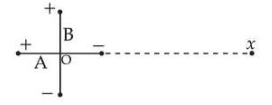
Let the distance of point \(x\) from the origin \(O\) be \(r\).
Point \(x\) lies on the axial line of dipole A. The electric field at \(x\) due to dipole A is directed along the horizontal axis and its magnitude is given by:
\(E_A = \dfrac{1}{4\pi\epsilon_0} \dfrac{2p_1}{r^3}\)
Point \(x\) lies on the equatorial line of dipole B. The electric field at \(x\) due to dipole B is directed perpendicular to the horizontal axis and its magnitude is given by:
\(E_B = \dfrac{1}{4\pi\epsilon_0} \dfrac{p_2}{r^3}\)
The resultant electric field makes an angle of \(60^{\circ}\) with the line \(Ox\) (the horizontal axis). Therefore, the tangent of this angle is the ratio of the perpendicular component of the electric field to the parallel component:
\(\tan 60^{\circ} = \dfrac{E_B}{E_A}\)
Substituting the expressions for \(E_A\) and \(E_B\):
\(\sqrt{3} = \dfrac{\dfrac{1}{4\pi\epsilon_0} \dfrac{p_2}{r^3}}{\dfrac{1}{4\pi\epsilon_0} \dfrac{2p_1}{r^3}}\)
\(\sqrt{3} = \dfrac{p_2}{2p_1}\)
\(\dfrac{p_2}{p_1} = 2\sqrt{3}\)
Answer: \(2\sqrt{3}\) -
- (A) \(\frac{9}{16}\sqrt{2}\times10^{5}\)
- (B) \(4.5 \sqrt{2}\times10^{4}\)
- (C) \(9\sqrt{2}\times10^{4}\)
- (D) \(\frac{9}{16}\sqrt{2}\times10^{4}\)
Show answer and solution
Correct Answer: (D)
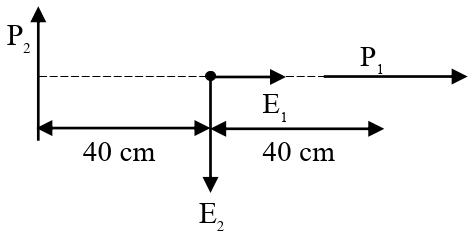
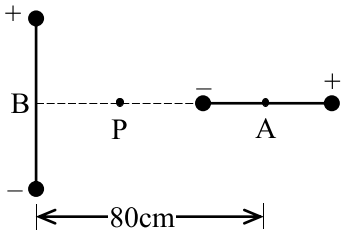
\(\overrightarrow{ E }_2=-\frac{ KP _2}{ r ^3} ; E _1=-\frac{2 KP _1}{ r ^3}\)
\(P_1=2 \times 10^{-6} \times 10^{-2}=2 \times 10^{-8}\)
\(P_2=4 \times 10^{-6} \times 10^{-2}=4 \times 10^{-8}\)
\(\overrightarrow{ E }_{\text {net }} \frac{2 \times 9 \times 10^9 \times 2 \times 10^{-8}}{(0.4)^3} \hat{ i }-\frac{9 \times 10^9 \times 4 \times 10^{-8}}{(0.4)^3} \hat{ j }\)
\(\overrightarrow{ E }_{\text {net }}=\frac{9 \times 10^9 \times 4 \times 10^{-8}}{(0.4)^3}[\hat{ i }-\hat{ j }]\)
\(\left|\overrightarrow{ E }_{\text {net }}\right|=\frac{9 \times 10^4}{16}(\sqrt{2})\) -
- (A) increase by 8 times
- (B) increase by 64 times
- (C) decrease by 8 times
- (D) decrease by 4 times
Show answer and solution
Correct Answer: (D)
\(V\rightarrow8V\Rightarrow R\rightarrow2R\)
\(\Rightarrow A\rightarrow4A\)
\(\Rightarrow I\rightarrow\frac{I_{0}}{4}\) -
- (A) 349
- (B) 379
- (C) 385
- (D) 394
Show answer and solution
Correct Answer: (A)
The standard equation of a transverse wave is given by \(y = A\sin(\omega t + kx + \phi)\)
Comparing this with the given equation \(y = 3\sin(36t + 0.018x + \pi/4)\), we get the wave number \(k = 0.018 \text{ cm}^{-1}\).
The least distance between two successive crests is the wavelength \(\lambda\) of the wave.
We know that \(k = \dfrac{2\pi}{\lambda}\)
\(\lambda = \dfrac{2\pi}{k} = \dfrac{2 \times 3.14}{0.018}\)
\(\lambda = \dfrac{6.28}{0.018} = \dfrac{6280}{18} = 348.88 \text{ cm}\)
Rounding to the nearest integer, we get \(349 \text{ cm}\).
Answer: \(349\) -
- (A) 275
- (B) 225
- (C) 200
- (D) 250
Show answer and solution
Correct Answer: (B)
\( f=n(\frac{V_{0}}{2L}) \)
\( \frac{6V_{0}}{2L}-\frac{3V_{0}}{2L}=2200 \)
\( \frac{3V_{0}}{2L}=2200 \)
\( \frac{3\times330}{2\times L}=2200 \)
\( L=\frac{3\times330}{2\times2200} \)
\( L=0.225\,m \)
\( L=225\,mm \) -
- (A) \(120\)
- (B) \(150\)
- (C) \(200\)
- (D) \(300\)
Show answer and solution
Correct Answer: (D)
The given equation of the wave is \(y = 5\cos\pi\left(200t - \dfrac{x}{150}\right)\)
Rewriting the equation, we get \(y = 5\cos\left(200\pi t - \dfrac{\pi x}{150}\right)\)
Comparing this with the standard wave equation \(y = A\cos(\omega t - kx)\), we have:
\(\omega = 200\pi\) rad/s
\(k = \dfrac{\pi}{150}\) rad/cm
The velocity of the wave is given by \(v = \dfrac{\omega}{k}\)
\(v = \dfrac{200\pi}{\dfrac{\pi}{150}} = 30000\) cm/s
Converting to m/s, we get \(v = \dfrac{30000}{100} = 300\) m/s
Answer: \(300\) -
- (A) 4
- (B) 2
- (C) 1
- (D) 3
Show answer and solution
Correct Answer: (B)
\(f_{5~closed}=f_{1~open}\)
\(\frac{5v}{4L_{closed}}=\frac{v}{2L_{open}}\)
\(\frac{L_{closed}}{L_{open}}=\frac{5}{2}\)
\(x=2\) - 317. The velocity of sound in air is doubled when the temperature is raised from \(0^{\circ} C\) to \(\alpha^{\circ} C\). The value of \(\alpha\) is ________. 2026 Medium
- (A) 546
- (B) 273
- (C) 819
- (D) 1092
Show answer and solution
Correct Answer: (C)
\(V =\sqrt{\frac{\gamma RT }{ M }}\)
\(\frac{V_1}{V_2}=\frac{\sqrt{T_1}}{\sqrt{T_2}}\)
\(\frac{ V _0}{2 V_0}=\sqrt{\frac{273}{T_2}}\)
\(\frac{1}{4}=\frac{273}{T_2}\)
\(T _2=4 \times 273=\alpha+273\)
\(\alpha=3 \times 273\)
\(\alpha=819^{\circ} C\) -
- (A) 300
- (B) 600
- (C) 450
- (D) 150
Show answer and solution
Correct Answer: (B)
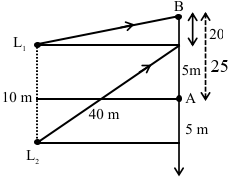
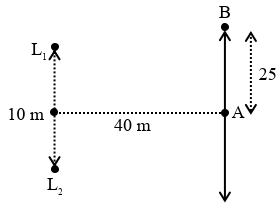
Point B will \(10^{\text {th }}\) maxima
\(\begin{array}{l}\Delta x=L_2 B-L_1 B \\ L_1 B=\sqrt{20^2+40^2}=20 \sqrt{5} m=44.6 m \\ L_2 B=\sqrt{40^2+30^2}=50 m \\ \Delta x=50-44.6=5.4 m\end{array}\)
\(\begin{array}{l}\Delta x=n \lambda \\ 5.4=10 \times \lambda \\ \lambda=0.54 m \\ V=f \lambda\end{array}\)
\(f =\frac{324}{0.54}=600 Hz\) -
- (A) 1.08
- (B) 1.9
- (C) 1.67
- (D) 1.18
Show answer and solution
Correct Answer: (D)
Given \(L _{ A }=2.5 m\),
\(L _{ B }=1.5 m\),
\(T =500 N\)
\(v_A=\sqrt{\frac{T}{\mu_A}}=\sqrt{\frac{500}{2 \times 10^{-4}}}=5 \sqrt{10} \times 10^2 m / s\)
\(v _{ B }=\sqrt{\frac{ T }{\mu_{ B }}}=\sqrt{\frac{500}{4 \times 10^{-4}}}=5 \sqrt{5} \times 10^2 m / s\)
\(t _1=\frac{ L _{ A }}{ v _{ A }}=\frac{2.5}{5 \sqrt{10}} \times 10^{-2} s\)
\(t_2=\frac{L_B}{v_B}=\frac{1.5}{5 \sqrt{5}} \times 10^{-2} s\)
\(\therefore \frac{ t _1}{ t _2}=\frac{2.5}{5 \sqrt{10}} \times \frac{5 \sqrt{5}}{1.5}=\frac{5}{3} \times \frac{1}{\sqrt{2}}=\frac{1.66}{1.41}=1.18\) -
- (A) 384
- (B) 376
- (C) 388
- (D) 372
Show answer and solution
Correct Answer: (A)
\(|f_{A}-f_{B}|=4\)
\(|f_{A}-380|=4\)
So, \(f_{A}=384~Hz\) or 376 Hz
on loading with wax \(f_{A}\) decreases
So, \(f_{A}=384~Hz\) -
- (A) \(2 \pi \sqrt{\frac{ M }{\rho Ag }}\)
- (B) \(\pi \sqrt{\frac{2 M }{\rho Ag }}\)
- (C) \(\pi \sqrt{\frac{\rho A }{ Mg }}\)
- (D) \(2 \pi \sqrt{\frac{\rho A}{ Mg }}\)
Show answer and solution
Correct Answer: (A)
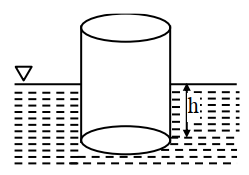
At equilibrium
\(\rho Ahg = Mg\)
After displacing by x ,
\(M a=-\rho A(h+x) g+M g\)
\(M a=-\rho A h g-\rho A x g+M g\)
\(Ma =-\rho Axg\)
\(a=\left(\frac{-\rho A g}{M}\right) x\)
on comparing with,
\(a=-\omega^2 x\)
\(\omega=\sqrt{\frac{\rho Ag }{ M }}\)
\(T =\frac{2 \pi}{\omega}=2 \pi \sqrt{\frac{ M }{\rho Ag }}\) -
- (A) \(1/4\)
- (B) \(5/4\)
- (C) \(5/8\)
- (D) \(3/8\)
Show answer and solution
Correct Answer: (C)
The equation of simple harmonic motion for a particle starting from the extreme position \(x = A\) is given by:
\(x = A \cos(\omega t)\)
We need to find the time \(t\) when the particle reaches \(x = \dfrac{A}{\sqrt{2}}\). Substituting this value into the equation:
\(\dfrac{A}{\sqrt{2}} = A \cos(\omega t)\)
\(\cos(\omega t) = \dfrac{1}{\sqrt{2}}\)
\(\omega t = \dfrac{\pi}{4}\)
Since the angular frequency \(\omega = \dfrac{2\pi}{T}\), we have:
\(\dfrac{2\pi}{T} t = \dfrac{\pi}{4}\)
\(t = \dfrac{T}{8}\)
Given the time period \(T = 5\) sec, the required time is:
\(t = \dfrac{5}{8}\) sec
Answer: \(5/8\) -
- (A) 120
- (B) 0.75
- (C) 7.5
- (D) 15
Show answer and solution
Correct Answer: (C)
Time period becomes half
and \( T\propto\sqrt{\ell} \)
So, length becomes \( \frac{\ell}{4} \)
So, \( \frac{\ell}{4}=\frac{30}{4}=7.5 \) -
- (A) 15
- (B) 20
- (C) 60
- (D) 45
Show answer and solution
Correct Answer: (C)
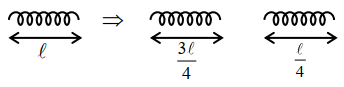
\(K \ell=\) constant
\(K \ell= K ^{\prime}\left(\frac{\ell}{4}\right)\)
\(K ^{\prime}=4 K\)
\(K ^{\prime}=60 N / m\) -
- (A) \(\dfrac{5\sqrt{50}}{\pi}\) and \(8 \times 10^{-3}\)
- (B) \(\dfrac{5\sqrt{50}}{\pi}\) and \(8\)
- (C) \(10\sqrt{50}\) and \(2 \times 10^{-3}\)
- (D) \(\dfrac{5\sqrt{50}}{\pi}\) and \(16 \times 10^{-3}\)
Show answer and solution
Correct Answer: (A)
At equilibrium, the restoring force of the spring balances the weight of the mass:
\(mg = kx_0\)
\(k = \dfrac{mg}{x_0} = \dfrac{0.2 \times 10}{2 \times 10^{-3}} = 1000\) N/m
The frequency of oscillation is given by:
\(f = \dfrac{1}{2\pi} \sqrt{\dfrac{k}{m}}\)
\(f = \dfrac{1}{2\pi} \sqrt{\dfrac{1000}{0.2}} = \dfrac{1}{2\pi} \sqrt{5000} = \dfrac{10\sqrt{50}}{2\pi} = \dfrac{5\sqrt{50}}{\pi}\) Hz
The maximum energy in the spring corresponds to its maximum elastic potential energy, which occurs at the maximum extension.
Maximum extension \(x_{max} = x_0 + A = 2 \text{ mm} + 2 \text{ mm} = 4 \text{ mm} = 4 \times 10^{-3}\) m
Maximum energy in the spring \(U_{max} = \dfrac{1}{2} k x_{max}^2\)
\(U_{max} = \dfrac{1}{2} \times 1000 \times (4 \times 10^{-3})^2\)
\(U_{max} = 500 \times 16 \times 10^{-6} = 8000 \times 10^{-6} = 8 \times 10^{-3}\) J
Answer: \(\dfrac{5\sqrt{50}}{\pi}\) and \(8 \times 10^{-3}\) -
- (A) \(2\pi\sqrt{\dfrac{5R}{4g}}\)
- (B) \(2\pi\sqrt{\dfrac{2R}{3g}}\)
- (C) \(2\pi\sqrt{\dfrac{3R}{2g}}\)
- (D) \(2\pi\sqrt{\dfrac{3R}{g}}\)
Show answer and solution
Correct Answer: (A)
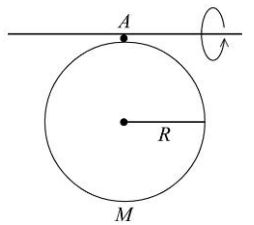
From the given figure, the axis of rotation is a horizontal line passing through the point \(A\) on the edge of the disc. The circular arrow around the axis indicates that the disc oscillates out of its plane, meaning the axis of rotation is a tangent to the disc in its own plane.
The moment of inertia of a uniform disc about its diameter is \(I_{cm} = \dfrac{1}{4}MR^2\).
Using the parallel axis theorem, the moment of inertia of the disc about the given axis of rotation is:
\(I = I_{cm} + MR^2 = \dfrac{1}{4}MR^2 + MR^2 = \dfrac{5}{4}MR^2\)
The distance from the center of mass of the disc to the axis of rotation is \(d = R\).
The time period of a physical pendulum is given by:
\(T = 2\pi\sqrt{\dfrac{I}{Mgd}}\)
Substituting the values of \(I\) and \(d\):
\(T = 2\pi\sqrt{\dfrac{\dfrac{5}{4}MR^2}{MgR}} = 2\pi\sqrt{\dfrac{5R}{4g}}\)
Answer: \(2\pi\sqrt{\dfrac{5R}{4g}}\) -
- (A) solid cylinder
- (B) ring
- (C) disc
- (D) solid sphere
Show answer and solution
Correct Answer: (D)
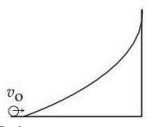
By the law of conservation of mechanical energy, the total initial kinetic energy of the rolling object is converted into potential energy at the maximum height.
Total initial kinetic energy for an object rolling without slipping is given by:
\(K = K_{\text{translational}} + K_{\text{rotational}}\)
\(K = \dfrac{1}{2}mv_0^2 + \dfrac{1}{2}I\omega^2\)
Substituting \(\omega = \dfrac{v_0}{R}\) and \(I = mk^2\) (where \(k\) is the radius of gyration):
\(K = \dfrac{1}{2}mv_0^2 + \dfrac{1}{2}(mk^2)\left(\dfrac{v_0}{R}\right)^2 = \dfrac{1}{2}mv_0^2\left(1 + \dfrac{k^2}{R^2}\right)\)
The potential energy at the maximum height \(h\) is:
\(U = mgh\)
Given \(h = \dfrac{7v_0^2}{10g}\), we have:
\(U = mg\left(\dfrac{7v_0^2}{10g}\right) = \dfrac{7}{10}mv_0^2\)
Equating kinetic and potential energy (\(K = U\)):
\(\dfrac{1}{2}mv_0^2\left(1 + \dfrac{k^2}{R^2}\right) = \dfrac{7}{10}mv_0^2\)
\(1 + \dfrac{k^2}{R^2} = \dfrac{14}{10} = \dfrac{7}{5}\)
\(\dfrac{k^2}{R^2} = \dfrac{7}{5} - 1 = \dfrac{2}{5}\)
The moment of inertia is \(I = \dfrac{2}{5}mR^2\), which corresponds to a solid sphere.
Answer: solid sphere -
- (A) 30
- (B) 27
- (C) 20
- (D) 5
Show answer and solution
Correct Answer: (A)
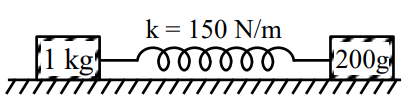
\(\mu=\frac{m_{1}m_{2}}{m_{1}+m_{2}}=\frac{1\times0.2}{1.2}\)
\(\mu=\frac{1}{6}\)
\(\omega=\sqrt{\frac{k}{\mu}}=\sqrt{\frac{150}{1/6}}=30\) -
- (A) A-III, B-I, C-IV, D-II
- (B) A-II, B-I, C-III, D-IV
- (C) A-III, B-II, C-IV, D-I
- (D) A-II, B-I, C-IV, D-III
Show answer and solution
Correct Answer: (A)
For A: \(y = \sin^2 \omega t = \dfrac{1 - \cos 2\omega t}{2} = \dfrac{1}{2} - \dfrac{1}{2} \cos 2\omega t\)
This represents simple harmonic motion (SHM) about the mean position \(y = \dfrac{1}{2}\) with an angular frequency of \(2\omega\). The time period is \(T = \dfrac{2\pi}{2\omega} = \dfrac{\pi}{\omega}\). Thus, A matches III.
For B: \(y = \sin^3(2\omega t) = \dfrac{3\sin 2\omega t - \sin 6\omega t}{4}\)
This is a superposition of two SHMs with angular frequencies \(2\omega\) and \(6\omega\). It is periodic but not SHM. The time period is the LCM of \(T_1 = \dfrac{2\pi}{2\omega} = \dfrac{\pi}{\omega}\) and \(T_2 = \dfrac{2\pi}{6\omega} = \dfrac{\pi}{3\omega}\), which is \(T = \dfrac{\pi}{\omega}\). Thus, B matches I.
For C: \(y = \sin(\omega t) + \cos(\pi \omega t)\)
The angular frequencies are \(\omega_1 = \omega\) and \(\omega_2 = \pi \omega\). The ratio \(\dfrac{\omega_1}{\omega_2} = \dfrac{1}{\pi}\) is an irrational number. Therefore, the function is non-periodic. Thus, C matches IV.
For D: \(y = \cos \omega t + \cos 2\omega t\)
This is a superposition of two SHMs with angular frequencies \(\omega\) and \(2\omega\). It is periodic but not SHM. The time period is the LCM of \(T_1 = \dfrac{2\pi}{\omega}\) and \(T_2 = \dfrac{2\pi}{2\omega} = \dfrac{\pi}{\omega}\), which is \(T = \dfrac{2\pi}{\omega}\). Thus, D matches II.
The correct matching is A-III, B-I, C-IV, D-II.
Answer: A-III, B-I, C-IV, D-II -
- (A) 1
- (B) 2
- (C) 4
- (D) 8
Show answer and solution
Correct Answer: (B)
Potential energy is maximum at extreme position The particle starting at mean position reaches extreme position in time \(\frac{ T }{4}\).
So \(T/2\beta = T/4 \Rightarrow 2\beta = 4 \Rightarrow \beta = 2\) -
- (A) \(\dfrac{\pi}{300} \, s, \dfrac{\pi}{75} \, s\)
- (B) \(\dfrac{\pi}{75} \, s, \dfrac{\pi}{300} \, s\)
- (C) \(\dfrac{\pi}{300} \, s, \dfrac{\pi}{25} \, s\)
- (D) \(\dfrac{\pi}{50} \, s, \dfrac{\pi}{100} \, s\)
Show answer and solution
Correct Answer: (A)
The equation of motion is given by \(x = a \sin\left(50t + \dfrac{\pi}{3}\right)\).
Velocity is the rate of change of displacement:
\(v = \dfrac{dx}{dt} = 50a \cos\left(50t + \dfrac{\pi}{3}\right)\)
The particle comes to rest when \(v = 0\). For the first time it comes to rest:
\(\cos\left(50t_1 + \dfrac{\pi}{3}\right) = 0\)
\(50t_1 + \dfrac{\pi}{3} = \dfrac{\pi}{2}\)
\(50t_1 = \dfrac{\pi}{2} - \dfrac{\pi}{3} = \dfrac{\pi}{6}\)
\(t_1 = \dfrac{\pi}{300} \text{ s}\)
Acceleration is the rate of change of velocity:
\(A = \dfrac{dv}{dt} = -2500a \sin\left(50t + \dfrac{\pi}{3}\right)\)
The particle has zero acceleration when \(A = 0\). For the first time it has zero acceleration:
\(\sin\left(50t_2 + \dfrac{\pi}{3}\right) = 0\)
\(50t_2 + \dfrac{\pi}{3} = \pi\)
\(50t_2 = \pi - \dfrac{\pi}{3} = \dfrac{2\pi}{3}\)
\(t_2 = \dfrac{2\pi}{150} = \dfrac{\pi}{75} \text{ s}\)
Answer: \(\dfrac{\pi}{300} \, s, \dfrac{\pi}{75} \, s\) -
- (A) \(1\)
- (B) \(2\)
- (C) \(\sqrt{2}\)
- (D) \(\sqrt{3}\)
Show answer and solution
Correct Answer: (C)
The frequency of oscillation of a spring-mass system is given by \(v = \dfrac{1}{2\pi} \sqrt{\dfrac{k}{m}}\), where \(k\) is the spring constant and \(m\) is the mass.
The spring constant \(k\) is inversely proportional to the length of the spring \(L\), so \(k \propto \dfrac{1}{L}\).
When the length of the spring is cut to half, the new length is \(L' = \dfrac{L}{2}\). The new spring constant becomes \(k' = 2k\).
The new frequency of oscillation is \(v_2 = \dfrac{1}{2\pi} \sqrt{\dfrac{k'}{m}} = \dfrac{1}{2\pi} \sqrt{\dfrac{2k}{m}} = \sqrt{2} v_1\).
Therefore, the ratio \(\dfrac{v_2}{v_1} = \sqrt{2}\).
Answer: \(\sqrt{2}\) -
- (A) 14
- (B) 88
- (C) 28
- (D) 176
Show answer and solution
Correct Answer: (A)
\( \omega=176~rad/sec \)
\( f_{k}=\frac{\omega}{2\pi}=\frac{176}{2\times22}\times7 \)
\( =\frac{176}{44}\times7 \)
\( =4\times7=28~Hz \)
So frequency of oscillator
\( =\frac{f_{k}}{2}=14Hz \) -
- (A) 40
- (B) 44
- (C) 48
- (D) 52
Show answer and solution
Correct Answer: (B)
The given equation is \(v^2 = 50 - x^2\)
Differentiating with respect to \(x\):
\(2v \dfrac{dv}{dx} = -2x\)
\(v \dfrac{dv}{dx} = -x\)
Since acceleration \(a = v \dfrac{dv}{dx}\), we get:
\(a = -x\)
Comparing this with the standard equation of SHM \(a = -\omega^2 x\), we get:
\(\omega^2 = 1 \Rightarrow \omega = 1\) rad/s
The time period of the motion is given by:
\(T = \dfrac{2\pi}{\omega} = 2\pi\)
Taking \(\pi = \dfrac{22}{7}\), we get:
\(T = 2 \times \dfrac{22}{7} = \dfrac{44}{7}\) s
Given that the time period is \(\dfrac{x}{7}\) s, comparing the two gives:
\(x = 44\)
Answer: \(44\) -
- (A) 100
- (B) 200
- (C) 300
- (D) 400
Show answer and solution
Correct Answer: (C)
Given \(n = 5\) moles, \(\Delta T = 20^{\circ}\text{C} - 10^{\circ}\text{C} = 10^{\circ}\text{C}\).
The molar specific heat at constant pressure is \(c_p = 8 \text{ cal/mol}\cdot^{\circ}\text{C}\).
The universal gas constant is \(R = 8.36 \text{ J/mol}\cdot^{\circ}\text{C}\).
Converting \(R\) into calories, we use \(1 \text{ cal} = 4.18 \text{ J}\):
\(R = \dfrac{8.36}{4.18} \text{ cal/mol}\cdot^{\circ}\text{C} = 2 \text{ cal/mol}\cdot^{\circ}\text{C}\)
Using Mayer's relation, the molar specific heat at constant volume is:
\(c_v = c_p - R = 8 - 2 = 6 \text{ cal/mol}\cdot^{\circ}\text{C}\)
The change in internal energy of the gas is given by:
\(\Delta U = n c_v \Delta T\)
\(\Delta U = 5 \times 6 \times 10 = 300 \text{ cal}\)
Answer: \(300\) -
- (A) 3730
- (B) 6460
- (C) 3230
- (D) 4000
Show answer and solution
Correct Answer: (A)
As per NTA
\(V =\) constant
so \(P \propto T\)
\(T _{ i }=50^{\circ} C =323 K\)
\(T _{ f }=100^{\circ} C =373 K\)
\(\Rightarrow \frac{ P _{ f }}{ P _{ i }}=\frac{ T _{ f }}{ T _{ i }}\)
\(\Rightarrow \frac{ P _{ f }}{3.23 kPa }=\frac{373}{323}\)
\(\Rightarrow P _{ f }=3730 Pa\) -
- (A) \(0.15\) and \(0.18\)
- (B) \(0.25\) and \(0.08\)
- (C) \(0.21\) and \(0.12\)
- (D) \(0.13\) and \(0.20\)
Show answer and solution
Correct Answer: (C)
Using the ideal gas equation, the total number of moles of the mixture is given by:
\(n = \dfrac{PV}{RT}\)
Substituting the given values:
\(P = 100 \text{ kPa} = 10^5 \text{ Pa}\)
\(V = 8310 \text{ cm}^3 = 8.31 \times 10^{-3} \text{ m}^3\)
\(T = 300 \text{ K}\)
\(R = 8.31 \text{ J/(mol}\cdot\text{K)}\)
\(n = \dfrac{10^5 \times 8.31 \times 10^{-3}}{8.31 \times 300} = \dfrac{100}{300} = \dfrac{1}{3} \text{ mol}\)
Let \(n_1\) and \(n_2\) be the number of moles of \(CO_2\) and \(O_2\) respectively.
\(n_1 + n_2 = \dfrac{1}{3}\)
The total mass of the mixture is \(13.2 \text{ g}\). Using the molar masses of \(CO_2\) (\(44 \text{ g/mol}\)) and \(O_2\) (\(32 \text{ g/mol}\)):
\(44n_1 + 32n_2 = 13.2\)
Substituting \(n_2 = \dfrac{1}{3} - n_1\) into the mass equation:
\(44n_1 + 32\left(\dfrac{1}{3} - n_1\right) = 13.2\)
\(12n_1 + \dfrac{32}{3} = 13.2\)
\(12n_1 = \dfrac{39.6 - 32}{3} = \dfrac{7.6}{3}\)
\(n_1 = \dfrac{7.6}{36} = \dfrac{19}{90} \approx 0.21 \text{ mol}\)
The number of moles of \(O_2\) is:
\(n_2 = \dfrac{1}{3} - \dfrac{19}{90} = \dfrac{11}{90} \approx 0.12 \text{ mol}\)
The number of moles of \(CO_2\) and \(O_2\) are \(0.21\) and \(0.12\) respectively.
Answer: \(0.21\) and \(0.12\) -
- (A) 4.2
- (B) 2.0
- (C) 3.0
- (D) 4.5
Show answer and solution
Correct Answer: (D)
For an air bubble rising in water, the no. of moles remain constant
\(\frac{P_1 V_1}{T_1}=\frac{P_2 V_2}{T_2}\)
\(\frac{\left( P _{ atm }+\rho gh \right) 2.9 cm^3}{290 K}=\frac{\left( P _{ atm }\right) V _2}{300}\)
\(V _2=4.5 cm^3\) -
- (A) 5
- (B) 6
- (C) 7
- (D) 8
Show answer and solution
Correct Answer: (C)
\(PV = nRT\)
\(\frac{P_1 V_1}{R T_1}=\frac{P_2 V_2}{R T_2}\)
\(\frac{2 \times 10^5 \times 60}{300}=\frac{ P _2 \times 20}{350}\)
\(P _2=\frac{2 \times 10^5 \times 7 \times 3}{6}\)
\(P_2=7 \times 10^5=7 atm\) -
- (A) \( 32\times10^{18} \)
- (B) \( 4\times10^{18} \)
- (C) \( 2\times10^{18} \)
- (D) \( 8\times10^{18} \)
Show answer and solution
Correct Answer: (B)
Collision frequency (z) \( =\sqrt{2}\pi d^{2}N\sqrt{\frac{8RT}{\pi M}} \)
Temp, N are same
\( Z\propto\frac{d^{2}}{\sqrt{M}} \)
\( d_{A}=\frac{d_{B}}{2} \)
\( M_{A}=4M_{B} \)
\( \frac{Z_{A}}{Z_{B}}=\frac{d_{A}^{2}}{\sqrt{M_{A}}}\times\frac{\sqrt{M_{B}}}{d_{B}^{2}}=(\sqrt{\frac{M_{B}}{M_{A}}})(\frac{d_{A}}{d_{B}})^{2} \)
\( =(\sqrt{\frac{1}{4}})(\frac{1}{2})^{2} \)
\( \frac{Z_{A}}{Z_{B}}=\frac{1}{2}\times\frac{1}{4}=\frac{1}{8} \)
\( \Rightarrow Z_{A}=\frac{32\times10^{8}}{8}=4\times10^{18}/s \) -
- (A) Both A and R are true and R is the correct explanation of A
- (B) Both A and R are true but R is NOT the correct explanation of A
- (C) A is true but R is false
- (D) A is false but R is true
Show answer and solution
Correct Answer: (C)
The average kinetic energy of a gas molecule is directly proportional to its absolute temperature and is given by \(E = \dfrac{f}{2} k_B T\), where \(f\) is the degree of freedom. Since both \(H_2\) and \(O_2\) are diatomic gases, they have the same degrees of freedom (\(f=5\)). Therefore, if their average kinetic energies are the same, their temperatures must be the same. Thus, Assertion A is true.
The root mean square (r.m.s.) speed of a gas molecule is given by \(v_{rms} = \sqrt{\dfrac{3RT}{M}}\). Since the molar mass \(M\) of \(H_2\) (\(2 \text{ g/mol}\)) is different from that of \(O_2\) (\(32 \text{ g/mol}\)), their r.m.s. speeds will be different even at the same temperature. Thus, Reason R is false.
Therefore, A is true but R is false.
Answer: A is true but R is false -
- (A) \(\dfrac{5}{2}T\)
- (B) \(\dfrac{5}{4}T\)
- (C) \(\dfrac{7}{2}T\)
- (D) \(\dfrac{7}{4}T\)
Show answer and solution
Correct Answer: (D)
Using the principle of conservation of internal energy for the mixture of ideal gases:
\(U_{mix} = U_1 + U_2\)
\((n_1 + n_2) C_{V} T_{mix} = n_1 C_{V} T_1 + n_2 C_{V} T_2\)
Since both gases are monoatomic, their molar heat capacities at constant volume are equal (\(C_{V} = \dfrac{3}{2}R\)).
\((n_1 + n_2) T_{mix} = n_1 T_1 + n_2 T_2\)
Substituting the given values \(n_1 = 2\), \(T_1 = T\), \(n_2 = 6\), and \(T_2 = 2T\):
\((2 + 6) T_{mix} = 2(T) + 6(2T)\)
\(8 T_{mix} = 2T + 12T\)
\(8 T_{mix} = 14T\)
\(T_{mix} = \dfrac{14}{8}T = \dfrac{7}{4}T\)
Answer: \(\dfrac{7}{4}T\) -
- (A) \((T_1 + T_2)/2\)
- (B) \(T_1 T_2 PV/(T_2 P_1 V_1 + T_1 P_2 V_2)\)
- (C) \((T_2 P_1 V_1 + T_1 P_2 V_2)/(T_1 T_2 PV)\)
- (D) \(|T_1 - T_2|/2\)
Show answer and solution
Correct Answer: (B)
From the ideal gas equation, the number of moles of the first gas is \(n_1 = \dfrac{P_1 V_1}{R T_1}\) and the number of moles of the second gas is \(n_2 = \dfrac{P_2 V_2}{R T_2}\).
For the mixture, the total number of moles is \(n = n_1 + n_2\).
Applying the ideal gas equation for the mixture:
\(P V = n R T\)
\(T = \dfrac{P V}{n R}\)
Substituting the values of \(n_1\) and \(n_2\):
\(T = \dfrac{P V}{\left( \dfrac{P_1 V_1}{R T_1} + \dfrac{P_2 V_2}{R T_2} \right) R}\)
\(T = \dfrac{P V}{\dfrac{P_1 V_1}{T_1} + \dfrac{P_2 V_2}{T_2}}\)
\(T = \dfrac{T_1 T_2 P V}{P_1 V_1 T_2 + P_2 V_2 T_1}\)
Answer: \(T_1 T_2 PV/(T_2 P_1 V_1 + T_1 P_2 V_2)\) -
- (A) \(2\sqrt{2}\times10^{-10}\)
- (B) \(10\sqrt{2}\times10^{-8}\)
- (C) \(2\sqrt{2}\times10^{-8}\)
- (D) \(2\times10^{-8}\)
Show answer and solution
Correct Answer: (C)
\(\lambda=\frac{k_{B}T}{\sqrt{2}\pi\sigma^{2}P}\)
\(=\frac{1.38\times10^{-23}\times(273+41)\times100}{\sqrt{2}\times3.14\times(5\times10^{-10})^{2}\times1.38\times10^{5}}=2\sqrt{2}\times10^{-8}\) -
- (A) \(-235\)
- (B) \(-100\)
- (C) \(-253\)
- (D) \(-20\)
Show answer and solution
Correct Answer: (C)
\( V_{rma}=\sqrt{\frac{3RT}{M}} \)
\( V_{rmsO_{2}}=V_{rmsH_{2}} \)
\( T_{O_{2}}=273+47=320K \)
\( \sqrt{\frac{3RT_{O_{2}}}{M_{O_{2}}}}=\sqrt{\frac{3R~T_{H_{2}}}{M_{H_{2}}}} \)
\( \frac{T_{2}}{M_{O_{2}}}=\frac{T_{H_{2}}}{M_{H_{2}}} \)
\( \frac{320}{32}=\frac{T_{H_{2}}}{2} \)
\( T_{H_{2}}=20K \)
\( T_{H_{2}}=-253^{\circ}C \) -
- (A) \(100\)
- (B) \(120\)
- (C) \(90\)
- (D) \(105\)
Show answer and solution
Correct Answer: (A)
Let the volume of each vessel be \(V\).
Initially, both vessels are at pressure \(P_1 = 90\) kPa and temperature \(T_1 = 400\) K.
Total number of moles initially is given by:
\(n_i = \dfrac{P_1 V}{R T_1} + \dfrac{P_1 V}{R T_1} = \dfrac{2 P_1 V}{R T_1}\)
Finally, the temperature of the first vessel is \(T_1 = 400\) K and the second vessel is \(T_2 = 500\) K. Let the final pressure be \(P_f\).
Total number of moles finally is given by:
\(n_f = \dfrac{P_f V}{R T_1} + \dfrac{P_f V}{R T_2}\)
Since the total number of moles remains constant, \(n_i = n_f\):
\(\dfrac{2 P_1 V}{R T_1} = \dfrac{P_f V}{R T_1} + \dfrac{P_f V}{R T_2}\)
Substituting the given values:
\(\dfrac{2 \times 90}{400} = \dfrac{P_f}{400} + \dfrac{P_f}{500}\)
\(\dfrac{180}{400} = P_f \left( \dfrac{1}{400} + \dfrac{1}{500} \right)\)
\(\dfrac{180}{400} = P_f \left( \dfrac{5 + 4}{2000} \right)\)
\(\dfrac{180}{400} = P_f \left( \dfrac{9}{2000} \right)\)
\(P_f = \dfrac{180 \times 2000}{400 \times 9}\)
\(P_f = 20 \times 5 = 100\) kPa
Answer: \(100\) -
- (A) 0.48
- (B) 4.81
- (C) 48.1
- (D) 0.048
Show answer and solution
Correct Answer: (A)
\(C _{ v }= C _{ P }- R =\frac{5}{2} R\)
\(\Delta Q = nC _{ V } \Delta T\)
\(300= n \times \frac{5}{2} \times 8.314 \times 30\)
\(n =0.48\)
\(\frac{ m }{ M }=0.48\)
We cannot find mass (m) because molar mass (M) not given. -
- (A) 24
- (B) 15
- (C) 21
- (D) 28
Show answer and solution
Correct Answer: (C)
\(\Delta Q=nC_{v}\Delta T\) (isochoric)
\(=\frac{C_{v}}{R}\cdot nR\Delta T=\frac{C_{v}}{R}(P_{2}-P_{1})V\)
\(=\frac{21}{8.3}\times(30-21.7)\times1=21J\) -
- (A) 250
- (B) 700
- (C) 500
- (D) 100
Show answer and solution
Correct Answer: (C)
\(\Delta U = nC _{ v } \Delta T\)
\(=n\left(C_P-R\right) \Delta T\)
\(=10(7-2)(40-30)\)
\(\Delta U =500\) -
- (A) 989
- (B) 1089
- (C) 889
- (D) 789
Show answer and solution
Correct Answer: (A)
For an isothermal process, the isothermal bulk modulus equals the gas pressure:
\(B_T = -V\dfrac{dP}{dV}\)
Since \(PV = \text{constant}\), differentiating gives \(P\,dV + V\,dP = 0\), so \(\dfrac{dP}{dV} = -\dfrac{P}{V}\), which yields \(B_T = P\).
Therefore, the initial pressure is:
\(P_o = 3 \times 10^5\text{ N/m}^2\)
Volumes:
\(V_o = 3\text{ L} = 3 \times 10^{-3}\text{ m}^3\)
\(V_f = \dfrac{1}{3}V_o = 10^{-3}\text{ m}^3\)
Work done on the gas during an isothermal compression:
\(W_{\text{on}} = -W_{\text{by}} = -P_o V_o \ln\left(\dfrac{V_f}{V_o}\right) = P_o V_o \ln\left(\dfrac{V_o}{V_f}\right)\)
\(W_{\text{on}} = (3 \times 10^5)(3 \times 10^{-3})\ln 3\)
\(W_{\text{on}} = 900 \ln 3\text{ J}\)
Using \(\ln 3 \approx 1.0986\):
\(W_{\text{on}} \approx 900 \times 1.0986 \approx 988.74\text{ J}\)
Rounded to the nearest integer:
\(W_{\text{on}} \approx 989\text{ J}\)
Hence, the work done on the gas is approximately \(989\text{ J}\).
No questions on this page match these filters.