


Questions
16 questionsShowing 1–16 of 16 questions
-
- (A) 5.1
- (B) 3.8
- (C) 6
- (D) 7.8
Show answer and solution
Correct Answer: (A)
\(\omega_1=3 \times 10^{15} rad / sec\)
\(\omega_2=12 \times 10^{15} rad / sec\)
\(\because \quad v=\frac{\omega}{2 \pi}\)
\(E_{\text {photon }}=h v=6.6 \times 10^{-34} \times 1.91 \times 10^{15}\)
\(=1.26 \times 10^{-18} J\)
\(E _{\max }=\frac{1.26 \times 10^{-18}}{1.6 \times 10^{-19}} \simeq 7.9 eV\)
\(K _{\max }= E _{\max }-\phi_0\)
\(=7.9-2.8\)
\(K _{\max }=5.1 eV\) -
- (A) Microwave
- (B) Infrared
- (C) Visible
- (D) Ultraviolet
Show answer and solution
Correct Answer: (D)
Power of the source, \(P = 15 \text{ kW} = 15 \times 10^3 \text{ J/s}\)
Number of photons emitted per second, \(n = 2.5 \times 10^{22} \text{ s}^{-1}\)
Energy of one photon, \(E = \dfrac{P}{n} = \dfrac{15 \times 10^3}{2.5 \times 10^{22}} = 6 \times 10^{-19} \text{ J}\)
Using \(E = \dfrac{hc}{\lambda}\), we get \(\lambda = \dfrac{hc}{E}\)
\(\lambda = \dfrac{6.6 \times 10^{-34} \times 3 \times 10^8}{6 \times 10^{-19}} = 3.3 \times 10^{-7} \text{ m} = 330 \text{ nm}\)
The wavelength \(330 \text{ nm}\) lies in the ultraviolet region of the electromagnetic spectrum.
Answer: Ultraviolet -
- (A) 5
- (B) 15
- (C) 10
- (D) 20
Show answer and solution
Correct Answer: (C)
\( \lambda=\frac{h}{\sqrt{2mqV}} \)
\( \lambda=\frac{6.6\times10^{-34}}{\sqrt{2\times18\times10^{-46}\times1.21}} \)
\( \lambda=10^{-11}m=10\times10^{-12}m \)
\( \alpha=10 \) -
- (A) \(1.20\)
- (B) \(1.0\)
- (C) \(1.25\)
- (D) \(0.75\)
Show answer and solution
Correct Answer: (C)
The de Broglie wavelength of an electron in free space is given by \(\lambda_0 = \dfrac{h}{mv}\).
When the electron enters the medium, its velocity is reduced by \(20\%\). The new velocity is \(v' = v - 0.20v = 0.80v\).
The de Broglie wavelength in the medium is \(\lambda' = \dfrac{h}{mv'}\).
Substituting \(v' = 0.80v\), we get \(\lambda' = \dfrac{h}{m(0.80v)} = \dfrac{1}{0.80} \left(\dfrac{h}{mv}\right)\).
Since 1 / 0.80 = 100 / 80 = 1.25,
we have λ' = 1.25λ_0.
Comparing this with λ' = αλ_0, we get α = 1.25. Answer: 1.25 -
- (A) \(\dfrac{4\lambda_0}{\left[1 - \dfrac{E_0 e}{2m}\dfrac{t}{v_0}\right]}\)
- (B) \(\dfrac{4\lambda_0}{\left[1 + \dfrac{E_0 e}{2m}\dfrac{t}{v_0}\right]}\)
- (C) \(\dfrac{4\lambda_0}{\left[1 + \dfrac{2E_0 e}{m}\dfrac{t}{v_0}\right]}\)
- (D) \(\dfrac{4\lambda_0}{\left[1 - \dfrac{2E_0 e}{m}\dfrac{t}{v_0}\right]}\)
Show answer and solution
Correct Answer: (C)
The force experienced by the electron in the electric field is given by \(\vec{F} = q\vec{E}\).
Since the charge of an electron is \(-e\) and the electric field is \(\vec{E} = -2E_0\hat{i}\), the force is:
\(\vec{F} = (-e)(-2E_0\hat{i}) = 2eE_0\hat{i}\)
The acceleration of the electron is:
\(\vec{a} = \dfrac{\vec{F}}{m} = \dfrac{2eE_0}{m}\hat{i}\)
Using the first equation of motion, the velocity of the electron at time \(t\) is:
\(\vec{v}(t) = \vec{V} + \vec{a}t = \left(v_0 + \dfrac{2eE_0}{m}t\right)\hat{i}\)
The de Broglie wavelength of the electron at time \(t\) is:
\(\lambda = \dfrac{h}{m|\vec{v}(t)|} = \dfrac{h}{m\left(v_0 + \dfrac{2eE_0}{m}t\right)}\)
We are given that \(\lambda_0 = \dfrac{h}{4mv_0}\), which implies \(h = 4mv_0\lambda_0\). Substituting this into the expression for \(\lambda\):
\(\lambda = \dfrac{4mv_0\lambda_0}{m\left(v_0 + \dfrac{2eE_0}{m}t\right)}\)
Dividing the numerator and the denominator by \(mv_0\), we get:
\(\lambda = \dfrac{4\lambda_0}{1 + \dfrac{2E_0 e}{m}\dfrac{t}{v_0}}\)
Answer: \(\dfrac{4\lambda_0}{\left[1 + \dfrac{2E_0 e}{m}\dfrac{t}{v_0}\right]}\) -
- (A) \(1\)
- (B) \(4\)
- (C) \(2\)
- (D) \(3\)
Show answer and solution
Correct Answer: (B)
Using Einstein's photoelectric equation:
\(eV_s = \dfrac{hc}{\lambda} - \Phi\)
For the first case:
\(3eV_0 = \dfrac{hc}{\lambda} - \Phi\)
For the second case:
\(eV_0 = \dfrac{hc}{2\lambda} - \Phi\)
Multiplying the second equation by \(3\) and equating with the first equation:
\(\dfrac{hc}{\lambda} - \Phi = \dfrac{3hc}{2\lambda} - 3\Phi\)
\(2\Phi = \dfrac{3hc}{2\lambda} - \dfrac{hc}{\lambda}\)
\(2\Phi = \dfrac{hc}{2\lambda}\)
\(\Phi = \dfrac{hc}{4\lambda}\)
Since the work function \(\Phi = \dfrac{hc}{\lambda_0}\), where \(\lambda_0\) is the threshold wavelength:
\(\dfrac{hc}{\lambda_0} = \dfrac{hc}{4\lambda}\)
\(\lambda_0 = 4\lambda\)
Given \(\lambda_0 = \alpha\lambda\), we get \(\alpha = 4\).
Answer: \(4\) -
- (A) \(K_2+2K_1\)
- (B) \(2K_2-K_1\)
- (C) \(K_1-2K_2\)
- (D) \(K_2-2K_1\)
Show answer and solution
Correct Answer: (D)
Using Einstein's photoelectric equation:
\(K_1 = \dfrac{hc}{\lambda_1} - \phi\)
\(K_2 = \dfrac{hc}{\lambda_2} - \phi\)
Given \(\lambda_1 = 2\lambda_2\), the first equation becomes:
\(K_1 = \dfrac{hc}{2\lambda_2} - \phi\)
Multiplying by \(2\):
\(2K_1 = \dfrac{hc}{\lambda_2} - 2\phi\)
Substituting \(\dfrac{hc}{\lambda_2} = K_2 + \phi\) from the second equation:
\(2K_1 = (K_2 + \phi) - 2\phi\)
\(2K_1 = K_2 - \phi\)
\(\phi = K_2 - 2K_1\)
Answer: \(K_2-2K_1\) -
- (A) \( 1.04\times10^{16} \)
- (B) \( 1.04\times10^{13} \)
- (C) \( 1.66\times10^{16} \)
- (D) \( 1.66\times10^{15} \)
Show answer and solution
Correct Answer: (A)
\( \phi=h\nu \)
\( \nu=\frac{\phi}{h} \)
\( \omega=2\pi \nu=\frac{2\pi\phi}{h}=\frac{2\times3.14\times110\times10^{-20}}{6.63\times10^{-34}} \)
\( \omega=1.04\times10^{16}\,rad/sec \) -
- (A) \(3.68\)
- (B) \(4.68\)
- (C) \(5.68\)
- (D) \(2.68\)
Show answer and solution
Correct Answer: (C)
Using Einstein's photoelectric equation:
\(\dfrac{hc}{\lambda} = \Phi + eV_0\)
The energy of the incident photon is:
\(E = \dfrac{hc}{\lambda} = \dfrac{6.62 \times 10^{-34} \times 3 \times 10^8}{331 \times 10^{-9}}\)
\(E = \dfrac{19.86 \times 10^{-26}}{331 \times 10^{-9}} = 6 \times 10^{-19}\) J
The maximum kinetic energy of the photoelectrons is:
\(K_{\text{max}} = eV_0 = 1.6 \times 10^{-19} \times 0.2 = 0.32 \times 10^{-19}\) J
The work function \(\Phi\) is:
\(\Phi = E - K_{\text{max}}\)
\(\Phi = 6 \times 10^{-19} - 0.32 \times 10^{-19} = 5.68 \times 10^{-19}\) J
Comparing with \(\alpha \times 10^{-19}\) J, we get \(\alpha = 5.68\).
Answer: \(5.68\) -
- (A) \(5\times10^{16}\)
- (B) \(5\times10^{15}\)
- (C) \(10\times10^{15}\)
- (D) \(2\times10^{16}\)
Show answer and solution
Correct Answer: (D)
\(P=\frac{nhC}{\lambda}\)
\(6\times10^{-3}=\frac{n\times6.63\times10^{-34}\times3\times10^{8}}{663\times10^{-9}}\)
\(n=2\times10^{16}\) photons -
- (A) \(\sqrt{\dfrac{m_p}{m_e}}\)
- (B) \(\sqrt{\dfrac{m_e}{m_p}}\)
- (C) \(\dfrac{m_p}{m_e}\)
- (D) \(\left(\dfrac{m_p}{m_e}\right)^2\)
Show answer and solution
Correct Answer: (A)
The de Broglie wavelength of a particle accelerated through a potential difference \(V\) is given by \(\lambda = \dfrac{h}{\sqrt{2mqV}}\).
For an electron, the charge is \(e\) and mass is \(m_e\). Its de Broglie wavelength is \(\lambda_e = \dfrac{h}{\sqrt{2m_e eV}}\).
For a proton, the charge is \(e\) and mass is \(m_p\). Its de Broglie wavelength is \(\lambda_p = \dfrac{h}{\sqrt{2m_p eV}}\).
Taking the ratio of the two wavelengths, we get \(\dfrac{\lambda_e}{\lambda_p} = \dfrac{\dfrac{h}{\sqrt{2m_e eV}}}{\dfrac{h}{\sqrt{2m_p eV}}} = \sqrt{\dfrac{m_p}{m_e}}\).
Answer: \(\sqrt{\dfrac{m_p}{m_e}}\) -
- (A) 1
- (B) 2
- (C) 3
- (D) 4
Show answer and solution
Correct Answer: (D)
The de Broglie wavelength of an electron accelerated through a potential difference \(V\) is given by \(\lambda = \dfrac{h}{\sqrt{2meV}}\).
This implies \(\lambda \propto \dfrac{1}{\sqrt{V}}\).
Given that the new wavelength \(\lambda_2\) is increased by \(50\%\), we have \(\lambda_2 = \lambda_1 + 0.5\lambda_1 = \dfrac{3}{2}\lambda_1\).
Taking the ratio of the wavelengths, we get \(\dfrac{\lambda_1}{\lambda_2} = \sqrt{\dfrac{V_2}{V_1}}\).
Substituting \(\lambda_2 = \dfrac{3}{2}\lambda_1\), we get \(\dfrac{2}{3} = \sqrt{\dfrac{V_2}{V_1}}\).
Squaring both sides yields \(\dfrac{V_2}{V_1} = \dfrac{4}{9}\), which gives \(\dfrac{V_1}{V_2} = \dfrac{9}{4}\).
Comparing this with the given relation \(\dfrac{V_1}{V_2} = \dfrac{9}{\alpha}\), we find \(\alpha = 4\).
Answer: \(4\) -
- (A) 26
- (B) 24
- (C) 30
- (D) 20
Show answer and solution
Correct Answer: (A)
\( \lambda=\frac{h}{\sqrt{2mK}}=\frac{h}{\sqrt{2m(\frac{3}{2}kT)}} \)
\( \lambda=\frac{h}{\sqrt{3mkT}} \)
\( =\frac{6.63\times10^{-34}}{\sqrt{3\times5.31\times10^{-26}\times1.38\times10^{-23}\times300}} \)
\( =2.58\times10^{-11}=25.8\times10^{-12} \)
So, \( x=26 \) -
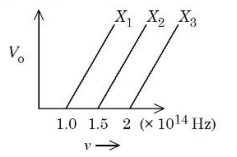
- (A) \(X_1\)
- (B) \(X_2\)
- (C) \(X_3\)
- (D) All the metals will give out photo electrons with same kinetic energies.
Show answer and solution
Correct Answer: (A)
From Einstein's photoelectric equation, the maximum kinetic energy of emitted photoelectrons is given by:
\(K_{\text{max}} = \dfrac{hc}{\lambda} - \Phi\)
where \(\lambda\) is the wavelength of incident radiation and \(\Phi\) is the work function of the metal.
The work function is related to the threshold frequency \(\nu_0\) by \(\Phi = h\nu_0\). From the given graph, the x-intercept represents the threshold frequency. We can observe that:
\(\nu_0(X_1) < \nu_0(X_2) < \nu_0(X_3)\)
Therefore, the work functions of the metals follow the order:
\(\Phi(X_1) < \Phi(X_2) < \Phi(X_3)\)
For the same wavelength \(\lambda\) of incident radiation, the term \(\dfrac{hc}{\lambda}\) is constant. Thus, the kinetic energy \(K_{\text{max}}\) will be greatest for the metal with the smallest work function.
Since metal \(X_1\) has the minimum work function, it will emit electrons with the greatest kinetic energy.
Answer: \(X_1\) -
- (A) 1
- (B) 2
- (C) 4
- (D) \(\sqrt{2}\)
Show answer and solution
Correct Answer: (B)
\(\lambda=\frac{ h }{ mv }=\frac{ h }{\sqrt{2 m \cdot KE }}\)
\(\frac{\lambda_{d}}{\lambda_{\alpha}} = \sqrt{\frac{m_{\alpha} \cdot KE_{\alpha}}{m_{d} \cdot KE_{d}}} = \sqrt{\frac{4m \cdot 2E}{2m \cdot E}} = 2:1\) -
- (A) \(2.9 \times 10^{-8}\)
- (B) \(2.2 \times 10^{-8}\)
- (C) \(3.1 \times 10^{-7}\)
- (D) \(2.5 \times 10^{-7}\)
Show answer and solution
Correct Answer: (D)
\(q.(3.2)=\frac{hc}{\lambda}-\phi\) ...(1)
\(q(0.7)=\frac{hc}{2\lambda}-\phi\) ...(2)
Eq. (1) - Eq. (2)
\(q.(2.5)=\frac{hc}{2\lambda}\)
\(2.5=(\frac{hc}{e})(\frac{1}{2\lambda})\)
\(2.5=\frac{12400}{2(\lambda)}\)
\(\lambda=\frac{12400}{5}\text{\AA}\)
\(\lambda=2480~\text{\AA}\)
\(\lambda=2.48\times10^{-7}m\)
No questions on this page match these filters.