


All JEE Mains 2026 Physics questions
31 chaptersShowing 451–469 of 469 questions
-
- (A) 20
- (B) 10
- (C) 25
- (D) 15
Show answer and solution
Correct Answer: (D)
\( T=\frac{2u_{y}}{g}=4 \)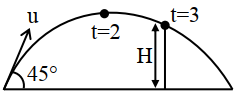
\(\Rightarrow u_y=\frac{40}{2}=20 m / s\)
\(y = u _{ y } \Delta t -\frac{1}{2} g(\Delta t )^2\)
\(\Rightarrow H =20 \times 3-5 \times 9\)
\(=60-45\)
\(=15 m\) -
- (A) 5
- (B) 6
- (C) 7
- (D) 8
Show answer and solution
Correct Answer: (D)
The maximum horizontal range of a projectile is given by \(R_{\text{max}} = \dfrac{u^2}{g}\).
Given \(R_{\text{max}} = 6.4\) m and \(g = 10\) m/s\(^2\).
Substituting the values:
\(6.4 = \dfrac{u^2}{10}\)
\(u^2 = 64\)
\(u = 8\) m/s.
Answer: \(8\) -
- (A) \( 40\sqrt{2} \)
- (B) 40
- (C) \( 20\sqrt{3} \)
- (D) \( 20\sqrt{2} \)
Show answer and solution
Correct Answer: (D)
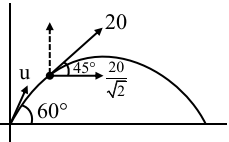
\( u~cos~60^{\circ}=\frac{20}{\sqrt{2}} \)
\( \frac{u}{2}=\frac{20}{\sqrt{2}} \)
\( u=\frac{40}{\sqrt{2}} \)
\(u =20 \sqrt{2}\) m/s -
- (A) 20 s and 100 m
- (B) 40 s and 0 m
- (C) 40 s and 200 m
- (D) 40 s and 100 m
Show answer and solution
Correct Answer: (C)
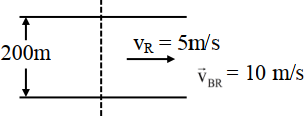
Minimum time :
\(t _{\min }=\frac{200}{10}=20 sec\)
\(t_{\min }=\frac{200}{10}=20 sec\)
For round trip \(=40 sec\).
Displacement along river bank \(=40 \times 5=200 m\) -
- (A) 1 : 2
- (B) 2 : 3
- (C) 1 : 4
- (D) 3 : 4
Show answer and solution
Correct Answer: (D)
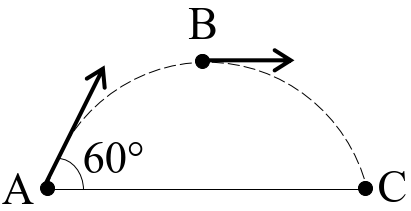
\( (KE)_{A}=K=\frac{1}{2}mu^{2} \)
\(( KE )_{ B }=\frac{ K }{4}=\frac{1}{2} m\left(\frac{ u }{2}\right)^2=\frac{ K }{4}\left( u _{ B }= u \cos 60^{\circ}=\frac{ u }{2}\right)\)
\( (KE)_{C}=K \)
Ratio \(= \frac{K-K/4}{K} \)
\(=\frac{3 K / 4}{K}=\frac{3}{4}\) -
- (A) \(60\)
- (B) \(45\)
- (C) \(30\)
- (D) \(75\)
Show answer and solution
Correct Answer: (B)
The velocity components of the projectile are given by the derivatives of the position coordinates with respect to time.
\(v_x = \dfrac{dx}{dt} = \dfrac{d}{dt}(24t) = 24\)
\(v_y = \dfrac{dy}{dt} = \dfrac{d}{dt}(43.6t - 4.9t^2) = 43.6 - 9.8t\)
At \(t = 2\) s, the velocity components are:
\(v_x = 24\)
\(v_y = 43.6 - 9.8(2) = 43.6 - 19.6 = 24\)
The angle \(\theta\) made by the velocity vector with the horizontal is given by:
\(\tan \theta = \dfrac{v_y}{v_x} = \dfrac{24}{24} = 1\)
\(\theta = 45^{\circ}\)
Answer: \(45\) - 457. The percentage error in the calculated volume of a sphere, if there is \(2\%\) error in its diameter measurement, is __________. 2026 Medium
- (A) \(1\)
- (B) \(2\)
- (C) \(6\)
- (D) \(8\)
Show answer and solution
Correct Answer: (C)
The volume of a sphere in terms of its diameter \(D\) is given by \(V = \dfrac{\pi}{6}D^3\)
Taking the natural logarithm on both sides, we get \(\ln V = \ln\left(\dfrac{\pi}{6}\right) + 3 \ln D\)
Differentiating for small errors, we obtain \(\dfrac{\Delta V}{V} = 3 \dfrac{\Delta D}{D}\)
Multiplying by \(100\) to find the percentage error, \(\dfrac{\Delta V}{V} \times 100 = 3 \left(\dfrac{\Delta D}{D} \times 100\right)\)
Given that the percentage error in the diameter is \(2\%\), we have \(\dfrac{\Delta D}{D} \times 100 = 2\)
Therefore, the percentage error in the volume is \(3 \times 2 = 6\%\)
Answer: \(6\) -
- (A) \(250\)
- (B) \(25\)
- (C) \(500\)
- (D) \(125\)
Show answer and solution
Correct Answer: (A)
For two projectiles to have the same horizontal range \(R\) with the same initial speed \(u\), their angles of projection must be complementary, i.e., \(\theta\) and \(90^\circ - \theta\).
The times of flight for these two angles are given by:
\(t_1 = \dfrac{2u \sin \theta}{g}\)
\(t_2 = \dfrac{2u \cos \theta}{g}\)
Multiplying \(t_1\) and \(t_2\), we get:
\(t_1 t_2 = \left(\dfrac{2u \sin \theta}{g}\right) \left(\dfrac{2u \cos \theta}{g}\right) = \dfrac{2}{g} \left(\dfrac{u^2 (2 \sin \theta \cos \theta)}{g}\right)\)
Since the horizontal range is \(R = \dfrac{u^2 \sin 2\theta}{g}\), we can write:
\(t_1 t_2 = \dfrac{2R}{g}\)
Given \(t_1 = 5\) s, \(t_2 = 10\) s, and \(g = 10\) m/s\(^2\), substituting these values:
\(5 \times 10 = \dfrac{2R}{10}\)
\(50 = \dfrac{2R}{10}\)
\(2R = 500 \Rightarrow R = 250\) m
Answer: \(250\) -
- (A) \(\sqrt{2}\)
- (B) \(\sqrt{3}\)
- (C) \(2\sqrt{3}\)
- (D) \(\dfrac{1}{\sqrt{2}}\)
Show answer and solution
Correct Answer: (B)
The horizontal range of a projectile is given by the formula \(R = \dfrac{u^2 \sin(2\theta)}{g}\).
For the first projectile, the angle of projection is \(\theta_1 = 15^\circ\).
\(R_1 = \dfrac{u^2 \sin(2 \times 15^\circ)}{g} = \dfrac{u^2 \sin(30^\circ)}{g} = \dfrac{u^2}{2g}\)
For the second projectile, the angle of projection is \(\theta_2 = 30^\circ\).
\(R_2 = \dfrac{u^2 \sin(2 \times 30^\circ)}{g} = \dfrac{u^2 \sin(60^\circ)}{g} = \dfrac{\sqrt{3}u^2}{2g}\)
The ratio of their ranges is:
\(\dfrac{R_1}{R_2} = \dfrac{\dfrac{u^2}{2g}}{\dfrac{\sqrt{3}u^2}{2g}} = \dfrac{1}{\sqrt{3}}\)
Given that the ratio is \(1:x\), we get \(x = \sqrt{3}\).
Answer: \(\sqrt{3}\) -
- (A) \(85\)
- (B) \(150\)
- (C) \(129\)
- (D) \(125\)
Show answer and solution
Correct Answer: (D)
When the stone is dropped, it acquires the initial velocity of the balloon. Taking the upward direction as positive, the initial velocity of the stone is \(u = 10\) m/s.
The displacement of the stone when it hits the ground is \(S = -75\) m, and its acceleration is \(a = -g = -10\) m/s\(^2\).
Using the equation of motion \(S = ut + \dfrac{1}{2}at^2\):
\(-75 = 10t - \dfrac{1}{2}(10)t^2\)
\(-75 = 10t - 5t^2\)
\(5t^2 - 10t - 75 = 0\)
\(t^2 - 2t - 15 = 0\)
\((t - 5)(t + 3) = 0\)
Since time cannot be negative, \(t = 5\) s.
During this time, the balloon continues to move upwards with a constant velocity of \(10\) m/s. The distance travelled by the balloon in \(5\) s is:
\(d = v \times t = 10 \times 5 = 50\) m
The total height of the balloon when the stone hits the ground is:
\(H = 75 + 50 = 125\) m
Answer: \(125\) -
- (A) 62.5
- (B) 92.5
- (C) 20
- (D) 82.5
Show answer and solution
Correct Answer: (B)
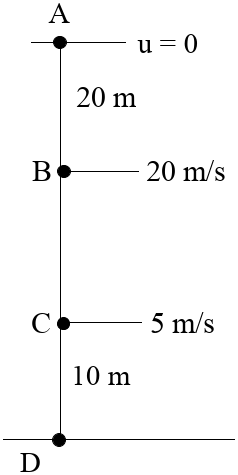
A to B
\(x _1=\frac{1}{2} \times 10 \times 2^2=20 m\)
\(V =0+10 \times 2\)
B to C
\(5^2=20^2-2(3) x_2\)
\(x_2=\frac{375}{6}\)
\(x_2=62.5\)
C to D
\(x _3=10 m\)
\(H=x_1+x_2+x_3=92.5\) -
- (A) A, C, D only
- (B) A, B, C only
- (C) C, E only
- (D) A, C only
Show answer and solution
Correct Answer: (B)
\(x=0\Rightarrow t=0,\frac{\sqrt{3}}{2}\)
\(v=12t^{2}-3\)
At turning point, \(v=0\)
\(t=\frac{1}{2}\Rightarrow x=\frac{4}{8}-\frac{3}{2}=-1\)
\(a=24t\) (always positive) -
- (A) 20
- (B) 13
- (C) 16
- (D) 15
Show answer and solution
Correct Answer: (B)
Let the ball fall a distance \(s\) from the initial height.
Initial velocity \(u = 0\)
Acceleration \(a = g = 10\) m/s\(^2\)
Given that the magnitude of velocity is equal to the magnitude of acceleration due to gravity, we have \(v = 10\) m/s.
Using the equation of motion \(v^2 = u^2 + 2gs\):
\((10)^2 = 0^2 + 2 \times 10 \times s\)
\(100 = 20s\)
\(s = 5\) m
The distance fallen by the ball is \(5\) m.
The height above the ground is \(h = H - s\)
\(h = 18 - 5 = 13\) m
Answer: \(13\) -
- (A) \(\sqrt{6}\)
- (B) \(9\)
- (C) \(\sqrt{33}\)
- (D) \(0\)
Show answer and solution
Correct Answer: (B)
The velocity vector is given by \(\vec{v} = v_x \hat{i} + v_y \hat{j} + v_z \hat{k} = -x \hat{i} + 2y \hat{j} - z \hat{k}\).
The components of acceleration are:
\(a_x = v_x \dfrac{\partial v_x}{\partial x} + v_y \dfrac{\partial v_x}{\partial y} + v_z \dfrac{\partial v_x}{\partial z} = (-x)(-1) + 0 + 0 = x\)
\(a_y = v_x \dfrac{\partial v_y}{\partial x} + v_y \dfrac{\partial v_y}{\partial y} + v_z \dfrac{\partial v_y}{\partial z} = 0 + (2y)(2) + 0 = 4y\)
\(a_z = v_x \dfrac{\partial v_z}{\partial x} + v_y \dfrac{\partial v_z}{\partial y} + v_z \dfrac{\partial v_z}{\partial z} = 0 + 0 + (-z)(-1) = z\)
The acceleration vector is \(\vec{a} = x \hat{i} + 4y \hat{j} + z \hat{k}\).
At the point \((1, 2, 4)\), substituting \(x = 1\), \(y = 2\), and \(z = 4\):
\(\vec{a} = 1 \hat{i} + 4(2) \hat{j} + 4 \hat{k} = \hat{i} + 8 \hat{j} + 4 \hat{k}\)
The magnitude of acceleration is:
\(|\vec{a}| = \sqrt{1^2 + 8^2 + 4^2} = \sqrt{1 + 64 + 16} = \sqrt{81} = 9\) m/s\(^2\)
Answer: \(9\) -
- (A) \(25\text{ m}\) and zero
- (B) \(50\text{ m}\) and zero
- (C) \(100\text{ m}\) and zero
- (D) \(100\text{ m}\) and \(2.5\text{ m/s}\)
Show answer and solution
Correct Answer: (C)
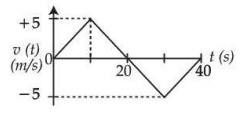
The total distance travelled by the particle is equal to the sum of the magnitudes of the areas under the velocity-time graph.
Area of the first triangle (from \(t = 0\) to \(t = 20\text{ s}\)) is:
\(A_1 = \dfrac{1}{2} \times 20 \times 5 = 50\text{ m}\)
Magnitude of the area of the second triangle (from \(t = 20\) to \(t = 40\text{ s}\)) is:
\(|A_2| = \left| \dfrac{1}{2} \times 20 \times (-5) \right| = 50\text{ m}\)
Total distance \(= A_1 + |A_2| = 50 + 50 = 100\text{ m}\)
The total displacement is the algebraic sum of the areas under the velocity-time graph.
Total displacement \(= A_1 + A_2 = 50 - 50 = 0\text{ m}\)
Average velocity is the ratio of total displacement to total time.
Average velocity \(= \dfrac{\text{Total displacement}}{\text{Total time}} = \dfrac{0}{40} = 0\)
Answer: \(100\text{ m}\) and zero -
- (A) \(18\)
- (B) \(28\)
- (C) \(38\)
- (D) \(48\)
Show answer and solution
Correct Answer: (C)
Velocity of car A, \(v_A = 100\) km/h
Velocity of car B, \(v_B = 80\) km/h
Velocity of the stone relative to car B is \(v\). The velocity of the stone relative to the ground is \(v_S = v_B + v = 80 + v\).
The velocity of the stone relative to car A is \(v_{S/A} = v_S - v_A = (80 + v) - 100 = v - 20\).
The stone hits car A with a relative speed of \(5\) m/s. Converting this speed to km/h:
\(v_{S/A} = 5 \times \dfrac{18}{5} = 18\) km/h
Equating the relative speeds:
\(v - 20 = 18 \Rightarrow v = 38\) km/h
Answer: \(38\) -
- (A) 10
- (B) 8
- (C) 9
- (D) 12
Show answer and solution
Correct Answer: (C)
The distance traversed in the \(n^{\text{th}}\) second is given by \(S_n = u + \dfrac{a}{2}(2n - 1)\).
For the first mass (\(m_1 = 3.4\) kg, \(u_1 = 5\) m/s):
\(104 = 5 + \dfrac{a_1}{2}(2 \times 5 - 1)\)
\(99 = \dfrac{9a_1}{2} \Rightarrow a_1 = 22\) m/s\(^2\)
For the second mass (\(m_2 = 2.5\) kg, \(u_2 = 12\) m/s):
\(129 = 12 + \dfrac{a_2}{2}(2 \times 5 - 1)\)
\(117 = \dfrac{9a_2}{2} \Rightarrow a_2 = 26\) m/s\(^2\)
Velocities of the masses after \(10\) s:
\(v_1 = u_1 + a_1 t = 5 + 22 \times 10 = 225\) m/s
\(v_2 = u_2 + a_2 t = 12 + 26 \times 10 = 272\) m/s
Momenta of the masses after \(10\) s:
\(p_1 = m_1 v_1 = 3.4 \times 225 = 765\) kg m/s
\(p_2 = m_2 v_2 = 2.5 \times 272 = 680\) kg m/s
Ratio of their momenta:
\(\dfrac{p_1}{p_2} = \dfrac{765}{680} = \dfrac{9}{8}\)
Comparing with \(\dfrac{x}{8}\), we get \(x = 9\).
Answer: \(9\) -
- (A) 2.5
- (B) 4
- (C) 4.2
- (D) 3.8
Show answer and solution
Correct Answer: (C)
Time to reach ground \(= \sqrt{\frac{2h}{g}} = \sqrt{\frac{2 \times 5}{10}} = 1 sec\)
Five drops per second
Time between each drop \(= 0.2\ sec.\)
Time of fall for \(4^th\) drop is \(1 - 0.6 = 0.4\ sec\)
Height fall of \(4^th\) drop is \(= \frac{1}{2} \times 10 \times 0.4^{2} = 0.8 m\)
Height from ground \(= 5 - 0.8 = 4.2\ m\) -
- (A) \( 89^{\circ}C \) and \( 73^{\circ}C \) respectively
- (B) \( 80^{\circ}C \) and \( 60^{\circ}C \) respectively
- (C) \( 80^{\circ}C \) and \( 70^{\circ}C \) respectively
- (D) \( 60^{\circ}C \) and \( 45^{\circ}C \) respectively
Show answer and solution
Correct Answer: (A)
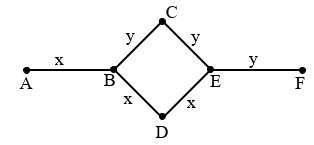
Let \(\left[ R =\frac{\ell}{3 KA }\right]\)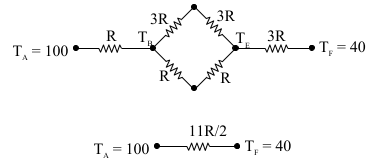
\(\left[ H =\frac{100-40}{\frac{11 R }{2}}\right]\) \(\quad\) ... (1)
\(H=\frac{100-T_B}{R}\)\(\quad\) ... (2)
\(H =\frac{ T _{ E }-40}{3 R }\)\(\quad\) ... (3)
using (1) and (2)
\(120=1100-11 T_{ A }\)
\(T _{ B }=89^{\circ} C\)
using (1) and (3)
\(T _{ E }=73^{\circ} C\)
No questions on this page match these filters.