


Questions
18 questionsShowing 1–18 of 18 questions
-
- (A) 24
- (B) 15
- (C) 21
- (D) 28
Show answer and solution
Correct Answer: (C)
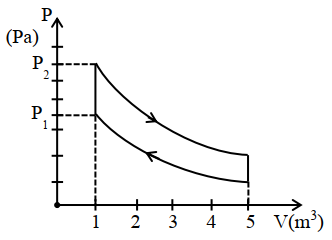
\(\Delta Q=nC_{v}\Delta T\) (isochoric)
\(=\frac{C_{v}}{R}\cdot nR\Delta T=\frac{C_{v}}{R}(P_{2}-P_{1})V\)
\(=\frac{21}{8.3}\times(30-21.7)\times1=21J\) -
- (A) 250
- (B) 700
- (C) 500
- (D) 100
Show answer and solution
Correct Answer: (C)
\(\Delta U = nC _{ v } \Delta T\)
\(=n\left(C_P-R\right) \Delta T\)
\(=10(7-2)(40-30)\)
\(\Delta U =500\) -
- (A) 989
- (B) 1089
- (C) 889
- (D) 789
Show answer and solution
Correct Answer: (A)
For an isothermal process, the isothermal bulk modulus equals the gas pressure:
\(B_T = -V\dfrac{dP}{dV}\)
Since \(PV = \text{constant}\), differentiating gives \(P\,dV + V\,dP = 0\), so \(\dfrac{dP}{dV} = -\dfrac{P}{V}\), which yields \(B_T = P\).
Therefore, the initial pressure is:
\(P_o = 3 \times 10^5\text{ N/m}^2\)
Volumes:
\(V_o = 3\text{ L} = 3 \times 10^{-3}\text{ m}^3\)
\(V_f = \dfrac{1}{3}V_o = 10^{-3}\text{ m}^3\)
Work done on the gas during an isothermal compression:
\(W_{\text{on}} = -W_{\text{by}} = -P_o V_o \ln\left(\dfrac{V_f}{V_o}\right) = P_o V_o \ln\left(\dfrac{V_o}{V_f}\right)\)
\(W_{\text{on}} = (3 \times 10^5)(3 \times 10^{-3})\ln 3\)
\(W_{\text{on}} = 900 \ln 3\text{ J}\)
Using \(\ln 3 \approx 1.0986\):
\(W_{\text{on}} \approx 900 \times 1.0986 \approx 988.74\text{ J}\)
Rounded to the nearest integer:
\(W_{\text{on}} \approx 989\text{ J}\)
Hence, the work done on the gas is approximately \(989\text{ J}\). -
- (A) \(3\)
- (B) \(4\)
- (C) \(14\)
- (D) \(9\)
Show answer and solution
Correct Answer: (B)
The right compartment is enclosed by adiabatic walls and an adiabatic piston, and no heat is supplied to it. Therefore, the gas in the right compartment undergoes an adiabatic compression.
Since the piston is frictionless, the pressure in the right compartment is always equal to the pressure in the left compartment. The final pressure in both compartments is \(P_f = \dfrac{27P}{8}\).
For the adiabatic process in the right compartment, the equation is:
\(P_i V_i^\gamma = P_f V_f^\gamma\)
Given \(P_i = P\), \(V_i = 9\) L, \(P_f = \dfrac{27P}{8}\), and \(\gamma = \dfrac{C_P}{C_V} = 1.5 = \dfrac{3}{2}\). Substituting these values:
\(P(9)^{3/2} = \left(\dfrac{27P}{8}\right) V_f^{3/2}\)
Since \(9^{3/2} = (3^2)^{3/2} = 3^3 = 27\), the equation becomes:
\(27P = \dfrac{27P}{8} V_f^{3/2}\)
Dividing both sides by \(27P\):
\(1 = \dfrac{1}{8} V_f^{3/2}\)
\(V_f^{3/2} = 8\)
Taking the power of \(2/3\) on both sides:
\(V_f = (8)^{2/3} = (2^3)^{2/3} = 2^2 = 4\) litres.
Answer: \(4\) -
- (A) 250
- (B) 350
- (C) 450
- (D) 100
Show answer and solution
Correct Answer: (B)
\(w =100 J= nR \Delta T\) for isobaric process.
\(Q = nC _{ p } \Delta T =\left(\frac{ f }{2}+1\right) nR \Delta T\)
\(=\frac{7}{2} \cdot(100)=350\) Joule -
- (A) 300
- (B) 600
- (C) 150
- (D) 450
Show answer and solution
Correct Answer: (A)
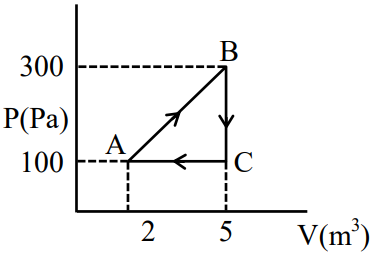
Work done = Area bounded by cycle
\(=\frac{1}{2}\times3\times200=300~J\) -
- (A) 40
- (B) 60
- (C) 80
- (D) 120
Show answer and solution
Correct Answer: (D)
Given \(P_1 = 8\) bar \(= 8 \times 10^5\) Pa, \(V_1 = 0.15\) m\(^3\), and \(P_2 = 1\) bar \(= 10^5\) Pa.
The adiabatic index \(\gamma\) is given by:
\(\gamma = \dfrac{c_p}{c_v} = \dfrac{3R}{2R} = 1.5\)
For an adiabatic process, \(P_1 V_1^\gamma = P_2 V_2^\gamma\).
\(V_2 = V_1 \left( \dfrac{P_1}{P_2} \right)^{\dfrac{1}{\gamma}}\)
\(V_2 = 0.15 \times \left( \dfrac{8}{1} \right)^{\dfrac{1}{1.5}} = 0.15 \times 8^{\dfrac{2}{3}} = 0.15 \times 4 = 0.6\) m\(^3\)
The work done during the adiabatic expansion is:
\(W = \dfrac{P_1 V_1 - P_2 V_2}{\gamma - 1}\)
\(W = \dfrac{8 \times 10^5 \times 0.15 - 1 \times 10^5 \times 0.6}{1.5 - 1}\)
\(W = \dfrac{1.2 \times 10^5 - 0.6 \times 10^5}{0.5}\)
\(W = \dfrac{0.6 \times 10^5}{0.5} = 1.2 \times 10^5\) J
\(W = 120\) kJ
Answer: \(120\) -
- (A) \(\dfrac{9P_o V_o}{8R}\)
- (B) \(\dfrac{11P_o V_o}{10R}\)
- (C) \(\dfrac{7P_o V_o}{6R}\)
- (D) \(\dfrac{13P_o V_o}{11R}\)
Show answer and solution
Correct Answer: (B)
The given relation between pressure and volume is:
\(P = P_o\left(1 + \left(\dfrac{V_o}{V}\right)^2\right)^{-1}\)
For sample A, the initial volume is \(V_A = V_o\). Substituting this into the given relation, the initial pressure \(P_A\) is:
\(P_A = P_o\left(1 + \left(\dfrac{V_o}{V_o}\right)^2\right)^{-1} = \dfrac{P_o}{2}\)
Using the ideal gas equation \(PV = nRT\) for \(n = 2\) moles, the initial temperature \(T_A\) is:
\(T_A = \dfrac{P_A V_A}{nR} = \dfrac{\left(\dfrac{P_o}{2}\right) V_o}{2R} = \dfrac{P_o V_o}{4R}\)
For sample B, the initial volume is \(V_B = 3V_o\). Substituting this into the relation, the initial pressure \(P_B\) is:
\(P_B = P_o\left(1 + \left(\dfrac{V_o}{3V_o}\right)^2\right)^{-1} = P_o\left(1 + \dfrac{1}{9}\right)^{-1} = \dfrac{9P_o}{10}\)
The initial temperature \(T_B\) for \(n = 2\) moles is:
\(T_B = \dfrac{P_B V_B}{nR} = \dfrac{\left(\dfrac{9P_o}{10}\right) (3V_o)}{2R} = \dfrac{27P_o V_o}{20R}\)
The difference in the initial temperatures of the two samples is:
\(T_B - T_A = \dfrac{27P_o V_o}{20R} - \dfrac{P_o V_o}{4R}\)
\(T_B - T_A = \dfrac{27P_o V_o - 5P_o V_o}{20R} = \dfrac{22P_o V_o}{20R} = \dfrac{11P_o V_o}{10R}\)
Answer: \(\dfrac{11P_o V_o}{10R}\) -
- (A) C, D and E Only
- (B) A, B and C Only
- (C) A, B and D Only
- (D) B, C and D Only
Show answer and solution
Correct Answer: (C)
Statement A is correct because the zeroth law of thermodynamics defines temperature and thermal equilibrium.
Statement B is correct because the first law of thermodynamics introduces the concept of internal energy through the equation \(\Delta Q = \Delta U + \Delta W\).
Statement C is incorrect because for an isothermal expansion of an ideal gas, the change in internal energy \(\Delta U = 0\). According to the first law of thermodynamics, \(\Delta Q = \Delta W\).
Statement D is correct because if an intensive variable (which is independent of the size of the system) is multiplied by an extensive variable (which is directly proportional to the size of the system), the product will be directly proportional to the size of the system, making it an extensive variable.
Statement E is incorrect because the ratio of two extensive variables (like any extensive variable and mass) is independent of the size of the system, making it an intensive variable.
Therefore, only statements A, B, and D are correct.
Answer: A, B and D Only -
- (A) 315826.2
- (B) 234699.2
- (C) 258700.8
- (D) 268799.2
Show answer and solution
Correct Answer: (D)
\( Q=mS\Delta T=4\times4200\times16~J=268800~J \)
\( W=P\Delta V \)
\( \Delta V=(\frac{m}{\rho_{f}}-\frac{m}{\rho_{i}})=4[\frac{1}{998}-\frac{1}{1000}] \)
\( P=10^{5}Pa. \)
.. \( W=10^{5}\times4\times[\frac{1}{998}-\frac{1}{1000}]=\frac{8\times10^{5}}{10^{3}\times998}\approx0.8~J \)
\( \Delta U=Q-W=268799.2~J \) -
- (A) Both A and R are true and R is the correct explanation of A
- (B) Both A and R are true but R is NOT the correct explanation of A
- (C) A is true but R is false
- (D) A is false but R is true
Show answer and solution
Correct Answer: (B)
Statement I is true because for an ideal gas, the change in internal energy is given by \(\Delta U = n C_v \Delta T\). Using Mayer's relation \(C_p - C_v = R\) and the ratio of specific heats \(\gamma = \dfrac{C_p}{C_v}\), we can write \(C_v = \dfrac{R}{\gamma - 1}\). Substituting this, we get \(\Delta U = \dfrac{nR}{\gamma - 1}(T_f - T_i)\).
Statement II is true because according to the law of equipartition of energy, the molar heat capacity at constant volume is \(C_v = \dfrac{f}{2}R\) and at constant pressure is \(C_p = \left(\dfrac{f}{2} + 1\right)R\). Therefore, \(\gamma = \dfrac{C_p}{C_v} = 1 + \dfrac{2}{f}\).
Statement II does not explain Statement I, as Statement I is derived purely from macroscopic thermodynamic relations (Mayer's relation) and is independent of the microscopic concept of degrees of freedom.
Hence, both statements are true but Statement II is NOT the correct explanation of Statement I.
Answer: Both A and R are true but R is NOT the correct explanation of A - 12. Heat is supplied to a diatomic gas at constant pressure. Then the ratio of \(\Delta Q : \Delta U : \Delta W\) is _______. 2026 Medium
- (A) \(2 : 3 : 5\)
- (B) \(5 : 3 : 2\)
- (C) \(2 : 5 : 7\)
- (D) \(7 : 5 : 2\)
Show answer and solution
Correct Answer: (D)
For a diatomic gas, the number of degrees of freedom is \(f = 5\).
The molar heat capacity at constant volume is \(C_v = \dfrac{f}{2}R = \dfrac{5}{2}R\).
The molar heat capacity at constant pressure is \(C_p = C_v + R = \dfrac{7}{2}R\).
At constant pressure, the heat supplied is \(\Delta Q = nC_p\Delta T = n\left(\dfrac{7}{2}R\right)\Delta T\).
The change in internal energy is \(\Delta U = nC_v\Delta T = n\left(\dfrac{5}{2}R\right)\Delta T\).
The work done by the gas is \(\Delta W = nR\Delta T = n\left(\dfrac{2}{2}R\right)\Delta T\).
The ratio \(\Delta Q : \Delta U : \Delta W\) is \(\dfrac{7}{2} : \dfrac{5}{2} : \dfrac{2}{2} = 7 : 5 : 2\).
Answer: \(7 : 5 : 2\) -
- (A) \(-\frac{1}{a}\)
- (B) \(+\frac{1}{3a}\)
- (C) \(\frac{1}{2a}\)
- (D) \(-\frac{1}{3a}\)
Show answer and solution
Correct Answer: (D)
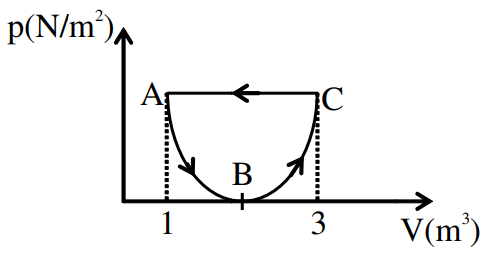
\(w =\) Area of parabola
\(=\frac{2}{3}(\) Area of rectangle AC 31 A\()\)
\(=\frac{2}{3} P _0(3-1)=\frac{4 P _0}{3}\)
When \(V =1\)
\((1-2)^2=4 aP _0\)
\(P _0=\frac{1}{4 a }\)
\(w =\frac{4}{3} P _0=\frac{4}{3} \frac{1}{4 a }=\frac{1}{3 a }\)
\(w _{ gas }=\frac{-1}{3 a }\) -
- (A) \(-2PV(3\sqrt{3}-1)\)
- (B) \(\dfrac{4}{3}PV\)
- (C) \(-\dfrac{4}{3}PV\)
- (D) \(\dfrac{3}{4}PV\)
Show answer and solution
Correct Answer: (C)
For a monoatomic ideal gas, the ratio of specific heats is \(\gamma = \dfrac{5}{3}\).
In an adiabatic process, \(PV^{\gamma} = \text{constant}\).
\(P_1 V_1^{\gamma} = P_2 V_2^{\gamma}\)
\(P V^{5/3} = P_2 (27V)^{5/3}\)
\(P_2 = P \left(\dfrac{1}{27}\right)^{5/3} = \dfrac{P}{243}\)
The change in internal energy is given by:
\(\Delta U = \dfrac{P_2 V_2 - P_1 V_1}{\gamma - 1}\)
Substituting the values:
\(\Delta U = \dfrac{\left(\dfrac{P}{243}\right)(27V) - PV}{\dfrac{5}{3} - 1}\)
\(\Delta U = \dfrac{\dfrac{PV}{9} - PV}{\dfrac{2}{3}}\)
\(\Delta U = \dfrac{-\dfrac{8}{9}PV}{\dfrac{2}{3}} = -\dfrac{4}{3}PV\)
Answer: \(-\dfrac{4}{3}PV\) -
- (A) \(-189\)
- (B) \(-56\)
- (C) \(-30\)
- (D) \(-117\)
Show answer and solution
Correct Answer: (B)
For Isothermal process
\(W _{\text {isothermal }}= nRT \ell n \left(\frac{ V _2}{V_1}\right)\)
\(=1 . R 300 . \ell n (2)\)
\(=300 R(0.693)\)............(1)
Now for adiabatic process,
It is given work done in Isothermal = work done in adiabatic
\(W_{\text {adiabatic }}=\frac{nR\left(T_1-T_2\right)}{\gamma-1}\)............(2)
\((1)=(2)\)
\(\frac{ nR \left(300- T _{\text {final }}\right)}{1.4-1}=300 R (0.693)\)
\(T _{\text {Final }}=216.84 K\)
\(=-56^{\circ} C\) -
- (A) \(24.8\)
- (B) \(25\)
- (C) \(15.04\)
- (D) \(29.98\)
Show answer and solution
Correct Answer: (B)
Using the first law of thermodynamics:
\(Q = \Delta U + W\)
Since the gas is diatomic with rotational modes only, the degrees of freedom are \(f = 5\), so:
\(C_V = \dfrac{5}{2}R\)
For \(n = 1\text{ mole}\) and \(\Delta T = 1.2\text{ K}\):
\(\Delta U = nC_V\Delta T = 1 \times \dfrac{5}{2} \times 8.3 \times 1.2 = 24.9\text{ J}\)
Work done by the gas:
\(W = P\,\Delta V\)
Cross-sectional area of the piston:
\(A = 4\text{ cm}^2 = 4 \times 10^{-4}\text{ m}^2\)
Piston displacement:
\(x = 25\text{ mm} = 2.5 \times 10^{-2}\text{ m}\)
Change in volume:
\(\Delta V = A \cdot x = (4 \times 10^{-4})(2.5 \times 10^{-2}) = 1 \times 10^{-5}\text{ m}^3\)
With \(P = 100\text{ kPa} = 10^5\text{ Pa}\):
\(W = (10^5)(1 \times 10^{-5}) = 1\text{ J}\)
Therefore, the heat supplied is:
\(Q = \Delta U + W = 24.9 + 1 = 25.9\text{ J}\)
Hence, the heat supplied to the gas is \(25.9\text{ J}\). -
- (A) 14.5
- (B) 1.55
- (C) 15.5
- (D) 1.45
Show answer and solution
Correct Answer: (C)
\(\Delta U=3nR\Delta T\)
\(\Delta U=3\times1\times\frac{25}{3}\times4=100~Joule\)
\(\Delta Q=126\)
\(W=26=P\Delta V\)
\(26=10^{3}\times17\times10^{-4}\Delta x\)
\(\Delta x=\frac{26}{170}=15.3\) -
- (A) \( CO_{2} \)
- (B) \( O_{2} \)
- (C) \( NH_{3} \)
- (D) He
Show answer and solution
Correct Answer: (D)
\( PV^{\gamma}=constant \)
\( TV^{\gamma-1}=(\frac{T}{4})(8V)^{(\gamma-1)} \)
\( 4=8^{(\gamma-1)} \)
\( 2^{2}=2^{3\gamma-3} \)
\( 2=3(\gamma-1) \)
\( \gamma=\frac{5}{3} \)
Gas is a monoatomic gas.
Answer is He.
No questions on this page match these filters.