


Questions
13 questionsShowing 1–13 of 13 questions
-
- (A) 7.3
- (B) 4.3
- (C) 6.3
- (D) 5.3
Show answer and solution
Correct Answer: (D)
\(Mg=F_{b}\)
\(dAHg=\rho Ahg\)
\(600\times8~cm=900\times h\)
\(h=\frac{16}{3}cm\)
\(h=5.3cm\) -
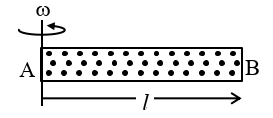
- (A) \( P_{B}=P_{A}exp(M\omega^{2}l^{2}/2RT) \)
- (B) \( P_{B}=P_{A} \)
- (C) \( P_{B}=P_{A}exp(M\omega^{2}l^{2}/3RT) \)
- (D) \( P_{B}=P_{A}exp(M\omega^{2}l^{2}/RT) \)
Show answer and solution
Correct Answer: (A)
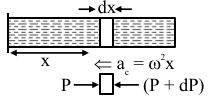
\(A[(P+d P)-P]=(d m)\left(\omega^2 x\right)\)
\(dP =\frac{( dm )}{ A } \omega^2 x\)
\(dP =\frac{(\rho)( A )( dx ) \omega^2 x }{ A }\)
also \([ PM =\rho RT ]\)
\(dP =\left(\frac{ PM }{ RT }\right) \omega^2 x dx\)
\(\int_{P_A}^{P_B} \frac{d P}{P}=\frac{\omega^2 M}{R T} \int_0^{\ell} x d x\)
\(\ell n\left(\frac{P_B}{P_A}\right)=\frac{\omega^2 \ell^2 M }{2 RT }\)
\(P_B=P_A e^{\frac{M \omega^2 \ell^2}{2 R T}}\) -
- (A) \(120\sqrt{2}\)
- (B) \(140\sqrt{2}\)
- (C) \(140\sqrt{3}\)
- (D) \(120\sqrt{3}\)
Show answer and solution
Correct Answer: (B)
Volume of the cylindrical vessel, \(V = 528\) dm\(^3 = 528000\) cm\(^3\)
Radius of the vessel, \(r = 40\) cm
Let the height of the vessel be \(H\).
\(V = \pi r^2 H\)
\(528000 = \dfrac{22}{7} \times (40)^2 \times H\)
\(H = \dfrac{528000 \times 7}{22 \times 1600} = 105\) cm
The vessel is placed on a block of height equal to the vessel, so the height of the block is \(105\) cm.
Depth of the hole from the top water level, \(h = 70\) cm
Height of the hole from the ground, \(y = \text{Height of block} + (H - h)\)
\(y = 105 + (105 - 70) = 140\) cm
Velocity of efflux, \(v = \sqrt{2gh}\)
Time of flight of water, \(t = \sqrt{\dfrac{2y}{g}}\)
Horizontal range, \(R = v \times t = \sqrt{2gh} \times \sqrt{\dfrac{2y}{g}} = 2\sqrt{hy}\)
\(R = 2\sqrt{70 \times 140} = 2\sqrt{70 \times 70 \times 2} = 140\sqrt{2}\) cm
Answer: \(140\sqrt{2}\) -
- (A) \(18\)
- (B) \(144\)
- (C) \(36\)
- (D) \(72\)
Show answer and solution
Correct Answer: (D)
Using the equation of continuity:
\(A_A v_A = A_B v_B\)
\((1.0 \times 10^{-4}) \times 0.1 = (20 \times 10^{-6}) \times v_B\)
\(v_B = \dfrac{10^{-5}}{2 \times 10^{-5}} = 0.5\) m/s
Using Bernoulli's equation for a horizontal tube:
\(P_A + \dfrac{1}{2} \rho v_A^2 = P_B + \dfrac{1}{2} \rho v_B^2\)
\(P_A - P_B = \dfrac{1}{2} \rho (v_B^2 - v_A^2)\)
Substituting the given values:
\(P_A - P_B = \dfrac{1}{2} \times 600 \times (0.5^2 - 0.1^2)\)
\(P_A - P_B = 300 \times (0.25 - 0.01)\)
\(P_A - P_B = 300 \times 0.24 = 72\) Pa
Answer: \(72\) -
- (A) 2.0
- (B) 1.0
- (C) 3.0
- (D) 1.5
Show answer and solution
Correct Answer: (A)
\(V _{ T }=\frac{2 r ^2 g}{9 \eta}\left(\rho_{ b }-\rho_{\ell}\right)\)
\(V _{ T }=\frac{2}{9} \frac{(.1)^2 \times 10}{(10)}(10.5-1.5)\)
\(V _{ T }=2 cm / sec\). -
- (A) \(2 \frac{\Delta r }{ r }-\frac{\Delta v _0}{ v _0}\)
- (B) \(\frac{2 \Delta r }{ r }+\frac{\Delta v _0}{ v _0}\)
- (C) \(2\left[\frac{\Delta r }{ r }+\frac{\Delta v _0}{ v _0}\right]\)
- (D) \(2\left[\frac{\Delta r }{ r }-\frac{\Delta v _0}{ v _0}\right]\)
Show answer and solution
Correct Answer: (B)
\(v _0=\frac{2}{9} \frac{ r ^2 g}{ n }\left(\rho_{ B }-\rho_{ L }\right)\)
\(n =\frac{2}{9} \frac{ r ^2 g}{ v _0}\left(\rho_{ B }-\rho_{ L }\right)\)
\(\frac{\Delta n }{ Il }=\frac{2 \Delta r }{ r }+\frac{\Delta v _0}{ v _0}\) -
- (A) \(4\)
- (B) \(0.25\)
- (C) \(32\)
- (D) \(16\)
Show answer and solution
Correct Answer: (D)
The terminal velocity of a spherical drop of radius \(r\) falling through a viscous medium is given by Stokes' law:
\(v = \dfrac{2}{9} \dfrac{r^2 (\rho - \sigma) g}{\eta}\)
From this relation, the terminal velocity is directly proportional to the square of the radius of the drop:
\(v \propto r^2\)
When the large drop of radius \(R\) is broken into \(64\) identical droplets of radius \(r\), the total volume remains conserved:
\(\dfrac{4}{3} \pi R^3 = 64 \times \dfrac{4}{3} \pi r^3\)
\(R^3 = 64 r^3\)
\(R = 4r\)
The ratio of the terminal velocities of the original drop and the smaller droplet is:
\(\dfrac{v_1}{v_2} = \dfrac{R^2}{r^2}\)
Substituting \(R = 4r\):
\(\dfrac{v_1}{v_2} = \dfrac{(4r)^2}{r^2} = 16\)
Answer: \(16\) -
- (A) 385
- (B) 386
- (C) 387
- (D) 388
Show answer and solution
Correct Answer: (C)
Let \(A\) be the base area of the wooden cube.
\(A = 10 \text{ cm} \times 10 \text{ cm} = 100 \text{ cm}^2\)
Let \(\Delta x\) be the increase in the submerged depth of the cube when the coin is placed on it.
\(\Delta x = 3.87 \text{ cm}\)
The additional volume of water displaced due to the weight of the metal coin is \(\Delta V = A \times \Delta x\).
\(\Delta V = 100 \times 3.87 = 387 \text{ cm}^3\)
By Archimedes' principle, the weight of the metal coin is balanced by the additional buoyant force, which is equal to the weight of the additional water displaced.
\(m g = \Delta V \rho_w g\)
\(m = \Delta V \rho_w\)
Substituting the values of \(\Delta V\) and the density of water \(\rho_w = 1 \text{ g/cm}^3\):
\(m = 387 \text{ cm}^3 \times 1 \text{ g/cm}^3 = 387 \text{ g}\)
Answer: \(387\) -
- (A) \(100\) m/s
- (B) \(10\) m/s
- (C) \(1000\) m/s
- (D) \(15 \times 10^2\) m/s
Show answer and solution
Correct Answer: (B)
From the equation of continuity:
\(A_1 v_1 = n A_2 v_2\)
Here,
\(A_1 = 30 \text{ cm}^2 = 30 \times 10^{-4} \text{ m}^2\)
\(v_1 = 50 \text{ cm/s} = 0.5 \text{ m/s}\)
\(n = 10\)
\(A_2 = 15 \text{ mm}^2 = 15 \times 10^{-6} \text{ m}^2\)
Substituting the given values:
\((30 \times 10^{-4}) \times 0.5 = 10 \times (15 \times 10^{-6}) \times v_2\)
\(15 \times 10^{-4} = 150 \times 10^{-6} \times v_2\)
\(15 \times 10^{-4} = 1.5 \times 10^{-4} \times v_2\)
\(v_2 = \dfrac{15 \times 10^{-4}}{1.5 \times 10^{-4}} = 10 \text{ m/s}\)
Answer: \(10\) m/s -
- (A) \(0.88\)
- (B) \(8.8\)
- (C) \(88.8\)
- (D) \(0.088\)
Show answer and solution
Correct Answer: (B)
The terminal velocity of an air bubble rising in a liquid is given by Stokes' law:
\(v = \dfrac{2}{9} \dfrac{r^2 \rho g}{\eta}\)
Where:
\(r = \dfrac{D}{2} = 1 \text{ mm} = 10^{-3} \text{ m}\)
\(\rho = 2000 \text{ kg/m}^3\)
\(g = 10 \text{ m/s}^2\)
\(v = 0.5 \text{ cm/s} = 5 \times 10^{-3} \text{ m/s}\)
Rearranging the formula for the coefficient of viscosity \(\eta\):
\(\eta = \dfrac{2}{9} \dfrac{r^2 \rho g}{v}\)
Substituting the given values:
\(\eta = \dfrac{2}{9} \times \dfrac{(10^{-3})^2 \times 2000 \times 10}{5 \times 10^{-3}}\)
\(\eta = \dfrac{2}{9} \times \dfrac{10^{-6} \times 20000}{5 \times 10^{-3}}\)
\(\eta = \dfrac{2}{9} \times \dfrac{2 \times 10^{-2}}{5 \times 10^{-3}}\)
\(\eta = \dfrac{2}{9} \times 4 = \dfrac{8}{9} \text{ Pa}\cdot\text{s}\)
To convert the viscosity from SI units (Pa\(\cdot\)s) to CGS units (Poise), we multiply by \(10\):
\(\eta = \dfrac{8}{9} \times 10 = \dfrac{80}{9} \text{ Poise}\)
\(\eta \approx 8.88 \text{ Poise}\)
The closest given option is \(8.8\).
Answer: \(8.8\) -
- (A) 120
- (B) 80
- (C) 160
- (D) 40
Show answer and solution
Correct Answer: (C)
\(V _{ T }=\frac{2 r ^2 g}{9 n }[\sigma-\rho]\)
\(V _{ T } \propto r ^2\)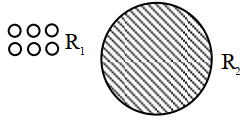
64 drop
\(64\left(\frac{4}{3} \pi R_1^3\right)=\frac{4}{3} \pi R_2^3\)
\(R _2=4 R _1\)
\(\frac{\left( V _{ T }\right)_1}{\left(V_{ T }\right)_2}=\left(\frac{ R _1}{ R _2}\right)^2=\left(\frac{1}{4}\right)^2\)
\(\frac{10}{\left(V_{ T }\right)_2}=\frac{1}{16}\)
\(\left( V _{ T }\right)_2=160 cm / sec\) -
- (A) 10
- (B) 5
- (C) 2.5
- (D) 15
Show answer and solution
Correct Answer: (B)
We know:
Terminal velocity \(\propto(\text { radius })^2\)
\(\frac{\left( v _{ T }\right)_1}{\left( v _{ T }\right)_2}=\left(\frac{6}{3}\right)^2\)
\(\left( v _{ T }\right)_2=\frac{\left( v _{ T }\right)_1}{4}=5 cm / sec\) -
- (A) \( \frac{200}{\sqrt{3}} \)
- (B) \( 200\sqrt{6} \)
- (C) \( 200\sqrt{3} \)
- (D) \( 100\sqrt{3} \)
Show answer and solution
Correct Answer: (C)
From continuity equation
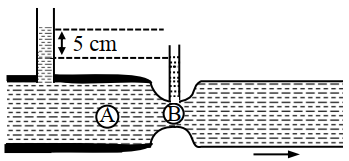
\( A_{A}V_{A} = A_{B}V_{B} \Rightarrow 6V_{A} = 3V_{B} \Rightarrow V_{B} = 2V_{A} \)
Applying Bernoullis equation between A & B,
\( P_{A} + \frac{1}{2}\rho V_{A}^{2} = P_{B} + \frac{1}{2}\rho V_{B}^{2} \)
\( \Rightarrow \rho g \times 0.05 = \frac{1}{2}\rho [V_{B}^{2} - V_{A}^{2}] = \frac{1}{2}\rho (3V_{A}^{2}) \)
\( \Rightarrow V_{A} = \sqrt{\frac{2g \times 0.05}{3}} m/s = \frac{1}{\sqrt{3}} m/s = \frac{100}{\sqrt{3}} cm/s \)
Volume flow rate \( = A_{A}V_{A} = \frac{6 \times 100}{\sqrt{3}} cm^{3}/sec = 200\sqrt{3} cm^{3}/sec \)
No questions on this page match these filters.