


Questions
20 questionsShowing 1–20 of 20 questions
-
- (A) \( 7.5 \times 10^{-2} \)
- (B) \( 5.7 \times 10^{-3} \)
- (C) \( 5.7 \times 10^{-2} \)
- (D) \( 7.5 \times 10^{-3} \)
Show answer and solution
Correct Answer: (D)
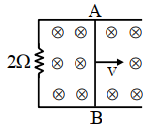
To maintain constant speed
\(F _{ ext }= F _{ B }\)
\(=\left(\frac{ vB l}{ R }\right) l B\)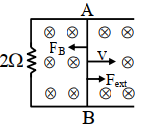
\(=\frac{ B ^2 l^2 v }{ R }\)
\(=\frac{(0.1)^2 \times(1)^2 \times 1.5}{2}\)
\(=7.5 \times 10^{-3} N\) -
- (A) \(0.2 \sqrt{10}\)
- (B) \( 20 \sqrt{10} \)
- (C) \( 2 \sqrt{10} \)
- (D) \( 200 \sqrt{10} \)
Show answer and solution
Correct Answer: (B)
\(\varepsilon= vB \ell\)
\( v=\sqrt{2gh}=\sqrt{2\times10\times200}=20\sqrt{10} \)
\( \varepsilon=(20\sqrt{10})(0.5\times10^{-4})20\)
\(=20 \sqrt{10} \times 10^{-3}=20 \sqrt{10} mV\) -
- (A) \(60\)
- (B) \(12\)
- (C) \(120\)
- (D) \(34\)
Show answer and solution
Correct Answer: (B)
Given:
Length of the solenoid, \(l = 30 \text{ cm} = 0.3 \text{ m}\)
Number of turns per unit length, \(n = 10 \text{ turns/cm} = 1000 \text{ turns/m}\)
Area of cross-section, \(A = 5 \text{ cm}^2 = 5 \times 10^{-4} \text{ m}^2\)
Change in current, \(\Delta I = 4 \text{ A} - 2 \text{ A} = 2 \text{ A}\)
Time interval, \(\Delta t = 3.14 \text{ s}\)
The self-inductance of the solenoid is given by:
\(L = \mu_0 n^2 A l\)
Substituting the given values:
\(L = 4\pi \times 10^{-7} \times (1000)^2 \times 5 \times 10^{-4} \times 0.3\)
\(L = 4\pi \times 10^{-7} \times 10^6 \times 1.5 \times 10^{-4}\)
\(L = 6\pi \times 10^{-5} \text{ H}\)
The magnitude of the induced e.m.f. is:
\(e = L \dfrac{\Delta I}{\Delta t}\)
Substituting the values of \(L\), \(\Delta I\), and \(\Delta t\):
\(e = 6\pi \times 10^{-5} \times \dfrac{2}{3.14}\)
Using \(\pi \approx 3.14\):
\(e = 6 \times 10^{-5} \times 2 = 12 \times 10^{-5} \text{ V}\)
Comparing this with \(e = \alpha \times 10^{-5} \text{ V}\), we get:
\(\alpha = 12\)
Answer: \(12\) -
- (A) 70
- (B) 75
- (C) 80
- (D) 85
Show answer and solution
Correct Answer: (B)
Let the length of the inclined plane be \(s\).
For the smooth inclined plane, the acceleration of the block is \(a_1 = g \sin \theta\).
The time taken is \(t_1 = \dfrac{t}{2}\). Using the second equation of motion \(s = ut + \dfrac{1}{2}at^2\) with \(u = 0\):
\(s = \dfrac{1}{2} (g \sin \theta) \left(\dfrac{t}{2}\right)^2 = \dfrac{1}{8} g \sin \theta t^2\)
For the rough inclined plane, the acceleration of the block is \(a_2 = g(\sin \theta - \mu \cos \theta)\).
The time taken is \(t_2 = t\). Using the equation of motion again:
\(s = \dfrac{1}{2} g(\sin \theta - \mu \cos \theta) t^2\)
Equating the two expressions for \(s\):
\(\dfrac{1}{8} g \sin \theta t^2 = \dfrac{1}{2} g(\sin \theta - \mu \cos \theta) t^2\)
\(\dfrac{1}{4} \sin \theta = \sin \theta - \mu \cos \theta\)
Given \(\theta = 45^{\circ}\), we have \(\sin 45^{\circ} = \cos 45^{\circ} = \dfrac{1}{\sqrt{2}}\). Substituting these values:
\(\dfrac{1}{4} = 1 - \mu\)
\(\mu = 1 - \dfrac{1}{4} = \dfrac{3}{4} = 0.75\)
We are given \(\mu = \dfrac{\alpha}{100}\).
\(\dfrac{\alpha}{100} = 0.75 \Rightarrow \alpha = 75\)
Answer: \(75\) -
- (A) \(2\sqrt{2} \, \dfrac{\mu_0 L^2}{R}\)
- (B) \(\sqrt{2} \, \dfrac{\mu_0 L^2}{R}\)
- (C) \(\sqrt{2} \, \dfrac{\mu_0 R^2}{L}\)
- (D) \(2\sqrt{2} \, \dfrac{\mu_0 R^2}{L}\)
Show answer and solution
Correct Answer: (D)
Using the reciprocity theorem, assume a current \(I\) flows through the larger square loop and compute the flux through the smaller circular loop. The mutual inductance is given by \(M = \dfrac{\Phi}{I}\).
Magnetic field at the centre of the square loop:
For a square of side \(L\), the perpendicular distance from the centre to any side is \(d = \dfrac{L}{2}\), and each side subtends angles \(\theta_1 = \theta_2 = 45^\circ\) at the centre.
The field due to one finite straight segment is:
\(B_{\text{segment}} = \dfrac{\mu_0 I}{4\pi d}(\sin\theta_1 + \sin\theta_2)\)
\(B_{\text{segment}} = \dfrac{\mu_0 I}{4\pi \cdot \frac{L}{2}}\left(\dfrac{1}{\sqrt{2}} + \dfrac{1}{\sqrt{2}}\right) = \dfrac{\mu_0 I}{2\pi L} \cdot \sqrt{2} = \dfrac{\sqrt{2}\,\mu_0 I}{2\pi L}\)
All four sides contribute equally in the same direction at the centre, so:
\(B_{\text{total}} = 4 \cdot \dfrac{\sqrt{2}\,\mu_0 I}{2\pi L} = \dfrac{2\sqrt{2}\,\mu_0 I}{\pi L}\)
Flux through the circular loop:
Since \(L \gg R\), the field \(B_{\text{total}}\) can be treated as uniform over the area \(A = \pi R^2\) of the circular loop.
\(\Phi = B_{\text{total}} \cdot A = \dfrac{2\sqrt{2}\,\mu_0 I}{\pi L} \cdot \pi R^2 = \dfrac{2\sqrt{2}\,\mu_0 R^2 I}{L}\)
Mutual inductance:
\(M = \dfrac{\Phi}{I} = \dfrac{2\sqrt{2}\,\mu_0 R^2}{L}\)
Hence, the correct option is \((4)\ \dfrac{2\sqrt{2}\,\mu_0 R^2}{L}\). -
- (A) 11
- (B) 22
- (C) 33
- (D) 44
Show answer and solution
Correct Answer: (D)
The magnetic flux linked with the circular loop is given by \(\Phi = BA \cos \theta\). Since the plane of the loop is perpendicular to the magnetic field, the angle between the area vector and the magnetic field is \(\theta = 0^{\circ}\).
\(\Phi = B \cdot \pi r^2\)
Given \(r = 20\text{ cm} = 0.2\text{ m}\), the area of the loop is:
\(A = \pi (0.2)^2 = 0.04\pi\text{ m}^2\)
The induced emf in the loop is given by Faraday's law of induction:
\(|E| = \dfrac{d\Phi}{dt} = A \dfrac{dB}{dt}\)
Given the magnetic field \(B = 2t^2 + 2t + 3\), we differentiate it with respect to time \(t\):
\(\dfrac{dB}{dt} = \dfrac{d}{dt}(2t^2 + 2t + 3) = 4t + 2\)
At \(t = 3\text{ s}\), the rate of change of the magnetic field is:
\(\dfrac{dB}{dt} = 4(3) + 2 = 14\text{ T/s}\)
Now, substituting the values into the emf equation:
\(|E| = 0.04\pi \times 14 = 0.56\pi\text{ V}\)
The induced current \(I\) in the loop is:
\(I = \dfrac{|E|}{R} = \dfrac{0.56\pi}{2} = 0.28\pi\text{ A}\)
Using \(\pi = \dfrac{22}{7}\), we get:
\(I = 0.28 \times \dfrac{22}{7} = 0.04 \times 22 = 0.88\text{ A}\)
We are given that the induced current is \(\dfrac{\alpha}{50}\text{ A}\). Equating the two values:
\(\dfrac{\alpha}{50} = 0.88\)
\(\alpha = 0.88 \times 50 = 44\)
Answer: \(44\) -
- (A) 6.6
- (B) 13.2
- (C) 8.25
- (D) 1.32
Show answer and solution
Correct Answer: (D)
induced EMF \(=\frac{ d \phi}{ dt }\)
circumference \(\simeq 14 \pi\)
side length of square loop \(=\frac{14 \pi}{4}=\frac{7 \pi}{2}\)
\(\Delta \phi= B \left( A _1- A _2\right)\)
\(=(.2)\left(\left(\frac{7 \pi}{2}\right) \times \frac{7 \pi}{2}-49 \pi\right) \times 10^{-4}\)
\(=.2\left(\frac{49 \pi^2}{4}-49 \pi\right) \times 10^{-4}\)
\(\Delta \phi=.2 \times 33.07 \times 10^{-4}\)
\(=.2\left(\frac{49 \pi^2}{4}-49 \pi\right) \times 10^{-4}\)
\(\Delta \phi=.2 \times 33.07 \times 10^{-4}\)
\(\Delta \phi=6.614 \times 10^{-4}\)
\(EMF =\frac{6.614 \times 10^{-4}}{\frac{1}{2}} V=13.23 \times 10^{-4} V\)
\(EMF =1.32 mV\) -
- (A) 7
- (B) 14
- (C) 21
- (D) 28
Show answer and solution
Correct Answer: (B)
\(E = B \omega A \sin \omega t\)
\(15.4 \times 10^{-3}=\frac{1}{2} \times 100 \times \frac{22}{7} r ^2 \times \frac{1}{2}\)
\(r =\sqrt{\frac{15.4 \times 28 \times 10^{-5}}{22}}\)
R=14mm -
- (A) \( \frac{\pi}{2} \)
- (B) \( 2\pi \)
- (C) \( \pi \)
- (D) \( \pi^{2} \)
Show answer and solution
Correct Answer: (C)
Area of the loop \(=1 m^2\)
\(B=\sin (100 t)\)
\(\therefore \quad \phi= BA =\sin (100 t )\)
\(\therefore \quad \frac{ d \phi}{ dt }=100 \cos (100 t )\)
\(\therefore \quad P=\frac{V^2}{R}=\frac{10^4 \cos ^2(100 t)}{100}\)
\(\therefore \quad\) Thermal energy dissipated in 1 time period
\(=\int_0^{ T } Pdt =\int_0^{ T } 100 \cos ^2(100 t ) dt\)
\(T =\frac{2 \pi}{100}=\frac{\pi}{50} sec\)
\(\therefore \quad Q=100 \int_0^{\pi / 50} \cos ^2(100 t) d t\)
\(=100 \int_0^{\pi / 50} \frac{1+\cos 200 t}{2} d t\)
\(=100\left[\frac{\pi}{100}\right]=\pi\) -
- (A) \(B_0 \omega \left[\dfrac{1}{\lambda^2} - e^{-\lambda L}\left(\dfrac{1}{\lambda^2} + \dfrac{L}{\lambda}\right)\right]\)
- (B) \(B_0 \omega \left[\dfrac{1}{\lambda^2} + e^{-\lambda L}\left(\dfrac{1}{\lambda^2} + \dfrac{L}{\lambda}\right)\right]\)
- (C) \(B_0 \omega \left[\dfrac{4}{\lambda^2} - e^{-2\lambda L}\left(\dfrac{1}{\lambda^2} + \dfrac{2L}{\lambda}\right)\right]\)
- (D) \(B_0 \omega \left[\dfrac{3}{\lambda^2} - e^{-3\lambda L}\left(\dfrac{3}{\lambda^2} + \dfrac{L}{\lambda}\right)\right]\)
Show answer and solution
Correct Answer: (A)
The motional emf \(dE\) induced in a small element of length \(dr\) at a distance \(r\) from the origin is given by:
\(dE = B(r) v(r) dr\)
Since the rod is rotating with angular velocity \(\omega\), the velocity of the element is \(v(r) = \omega r\).
\(dE = B_0 e^{-\lambda r} (\omega r) dr\)
The total emf induced \(E\) is the integral of \(dE\) from \(r = 0\) to \(r = L\):
\(E = \int_0^L B_0 \omega r e^{-\lambda r} dr\)
\(E = B_0 \omega \int_0^L r e^{-\lambda r} dr\)
Using integration by parts:
\(\int r e^{-\lambda r} dr = r \left( \dfrac{e^{-\lambda r}}{-\lambda} \right) - \int 1 \cdot \left( \dfrac{e^{-\lambda r}}{-\lambda} \right) dr\)
\(= -\dfrac{r}{\lambda} e^{-\lambda r} - \dfrac{1}{\lambda^2} e^{-\lambda r}\)
Evaluating the definite integral from \(0\) to \(L\):
\(\int_0^L r e^{-\lambda r} dr = \left[ -\dfrac{L}{\lambda} e^{-\lambda L} - \dfrac{1}{\lambda^2} e^{-\lambda L} \right] - \left[ 0 - \dfrac{1}{\lambda^2} e^0 \right]\)
\(= \dfrac{1}{\lambda^2} - e^{-\lambda L} \left( \dfrac{1}{\lambda^2} + \dfrac{L}{\lambda} \right)\)
Therefore, the total induced emf is:
\(E = B_0 \omega \left[ \dfrac{1}{\lambda^2} - e^{-\lambda L} \left( \dfrac{1}{\lambda^2} + \dfrac{L}{\lambda} \right) \right]\)
Answer: \(B_0 \omega \left[\dfrac{1}{\lambda^2} - e^{-\lambda L}\left(\dfrac{1}{\lambda^2} + \dfrac{L}{\lambda}\right)\right]\) -
- (A) 50
- (B) 100
- (C) 150
- (D) 200
Show answer and solution
Correct Answer: (B)
\(\varepsilon_{\max }=\frac{B \omega_{\max } \ell^2}{2}\) \(\quad\) ...(1)
Using energy conservation,
\(\operatorname{mg} \ell\left(1-\cos 60^{\circ}\right)=\frac{1}{2}\left(m \ell^2\right) \omega_{ m }^2\)
\(\omega_{ m }=\sqrt{\frac{ g }{\ell}}=10 rad / s\)
From eq.(1),
\(\varepsilon_{\max }=\frac{2 \times 10 \times 0.01}{2}=0.1 V\)
\(=100 mV\) -
- (A) \(12\)
- (B) \(18\)
- (C) \(21\)
- (D) \(24\)
Show answer and solution
Correct Answer: (D)
Given:
Side of the square loop, \(a = 2\) cm \(= 2 \times 10^{-2}\) m
Area of the loop, \(A = a^2 = 4 \times 10^{-4}\) m\(^2\)
Magnetic field, \(B = 0.4 \sin(300t)\) T
Angle between the normal to the plane and the magnetic field, \(\theta = 60^\circ\)
The magnetic flux through the loop is given by:
\(\Phi = \vec{B} \cdot \vec{A} = B A \cos\theta\)
\(\Phi = (0.4 \sin(300t))(4 \times 10^{-4}) \cos(60^\circ)\)
\(\Phi = 1.6 \times 10^{-4} \sin(300t) \times \dfrac{1}{2}\)
\(\Phi = 0.8 \times 10^{-4} \sin(300t)\) Wb
By Faraday's law of induction, the induced emf is:
\(e = -\dfrac{d\Phi}{dt}\)
\(e = -\dfrac{d}{dt} (0.8 \times 10^{-4} \sin(300t))\)
\(e = -0.8 \times 10^{-4} \times 300 \cos(300t)\)
\(e = -240 \times 10^{-4} \cos(300t)\) V
\(e = -24 \times 10^{-3} \cos(300t)\) V
The maximum induced emf is the amplitude of \(e\):
\(e_{\text{max}} = 24 \times 10^{-3}\) V \(= 24\) mV
Answer: \(24\) -
- (A) \(4/3\)
- (B) \(3/4\)
- (C) \(5/3\)
- (D) \(3/5\)
Show answer and solution
Correct Answer: (A)
In an LR circuit, the equation for the voltage is given by Kirchhoff's loop law:
\(E = L \dfrac{di}{dt} + iR\)
The instantaneous voltage across the ideal inductor is the induced EMF, which is given by:
\(V_L = L \dfrac{di}{dt} = E - iR\)
Given values are:
\(E = 1.0\) V
\(R = 100\,\Omega\)
For current \(i_1 = 2\) mA \(= 2 \times 10^{-3}\) A, the voltage across the inductor is:
\(V_{L1} = 1.0 - (2 \times 10^{-3} \times 100) = 1.0 - 0.2 = 0.8\) V
For current \(i_2 = 4\) mA \(= 4 \times 10^{-3}\) A, the voltage across the inductor is:
\(V_{L2} = 1.0 - (4 \times 10^{-3} \times 100) = 1.0 - 0.4 = 0.6\) V
The ratio of the instantaneous voltages is:
\(\dfrac{V_{L1}}{V_{L2}} = \dfrac{0.8}{0.6} = \dfrac{4}{3}\)
Answer: \(4/3\) -
- (A) 1
- (B) zero
- (C) 3
- (D) 2
Show answer and solution
Correct Answer: (A)
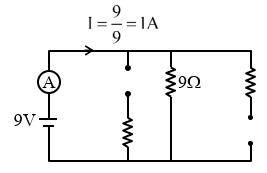
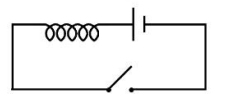
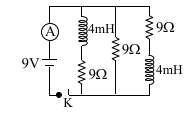
Just after closing the switch, inductor will behave as open circuit.
-
- (A) 0
- (B) 3
- (C) 6
- (D) 9
Show answer and solution
Correct Answer: (C)
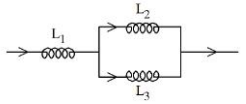
Let the inductance of each inductor be \(L\), so \(L_1 = L_2 = L_3 = L\).
Let the total current flowing through the circuit be \(I\). This current flows entirely through \(L_1\).
Since \(L_2\) and \(L_3\) are connected in parallel and have equal inductances, the current \(I\) divides equally between them. Therefore, the current through \(L_2\) is \(\dfrac{I}{2}\) and the current through \(L_3\) is \(\dfrac{I}{2}\).
The magnetic energy stored in an inductor is given by \(U = \dfrac{1}{2} L i^2\).
The energy stored in the inductor \(L_2\) is:
\(U_l = \dfrac{1}{2} L \left(\dfrac{I}{2}\right)^2 = \dfrac{1}{8} L I^2\)
The equivalent inductance of the entire circuit is:
\(L_{eq} = L_1 + \dfrac{L_2 L_3}{L_2 + L_3} = L + \dfrac{L \cdot L}{L + L} = L + \dfrac{L}{2} = \dfrac{3L}{2}\)
The total magnetic energy stored in the entire circuit is:
\(U_t = \dfrac{1}{2} L_{eq} I^2 = \dfrac{1}{2} \left(\dfrac{3L}{2}\right) I^2 = \dfrac{3}{4} L I^2\)
The ratio of the total energy to the energy stored in \(L_2\) is:
\(\dfrac{U_t}{U_l} = \dfrac{\dfrac{3}{4} L I^2}{\dfrac{1}{8} L I^2} = \dfrac{3}{4} \times 8 = 6\)
Answer: \(6\) -
- (A) 10
- (B) 20
- (C) 40
- (D) 5
Show answer and solution
Correct Answer: (B)
\(L =10 \times 10^{-3} H\)
N=104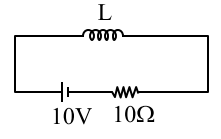
\(I _0=\frac{10}{10}=1 A\) (max current)
\(I =\frac{1}{ e }\)
\(\begin{array}{l} E _{ d }=\frac{ B ^2}{2 \mu_0} \\ B=\mu_0 nI \\ L =\mu_0 n ^2 \pi R ^2 \ell \\ E _{ d }=\frac{\mu_0 n ^2 I ^2}{2}\end{array}\)
\(=\frac{4 \pi \times 10^{-7} \times 10^8 \times \frac{1}{ e ^2}}{2}\)
\(=\frac{20 \pi}{ e ^2}\) -
- (A) A-IV, B-III, C-I, D-II
- (B) A-III, B-IV, C-II, D-I
- (C) A-I, B-III, C-IV, D-II
- (D) A-III, B-IV, C-I, D-II
Show answer and solution
Correct Answer: (D)
Magnetic induction
\( F=qvB \)
\( [B]=[\frac{F}{qV}] \)
\( [B]=[MT^{-2}A^{-1}] \)
Magnetic Flux (ф)
\( \phi=(B). \) (Area)
\( [\phi]=[ML^{2}T^{-2}A^{-1}] \)
Magnetic Permeability
\( [\mu]=[MLT^{-2}A^{-2}] \)
Self inductance
Using
\( U=\frac{1}{2}LI^{2} \)
[Self inductance] = \( [ML^{2}T^{-2}A^{-1}] \)
A-III, B-IV, C-I, D-II -
- (A) 197
- (B) 80
- (C) 280
- (D) 100
Show answer and solution
Correct Answer: (A)
EMF induced \(\varepsilon= A \frac{ dB }{ dt }= A \mu_0 n \frac{ di }{ dt }\)
\(\varepsilon= A \mu_0 n i _0 \omega \cos \omega t\)
current induced \(i =\frac{\varepsilon}{ R }=\frac{\pi r ^2 \mu_0 ni _0 \omega}{ R } \cos \omega t\)
So \(i =\frac{\pi r ^2 \mu_0 ni _0 \omega}{\sqrt{2} R }\)
\(=\frac{\pi \times 10^{-4} \times 4 \pi \times 10^{-7} \times 500 \times 10 \times 10^3}{\sqrt{2} \times 10}\)
\(=\frac{20 \pi^2}{\sqrt{2}} \times 10^{-6}\)
\(\simeq \frac{197}{\sqrt{2}} \mu A\) -
- (A) \( C_{1} \) and \( C_{3} \) move with equal speeds away from \( C_{2} \)
- (B) \( C_{1} \) moves towards \( C_{2} \) and \( C_{3} \) moves away from \( C_{2} \)
- (C) \( C_{1} \) moves away from \( C_{2} \) and \( C_{3} \) moves towards \( C_{2} \)
- (D) \( C_{1} \) and \( C_{3} \) move with equal speeds towards \( C_{2} \)
Show answer and solution
Correct Answer: (B)
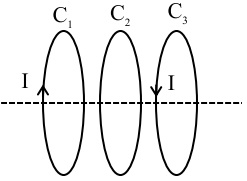
Magnetic field through the coil is
\( \vec{B}=(B_{C_{2}}-B_{C_{1}})\hat{i} \)
\( \phi=(B_{C_{2}}-B_{C_{1}})A \)
\( \epsilon=\frac{-d\phi}{dt} \)
Find the direction according to Lenz's law.
If coil move away then magnetic field decreases & vice versa
Correct Ans. (2) -
- (A) \(36\)
- (B) \(128\sqrt{2}\)
- (C) \(16\)
- (D) \(64\)
Show answer and solution
Correct Answer: (A)
The induced emf in the coil is given by Faraday's law:
\(E = N A \dfrac{dB}{dt}\)
The resistance of the coil is \(R = \rho \dfrac{l}{a}\), where \(l\) is the total length of the wire and \(a\) is its cross-sectional area.
The length of the wire is \(l = N (2\pi R_c)\), where \(R_c\) is the radius of the coil. Since the area of the coil is \(A = \pi R_c^2\), we have \(R_c = \sqrt{\dfrac{A}{\pi}}\).
Thus, \(l = 2N\sqrt{\pi A}\).
The cross-sectional area of the wire is \(a = \pi r^2\).
Therefore, the resistance is:
\(R = \rho \dfrac{2N\sqrt{\pi A}}{\pi r^2} \propto \dfrac{N\sqrt{A}}{r^2}\)
The power dissipated in the coil is:
\(P = \dfrac{E^2}{R} \propto \dfrac{(N A)^2}{\dfrac{N\sqrt{A}}{r^2}} = N A^{3/2} r^2\)
For the second coil, the parameters are \(N' = 2N\), \(A' = 2A\), and \(r' = 3r\). The new power dissipated is:
\(P' = P \left(\dfrac{2N}{N}\right) \left(\dfrac{2A}{A}\right)^{3/2} \left(\dfrac{3r}{r}\right)^2\)
\(P' = P (2) (2\sqrt{2}) (9) = 36\sqrt{2} P\)
Given that \(P' = \sqrt{2}\alpha P\), we can compare the expressions to find:
\(\sqrt{2}\alpha = 36\sqrt{2} \Rightarrow \alpha = 36\)
Answer: \(36\)
No questions on this page match these filters.