


Questions
10 questionsShowing 1–10 of 10 questions
-
- (A) \(\dfrac{1}{2}mgR_e\)
- (B) \(\dfrac{3}{4}mgR_e\)
- (C) \(\dfrac{1}{4}mgR_e\)
- (D) \(\dfrac{2}{3}mgR_e\)
Show answer and solution
Correct Answer: (D)
Initial potential energy of the body at the surface of the earth is given by:
\(U_i = -\dfrac{GMm}{R_e}\)
Final potential energy of the body at a height \(h = 2R_e\) from the surface of the earth is:
\(U_f = -\dfrac{GMm}{R_e + h} = -\dfrac{GMm}{R_e + 2R_e} = -\dfrac{GMm}{3R_e}\)
The increase in potential energy is:
\(\Delta U = U_f - U_i = -\dfrac{GMm}{3R_e} - \left(-\dfrac{GMm}{R_e}\right)\)
\(\Delta U = \dfrac{GMm}{R_e} \left(1 - \dfrac{1}{3}\right) = \dfrac{2GMm}{3R_e}\)
Acceleration due to gravity at the surface of the earth is \(g = \dfrac{GM}{R_e^2}\), which gives \(GM = gR_e^2\).
Substituting this value, we get:
\(\Delta U = \dfrac{2(gR_e^2)m}{3R_e} = \dfrac{2}{3}mgR_e\)
Answer: \(\dfrac{2}{3}mgR_e\) -
- (A) \(\dfrac{1}{2}\)
- (B) \(2\)
- (C) \(4\)
- (D) \(\dfrac{1}{4}\)
Show answer and solution
Correct Answer: (B)
Using Kepler's third law, the time period of revolution of a planet is given by \(T = 2\pi \sqrt{\dfrac{r^3}{GM_s}}\).
For planet \(P_1\), the orbital radius is \(r = R\) and the mass of the star is \(M_s = 2M\):
\(T_1 = 2\pi \sqrt{\dfrac{R^3}{G(2M)}}\)
For planet \(P_2\), the orbital radius is \(r = 2R\) and the mass of the star is \(M_s = 4M\):
\(T_2 = 2\pi \sqrt{\dfrac{(2R)^3}{G(4M)}} = 2\pi \sqrt{\dfrac{8R^3}{4GM}} = 2\pi \sqrt{\dfrac{2R^3}{GM}}\)
Taking the ratio of \(T_2\) and \(T_1\):
\(\dfrac{T_2}{T_1} = \dfrac{\sqrt{\dfrac{2R^3}{GM}}}{\sqrt{\dfrac{R^3}{2GM}}} = \sqrt{2 \times 2} = 2\)
Answer: \(2\) -
- (A) Both Statement I and Statement II are false
- (B) Both Statement I and Statement II are true
- (C) Statement I is true but Statement II is false
- (D) Statement I is false but Statement II is true
Show answer and solution
Correct Answer: (B)
\(T =2 \pi \sqrt{\frac{ R ^3}{ GM }}\)
\(\because M =\rho \cdot \frac{4}{3} \pi R ^3\)
\(\therefore T=2 g p \sqrt{\frac{1}{G \rho \frac{4}{3} \pi}}\)
Statement I is correct.
And \(\therefore \frac{ GM }{ R ^2}= g\)
\(\therefore T =2 \pi \sqrt{\frac{ R }{ g }}\)
Statement II is correct
Ans. (2) -
- (A) \(11.2\) km/s; \(6.27 \times 10^7\) J
- (B) \(11.2\) km/s; \(12.54 \times 10^7\) J
- (C) \(8.8\) km/s; \(6.27 \times 10^7\) J
- (D) \(8.8\) km/s; \(12.54 \times 10^7\) J
Show answer and solution
Correct Answer: (A)
By conservation of mechanical energy, the total energy of the body at infinity is zero.
When the body reaches the surface of the earth, its potential energy is \(-\dfrac{GMm}{R}\) and kinetic energy is \(k = \dfrac{1}{2}mv^2\).
\(0 = k - \dfrac{GMm}{R}\)
\(k = \dfrac{GMm}{R} = mgR\)
Substituting \(m = 1\) kg, \(g = 9.8\) m/s\(^2\), and \(R = 6400 \times 10^3\) m:
\(k = 1 \times 9.8 \times 6400 \times 10^3 = 6.272 \times 10^7\) J
The velocity \(v\) is given by \(\dfrac{1}{2}mv^2 = k\).
\(v = \sqrt{2gR} = \sqrt{2 \times 9.8 \times 6400 \times 10^3}\)
\(v = \sqrt{125.44 \times 10^6} = 11.2 \times 10^3\) m/s \(= 11.2\) km/s
Answer: \(11.2\) km/s; \(6.27 \times 10^7\) J -
- (A) 150
- (B) 500
- (C) 100
- (D) 1000
Show answer and solution
Correct Answer: (D)
Energy of a satellite in a circular orbit is given as\(E =\frac{- GM _{ E } m }{2 r } ; r =\) radius of circular orbit
Required energy to be supplied \(=\Delta E=E_f-E_i\)
\(\Delta E =\left(\frac{- GM _{ E } m }{2\left(3 R _{ E }\right)}\right)-\left(\frac{- GM _{ E } m }{2\left(1.5 R _{ E }\right)}\right)\)
\(=\frac{ GM _{ E } m }{6 R _{ E }}\)
Now, \(g =\frac{ GM _{ E }}{ R _{ E }^2} \Rightarrow \frac{ GM _{ E }}{ R _{ E }}= gR _{ E }\)
\(\therefore \quad \Delta E =\frac{1}{6} gmR _{ E }\)
\(=\frac{1}{6} \times 10 \times 100 \times 6 \times 10^6\)
\(=1000 \times 10^6\)
\(\alpha=1000\) -
- (A) 2
- (B) 3
- (C) 1
- (D) \( 2\sqrt{5} \)
Show answer and solution
Correct Answer: (A)
Initial configuration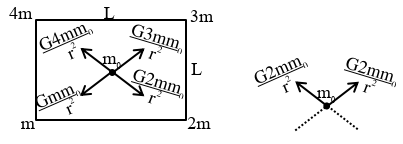
\( F=2\sqrt{2}\frac{Gmm_{0}}{r^{2}} \)
New configuration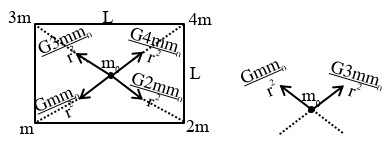
\( F'=\sqrt{10}\frac{Gmm_{0}}{r^{2}}\Rightarrow\frac{F}{F'}=2\sqrt{2}.\frac{1}{\sqrt{10}}=\frac{2}{\sqrt{5}} \)
\( \alpha=2 \) -
- (A) 1000
- (B) \( 200\sqrt{5} \)
- (C) \( 100\sqrt{10} \)
- (D) \( 1000\sqrt{2} \)
Show answer and solution
Correct Answer: (C)
\( V_{e}=\sqrt{\frac{2GM}{R}}=\sqrt{\frac{2G\times\rho\times\frac{4\pi R^{3}}{3}}{R}}\Rightarrow V_{e}\propto\sqrt{\rho}\times R \)
\( \frac{(V_{e})_{B}}{(V_{e})_{A}}=\sqrt{\frac{\rho_{B}}{P_{A}}}\times\frac{R_{B}}{R_{A}}=\sqrt{\frac{0.1P_{A}}{P_{A}}}\times(\frac{0.1R_{A}}{R_{A}}) \)
\( \frac{(V_{e})_{B}}{(V_{e})_{A}}=\frac{1}{10}\times\frac{1}{\sqrt{10}} \)
\( (V_{e})_{B}=\frac{10\times1000}{10\sqrt{10}}=100\sqrt{10}m/sec \) -
- (A) \(\sqrt{3}R\)
- (B) \(2\sqrt{2}R\)
- (C) \(2R\)
- (D) \(\dfrac{4}{9}R\)
Show answer and solution
Correct Answer: (C)
The acceleration due to gravity at a height \(h\) above the surface of the earth is given by
\(g' = \dfrac{g}{\left(1 + \dfrac{h}{R}\right)^2}\)
Given that \(g' = \dfrac{g}{9}\), we get
\(\dfrac{g}{9} = \dfrac{g}{\left(1 + \dfrac{h}{R}\right)^2}\)
\(\left(1 + \dfrac{h}{R}\right)^2 = 9\)
\(1 + \dfrac{h}{R} = 3\)
\(\dfrac{h}{R} = 2\)
\(h = 2R\)
Answer: \(2R\) -
- (A) \( 9.86\times10^{-6} \)
- (B) \( 2.85\times10^{-7} \)
- (C) \( 1.74\times10^{-7} \)
- (D) \( 4.77\times10^{-7} \)
Show answer and solution
Correct Answer: (C)
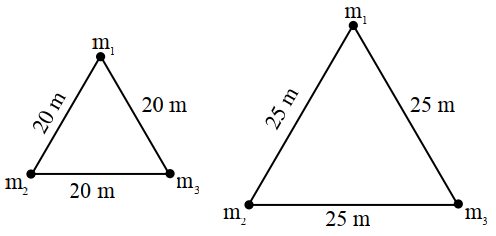
Work done by external agent :
\(w _{ ext }=\Delta U\)
\(U _{ i }=-\frac{ Gm _1 m_2}{ r _{ i }}-\frac{ Gm _2 m_3}{ r _{ i }}-\frac{ Gm _1 m_3}{ r _{ i }}: r _{ i }=20 m\)
\(U _{ f }=-\frac{ Gm _1 m_2}{ r _{ f }}-\frac{ Gm _2 m_3}{ r _{ f }}-\frac{ Gm _1 m_3}{ r _{ f }}: r _{ f }=25 m\)
\(U _{ i }=\frac{-6.67 \times 10^{-11}}{20}[200 \times 300+300 \times 400+200 \times 400]\)
\(=\frac{-6.67 \times 10^{-11}}{20} \times 26 \times 10^4=-86.71 \times 10^{-8} J\)
\(U_f=\frac{-6.67 \times 10^{-11}}{0.25}[200 \times 300+300 \times 400+200 \times 400]\)
\(=\frac{-6.67 \times 10^{-11}}{0.25} \times 26 \times 10^4=-693.68 \times 10^{-9}\)
\(=-69.36 \times 10^{-8} J\)
\(\Delta U = U _{ f }- U _{ i }=1.74 \times 10^{-7} J\) -
- (A) \(0.12\)
- (B) \(0.25\)
- (C) \(0.50\)
- (D) \(0.75\)
Show answer and solution
Correct Answer: (B)
The acceleration due to gravity at a depth \(d\) below the earth's surface is given by:
\(g_d = g\left(1 - \dfrac{d}{R}\right)\)
The acceleration due to gravity at a height \(h\) above the earth's surface (for \(h \ll R\)) is given by:
\(g_h = g\left(1 - \dfrac{2h}{R}\right)\)
Given \(d = 16\) km and \(h = 16\) km, we can find the values of \(g_d\) and \(g_h\):
\(g_d = g\left(1 - \dfrac{16}{6400}\right) = g\left(1 - \dfrac{1}{400}\right)\)
\(g_h = g\left(1 - \dfrac{2 \times 16}{6400}\right) = g\left(1 - \dfrac{2}{400}\right)\)
The magnitude of the change in acceleration due to gravity when moving from the depth \(d\) to the height \(h\) is:
\(\Delta g = g_d - g_h = g\left(1 - \dfrac{1}{400}\right) - g\left(1 - \dfrac{2}{400}\right)\)
\(\Delta g = g\left(\dfrac{2}{400} - \dfrac{1}{400}\right) = \dfrac{g}{400}\)
The percentage change in \(g\) is approximately:
\(\dfrac{\Delta g}{g} \times 100 = \dfrac{\dfrac{g}{400}}{g} \times 100 = \dfrac{100}{400} = 0.25\%\)
Thus, the value of \(\alpha\) is \(0.25\).
Answer: \(0.25\)
No questions on this page match these filters.