


Questions
10 questionsShowing 1–10 of 10 questions
-
- (A) \(\frac{u^{2}}{4g~sin~\theta}\)
- (B) \(\frac{2u^{2}}{g~cos~\theta}\)
- (C) \(\frac{u^{2}}{\sqrt{2}g~cos~\theta}\)
- (D) \( \frac{u^2}{2g \sin \theta} \)
Show answer and solution
Correct Answer: (D)
Explanation:
The distance covered by the block moving up the smooth inclined plane can be determined using basic kinematic principles:
1. Forces Acting on the Block: When the block is projected upwards along the incline with an initial velocity \( u \), the component of gravitational force acting parallel to the inclined plane opposes its motion. This component acts directly downwards along the slope and is given by \( mg \sin \theta \).
2. Retardation (Deceleration): Using Newton's second law, the constant acceleration \( a \) of the block along the incline is:
\( a = -g \sin \theta \)
3. Applying the Third Equation of Motion:
\( v^2 = u^2 + 2aS \)
At the maximum distance \( S \), the final velocity of the block becomes zero (\( v = 0 \)):
\( 0 = u^2 + 2(-g \sin \theta)S \)
\( 2g \sin \theta \cdot S = u^2 \)
\( S = \frac{u^2}{2g \sin \theta} \)
Therefore, the mathematically accurate answer is \( \frac{u^2}{2g \sin \theta} \). Option A given in the original key is incorrect, as this question contained a typographical error in the option list during the official examination and is treated as a bonus/corrected to Option D.
Hence, Option D is the correct choice. -
- (A) 20
- (B) 10
- (C) 25
- (D) 15
Show answer and solution
Correct Answer: (D)
\( T=\frac{2u_{y}}{g}=4 \)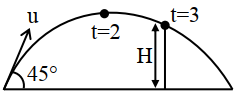
\(\Rightarrow u_y=\frac{40}{2}=20 m / s\)
\(y = u _{ y } \Delta t -\frac{1}{2} g(\Delta t )^2\)
\(\Rightarrow H =20 \times 3-5 \times 9\)
\(=60-45\)
\(=15 m\) -
- (A) 5
- (B) 6
- (C) 7
- (D) 8
Show answer and solution
Correct Answer: (D)
The maximum horizontal range of a projectile is given by \(R_{\text{max}} = \dfrac{u^2}{g}\).
Given \(R_{\text{max}} = 6.4\) m and \(g = 10\) m/s\(^2\).
Substituting the values:
\(6.4 = \dfrac{u^2}{10}\)
\(u^2 = 64\)
\(u = 8\) m/s.
Answer: \(8\) -
- (A) \( 40\sqrt{2} \)
- (B) 40
- (C) \( 20\sqrt{3} \)
- (D) \( 20\sqrt{2} \)
Show answer and solution
Correct Answer: (D)
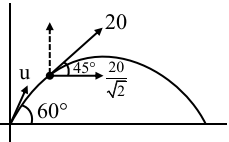
\( u~cos~60^{\circ}=\frac{20}{\sqrt{2}} \)
\( \frac{u}{2}=\frac{20}{\sqrt{2}} \)
\( u=\frac{40}{\sqrt{2}} \)
\(u =20 \sqrt{2}\) m/s -
- (A) 20 s and 100 m
- (B) 40 s and 0 m
- (C) 40 s and 200 m
- (D) 40 s and 100 m
Show answer and solution
Correct Answer: (C)
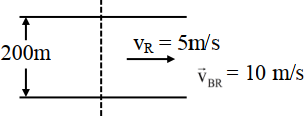
Minimum time :
\(t _{\min }=\frac{200}{10}=20 sec\)
\(t_{\min }=\frac{200}{10}=20 sec\)
For round trip \(=40 sec\).
Displacement along river bank \(=40 \times 5=200 m\) -
- (A) 1 : 2
- (B) 2 : 3
- (C) 1 : 4
- (D) 3 : 4
Show answer and solution
Correct Answer: (D)
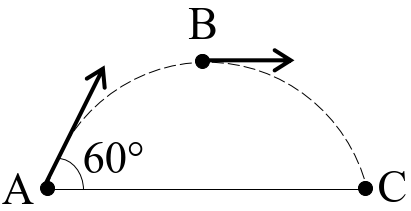
\( (KE)_{A}=K=\frac{1}{2}mu^{2} \)
\(( KE )_{ B }=\frac{ K }{4}=\frac{1}{2} m\left(\frac{ u }{2}\right)^2=\frac{ K }{4}\left( u _{ B }= u \cos 60^{\circ}=\frac{ u }{2}\right)\)
\( (KE)_{C}=K \)
Ratio \(= \frac{K-K/4}{K} \)
\(=\frac{3 K / 4}{K}=\frac{3}{4}\) -
- (A) \(60\)
- (B) \(45\)
- (C) \(30\)
- (D) \(75\)
Show answer and solution
Correct Answer: (B)
The velocity components of the projectile are given by the derivatives of the position coordinates with respect to time.
\(v_x = \dfrac{dx}{dt} = \dfrac{d}{dt}(24t) = 24\)
\(v_y = \dfrac{dy}{dt} = \dfrac{d}{dt}(43.6t - 4.9t^2) = 43.6 - 9.8t\)
At \(t = 2\) s, the velocity components are:
\(v_x = 24\)
\(v_y = 43.6 - 9.8(2) = 43.6 - 19.6 = 24\)
The angle \(\theta\) made by the velocity vector with the horizontal is given by:
\(\tan \theta = \dfrac{v_y}{v_x} = \dfrac{24}{24} = 1\)
\(\theta = 45^{\circ}\)
Answer: \(45\) - 8. The percentage error in the calculated volume of a sphere, if there is \(2\%\) error in its diameter measurement, is __________. 2026 Medium
- (A) \(1\)
- (B) \(2\)
- (C) \(6\)
- (D) \(8\)
Show answer and solution
Correct Answer: (C)
The volume of a sphere in terms of its diameter \(D\) is given by \(V = \dfrac{\pi}{6}D^3\)
Taking the natural logarithm on both sides, we get \(\ln V = \ln\left(\dfrac{\pi}{6}\right) + 3 \ln D\)
Differentiating for small errors, we obtain \(\dfrac{\Delta V}{V} = 3 \dfrac{\Delta D}{D}\)
Multiplying by \(100\) to find the percentage error, \(\dfrac{\Delta V}{V} \times 100 = 3 \left(\dfrac{\Delta D}{D} \times 100\right)\)
Given that the percentage error in the diameter is \(2\%\), we have \(\dfrac{\Delta D}{D} \times 100 = 2\)
Therefore, the percentage error in the volume is \(3 \times 2 = 6\%\)
Answer: \(6\) -
- (A) \(250\)
- (B) \(25\)
- (C) \(500\)
- (D) \(125\)
Show answer and solution
Correct Answer: (A)
For two projectiles to have the same horizontal range \(R\) with the same initial speed \(u\), their angles of projection must be complementary, i.e., \(\theta\) and \(90^\circ - \theta\).
The times of flight for these two angles are given by:
\(t_1 = \dfrac{2u \sin \theta}{g}\)
\(t_2 = \dfrac{2u \cos \theta}{g}\)
Multiplying \(t_1\) and \(t_2\), we get:
\(t_1 t_2 = \left(\dfrac{2u \sin \theta}{g}\right) \left(\dfrac{2u \cos \theta}{g}\right) = \dfrac{2}{g} \left(\dfrac{u^2 (2 \sin \theta \cos \theta)}{g}\right)\)
Since the horizontal range is \(R = \dfrac{u^2 \sin 2\theta}{g}\), we can write:
\(t_1 t_2 = \dfrac{2R}{g}\)
Given \(t_1 = 5\) s, \(t_2 = 10\) s, and \(g = 10\) m/s\(^2\), substituting these values:
\(5 \times 10 = \dfrac{2R}{10}\)
\(50 = \dfrac{2R}{10}\)
\(2R = 500 \Rightarrow R = 250\) m
Answer: \(250\) -
- (A) \(\sqrt{2}\)
- (B) \(\sqrt{3}\)
- (C) \(2\sqrt{3}\)
- (D) \(\dfrac{1}{\sqrt{2}}\)
Show answer and solution
Correct Answer: (B)
The horizontal range of a projectile is given by the formula \(R = \dfrac{u^2 \sin(2\theta)}{g}\).
For the first projectile, the angle of projection is \(\theta_1 = 15^\circ\).
\(R_1 = \dfrac{u^2 \sin(2 \times 15^\circ)}{g} = \dfrac{u^2 \sin(30^\circ)}{g} = \dfrac{u^2}{2g}\)
For the second projectile, the angle of projection is \(\theta_2 = 30^\circ\).
\(R_2 = \dfrac{u^2 \sin(2 \times 30^\circ)}{g} = \dfrac{u^2 \sin(60^\circ)}{g} = \dfrac{\sqrt{3}u^2}{2g}\)
The ratio of their ranges is:
\(\dfrac{R_1}{R_2} = \dfrac{\dfrac{u^2}{2g}}{\dfrac{\sqrt{3}u^2}{2g}} = \dfrac{1}{\sqrt{3}}\)
Given that the ratio is \(1:x\), we get \(x = \sqrt{3}\).
Answer: \(\sqrt{3}\)
No questions on this page match these filters.