


All JEE Mains 2026 Physics questions
31 chaptersShowing 151–200 of 469 questions
-
- (A) 20
- (B) 24
- (C) 26
- (D) 28
Show answer and solution
Correct Answer: (A)
Sunlight comes from infinity and is focused at the principal focus of the convex lens. The paper burns in the shortest time when the intensity of light is maximum, which occurs at the focal point.
Therefore, the focal length of the convex lens is \(f = 30\) cm.
Assuming the lens is equiconvex, the radii of curvature are \(R_1 = 60\) cm and \(R_2 = -60\) cm.
Using the Lens Maker's formula:
\(\dfrac{1}{f} = (\mu - 1) \left( \dfrac{1}{R_1} - \dfrac{1}{R_2} \right)\)
Substituting the given values:
\(\dfrac{1}{30} = (\mu - 1) \left( \dfrac{1}{60} - \left( -\dfrac{1}{60} \right) \right)\)
\(\dfrac{1}{30} = (\mu - 1) \left( \dfrac{2}{60} \right)\)
\(\dfrac{1}{30} = (\mu - 1) \left( \dfrac{1}{30} \right)\)
\(\mu - 1 = 1 \Rightarrow \mu = 2\)
Given that the refractive index is \(\dfrac{\alpha}{10}\):
\(\dfrac{\alpha}{10} = 2 \Rightarrow \alpha = 20\)
Answer: \(20\) -
- (A) 2
- (B) 5
- (C) 3.5
- (D) 4
Show answer and solution
Correct Answer: (A)
\( f_{0}=2~cm \),\( fe=5~cm \)
\( l=10 \),\( D=25~cm \)
\( M=\frac{l}{f_{0}}.\frac{D}{f_{c}}=25 \) -
- (A) 50
- (B) 100
- (C) 150
- (D) 200
Show answer and solution
Correct Answer: (B)
Explanation:
Let us clarify the concept of magnification under different adjustments step-by-step based on the Ray Optics and Optical Instruments chapter of the NCERT Class 12 Physics textbook:
Step 1: Understand the meaning of "Normal Adjustment"
In optical instruments, "Normal Adjustment" explicitly means that the final image is formed at infinity \(\infty\), allowing the observer's eye to view it in a completely relaxed state.
Step 2: Apply the correct formula for Normal Adjustment
When the final image is formed at infinity, the magnifying power \(m\) of a compound microscope is given by:
\(m = \frac{L}{f_o} \times \frac{D}{f_e}\)
Where:
- \(L\) = Tube length = 32 cm
- \(f_o\) = Focal length of objective = 2 cm
- \(f_e\) = Focal length of eyepiece = 4 cm
- \(D\) = Least distance of distinct vision = 25 cm
Step 3: Calculate the value
Substitute the given values into the infinity-adjustment formula:
\(m = \frac{32}{2} \times \frac{25}{4}\)
\(m = 16 \times 6.25 = 100\)
Why 116 is incorrect here:
The handwritten solution uses the formula \(m = \frac{L}{f_o}\left(1 + \frac{D}{f_e}\right)\). This formula belongs to the near-point adjustment, where the final image is formed at the least distance of distinct vision (\(D = 25\text{ cm}\)). Since this specific question asks for normal adjustment, using that formula is a conceptual error. The app's answer of 100 is fully correct.
Hence, Option B is the correct choice. - 154. In parallax method for the determination of focal length of a concave mirror, the object should always be placed : 2026 Easy
- (A) between the focus (F) and the centre of curvature (C) of the mirror ONLY
- (B) at any point beyond the focus (F) of the mirror
- (C) beyond the centre of the curvature (C) of the mirror ONLY
- (D) between the pole (P) and the focus (F) of the concave mirror ONLY
Show answer and solution
Correct Answer: (B)
Image should be real. So object should be placed beyond focus. -
- (A) \(1.6\)
- (B) \(0.16\)
- (C) \(11.6\)
- (D) \(16\)
Show answer and solution
Correct Answer: (A)
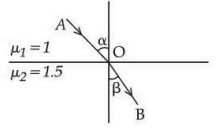
From the given figure, the interface is horizontal and the normal is along the y-axis.
The incident ray is along the vector \(\vec{AO} = 2\hat{i} - 3\hat{j}\).
The angle of incidence \(\alpha\) is the angle between the incident ray and the normal.
\(\sin \alpha = \dfrac{2}{\sqrt{2^2 + (-3)^2}} = \dfrac{2}{\sqrt{13}}\)
The refracted ray is along the vector \(\vec{OB} = C\hat{i} - 4\hat{j}\).
The angle of refraction \(\beta\) is the angle between the refracted ray and the normal.
\(\sin \beta = \dfrac{C}{\sqrt{C^2 + (-4)^2}} = \dfrac{C}{\sqrt{C^2 + 16}}\)
Applying Snell's law at the interface:
\(\mu_1 \sin \alpha = \mu_2 \sin \beta\)
\(1 \times \dfrac{2}{\sqrt{13}} = 1.5 \times \dfrac{C}{\sqrt{C^2 + 16}}\)
\(\dfrac{2}{\sqrt{13}} = \dfrac{3}{2} \dfrac{C}{\sqrt{C^2 + 16}}\)
Squaring both sides:
\(\dfrac{4}{13} = \dfrac{9}{4} \left( \dfrac{C^2}{C^2 + 16} \right)\)
\(16(C^2 + 16) = 117 C^2\)
\(16 C^2 + 256 = 117 C^2\)
\(101 C^2 = 256\)
\(C^2 = \dfrac{256}{101}\)
\(C = \dfrac{16}{\sqrt{101}} \approx 1.592\)
Approximating \(\sqrt{101} \approx 10\), we get \(C \approx 1.6\).
Answer: \(1.6\) -
- (A) \(3\sqrt{3}/1.6\)
- (B) \(\sqrt{3}\)
- (C) \(3.2/\sqrt{3}\)
- (D) \(4\sqrt{3}/5\)
Show answer and solution
Correct Answer: (D)
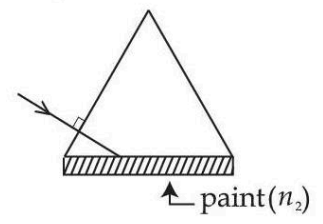
Given that the prism is an equilateral triangle, all its refracting angles are \(60^\circ\).
The incident ray falls normally on one of the faces of the prism. Therefore, the angle of incidence is \(0^\circ\) and the ray enters the prism undeviated.
From the geometry of the figure, the ray strikes the bottom painted face. In the right-angled triangle formed by the ray and the two faces of the prism, the angle between the left face and the bottom face is \(60^\circ\).
The angle the refracted ray makes with the bottom face is \(90^\circ - 60^\circ = 30^\circ\).
The angle of incidence \(i\) at the bottom painted face is the angle made with the normal to that face:
\(i = 90^\circ - 30^\circ = 60^\circ\)
For total internal reflection to occur at the painted face, the angle of incidence must be greater than or equal to the critical angle \(\theta_c\) for the prism-paint interface:
\(i \ge \theta_c\)
\(\sin i \ge \sin \theta_c\)
The critical angle is given by \(\sin \theta_c = \dfrac{n_2}{n_1}\), where \(n_1 = 1.6\) is the refractive index of the prism and \(n_2\) is the refractive index of the paint.
Substituting the values:
\(\sin 60^\circ \ge \dfrac{n_2}{1.6}\)
\(\dfrac{\sqrt{3}}{2} \ge \dfrac{n_2}{1.6}\)
\(n_2 \le 1.6 \times \dfrac{\sqrt{3}}{2}\)
\(n_2 \le 0.8\sqrt{3} = \dfrac{4\sqrt{3}}{5}\)
The limiting value of \(n_2\) required for total internal reflection is \(\dfrac{4\sqrt{3}}{5}\).
Answer: \(4\sqrt{3}/5\) - 157. Refer the figure given below. \(\mu_1\) and \(\mu_2\) are refractive indices of air and lens material. The height of image will be _______ cm.
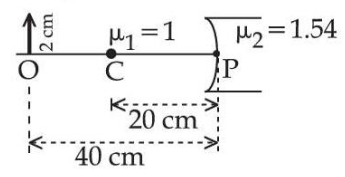 2026 Medium
- (A) \(1\)
- (B) \(0.5\)
- (C) \(1.2\)
- (D) \(0.25\)
Show answer and solution
Correct Answer: (A)
Taking the pole \(P\) as the origin and the direction of incident light as positive:
\(\mu_1 = 1\) (air), \(\mu_2 = 1.5\) (lens)
\(u = -40\text{ cm}\)
\(R = -20\text{ cm}\) (centre of curvature lies to the left of \(P\))
\(h_o = +2\text{ cm}\)
Using the formula for refraction at a single spherical surface:
\(\dfrac{\mu_2}{v} - \dfrac{\mu_1}{u} = \dfrac{\mu_2 - \mu_1}{R}\)
\(\dfrac{1.5}{v} - \dfrac{1}{-40} = \dfrac{1.5 - 1}{-20}\)
\(\dfrac{1.5}{v} + \dfrac{1}{40} = -\dfrac{1}{40}\)
\(\dfrac{1.5}{v} = -\dfrac{2}{40} = -\dfrac{1}{20}\)
\(v = -30\text{ cm}\)
The negative sign indicates a virtual image formed \(30\text{ cm}\) to the left of \(P\).
The transverse magnification for refraction at a spherical surface is:
\(m = \dfrac{\mu_1 \cdot v}{\mu_2 \cdot u} = \dfrac{1 \cdot (-30)}{1.5 \cdot (-40)} = \dfrac{-30}{-60} = 0.5\)
Therefore:
\(h_i = m \cdot h_o = 0.5 \times 2 = 1\text{ cm}\)
Hence, the correct option is \((1)\ 1\). -
- (A) \( 60^{\circ} \)
- (B) \( 15^{\circ} \)
- (C) \( 30^{\circ} \)
- (D) \( 45^{\circ} \)
Show answer and solution
Correct Answer: (A)
\(i = e \& r = A / 2\) for minimum deviation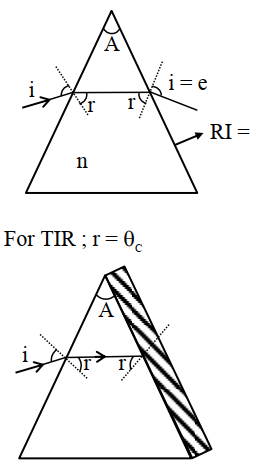
\(\operatorname{Sin} r =\operatorname{Sin} \theta_{ c }\)
\(\operatorname{Sin} r =\frac{ n / 2}{ n }\)
\(\operatorname{Sin} r =\frac{1}{2}\)
\(\operatorname{Sin} \frac{ A }{2}=\sin 30^{\circ}\)
\(\frac{ A }{2}=30^{\circ}\)
\(A =60^{\circ}\) -
- (A) 5 : 2
- (B) 5 : 12
- (C) 12 : 5
- (D) 2 : 5
Show answer and solution
Correct Answer: (A)
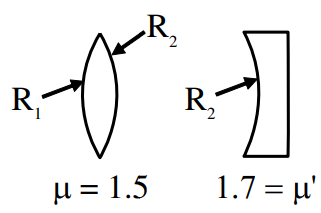
\(\left| P _{ A }\right|=\left| P _{ B }\right|\)
\(0.5\left(\frac{1}{ R _1}+\frac{1}{ R _2}\right)=\frac{0.7}{ R _2}\)
\(\frac{5}{ R _1}=\frac{2}{ R _2}\)
\(\frac{ R _1}{ R _2}=\frac{5}{2}\) -
- (A) 12
- (B) 16
- (C) 18
- (D) 20
Show answer and solution
Correct Answer: (B)
\(m=\frac{f}{f+u}\)
\(m _1=- m _2\)
\(\frac{f}{f-8}=-\frac{f}{f-24}\)
\(f-8=24-f\)
\(2 f=32\)
\(f =16 cm\) -
- (A) 380
- (B) 840
- (C) 480
- (D) 540
Show answer and solution
Correct Answer: (C)
\(\left.\frac{\mu_1}{\mu_2}=\frac{ v _2}{ v _1}=\frac{\lambda_2}{\lambda_1} \right\rvert\, v = f \lambda\)
\(\frac{\mu_1}{\mu_2}=\frac{\lambda_2}{\lambda_1}\)
\(\frac{\mu_{ B }}{3 / 2}=\frac{\lambda}{540}\)
\(\lambda=\left(\frac{4 \times 2}{3 \times 3} \times 540\right)\)
\(\lambda=480\) nm -
- (A) \(\frac{\pi \sqrt{ LC }}{3}\)
- (B) \(\frac{\pi \sqrt{ LC }}{6}\)
- (C) \(\frac{\pi \sqrt{ LC }}{2}\)
- (D) \(\pi \sqrt{\frac{ LC }{2}}\)
Show answer and solution
Correct Answer: (B)
\( U_{c_{f}}=75\%U_{c_{i}} \)
\( Q_{F}^{2}=\frac{3}{4}Q_{1}^{2} \)
\( Q_{i}cos~\omega t=\frac{\sqrt{3}}{2}Q_{i}\Rightarrow t=\frac{T}{12} \)
\( t=\frac{\pi}{6}\sqrt{LC} \) -
- (A) 600
- (B) 400
- (C) 300
- (D) 200
Show answer and solution
Correct Answer: (D)
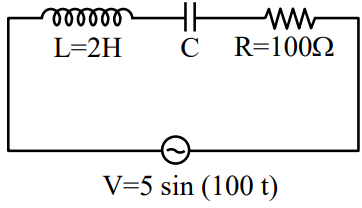
Given \(L = 1.6\text{ H}\) and \(C = 40\ \mu\text{F} = 40 \times 10^{-6}\text{ F}\).
At resonance, the angular frequency is \(\omega_r = \dfrac{1}{\sqrt{LC}}\).
The inductive reactance at resonance is \(X_L = \omega_r L = \dfrac{L}{\sqrt{LC}} = \sqrt{\dfrac{L}{C}}\).
Substituting the given values:
\(X_L = \sqrt{\dfrac{1.6}{40 \times 10^{-6}}}\)
\(X_L = \sqrt{\dfrac{1.6}{4 \times 10^{-5}}}\)
\(X_L = \sqrt{4 \times 10^4}\)
\(X_L = 200\ \Omega\)
Answer: \(200\) -
- (A) \(\sqrt{\dfrac{6}{7}}\)
- (B) \(\sqrt{\dfrac{3}{5}}\)
- (C) \(\sqrt{\dfrac{7}{8}}\)
- (D) \(\sqrt{\dfrac{3}{4}}\)
Show answer and solution
Correct Answer: (C)
The current in the RC circuit at frequency \(\omega\) is given by
\(I = \dfrac{V}{\sqrt{R^2 + X_C^2}}\)
where \(X_C = \dfrac{1}{\omega C}\) is the capacitive reactance.
When the frequency is changed to \(\omega/4\), the new reactance becomes \(X_C' = \dfrac{1}{(\omega/4)C} = 4X_C\).
The new current is given as \(I/3\), so
\(\dfrac{I}{3} = \dfrac{V}{\sqrt{R^2 + (4X_C)^2}}\)
Substituting the expression for \(I\), we get
\(\dfrac{V}{3\sqrt{R^2 + X_C^2}} = \dfrac{V}{\sqrt{R^2 + 16X_C^2}}\)
Squaring both sides, we obtain
\(\dfrac{1}{9(R^2 + X_C^2)} = \dfrac{1}{R^2 + 16X_C^2}\)
\(9R^2 + 9X_C^2 = R^2 + 16X_C^2\)
\(8R^2 = 7X_C^2\)
\(\dfrac{R^2}{X_C^2} = \dfrac{7}{8}\)
\(\dfrac{R}{X_C} = \sqrt{\dfrac{7}{8}}\)
Answer: \(\sqrt{\dfrac{7}{8}}\) -
- (A) 50
- (B) 100
- (C) 125
- (D) 150
Show answer and solution
Correct Answer: (B)
The power factor of an LCR series circuit is given by \(\cos \phi = \dfrac{R}{Z}\).
Given \(\cos \phi = 0.5\) and \(R = 100 \ \Omega\).
Substituting the values, we get:
\(0.5 = \dfrac{100}{Z} \Rightarrow Z = 200 \ \Omega\)
The impedance \(Z\) of the circuit is also given by:
\(Z = \sqrt{R^2 + (X_L - X_C)^2}\)
Squaring both sides and substituting the values of \(Z\) and \(R\):
\((200)^2 = (100)^2 + (X_L - X_C)^2\)
\(40000 = 10000 + (X_L - X_C)^2\)
\((X_L - X_C)^2 = 30000\)
\(|X_L - X_C| = 100\sqrt{3} \ \Omega\)
The difference in inductive and capacitive reactance is given as \(\sqrt{3}\alpha \ \Omega\).
Comparing the two expressions:
\(\sqrt{3}\alpha = 100\sqrt{3}\)
\(\alpha = 100\)
Answer: \(100\) -
- (A) 157
- (B) 314
- (C) 628
- (D) 100
Show answer and solution
Correct Answer: (B)
\(\frac{1}{2}Li_{ms}^{2}=16\Rightarrow L=8\)
\(i^{2}R=32\Rightarrow R=8\)
\(x_{L}=\omega L\Rightarrow2\times3.14\times50\times8\)
\(\Rightarrow800\times3.14\)
\(R=8\)
\(\frac{x_{L}}{R}=314\) -
- (A) 4
- (B) 10
- (C) 6
- (D) 8
Show answer and solution
Correct Answer: (C)
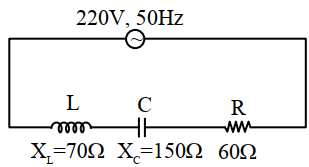
Power factor \( =\frac{R}{Z} \)
\( Z=\sqrt{R^{2}+(X_{L}-X_{C})^{2}} \)
\( =\sqrt{60^{2}+(150-70)^{2}}=100\Omega \)
∴ Power factor \(=\frac{60}{100}=\frac{6}{10}\)
Then \( a=6 \) -
- (A) \(\frac{i_{0}}{\sqrt{2}}\)
- (B) \(i_{0}\)
- (C) \(\frac{i_{0}}{\sqrt{6}}\)
- (D) \(\frac{i_{0}}{\sqrt{3}}\)
Show answer and solution
Correct Answer: (D)
\(i _{ rms }^2=\frac{\int_0^{ T }\left( i _0^2 t ^2 / T ^2\right) dt }{\int_0^{ T } dt }=\frac{ i _0^2}{T^3} \cdot \frac{T^3}{3}=\frac{ i _0^2}{3}\)
\(i _{ rms }=\frac{ i _0}{\sqrt{3}}\) -
- (A) \(\dfrac{9}{2}\)
- (B) \(\dfrac{2}{9}\)
- (C) \(\dfrac{1}{3}\)
- (D) \(3\)
Show answer and solution
Correct Answer: (B)
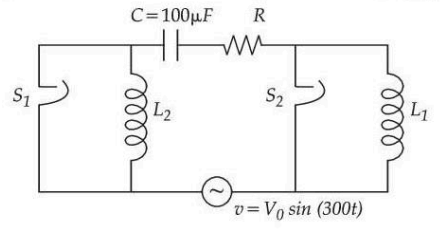
From the source \(v = V_0 \sin(300t)\), the angular frequency is \(\omega = 300\text{ rad/s}\).
Capacitance \(C = 100\ \mu\text{F} = 10^{-4}\text{ F}\), so \(X_C = \dfrac{1}{\omega C}\).
Case 1 (\(S_1\) closed, \(S_2\) open):
Closing \(S_1\) short-circuits \(L_2\), leaving an LCR series circuit with \(C\), \(R\) and \(L_1\). With phase difference \(\phi_1 = 30^\circ\):
\(\tan 30^\circ = \dfrac{\omega L_1 - X_C}{R}\)
\(\dfrac{1}{\sqrt{3}} = \dfrac{\omega L_1 - X_C}{R} \Rightarrow R = \sqrt{3}\,(\omega L_1 - X_C)\) ... (1)
Case 2 (\(S_2\) closed, \(S_1\) open):
Closing \(S_2\) short-circuits \(L_1\), leaving an LCR series circuit with \(C\), \(R\) and \(L_2\). With phase difference \(\phi_2 = 60^\circ\):
\(\tan 60^\circ = \dfrac{\omega L_2 - X_C}{R}\)
\(\sqrt{3} = \dfrac{\omega L_2 - X_C}{R} \Rightarrow \omega L_2 - X_C = R\sqrt{3}\) ... (2)
Substituting \(R\) from (1) into (2):
\(\omega L_2 - X_C = \sqrt{3}\,(\omega L_1 - X_C) \cdot \sqrt{3}\)
\(\omega L_2 - X_C = 3\omega L_1 - 3X_C\)
\(2X_C = 3\omega L_1 - \omega L_2 = \omega(3L_1 - L_2)\)
Therefore:
\(3L_1 - L_2 = \dfrac{2X_C}{\omega} = \dfrac{2}{\omega^2 C}\)
Substituting \(\omega = 300\text{ rad/s}\) and \(C = 10^{-4}\text{ F}\):
\(\omega^2 C = (300)^2 \cdot 10^{-4} = 9 \times 10^4 \cdot 10^{-4} = 9\)
\(3L_1 - L_2 = \dfrac{2}{9}\text{ H}\)
Hence, the correct option is \((2)\ \dfrac{2}{9}\). -
- (A) 25
- (B) 50
- (C) 75
- (D) 100
Show answer and solution
Correct Answer: (B)
Current is maximum, so resonance
and \(\omega=\frac{1}{\sqrt{ LC }}\)
\(C=\frac{1}{\omega^2 L}=\frac{1}{2 \times 10^4}\)
\(=50 \times 10^{-6}=50 \mu F\) -
- (A) 4
- (B) 8
- (C) 16
- (D) 32
Show answer and solution
Correct Answer: (C)
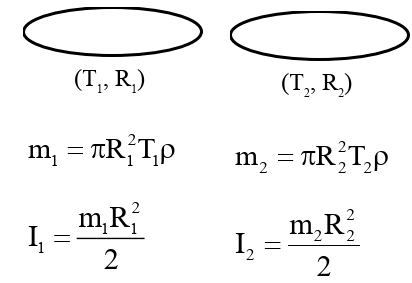
\(I _1= I _2\)
\(\frac{\pi R _1^2 T_1 \rho R _1^2}{2}=\frac{\pi R _2^2 T_2 \rho R _2^2}{2} \Rightarrow \frac{T_1}{T_2}=\frac{1}{16}\) -
- (A) 30
- (B) 60
- (C) 45
- (D) 90
Show answer and solution
Correct Answer: (A)
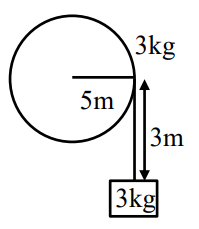
\(mg\times3=\frac{1}{2}.\frac{mR^{2}}{2}\omega^{2}+\frac{1}{2}mv^{2}\) ...(i)
& \(v=\omega R\) ...(ii)
From equation (i) & (ii)
\(g\times3=\frac{3}{4}.v^{2}\)
K.E. of flywheel \(=\frac{1}{2}\times\frac{mR^{2}}{2}\times\omega^{2}=\frac{1}{4}mv^{2}\)
\(=\frac{1}{4}\times3\times40=30\) Joule -
- (A) \(0.8\)
- (B) \(0.64\)
- (C) \(0.9\)
- (D) \(0.5\)
Show answer and solution
Correct Answer: (A)
The impedance of the LCR series circuit is given by \(Z = \sqrt{R^2 + (X_C - X_L)^2}\).
Substituting the given values:
\(Z = \sqrt{80^2 + (80 - 20)^2}\)
\(Z = \sqrt{80^2 + 60^2}\)
\(Z = \sqrt{6400 + 3600} = \sqrt{10000} = 100\,\Omega\)
The power factor of the circuit is given by \(\cos \phi = \dfrac{R}{Z}\).
\(\cos \phi = \dfrac{80}{100} = 0.8\)
Answer: \(0.8\) -
- (A) \(150\)
- (B) \(120\)
- (C) \(130\)
- (D) \(170\)
Show answer and solution
Correct Answer: (C)
Given \(\theta = \dfrac{5t^4}{40} - \dfrac{t^3}{3} = \dfrac{t^4}{8} - \dfrac{t^3}{3}\)
Angular velocity \(\omega = \dfrac{d\theta}{dt} = \dfrac{4t^3}{8} - \dfrac{3t^2}{3} = \dfrac{t^3}{2} - t^2\)
Angular acceleration \(\alpha = \dfrac{d\omega}{dt} = \dfrac{3t^2}{2} - 2t\)
At \(t = 10\) s, \(\alpha = \dfrac{3(10)^2}{2} - 2(10)\)
\(\alpha = 150 - 20 = 130\) rad/s\(^2\)
Answer: \(130\) -
- (A) \(15\)
- (B) \(5\)
- (C) \(10\)
- (D) \(7.5\)
Show answer and solution
Correct Answer: (B)
Initial translational velocity, \(v_0 = 49\) m/s.
Initial angular velocity, \(\omega_0 = \dfrac{v_0}{4R}\).
Velocity of the lowest point of the cylinder is \(v_{bottom} = v_0 - \omega_0 R = v_0 - \dfrac{v_0}{4} = \dfrac{3v_0}{4} > 0\).
Since the lowest point is slipping forward, kinetic friction \(f_k = \mu_k m g\) acts in the backward direction.
Translational acceleration, \(a = -\dfrac{f_k}{m} = -\mu_k g\).
Angular acceleration, \(\alpha = \dfrac{f_k R}{I} = \dfrac{\mu_k m g R}{\dfrac{1}{2} m R^2} = \dfrac{2\mu_k g}{R}\).
At time \(t\), the translational velocity is \(v = v_0 - \mu_k g t\).
The angular velocity is \(\omega = \omega_0 + \alpha t = \dfrac{v_0}{4R} + \dfrac{2\mu_k g}{R} t\).
For pure rolling to start, \(v = \omega R\).
\(v_0 - \mu_k g t = \left( \dfrac{v_0}{4R} + \dfrac{2\mu_k g}{R} t \right) R\)
\(v_0 - \mu_k g t = \dfrac{v_0}{4} + 2\mu_k g t\)
\(3\mu_k g t = \dfrac{3v_0}{4}\)
\(t = \dfrac{v_0}{4\mu_k g}\)
Substituting the given values \(v_0 = 49\) m/s, \(\mu_k = 0.25\), and \(g = 9.8\) m/s\(^2\):
\(t = \dfrac{49}{4 \times 0.25 \times 9.8} = \dfrac{49}{9.8} = 5\) s.
Answer: \(5\) -
- (A) \(5 : 21\)
- (B) \(6 : 10\)
- (C) \(21 : 25\)
- (D) \(1 : 5\)
Show answer and solution
Correct Answer: (A)
For a body of mass \(M\) and radius \(R\) rolling without slipping under a force \(F\) applied tangentially at the highest point, the torque about the point of contact with the ground is \(\tau = F(2R)\).
The moment of inertia about the point of contact is \(I = I_{cm} + MR^2\).
Using \(\tau = I\alpha\) and the rolling without slipping condition \(a = \alpha R\), we get:
\(F(2R) = (I_{cm} + MR^2) \dfrac{a}{R} \Rightarrow a = \dfrac{2FR^2}{I_{cm} + MR^2}\)
For the solid sphere \(A\) of mass \(5m\):
\(I_{cm,A} = \dfrac{2}{5}(5m)R^2 = 2mR^2\)
\(a_A = \dfrac{2FR^2}{2mR^2 + 5mR^2} = \dfrac{2F}{7m}\)
For the spherical shell \(B\) of mass \(m\):
\(I_{cm,B} = \dfrac{2}{3}mR^2\)
\(a_B = \dfrac{2FR^2}{\dfrac{2}{3}mR^2 + mR^2} = \dfrac{2F}{\dfrac{5}{3}m} = \dfrac{6F}{5m}\)
The ratio of their accelerations is:
\(\dfrac{a_A}{a_B} = \dfrac{\dfrac{2F}{7m}}{\dfrac{6F}{5m}} = \dfrac{2}{7} \times \dfrac{5}{6} = \dfrac{5}{21}\)
Answer: \(5 : 21\) -
- (A) 0.36
- (B) 0.72
- (C) 0.18
- (D) 0.63
Show answer and solution
Correct Answer: (D)
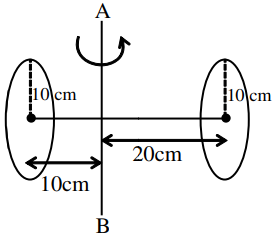
\( I=\frac{7}{5}[m_{1}R_{1}^{2}+m_{2}R_{2}^{2}] \)
\( =\frac{7}{5}[5(10)^{2}+10\times(20)^{2}]\times10^{-4} \)
\( I=63\times10^{-2}kg~m^{2} \)
\( I=0.63~kg~m^{2} \) -
- (A) \(35\)
- (B) \(70\)
- (C) \(140\)
- (D) \(210\)
Show answer and solution
Correct Answer: (B)
Let the mass of the original solid sphere be \(M\) and its radius be \(R\).
Mass of the smaller sphere, \(m_1 = \dfrac{M}{8}\).
Since the material remains the same, the density is constant. The volume is directly proportional to the mass.
\(\dfrac{4}{3}\pi r^3 = \dfrac{1}{8} \left(\dfrac{4}{3}\pi R^3\right) \Rightarrow r^3 = \dfrac{R^3}{8} \Rightarrow r = \dfrac{R}{2}\)
Moment of inertia of the smaller sphere about an axis through its centre is:
\(I_1 = \dfrac{2}{5} m_1 r^2 = \dfrac{2}{5} \left(\dfrac{M}{8}\right) \left(\dfrac{R}{2}\right)^2 = \dfrac{2}{5} \times \dfrac{M}{8} \times \dfrac{R^2}{4} = \dfrac{M R^2}{80}\)
Mass of the larger part (which is converted into a disc) is:
\(m_2 = M - \dfrac{M}{8} = \dfrac{7M}{8}\)
The radius of the disc is given as \(2R\). The moment of inertia of a disc about its diameter is:
\(I_2 = \dfrac{1}{4} m_2 (\text{radius})^2 = \dfrac{1}{4} \left(\dfrac{7M}{8}\right) (2R)^2 = \dfrac{1}{4} \times \dfrac{7M}{8} \times 4R^2 = \dfrac{7M R^2}{8}\)
The ratio of their moments of inertia is:
\(\dfrac{I_2}{I_1} = \dfrac{\dfrac{7M R^2}{8}}{\dfrac{M R^2}{80}} = \dfrac{7}{8} \times 80 = 70\)
Answer: \(70\) -
- (A) 265
- (B) 100
- (C) 325
- (D) 125
Show answer and solution
Correct Answer: (A)
Let radius of gyration is k
\( \Rightarrow mk^{2} = \frac{2}{5} mR^{2} + md^{2}\)
\(k^{2} = \frac{2}{3} \times 10^{2} + 15^{2} = 265\)
\((\sqrt{n})^{2} = 265 \Rightarrow n = 265\) -
- (A) \(0.128\pi\) Nm, \(100\)
- (B) \(0.0128\pi\) Nm, \(50\)
- (C) \(0.128\pi\) Nm, \(50\)
- (D) \(0.0128\pi\) Nm, \(100\)
Show answer and solution
Correct Answer: (D)
Initial angular velocity \(\omega_0 = 1200 \text{ rpm} = \dfrac{1200 \times 2\pi}{60} = 40\pi \text{ rad/s}\)
Final angular velocity \(\omega = 0\)
Time \(t = 10 \text{ s}\)
Angular acceleration \(\alpha = \dfrac{\omega - \omega_0}{t} = \dfrac{0 - 40\pi}{10} = -4\pi \text{ rad/s}^2\)
Moment of inertia of the solid sphere \(I = \dfrac{2}{5}MR^2 = \dfrac{2}{5} \times 5 \times (0.04)^2 = 0.0032 \text{ kg m}^2\)
Torque \(\tau = I|\alpha| = 0.0032 \times 4\pi = 0.0128\pi \text{ Nm}\)
Angle rotated \(\theta = \dfrac{\omega_0 + \omega}{2}t = \dfrac{40\pi + 0}{2} \times 10 = 200\pi \text{ rad}\)
Number of rotations \(N = \dfrac{\theta}{2\pi} = \dfrac{200\pi}{2\pi} = 100\)
Answer: \(0.0128\pi\) Nm, \(100\) -
- (A) \(\sqrt{\frac{3}{2} \frac{g}{ L }}\)
- (B) \(\frac{3}{\sqrt{2}}\sqrt{\frac{g}{L}}\)
- (C) \(\frac{1}{\sqrt{2}}\sqrt{\frac{g}{L}}\)
- (D) \(\sqrt{\frac{3g}{L}}\)
Show answer and solution
Correct Answer: (D)
Explanation:
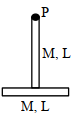
To find the correct angular velocity of the rod when it hits the table top, we apply the law of conservation of mechanical energy step-by-step:
1. Determine the Center of Mass (CM) Position:
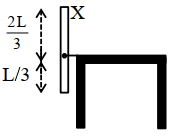
The center of mass of a thin uniform rod of length \( L \) lies at its geometric center, which is at a distance of \( \frac{L}{2} \) from either end.
According to the figure, the pivot is located at a distance of \( \frac{L}{3} \) from the bottom end. Therefore, the distance (\( d \)) between the pivot and the center of mass is:
\( d = \frac{L}{2} - \frac{L}{3} = \frac{L}{6} \)
2. Calculate the Moment of Inertia (\( I \)) about the Pivot:
Using the parallel axis theorem (\( I = I_{\text{cm}} + Md^2 \)):
\( I = \frac{1}{12}ML^2 + M\left(\frac{L}{6}\right)^2 \)
\( I = \frac{1}{12}ML^2 + \frac{1}{36}ML^2 = \frac{3 + 1}{36}ML^2 = \frac{4}{36}ML^2 = \frac{1}{9}ML^2 \)
3. Calculate the Loss in Potential Energy (\( \Delta \text{PE} \)):
- In the initial vertical position, the center of mass is located at a height of \( \frac{L}{6} \) directly above the pivot point (table level).
- In the final horizontal position, the entire rod lies flat on the table, meaning its center of mass drops down to the exact level of the pivot.
Thus, the net vertical displacement of the center of mass is \( \Delta h = \frac{L}{6} \), giving a potential energy loss of:
\( \Delta \text{PE} = Mg\Delta h = Mg\left(\frac{L}{6}\right) \)
4. Apply Conservation of Energy:
The loss in potential energy is fully converted into rotational kinetic energy (\( \frac{1}{2}I\omega^2 \)):
\( \frac{1}{2}I\omega^2 = \Delta \text{PE} \)
\( \frac{1}{2}\left(\frac{1}{9}ML^2\right)\omega^2 = Mg\left(\frac{L}{6}\right) \)
\( \frac{1}{18}ML^2\omega^2 = \frac{1}{6}MgL \)
Simplifying the equation to solve for \( \omega \):
\( \omega^2 = \frac{18}{6}\frac{g}{L} = \frac{3g}{L} \)
\( \omega = \sqrt{\frac{3g}{L}} \)
The mathematical derivation confirms that the provided answer key is completely accurate.
Hence, Option D is the correct choice. -
- (A) 33
- (B) \( 2\sqrt{88} \)
- (C) 66
- (D) 32
Show answer and solution
Correct Answer: (A)
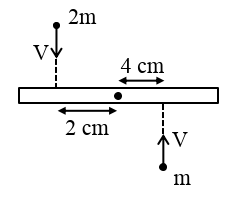
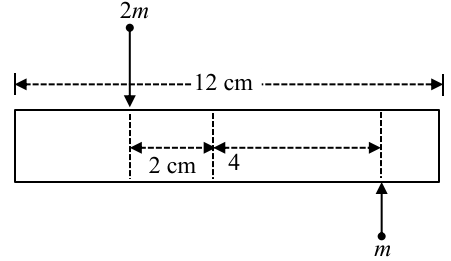
Using angular momentum conservation about COM of rod:
\( L_{i}=L_{f} \)
\( m\times V\times4+2m\times V\times2=(\frac{20m(12)^{2}}{12}+m\times4^{2}+2m\times2^{2})\omega \)
\( 8mV=(240m+24m)\omega \)
\( 8V=264 \omega \)
\( \frac{V}{\omega}=33 \) -
- (A) mg/2
- (B) mg/4
- (C) mg/3
- (D) mg
Show answer and solution
Correct Answer: (B)
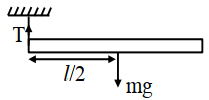
\(mg \frac{l}{2}=\frac{ m l^2}{3} \alpha\)
\(\alpha=\frac{3 g}{2 l}\)...(1)
\(mg - T = ma _{ c }\)
\(T = mg - ma _{ c }\)
\(= mg - m \left(\frac{l}{2} \alpha\right)\)
\(= mg - m \left(\frac{l}{2} \cdot \frac{3 g}{2 l}\right)\)
\(T =\frac{ mg }{4}\) -
- (A) 162
- (B) 81
- (C) 54
- (D) 27
Show answer and solution
Correct Answer: (A)
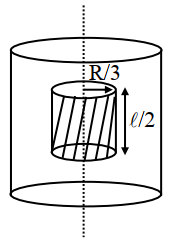
Original mass (M)
The removed mass (m)
\(m=\rho \times \pi\left(\frac{ R }{3}\right)^2 \times \frac{ L }{2}\)
\(=\frac{\rho \cdot \pi R ^2 L}{18}=\frac{ M }{18}\)
\(I ^{\prime}=\frac{1}{2} \cdot \frac{ M }{18} \cdot \frac{ R ^2}{9}=\frac{1}{324} MR ^2\)
\(\frac{ I }{ I ^{\prime}}=\frac{\frac{1}{2} MR ^2}{\frac{1}{324} MR ^2}=162\) -
- (A) \(6\)
- (B) \(3\)
- (C) \(4\)
- (D) \(\dfrac{1}{3}\)
Show answer and solution
Correct Answer: (B)
Using the equation of rotational kinematics \(\theta = \omega_0 t + \dfrac{1}{2} \alpha t^2\).
Since the wheel is initially at rest, \(\omega_0 = 0\).
Angle rotated in the first \(2\text{ s}\):
\(\theta_1 = \dfrac{1}{2} \alpha (2)^2 = 2\alpha\)
Angle rotated in the first \(4\text{ s}\):
\(\theta_{total} = \dfrac{1}{2} \alpha (4)^2 = 8\alpha\)
Angle rotated in the next \(2\text{ s}\):
\(\theta_2 = \theta_{total} - \theta_1 = 8\alpha - 2\alpha = 6\alpha\)
The ratio is:
\(\dfrac{\theta_2}{\theta_1} = \dfrac{6\alpha}{2\alpha} = 3\)
Answer: \(3\) -
- (A) Both Statement I and Statement II are true
- (B) Statement I is true but Statement II is false
- (C) Statement I is false but Statement II is true
- (D) Both Statement I and Statement II are false
Show answer and solution
Correct Answer: (A)
\( KE=\frac{1}{2}m_{1}v_{1}^{2}+\frac{1}{2}m_{2}v_{2}^{2} \)
\( KE=\frac{1}{2}(m_{1}+m_{2})v_{cm}^{2}+\frac{1}{2}\frac{m_{1}m_{2}}{m_{1}+m_{2}}|\vec{v}_{1}-\vec{v}_{2}|^{2} \)
So Ans. is (1) -
- (A) 10
- (B) 15
- (C) 20
- (D) 25
Show answer and solution
Correct Answer: (B)
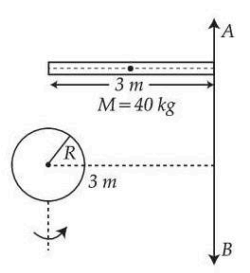
Moment of inertia of the rod about axis \(AB\) passing through one of its ends:
\(I_{\text{rod}} = \dfrac{ML^2}{3} = \dfrac{40 \times (3)^2}{3} = \dfrac{40 \times 9}{3} = 120\text{ kg}\cdot\text{m}^2\)
Moment of inertia of the solid sphere about the same axis \(AB\), using the parallel axis theorem \(I = I_{\text{cm}} + md^2\):
Mass \(m = 10\text{ kg}\), radius \(R\), distance from the centre of the sphere to axis \(AB\) is \(d = 3\text{ m}\).
\(I_{\text{sphere}} = \dfrac{2}{5}mR^2 + md^2 = \dfrac{2}{5}(10)R^2 + 10(3)^2 = 4R^2 + 90\)
Equating the two moments of inertia:
\(120 = 4R^2 + 90\)
\(4R^2 = 30\)
\(R^2 = \dfrac{15}{2}\)
\(R = \sqrt{\dfrac{15}{2}}\)
Comparing with \(R = \sqrt{\dfrac{\alpha}{2}}\):
\(\alpha = 15\)
Hence, \(\alpha = 15\). -
- (A) 100
- (B) 109
- (C) 128
- (D) 156
Show answer and solution
Correct Answer: (B)
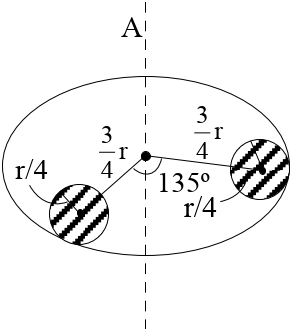
\(M =\sigma \pi R ^2\)
\(\sigma \pi R ^2=16 m\)
\(m =\frac{\sigma \pi R ^2}{16}\)
\(I _{\text {system }}=\frac{ MR ^2}{2}-2\left(\frac{ mR ^2}{2 \times 16}+\frac{9 mR ^2}{16}\right)\)
\(=\frac{ MR ^2}{2}-2 \times \frac{19 mR ^2}{32}\)
\(=\frac{ MR ^2}{2}-\frac{19}{16} mR ^2\)
\(=\frac{ MR ^2}{2}-\frac{19}{256} MR ^2 \quad\)becoz \(m =\frac{ M }{16}\)
\(=\frac{(128-19)\left( MR ^2\right)}{256}\)
\(=\frac{109 MR ^2}{256}\) -
- (A) \( \frac{3}{8}MR^{2}+\frac{7}{12}ML^{2} \)
- (B) \( \frac{3}{4}MR^{2}+\frac{1}{6}ML^{2} \)
- (C) \( \frac{3}{4}MR^{2}+\frac{7}{12}ML^{2} \)
- (D) \( \frac{3}{8}MR^{2}+\frac{1}{6}ML^{2} \)
Show answer and solution
Correct Answer: (D)
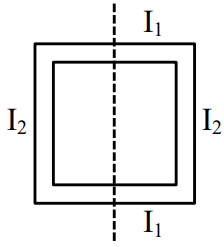
\(I _{ net }=2\left( I _1+ I _2\right)\)
\(=2\left(\frac{ M ^{\prime} R ^2}{4}+\frac{ M ^{\prime} \ell^2}{12}\right)+2\left(\frac{ M ^{\prime} R ^2}{2}+ M ^{\prime}\left(\frac{\ell}{2}\right)^2\right)\)
\(=\frac{M^{\prime} R^2}{2}+\frac{M^{\prime} R^2}{6}+M^{\prime} R^2+\frac{M^{\prime} \ell^2}{2}\)
\(=\frac{3 M ^{\prime} R ^2}{2}+\frac{2 M ^{\prime} \ell^2}{3}\)
Given masses \(M ^{\prime}=\frac{ M }{4}\)
So, \(I=\frac{3(M / 4) R^2}{2}+2 \frac{(M / 4) \ell^2}{3}\)
\(I =\frac{3}{8} MR ^2+\frac{ M \ell^2}{6}\) -
- (A) \(\left(\dfrac{\sqrt{3}}{4}, 1.25\right)\)
- (B) \(\left(\dfrac{\sqrt{3}}{4}, 1.0\right)\)
- (C) \((0, 0)\)
- (D) \((1.25, 0)\)
Show answer and solution
Correct Answer: (A)
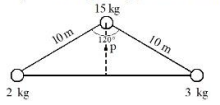
Let the midpoint \(p\) of the normal bisector be the origin \((0,0)\).
The triangle is isosceles with two sides of \(10\text{ m}\) and an included angle of \(120^\circ\). The altitude from the \(15\text{ kg}\) mass bisects the angle into two \(60^\circ\) angles.
The length of the altitude is \(10 \cos(60^\circ) = 5\text{ m}\).
Since \(p\) is the midpoint of this altitude, the \(15\text{ kg}\) mass is at a distance of \(2.5\text{ m}\) above \(p\), and the base is \(2.5\text{ m}\) below \(p\).
The distance of the \(2\text{ kg}\) and \(3\text{ kg}\) masses from the altitude is \(10 \sin(60^\circ) = 5\sqrt{3}\text{ m}\).
The coordinates of the masses with respect to \(p\) are:
\(m_1 = 15\text{ kg}\) at \((0, 2.5)\)
\(m_2 = 2\text{ kg}\) at \((-5\sqrt{3}, -2.5)\)
\(m_3 = 3\text{ kg}\) at \((5\sqrt{3}, -2.5)\)
The x-coordinate of the center of mass is:
\(x_{cm} = \dfrac{m_1 x_1 + m_2 x_2 + m_3 x_3}{m_1 + m_2 + m_3} = \dfrac{15(0) + 2(-5\sqrt{3}) + 3(5\sqrt{3})}{15 + 2 + 3} = \dfrac{5\sqrt{3}}{20} = \dfrac{\sqrt{3}}{4}\)
The y-coordinate of the center of mass is:
\(y_{cm} = \dfrac{m_1 y_1 + m_2 y_2 + m_3 y_3}{m_1 + m_2 + m_3} = \dfrac{15(2.5) + 2(-2.5) + 3(-2.5)}{20} = \dfrac{37.5 - 12.5}{20} = \dfrac{25}{20} = 1.25\)
The position of the center of mass is \(\left(\dfrac{\sqrt{3}}{4}, 1.25\right)\).
Answer: \(\left(\dfrac{\sqrt{3}}{4}, 1.25\right)\) -
- (A) \(\frac{(M-m) g}{\left[\left(\frac{13}{6}\right) M+m\right]}\)
- (B) \(\frac{( M - m ) g }{ M + m }\)
- (C) \(\frac{( M - m ) g }{\left[\left(\frac{8}{3}\right) M + m \right]}\)
- (D) \(\frac{( M - m ) g }{2 M + m }\)
Show answer and solution
Correct Answer: (C)
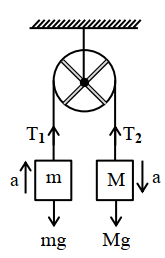
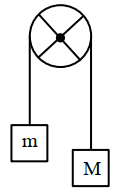
\(Mg - T _2= Ma\)\(\quad\)...(1)
\(T _1- mg = ma\)\(\quad\)...(2)
\(\left( T _2- T _1\right) r = I \frac{ a }{ r }\)\(\quad\)...(3)
\((1)+(2)+(3)\)
\((M-m) g=\left(M+m+\frac{I}{r^2}\right) a\)
Here \(I= Mr ^2+\frac{ M \times(2 r )^2}{12} \times 2\)
\(=\left(1+\frac{2}{3}\right) Mr ^2\)
\(=\frac{5}{3} Mr ^2\)
\((M-m) g=\left[M+m+\frac{5 M}{3}\right] a\)
\(a=\frac{(M-m) g}{\left[M+m+\frac{5 M}{3}\right]}\) -
- (A) \(3.33\)
- (B) \(3.12\)
- (C) \(2.22\)
- (D) \(1.42\)
Show answer and solution
Correct Answer: (C)
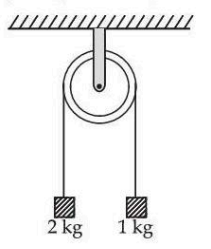
The acceleration of the blocks in the Atwood machine is given by:
\(a = \dfrac{m_1 - m_2}{m_1 + m_2} g\)
Substituting the given values (\(m_1 = 2\) kg, \(m_2 = 1\) kg):
\(a = \dfrac{2 - 1}{2 + 1} g = \dfrac{g}{3}\)
Taking the downward direction as positive, the acceleration of the \(2\) kg block is \(a_1 = \dfrac{g}{3}\) and the acceleration of the \(1\) kg block is \(a_2 = -\dfrac{g}{3}\).
The acceleration of the centre of mass is:
\(a_{cm} = \dfrac{m_1 a_1 + m_2 a_2}{m_1 + m_2}\)
\(a_{cm} = \dfrac{2 \left(\dfrac{g}{3}\right) + 1 \left(-\dfrac{g}{3}\right)}{2 + 1} = \dfrac{\dfrac{g}{3}}{3} = \dfrac{g}{9}\)
Since the system is released from rest, the initial velocity of the centre of mass is zero.
The distance traversed by the centre of mass in \(t = 2\) s is:
\(S_{cm} = \dfrac{1}{2} a_{cm} t^2\)
\(S_{cm} = \dfrac{1}{2} \left(\dfrac{10}{9}\right) (2)^2 = \dfrac{20}{9} \approx 2.22 \text{ m}\)
Answer: \(2.22\) -
- (A) \( 3.6\times10^{5} \)
- (B) \( 10^{5} \)
- (C) \( 3\times10^{5} \)
- (D) \( 2\times10^{5} \)
Show answer and solution
Correct Answer: (B)
\( L=m.V_{rel}r_{\perp} \)
\( =1000\times(36\times\frac{5}{18})\times10 \)
\( =10^{5}kg~m^{2}/s \) -
- (A) 22
- (B) 11
- (C) 100
- (D) 27
Show answer and solution
Correct Answer: (B)
\(\alpha = \frac{\tau}{I}\)
\(I =\frac{1}{4} mR ^2+ mR ^2+\frac{1}{4} mR ^2+ m (2 R )^2+\frac{ m (3 R )^2}{12}+ m \left(\frac{ R }{2}\right)^2\)
\(=\left(\frac{3}{2}+4+1\right) mR ^2=\frac{13}{2} mR ^2=\frac{13}{2} \times 600 \times 10^2=39 \times 10^4\)
\(\alpha=\frac{43 \times 10^5}{39 \times 10^4} rad / s ^2=\frac{430}{39} rad / s ^2 \approx 11 rad / s ^2\) -
- (A) circular
- (B) parabolic
- (C) straight line
- (D) elliptical
Show answer and solution
Correct Answer: (C)
Velocity of the centre of mass is given by:
\(\vec{v}_{cm} = \dfrac{m_1\vec{v}_1 + m_2\vec{v}_2}{m_1 + m_2}\)
Since \(m_1 = m_2 = m\), we get:
\(\vec{v}_{cm} = \dfrac{m(4\hat{i}) + m(4\hat{j})}{2m} = 2\hat{i} + 2\hat{j}\) m/s
Acceleration of the centre of mass is given by:
\(\vec{a}_{cm} = \dfrac{m_1\vec{a}_1 + m_2\vec{a}_2}{m_1 + m_2}\)
\(\vec{a}_{cm} = \dfrac{m(6\hat{i} + 6\hat{j}) + 0}{2m} = 3\hat{i} + 3\hat{j}\) m/s\(^2\)
Here, \(\vec{v}_{cm} = 2(\hat{i} + \hat{j})\) and \(\vec{a}_{cm} = 3(\hat{i} + \hat{j})\).
Since the initial velocity and acceleration of the centre of mass are parallel to each other, the centre of mass moves in a straight line path.
Answer: straight line -
- (A) 12
- (B) 17
- (C) 13
- (D) 15
Show answer and solution
Correct Answer: (B)
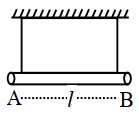
\(I =\frac{ ML ^2}{3}+\left(\frac{ ML ^2}{12}+ ML ^2\right)\)
\(=\frac{4 ML ^2+ ML ^2+12 ML ^2}{12}\)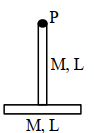
\(I =\frac{17}{12} ML ^2\)
\(\therefore \quad x =17\) -
- (A) \( 9.5\times10^{-3} \)
- (B) \( 4.75\times10^{-3} \)
- (C) \( 1.86\times10^{-2} \)
- (D) \( 8.3\times10^{-3} \)
Show answer and solution
Correct Answer: (A)
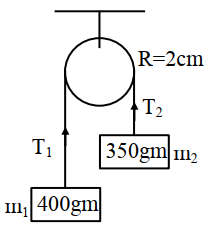
\(S=u t+\frac{1}{2} a t^2\)
\(a =\frac{2 s}{ t ^2}=\frac{2 \times 0.81}{81}=0.02 m / s ^2\)
\(m _1 g- T _1= m _1 a\)
\(T _2- m _2 g= m _2 a\)
\(\left( T _1- T _2\right) R = I \cdot \frac{ a }{ R }\)
\(\therefore a=\frac{\left(m_1-m_2\right) g}{m_1+m_2+\frac{I}{R^2}}\)
\(0.02=\frac{(400-350)\left(10^{-3}\right) g }{(400+350)\left(10^{-3}\right)+\frac{ I }{ R ^2}}\)
\(\frac{ I }{ R ^2}=\frac{50 \times 10^{-3} g}{0.02}-750 \times 10^{-3}=23.75\)
\(I =23.75 \times 4 \times 10^{-4}=9.5 \times 10^{-3} kg- m ^2\) -
- (A) 1
- (B) 2
- (C) 3
- (D) 4
Show answer and solution
Correct Answer: (B)
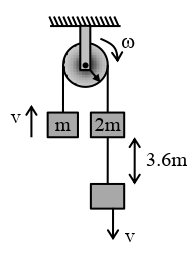
Using energy conservation
\( \frac{1}{2}mv^{2}+\frac{1}{2}2mv^{2}+\frac{1}{2}\frac{30mR^{2}}{2}\times\frac{v^{2}}{R^{2}}=mgh \)
\( 9\,mv^{2}=mgh \)
\( v=\sqrt{\frac{gh}{9}}=\sqrt{\frac{10\times3.6}{9}} \)
\( v=\sqrt{4}=2\,m/s \) -
- (A) \( \frac{3}{2}\frac{L}{md^{2}} \)
- (B) \( \frac{2L}{md^{2}} \)
- (C) \( \frac{4}{3}\frac{L}{md^{2}} \)
- (D) \( \frac{2L}{5md^{2}} \)
Show answer and solution
Correct Answer: (A)
\(L = I \omega\) and \(\omega=\frac{ L }{ I }\)
\(\omega=\frac{L}{m\left(\frac{2 d}{3}\right)^2+2 m\left(\frac{d}{3}\right)^2}=\frac{L}{\frac{4}{9} m d^2+\frac{2}{9} m d^2}=\frac{L}{\frac{6 m d^2}{9}}\)
\(\omega=\frac{3 L}{2 md ^2}\) -
- (A) Linear momentum
- (B) Velocity
- (C) Acceleration
- (D) Angular momentum
Show answer and solution
Correct Answer: (D)
\(\vec{r}=x\hat{i}+y\hat{j}+z\hat{k}\)
\(\vec{v}=\frac{d\vec{r}}{dt}=v_{x}\hat{i}+v_{y}\hat{j}+v_{z}\hat{k}\)
\(\vec{p}=m\vec{v}\)
\(\overline{L}=m(\vec{r}\times\vec{v})\)
\(=(x\hat{i}+y\hat{j}+z\hat{k})\times m(v_{x}\hat{i}+v_{y}\hat{j}+v_{z}\hat{k})\)
When sign of \(\vec{r}\) changes, \(\overrightarrow{ L }\) remains same.
No questions on this page match these filters.