


Questions
4 questionsShowing 1–4 of 4 questions
-
- (A) 32
- (B) 64
- (C) 16
- (D) 128
Show answer and solution
Correct Answer: (B)
\( \tau=\mu B~sin~\theta\Rightarrow0.016=\mu\times B\times\frac{1}{2} \)
\( \Rightarrow\mu=\frac{0.032}{B} \)
\( W_{ext}=U_{f}-U_{i}=\mu B-(-\mu B)=2\mu B \)
\( =2\times\frac{0.032}{B}\times B \)
\( =0.064~J \) -
- (A) \(\dfrac{25}{\pi}\)
- (B) \(\dfrac{1}{16\pi}\)
- (C) \(\dfrac{1}{\pi}\)
- (D) \(\dfrac{1}{4\pi}\)
Show answer and solution
Correct Answer: (B)
The magnetic field \(B\) inside the solenoid is related to the magnetic intensity \(H\) by the formula:
\(B = \mu H = \mu_0 \mu_r H\)
Rearranging for \(H\), we get:
\(H = \dfrac{B}{\mu_0 \mu_r}\)
Substituting the given values (\(B = 1.0\) T, \(\mu_r = 400\), and \(\mu_0 = 4\pi \times 10^{-7}\) T m/A):
\(H = \dfrac{1.0}{4\pi \times 10^{-7} \times 400}\)
\(H = \dfrac{1.0}{1600\pi \times 10^{-7}}\)
\(H = \dfrac{1}{16\pi \times 10^{-5}}\)
\(H = \dfrac{1}{16\pi} \times 10^5\) A/m
Comparing this with the given expression \(H = \alpha \times 10^5\), we find:
\(\alpha = \dfrac{1}{16\pi}\)
Answer: \(\dfrac{1}{16\pi}\) -
- (A) (A) is true but (R) is false
- (B) Both true, but (R) is NOT the correct explanation
- (C) Both true, and (R) is the correct explanation
- (D) (A) is false but (R) is true
Show answer and solution
Correct Answer: (B)
Conceptual -
- (A) 10
- (B) 12
- (C) 14
- (D) 16
Show answer and solution
Correct Answer: (B)
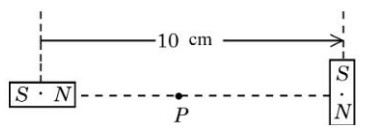
Let the magnetic moment of each magnet be \(M = 3\sqrt{5}\) J/T.
The distance of point P from the center of each magnet is \(r = 5\) cm \(= 0.05\) m.
For the first magnet (horizontal), point P lies on its axial line. The magnetic field at P due to the first magnet is:
\(B_1 = \dfrac{\mu_0}{4\pi} \dfrac{2M}{r^3}\)
The direction of \(\vec{B}_1\) is along the axis of the first magnet.
For the second magnet (vertical), point P lies on its equatorial line. The magnetic field at P due to the second magnet is:
\(B_2 = \dfrac{\mu_0}{4\pi} \dfrac{M}{r^3}\)
The direction of \(\vec{B}_2\) is parallel to the axis of the second magnet, which is perpendicular to the axis of the first magnet.
Since \(\vec{B}_1\) and \(\vec{B}_2\) are perpendicular to each other, the net magnetic field at P is:
\(B = \sqrt{B_1^2 + B_2^2}\)
Substituting the expressions for \(B_1\) and \(B_2\):
\(B = \sqrt{\left(\dfrac{\mu_0}{4\pi} \dfrac{2M}{r^3}\right)^2 + \left(\dfrac{\mu_0}{4\pi} \dfrac{M}{r^3}\right)^2}\)
\(B = \dfrac{\mu_0}{4\pi} \dfrac{M}{r^3} \sqrt{2^2 + 1^2} = \dfrac{\mu_0}{4\pi} \dfrac{\sqrt{5}M}{r^3}\)
Substituting the given values \(\dfrac{\mu_0}{4\pi} = 10^{-7}\) T m/A, \(M = 3\sqrt{5}\) J/T, and \(r = 0.05\) m:
\(B = 10^{-7} \times \dfrac{\sqrt{5} \times 3\sqrt{5}}{(0.05)^3}\)
\(B = 10^{-7} \times \dfrac{15}{125 \times 10^{-6}}\)
\(B = \dfrac{15 \times 10^{-1}}{125}\)
\(B = 0.1 \times 0.12\) T
\(B = 0.012\) T
\(B = 12 \times 10^{-3}\) T
Comparing this with the given value \(\alpha \times 10^{-3}\) T, we get \(\alpha = 12\).
Answer: \(12\)
No questions on this page match these filters.