


All JEE Mains 2026 Physics questions
31 chaptersShowing 351–400 of 469 questions
-
- (A) \(3\)
- (B) \(4\)
- (C) \(14\)
- (D) \(9\)
Show answer and solution
Correct Answer: (B)
The right compartment is enclosed by adiabatic walls and an adiabatic piston, and no heat is supplied to it. Therefore, the gas in the right compartment undergoes an adiabatic compression.
Since the piston is frictionless, the pressure in the right compartment is always equal to the pressure in the left compartment. The final pressure in both compartments is \(P_f = \dfrac{27P}{8}\).
For the adiabatic process in the right compartment, the equation is:
\(P_i V_i^\gamma = P_f V_f^\gamma\)
Given \(P_i = P\), \(V_i = 9\) L, \(P_f = \dfrac{27P}{8}\), and \(\gamma = \dfrac{C_P}{C_V} = 1.5 = \dfrac{3}{2}\). Substituting these values:
\(P(9)^{3/2} = \left(\dfrac{27P}{8}\right) V_f^{3/2}\)
Since \(9^{3/2} = (3^2)^{3/2} = 3^3 = 27\), the equation becomes:
\(27P = \dfrac{27P}{8} V_f^{3/2}\)
Dividing both sides by \(27P\):
\(1 = \dfrac{1}{8} V_f^{3/2}\)
\(V_f^{3/2} = 8\)
Taking the power of \(2/3\) on both sides:
\(V_f = (8)^{2/3} = (2^3)^{2/3} = 2^2 = 4\) litres.
Answer: \(4\) - 352. A diatomic gas \((\gamma=1.4)\) does 100 J of work when it is expanded isobarically. Then the heat given to the gas _________ J. 2026 Easy
- (A) 250
- (B) 350
- (C) 450
- (D) 100
Show answer and solution
Correct Answer: (B)
\(w =100 J= nR \Delta T\) for isobaric process.
\(Q = nC _{ p } \Delta T =\left(\frac{ f }{2}+1\right) nR \Delta T\)
\(=\frac{7}{2} \cdot(100)=350\) Joule -
- (A) 300
- (B) 600
- (C) 150
- (D) 450
Show answer and solution
Correct Answer: (A)
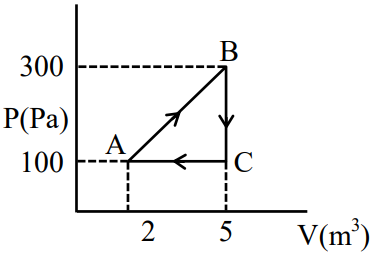
Work done = Area bounded by cycle
\(=\frac{1}{2}\times3\times200=300~J\) -
- (A) 40
- (B) 60
- (C) 80
- (D) 120
Show answer and solution
Correct Answer: (D)
Given \(P_1 = 8\) bar \(= 8 \times 10^5\) Pa, \(V_1 = 0.15\) m\(^3\), and \(P_2 = 1\) bar \(= 10^5\) Pa.
The adiabatic index \(\gamma\) is given by:
\(\gamma = \dfrac{c_p}{c_v} = \dfrac{3R}{2R} = 1.5\)
For an adiabatic process, \(P_1 V_1^\gamma = P_2 V_2^\gamma\).
\(V_2 = V_1 \left( \dfrac{P_1}{P_2} \right)^{\dfrac{1}{\gamma}}\)
\(V_2 = 0.15 \times \left( \dfrac{8}{1} \right)^{\dfrac{1}{1.5}} = 0.15 \times 8^{\dfrac{2}{3}} = 0.15 \times 4 = 0.6\) m\(^3\)
The work done during the adiabatic expansion is:
\(W = \dfrac{P_1 V_1 - P_2 V_2}{\gamma - 1}\)
\(W = \dfrac{8 \times 10^5 \times 0.15 - 1 \times 10^5 \times 0.6}{1.5 - 1}\)
\(W = \dfrac{1.2 \times 10^5 - 0.6 \times 10^5}{0.5}\)
\(W = \dfrac{0.6 \times 10^5}{0.5} = 1.2 \times 10^5\) J
\(W = 120\) kJ
Answer: \(120\) -
- (A) \(\dfrac{9P_o V_o}{8R}\)
- (B) \(\dfrac{11P_o V_o}{10R}\)
- (C) \(\dfrac{7P_o V_o}{6R}\)
- (D) \(\dfrac{13P_o V_o}{11R}\)
Show answer and solution
Correct Answer: (B)
The given relation between pressure and volume is:
\(P = P_o\left(1 + \left(\dfrac{V_o}{V}\right)^2\right)^{-1}\)
For sample A, the initial volume is \(V_A = V_o\). Substituting this into the given relation, the initial pressure \(P_A\) is:
\(P_A = P_o\left(1 + \left(\dfrac{V_o}{V_o}\right)^2\right)^{-1} = \dfrac{P_o}{2}\)
Using the ideal gas equation \(PV = nRT\) for \(n = 2\) moles, the initial temperature \(T_A\) is:
\(T_A = \dfrac{P_A V_A}{nR} = \dfrac{\left(\dfrac{P_o}{2}\right) V_o}{2R} = \dfrac{P_o V_o}{4R}\)
For sample B, the initial volume is \(V_B = 3V_o\). Substituting this into the relation, the initial pressure \(P_B\) is:
\(P_B = P_o\left(1 + \left(\dfrac{V_o}{3V_o}\right)^2\right)^{-1} = P_o\left(1 + \dfrac{1}{9}\right)^{-1} = \dfrac{9P_o}{10}\)
The initial temperature \(T_B\) for \(n = 2\) moles is:
\(T_B = \dfrac{P_B V_B}{nR} = \dfrac{\left(\dfrac{9P_o}{10}\right) (3V_o)}{2R} = \dfrac{27P_o V_o}{20R}\)
The difference in the initial temperatures of the two samples is:
\(T_B - T_A = \dfrac{27P_o V_o}{20R} - \dfrac{P_o V_o}{4R}\)
\(T_B - T_A = \dfrac{27P_o V_o - 5P_o V_o}{20R} = \dfrac{22P_o V_o}{20R} = \dfrac{11P_o V_o}{10R}\)
Answer: \(\dfrac{11P_o V_o}{10R}\) -
- (A) C, D and E Only
- (B) A, B and C Only
- (C) A, B and D Only
- (D) B, C and D Only
Show answer and solution
Correct Answer: (C)
Statement A is correct because the zeroth law of thermodynamics defines temperature and thermal equilibrium.
Statement B is correct because the first law of thermodynamics introduces the concept of internal energy through the equation \(\Delta Q = \Delta U + \Delta W\).
Statement C is incorrect because for an isothermal expansion of an ideal gas, the change in internal energy \(\Delta U = 0\). According to the first law of thermodynamics, \(\Delta Q = \Delta W\).
Statement D is correct because if an intensive variable (which is independent of the size of the system) is multiplied by an extensive variable (which is directly proportional to the size of the system), the product will be directly proportional to the size of the system, making it an extensive variable.
Statement E is incorrect because the ratio of two extensive variables (like any extensive variable and mass) is independent of the size of the system, making it an intensive variable.
Therefore, only statements A, B, and D are correct.
Answer: A, B and D Only -
- (A) 315826.2
- (B) 234699.2
- (C) 258700.8
- (D) 268799.2
Show answer and solution
Correct Answer: (D)
\( Q=mS\Delta T=4\times4200\times16~J=268800~J \)
\( W=P\Delta V \)
\( \Delta V=(\frac{m}{\rho_{f}}-\frac{m}{\rho_{i}})=4[\frac{1}{998}-\frac{1}{1000}] \)
\( P=10^{5}Pa. \)
.. \( W=10^{5}\times4\times[\frac{1}{998}-\frac{1}{1000}]=\frac{8\times10^{5}}{10^{3}\times998}\approx0.8~J \)
\( \Delta U=Q-W=268799.2~J \) -
- (A) Both A and R are true and R is the correct explanation of A
- (B) Both A and R are true but R is NOT the correct explanation of A
- (C) A is true but R is false
- (D) A is false but R is true
Show answer and solution
Correct Answer: (B)
Statement I is true because for an ideal gas, the change in internal energy is given by \(\Delta U = n C_v \Delta T\). Using Mayer's relation \(C_p - C_v = R\) and the ratio of specific heats \(\gamma = \dfrac{C_p}{C_v}\), we can write \(C_v = \dfrac{R}{\gamma - 1}\). Substituting this, we get \(\Delta U = \dfrac{nR}{\gamma - 1}(T_f - T_i)\).
Statement II is true because according to the law of equipartition of energy, the molar heat capacity at constant volume is \(C_v = \dfrac{f}{2}R\) and at constant pressure is \(C_p = \left(\dfrac{f}{2} + 1\right)R\). Therefore, \(\gamma = \dfrac{C_p}{C_v} = 1 + \dfrac{2}{f}\).
Statement II does not explain Statement I, as Statement I is derived purely from macroscopic thermodynamic relations (Mayer's relation) and is independent of the microscopic concept of degrees of freedom.
Hence, both statements are true but Statement II is NOT the correct explanation of Statement I.
Answer: Both A and R are true but R is NOT the correct explanation of A - 359. Heat is supplied to a diatomic gas at constant pressure. Then the ratio of \(\Delta Q : \Delta U : \Delta W\) is _______. 2026 Medium
- (A) \(2 : 3 : 5\)
- (B) \(5 : 3 : 2\)
- (C) \(2 : 5 : 7\)
- (D) \(7 : 5 : 2\)
Show answer and solution
Correct Answer: (D)
For a diatomic gas, the number of degrees of freedom is \(f = 5\).
The molar heat capacity at constant volume is \(C_v = \dfrac{f}{2}R = \dfrac{5}{2}R\).
The molar heat capacity at constant pressure is \(C_p = C_v + R = \dfrac{7}{2}R\).
At constant pressure, the heat supplied is \(\Delta Q = nC_p\Delta T = n\left(\dfrac{7}{2}R\right)\Delta T\).
The change in internal energy is \(\Delta U = nC_v\Delta T = n\left(\dfrac{5}{2}R\right)\Delta T\).
The work done by the gas is \(\Delta W = nR\Delta T = n\left(\dfrac{2}{2}R\right)\Delta T\).
The ratio \(\Delta Q : \Delta U : \Delta W\) is \(\dfrac{7}{2} : \dfrac{5}{2} : \dfrac{2}{2} = 7 : 5 : 2\).
Answer: \(7 : 5 : 2\) -
- (A) \(-\frac{1}{a}\)
- (B) \(+\frac{1}{3a}\)
- (C) \(\frac{1}{2a}\)
- (D) \(-\frac{1}{3a}\)
Show answer and solution
Correct Answer: (D)
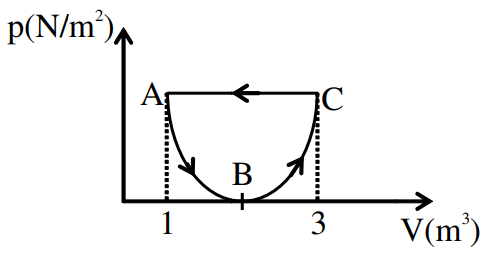
\(w =\) Area of parabola
\(=\frac{2}{3}(\) Area of rectangle AC 31 A\()\)
\(=\frac{2}{3} P _0(3-1)=\frac{4 P _0}{3}\)
When \(V =1\)
\((1-2)^2=4 aP _0\)
\(P _0=\frac{1}{4 a }\)
\(w =\frac{4}{3} P _0=\frac{4}{3} \frac{1}{4 a }=\frac{1}{3 a }\)
\(w _{ gas }=\frac{-1}{3 a }\) -
- (A) \(-2PV(3\sqrt{3}-1)\)
- (B) \(\dfrac{4}{3}PV\)
- (C) \(-\dfrac{4}{3}PV\)
- (D) \(\dfrac{3}{4}PV\)
Show answer and solution
Correct Answer: (C)
For a monoatomic ideal gas, the ratio of specific heats is \(\gamma = \dfrac{5}{3}\).
In an adiabatic process, \(PV^{\gamma} = \text{constant}\).
\(P_1 V_1^{\gamma} = P_2 V_2^{\gamma}\)
\(P V^{5/3} = P_2 (27V)^{5/3}\)
\(P_2 = P \left(\dfrac{1}{27}\right)^{5/3} = \dfrac{P}{243}\)
The change in internal energy is given by:
\(\Delta U = \dfrac{P_2 V_2 - P_1 V_1}{\gamma - 1}\)
Substituting the values:
\(\Delta U = \dfrac{\left(\dfrac{P}{243}\right)(27V) - PV}{\dfrac{5}{3} - 1}\)
\(\Delta U = \dfrac{\dfrac{PV}{9} - PV}{\dfrac{2}{3}}\)
\(\Delta U = \dfrac{-\dfrac{8}{9}PV}{\dfrac{2}{3}} = -\dfrac{4}{3}PV\)
Answer: \(-\dfrac{4}{3}PV\) -
- (A) \(-189\)
- (B) \(-56\)
- (C) \(-30\)
- (D) \(-117\)
Show answer and solution
Correct Answer: (B)
For Isothermal process
\(W _{\text {isothermal }}= nRT \ell n \left(\frac{ V _2}{V_1}\right)\)
\(=1 . R 300 . \ell n (2)\)
\(=300 R(0.693)\)............(1)
Now for adiabatic process,
It is given work done in Isothermal = work done in adiabatic
\(W_{\text {adiabatic }}=\frac{nR\left(T_1-T_2\right)}{\gamma-1}\)............(2)
\((1)=(2)\)
\(\frac{ nR \left(300- T _{\text {final }}\right)}{1.4-1}=300 R (0.693)\)
\(T _{\text {Final }}=216.84 K\)
\(=-56^{\circ} C\) -
- (A) \(24.8\)
- (B) \(25\)
- (C) \(15.04\)
- (D) \(29.98\)
Show answer and solution
Correct Answer: (B)
Using the first law of thermodynamics:
\(Q = \Delta U + W\)
Since the gas is diatomic with rotational modes only, the degrees of freedom are \(f = 5\), so:
\(C_V = \dfrac{5}{2}R\)
For \(n = 1\text{ mole}\) and \(\Delta T = 1.2\text{ K}\):
\(\Delta U = nC_V\Delta T = 1 \times \dfrac{5}{2} \times 8.3 \times 1.2 = 24.9\text{ J}\)
Work done by the gas:
\(W = P\,\Delta V\)
Cross-sectional area of the piston:
\(A = 4\text{ cm}^2 = 4 \times 10^{-4}\text{ m}^2\)
Piston displacement:
\(x = 25\text{ mm} = 2.5 \times 10^{-2}\text{ m}\)
Change in volume:
\(\Delta V = A \cdot x = (4 \times 10^{-4})(2.5 \times 10^{-2}) = 1 \times 10^{-5}\text{ m}^3\)
With \(P = 100\text{ kPa} = 10^5\text{ Pa}\):
\(W = (10^5)(1 \times 10^{-5}) = 1\text{ J}\)
Therefore, the heat supplied is:
\(Q = \Delta U + W = 24.9 + 1 = 25.9\text{ J}\)
Hence, the heat supplied to the gas is \(25.9\text{ J}\). -
- (A) 14.5
- (B) 1.55
- (C) 15.5
- (D) 1.45
Show answer and solution
Correct Answer: (C)
\(\Delta U=3nR\Delta T\)
\(\Delta U=3\times1\times\frac{25}{3}\times4=100~Joule\)
\(\Delta Q=126\)
\(W=26=P\Delta V\)
\(26=10^{3}\times17\times10^{-4}\Delta x\)
\(\Delta x=\frac{26}{170}=15.3\) -
- (A) \( CO_{2} \)
- (B) \( O_{2} \)
- (C) \( NH_{3} \)
- (D) He
Show answer and solution
Correct Answer: (D)
\( PV^{\gamma}=constant \)
\( TV^{\gamma-1}=(\frac{T}{4})(8V)^{(\gamma-1)} \)
\( 4=8^{(\gamma-1)} \)
\( 2^{2}=2^{3\gamma-3} \)
\( 2=3(\gamma-1) \)
\( \gamma=\frac{5}{3} \)
Gas is a monoatomic gas.
Answer is He. -
- (A) 10
- (B) 15
- (C) 6.67
- (D) 11.6
Show answer and solution
Correct Answer: (A)
\(10 \times 3.36 \times 10^5+10 \times 2100 \times 10+10 \times 4200 \times(T-0)\)
\(=100 \times 4200 \times(25- T )\)
\(\Rightarrow T =15^{\circ} C\)
\(\Delta T =25-15=10^{\circ} C\) -
- (A) \(-86\)
- (B) \(-71\)
- (C) \(-65\)
- (D) \(-80\)
Show answer and solution
Correct Answer: (B)
\( T=\alpha YA(27-(-43).....(i) \)
\( 1.4~T=\alpha YA(27-\theta) \) ....(ii)
using (ii)/(i)
\( 1.4=\frac{27-\theta}{70} \)
\( 27-\theta=98 \)
\(\therefore \theta=-71^{\circ} C\) -
- (A) 2.1
- (B) 4.2
- (C) 0.42
- (D) 0.21
Show answer and solution
Correct Answer: (C)
Water flow rate \(=5 \ell / \min =\frac{5}{60} kg / s\)
∴ Power of heater \(=\frac{ dm }{ dt } S \Delta T =\frac{1}{12} \times 4200 \times 60 W\)
\(\therefore \quad\) Let rate of consumption of gas be x \( g / s\).
\(\therefore \quad x \times 5.0 \times 10^4=\frac{1}{12} \times 4200 \times 60\)
\(\Rightarrow \quad x=4200 \times 10^{-4}=0.42 g / s\) -
- (A) 120.20 cm
- (B) 120.15 cm
- (C) 120.03 cm
- (D) 120.06 cm
Show answer and solution
Correct Answer: (B)
\(\ell_{\text {final }}=\ell_0\left(1+\alpha_{ A } \Delta T \right)+\ell_0\left(1+\alpha_{ B } \Delta T \right)\)
\(=\ell_0\left[2+\left(\alpha_{ A }+\alpha_{ B }\right) \Delta T \right]\)
\(=60\left[2+\left(36 \times 10^{-6}\right) \times 70\right]\)
\(=60[2+0.0025]\)
\(=120.15 cm\) -
- (A) \(\dfrac{2}{T}\)
- (B) \(\dfrac{1}{T}\)
- (C) \(\dfrac{4}{T}\)
- (D) \(\dfrac{3}{T}\)
Show answer and solution
Correct Answer: (C)
Given the process equation for the ideal gas:
\(PT^3 = \text{constant}\)
From the ideal gas equation, \(PV = nRT\), which gives \(P = \dfrac{nRT}{V}\).
Substituting \(P\) into the process equation:
\(\left(\dfrac{nRT}{V}\right) T^3 = \text{constant}\)
\(\dfrac{T^4}{V} = \text{constant}\)
\(V = k T^4\)
Differentiating both sides with respect to temperature \(T\):
\(\dfrac{dV}{dT} = 4k T^3\)
The coefficient of volume expansion \(\gamma\) is defined as:
\(\gamma = \dfrac{1}{V} \dfrac{dV}{dT}\)
Substituting the values of \(V\) and \(\dfrac{dV}{dT}\):
\(\gamma = \dfrac{1}{k T^4} (4k T^3) = \dfrac{4}{T}\)
Answer: \(\dfrac{4}{T}\) -
- (A) \(\Delta L_1[1+2\alpha^2(\Delta T)^2]\)
- (B) \(\Delta L_1[1+\alpha^2(\Delta T)^2]\)
- (C) \(\Delta L_1[1+2\alpha\Delta T]\)
- (D) \(\Delta L_1[1+\alpha\Delta T]\)
Show answer and solution
Correct Answer: (D)
Let the length of the metal strip at temperature \(T_1\) be \(L_1\).
When the temperature is increased from \(T_1\) to \(T_2\), the new length \(L_2\) is given by:
\(L_2 = L_1(1 + \alpha \Delta T)\)
where \(\Delta T = T_2 - T_1\).
The increase in length is:
\(\Delta L_1 = L_2 - L_1 = L_1 \alpha \Delta T\)
When the temperature is further increased from \(T_2\) to \(T_3\), the new length \(L_3\) is:
\(L_3 = L_2(1 + \alpha \Delta T')\)
where \(\Delta T' = T_3 - T_2\).
Given \(T_3 + T_1 = 2T_2\), we have \(T_3 - T_2 = T_2 - T_1 = \Delta T\).
Thus, \(\Delta T' = \Delta T\).
The increase in length for this second temperature change is:
\(\Delta L_2 = L_3 - L_2 = L_2 \alpha \Delta T\)
Substituting \(L_2 = L_1(1 + \alpha \Delta T)\) into the equation for \(\Delta L_2\):
\(\Delta L_2 = L_1(1 + \alpha \Delta T) \alpha \Delta T\)
\(\Delta L_2 = (L_1 \alpha \Delta T)(1 + \alpha \Delta T)\)
Since \(\Delta L_1 = L_1 \alpha \Delta T\), substituting this gives:
\(\Delta L_2 = \Delta L_1(1 + \alpha \Delta T)\)
Answer: \(\Delta L_1[1+\alpha\Delta T]\) -
- (A) 33
- (B) 34
- (C) 35
- (D) 36
Show answer and solution
Correct Answer: (A)
Given parameters:
\(L = 3\text{ m}\)
\(\Delta L = 3 \times 10^{-3}\text{ m}\)
\(V = 600 \times 10^{-6}\text{ m}^3\)
\(Y = 1.1 \times 10^{11}\text{ N/m}^2\)
Strain is given by:
\(\text{Strain} = \dfrac{\Delta L}{L} = \dfrac{3 \times 10^{-3}}{3} = 10^{-3}\)
Elastic potential energy stored in the wire is:
\(U = \dfrac{1}{2} \times \text{Stress} \times \text{Strain} \times \text{Volume}\)
Since \(\text{Stress} = Y \times \text{Strain}\):
\(U = \dfrac{1}{2} \times Y \times (\text{Strain})^2 \times V\)
Substituting the values:
\(U = \dfrac{1}{2} \times (1.1 \times 10^{11}) \times (10^{-3})^2 \times (600 \times 10^{-6})\)
\(U = \dfrac{1}{2} \times 1.1 \times 10^{11} \times 10^{-6} \times 600 \times 10^{-6}\)
\(U = \dfrac{1}{2} \times 1.1 \times 600 \times 10^{-1}\)
\(U = \dfrac{1}{2} \times 66 = 33\text{ J}\)
Answer: \(33\) -
- (A) 2
- (B) 3
- (C) 4
- (D) 5
Show answer and solution
Correct Answer: (A)
Given:
Side length of the cube, \(L = 5\) cm \(= 0.05\) m
Modulus of rigidity, \(\eta = 10^5\) N/m\(^2\)
Force applied on the upper face, \(F = 10\) N
Area of the upper face, \(A = L^2 = (0.05)^2 = 2.5 \times 10^{-3}\) m\(^2\)
Shear stress is given by:
\(\text{Stress} = \dfrac{F}{A} = \dfrac{10}{2.5 \times 10^{-3}} = 4000\) N/m\(^2\)
Shear strain is given by:
\(\text{Strain} = \dfrac{\Delta x}{L}\)
Modulus of rigidity is defined as the ratio of shear stress to shear strain:
\(\eta = \dfrac{\text{Stress}}{\text{Strain}} = \dfrac{F/A}{\Delta x/L}\)
Rearranging for displacement \(\Delta x\):
\(\Delta x = \dfrac{F \cdot L}{A \cdot \eta}\)
Substituting the values:
\(\Delta x = \dfrac{10 \times 0.05}{2.5 \times 10^{-3} \times 10^5}\)
\(\Delta x = \dfrac{0.5}{250} = 0.002\) m
Converting to millimeters:
\(\Delta x = 0.002 \times 1000 = 2\) mm
Answer: \(2\) -
- (A) \(1\)
- (B) \(4\)
- (C) \(8\)
- (D) \(6\)
Show answer and solution
Correct Answer: (D)
Tension in string \(B\) is due to the block of mass \(2M\):
\(T_B = 2Mg\)
Tension in string \(A\) is due to both blocks of mass \(M\) and \(2M\):
\(T_A = Mg + 2Mg = 3Mg\)
The elongation in a string is given by Hooke's law as \(\Delta L = \dfrac{TL}{AY}\).
The ratio of elongations in string \(A\) to string \(B\) is:
\(\dfrac{\Delta L_A}{\Delta L_B} = \left(\dfrac{T_A}{T_B}\right) \left(\dfrac{L_A}{L_B}\right) \left(\dfrac{A_B}{A_A}\right) \left(\dfrac{Y_B}{Y_A}\right)\)
Given that \(\dfrac{L_A}{L_B} = 2\), \(\dfrac{A_B}{A_A} = 1\), and \(\dfrac{Y_A}{Y_B} = 0.5 \Rightarrow \dfrac{Y_B}{Y_A} = 2\).
Substituting the values into the ratio equation:
\(\dfrac{\Delta L_A}{\Delta L_B} = \left(\dfrac{3Mg}{2Mg}\right) \times (2) \times (1) \times (2)\)
\(\dfrac{\Delta L_A}{\Delta L_B} = \dfrac{3}{2} \times 4 = 6\)
Answer: \(6\) -
- (A) \(3\)
- (B) \(2\)
- (C) \(1.9\)
- (D) \(1\)
Show answer and solution
Correct Answer: (B)
Given:
Length of string A, \(L_A = 0.314\) m
Young's modulus of string A, \(Y_A = 2 \times 10^{10}\) N/m\(^2\)
Radius of both strings, \(r = 0.2\) mm \(= 2 \times 10^{-4}\) m
Length of string B, \(L_B = 2L_A = 0.628\) m
Young's modulus of string B, \(Y_B = 2Y_A = 4 \times 10^{10}\) N/m\(^2\)
Mass of load, \(m = 0.8\) kg
Acceleration due to gravity, \(g = 10\) m/s\(^2\)
Tension in both strings, \(T = mg = 0.8 \times 10 = 8\) N
Cross-sectional area of both strings:
\(A = \pi r^2 = 3.14 \times (2 \times 10^{-4})^2 = 3.14 \times 4 \times 10^{-8}\) m\(^2\)
Elongation in string A:
\(\Delta L_A = \dfrac{T L_A}{A Y_A}\)
\(\Delta L_A = \dfrac{8 \times 0.314}{3.14 \times 4 \times 10^{-8} \times 2 \times 10^{10}}\)
\(\Delta L_A = \dfrac{8 \times 0.314}{8 \times 3.14 \times 10^2} = \dfrac{0.1}{10^2} = 10^{-3}\) m \(= 1\) mm
Elongation in string B:
\(\Delta L_B = \dfrac{T L_B}{A Y_B}\)
\(\Delta L_B = \dfrac{8 \times (2 \times 0.314)}{A \times (2 Y_A)} = \dfrac{T L_A}{A Y_A} = 1\) mm
Net change in length of the combination:
\(\Delta L = \Delta L_A + \Delta L_B = 1 + 1 = 2\) mm
Answer: \(2\) -
- (A) 6
- (B) 9
- (C) 12
- (D) 3
Show answer and solution
Correct Answer: (D)
Let \(T\) be the tension in the wire at a distance \(\dfrac{l}{3}\) from the top.
The length of the wire below this point is \(l - \dfrac{l}{3} = \dfrac{2l}{3}\).
The weight of this lower part of the wire is \(\dfrac{w}{l} \times \dfrac{2l}{3} = \dfrac{2w}{3}\).
The total downward force (tension \(T\)) at this point is the sum of the weight \(W\) attached at the bottom and the weight of the lower part of the wire:
\(T = W + \dfrac{2w}{3}\)
The stress at this point is given by the tension divided by the cross-sectional area \(A\):
\(\text{Stress} = \dfrac{T}{A} = \dfrac{W + \dfrac{2w}{3}}{A} = \dfrac{W}{A} + \dfrac{2}{3}\dfrac{w}{A}\)
Comparing this with the given expression for stress, \(\dfrac{W}{A} + \dfrac{2}{\gamma}\dfrac{w}{A}\), we get:
\(\gamma = 3\)
Answer: \(3\) -
- (A) \(1.0 \times 10^{11}\)
- (B) \(2.0 \times 10^{10}\)
- (C) \(1.0 \times 10^{10}\)
- (D) \(2.0 \times 10^{11}\)
Show answer and solution
Correct Answer: (C)
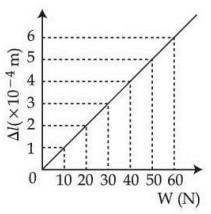
From the given graph, we can observe that for a load \(W = 20\) N, the extension is \(\Delta l = 2 \times 10^{-4}\) m.
The formula for Young's modulus \(Y\) is:
\(Y = \dfrac{\text{Stress}}{\text{Strain}} = \dfrac{W / A}{\Delta l / L} = \dfrac{W L}{A \Delta l}\)
Given:
Length of the wire, \(L = 1\) m
Cross-sectional area, \(A = 10^{-5}\) m\(^2\)
Substituting the values into the formula:
\(Y = \dfrac{20 \times 1}{10^{-5} \times 2 \times 10^{-4}}\)
\(Y = \dfrac{20}{2 \times 10^{-9}}\)
\(Y = 10 \times 10^9 = 1.0 \times 10^{10}\) N/m\(^2\)
Answer: \(1.0 \times 10^{10}\) -
- (A) 920
- (B) 922
- (C) 924
- (D) 926
Show answer and solution
Correct Answer: (B)
Heat extracted to cool \(x\) gram of water from \(50^{\circ}\text{C}\) to \(0^{\circ}\text{C}\) is given by:
\(Q_1 = m_1 c \Delta T_1\)
\(Q_1 = x \times 4.2 \times (50 - 0) = 210x \text{ J}\)
Heat required to raise the temperature of \((1000 - x)\) gram of water from \(50^{\circ}\text{C}\) to \(100^{\circ}\text{C}\) and evaporate it is given by:
\(Q_2 = m_2 c \Delta T_2 + m_2 L\)
\(Q_2 = (1000 - x) \times [4.2 \times (100 - 50) + 2256]\)
\(Q_2 = (1000 - x) \times (210 + 2256) = 2466(1000 - x) \text{ J}\)
Equating the heat extracted and the heat required:
\(Q_1 = Q_2\)
\(210x = 2466(1000 - x)\)
\(210x = 2466000 - 2466x\)
\(2676x = 2466000\)
\(x = \dfrac{2466000}{2676} \approx 921.52\)
The closest integer value for \(x\) is \(922\).
Answer: \(922\) -
- (A) \(2\%\)
- (B) \(3\%\)
- (C) \(6\%\)
- (D) \(4\%\)
Show answer and solution
Correct Answer: (B)
Bulk modulus is given by \(B = \dfrac{\Delta P}{-\dfrac{\Delta V}{V}}\)
The fractional decrease in volume is \(-\dfrac{\Delta V}{V} = \dfrac{\Delta P}{B}\)
Substituting the given values:
\(-\dfrac{\Delta V}{V} = \dfrac{6.3 \times 10^7}{2.1 \times 10^9} = 3 \times 10^{-2}\)
The percentage decrease in volume is \(\left(-\dfrac{\Delta V}{V}\right) \times 100\)
Percentage decrease \(= 3 \times 10^{-2} \times 100 = 3\%\)
Answer: \(3\%\) -
- (A) 399
- (B) 398
- (C) 402
- (D) 401
Show answer and solution
Correct Answer: (D)
\(V_{sound}=\sqrt{\frac{Y}{\rho}}\)
\(\frac{\Delta V}{V}\times100=\frac{1}{2}(\frac{\Delta Y}{Y}\times100)-\frac{1}{2}(\frac{\Delta\rho}{\rho}\times100)\)
\(=\frac{1}{2}\times1-\frac{1}{2}\times0.5\)
\(\frac{\Delta V}{V}\times100=\frac{1}{4}\)
\(\Delta V=\frac{1}{4}\times\frac{V}{100}\)
\(\Delta V=1m/s\)
\(V_{final}=400+1=401~m/s\) - 381. The strain-stress plot for materials A, B, C and D is shown in the figure. Which material has the largest Young's modulus?
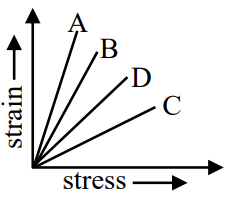 2026 Medium
- (A) C
- (B) D
- (C) A
- (D) B
Show answer and solution
Correct Answer: (A)
\(\frac{\text { Strain }}{\text { Stress }}=\frac{1}{ Y }=\) Slope -
- (A) \(1.1\)
- (B) \(2.22\)
- (C) \(1.21\)
- (D) \(4.44\)
Show answer and solution
Correct Answer: (C)
Given that the wires have equal cross-sectional area \(A\) and are under the same tension \(F\), the elongation \(\Delta L\) is given by:
\(\Delta L = \dfrac{F L}{A Y}\)
Since the elongations in both wires are equal (\(\Delta L_A = \Delta L_B\)):
\(\dfrac{F L_A}{A Y_A} = \dfrac{F L_B}{A Y_B}\)
\(\dfrac{L_A}{Y_A} = \dfrac{L_B}{Y_B}\)
\(L_B = L_A \times \dfrac{Y_B}{Y_A}\)
Substituting the given values \(L_A = 2.2\) m and \(\dfrac{Y_A}{Y_B} = \dfrac{20}{11}\):
\(L_B = 2.2 \times \dfrac{11}{20}\)
\(L_B = \dfrac{24.2}{20} = 1.21\) m
Answer: \(1.21\) -
- (A) increases by two times
- (B) reduces by half
- (C) remains unchanged
- (D) becomes one fourth
Show answer and solution
Correct Answer: (C)
Young's modulus \(Y\) is an intrinsic property of the material of the wire.
It depends only on the nature of the material and its temperature, and is independent of the dimensions of the wire such as length \(L\) and radius \(r\).
Therefore, when the radius and length of the steel wire are doubled, its Young's modulus remains unchanged.
Answer: remains unchanged -
- (A) 1
- (B) 4
- (C) 2
- (D) 5
Show answer and solution
Correct Answer: (D)
\(T =\frac{ F / A }{\Delta \ell / \ell} \Rightarrow Y =\frac{ F \ell}{ A \Delta \ell}\)
\(\frac{Y_{A}}{Y_{B}} = \frac{l_{A}}{l_{B}} (\frac{A_{B}}{A_{A}})\)
\(= \frac{6}{5.4} (\frac{4.5 \times 10^{-5}}{3 \times 10^{-5}}) = \frac{9}{5.4} = \frac{5}{3}\)\(\Rightarrow \frac{x}{3} = \frac{5}{3}\)
\(\Rightarrow x = 5\) -
- (A) \(56\)
- (B) \(38\)
- (C) \(96\)
- (D) \(5.6\)
Show answer and solution
Correct Answer: (B)
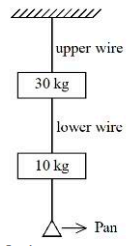
Let the maximum mass that can be added to the pan be \(m\).
The breaking stress for both wires is \(\sigma_{max} = 12 \times 10^8 \text{ N/m}^2\).
For the upper wire:
Area of cross-section, \(A_u = 0.008 \text{ cm}^2 = 8 \times 10^{-7} \text{ m}^2\)
Maximum tension the upper wire can withstand is:
\(T_{u,max} = \sigma_{max} \times A_u = (12 \times 10^8) \times (8 \times 10^{-7}) = 960 \text{ N}\)
The total mass supported by the upper wire is \((30 + 10 + m) = (40 + m) \text{ kg}\).
Tension in the upper wire, \(T_u = (40 + m)g = (40 + m) \times 10\)
To avoid breaking the upper wire:
\((40 + m) \times 10 \le 960\)
\(40 + m \le 96 \implies m \le 56 \text{ kg}\)
For the lower wire:
Area of cross-section, \(A_l = 0.004 \text{ cm}^2 = 4 \times 10^{-7} \text{ m}^2\)
Maximum tension the lower wire can withstand is:
\(T_{l,max} = \sigma_{max} \times A_l = (12 \times 10^8) \times (4 \times 10^{-7}) = 480 \text{ N}\)
The total mass supported by the lower wire is \((10 + m) \text{ kg}\).
Tension in the lower wire, \(T_l = (10 + m)g = (10 + m) \times 10\)
To avoid breaking the lower wire:
\((10 + m) \times 10 \le 480\)
\(10 + m \le 48 \implies m \le 38 \text{ kg}\)
To ensure neither wire breaks, the added mass \(m\) must satisfy both conditions. Therefore, the maximum mass that can be added is the smaller of the two values:
\(m = 38 \text{ kg}\)
Answer: \(38\) -
- (A) \(10\)
- (B) \(7\)
- (C) \(8\)
- (D) \(11\)
Show answer and solution
Correct Answer: (B)
Let the radius of the initial drop be \(R\) and the radius of each small droplet be \(r\).
Given diameter \(D = 2\) mm, so \(R = 1\) mm \(= 10^{-3}\) m.
By conservation of volume:
\(\dfrac{4}{3}\pi R^3 = 512 \times \dfrac{4}{3}\pi r^3\)
\(R^3 = 512 r^3 \Rightarrow R = 8r \Rightarrow r = \dfrac{R}{8}\)
Initial surface area, \(A_i = 4\pi R^2\)
Final surface area, \(A_f = 512 \times 4\pi r^2 = 512 \times 4\pi \left(\dfrac{R}{8}\right)^2 = 32\pi R^2\)
Change in surface area, \(\Delta A = A_f - A_i = 32\pi R^2 - 4\pi R^2 = 28\pi R^2\)
Change in surface energy, \(\Delta U = T \Delta A\)
\(\Delta U = 0.08 \times 28\pi R^2\)
Substituting \(R = 10^{-3}\) m and \(\pi \approx \dfrac{22}{7}\):
\(\Delta U = 0.08 \times 28 \times \dfrac{22}{7} \times (10^{-3})^2\)
\(\Delta U = 0.08 \times 4 \times 22 \times 10^{-6}\)
\(\Delta U = 7.04 \times 10^{-6}\) J
Comparing with \(\alpha \times 10^{-6}\) J, we get \(\alpha \approx 7\).
Answer: \(7\) -
- (A) 11304
- (B) 3696
- (C) 12000
- (D) 15000
Show answer and solution
Correct Answer: (A)
\(W =\Delta u\)
\(= S \times\left(8 \pi r_2^2-8 \pi r_1^2\right)\)
\(=0.04 \times 2 \times \frac{22}{7}(147) \times 10^{-4}\)
\(W =3696 \times 10^{-6} J\)
\(3696=15000-x\)
\(x =11304 \mu J\) -
- (A) \(8\pi r^2 S\)
- (B) \(16\pi r^2 S\)
- (C) \(64\pi r^2 S\)
- (D) \(4\pi r^2 S\)
Show answer and solution
Correct Answer: (B)
Let the radius of the bigger drop be \(R\). Since the total volume remains conserved during the process:
\(8 \times \dfrac{4}{3} \pi r^3 = \dfrac{4}{3} \pi R^3\)
\(R^3 = 8r^3 \Rightarrow R = 2r\)
Initial surface energy of the \(8\) drops is:
\(U_i = 8 \times (4 \pi r^2 S) = 32 \pi r^2 S\)
Final surface energy of the bigger drop is:
\(U_f = 4 \pi R^2 S = 4 \pi (2r)^2 S = 16 \pi r^2 S\)
The surface energy released in the process is:
\(\Delta U = U_i - U_f = 32 \pi r^2 S - 16 \pi r^2 S = 16 \pi r^2 S\)
Answer: \(16\pi r^2 S\) -
- (A) Statement I is true but Statement II is false
- (B) Both Statement I and Statement II are false
- (C) Both Statement I and Statement II are true
- (D) Statement I is false but Statement II is true
Show answer and solution
Correct Answer: (D)
According to pascal's law pressure at any point in liquid at rest is same in all direction.
It exist at every point in the liquid not just at boundaries. So statement (1) is false.
For interior molecule net cohesive forces are zero statement (2) is correct. -
- (A) А-I, В-II, С-IV, D-III
- (B) A-IV, B-III, C-I, D-II
- (C) A-I, B-III, C-II, D-IV
- (D) A-IV, B-I, C-II, D-III
Show answer and solution
Correct Answer: (B)
(A) \(\eta=\frac{ Fdr }{ Adv }=\frac{\left[ MLT ^{-2}\right][ L ]}{\left[ L ^2\right]\left[ LT ^{-1}\right]}=\left[ ML ^{-1} T^{-1}\right]\)
(B) \(S =\frac{ F }{ L }=\frac{\left[ MLT ^{-2}\right]}{[ L ]}=\left[ MT ^{-2}\right]\)
(C) \(P =\frac{ F }{ A }=\frac{\left[ MLT ^{-2}\right]}{\left[ L ^2\right]}=\left[ ML ^{-1} T^{-2}\right]\)
(D) \(E = S \times A =\left[ MT ^{-2}\right]\left[ L ^2\right]=\left[ ML ^2 T^{-2}\right]\) -
- (A) \(h_{1} < h_{2} \) and \( T_{1}=T_{2} \)
- (B) \( h_{1}=h_{2} \) and \( T_{1}=T_{2} \)
- (C) \( h_{1}>h_{2} \) and \( T_{1}=T_{2} \)
- (D) \( h_{1}>h_{2} \) and \( T_{1} < T_{2} \)
Show answer and solution
Correct Answer: (A)
\( h=\frac{2T}{\rho gr} \)
\( h\propto\frac{1}{r} \)
if \( r_{1}>r_{2}\Rightarrow h_{2}>h_{1} \) -
- (A) \(0.86\)
- (B) \(0.64\)
- (C) \(1.92\)
- (D) \(7.68\)
Show answer and solution
Correct Answer: (C)
Initial radius \(r_1 = \dfrac{2}{2} = 1\) cm \(= 10^{-2}\) m
Final radius \(r_2 = \dfrac{6}{2} = 3\) cm \(= 3 \times 10^{-2}\) m
Surface tension \(T = 0.03\) N/m
A soap bubble has two free surfaces. The change in total surface area is given by:
\(\Delta A = 2 \times 4\pi (r_2^2 - r_1^2)\)
\(\Delta A = 8\pi ((3 \times 10^{-2})^2 - (10^{-2})^2)\)
\(\Delta A = 8\pi (9 \times 10^{-4} - 10^{-4}) = 64\pi \times 10^{-4}\) m\(^2\)
Work done \(W = T \Delta A\)
\(W = 0.03 \times 64\pi \times 10^{-4}\)
\(W = 1.92\pi \times 10^{-4}\) J
Comparing with \(\alpha \pi \times 10^{-4}\) J, we get \(\alpha = 1.92\).
Answer: \(1.92\) -
- (A) 262
- (B) 263
- (C) 264
- (D) 265
Show answer and solution
Correct Answer: (C)
The work done to increase the radius of a soap bubble is given by \(W = T \times \Delta A\)
Since a soap bubble has two free surfaces, the change in surface area is \(\Delta A = 2 \times 4\pi (r_2^2 - r_1^2)\)
Substituting the given values:
\(W = 3.5 \times 10^{-2} \times 8\pi \times ((2 \times 10^{-2})^2 - (1 \times 10^{-2})^2)\)
\(W = 3.5 \times 10^{-2} \times 8\pi \times (4 \times 10^{-4} - 1 \times 10^{-4})\)
\(W = 3.5 \times 10^{-2} \times 8\pi \times 3 \times 10^{-4}\)
\(W = 84\pi \times 10^{-6}\)
Using \(\pi = \dfrac{22}{7}\):
\(W = 84 \times \dfrac{22}{7} \times 10^{-6} = 264 \times 10^{-6}\) J
Comparing with \(\alpha \times 10^{-6}\) J, we get \(\alpha = 264\)
Answer: \(264\) -
- (A) -1
- (B) +3
- (C) -3
- (D) +1
Show answer and solution
Correct Answer: (D)
\( h=\frac{2T \cos \theta}{\rho gr} \)
\( \frac{\Delta h}{h}\%=\frac{\Delta T}{T}\%-\frac{\Delta\rho}{\rho}\%-\frac{\Delta r}{r}\% \)
\(\frac{\Delta h }{ h } \%=1+1+1\)
\( \frac{\Delta h}{h}=+1\% \) -
- (A) 7.3
- (B) 4.3
- (C) 6.3
- (D) 5.3
Show answer and solution
Correct Answer: (D)
\(Mg=F_{b}\)
\(dAHg=\rho Ahg\)
\(600\times8~cm=900\times h\)
\(h=\frac{16}{3}cm\)
\(h=5.3cm\) -
- (A) \( P_{B}=P_{A}exp(M\omega^{2}l^{2}/2RT) \)
- (B) \( P_{B}=P_{A} \)
- (C) \( P_{B}=P_{A}exp(M\omega^{2}l^{2}/3RT) \)
- (D) \( P_{B}=P_{A}exp(M\omega^{2}l^{2}/RT) \)
Show answer and solution
Correct Answer: (A)
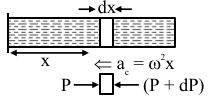
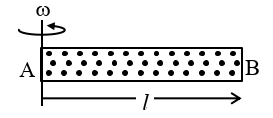
\(A[(P+d P)-P]=(d m)\left(\omega^2 x\right)\)
\(dP =\frac{( dm )}{ A } \omega^2 x\)
\(dP =\frac{(\rho)( A )( dx ) \omega^2 x }{ A }\)
also \([ PM =\rho RT ]\)
\(dP =\left(\frac{ PM }{ RT }\right) \omega^2 x dx\)
\(\int_{P_A}^{P_B} \frac{d P}{P}=\frac{\omega^2 M}{R T} \int_0^{\ell} x d x\)
\(\ell n\left(\frac{P_B}{P_A}\right)=\frac{\omega^2 \ell^2 M }{2 RT }\)
\(P_B=P_A e^{\frac{M \omega^2 \ell^2}{2 R T}}\) -
- (A) \(120\sqrt{2}\)
- (B) \(140\sqrt{2}\)
- (C) \(140\sqrt{3}\)
- (D) \(120\sqrt{3}\)
Show answer and solution
Correct Answer: (B)
Volume of the cylindrical vessel, \(V = 528\) dm\(^3 = 528000\) cm\(^3\)
Radius of the vessel, \(r = 40\) cm
Let the height of the vessel be \(H\).
\(V = \pi r^2 H\)
\(528000 = \dfrac{22}{7} \times (40)^2 \times H\)
\(H = \dfrac{528000 \times 7}{22 \times 1600} = 105\) cm
The vessel is placed on a block of height equal to the vessel, so the height of the block is \(105\) cm.
Depth of the hole from the top water level, \(h = 70\) cm
Height of the hole from the ground, \(y = \text{Height of block} + (H - h)\)
\(y = 105 + (105 - 70) = 140\) cm
Velocity of efflux, \(v = \sqrt{2gh}\)
Time of flight of water, \(t = \sqrt{\dfrac{2y}{g}}\)
Horizontal range, \(R = v \times t = \sqrt{2gh} \times \sqrt{\dfrac{2y}{g}} = 2\sqrt{hy}\)
\(R = 2\sqrt{70 \times 140} = 2\sqrt{70 \times 70 \times 2} = 140\sqrt{2}\) cm
Answer: \(140\sqrt{2}\) -
- (A) \(18\)
- (B) \(144\)
- (C) \(36\)
- (D) \(72\)
Show answer and solution
Correct Answer: (D)
Using the equation of continuity:
\(A_A v_A = A_B v_B\)
\((1.0 \times 10^{-4}) \times 0.1 = (20 \times 10^{-6}) \times v_B\)
\(v_B = \dfrac{10^{-5}}{2 \times 10^{-5}} = 0.5\) m/s
Using Bernoulli's equation for a horizontal tube:
\(P_A + \dfrac{1}{2} \rho v_A^2 = P_B + \dfrac{1}{2} \rho v_B^2\)
\(P_A - P_B = \dfrac{1}{2} \rho (v_B^2 - v_A^2)\)
Substituting the given values:
\(P_A - P_B = \dfrac{1}{2} \times 600 \times (0.5^2 - 0.1^2)\)
\(P_A - P_B = 300 \times (0.25 - 0.01)\)
\(P_A - P_B = 300 \times 0.24 = 72\) Pa
Answer: \(72\) -
- (A) 2.0
- (B) 1.0
- (C) 3.0
- (D) 1.5
Show answer and solution
Correct Answer: (A)
\(V _{ T }=\frac{2 r ^2 g}{9 \eta}\left(\rho_{ b }-\rho_{\ell}\right)\)
\(V _{ T }=\frac{2}{9} \frac{(.1)^2 \times 10}{(10)}(10.5-1.5)\)
\(V _{ T }=2 cm / sec\). -
- (A) \(2 \frac{\Delta r }{ r }-\frac{\Delta v _0}{ v _0}\)
- (B) \(\frac{2 \Delta r }{ r }+\frac{\Delta v _0}{ v _0}\)
- (C) \(2\left[\frac{\Delta r }{ r }+\frac{\Delta v _0}{ v _0}\right]\)
- (D) \(2\left[\frac{\Delta r }{ r }-\frac{\Delta v _0}{ v _0}\right]\)
Show answer and solution
Correct Answer: (B)
\(v _0=\frac{2}{9} \frac{ r ^2 g}{ n }\left(\rho_{ B }-\rho_{ L }\right)\)
\(n =\frac{2}{9} \frac{ r ^2 g}{ v _0}\left(\rho_{ B }-\rho_{ L }\right)\)
\(\frac{\Delta n }{ Il }=\frac{2 \Delta r }{ r }+\frac{\Delta v _0}{ v _0}\)
No questions on this page match these filters.