


Questions
35 questionsShowing 1–35 of 35 questions
-
- (A) \(-2\)
- (B) \(+2\)
- (C) \(+2.5\)
- (D) \(-2.5\)
Show answer and solution
Correct Answer: (A)
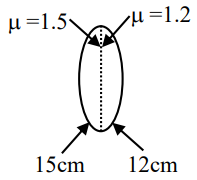
\(\frac{1}{v}-\frac{1}{u}=\frac{1}{f_{net}}=\frac{1}{f_{1}}+\frac{1}{f_{2}}\)
\(\frac{1}{v}+\frac{1}{30}=(1.5-1)(\frac{1}{15}-\frac{1}{\infty})+(1.2-1)(\frac{1}{\infty}+\frac{1}{12})\)
\(\frac{1}{v}+\frac{1}{30}=\frac{1}{30}+\frac{1}{60}\)
\(v=60\)
\(m=\frac{v}{u}=\frac{60}{-30}=-2\) -
- (A) 140
- (B) 280
- (C) 80
- (D) 200
Show answer and solution
Correct Answer: (B)
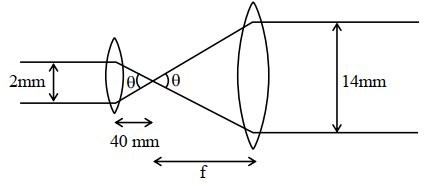
\(\frac{40}{2}=\frac{f}{14}\)
\(\Rightarrow f =280 mm\) -
- (A) increased two times
- (B) increased \(\dfrac{3}{2}\) times
- (C) decreased two times
- (D) decreased \(\dfrac{3}{2}\) times
Show answer and solution
Correct Answer: (A)
Focal length of the objective after cutting:
For a symmetric biconvex lens with both radii of magnitude \(R\):
\(\dfrac{1}{f_o} = (\mu - 1)\left(\dfrac{1}{R} - \dfrac{1}{-R}\right) = \dfrac{2(\mu - 1)}{R}\)
When the lens is cut vertically (perpendicular to the principal axis), each half becomes a plano-convex lens with one flat surface:
\(\dfrac{1}{f_o'} = (\mu - 1)\left(\dfrac{1}{R} - 0\right) = \dfrac{\mu - 1}{R}\)
Comparing the two: \(f_o' = 2f_o\), so the focal length of the objective doubles.
Magnification of a compound microscope:
\(M \approx \dfrac{L}{f_o} \cdot \dfrac{D}{f_e}\)
where \(L\) is the tube length, \(f_o\) is the objective focal length, \(f_e\) is the eyepiece focal length and \(D\) is the least distance of distinct vision.
Since the eyepiece and \(D\) are unchanged, equating the initial and final magnifications:
\(\dfrac{L_{\text{initial}}}{f_o} \cdot \dfrac{D}{f_e} = \dfrac{L_{\text{final}}}{2f_o} \cdot \dfrac{D}{f_e}\)
\(\dfrac{L_{\text{initial}}}{f_o} = \dfrac{L_{\text{final}}}{2f_o}\)
\(L_{\text{final}} = 2\,L_{\text{initial}}\)
Hence, to maintain the same magnification, the tube length must be doubled.
The correct option is \((1)\) increased two times. -
- (A) 5
- (B) 10
- (C) 45
- (D) 55
Show answer and solution
Correct Answer: (B)
Given focal length of the concave mirror, \(f = -10\) cm.
The image is double the size of the object, so the magnification can be \(m = \pm 2\).
Using the magnification formula in terms of focal length and object distance:
\(m = \dfrac{f}{f - u}\)
Case 1: For a real image, \(m = -2\)
\(-2 = \dfrac{-10}{-10 - u_1}\)
\(20 + 2u_1 = -10\)
\(2u_1 = -30 \Rightarrow u_1 = -15\) cm
Case 2: For a virtual image, \(m = +2\)
\(2 = \dfrac{-10}{-10 - u_2}\)
\(-20 - 2u_2 = -10\)
\(-2u_2 = 10 \Rightarrow u_2 = -5\) cm
The distance between the two positions of the object is:
\(\Delta u = |u_1 - u_2| = |-15 - (-5)| = 10\) cm
Answer: \(10\) -
- (A) \(0.5\)
- (B) \(2.5\)
- (C) \(0.8\)
- (D) \(1.25\)
Show answer and solution
Correct Answer: (D)
Using the lens maker's formula:
\(\dfrac{1}{f} = (\mu - 1) \left( \dfrac{1}{R_1} - \dfrac{1}{R_2} \right)\)
For an equiconvex lens, \(R_1 = R\) and \(R_2 = -R\). Given \(\mu = 1.4\):
\(\dfrac{1}{f} = (1.4 - 1) \left( \dfrac{1}{R} - \dfrac{1}{-R} \right)\)
\(\dfrac{1}{f} = 0.4 \times \dfrac{2}{R}\)
\(\dfrac{1}{f} = \dfrac{0.8}{R}\)
\(\dfrac{f}{R} = \dfrac{1}{0.8} = 1.25\)
Answer: \(1.25\) -
- (A) 1
- (B) 2
- (C) 3
- (D) 4
Show answer and solution
Correct Answer: (C)
Explanation:
According to the Lens Maker's Formula, the focal length of a lens is given by:
\( \frac{1}{f} = (\mu_{rel} - 1)\left(\frac{1}{R_1} - \frac{1}{R_2}\right) \)
1. When the lens is in the air:
\( \frac{1}{f_{air}} = (\mu_g - 1)\left(\frac{1}{R_1} - \frac{1}{R_2}\right) \)
Substituting \( \mu_g = 1.5 \) and \( f_{air} = f \):
\( \frac{1}{f} = (1.5 - 1)\left(\frac{1}{R_1} - \frac{1}{R_2}\right) = 0.5 \left(\frac{1}{R_1} - \frac{1}{R_2}\right) \) --- (Equation 1)
2. When the lens is immersed in water:
The relative refractive index becomes \( \frac{\mu_g}{\mu_w} \).
\( \frac{1}{f_{water}} = \left(\frac{\mu_g}{\mu_w} - 1\right)\left(\frac{1}{R_1} - \frac{1}{R_2}\right) \)
Substituting \( \mu_g = 1.5 \) and \( \mu_w = \frac{4}{3} \):
\( \frac{1}{f_{water}} = \left(\frac{1.5}{4/3} - 1\right)\left(\frac{1}{R_1} - \frac{1}{R_2}\right) = \left(\frac{4.5}{4} - 1\right)\left(\frac{1}{R_1} - \frac{1}{R_2}\right) \)
\( \frac{1}{f_{water}} = \left(1.125 - 1\right)\left(\frac{1}{R_1} - \frac{1}{R_2}\right) = 0.125 \left(\frac{1}{R_1} - \frac{1}{R_2}\right) \) --- (Equation 2)
3. Taking the ratio of Equation 1 and Equation 2:
\( \frac{f_{water}}{f} = \frac{0.5}{0.125} = 4 \)
Therefore, \( f_{water} = 4f \)
4. Finding the difference:
Difference in focal lengths = \( f_{water} - f_{air} \)
Difference = \( 4f - f = 3f \)
Given that the difference is \( \alpha \times f \), we can clearly see that \( \alpha = 3 \).
Hence, Option C is the correct choice. -
- (A) 50
- (B) 100
- (C) 150
- (D) 200
Show answer and solution
Correct Answer: (B)
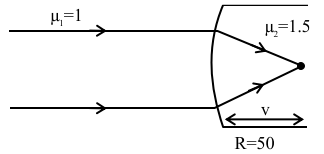
\( \frac{\mu_{2}}{v}-\frac{\mu_{1}}{u}=\frac{\mu_{2}-\mu_{1}}{R}\Rightarrow\frac{1.5}{v}-\frac{1}{\infty}=\frac{1.5-1}{50} \)
\( V=150~cm \)
\(x \rightarrow\) measure from center
x = V - R
= 150 - 50 = 100 cm -
- (A) between \(15^{\circ}\) and \(20^{\circ}\)
- (B) \(15^{\circ}\)
- (C) \(>25^{\circ}\)
- (D) \(<15^{\circ}\)
Show answer and solution
Correct Answer: (C)
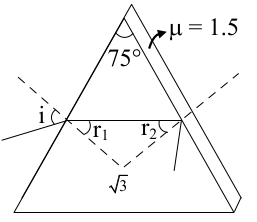
\(r_1+r_2=75^{\circ}\)
For T I R at back surface
\(\sqrt{3} \sin r_2=\frac{3}{2} \sin 90^{\circ}\)
\(r_2 \geq 60^{\circ}\)
\(r_1 \leq 15^{\circ}\)
\(1 \sin i=\sqrt{3} \sin 15^{\circ}\)
\(\sin i =1.73 \times .25\)
\(\sin i =.433\)
\(i=25^{\circ} \Rightarrow i<25^{\circ}\) -
- (A) \(45\)
- (B) \(30\)
- (C) \(28\)
- (D) \(58\)
Show answer and solution
Correct Answer: (B)
Velocity of light in vacuum, \(c = 3 \times 10^8\) m/s
Velocity of light in the prism, \(v = 2.12 \times 10^8\) m/s
Refractive index of the prism material, \(\mu = \dfrac{c}{v} = \dfrac{3 \times 10^8}{2.12 \times 10^8} \approx 1.414 \approx \sqrt{2}\)
For an equilateral prism, the angle of the prism \(A = 60^\circ\).
Using the prism formula:
\(\mu = \dfrac{\sin\left(\dfrac{A + \delta_m}{2}\right)}{\sin\left(\dfrac{A}{2}\right)}\)
\(\sqrt{2} = \dfrac{\sin\left(\dfrac{60^\circ + \delta_m}{2}\right)}{\sin(30^\circ)}\)
\(\sqrt{2} = \dfrac{\sin\left(30^\circ + \dfrac{\delta_m}{2}\right)}{\dfrac{1}{2}}\)
\(\sin\left(30^\circ + \dfrac{\delta_m}{2}\right) = \dfrac{\sqrt{2}}{2} = \dfrac{1}{\sqrt{2}}\)
\(30^\circ + \dfrac{\delta_m}{2} = 45^\circ\)
\(\dfrac{\delta_m}{2} = 15^\circ\)
\(\delta_m = 30^\circ\)
Answer: \(30\) -
- (A) \(2.5\)
- (B) \(5\)
- (C) \(7.5\)
- (D) \(7\)
Show answer and solution
Correct Answer: (B)
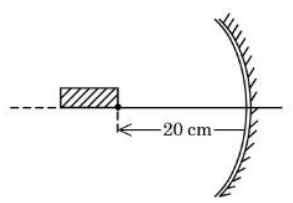
For the given concave mirror, the focal length is \(f = -10\) cm.
The rod lies along the principal axis. From the figure, the near end of the rod is at a distance of \(20\) cm from the pole of the mirror. Since the length of the rod is \(10\) cm, the far end is at a distance of \(20 + 10 = 30\) cm from the pole.
Let the near end be \(A\) and the far end be \(B\).
Object distance for end \(A\), \(u_A = -20\) cm.
Object distance for end \(B\), \(u_B = -30\) cm.
Using the mirror formula, \(\dfrac{1}{v} + \dfrac{1}{u} = \dfrac{1}{f}\)
For end \(A\):
\(\dfrac{1}{v_A} + \dfrac{1}{-20} = \dfrac{1}{-10}\)
\(\dfrac{1}{v_A} = \dfrac{1}{20} - \dfrac{1}{10} = -\dfrac{1}{20}\)
\(v_A = -20\) cm
For end \(B\):
\(\dfrac{1}{v_B} + \dfrac{1}{-30} = \dfrac{1}{-10}\)
\(\dfrac{1}{v_B} = \dfrac{1}{30} - \dfrac{1}{10} = \dfrac{1 - 3}{30} = -\dfrac{2}{30} = -\dfrac{1}{15}\)
\(v_B = -15\) cm
The length of the image is the distance between the images of the two ends:
\(\text{Length of image} = |v_A - v_B| = |-20 - (-15)| = |-5| = 5\) cm.
Answer: \(5\) -
- (A) \(1.66\)
- (B) \(2.33\)
- (C) \(2.66\)
- (D) \(1.33\)
Show answer and solution
Correct Answer: (A)
Given:
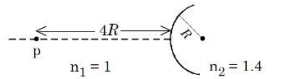
Refractive index of the first medium, \(n_1 = 1\)
Refractive index of the second medium, \(n_2 = 1.4 = \dfrac{7}{5}\)
Object distance, \(u = -4R\)
Radius of curvature of the spherical interface, \(R = +R\) (since the surface is convex towards the rarer medium)
Using the formula for refraction at a single spherical surface:
\(\dfrac{n_2}{v} - \dfrac{n_1}{u} = \dfrac{n_2 - n_1}{R}\)
Substituting the given values:
\(\dfrac{1.4}{v} - \dfrac{1}{-4R} = \dfrac{1.4 - 1}{R}\)
\(\dfrac{7}{5v} + \dfrac{1}{4R} = \dfrac{0.4}{R}\)
\(\dfrac{7}{5v} + \dfrac{1}{4R} = \dfrac{2}{5R}\)
\(\dfrac{7}{5v} = \dfrac{2}{5R} - \dfrac{1}{4R}\)
\(\dfrac{7}{5v} = \dfrac{8 - 5}{20R} = \dfrac{3}{20R}\)
\(v = \dfrac{7 \times 20R}{5 \times 3} = \dfrac{28R}{3}\)
The transverse magnification \(m\) for a spherical refracting surface is given by:
\(m = \dfrac{n_1 v}{n_2 u}\)
Substituting the values of \(n_1\), \(n_2\), \(u\), and \(v\):
\(m = \dfrac{1 \times \left(\dfrac{28R}{3}\right)}{1.4 \times (-4R)}\)
\(m = \dfrac{\dfrac{28R}{3}}{-\dfrac{28R}{5}}\)
\(m = -\dfrac{5}{3}\)
The magnitude of the magnification is:
\(|m| = \dfrac{5}{3} \approx 1.66\)
Answer: \(1.66\) -
- (A) \(10\)
- (B) \(12.5\)
- (C) \(13\)
- (D) \(13.5\)
Show answer and solution
Correct Answer: (A)
When one surface of a lens is silvered, the system behaves like an equivalent mirror. The light refracts through the lens, reflects off the silvered surface, and refracts through the lens again, so the equivalent power is:
\(P_{eq} = P_L + P_M + P_L = 2P_L + P_M\)
Power of the biconvex lens:
For a thin biconvex lens with \(R_1 = +20\text{ cm}\), \(R_2 = -20\text{ cm}\) and \(\mu = 1.5\), the lens maker's formula gives:
\(\dfrac{1}{f_L} = (\mu - 1)\left(\dfrac{1}{R_1} - \dfrac{1}{R_2}\right)\)
\(\dfrac{1}{f_L} = (1.5 - 1)\left(\dfrac{1}{20} - \dfrac{1}{-20}\right) = 0.5 \cdot \dfrac{2}{20} = \dfrac{1}{20}\text{ cm}^{-1}\)
So, \(P_L = \dfrac{1}{20}\text{ cm}^{-1}\).
Power of the silvered surface (acting as a concave mirror):
The back surface has radius of curvature \(R = 20\text{ cm}\), so its focal length is:
\(f_M = \dfrac{R}{2} = 10\text{ cm}\)
\(P_M = \dfrac{1}{f_M} = \dfrac{1}{10}\text{ cm}^{-1}\)
Equivalent focal length:
\(P_{eq} = 2P_L + P_M = 2 \cdot \dfrac{1}{20} + \dfrac{1}{10} = \dfrac{1}{10} + \dfrac{1}{10} = \dfrac{1}{5}\text{ cm}^{-1}\)
\(F_{eq} = \dfrac{1}{P_{eq}} = 5\text{ cm}\)
Since \(P_{eq} > 0\), the system behaves as a converging (concave) equivalent mirror of focal length \(5\text{ cm}\).
Object position for object and image to coincide:
For a concave mirror, the image coincides with the object when the object is placed at the centre of curvature, i.e., at a distance \(2F_{eq}\) from the mirror:
\(u = 2F_{eq} = 2 \times 5 = 10\text{ cm}\)
Hence, the correct option is \((1)\ 10\). -
- (A) behaves as concave lens if \(|f_{\text{convex}}| > |f_{\text{concave}}|\)
- (B) behaves as concave lens if \(|f_{\text{convex}}| < |f_{\text{concave}}|\)
- (C) behaves as convex lens if \(|f_{\text{convex}}| > |f_{\text{concave}}|\)
- (D) Focal length of the lens system will change if the positions of two lenses are interchanged
Show answer and solution
Correct Answer: (A)
The equivalent focal length \(F\) of two thin lenses in contact is given by \(\dfrac{1}{F} = \dfrac{1}{f_1} + \dfrac{1}{f_2}\)
For a convex lens, the focal length is positive, so \(f_1 = |f_{\text{convex}}|\)
For a concave lens, the focal length is negative, so \(f_2 = -|f_{\text{concave}}|\)
Substituting these values, we get \(\dfrac{1}{F} = \dfrac{1}{|f_{\text{convex}}|} - \dfrac{1}{|f_{\text{concave}}|}\)
If \(|f_{\text{convex}}| > |f_{\text{concave}}|\), then \(\dfrac{1}{|f_{\text{convex}}|} < \dfrac{1}{|f_{\text{concave}}|}\)
This implies \(\dfrac{1}{F} < 0\), so \(F\) is negative.
A negative equivalent focal length indicates that the combination behaves as a diverging or concave lens.
Interchanging the positions of the lenses does not change the equivalent focal length since \(\dfrac{1}{f_1} + \dfrac{1}{f_2} = \dfrac{1}{f_2} + \dfrac{1}{f_1}\).
Answer: behaves as concave lens if \(|f_{\text{convex}}| > |f_{\text{concave}}|\) -
- (A) \( \frac{5}{6} \)
- (B) \( \frac{5}{27} \)
- (C) \( \frac{3}{2} \)
- (D) \( \frac{25}{27} \)
Show answer and solution
Correct Answer: (A)
Explanation:
We determine the ratio of magnitudes of magnification by analyzing the system under two distinct configurations:
Case 1: Lenses in direct contact with no gap (\( d = 0 \))
1. Equivalent Focal Length Calculation:
The focal length of the convex lens is \( f_1 = +5\text{ cm} \) and the focal length of the concave lens is \( f_2 = -4\text{ cm} \). When two thin lenses are in contact, the net focal length (\( F \)) of the combination is:
\( \frac{1}{F} = \frac{1}{f_1} + \frac{1}{f_2} \)
\( \frac{1}{F} = \frac{1}{5} + \frac{1}{-4} = \frac{4 - 5}{20} = -\frac{1}{20} \implies F = -20\text{ cm} \)
2. Image Distance and Magnification (\( m_1 \)):
The object is situated at a distance of \( u = -10\text{ cm} \) from the combined lens system. Using the standard lens formula:
\( \frac{1}{v_1} - \frac{1}{u} = \frac{1}{F} \)
\( \frac{1}{v_1} - \frac{1}{-10} = \frac{1}{-20} \implies \frac{1}{v_1} = -\frac{1}{20} - \frac{1}{10} = -\frac{3}{20} \implies v_1 = -\frac{20}{3}\text{ cm} \)
The linear magnification \( m_1 \) for this combined case is:
\( m_1 = \frac{v_1}{u} = \frac{-20/3}{-10} = \frac{2}{3} \)
Case 2: Lenses separated by a distance (\( d = 1\text{ cm} \))
1. Refraction through the First Lens (Convex Lens):
For the convex lens alone, the object distance is \( u_1 = -10\text{ cm} \) and \( f_1 = +5\text{ cm} \):
\( \frac{1}{v'_1} - \frac{1}{u_1} = \frac{1}{f_1} \)
\( \frac{1}{v'_1} - \frac{1}{-10} = \frac{1}{5} \implies \frac{1}{v'_1} = \frac{1}{5} - \frac{1}{10} = \frac{1}{10} \implies v'_1 = +10\text{ cm} \)
The magnification produced by the first lens is:
\( m'_1 = \frac{v'_1}{u_1} = \frac{10}{-10} = -1 \)
2. Refraction through the Second Lens (Concave Lens):
The real image formed by the convex lens at a distance of \( 10\text{ cm} \) serves as a virtual object for the shifted concave lens. Since the concave lens is separated from the convex lens by a distance of \( 1\text{ cm} \), the virtual object distance (\( u_2 \)) measured from the concave lens is:
\( u_2 = +10\text{ cm} - 1\text{ cm} = +9\text{ cm} \)
Using the lens formula with \( f_2 = -4\text{ cm} \):
\( \frac{1}{v_2} - \frac{1}{u_2} = \frac{1}{f_2} \)
\( \frac{1}{v_2} - \frac{1}{9} = \frac{1}{-4} \implies \frac{1}{v_2} = \frac{1}{9} - \frac{1}{4} = \frac{4 - 9}{36} = -\frac{5}{36} \implies v_2 = -\frac{36}{5}\text{ cm} \)
The magnification produced by the second lens is:
\( m'_2 = \frac{v_2}{u_2} = \frac{-36/5}{9} = -\frac{4}{5} \)
3. Total Magnification (\( m_2 \)):
The net system magnification is the product of individual component magnifications:
\( m_2 = m'_1 \times m'_2 = (-1) \times \left(-\frac{4}{5}\right) = \frac{4}{5} \)
Finding the Ratio Magnitude:
Comparing the two calculated magnification parameters yields:
\( \left|\frac{m_1}{m_2}\right| = \frac{2/3}{4/5} = \frac{2}{3} \times \frac{5}{4} = \frac{5}{6} \)
Hence, Option A is the correct choice. -
- (A) \( 4.5^{\circ} \)
- (B) \( 6^{\circ} \)
- (C) \( 4^{\circ} \)
- (D) \( 5^{\circ} \)
Show answer and solution
Correct Answer: (C)
\( \delta_{net}=0 \)
\( \delta_{1}+\delta_{2}=0 \)
\( (\mu_{1}-1)A_{1}+(\mu_{2}-1)A_{2}=0 \)
\( A_{2}=\frac{(\mu_{1}-1)A_{1}}{(\mu_{2}-1)} \)
\( A_{2}=\frac{(1.72-1)}{(1.9-1)}\times5^{\circ}=4^{\circ} \) -
- (A) virtual, formed at \(7.5\text{ cm}\) right of lens \(Q\), with a size bigger than that of \(AB\)
- (B) real, formed at \(7.5\text{ cm}\) right of lens \(Q\), with a size same as that of \(AB\)
- (C) formed at infinity.
- (D) real, formed at \(7\text{ cm}\) right of lens \(Q\), with a size smaller than that of \(AB\)
Show answer and solution
Correct Answer: (B)
For lens \(P\):
\(\dfrac{1}{v_1} - \dfrac{1}{u_1} = \dfrac{1}{f_1}\)
\(\dfrac{1}{v_1} - \dfrac{1}{-15} = \dfrac{1}{10}\)
\(\dfrac{1}{v_1} = \dfrac{1}{10} - \dfrac{1}{15} = \dfrac{1}{30} \Rightarrow v_1 = 30\text{ cm}\)
Magnification \(m_1 = \dfrac{v_1}{u_1} = \dfrac{30}{-15} = -2\)
The image formed by lens \(P\) acts as a virtual object for lens \(Q\). Since the distance between the lenses is \(15\text{ cm}\), the object distance for lens \(Q\) is:
\(u_2 = 30 - 15 = +15\text{ cm}\)
For lens \(Q\):
\(\dfrac{1}{v_2} - \dfrac{1}{u_2} = \dfrac{1}{f_2}\)
\(\dfrac{1}{v_2} - \dfrac{1}{15} = \dfrac{1}{15}\)
\(\dfrac{1}{v_2} = \dfrac{2}{15} \Rightarrow v_2 = 7.5\text{ cm}\)
The positive sign indicates that the final image is real and formed \(7.5\text{ cm}\) to the right of lens \(Q\).
Magnification \(m_2 = \dfrac{v_2}{u_2} = \dfrac{7.5}{15} = \dfrac{1}{2}\)
Total magnification \(m = m_1 \times m_2 = -2 \times \dfrac{1}{2} = -1\)
Since \(|m| = 1\), the size of the final image is the same as that of the object \(AB\).
Answer: real, formed at \(7.5\text{ cm}\) right of lens \(Q\), with a size same as that of \(AB\) - 17. Angle of minimum deviation is equal to the half of the angle of prism in an equilateral prism. The refractive index of the prism is __________. 2026 Medium
- (A) \(1.5\)
- (B) \(\sqrt{3}\)
- (C) \(\sqrt{2}\)
- (D) \(1.65\)
Show answer and solution
Correct Answer: (C)
For an equilateral prism, the angle of the prism is \(A = 60^{\circ}\).
Given that the angle of minimum deviation is half of the angle of the prism:
\(\delta_{m} = \dfrac{A}{2} = \dfrac{60^{\circ}}{2} = 30^{\circ}\)
The refractive index of the prism is given by:
\(\mu = \dfrac{\sin\left(\dfrac{A + \delta_{m}}{2}\right)}{\sin\left(\dfrac{A}{2}\right)}\)
Substituting the values of \(A\) and \(\delta_{m}\):
\(\mu = \dfrac{\sin\left(\dfrac{60^{\circ} + 30^{\circ}}{2}\right)}{\sin\left(\dfrac{60^{\circ}}{2}\right)}\)
\(\mu = \dfrac{\sin(45^{\circ})}{\sin(30^{\circ})}\)
\(\mu = \dfrac{\dfrac{1}{\sqrt{2}}}{\dfrac{1}{2}} = \sqrt{2}\)
Answer: \(\sqrt{2}\) -
- (A) 60°
- (B) 75°
- (C) 90°
- (D) 45°
Show answer and solution
Correct Answer: (A)
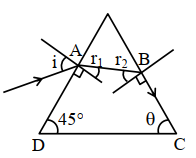
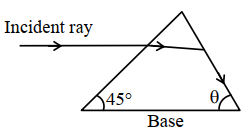
For grazing emergence
\(\sin r_2=\frac{1}{\mu}\)
By Snell's Law at incident surface
\(1 \times \frac{1}{\sqrt{2}}=\sqrt{2} \sin r _1\)
\(r_1=30\)
\(r _1+ r _2= A\)
\(A=75\)
\(75+45+\theta=180^{\circ}\)
\(\theta=60^{\circ}\) -
- (A) \( 15^{\circ} \)
- (B) \( 20^{\circ} \)
- (C) \( 40^{\circ} \)
- (D) \( 30^{\circ} \)
Show answer and solution
Correct Answer: (A)
Equilateral prism.
\( A=60^{\circ} \)
\( \mu~Sinr_{2}=1.sine=1 \)
\( Sinr_{2}=\frac{1}{\mu}=\frac{1}{\sqrt{2}} \)
\( r_{2}=45^{\circ} \)
\(\therefore r_1=A-r_2=15^{\circ}\) -
- (A) \( \cot^{-1}(\frac{3}{\sqrt{13}}) \)
- (B) \( \sin^{-1}(\frac{9}{8}) \)
- (C) \( \tan^{-1}(\frac{8}{\sqrt{17}}) \)
- (D) \( \cos^{-1}(\frac{8}{9}) \)
Show answer and solution
Correct Answer: (C)
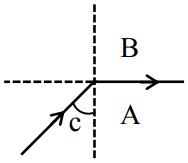
\(\mu_A \sin c=\mu_B \sin 90\)
\(\Rightarrow \sin c =\frac{\mu_{ B }}{\mu_{ A }}=\frac{ v _{ A }}{ v _{ B }}\)
\(\therefore \sin c=\frac{2.4 \times 10^8}{2.7 \times 10^8}=\frac{8}{9}\)
\(\Rightarrow \tan c=\frac{8}{\sqrt{81-64}}=\frac{8}{\sqrt{17}}\)
\(c=\tan ^{-1}\left(\frac{8}{\sqrt{17}}\right)\) - 21. Distance between an object and three times magnified real image is 40 cm . The focal length of the mirror used is _________ cm . 2026 Medium
- (A) \(-15 / 2\)
- (B) \(-10\)
- (C) \(-20\)
- (D) \(-15\)
Show answer and solution
Correct Answer: (D)
\(m=-3=\frac{v}{u}\)
\(v=-3u\)
\(|v|-|u|=40\)
\(u=20~cm,\)
\(v=60~cm\)
\(\therefore \frac{1}{v}+\frac{1}{u}=\frac{1}{f}\)
\(\frac{1}{-60}+\frac{1}{-20}=\frac{1}{ f }\)
\(f =-15 cm\) -
- (A) Readings recorded by all persons are correct
- (B) Reading recorded by \(P_{3}\) persons are incorrect
- (C) Reading recorded by \(P_{3}\) and \(P_{2}\) persons are incorrect
- (D) Reading recorded by \(P_{4}\) and \(P_{5}\) persons are incorrect
Show answer and solution
Correct Answer: (B)
\(P =+5 D\)
\(\frac{1}{ f }=5 \Rightarrow f =20 cm\)
⇒ If object is between f & 2f image will be beyond 2f & magnified.
⇒ If object is beyond 2 f , image will be between f & 2f & diminished.
Hence reading of \(P_3\) are incorrect. - 23. For a thin symmetric prism made of glass (refractive index \(1.5\)), the ratio of incident angle and minimum deviation will be _______. 2026 Medium
- (A) \(3 : 4\)
- (B) \(3 : 2\)
- (C) \(2 : 1\)
- (D) \(1 : 2\)
Show answer and solution
Correct Answer: (B)
For a thin prism, the angle of minimum deviation is given by \(\delta_m = (\mu - 1)A\).
At the position of minimum deviation, the angle of incidence \(i\) and angle of emergence \(e\) are equal, and the angle of refraction is \(r = \dfrac{A}{2}\).
Using Snell's law for small angles, \(i = \mu r = \mu \left(\dfrac{A}{2}\right)\).
The ratio of the incident angle to the minimum deviation is:
\(\dfrac{i}{\delta_m} = \dfrac{\dfrac{\mu A}{2}}{(\mu - 1)A} = \dfrac{\mu}{2(\mu - 1)}\)
Given \(\mu = 1.5\), substituting the value:
\(\dfrac{i}{\delta_m} = \dfrac{1.5}{2(1.5 - 1)} = \dfrac{1.5}{2(0.5)} = \dfrac{1.5}{1} = \dfrac{3}{2}\)
Answer: \(3 : 2\) -
- (A) \(\sqrt{2} < n < 2\sqrt{2}\)
- (B) \(1 < n < 2\)
- (C) \(n\ge 2\)
- (D) \(\sqrt{2} < n < 2\)
Show answer and solution
Correct Answer: (D)
Explanation:
The relation between the refractive index (\( n \)), refracting angle of the prism (\( A \)), and the angle of minimum deviation (\( \delta_{\text{min}} \)) is given by the prism formula:
\( n = \frac{\sin\left(\frac{A + \delta_{\text{min}}}{2}\right)}{\sin\left(\frac{A}{2}\right)} \)
1. Applying Given Condition:
According to the question, the angle of minimum deviation is equal to the refracting angle of the prism (\( \delta_{\text{min}} = A \)). Substituting this into the formula:
\( n = \frac{\sin\left(\frac{A + A}{2}\right)}{\sin\left(\frac{A}{2}\right)} = \frac{\sin A}{\sin\left(\frac{A}{2}\right)} \)
Using the trigonometric identity \( \sin A = 2\sin\left(\frac{A}{2}\right)\cos\left(\frac{A}{2}\right) \):
\( n = \frac{2\sin\left(\frac{A}{2}\right)\cos\left(\frac{A}{2}\right)}{\sin\left(\frac{A}{2}\right)} = 2\cos\left(\frac{A}{2}\right) \)
2. Determining Limiting Conditions:
For minimum deviation, the angle of incidence (\( i \)is given by:
\( i = \frac{A + \delta_{\text{min}}}{2} = \frac{A + A}{2} = A \)
For a light ray to physically enter the prism, the angle of incidence must be strictly less than the grazing angle of \( 90^\circ \):
\( i < 90^\circ \implies A < 90^\circ \)
Since \( A \) is a positive angle for a real prism, the range of \( A \) is:
\( 0^\circ < A < 90^\circ \implies 0^\circ < \frac{A}{2} < 45^\circ \)
3. Finding the Range of Refractive Index:
Taking the cosine function across this inequality (reversing the inequality signs as cosine values decrease from \( 0^\circ \) to \( 45^\circ \)):
\( \cos(45^\circ) < \cos\left(\frac{A}{2}\right) < \cos(0^\circ) \)
\( \frac{1}{\sqrt{2}} < \cos\left(\frac{A}{2}\right) < 1 \)
Multiplying the entire inequality by 2:
\( 2 \cdot \frac{1}{\sqrt{2}} < 2\cos\left(\frac{A}{2}\right) < 2 \cdot 1 \)
\( \sqrt{2} < n < 2 \)
Hence, Option D is the correct choice. -
- (A) 20
- (B) 24
- (C) 26
- (D) 28
Show answer and solution
Correct Answer: (A)
Sunlight comes from infinity and is focused at the principal focus of the convex lens. The paper burns in the shortest time when the intensity of light is maximum, which occurs at the focal point.
Therefore, the focal length of the convex lens is \(f = 30\) cm.
Assuming the lens is equiconvex, the radii of curvature are \(R_1 = 60\) cm and \(R_2 = -60\) cm.
Using the Lens Maker's formula:
\(\dfrac{1}{f} = (\mu - 1) \left( \dfrac{1}{R_1} - \dfrac{1}{R_2} \right)\)
Substituting the given values:
\(\dfrac{1}{30} = (\mu - 1) \left( \dfrac{1}{60} - \left( -\dfrac{1}{60} \right) \right)\)
\(\dfrac{1}{30} = (\mu - 1) \left( \dfrac{2}{60} \right)\)
\(\dfrac{1}{30} = (\mu - 1) \left( \dfrac{1}{30} \right)\)
\(\mu - 1 = 1 \Rightarrow \mu = 2\)
Given that the refractive index is \(\dfrac{\alpha}{10}\):
\(\dfrac{\alpha}{10} = 2 \Rightarrow \alpha = 20\)
Answer: \(20\) -
- (A) 2
- (B) 5
- (C) 3.5
- (D) 4
Show answer and solution
Correct Answer: (A)
\( f_{0}=2~cm \),\( fe=5~cm \)
\( l=10 \),\( D=25~cm \)
\( M=\frac{l}{f_{0}}.\frac{D}{f_{c}}=25 \) -
- (A) 50
- (B) 100
- (C) 150
- (D) 200
Show answer and solution
Correct Answer: (B)
Explanation:
Let us clarify the concept of magnification under different adjustments step-by-step based on the Ray Optics and Optical Instruments chapter of the NCERT Class 12 Physics textbook:
Step 1: Understand the meaning of "Normal Adjustment"
In optical instruments, "Normal Adjustment" explicitly means that the final image is formed at infinity \(\infty\), allowing the observer's eye to view it in a completely relaxed state.
Step 2: Apply the correct formula for Normal Adjustment
When the final image is formed at infinity, the magnifying power \(m\) of a compound microscope is given by:
\(m = \frac{L}{f_o} \times \frac{D}{f_e}\)
Where:
- \(L\) = Tube length = 32 cm
- \(f_o\) = Focal length of objective = 2 cm
- \(f_e\) = Focal length of eyepiece = 4 cm
- \(D\) = Least distance of distinct vision = 25 cm
Step 3: Calculate the value
Substitute the given values into the infinity-adjustment formula:
\(m = \frac{32}{2} \times \frac{25}{4}\)
\(m = 16 \times 6.25 = 100\)
Why 116 is incorrect here:
The handwritten solution uses the formula \(m = \frac{L}{f_o}\left(1 + \frac{D}{f_e}\right)\). This formula belongs to the near-point adjustment, where the final image is formed at the least distance of distinct vision (\(D = 25\text{ cm}\)). Since this specific question asks for normal adjustment, using that formula is a conceptual error. The app's answer of 100 is fully correct.
Hence, Option B is the correct choice. - 28. In parallax method for the determination of focal length of a concave mirror, the object should always be placed : 2026 Easy
- (A) between the focus (F) and the centre of curvature (C) of the mirror ONLY
- (B) at any point beyond the focus (F) of the mirror
- (C) beyond the centre of the curvature (C) of the mirror ONLY
- (D) between the pole (P) and the focus (F) of the concave mirror ONLY
Show answer and solution
Correct Answer: (B)
Image should be real. So object should be placed beyond focus. -
- (A) \(1.6\)
- (B) \(0.16\)
- (C) \(11.6\)
- (D) \(16\)
Show answer and solution
Correct Answer: (A)
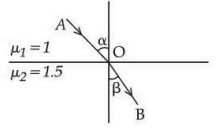
From the given figure, the interface is horizontal and the normal is along the y-axis.
The incident ray is along the vector \(\vec{AO} = 2\hat{i} - 3\hat{j}\).
The angle of incidence \(\alpha\) is the angle between the incident ray and the normal.
\(\sin \alpha = \dfrac{2}{\sqrt{2^2 + (-3)^2}} = \dfrac{2}{\sqrt{13}}\)
The refracted ray is along the vector \(\vec{OB} = C\hat{i} - 4\hat{j}\).
The angle of refraction \(\beta\) is the angle between the refracted ray and the normal.
\(\sin \beta = \dfrac{C}{\sqrt{C^2 + (-4)^2}} = \dfrac{C}{\sqrt{C^2 + 16}}\)
Applying Snell's law at the interface:
\(\mu_1 \sin \alpha = \mu_2 \sin \beta\)
\(1 \times \dfrac{2}{\sqrt{13}} = 1.5 \times \dfrac{C}{\sqrt{C^2 + 16}}\)
\(\dfrac{2}{\sqrt{13}} = \dfrac{3}{2} \dfrac{C}{\sqrt{C^2 + 16}}\)
Squaring both sides:
\(\dfrac{4}{13} = \dfrac{9}{4} \left( \dfrac{C^2}{C^2 + 16} \right)\)
\(16(C^2 + 16) = 117 C^2\)
\(16 C^2 + 256 = 117 C^2\)
\(101 C^2 = 256\)
\(C^2 = \dfrac{256}{101}\)
\(C = \dfrac{16}{\sqrt{101}} \approx 1.592\)
Approximating \(\sqrt{101} \approx 10\), we get \(C \approx 1.6\).
Answer: \(1.6\) -
- (A) \(3\sqrt{3}/1.6\)
- (B) \(\sqrt{3}\)
- (C) \(3.2/\sqrt{3}\)
- (D) \(4\sqrt{3}/5\)
Show answer and solution
Correct Answer: (D)
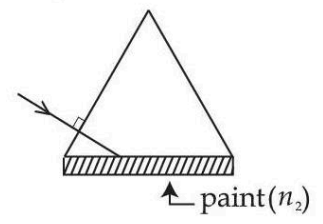
Given that the prism is an equilateral triangle, all its refracting angles are \(60^\circ\).
The incident ray falls normally on one of the faces of the prism. Therefore, the angle of incidence is \(0^\circ\) and the ray enters the prism undeviated.
From the geometry of the figure, the ray strikes the bottom painted face. In the right-angled triangle formed by the ray and the two faces of the prism, the angle between the left face and the bottom face is \(60^\circ\).
The angle the refracted ray makes with the bottom face is \(90^\circ - 60^\circ = 30^\circ\).
The angle of incidence \(i\) at the bottom painted face is the angle made with the normal to that face:
\(i = 90^\circ - 30^\circ = 60^\circ\)
For total internal reflection to occur at the painted face, the angle of incidence must be greater than or equal to the critical angle \(\theta_c\) for the prism-paint interface:
\(i \ge \theta_c\)
\(\sin i \ge \sin \theta_c\)
The critical angle is given by \(\sin \theta_c = \dfrac{n_2}{n_1}\), where \(n_1 = 1.6\) is the refractive index of the prism and \(n_2\) is the refractive index of the paint.
Substituting the values:
\(\sin 60^\circ \ge \dfrac{n_2}{1.6}\)
\(\dfrac{\sqrt{3}}{2} \ge \dfrac{n_2}{1.6}\)
\(n_2 \le 1.6 \times \dfrac{\sqrt{3}}{2}\)
\(n_2 \le 0.8\sqrt{3} = \dfrac{4\sqrt{3}}{5}\)
The limiting value of \(n_2\) required for total internal reflection is \(\dfrac{4\sqrt{3}}{5}\).
Answer: \(4\sqrt{3}/5\) - 31. Refer the figure given below. \(\mu_1\) and \(\mu_2\) are refractive indices of air and lens material. The height of image will be _______ cm.
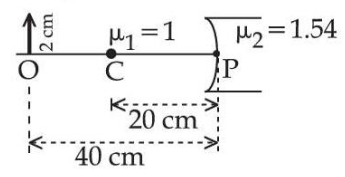 2026 Medium
- (A) \(1\)
- (B) \(0.5\)
- (C) \(1.2\)
- (D) \(0.25\)
Show answer and solution
Correct Answer: (A)
Taking the pole \(P\) as the origin and the direction of incident light as positive:
\(\mu_1 = 1\) (air), \(\mu_2 = 1.5\) (lens)
\(u = -40\text{ cm}\)
\(R = -20\text{ cm}\) (centre of curvature lies to the left of \(P\))
\(h_o = +2\text{ cm}\)
Using the formula for refraction at a single spherical surface:
\(\dfrac{\mu_2}{v} - \dfrac{\mu_1}{u} = \dfrac{\mu_2 - \mu_1}{R}\)
\(\dfrac{1.5}{v} - \dfrac{1}{-40} = \dfrac{1.5 - 1}{-20}\)
\(\dfrac{1.5}{v} + \dfrac{1}{40} = -\dfrac{1}{40}\)
\(\dfrac{1.5}{v} = -\dfrac{2}{40} = -\dfrac{1}{20}\)
\(v = -30\text{ cm}\)
The negative sign indicates a virtual image formed \(30\text{ cm}\) to the left of \(P\).
The transverse magnification for refraction at a spherical surface is:
\(m = \dfrac{\mu_1 \cdot v}{\mu_2 \cdot u} = \dfrac{1 \cdot (-30)}{1.5 \cdot (-40)} = \dfrac{-30}{-60} = 0.5\)
Therefore:
\(h_i = m \cdot h_o = 0.5 \times 2 = 1\text{ cm}\)
Hence, the correct option is \((1)\ 1\). -
- (A) \( 60^{\circ} \)
- (B) \( 15^{\circ} \)
- (C) \( 30^{\circ} \)
- (D) \( 45^{\circ} \)
Show answer and solution
Correct Answer: (A)
\(i = e \& r = A / 2\) for minimum deviation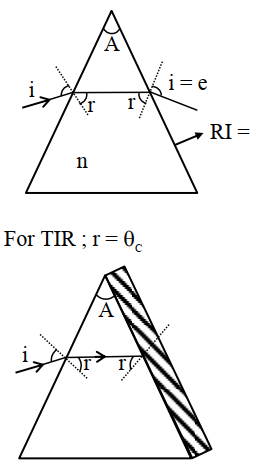
\(\operatorname{Sin} r =\operatorname{Sin} \theta_{ c }\)
\(\operatorname{Sin} r =\frac{ n / 2}{ n }\)
\(\operatorname{Sin} r =\frac{1}{2}\)
\(\operatorname{Sin} \frac{ A }{2}=\sin 30^{\circ}\)
\(\frac{ A }{2}=30^{\circ}\)
\(A =60^{\circ}\) -
- (A) 5 : 2
- (B) 5 : 12
- (C) 12 : 5
- (D) 2 : 5
Show answer and solution
Correct Answer: (A)
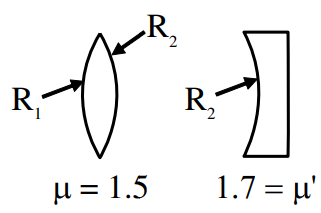
\(\left| P _{ A }\right|=\left| P _{ B }\right|\)
\(0.5\left(\frac{1}{ R _1}+\frac{1}{ R _2}\right)=\frac{0.7}{ R _2}\)
\(\frac{5}{ R _1}=\frac{2}{ R _2}\)
\(\frac{ R _1}{ R _2}=\frac{5}{2}\) -
- (A) 12
- (B) 16
- (C) 18
- (D) 20
Show answer and solution
Correct Answer: (B)
\(m=\frac{f}{f+u}\)
\(m _1=- m _2\)
\(\frac{f}{f-8}=-\frac{f}{f-24}\)
\(f-8=24-f\)
\(2 f=32\)
\(f =16 cm\) -
- (A) 380
- (B) 840
- (C) 480
- (D) 540
Show answer and solution
Correct Answer: (C)
\(\left.\frac{\mu_1}{\mu_2}=\frac{ v _2}{ v _1}=\frac{\lambda_2}{\lambda_1} \right\rvert\, v = f \lambda\)
\(\frac{\mu_1}{\mu_2}=\frac{\lambda_2}{\lambda_1}\)
\(\frac{\mu_{ B }}{3 / 2}=\frac{\lambda}{540}\)
\(\lambda=\left(\frac{4 \times 2}{3 \times 3} \times 540\right)\)
\(\lambda=480\) nm
No questions on this page match these filters.