


Questions
14 questionsShowing 1–14 of 14 questions
-
- (A) \( 5.76\times10^{-14} \)
- (B) \( 1.44\times10^{-13} \)
- (C) \( 2.88\times10^{-14} \)
- (D) \( 1.69\times10^{-12} \)
Show answer and solution
Correct Answer: (A)
By mechanical energy conservation
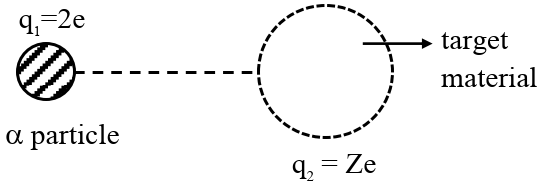
\(( Me )_{ i }=( Me )_{ f }\)
\(P E_i+K E_i=P E_f+K E_f\)
\(0+7.9 \times 10^6 \times 1.6 \times 10^{-19}=\frac{ k (2 e )( Ze )}{ r }+0\)
\(r =\frac{9 \times 10^9 \times 2 \times\left(1.6 \times 10^{-19}\right)^2 \times 79}{7.9 \times 10^6 \times 1.6 \times 10^{-19}}=2.88 \times 10^{-14} m\)
For diameter ⇒ \(D=2 r=5.76 \times 10^{-14} m\) -
- (A) 2
- (B) 8
- (C) 1
- (D) 0.5
Show answer and solution
Correct Answer: (D)
\(R_{\alpha}=R_{0}\alpha^{1/3}\)
\(R_{\beta}=R_{0}\beta^{1/3}\)
\(\frac{R_{\alpha}}{R_{\beta}}=(\frac{\alpha}{\beta})^{1/3}=\frac{1}{2}\) -
- (A) 250%
- (B) 150%
- (C) 225%
- (D) 900%
Show answer and solution
Correct Answer: (C)
Surface area \(x \propto A ^{2 / 3}\)
\(X_i=8^{2 / 3} K=4 K\)
\(X_f=(8+10+9)^{2 / 3} K=9 K\)
% increase in surface area of nucleus
\(x_i=\frac{9 K-4 K}{4 K} \times 100=125\) % -
- (A) \(127.5\)
- (B) \(89.03\)
- (C) \(272.0\)
- (D) \(92.0\)
Show answer and solution
Correct Answer: (B)
The mass of \(6\) protons is \(6 \times 1.00727\text{ u} = 6.04362\text{ u}\).
The mass of \(6\) neutrons is \(6 \times 1.00866\text{ u} = 6.05196\text{ u}\).
Total mass of the constituent nucleons is \(6.04362\text{ u} + 6.05196\text{ u} = 12.09558\text{ u}\).
The mass defect \(\Delta m\) is the difference between the total mass of the nucleons and the experimental mass of the atom (ignoring electron mass as per the given data):
\(\Delta m = 12.09558\text{ u} - 12\text{ u} = 0.09558\text{ u}\)
Converting the mass defect into \(\text{MeV}/c^2\):
\(\Delta m = 0.09558 \times 931.5\text{ MeV}/c^2 = 89.03277\text{ MeV}/c^2 \approx 89.03\text{ MeV}/c^2\)
Answer: \(89.03\) -
- (A) Both Statement I and Statement II are true
- (B) Statement I is true but Statement II is false
- (C) Both Statement I and Statement II are false
- (D) Statement I is false but Statement II is true
Show answer and solution
Correct Answer: (D)
Theoretical -
- (A) 114
- (B) 228
- (C) 190
- (D) 456
Show answer and solution
Correct Answer: (B)
Total numbers of U-235 atom is
\(47 g=\frac{47}{235}\) moles \(=\frac{1}{5}\) moles
∴ Total energy released \(=\frac{1}{5} \times 6 \times 10^{23} \times 190 MeV\)
\(=228 \times 10^{23} MeV\) -
- (A) \(X_4>X_5>X_3\)
- (B) \(X_{4}=X_{5}=X_{3}\)
- (C) \(X_{4} > X_{5} < X_{3}\)
- (D) \(X_{4} < X_{5} < X_{3}\)
Show answer and solution
Correct Answer: (A)
\(BE_{He^{4}}-BE_{He^{3}}=20MeV\) ...(1)
\(BE_{He^{5}}-BE_{He^{4}}=-0.9MeV\) ...(2)
From eq (1) & (2)
\(BE_{He^{4}}>BE_{He^{5}}>BE_{He^{3}}\)
\(X_{4}>X_{5}>X_{3}\) -
- (A) \(7.48\)
- (B) \(7.84\)
- (C) \(8.79\)
- (D) \(6.94\)
Show answer and solution
Correct Answer: (B)
For the nucleus \(^{209}_{83}Bi\), the number of protons is \(Z = 83\) and the number of neutrons is \(N = 209 - 83 = 126\).
Mass of \(83\) protons \(= 83 \times 1.007825 = 83.649475 \, u\)
Mass of \(126\) neutrons \(= 126 \times 1.008665 = 127.091790 \, u\)
Total mass of the nucleons \(= 83.649475 + 127.091790 = 210.741265 \, u\)
The mass defect \(\Delta m\) is given by:
\(\Delta m = \text{Total mass of nucleons} - \text{Mass of nucleus}\)
\(\Delta m = 210.741265 - 208.980388 = 1.760877 \, u\)
The total binding energy (\(BE\)) is:
\(BE = \Delta m \times 931 \, \text{MeV}\)
\(BE = 1.760877 \times 931 = 1639.376 \, \text{MeV}\)
The binding energy per nucleon is:
\(\dfrac{BE}{A} = \dfrac{1639.376}{209} \approx 7.84 \, \text{MeV}\)
Answer: \(7.84\) -
- (A) \(6.1\)
- (B) \(24.4\)
- (C) \(26.6\)
- (D) \(5\)
Show answer and solution
Correct Answer: (B)
The fusion reaction is given by:
\(2 ^{2}_{1}\text{H} \rightarrow ^{4}_{2}\text{He}\)
Binding energy of one \(^{2}_{1}\text{H}\) nucleus = \(2 \times 1.1 = 2.2\) MeV
Total initial binding energy = \(2 \times 2.2 = 4.4\) MeV
Binding energy of \(^{4}_{2}\text{He}\) nucleus = \(4 \times 7.2 = 28.8\) MeV
Energy released \(\Delta E\) = Final binding energy - Initial binding energy
\(\Delta E = 28.8 - 4.4 = 24.4\) MeV
Answer: \(24.4\) -
- (A) 6
- (B) 12
- (C) 18
- (D) 24
Show answer and solution
Correct Answer: (A)
The nuclear reaction for the proton bombardment of Lithium is:
\(^{7}_{3}\text{Li} + ^{1}_{1}\text{H} \rightarrow 2 ^{4}_{2}\text{He}\)
The mass defect (\(\Delta m\)) for the reaction is:
\(\Delta m = m(^{7}_{3}\text{Li}) + m(^{1}_{1}\text{H}) - 2m(^{4}_{2}\text{He})\)
\(\Delta m = 7.0183 + 1.008 - 2(4.004)\)
\(\Delta m = 8.0263 - 8.008 = 0.0183 \text{ u}\)
Energy released per reaction (\(Q\)) is:
\(Q = \Delta m \times 931 \text{ MeV} = 0.0183 \times 931 \text{ MeV} = 17.0373 \text{ MeV}\)
Number of moles of \(^{7}_{3}\text{Li}\) in \(\dfrac{7}{17.13} \text{ kg}\):
\(n = \dfrac{\dfrac{7}{17.13} \times 10^3 \text{ g}}{7 \text{ g/mol}} = \dfrac{1000}{17.13} \text{ mol}\)
Number of atoms of \(^{7}_{3}\text{Li}\):
\(N = n \times N_A = \dfrac{1000}{17.13} \times 6.0 \times 10^{23} = \dfrac{6}{17.13} \times 10^{26}\)
Total energy released (\(E\)) is:
\(E = N \times Q = \left(\dfrac{6}{17.13} \times 10^{26}\right) \times (17.0373 \times 10^6 \text{ eV})\)
\(E = \dfrac{102.2238}{17.13} \times 10^{32} \text{ eV} \approx 5.967 \times 10^{32} \text{ eV}\)
Rounding to the nearest integer, we get \(\alpha = 6\).
Answer: \(6\) -
- (A) \(9 \times 10^{19}\)
- (B) \(9 \times 10^{20}\)
- (C) \(14.94 \times 10^{20}\)
- (D) \(14.94 \times 10^{19}\)
Show answer and solution
Correct Answer: (D)
\( hv=(4\times4.002-15.348)\times1.66\times10^{-27}\times(3\times10^{8})^{2} \)
\( v=14.94\times10^{19}kHz \) -
- (A) \(6.9\)
- (B) \(7.9\)
- (C) \(2.2\)
- (D) \(4.3\)
Show answer and solution
Correct Answer: (C)
The nuclear reaction is given by:
\(2 X^{3} + Y^{4} \rightarrow Z^{10}\)
The total binding energy of the reactants is the sum of the binding energies of the two nuclei of mass number \(3\) and the nucleus of mass number \(4\).
Binding energy of reactants \(= 2 \times (3 \times 5.6) + (4 \times 7.4)\)
\(= 33.6 + 29.6 = 63.2\) MeV
The total binding energy of the product nucleus of mass number \(10\) is:
Binding energy of product \(= 10 \times 6.1 = 61.0\) MeV
The change in mass energy \(\Delta M c^2\) is equal to the difference in the total binding energies of the reactants and the product.
\(\Delta M c^2 = |63.2 - 61.0| = 2.2\) MeV
Answer: \(2.2\) -
- (A) \(\dfrac{2548}{2650}\)
- (B) \(\dfrac{2706}{2646}\)
- (C) \(\dfrac{2597}{2600}\)
- (D) \(\dfrac{2862}{2499}\)
Show answer and solution
Correct Answer: (C)
In an \(\alpha\)-decay, the kinetic energy of the emitted \(\alpha\)-particle is given by the conservation of momentum and energy as:
\(K_{\alpha} = \dfrac{A - 4}{A} Q\)
where \(A\) is the mass number of the parent nucleus.
For substance A (\(A = 200\)):
\(K_{\alpha, A} = \dfrac{200 - 4}{200} Q = \dfrac{196}{200} Q\)
For substance B (\(A = 212\)):
\(K_{\alpha, B} = \dfrac{212 - 4}{212} Q = \dfrac{208}{212} Q\)
The ratio of the energies of the \(\alpha\)-rays produced by A and B is:
\(\dfrac{K_{\alpha, A}}{K_{\alpha, B}} = \dfrac{\dfrac{196}{200} Q}{\dfrac{208}{212} Q} = \dfrac{196}{200} \times \dfrac{212}{208}\)
Simplifying the fractions:
\(\dfrac{K_{\alpha, A}}{K_{\alpha, B}} = \dfrac{49}{50} \times \dfrac{53}{52} = \dfrac{2597}{2600}\)
Answer: \(\dfrac{2597}{2600}\) -
- (A) \({}_{1}^{2}H\) and \({}_{1}^{3}H\)
- (B) \({}_{92}^{236}U\) and \({}_{92}^{238}U\)
- (C) \({}_{80}^{198}Hg\) and \({}_{79}^{197}Au\)
- (D) \({}_{1}^{3}H\) and \({}_{2}^{3}He\)
Show answer and solution
Correct Answer: (D)
Isobars are nuclei that have the same mass number \({ }_1^3 H \&{ }_2^3 He\) have same mass number.
No questions on this page match these filters.