


Questions
29 questionsShowing 1–29 of 29 questions
-
- (A) 2
- (B) 6
- (C) 3
- (D) 4
Show answer and solution
Correct Answer: (D)
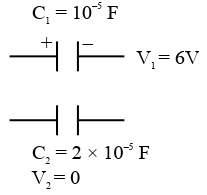
\(V=\frac{C_1 V_1+C_2 V_2}{C_1+C_2}=\frac{10^{-5} \times 6+0}{3 \times 10^{-5}}\)
V=2 volt
\(Q _2= C _2 V=2 \times 10^{-5} \times 2=4 \times 10^{-5} C\) -
- (A) \(33.34\)
- (B) \(66.67\)
- (C) \(200\)
- (D) \(400\)
Show answer and solution
Correct Answer: (B)
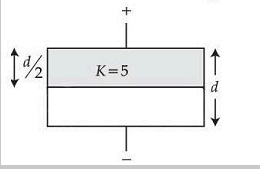
Initial capacitance of the air capacitor is given by:
\(C = \dfrac{\epsilon_0 A}{d}\)
When the capacitor is half-filled with a dielectric of thickness \(d/2\), it can be considered as two capacitors connected in series.
Capacitance of the dielectric-filled part:
\(C_1 = \dfrac{K \epsilon_0 A}{d/2} = \dfrac{2K \epsilon_0 A}{d} = 2KC\)
Capacitance of the air-filled part:
\(C_2 = \dfrac{\epsilon_0 A}{d/2} = \dfrac{2 \epsilon_0 A}{d} = 2C\)
The equivalent capacitance \(C_{eq}\) of the series combination is:
\(C_{eq} = \dfrac{C_1 C_2}{C_1 + C_2} = \dfrac{(2KC)(2C)}{2KC + 2C} = \dfrac{2K}{K+1} C\)
Substituting \(K = 5\):
\(C_{eq} = \dfrac{2(5)}{5+1} C = \dfrac{10}{6} C = \dfrac{5}{3} C\)
The increase in capacitance is:
\(\Delta C = C_{eq} - C = \dfrac{5}{3} C - C = \dfrac{2}{3} C\)
The percentage increase in capacitance is:
\(\% \text{ increase} = \dfrac{\Delta C}{C} \times 100 = \dfrac{2}{3} \times 100 \approx 66.67\%\)
Answer: \(66.67\) -
- (A) \(-2\)
- (B) \(1\)
- (C) \(-1\)
- (D) \(2\)
Show answer and solution
Correct Answer: (A)
The electrostatic energy of a parallel plate capacitor is given by \(U = \dfrac{1}{2} C V^2\).
For a parallel plate capacitor, the capacitance is \(C = \dfrac{\varepsilon_0 A}{x}\), where \(x\) is the separation between the plates.
Since the capacitor remains connected to the battery, the potential difference \(V\) across the plates is constant.
Substituting \(C\) into the energy equation gives:
\(U = \dfrac{\varepsilon_0 A V^2}{2x}\)
Differentiating \(U\) with respect to time \(t\) to find the time rate of change of electrostatic energy:
\(\dfrac{dU}{dt} = \dfrac{d}{dt} \left( \dfrac{\varepsilon_0 A V^2}{2x} \right) = -\dfrac{\varepsilon_0 A V^2}{2x^2} \dfrac{dx}{dt}\)
Given that the plates are pulled apart at a uniform speed \(v\), we have \(\dfrac{dx}{dt} = v\).
\(\dfrac{dU}{dt} = -\dfrac{\varepsilon_0 A V^2 v}{2x^2}\)
From the above expression, it is clear that \(\dfrac{dU}{dt} \propto x^{-2}\).
Comparing this with \(x^\alpha\), we get \(\alpha = -2\).
Answer: \(-2\) -
- (A) \(\frac{3 KC }{2 K+1}\)
- (B) \(\frac{ CK }{2+ K }\)
- (C) \(\frac{3 CK ^2}{(2 K+1)^2}\)
- (D) \(\frac{4 KC }{3 K-1}\)
Show answer and solution
Correct Answer: (A)
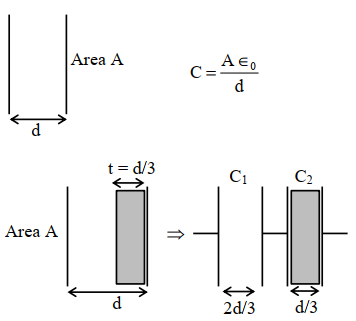
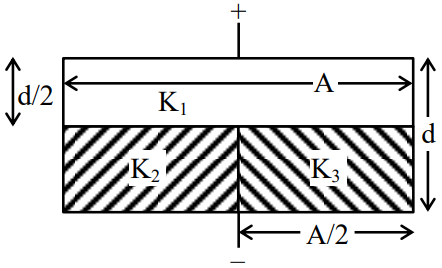
\(C_1=\frac{3 A \epsilon_0}{2 d}\)\(\quad\)\(C _2=\frac{3 A \in_0 \times K }{ d }\)
\(C _1=\frac{3}{2} C\)\(\quad\)\(C _2=3 KC\)
\(Ceq =\frac{ C _1 C _2}{ C _1+ C _2}=\frac{\frac{3}{2} C \times 3 KC }{\frac{3}{2} C +3 KC }\)
\(Ceq =\frac{\frac{9}{2} KC ^2}{\frac{3}{2} C (2 K+1)}=\frac{3 KC }{2 K+1}\) -
- (A) 0
- (B) 2
- (C) 4
- (D) 6
Show answer and solution
Correct Answer: (B)
The resistance of the insulating material is given by \(R = \dfrac{\rho d}{A}\).
The capacitance of the parallel plate capacitor is given by \(C = \dfrac{\epsilon_0 \epsilon_r A}{d}\).
Multiplying the expressions for \(R\) and \(C\), we get:
\(RC = \rho \epsilon_0 \epsilon_r\)
Rearranging for relative permittivity \(\epsilon_r\):
\(\epsilon_r = \dfrac{RC}{\rho \epsilon_0}\)
Substituting the given values:
\(\epsilon_r = \dfrac{17.7 \times 10^{14} \times 10^{-6}}{10^{13} \times 8.85 \times 10^{-12}}\)
\(\epsilon_r = \dfrac{17.7 \times 10^8}{8.85 \times 10^1}\)
\(\epsilon_r = 2 \times 10^7\)
Comparing this with the given expression \(\epsilon_r = \alpha \times 10^7\), we get:
\(\alpha = 2\)
Answer: \(2\) -
- (A) 2.5
- (B) 2.0
- (C) 1.5
- (D) 1.0
Show answer and solution
Correct Answer: (B)
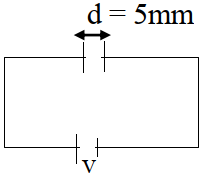
\(C =\frac{\epsilon_0 A}{ d }\)
\(Q _1= CV\)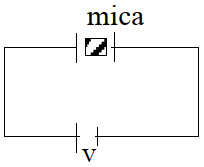
\(Q _2=\left( c _{ eq }\right) v\)
\(Q _2=1.25 cv\)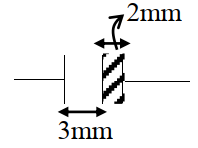
\(c_{e q}=\frac{C_1 C_2}{C_1+C_2}=\frac{\frac{\in_0 A}{3} \times \frac{K \in_0 A}{2}}{\frac{\in_0 A}{3}+\frac{K \in_0 A}{2}}\)
\(c_{e q}=\frac{\left(\epsilon_0 A\right)^2\left(\frac{K}{6}\right)}{\epsilon_0 A\left(\frac{2+3 K}{6}\right)} \Rightarrow C_{e q}=\frac{K \epsilon_0 A}{2+3 K}\)
\(1.25 \times \frac{\in_0 A}{5}=\frac{K \in_0 A}{2+3 K} \Rightarrow 0.25(2+3 K)=K\)
\(2+3 K=4 K \Rightarrow K =2\) -
- (A) \(45 \times 10^{-6}\)
- (B) \(0\)
- (C) \(30 \times 10^{-6}\)
- (D) \(15 \times 10^{-6}\)
Show answer and solution
Correct Answer: (C)
Work done by external agent :
\(W _{ ext }=\Delta U ;\)
\(\Delta U \rightarrow\) Change in potential energy in taking the charge from initial to final configuration
\(\Rightarrow W _{ ext }=\frac{1}{4 \pi \epsilon_0} \frac{ q _1 q _2}{ r _{ f }}-\frac{1}{4 \pi \epsilon_0} \frac{ q _1 q _2}{ r _{ i }}\)
Now, \(r_f=\sqrt{(2-0)^2+(2-0)^2+(1-0)^2}=3 m\)
\(r_i=\sqrt{(4-0)^2+(4-0)^2+(2-0)^2}=6 m\)
\(\therefore \quad W _{\text {ext }}=\left(9 \times 10^9\right) \times\left(10^{-8} \times 2 \times 10^{-6}\right)\left[\frac{1}{3}-\frac{1}{6}\right]\)
\(=3 \times 10^{-5}\)
\(=30 \times 10^{-6} J\) -
- (A) \(5\)
- (B) \(\dfrac{5}{2}\)
- (C) \(\dfrac{7}{2}\)
- (D) \(\dfrac{9}{2}\)
Show answer and solution
Correct Answer: (B)
Initial energy of the charged sphere is given by:
\(U_i = \dfrac{1}{2} C V^2\)
\(U_i = \dfrac{1}{2} \times 100 \times 10^{-12} \times (100)^2 = 5 \times 10^{-7}\) J
When the identical uncharged sphere is brought in contact, the charge is shared equally and the common potential becomes:
\(V' = \dfrac{V}{2} = 50\) V
Final total energy of the two spheres is:
\(U_f = 2 \times \left( \dfrac{1}{2} C V'^2 \right) = C V'^2\)
\(U_f = 100 \times 10^{-12} \times (50)^2 = 2.5 \times 10^{-7}\) J
Change in energy is the loss of energy during charge sharing:
\(\Delta U = U_i - U_f = 5 \times 10^{-7} - 2.5 \times 10^{-7} = 2.5 \times 10^{-7}\) J
\(\Delta U = \dfrac{5}{2} \times 10^{-7}\) J
Comparing with \(\alpha \times 10^{-7}\) J, we get \(\alpha = \dfrac{5}{2}\).
Answer: \(\dfrac{5}{2}\) -
- (A) 180
- (B) 182
- (C) 184
- (D) 186
Show answer and solution
Correct Answer: (D)
The force experienced by the charge in the electric field is given by \(\vec{F} = q\vec{E}\).
Given \(q = 3\) C and \(\vec{E} = 2x\hat{i} + 3y^2\hat{j} + 4\hat{k}\) N/C, the force is:
\(\vec{F} = 3(2x\hat{i} + 3y^2\hat{j} + 4\hat{k}) = 6x\hat{i} + 9y^2\hat{j} + 12\hat{k}\) N
The work done by the electric field in moving the charge is:
\(W = \int \vec{F} \cdot d\vec{r} = \int_{x_1}^{x_2} F_x dx + \int_{y_1}^{y_2} F_y dy + \int_{z_1}^{z_2} F_z dz\)
Substituting the limits from the initial point \((0, -2, -5)\) to the final point \((5, 1, 2)\):
\(W = \int_{0}^{5} 6x dx + \int_{-2}^{1} 9y^2 dy + \int_{-5}^{2} 12 dz\)
Evaluating each integral separately:
\(\int_{0}^{5} 6x dx = \left[ 3x^2 \right]_{0}^{5} = 3(5^2 - 0^2) = 75\) J
\(\int_{-2}^{1} 9y^2 dy = \left[ 3y^3 \right]_{-2}^{1} = 3(1^3 - (-2)^3) = 3(1 - (-8)) = 3(9) = 27\) J
\(\int_{-5}^{2} 12 dz = \left[ 12z \right]_{-5}^{2} = 12(2 - (-5)) = 12(7) = 84\) J
Total work done \(W = 75 + 27 + 84 = 186\) J.
Answer: \(186\) -
- (A) \(\sqrt{\frac{k Q^2}{4 m R}\left(1-\frac{G m^2}{k Q^2}\right)}\)
- (B) \(\sqrt{\frac{k Q^2}{4 m R}\left(1+\frac{G m^2}{k Q^2}\right)}\)
- (C) \( \sqrt{\frac{kQ^{2}}{2mR}(1-\frac{Gm^{2}}{kQ^{2}})} \)
- (D) \(\sqrt{\frac{k Q^2}{2 m R}\left(1-\frac{G m^2}{2 k Q^2}\right)}\)
Show answer and solution
Correct Answer: (A)
Using energy conservation
(2) \(\left(\frac{1}{2} mu ^2\right)-\frac{ Gm ^2}{4 r }+\frac{ KQ ^2}{4 r }=-\frac{ Gm ^2}{2 r }+\frac{ KQ ^2}{2 r }\)
\(u =\sqrt{\frac{1}{4 mr }\left( KQ ^2- Gm ^2\right)}\) -
- (A) 1000
- (B) 500
- (C) 2000
- (D) 0
Show answer and solution
Correct Answer: (C)
\( \vec{E}=10x\hat{i}+5y\hat{j} \)
\( V_{at(10,20)}=500~V \)
\( \Delta V=-\int\vec{E}\cdot d\vec{r} \)
\( 500-V_{0}=-\int_{(0,0)}^{(10,20)}(10x\hat{i}+5y\hat{j})\cdot(dx\hat{i}+dy\hat{j}) \)
\( 500-V_{0}=-[5x^{2}+\frac{5y^{2}}{2}]_{(0,0)}^{(10,20)} \)
\( V_{0}-500=(500+5\times\frac{400}{2})-(0-0) \)
\( V_{0}-500=500+1000 \)
\( V_{0}=2000V \) -
- (A) \(V=\frac{5 q}{4 \pi \varepsilon_0 r}\) and \(\vec{E}=0\)
- (B) \(V=\frac{5 q}{4 \pi \varepsilon_0 r}\) and \(\vec{E}=\frac{5 \sqrt{3} q}{8 \pi \varepsilon_0 r^2} \hat{r}\)
- (C) \(V=\frac{5 q}{4 \pi \varepsilon_0 r}\) and \(\vec{E}=\frac{5 q}{4 \pi \varepsilon_0 r^2} \hat{r}\)
- (D) \(V=0\) and \(\vec{E}=0\)
Show answer and solution
Correct Answer: (A)
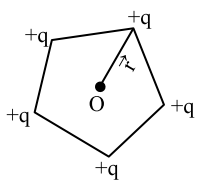
Electric potential \(\rightarrow V =\frac{5 Kq }{ R }\)
As regular polygon \( \rightarrow \vec{E}=0 \) -
- (A) \(2\)
- (B) \(7/2\)
- (C) \(7/3\)
- (D) \(5/2\)
Show answer and solution
Correct Answer: (A)
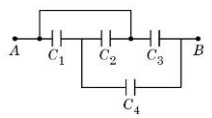
Let the nodes in the circuit be labeled to identify the connections:
- Let the input terminal be Node A.
- Let the junction between \(C_1\) and \(C_2\) be Node X.
- The top wire connects Node A to the junction between \(C_2\) and \(C_3\). Thus, this junction is also at the potential of Node A.
- The bottom wire connects Node X to the output terminal Node B, with capacitor \(C_4\) in this path.
Based on these nodes, the connections of each capacitor are as follows:
- \(C_1\) is connected between Node A and Node X.
- \(C_2\) is connected between Node X and Node A.
- \(C_3\) is connected between Node A and Node B.
- \(C_4\) is connected between Node X and Node B.
We can now simplify the circuit step-by-step:
Capacitors \(C_1\) and \(C_2\) are in parallel between nodes A and X. Their equivalent capacitance is:
\(C_{12} = C_1 + C_2 = 1\,\mu\text{F} + 1\,\mu\text{F} = 2\,\mu\text{F}\)
This equivalent capacitor \(C_{12}\) is in series with \(C_4\) (which is connected between X and B). The equivalent capacitance of this branch is:
\(C_{AXB} = \dfrac{C_{12} \times C_4}{C_{12} + C_4} = \dfrac{2 \times 2}{2 + 2} = 1\,\mu\text{F}\)
Finally, this branch is in parallel with \(C_3\) (which is connected directly between A and B). The total equivalent capacitance between A and B is:
\(C_{AB} = C_{AXB} + C_3 = 1\,\mu\text{F} + 1\,\mu\text{F} = 2\,\mu\text{F}\)
Answer: \(2\) -
- (A) Both A and R are true and R is the correct explanation of A
- (B) Both A and R are true but R is NOT the correct explanation of A
- (C) A is true but R is false
- (D) A is false but R is true
Show answer and solution
Correct Answer: (B)
In electrostatics, the electric field inside a conductor is zero. According to Gauss's law, \(\oint \vec{E} \cdot d\vec{s} = \dfrac{q_{in}}{\epsilon_0}\). Since \(\vec{E} = 0\) everywhere inside the conductor, the net charge enclosed \(q_{in}\) must be zero. Thus, a conductor does not store any net charge inside its bulk, and any excess charge resides only on its surface. Assertion A is true.
Inside a capacitor with no dielectric medium, a uniform electric field exists between the plates. If free charge carriers are placed in this region, they will experience an electrostatic force \(\vec{F} = q\vec{E}\) and will drift towards the respective oppositely charged plates. Reason R is true.
Although both statements are factually correct, the behavior of charge carriers in the electric field of a capacitor does not explain why the net charge inside a conductor is zero in electrostatics. Therefore, both A and R are true but R is NOT the correct explanation of A.
Answer: Both A and R are true but R is NOT the correct explanation of A -
- (A) A, B and C only
- (B) C and D only
- (C) A, C and D only
- (D) B and D only
Show answer and solution
Correct Answer: (C)
For series combination
\(\frac{1}{C_{eq}}=\frac{1}{C_{1}}+\frac{1}{C_{2}}\)
.. \(C_{\mathfrak{eq}}\) is less than \(C_{1}\&C_{2}\)
Note : In statement C, capacitor is assumed to be completely filled with dielectric then on decreasing thickness of dielectric capacitance will increase. -
- (A) \((-20\hat{i} + 30\hat{j})\)
- (B) \((20\hat{i} - 30\hat{j})\)
- (C) \((20\hat{i} + 45\hat{j})\)
- (D) \((-4\hat{i} + 6\hat{j})\)
Show answer and solution
Correct Answer: (A)
The electric field \(\vec{E}\) is given by the negative gradient of the electric potential \(V\):
\(\vec{E} = -\left( \dfrac{\partial V}{\partial x} \hat{i} + \dfrac{\partial V}{\partial y} \hat{j} \right)\)
Given \(V = 5(x^2 - y^2)\), we find the partial derivatives:
\(\dfrac{\partial V}{\partial x} = 10x\)
\(\dfrac{\partial V}{\partial y} = -10y\)
Substituting these into the expression for \(\vec{E}\):
\(\vec{E} = -(10x \hat{i} - 10y \hat{j}) = -10x \hat{i} + 10y \hat{j}\)
At the point \((2, 3)\), substitute \(x = 2\) and \(y = 3\):
\(\vec{E} = -10(2) \hat{i} + 10(3) \hat{j} = -20\hat{i} + 30\hat{j}\) V/m
Answer: \((-20\hat{i} + 30\hat{j})\) -
- (A) \(-12\)
- (B) \(-6\)
- (C) \(-9\)
- (D) \(-8\)
Show answer and solution
Correct Answer: (A)
\( v=ar^{3}+b \)
\( E=-\frac{dv}{dr}=-3ar^{2} \)
\( \phi_{closed}=\frac{q_{cnc}}{\epsilon_{0}} \)
\( q_{cnc}=\epsilon_{0}.E.A \)
\( =\epsilon_{0}(-3a.(1)^{2})4\pi(1)^{2} \)
\( =-12\pi a\epsilon_{0} \)
\(\therefore x =-12\) -
- (A) 2
- (B) 1
- (C) \(1/2\)
- (D) \(0\)
Show answer and solution
Correct Answer: (B)
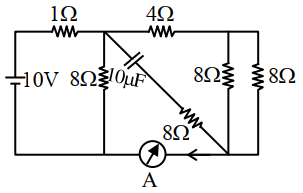
In steady state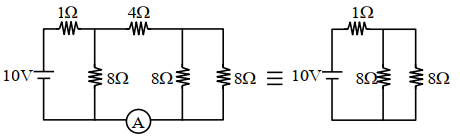
\(I =2 A\)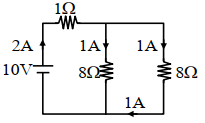
Ammeter reading is 1 A . -
- (A) 6
- (B) 7
- (C) 8
- (D) 9
Show answer and solution
Correct Answer: (C)
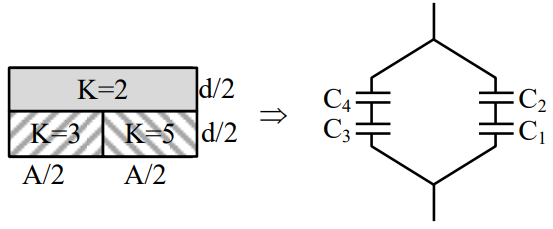
\(C _1=\frac{5 \in_0 A / 2}{d / 2}=\frac{5 \in_0 A}{ d }=5 C\)
\(C _2=\frac{2 \in_0 A / 2}{d / 2}=\frac{2 \in_0 A}{ d }=2 C\)
\(C _1 \& C _2\) in series.
\(C^{\prime}=\frac{C_1 C_2}{C_1+C_2}=\frac{(5 C)(2 C)}{7 C}=\frac{10}{7} C\)
\(C _3=\frac{3 \in_0 A / 2}{d / 2}=3 C\)
\(C _4=\frac{2 \epsilon_0 A / 2}{d / 2}=2 C\)
\(C _4 \& C _3\) in series; \(C ^{\prime \prime}=\frac{(2 C )(3 C )}{5 C }=\frac{6}{5} C\)
\(C ^{\prime} \& C ^{\prime \prime}\) in parallel;
So, \(C _{ eq }= C \left(\frac{6}{5}+\frac{10}{7}\right)= C \left(\frac{42+50}{35}\right)=\left(\frac{92}{35}\right) C\)
\(\frac{92}{35} C =\frac{ nC }{3}\)
\(n =\frac{92 \times 3}{35}=7.9 \Rightarrow n \simeq 8\) - 20. The stored charge in the capacitor in steady state of the following circuit is ________ \(\mu\)C.
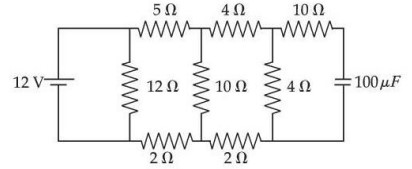 2026 Medium
- (A) 50
- (B) 100
- (C) 150
- (D) 200
Show answer and solution
Correct Answer: (D)
In steady state, the capacitor acts as an open circuit, meaning no current flows through the branch containing the \(100\ \mu\text{F}\) capacitor. Consequently, no current flows through the \(10\ \Omega\) resistor in series with it on the top right.
The voltage across the capacitor will be equal to the voltage across the \(4\ \Omega\) vertical resistor.
Let's simplify the circuit to find this voltage. The \(12\ \Omega\) resistor on the left is in parallel with the \(12\ \text{V}\) battery, so the voltage across the rest of the circuit remains \(12\ \text{V}\).
For the rightmost part of the active circuit, the \(4\ \Omega\) top resistor, the \(4\ \Omega\) vertical resistor, and the \(2\ \Omega\) bottom resistor are in series. Their equivalent resistance is:
\(R_{\text{right}} = 4\ \Omega + 4\ \Omega + 2\ \Omega = 10\ \Omega\)
This \(10\ \Omega\) equivalent resistance is in parallel with the \(10\ \Omega\) vertical resistor in the middle. The equivalent resistance of this parallel combination is:
\(R_{\text{mid}} = \dfrac{10 \times 10}{10 + 10} = 5\ \Omega\)
Now, the total resistance of the main circuit connected to the \(12\ \text{V}\) source is the sum of the \(5\ \Omega\) top-left resistor, the \(5\ \Omega\) equivalent middle resistance, and the \(2\ \Omega\) bottom-left resistor:
\(R_{\text{total}} = 5\ \Omega + 5\ \Omega + 2\ \Omega = 12\ \Omega\)
The total current flowing from the \(12\ \text{V}\) source into this main branch is:
\(I = \dfrac{12\ \text{V}}{12\ \Omega} = 1\ \text{A}\)
The voltage across the parallel combination (the middle section) is:
\(V_{\text{mid}} = I \times R_{\text{mid}} = 1\ \text{A} \times 5\ \Omega = 5\ \text{V}\)
This \(5\ \text{V}\) is applied across the right branch which has a total resistance of \(10\ \Omega\). The current through this branch is:
\(I_{\text{right}} = \dfrac{5\ \text{V}}{10\ \Omega} = 0.5\ \text{A}\)
The voltage across the \(4\ \Omega\) vertical resistor is:
\(V_{4\Omega} = I_{\text{right}} \times 4\ \Omega = 0.5\ \text{A} \times 4\ \Omega = 2\ \text{V}\)
Since the capacitor is in parallel with this \(4\ \Omega\) resistor (with no voltage drop across the \(10\ \Omega\) resistor in its branch), the voltage across the capacitor is also \(2\ \text{V}\).
The stored charge in the capacitor is:
\(Q = C \times V = 100\ \mu\text{F} \times 2\ \text{V} = 200\ \mu\text{C}\)
Answer: \(200\) -
- (A) \(\frac{1}{4 \pi \epsilon_0}\left(\frac{q_1+q_2+q_3}{a}\right), \frac{1}{4 \pi \epsilon_0}\left(\frac{q_1+q_2+q_3}{b}\right), \frac{1}{4 \pi \epsilon_0}\left(\frac{q_1+q_2+q_3}{c}\right)\)
- (B) \(\frac{1}{4 \pi \epsilon_0}\left(\frac{q_1+q_2+q_3}{a}\right), \frac{1}{4 \pi \epsilon_0}\left(\frac{q_1+q_2}{b}+\frac{q_3}{c}\right), \frac{1}{4 \pi \epsilon_0}\left(\frac{q_1}{a}+\frac{q_2}{b}+\frac{q_3}{c}\right)\)
- (C) \(\frac{1}{4 \pi \epsilon_0}\left(\frac{q_1}{a}+\frac{q_2}{b}+\frac{q_3}{c}\right), \frac{1}{4 \pi \epsilon_0}\left(\frac{q_1+q_2}{b}+\frac{q_3}{c}\right), \frac{1}{4 \pi \epsilon_0}\left(\frac{q_1+q_2+q_3}{c}\right)\)
- (D) \(\frac{1}{4 \pi \epsilon_0}\left(\frac{q_1}{a}+\frac{q_2}{b}+\frac{q_3}{c}\right), \frac{1}{4 \pi \epsilon_0}\left(\frac{q_1+q_2+q_3}{b}\right), \frac{1}{4 \pi \epsilon_0}\left(\frac{q_1+q_2+q_3}{c}\right)\)
Show answer and solution
Correct Answer: (C)
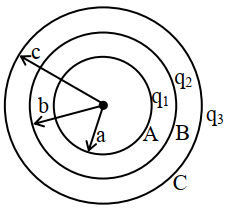
\(V _{ A }=\frac{ Kq _1}{ a }+\frac{ Kq _2}{b}+\frac{ Kq _3}{ c }=\frac{1}{4 \pi \varepsilon_0}\left(\frac{ q _1}{ a }+\frac{ q _2}{b}+\frac{ q _3}{ c }\right)\)
\(V _{ B }=\frac{ Kq _1}{b}+\frac{ Kq _2}{b}+\frac{ Kq _3}{ c }=\frac{1}{4 \pi \varepsilon_0}\left(\frac{ q _1+ q _2}{b}+\frac{ q _3}{ c }\right)\)
\(V _{ C }=\frac{ Kq _1}{ c }+\frac{ Kq _2}{ c }+\frac{ Kq _3}{ c }=\frac{1}{4 \pi \varepsilon_0}\left(\frac{ q _1+ q _2+ q _3}{ c }\right)\) -
- (A) \(C_{B}>C_{C}>C_{A}\)
- (B) \(C_{C}>C_{B}>C_{A}\)
- (C) \(C_{C}>C_{A}>C_{B}\)
- (D) \(C_{A}>C_{C}>C_{B}\)
Show answer and solution
Correct Answer: (D)
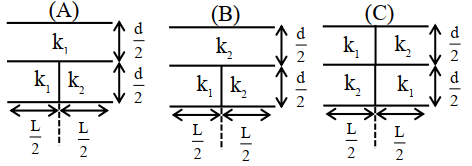
For \(C_A\) :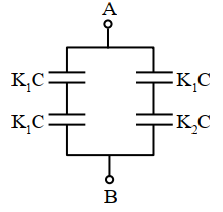
Let \(\frac{\varepsilon_0 A}{ d }= C\)
\(\therefore \quad C _{ A }=\frac{ K _1 C }{2}+\frac{ K _1 K_2 C }{ K _1+ K _2}\)
\(= K _1 C \left[\frac{ K _1+2 K_2}{2\left(K_1+ K _2\right)}\right]\)
For \(C _{ B }\) :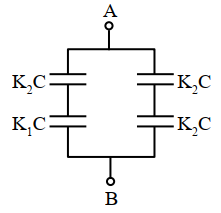
\(C _{ B }=\frac{ K _2 C }{2}+\frac{ K _1 K_2 C }{ K _1+ K _2}\)
\(= K _2 C \left[\frac{ K _1+2 K_2}{2\left(K_1+ K _2\right)}\right]\)
For \(C _{ C }\) :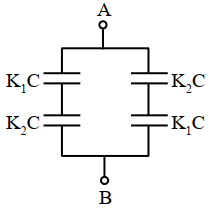
\(C _{ C }=\frac{2 K_1 K_2 C }{\left( K _1+ K _2\right)}\)
\(C_A>C_C>C_B\) -
- (A) \( 1:3^{1/3} \)
- (B) \( 1:2^{2/3} \)
- (C) \( 3^{2/3}: 1 \)
- (D) \( 1:3^{2/3} \)
Show answer and solution
Correct Answer: (D)
Using volume conservation
\( 3(\frac{4}{3}\pi r^{3})=(\frac{4}{3}\pi R^{3}) \)
\( R=3^{1/3}r \)
\( \frac{V_{i}}{V_{f}}=\frac{\frac{kq}{r}}{\frac{k3q}{R}}=\frac{R}{3r}=\frac{3^{1/3}r}{3r}=\frac{1}{3^{2/3}} \) -
- (A) \(\dfrac{3}{2}\)
- (B) \(\dfrac{2}{3}\)
- (C) \(\dfrac{4}{9}\)
- (D) \(\dfrac{9}{4}\)
Show answer and solution
Correct Answer: (D)
When two conducting spheres are connected by a wire, charge flows until their potentials become equal.
\(V_1 = V_2\)
\(\dfrac{k Q_1}{R_1} = \dfrac{k Q_2}{R_2}\)
The electric field on the surface of a conducting sphere is given by \(E = \dfrac{k Q}{R^2}\), which can be written as \(E = \dfrac{V}{R}\).
Since \(V_1 = V_2\), we have:
\(E_{S_1} R_1 = E_{S_2} R_2\)
\(\dfrac{E_{S_1}}{E_{S_2}} = \dfrac{R_2}{R_1}\)
Given \(R_1 = 8\) cm and \(R_2 = 18\) cm:
\(\dfrac{E_{S_1}}{E_{S_2}} = \dfrac{18}{8} = \dfrac{9}{4}\)
Answer: \(\dfrac{9}{4}\) -
- (A) 1.4
- (B) -90.7
- (C) 49.3
- (D) 24.3
Show answer and solution
Correct Answer: (C)
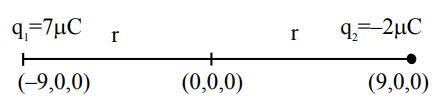
\(dV =-\overrightarrow{ E } \cdot \overrightarrow{ dr }\)
\(\int_0^{ v } dV =-\int_{\infty}^{ r } \frac{ A }{ r ^2} dr\)
\(V =-\left[\frac{- A }{ r ^2}\right]_{\infty}^{ r } \Rightarrow V =\frac{ A }{ r }\)
\(U = U _{\text {self }}+ U _{\text {interaction }}\)
\(= q _1 v _1= q _2 v _2+\frac{ kq _1 q _2}{2 r }\)
\(=7 \times 10^{-6} \frac{A}{9 \times 10^{-2}}-2 \times 10^{-6} \frac{A}{9 \times 10^{-2}}\)
\(-\frac{9 \times 10^9 \times 14 \times 10^{-12}}{2 \times 9 \times 10^{-2}}\)
\(=\frac{5 \times 10^{-6} \times 9 \times 10^5}{9 \times 10^{-2}}-7 \times 10^{-1}\)
\(=50-0.7\)
\(=49.3 J\) -
- (A) \(100 \, V\) and \(580 \, V\)
- (B) \(580 \, V\) and \(100 \, V\)
- (C) \(60 \, V\) and \(400 \, V\)
- (D) \(0 \, V\) and \(-200 \, V\)
Show answer and solution
Correct Answer: (A)
For the oil droplets to not descend, the upward electric force must balance the downward gravitational force.
\(qE = mg\)
The mass of the oil droplet is given by:
\(m = \dfrac{4}{3} \pi r^3 \rho\)
Substituting the given values \(r = 10^{-3}\) m and \(\rho = 1500\) kg/m\(^3\):
\(m = \dfrac{4}{3} \pi (10^{-3})^3 \times 1500 = 2 \pi \times 10^{-6}\) kg
The electric field \(E\) required is:
\(E = \dfrac{mg}{q} = \dfrac{2 \pi \times 10^{-6} \times 10}{5 \times 10^{-9}} = 4000 \pi\) V/m
The potential difference \(\Delta V\) between the plates is:
\(\Delta V = E \times d = 4000 \pi \times \left(\dfrac{12}{\pi} \times 10^{-2}\right) = 480\) V
Since the charge on the droplet is positive, the electric field must be directed upwards to provide an upward force. Electric field lines point from higher potential to lower potential, so the bottom plate B must be at a higher potential than the top plate A.
\(V_B - V_A = 480\) V
Checking the given options, \(V_A = 100\) V and \(V_B = 580\) V satisfies this condition.
Answer: \(100 \, V\) and \(580 \, V\) -
- (A) 2.7
- (B) 5.4
- (C) 3.3
- (D) 27
Show answer and solution
Correct Answer: (A)
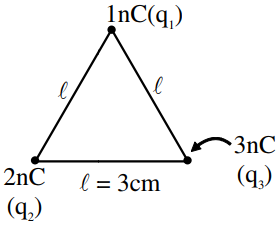
\(W = (\frac{kq_{1}}{\ell} + \frac{kq_{2}}{\ell}) q_{3}\)
\(=\frac{9 \times 10^9}{3 \times 10^{-2}}\left(3 \times 10^{-9}\right) \times 3 \times 10^{-9}\)
\(= 27 \times 10^{-7} J = 2.7 \mu J\) - 28. Under steady state condition the potential difference across the capacitor in the circuit is _______ V.
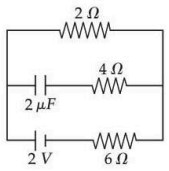 2026 Medium
- (A) \(0.5\)
- (B) \(1.5\)
- (C) \(0\)
- (D) \(2\)
Show answer and solution
Correct Answer: (A)
In steady state, the capacitor acts as an open circuit, meaning no current flows through the middle branch.
The circuit simplifies to a single loop containing the \(2 \text{ V}\) battery, the \(6 \Omega\) resistor, and the \(2 \Omega\) resistor.
The total resistance of this loop is \(R_{\text{eq}} = 2 + 6 = 8 \Omega\).
The current flowing through the loop is \(I = \dfrac{2}{8} = 0.25 \text{ A}\).
The potential difference across the parallel branches is equal to the voltage drop across the \(2 \Omega\) resistor:
\(V = I \times 2 = 0.25 \times 2 = 0.5 \text{ V}\)
Since there is no current in the middle branch, the voltage drop across the \(4 \Omega\) resistor is zero. Thus, the entire potential difference of \(0.5 \text{ V}\) appears across the capacitor.
Answer: \(0.5\) -
- (A) Voltage difference
- (B) Resistance
- (C) Voltage
- (D) Displacement current
Show answer and solution
Correct Answer: (C)
Here from voltage, question refers to potential. We can measure potential difference between two points but not potential at any point.
Note : If the potential of reference point is known then we can measure potential as well.
No questions on this page match these filters.